


MDCAT Chemistry MCQs

MDCAT Chemistry MCQs, with every answer explained.

Chemistry is 45 of the 180 MDCAT MCQs: physical, inorganic and organic. Try real past-paper Chemistry MCQs free, with every calculation worked line by line.
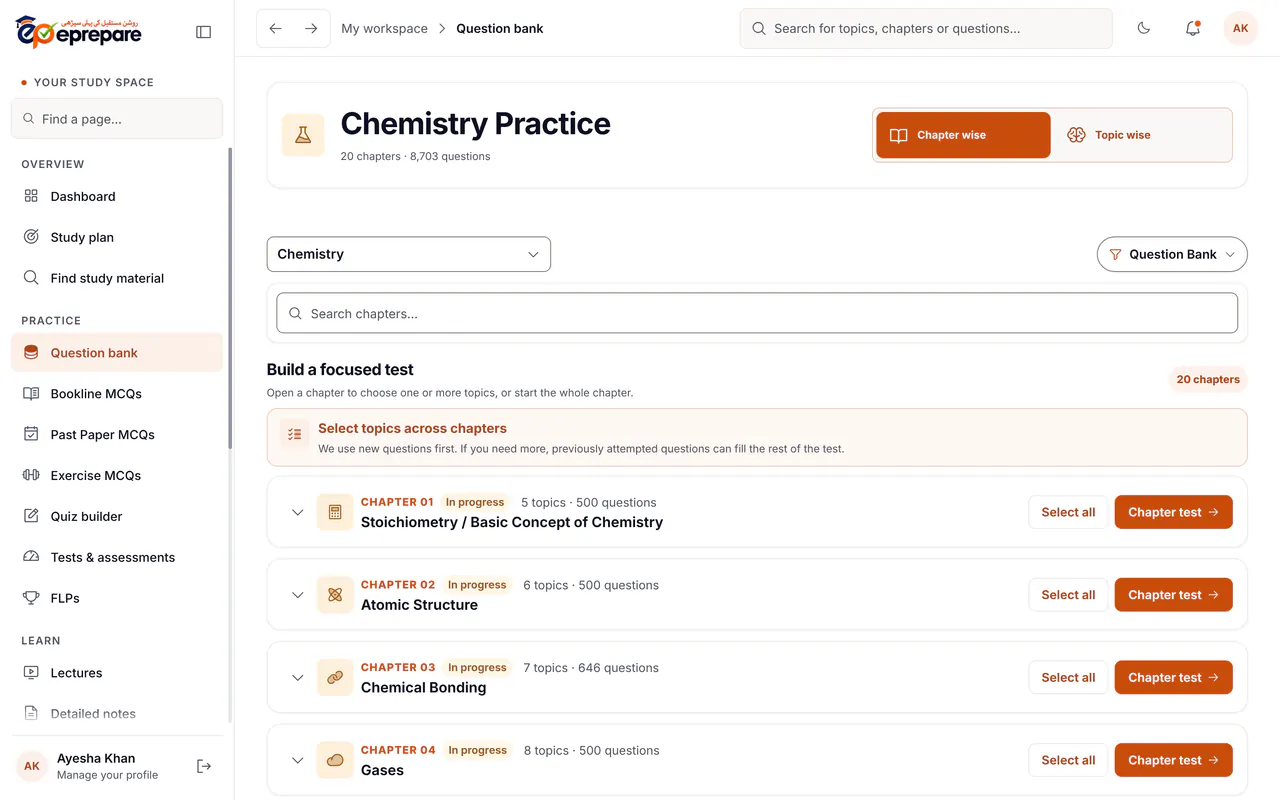
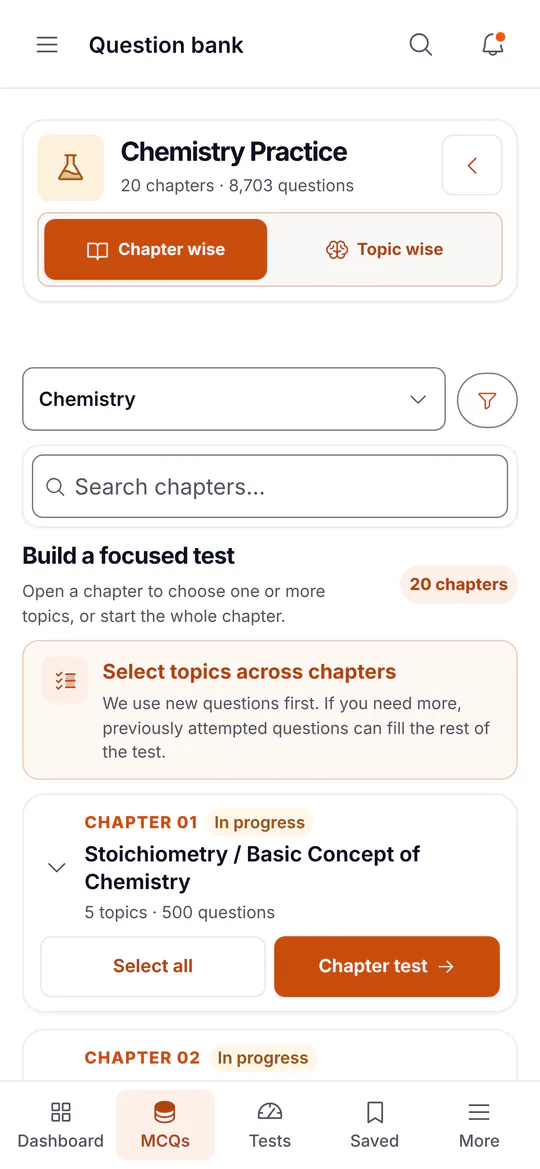
The ePrepare question bank with Chemistry chapters and MCQ counts

How we teach Chemistry through MCQs.

Calculations, worked

Moles, Ksp, Kp and Kc, gas laws: every numerical is worked one step per line.

Past-paper Chemistry

Real KMU, NUMS, UHS and other board Chemistry MCQs, filed by chapter.

Explained in Urdu too

English and easy Urdu explanations, with a hint before you answer.

Organic reactions

Learn reaction rules like Markovnikov's and dehydration with MCQs that test them.

Try real Chemistry MCQs, free.

11 Chemistry MCQs from real KMU and NUMS papers. Take a hint if you are stuck and read every explanation in English or Urdu.

Chemistry past-paper MCQs

11 real MCQs from KMU MDCAT 2026, NUMS 2026, KMU MDCAT 2025. Free to try.

0/0 correct

Q118 of 180Chemistry · Stoichiometry
EasyApplicationPast paper · KMU MDCAT 2026

What is the mass of 1 mole of calcium carbonate (CaCO₃)? (Molar mass of calcium: 40 g/mol, carbon: 12 g/mol, oxygen: 16 g/mol)

1 / 11

Chemistry in the paper.

TestChemistry MCQsShare
PM&DC MDCAT (180 MCQs)4525%
NUMS Paper I (150 MCQs)4027%
PM&DC units and outcomes20 units120 learning outcomes

Every Chemistry unit, and what PM&DC tests.

20 units and 120 learning outcomes from PM&DC's uniform MDCAT curriculum. Open a unit to see its topics and outcomes.

1Fundamental concepts6 outcomes

Moles and Avogadro’s Numbers

  • 1.1Construct mole ratios from balanced equations for use as conversion factors in stoichiometric problems.
  • 1.2Perform stoichiometric calculations with balanced equations using moles, representative particles, masses and volumes of the gases (at ST).

Limiting and Excess Reactants

  • 1.3Explain the limiting reagent in reaction
  • 1.4Calculate the maximum number of products produced and the amount of any un-reacted excess reagent

Yield

  • 1.5Given information from which any two the following may be determine, calculate the third: theoretical yield, actual yield, percentage yield.
  • 1.6Calculate the theoretical yield and the percent yield when given the balanced equation, the amount of reactants and the actual yield.
2Atomic structure8 outcomes

Discovery of Proton and Planck’s Quantum Theory

  • 2.1Describe discovery and properties of proton (Positive rays)
  • 2.2Define Photon as a unit of radiation energy

Quantum Number

  • 2.3Describe the concept of orbitals.
  • 2.4Distinguish among Principal energy level, energy sub-level and atomic orbitals

Shapes of orbitals

  • 2.5Describe the general shapes of S, P and orbitals.

Spectrum of Hydrogen

  • 2.6Describe Hydrogen Atom using the quantum theory

Electronic Configuration

  • 2.7Use the Aufbau principle, the Pauli Exclusion Principle and Hund’s Rule to write the Electronic Configuration of atoms.
  • 2.8Write electronic configuration of atom
3Gases9 outcomes

Kinetic Molecular Theory

  • 3.1List the postulates of Kinetic Molecular Theory
  • 3.2Describe the motion of particles of the gas according to kinetic theory.

Standard Temperature and Pressure (STP)

  • 3.3State the values of standard temperature and pressure (STP)

Boyle’s Law

  • 3.4Describe the effect of change in pressure on the volume of gas.

Charles’s Law

  • 3.5Describe the effect of change in temperature on the volume of gas.

Absolute Zero

  • 3.6Explain the significance of the absolute zero, giving its value in degree.

Ideal Gas Equation

  • 3.7Derive Ideal Gas equation using Boyle’s Law, Charle’s Law and Avogadro’s Law.

Unit of “R”

  • 3.8Explain the significance and different units of ideal gas constant.

Real and Ideal Gas

  • 3.9Distinguish between Real and Ideal Gases.
4Liquids4 outcomes

Properties Of Liquids based on Kinetic Molecular Theory

  • 4.1Describe simple properties of liquids e.g diffusion, compression, expansion, motion of molecules, spaces between them, inter molecular forces and kinetic energy based on kinetic molecular theory.

Evaporation, Boiling point and Vapor Pressure

  • 4.2Explain physical properties of liquid such as evaporation, vapor pressure, boiling point

Hydrogen Bonding

  • 4.3Describe the hydrogen bonding in H₂O, NH₃ and HF molecules.

Anomalous behavior of Water

  • 4.4Anomalous behavior of water when its density shows maximum at 4 degrees centigrade.
5Solids5 outcomes

Crystalline Solids

  • 5.1Describe crystalline solid

Factors Affecting the Shape of Ionic Crystals

  • 5.2Name three factors that affect the shape of the ionic crystals.

Difference between Ionic and Molecular Crystals

  • 5.3Give brief description of ionic and molecular crystals.

Crystal lattice

  • 5.4Explain the structure of a crystal lattice

Lattice Energy

  • 5.5Define Lattice Energy,
6Chemical equilibrium7 outcomes

Chemical Equilibrium

  • 6.1Define chemical equilibrium in terms of reversible reaction.
  • 6.2Write both forward and reverse. Describe them macroscopic characteristics of each

Le Chatelier’s principle

  • 6.3State Le Chatelier’s principle and be able to apply it to systems in equilibrium with changes in concentration, pressure, temperature or addition of catalyst.

Solubility Products

  • 6.4Define and explain solubility products.

Common Ion Effect

  • 6.5Define and explain the common ion effect by giving suitable examples.

Buffer Solution

  • 6.6Define buffer solution and explain types of buffers.

Haber’s Process

  • 6.7Explain synthesis of Ammonia by Haber’s process.
7Reaction kinetics7 outcomes

Chemical Kinetics

  • 7.1Define chemical kinetics.
  • 7.2Explain the terms: rate of reaction, rate equation.

Factors affecting rate of reaction

  • 7.3Explain qualitatively factors affecting rate of reaction.

Order of Reaction

  • 7.4Give the order with respect to the reactant, write the rate of law for reaction.
  • 7.5Explain the meaning of the term “activation energy” and “activated complex”.
  • 7.6Relate the ideas of activation energy and the activated complex to the rate of reaction.

Rate Constant

  • 7.7Describe the role of the rate constant in the theoretical determination of reaction rate.
8Thermochemistry7 outcomes

Thermodynamics

  • 8.1Define Thermodynamics

Exothermic and Endothermic Reaction

  • 8.2Classify reactions as exothermic and endothermic

Different Terms Used

  • 8.3Define the terms system, surrounding boundary, state function, heat, heat capacity, internal energy, work done and enthalpy of a substance.

Internal Energies

  • 8.4Name and define the units of the Internal energy.

Law of Thermodynamics

  • 8.5Explain the first law of thermodynamics of energy conservation.

Hess’s Law

  • 8.6Apply Hess’s Law to construct simple energy cycles.

Enthalpy

  • 8.7Describe enthalpy of the reaction
9Electrochemistry5 outcomes

Redox Reaction

  • 9.1Give the characteristics of a redox reaction.

Oxidation and Reduction

  • 9.2Define oxidation and reduction in terms of a change in oxidation number.

Balancing Chemical Reaction

  • 9.3Use the oxidation number change method to identify atoms being oxidized or reduced in redox reactions.

Standard Hydrogen Electrode (SHE)

  • 9.4Define Cathode, anode, electrode potential and S.H.E
  • 9.5Define the standard electrode potential of an electrode.
10Chemical bonding8 outcomes

VSEPR Theory

  • 10.1Use VSEPR Theory to describe the shapes of the molecules.

Sigma and Pi Bond

  • 10.2Describe the features of sigma and pi- bonds.

Hybridization

  • 10.3Describe the shapes of simple molecules using orbital hybridization.

Application of VSEPR Theory

  • 10.4Determine the shapes of some molecules from the number of the bonded pairs.

Dipole Movement

  • 10.5Predict the molecular polarity from the shapes of molecules.

Application of Dipole Movement

  • 10.6Explain what is meant by the term ionic character of the covalent bond.
  • 10.7Describe how knowledge of molecular polarity can be used to explain some physical and chemical properties of the molecules.

Bond Energy

  • 10.8Define bond energies and explain how they can be used to compare bonds strength of different chemical bonds.
11s- and p-block elements5 outcomes

Properties and their Trends

  • 11.1Define and explain the terms atomic radii, ionic radii, covalent radii, ionization energy, electron affinity, electro negativity, bond energy and bond length.

S-, P-, D- & F- Block Elements

  • 11.2Recognize the demarcation of the periodic table into S-block, P-block, D-block and F- block.

Reaction of Group I elements

  • 11.3Describe reactions of Group I elements with water, oxygen and chlorine.

Reaction of Group II elements

  • 11.4Describe reactions of Group II elements with water, oxygen and chlorine.

Reaction of Group IV elements

  • 11.5Describe reactions of Group IV Elements.
12Transition elements1 outcome

Electronic Structure

  • 12.1Describe the electronic structures of the elements and ions of d-block Elements.
13Fundamental principles of organic chemistry4 outcomes

Definition and Classification of Organic Compound

  • 13.1Define organic chemistry and organic compound.
  • 13.2Classify organic compounds on structural basis.

Functional Group

  • 13.3Define functional group.

Isomerism

  • 13.4Explain stereoisomerism and its types.
14Hydrocarbons19 outcomes

Nomenclature of Alkanes

  • 14.1Describe the nomenclature of Alkanes.

Free Radical Mechanism

  • 14.2Define Free Radical Initiation, propagation and termination.
  • 14.3Describe the mechanism of the free radical substitution in alkanes exemplified by Methane and Ethane.

Nomenclature of Alkenes

  • 14.4Explain the IUPAC nomenclature of alkenes.

Shapes of Alkenes

  • 14.5Explain the shapes of the Ethene molecules in terms of Sigma and Pi C-C Bonds.

Structure and Reactivity of Alkenes

  • 14.6Describe the structure and reactivity of Alkenes as exemplified by Ethene.

Preparation of Alkanes

  • 14.7Explain Dehydration of Alcohols and Dehydrohalogenation of RX for the preparation of Ethane

MOT of Benzene, Resonance and Resonance Energy

  • 14.8Explain the shape of Benzene Molecules (Molecular orbital treatment).
  • 14.9Define resonance, resonance energy and relative stability.

Reactivity of Benzene

  • 14.10Compare the reactivity of benzene with alkanes and alkenes.

Chemical Reactions of Benzenes

  • 14.11Define addition reactions of benzene and methylbenzene.
  • 14.12Describe the mechanism of electrophilic substitution in Benzene.
  • 14.13Discuss chemistry of benzene and methylbenzene by nitration, sulphonation, halogenation, Friedal Craft’s Alkylation and acylation.

Effect of Substituents

  • 14.14Apply the knowledge of positions of substituents in the electrophilic substitution of benzene.

IUPAC System of Alkynes

  • 14.15Use the IUPAC naming System of Alkynes.

Preparation of Alkynes

  • 14.16Describe the preparation of Alkynes using elimination reactions.

Acidity of Alkynes

  • 14.17Describe the acidity of alkynes

Reactions of Alkynes

  • 14.18Discuss chemistry of alkynes by hydrogenation, hydro halogenation and hydration.

Substitution vs Addition

  • 14.19Describe and differentiate between substitution and Addition reactions.
15Alkyl halides4 outcomes

Nomenclature Structure and Reactivity

  • 15.1Name Alkyl Halides using IUPAC system.
  • 15.2Discuss the structure and reactivity of RX.

Substitution vs Elimination

  • 15.3Describe the mechanism and types of nucleophilic substitution reactions.
  • 15.4Describe the mechanism and types of elimination reactions.
16Alcohols and phenols6 outcomes

Nomenclature, structure and reactivity of Alcohol

  • 16.1Explain nomenclature and structure of Alcohols.
  • 16.2Explain the reactivity of Alcohols.
  • 16.3Describe the chemistry of alcohols by preparation of ethers and esters.

Nomenclature, structure and reactivity of Phenols

  • 16.4Explain the nomenclature, structure and reactivity of Alcohol
  • 16.5Discuss the reactivity of phenol and their chemistry by electrophilic aromatic substitution.

Alcohols and Phenols

  • 16.6Differentiate between an alcohol and phenol.
17Aldehydes and ketones6 outcomes

Nomenclature and structure of Aldehydes and Ketones

  • 17.1Explain nomenclature and structure of Aldehydes and Ketones.

Preparation

  • 17.2Discuss the preparation of aldehydes and ketones.

Reactivity of Aldehydes and Ketones

  • 17.3Describe Reactivity of Aldehydes and Ketones and their comparison.

Reaction of Aldehydes and Ketones

  • 17.4Describe Acid and Base catalyzed Nucleophilic addition reactions of aldehydes and ketones.
  • 17.5Discuss the chemistry of Aldehydes and Ketones by their reduction to alcohols
  • 17.6Describe oxidation reactions of aldehydes and ketones.
18Carboxylic acids3 outcomes

Nomenclature, Structure and Preparation of Carboxylic Acid

  • 18.1Describe nomenclature, Structure and Preparation of Carboxylic Acid.

Chemical Reactions/Reactivity

  • 18.2Discuss reactivity of carboxylic acid.

Conversion of Carboxylic Acid

  • 18.3Describe the Chemistry of carboxylic acid by conversion to carboxylic acid derivative: acyl halides, an acid hydrides, esters and reaction involving into conversion of these.
19Macromolecules3 outcomes

Classification of Proteins

  • 19.1Explain the basis of classification and structure function relationship of proteins.

Importance of Proteins

  • 19.2Describe the role of various proteins in maintaining body functions and their Nutritional importance.

Enzymes as Biocatalyst

  • 19.3Describe the role of enzymes as Biocatalyst.
20Industrial chemistry3 outcomes

Adhesive

  • 20.1Know about types and application of Adhesive.

Dyes

  • 20.2Know about types of dies and their uses.

Polymers

  • 20.3Know about condensation and addition polymers and their sub-types.

How to prepare MDCAT Chemistry.

  • Split Chemistry into three parts: physical (moles, gases, equilibrium, kinetics, energetics), inorganic (periodic trends, s, p and d blocks) and organic.
  • Physical chemistry is calculation-heavy. Write the formula, put in values, and keep units on every line; most mistakes are unit or power-of-ten slips.
  • For organic chemistry, learn each reaction as reagent, condition and product, and practise naming compounds by IUPAC rules.
  • Memorise the exceptions MDCAT loves: chromium and copper configurations, anomalous water, the most electronegative element.
  • Practise past-paper Chemistry by chapter, then mixed, and redo every MCQ you got wrong a week later.

Facts we checked

Last checked against the official documents on 25 October 2026.

Practise Chemistry in four steps.

  1. Step 1Study the chapterLecture, notes and textbook first, so the MCQs test what you just learnt.
  2. Step 2Chapter MCQsAttempt chapter MCQs with a hint when stuck and read every explanation.
  3. Step 3Past papersReal Chemistry MCQs from KMU, NUMS, UHS and other papers, by chapter.
  4. Step 4Fix your mistakesPractise your wrong MCQs until they are right.

In students' own words.

From our Google reviews. Read more reviews

My experience with Eprepare was exceptional, and im more than satisfied. Eprepare helped me immensely in understanding concepts more clearly, especially Physics, which was my weakest subject. The Bookline MCQs were invaluable in strengthening my concepts and making sure I understood everything I needed to know. All the other features, such as the Koshash Series, Quick Revision MCQs, My Wrong MCQs, and many more, were incredibly useful for effective preparation. On top of that, there are past-year papers, lecture videos, notes, FLPs, and so much more. It genuinely feels like a treasure trove for every MDCAT student, where you can find practically EVERYTHING you need for preparation, all in one place.10/10 highly recommended to all future MDCAT aspirants! ❤️
Saddaf IllahiGoogle review, 2026
ePrepare is undoubtedly one of the best online platforms for MDCAT preparation. What makes it stand out is its excellent quality at a very reasonable price. … The mentors are also highly responsive—whenever you need help, you can message them and receive proper guidance. … You get the lecture, practice MCQs, explanations, and proper direction—all in one place.
Hasnain ZafarGoogle review, 2026
My experience with ePrepare Academy has been really great. The FLPs are well-designed, challenging, and very helpful for MDCAT preparation. They cover important concepts and help me identify my weak areas and improve my overall performance. I especially appreciate the quality of questions, regular practice, and the exam-like environment provided through the FLPs. They have played an important role in improving my preparation and building my confidence. Thank you ePrepare Academy for your hard work and continuous support. Highly recommended for every serious MDCAT aspirant! ❤️✨
Sayed Haroon ShahGoogle review, 2026
As a current student of Eprepare Academy, I’m extremely satisfied with the quality of their MCQs. They are well-structured, challenging, and closely follow the MDCAT pattern. Each question truly tests your concept clarity and sharpens critical thinking. I also appreciate the detailed explanations provided with the MCQs — they help clear up any confusion immediately. Practicing daily through Eprepare has boosted my confidence a lot. Highly recommended for anyone aiming to master MCQs and score high!
Sana FareedGoogle review, 2025
ePrepare has created such a thoughtfully designed platform for MDCAT students—whether it's MCQs practice, insightful lectures, or meaningful discussions, everything reflects genuine care for students' growth. What makes it even more special is its affordability. I deeply appreciate the consistent motivation, timely support, and the sincere efforts e prepare team put into our learning journey. I would highly recommend ePrepare to every MDCAT aspirant looking for quality guidance and a supportive environment. Thank you, ePrepare, for being a guiding light in the academic path of students like me. Keep shining!
Muhammad Aamir NazeerGoogle review, 2025
Amazingg.. the best decision was to join it and the most amazing part is that it specifucally focusses on kpk books no irrelevant stuff which i dont think any other academy provides.. really helped me specially revision mcqs and koshish test series and the book lines nothing can beat it... inshallah this time there will be more and more selections from thiss😇😇😇😇😇
OmamaGoogle review, 2026

Questions students ask

Still have a question?

Message our team on WhatsApp at 0341 4874938.

Chat on WhatsApp
How many Chemistry MCQs are in MDCAT?

45 out of 180 (25%) in PM&DC's MDCAT. The NUMS test has 40 Chemistry MCQs out of 150 in Paper I.

How many units are in MDCAT Chemistry?

20 units in PM&DC's curriculum, from fundamental concepts to industrial chemistry, with 120 learning outcomes.

Is a calculator allowed in MDCAT?

No. MDCAT is paper-based and calculators are not allowed, so practise doing the arithmetic in calculation MCQs by hand.

Which Chemistry chapters are most important?

Every unit can appear. Our guide to high-yield Chemistry chapters breaks down where the MCQs usually come from.

Every Chemistry chapter, in one app.

Lectures, notes, MCQs and past papers in every package, from PKR 8,000.