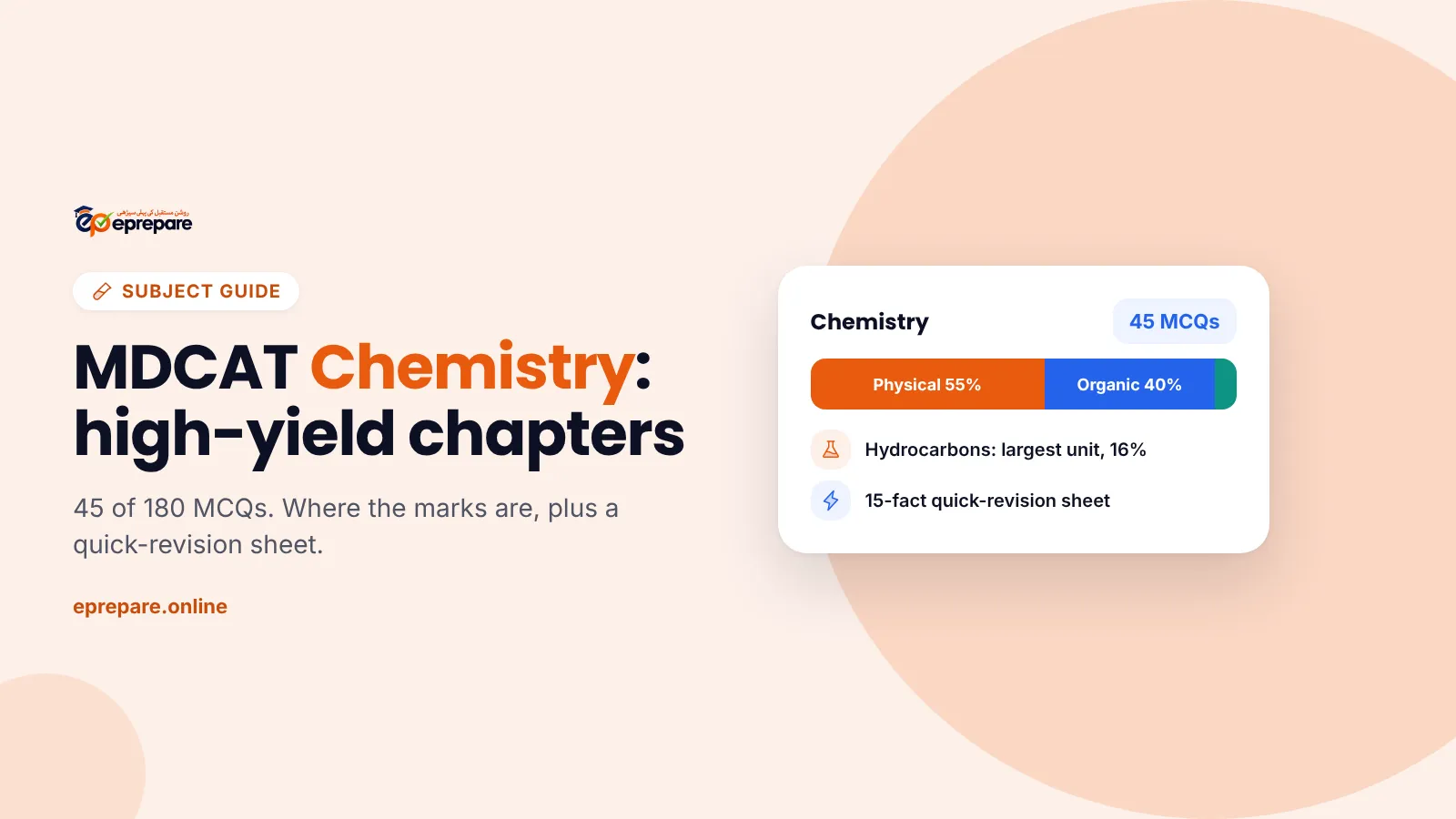
Chemistry has 45 of the 180 MDCAT questions, a quarter of the paper. It is also the subject where students most often feel they "know it" and then lose marks: a forgotten bond angle, a slip in a mole calculation, a reaction they half remember. Chemistry rewards students who revise little and often, with clear notes they can go through in minutes.
This guide shows where the Chemistry marks are, which units carry the most weight, and a quick-revision sheet you can use in the final weeks.
Where the 45 Chemistry marks come from
PMDC's Chemistry curriculum has 20 units. They fall into three familiar parts: physical, inorganic and organic chemistry. PMDC does not publish how many questions come from each unit, so we measured each part by how many learning outcomes it has in the official curriculum.
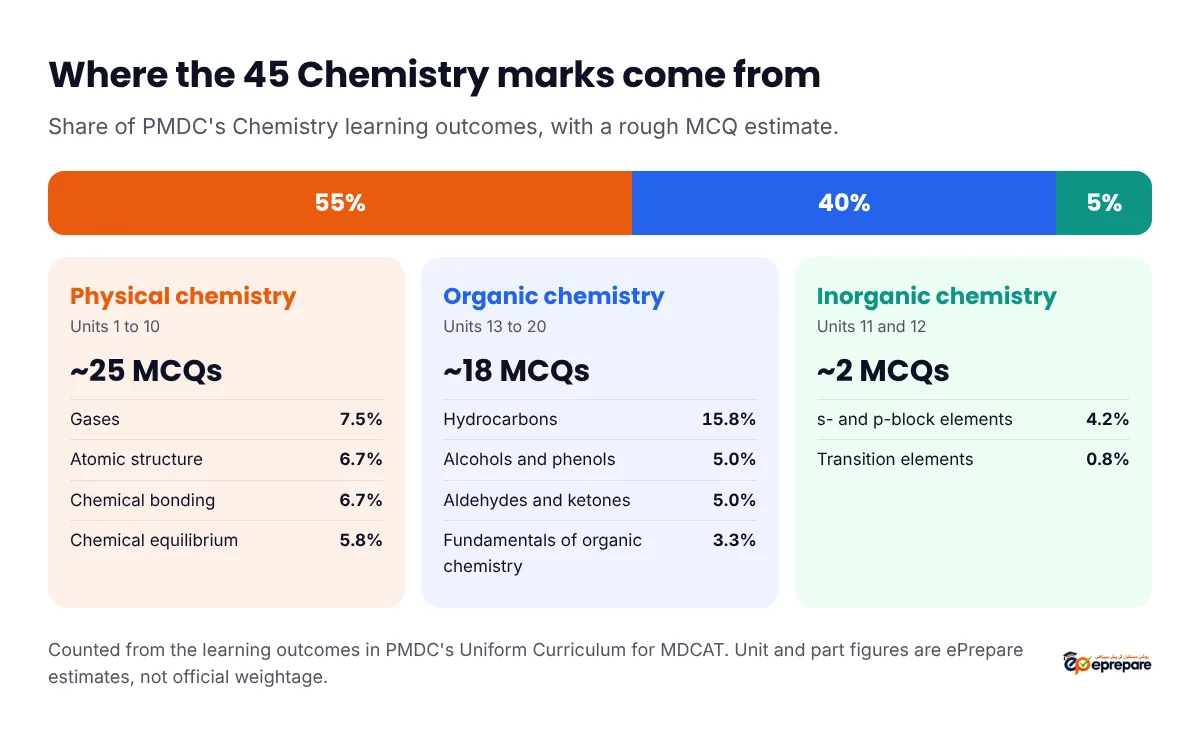
- Physical chemistry (units 1 to 10), about 55%: fundamental concepts, atomic structure, gases, liquids, solids, equilibrium, kinetics, thermochemistry, electrochemistry and bonding.
- Organic chemistry (units 13 to 20), about 40%: fundamentals, hydrocarbons, alkyl halides, alcohols and phenols, aldehydes and ketones, carboxylic acids, macromolecules and industrial chemistry.
- Inorganic chemistry (units 11 and 12), about 5%: s- and p-block elements and transition elements.
High-yield Chemistry units
| Unit | Share of curriculum | Focus on |
|---|---|---|
| Hydrocarbons | 15.8% | Naming, alkanes, alkenes and alkynes, benzene and resonance, free-radical and electrophilic substitution, addition reactions |
| Gases | 7.5% | Kinetic theory, Boyle's and Charles's laws, absolute zero, the ideal gas equation and units of R, real vs ideal gases |
| Atomic structure | 6.7% | Orbitals and shapes, quantum numbers, hydrogen spectrum, Aufbau, Pauli and Hund |
| Chemical bonding | 6.7% | VSEPR shapes and angles, sigma and pi bonds, hybridisation, polarity and dipole moment |
| Equilibrium, kinetics, thermochemistry | 5.8% each | Le Chatelier, Ksp and buffers; rate law and order; Hess's law and enthalpy |
Hydrocarbons alone is about a sixth of the curriculum, more than any other unit. If organic chemistry worries you, start there: once you understand hydrocarbon reactions, the later organic units are mostly the same ideas applied to new functional groups.
For every unit, see MDCAT chapter-wise weightage.
How to prepare each part
Physical chemistry: understand, then drill numericals
Physical chemistry MCQs are a mix of concepts and short calculations. Learn each formula with its units, then solve a set of numericals on it the same day. Most mistakes here are unit slips (dm³ vs m³, °C vs K), so write units in every step during practice.
Organic chemistry: build a reaction map
Do not memorise reactions one by one. Draw one page that links alkanes, alkenes, alkynes, alkyl halides, alcohols, aldehydes, ketones and carboxylic acids with arrows labelled by reagent and condition. Revise that page every few days. Questions about "which reagent converts X into Y" become easy once you can see the map in your head.
Inorganic chemistry: trends and exceptions
Inorganic is small, so learn it fully: periodic trends (atomic radius, ionisation energy, electronegativity) across periods and down groups, Group I, II and IV reactions, and the electronic structure of transition elements and their ions.
Quick-revision sheet
These are the facts that come up again and again. Copy them into your own notebook and add to them as you practise.
| Topic | Remember |
|---|---|
| Mole | Avogadro's number = 6.022 × 10²³; molar volume of a gas at STP = 22.414 dm³ |
| Gas constant | R = 0.0821 dm³ atm K⁻¹ mol⁻¹ = 8.314 J K⁻¹ mol⁻¹ |
| Absolute zero | 0 K = −273.15 °C |
| Yield | % yield = actual yield ÷ theoretical yield × 100; the limiting reactant decides the theoretical yield |
| Hybridisation | sp = 180° (linear), sp² = 120° (trigonal planar), sp³ = 109.5° (tetrahedral) |
| Lone pairs | NH₃ about 107°, H₂O about 104.5°: lone pairs squeeze bond angles |
| Electron filling | Aufbau (lowest energy first), Pauli (two electrons with opposite spins per orbital), Hund (fill singly before pairing) |
| Equilibrium | Le Chatelier: a system shifts to oppose a change in concentration, pressure or temperature; a catalyst does not shift the equilibrium |
| Rate law | Overall order = sum of the powers in the rate law, found by experiment, not from the balanced equation |
| Hess's law | The enthalpy change is the same whatever the route between the same start and end |
| Alkenes | Addition reactions; Markovnikov's rule for HX adding to an unsymmetrical alkene |
| Benzene | Resonance-stabilised, so it prefers electrophilic substitution over addition |
| Alkyl halides | SN1: two steps, carbocation, favoured by tertiary halides. SN2: one step, inversion, favoured by primary halides |
| Alcohol vs phenol | Phenol is more acidic because its ion is stabilised by the benzene ring |
| Aldehydes vs ketones | Aldehydes are easily oxidised and give positive Tollens' and Fehling's tests; ketones generally do not |
A 30-day Chemistry revision plan
- Days 1 to 10: physical chemistry, one or two units a day, each followed by a timed set of 20 to 30 MCQs.
- Days 11 to 20: organic chemistry around your reaction map, then inorganic trends.
- Days 21 to 30: mixed Chemistry sets and full-length papers, revising only your mistakes and your quick-revision sheet.
In the exam, aim to finish the 45 Chemistry MCQs in about 42 minutes. If a numerical is taking too long, mark your best guess, move on and come back at the end: there is no negative marking.
"I also appreciate the detailed explanations provided with the MCQs — they help clear up any confusion immediately. Practicing daily through Eprepare has boosted my confidence a lot."
Sana Fareed, Google review (2025)
If you are also taking NUMS MDCAT
Chemistry is where PMDC and NUMS are closest: units 1 to 19 have the same titles and most learning objectives are word for word the same. The differences to know:
- Only in PMDC: Industrial Chemistry (adhesives, dyes, condensation and addition polymers), reactions of Group IV elements, Group II with chlorine, and stereoisomerism.
- Only in NUMS: six reactions of ethene (hydrogenation, hydrohalogenation, hydration, halogenation, halohydration, polymerisation), balancing redox equations by the ion-electron and oxidation-number methods, electrolysis, the equilibrium constant, the rate-determining step, Group III reactions, structural isomerism and amides.
The full unit-by-unit table is in PMDC MDCAT vs NUMS MDCAT.
Common Chemistry mistakes
- Unit slips in gas and mole calculations.
- Mixing up conditions for organic reactions, such as aqueous vs alcoholic KOH with alkyl halides.
- Learning shapes without angles, or angles without lone pairs.
- Leaving organic chemistry for the end, when it is about 40% of the curriculum.
Frequently asked questions
How many Chemistry MCQs are in MDCAT?
45 out of 180, which is 25% of the paper.
Which Chemistry chapter is the most important for MDCAT?
Hydrocarbons has the largest share of the PMDC Chemistry curriculum, about 16%. Gases, atomic structure, chemical bonding, equilibrium, kinetics and thermochemistry follow.
Is MDCAT Chemistry mostly numerical?
No. Most questions test concepts and facts. Numericals come mainly from physical chemistry units such as fundamental concepts, gases, equilibrium and thermochemistry.
How do I remember organic reactions?
Use one reaction map that links the functional groups with reagents and conditions, and revise it every few days instead of memorising each reaction separately.
Turn Chemistry into steady marks
Chemistry is not about cramming more; it is about revising the same core ideas until they are automatic. Register on ePrepare for Chemistry lectures, Bookline and past-paper MCQs with explanations, and Wrong MCQs that bring back every reaction and formula you missed until you get it right.