

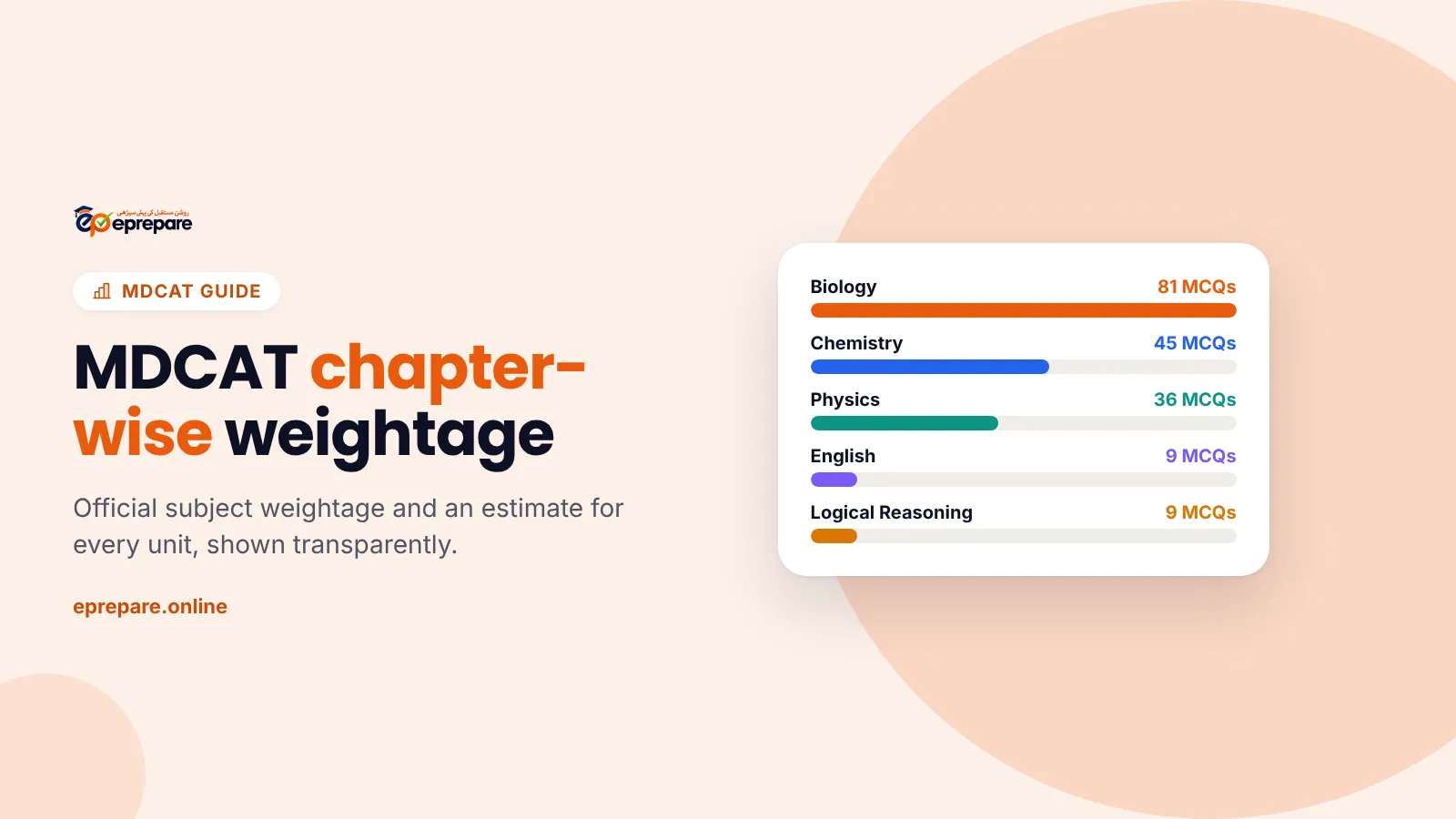
"Which chapters carry the most marks?" is one of the most searched MDCAT questions, and one of the most misunderstood. PMDC tells you exactly how many questions each subject has. It does not publish how many come from each chapter. Lists that claim exact chapter-wise marks are guesses, and they change from one website to the next.
This guide gives you the official subject weightage, then a transparent estimate for every unit, based on how much of PMDC's own curriculum each unit takes up. You can see exactly how the numbers are worked out, and use them to plan your time without skipping anything.
Official subject-wise weightage
| Subject | MCQs | Weightage |
|---|---|---|
| Biology | 81 | 45% |
| Chemistry | 45 | 25% |
| Physics | 36 | 20% |
| English | 9 | 5% |
| Logical Reasoning | 9 | 5% |
| Total | 180 | 100% |
The paper is 15% easy, 70% moderate and 15% difficult questions, with no negative marking. See the MDCAT paper pattern for timing.
How we estimate chapter-wise weightage
PMDC's curriculum lists learning outcomes for every unit, such as "Explain the double helical structure of DNA". Examiners write questions from these outcomes, so a unit with more outcomes has more material to ask about. We counted the outcomes in each unit and turned them into a share of that subject, then multiplied by the subject's MCQs:
Estimated MCQs = (outcomes in the unit ÷ outcomes in the subject) × MCQs in the subject. Treat these as a guide to how much time a unit deserves, not a promise of how many questions will come from it.
Biology chapter-wise weightage (81 MCQs)
| Unit | Outcomes | Share | Est. MCQs |
|---|---|---|---|
| 1. Acellular life | 2 | 2.9% | about 2 |
| 2. Bioenergetics | 1 | 1.4% | about 1 |
| 3. Biological molecules | 10 | 14.5% | about 12 |
| 4. Cell structure and function | 4 | 5.8% | about 5 |
| 5. Coordination and control | 7 | 10.1% | about 8 |
| 6. Enzymes | 4 | 5.8% | about 5 |
| 7. Evolution | 3 | 4.3% | about 4 |
| 8. Reproduction | 3 | 4.3% | about 4 |
| 9. Support and movement | 7 | 10.1% | about 8 |
| 10. Inheritance | 7 | 10.1% | about 8 |
| 11. Circulation | 4 | 5.8% | about 5 |
| 12. Immunity | 1 | 1.4% | about 1 |
| 13. Respiration | 3 | 4.3% | about 4 |
| 14. Digestion | 2 | 2.9% | about 2 |
| 15. Homeostasis | 8 | 11.6% | about 9 |
| 16. Biotechnology | 3 | 4.3% | about 4 |
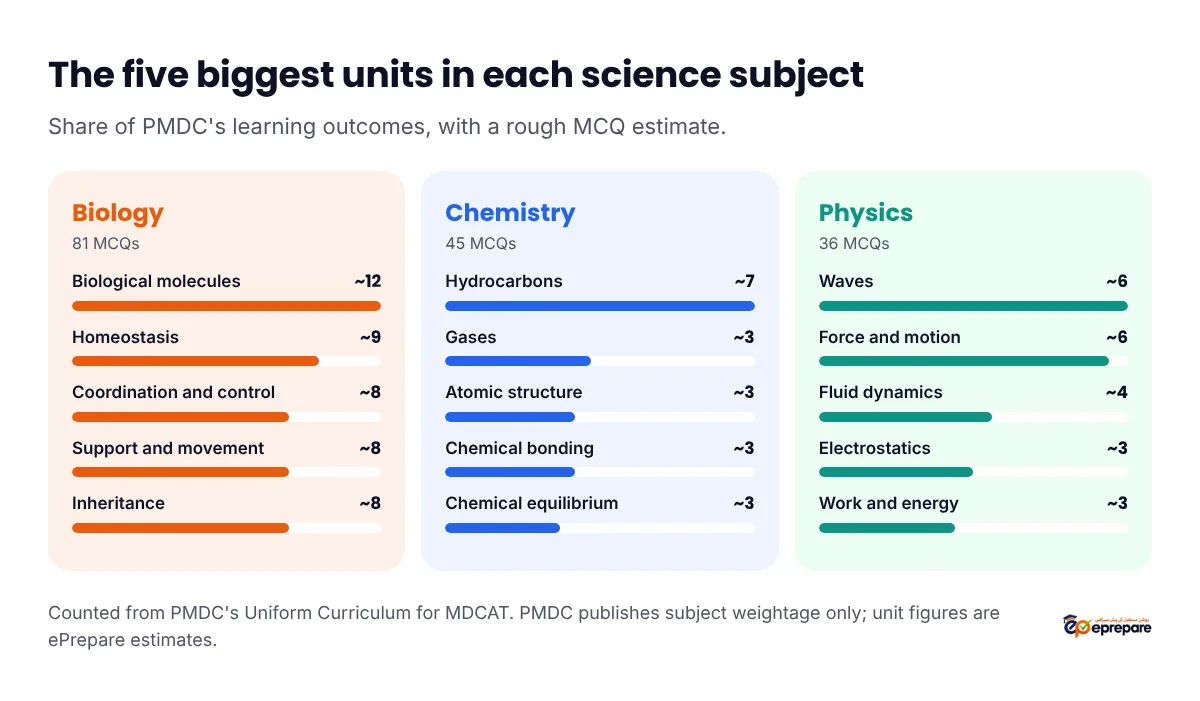
Biological molecules alone is about a seventh of Biology. Five units (Biological molecules, Homeostasis, Coordination and control, Support and movement, Inheritance) make up more than half. More in MDCAT Biology high-yield chapters.
Chemistry chapter-wise weightage (45 MCQs)
| Unit | Outcomes | Share | Est. MCQs |
|---|---|---|---|
| 1. Fundamental concepts | 6 | 5.0% | about 2 |
| 2. Atomic structure | 8 | 6.7% | about 3 |
| 3. Gases | 9 | 7.5% | about 3 |
| 4. Liquids | 4 | 3.3% | about 2 |
| 5. Solids | 5 | 4.2% | about 2 |
| 6. Chemical equilibrium | 7 | 5.8% | about 3 |
| 7. Reaction kinetics | 7 | 5.8% | about 3 |
| 8. Thermochemistry | 7 | 5.8% | about 3 |
| 9. Electrochemistry | 5 | 4.2% | about 2 |
| 10. Chemical bonding | 8 | 6.7% | about 3 |
| 11. s- and p-block elements | 5 | 4.2% | about 2 |
| 12. Transition elements | 1 | 0.8% | under 1 |
| 13. Fundamentals of organic chemistry | 4 | 3.3% | about 2 |
| 14. Hydrocarbons | 19 | 15.8% | about 7 |
| 15. Alkyl halides | 4 | 3.3% | about 2 |
| 16. Alcohols and phenols | 6 | 5.0% | about 2 |
| 17. Aldehydes and ketones | 6 | 5.0% | about 2 |
| 18. Carboxylic acids | 3 | 2.5% | about 1 |
| 19. Macromolecules | 3 | 2.5% | about 1 |
| 20. Industrial chemistry | 3 | 2.5% | about 1 |
Hydrocarbons is the single largest Chemistry unit. Physical chemistry (units 1 to 10) is about 55% of the curriculum and organic chemistry (units 13 to 20) about 40%. More in MDCAT Chemistry high-yield chapters.
Physics chapter-wise weightage (36 MCQs)
| Unit | Outcomes | Share | Est. MCQs |
|---|---|---|---|
| 1. Vectors and equilibrium | 3 | 3.0% | about 1 |
| 2. Force and motion | 17 | 17.0% | about 6 |
| 3. Work and energy | 8 | 8.0% | about 3 |
| 4. Rotational and circular motion | 4 | 4.0% | about 1 |
| 5. Fluid dynamics | 10 | 10.0% | about 4 |
| 6. Waves | 18 | 18.0% | about 6 |
| 7. Thermodynamics | 7 | 7.0% | about 2 |
| 8. Electrostatics | 9 | 9.0% | about 3 |
| 9. Current electricity | 5 | 5.0% | about 2 |
| 10. Electromagnetism | 4 | 4.0% | about 1 |
| 11. Electromagnetic induction | 4 | 4.0% | about 1 |
| 12. Alternating current | 3 | 3.0% | about 1 |
| 13. Electronics | 2 | 2.0% | about 1 |
| 14. Dawn of modern physics | 1 | 1.0% | under 1 |
| 15. Atomic spectra | 1 | 1.0% | under 1 |
| 16. Nuclear physics | 4 | 4.0% | about 1 |
Waves (including simple harmonic motion) and Force and motion together are over a third of the Physics curriculum. Fluid dynamics and Electrostatics follow. The last three units of modern physics are short, so they are quick to finish. More in MDCAT Physics high-yield chapters and formulas.
English and Logical Reasoning
English (9 MCQs) is grouped into three skill areas: reading and thinking, formal and lexical aspects of language, and writing skills. Most of its learning outcomes are grammar and usage. Logical Reasoning (9 MCQs) has six themes: critical thinking, letter and symbol series, logical deductions, logical problems, course of action, and cause and effect. See MDCAT English grammar topics and MDCAT Logical Reasoning question types.
How to use weightage without hurting your score
- Start with the big units. Learn them early so they get the most revision.
- Do not skip small units. A unit with one or two outcomes can still give you a question or two, and often takes an evening to finish. They are the cheapest marks in the syllabus.
- Weight your practice, not just your reading. Solve more MCQs from the big units, and revisit them more often.
- Let your results lead. Your own weak topics matter more than any average. On ePrepare, your predicted score and Fix next list show which topics are costing you the most marks right now. See how the predicted score works.
"Eprepare helped me immensely in understanding concepts more clearly, especially Physics, which was my weakest subject. The Bookline MCQs were invaluable in strengthening my concepts and making sure I understood everything I needed to know."
Saddaf Illahi, Google review (2026)
Frequently asked questions
Does PMDC publish chapter-wise weightage for MDCAT?
No. PMDC publishes subject-wise weightage only: Biology 81, Chemistry 45, Physics 36, English 9 and Logical Reasoning 9 MCQs.
Which Biology chapter has the most weightage in MDCAT?
By share of the PMDC curriculum, Biological molecules (about 14.5% of Biology, roughly 12 MCQs), followed by Homeostasis.
Which Chemistry chapter has the most weightage?
Hydrocarbons, about 16% of the Chemistry curriculum, roughly 7 MCQs.
Which Physics chapter has the most weightage?
Waves and Force and motion, each about 17 to 18% of the Physics curriculum, roughly 6 MCQs each.
Will the chapter-wise weightage be the same for MDCAT 2027?
The PMDC curriculum is the same for 2025, 2026 and 2027 unless PMDC announces a change. If it changes, we will update this page.
Plan by weightage, finish everything
Weightage tells you where to start, not what to skip. Register on ePrepare for chapter-wise and topic-wise MCQs in every unit, a study plan that covers the whole syllabus, and full-length papers with the exact subject split of the real test.