English has only 9 of the 180 MDCAT questions, so many students ignore it until the last month. That is a mistake. Nine marks is about 2.5 aggregate points in Khyber Pakhtunkhwa, often the gap between two colleges on the merit list. And unlike Biology, English improves quickly: a few weeks of focused practice can take you from 5 out of 9 to 8 or 9.
This guide lists the grammar and vocabulary topics in PMDC's English curriculum, shows what each question type looks like with worked examples, and gives a simple routine to get these marks without taking time away from the sciences.
What MDCAT English tests
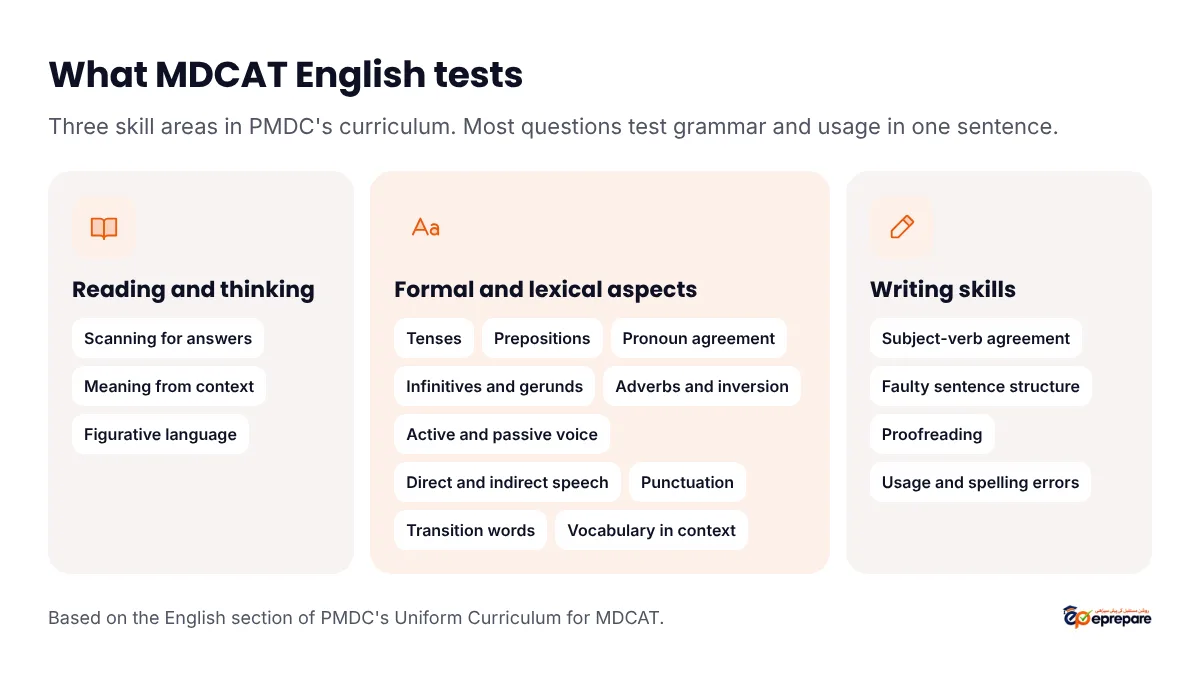
PMDC's English curriculum has three skill areas. Here is what each covers, in plain words:
| Skill area | What it includes |
|---|---|
| Reading and thinking | Scanning a short text for answers, working out meaning from context, figurative language |
| Formal and lexical aspects | Contextual vocabulary and synonyms, pronoun-antecedent agreement, tenses, infinitives, gerunds, position of adverbs, prepositions, transition words, punctuation, sentence classes and phrases, inversion, active and passive voice, direct and indirect speech |
| Writing skills | Proofreading and editing, faulty sentence structure, subject-verb agreement, errors of usage and spelling |
Grammar topics that matter most
The middle area, formal and lexical aspects, has by far the most learning outcomes, so most of your 9 questions will test grammar in one way or another. Make sure you are confident with these:
- Subject-verb agreement: "Each of the students has", "The list of items is", "Neither the teacher nor the students were".
- Tenses: especially present perfect vs past simple, and time words such as since, for, already and yet.
- Prepositions: of time (at, on, in), place and direction, and fixed pairs such as "interested in", "good at", "afraid of".
- Pronoun-antecedent agreement: "Everyone should bring his or her admit card", and clear reference with no confusing "it" or "they".
- Active and passive voice, direct and indirect speech: tense shifts, pronoun changes, and word order in reported questions.
- Infinitives and gerunds: "avoid making", "decide to make", "look forward to meeting".
- Adverbs and inversion: "Hardly had she arrived when…", "Never have I seen…".
- Vocabulary in context: choosing the word whose meaning fits the sentence, not just a dictionary synonym.
Question types, with examples
These are our own practice examples, written to match the style of the curriculum.
1. Find the error
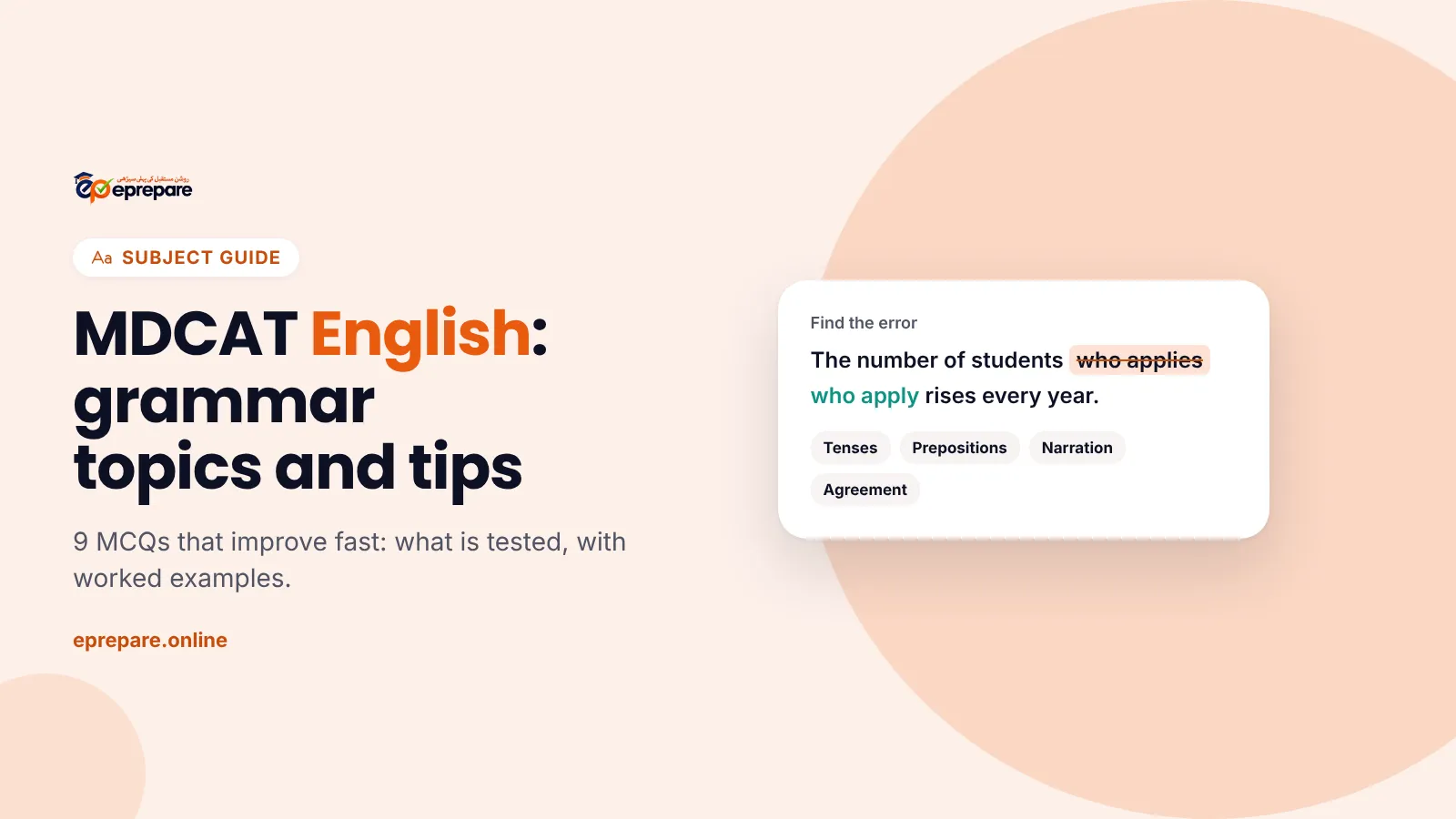
Example: "The number of students (A) who applies (B) for MDCAT (C) rises every year (D)."
Answer: B. "Who" refers to "students", which is plural, so it should be "who apply". Read the whole sentence and ask what each verb really refers to.
2. Choose the correct option
Example: "She has been preparing for MDCAT ___ last June."
(A) for (B) since (C) from (D) by
Answer: B. "Since" goes with a point in time; "for" goes with a period of time ("for ten months").
3. Correct sentence
Example: Which sentence is correct?
(A) Neither of the answers are correct. (B) Neither of the answers is correct. (C) Neither of the answer is correct. (D) Neither of answers are correct.
Answer: B. "Neither of" takes a plural noun and a singular verb.
4. Vocabulary in context
Example: "The doctor's explanation was so lucid that every student understood it." The closest meaning of lucid is:
(A) long (B) clear (C) complex (D) quiet
Answer: B. The rest of the sentence, "every student understood it", tells you the meaning.
5. Voice and narration
Example: Change into indirect speech: He said, "I am revising Biology."
Answer: He said that he was revising Biology. The present continuous shifts to past continuous, and "I" becomes "he".
How to prepare English in 20 minutes a day
- One grammar rule a day. Read the rule, then solve 15 to 20 MCQs on it. In about six weeks you will have covered every topic above.
- Keep an error notebook. Write each mistake as a correct sentence with the rule in a few words. Read it once a week.
- Read the whole sentence before choosing. Most errors only make sense in context.
- Practise under time. In the exam, about 7 minutes is enough for 9 English MCQs. See the time plan in the MDCAT paper pattern.
"The eprepare App is very useful for mdcat student. The chapter wise tests and detailed explanations helped me a lot."
Zarafsha Khan, Google review (2025)
If you are also taking NUMS MDCAT
NUMS gives English 15 of its 150 MCQs, and its syllabus emphasises slightly different skills. From our line-by-line comparison:
| Only in PMDC | Only in NUMS |
|---|---|
| Active and passive voice; direct and indirect speech | Antonyms and homophones |
| Infinitives, gerunds, position of adverbs, inversion | Conditionals, types of clauses, sentence fragments |
| Pronoun-antecedent agreement, transition words | Articles, capitalisation, apostrophes and abbreviations |
| Figurative language; synonyms with shades of meaning | Short reading passages with questions from the text |
Both test vocabulary in context, tenses, prepositions, subject-verb agreement, punctuation and spotting errors in sentences. Full details in PMDC MDCAT vs NUMS MDCAT.
Common English mistakes
- Choosing what "sounds right". Spoken English and exam English differ. Check the rule.
- Ignoring words between subject and verb. "The quality of the answers is good": the subject is "quality".
- Rushing English to save time. Seven calm minutes for nine marks is excellent value.
- Leaving English for the last week. Little and often works much better.
Frequently asked questions
How many English MCQs are in MDCAT?
9 out of 180, which is 5% of the paper. NUMS MDCAT has 15 English MCQs out of 150.
Which grammar topics come in MDCAT English?
Subject-verb agreement, tenses, prepositions, pronoun agreement, voice, narration, infinitives and gerunds, adverbs and inversion, punctuation and vocabulary in context, plus spotting errors in sentences.
Is MDCAT English difficult?
Usually not. Most questions test one grammar rule in one sentence. Regular practice is enough to score 8 or 9 out of 9.
How can I improve English for MDCAT quickly?
Learn one rule a day, solve MCQs on it straight away, keep an error notebook, and practise English inside timed full-length papers.
Nine easy marks, if you practise
English will never take as much time as Biology, and it does not need to. A short daily routine is enough. Register on ePrepare for English MCQs with clear explanations, past-paper questions and full-length papers that include English and Logical Reasoning exactly as in the real test. For the other 9 non-science marks, read MDCAT Logical Reasoning question types.