

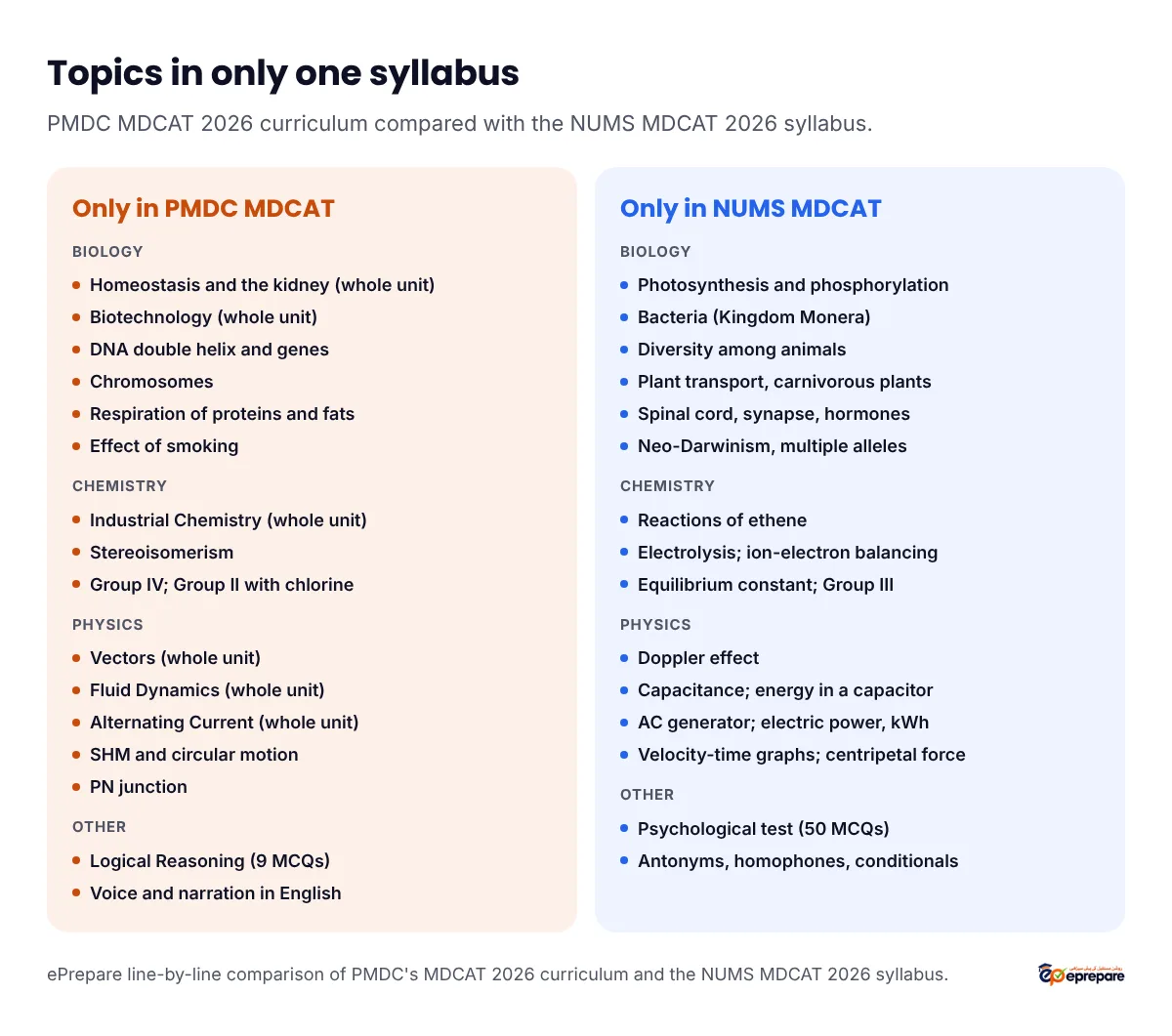
Most comparisons of PMDC MDCAT and NUMS MDCAT stop at the number of MCQs. That is not what decides your preparation. What matters is which topics each test can ask about, and the two syllabuses differ in ways that surprise most students: NUMS has no kidney or homeostasis content in Biology, no fluid dynamics in Physics, and no Logical Reasoning, while PMDC has no photosynthesis, no bacteria and no Doppler effect.
For this guide we compared PMDC's MDCAT 2026 curriculum and the NUMS MDCAT 2026 syllabus line by line, learning objective by learning objective, and checked what NUMS changed from its 2025 syllabus. Below is every difference we found, subject by subject, followed by a checklist for students taking both tests.
Key findings. (1) NUMS 2026 cut Biology from 65 to 55 MCQs and raised Physics from 30 to 40, with a harder difficulty mix (20% easy, 60% moderate, 20% hard). (2) The NUMS syllabus text itself did not change from 2025 to 2026. (3) In Biology, Homeostasis and Biotechnology are PMDC-only; photosynthesis, bacteria, animal diversity and plant transport are NUMS-only. (4) In Physics, Vectors, Fluid Dynamics and Alternating Current are PMDC-only; Doppler effect, capacitance and the AC generator are NUMS-only. (5) Chemistry is almost identical, except PMDC's Industrial Chemistry and a short list of NUMS extras such as reactions of ethene and electrolysis.
The two tests at a glance
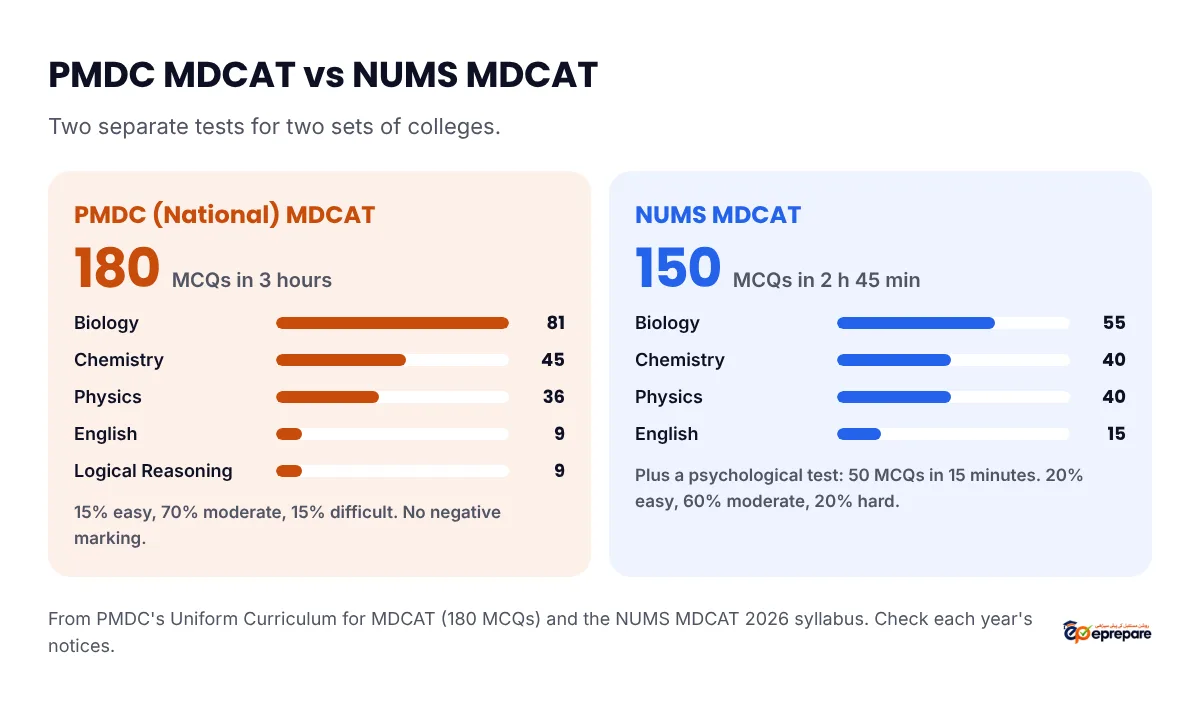
| Feature | PMDC MDCAT | NUMS MDCAT 2026 |
|---|---|---|
| For admission to | Public and private medical and dental colleges nationwide (in KPK, through KMU) | NUMS constituent, affiliated and Armed Forces administered colleges |
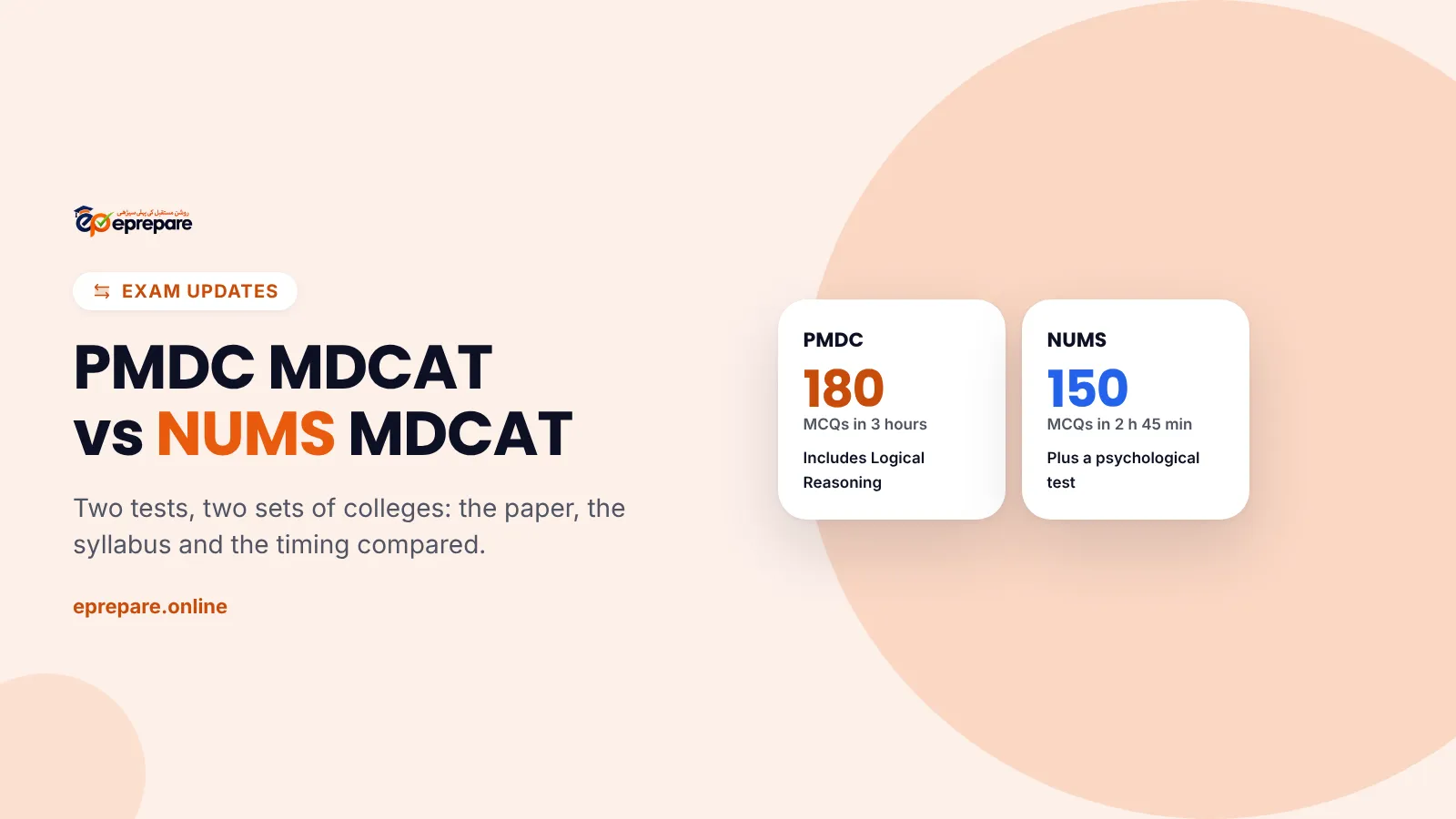
| Subject paper | 180 MCQs, 3 hours | 150 MCQs, 2 hours 45 minutes |
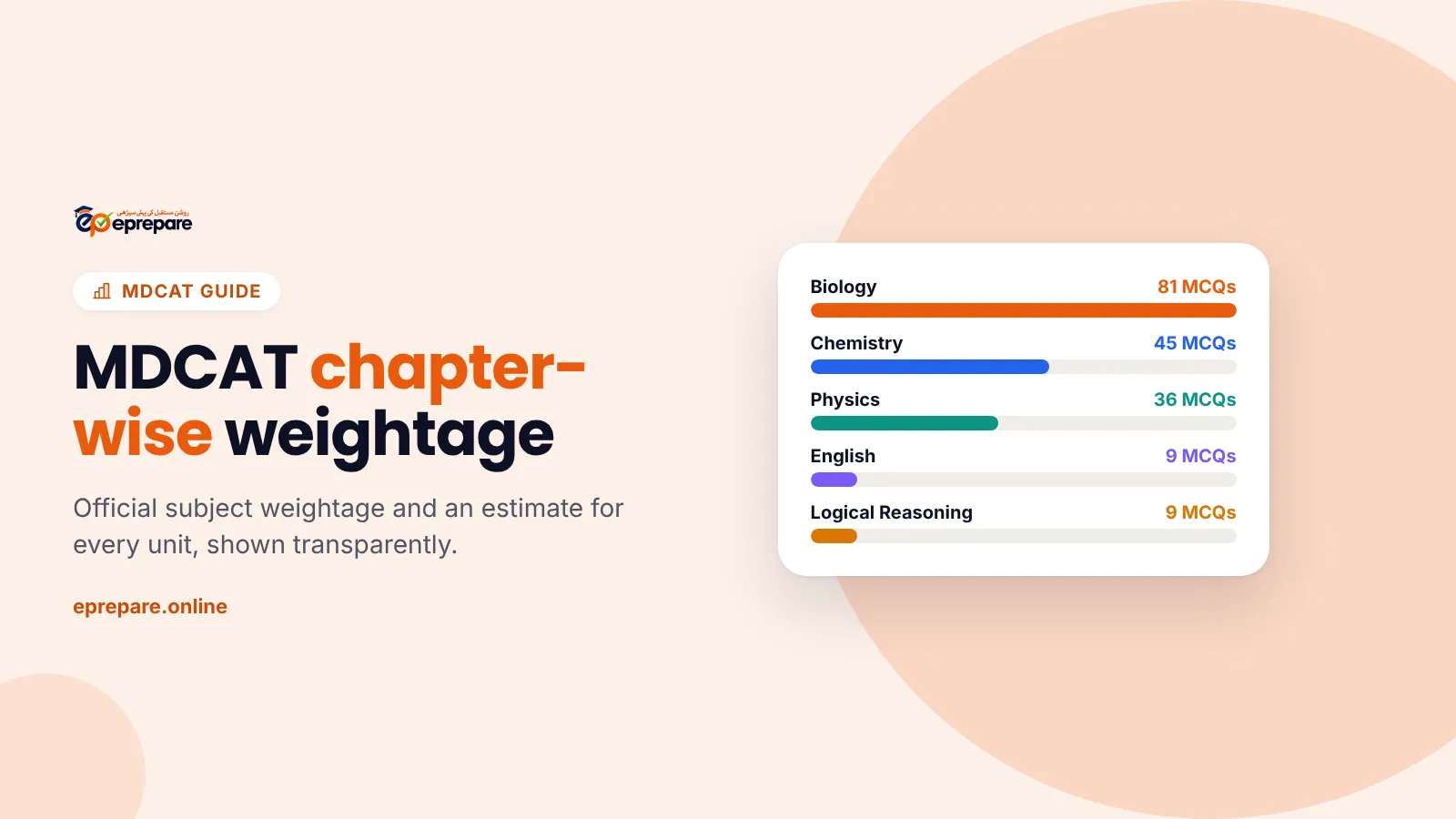
| Biology | 81 (45%) | 55 (37%) |
| Chemistry | 45 (25%) | 40 (26.5%) |
| Physics | 36 (20%) | 40 (26.5%) |
| English | 9 (5%) | 15 (10%) |
| Logical Reasoning | 9 (5%) | Not in the paper |
| Extra component | None | Psychological test: 50 MCQs in 15 minutes |
| Difficulty | 15% easy, 70% moderate, 15% difficult | 20% easy, 60% moderate, 20% hard; science questions 70% recall, 30% application |
| Time per MCQ | 1 minute | About 66 seconds |
What NUMS changed from 2025 to 2026
We compared the NUMS 2025 and 2026 syllabus documents word by word. The topic lists and learning objectives for Biology, Chemistry and Physics are identical; only the weighting and difficulty changed:
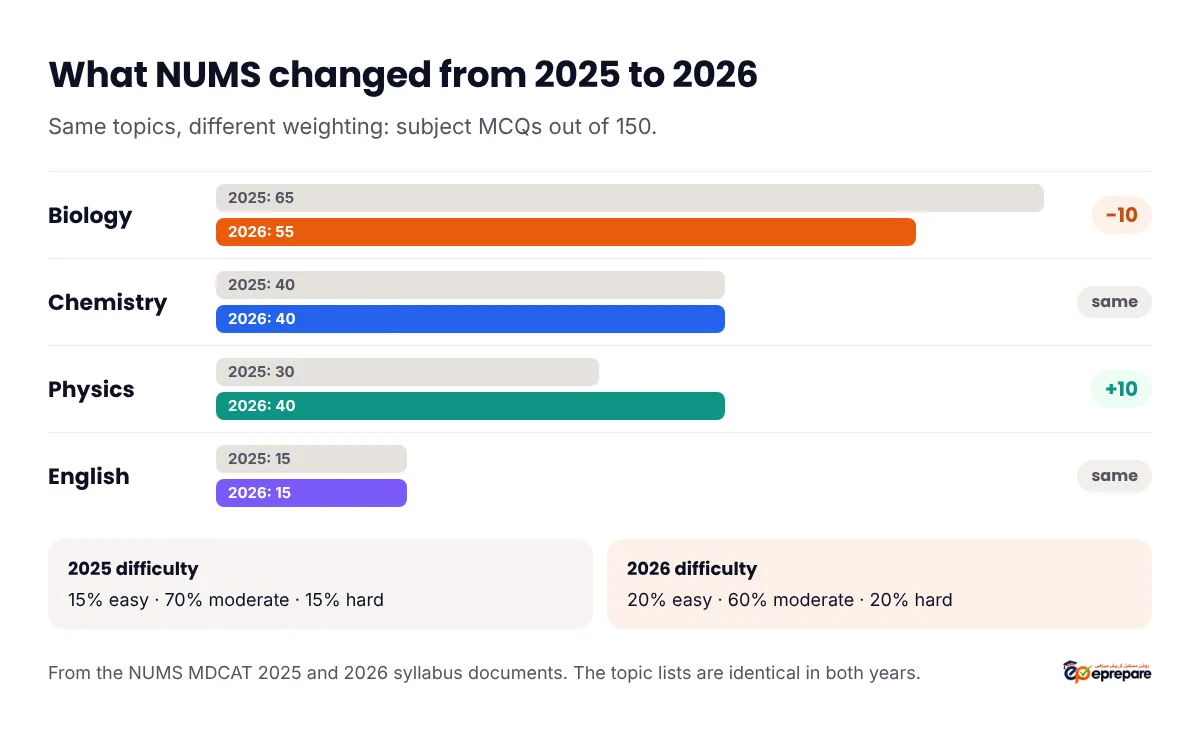
| NUMS | 2025 | 2026 |
|---|---|---|
| Biology | 65 | 55 |
| Chemistry | 40 | 40 |
| Physics | 30 | 40 |
| English | 15 | 15 |
| Difficulty (easy / moderate / hard) | 15 / 70 / 15 | 20 / 60 / 20 |
For NUMS candidates this is a big shift: Physics is now worth as much as Chemistry, and there are more hard questions. A Biology-heavy plan that suited 2025 is no longer the best plan for NUMS.
Biology: chapter by chapter
PMDC has 16 Biology units with 69 learning outcomes. NUMS has 13 content items with 70 learning objectives. Fourteen PMDC units have a NUMS counterpart, but the content inside them differs more than the titles suggest.
How to read this: for each chapter you will see the extra topics in NUMS and the extra topics in PMDC MDCAT. Tap "All PMDC MDCAT topics" or "All NUMS topics" to open the complete list each official syllabus gives for that chapter. Items marked "(learning outcome)" or "(learning objective)" come from the syllabus's learning outcomes rather than its topic list.
Acellular life (viruses)
PMDC unit 1. Acellular life · NUMS topic 1. Biodiversity (acellular life / variety of life)
Extra topics in NUMS:
- Discovery of viruses
- Structure of viruses as a separate topic
Extra topics in PMDC MDCAT: none. Every PMDC MDCAT topic in this chapter is also in the NUMS syllabus.
Note: NUMS's title also says 'variety of life', but no NUMS subtopic or objective covers general classification of living things.
All PMDC MDCAT topics in this chapter (2)
- Viruses
- AIDS and HIV infection
All NUMS topics in this chapter (4)
- Classification of viruses
- Discovery of viruses
- Structure of viruses
- Viral disease (for example AIDS)
Bioenergetics
PMDC unit 2. Bioenergetics · NUMS topic 2. Bioenergetics
Extra topics in NUMS:
- Photosynthesis: the process
- Light-dependent and light-independent reactions
- Factors affecting photosynthesis (light, water, CO2)
- Cyclic and non-cyclic phosphorylation
- Glycolysis, electron transport chain and oxidative phosphorylation named explicitly
- Aerobic vs anaerobic respiration
- Production of ATP
Extra topics in PMDC MDCAT:
- Respiration of proteins and fats, compared with glucose
Note: The overlap is minimal: PMDC has a single outcome on respiration of proteins and fats, while NUMS covers photosynthesis and glucose respiration in detail; neither names the Krebs cycle.
All PMDC MDCAT topics in this chapter (2)
- Respiration
- Cellular respiration of proteins and fats, compared with that of glucose (learning outcome)
All NUMS topics in this chapter (8)
- Anaerobic respiration (respiration without oxygen)
- Electron transport chain
- Glycolysis/glycolytic pathway/aerobic respiration
- Light dependent and light independent phases/reactions
- Oxidative phosphorylation/cyclic and non-cyclic phosphorylation
- Photosynthesis
- Production of ATP
- Role of light, water, CO2/factors affecting photosynthesis
Biological molecules
PMDC unit 3. Biological molecules · NUMS topic 3. Biological molecules
Extra topics in NUMS: none. Every NUMS topic in this chapter is also in the PMDC MDCAT syllabus.
Extra topics in PMDC MDCAT:
- DNA double helix (Watson and Crick model)
- Gene as a sequence of DNA nucleotides coding for a polypeptide
- Structure and function of RNA (NUMS only says 'give an account of RNA')
All PMDC MDCAT topics in this chapter (9)
- Biological molecules
- Biological importance of water
- Carbohydrates
- Proteins
- Lipids
- Ribonucleic acid (RNA)
- Conjugated molecules
- Structure of DNA
- Gene as a sequence of nucleotides in DNA that codes for a polypeptide (learning outcome)
All NUMS topics in this chapter (7)
- Introduction to biological molecules
- Water
- Carbohydrates
- Proteins
- Lipids
- Conjugated molecules (glycolipids, glycoproteins)
- RNA (learning objective)
Cell structure and function
PMDC unit 4. Cell structure and function · NUMS topic 4. Cell structure and function
Extra topics in NUMS:
- Fluid mosaic model of the cell membrane
- Cell wall
- Lysosomes, plastids/chloroplasts and vacuoles
Extra topics in PMDC MDCAT:
- Chromosomes: structure, chemical composition and function
All PMDC MDCAT topics in this chapter (4)
- Cell structure
- Prokaryotic and eukaryotic cell
- Cytoplasmic organelles
- Chromosomes
All NUMS topics in this chapter (12)
- Cell wall
- Cytoplasm and cell organelles
- Nucleus
- Endoplasmic reticulum
- Mitochondria
- Golgi apparatus/Golgi complex/Golgi bodies
- Lysosomes
- Plastids/chloroplasts
- Vacuoles
- Prokaryote and eukaryote
- Fluid mosaic model
- Comparison of typical animal and plant cells (learning objective)
Coordination and control
PMDC unit 5. Coordination and control / nervous and chemical coordination · NUMS topic 5. Coordination and control / nervous and chemical coordination
Extra topics in NUMS:
- Spinal cord: levels and functions
- Synapse: electrical and chemical synapses, transmission across a synapse
- Hormones and endocrine glands
- Positive and negative feedback mechanisms
- Steps involved in nervous coordination
- Types of neurons
- Schwann cells
Extra topics in PMDC MDCAT: none. Every PMDC MDCAT topic in this chapter is also in the NUMS syllabus.
Note: PMDC asks you to discuss the main parts of the brain where NUMS only asks you to list them, and although PMDC's unit title mentions chemical coordination it lists no hormone or endocrine topics.
All PMDC MDCAT topics in this chapter (5)
- Receptors
- Neurons
- Brain
- Nerve impulse (learning outcome)
- Reflexes and reflex arc (learning outcome)
All NUMS topics in this chapter (18)
- Nervous system
- Nerve impulse
- Steps involved in nervous coordination
- Neurons (structure and types)
- Transmission of action potential between cells (synapse)
- Electrical synapses
- Chemical synapses
- Transmission of nerve impulse across synapse
- Hormones
- Endocrine glands
- Feedback mechanism
- Positive feedback mechanism
- Negative feedback mechanism
- Reflexes and reflex arc
- Levels of the spinal cord and its main functions
- Parts of the brain with their main functions
- Receptors as transducers sensitive to various stimuli (learning objective)
- Structure of a typical neuron: cell body, dendrites, axon, myelin sheath and Schwann cells (learning objective)
Enzymes
PMDC unit 6. Enzymes · NUMS topic 7. Enzymes
Extra topics in NUMS: none. Every NUMS topic in this chapter is also in the PMDC MDCAT syllabus.
Extra topics in PMDC MDCAT: none. Every PMDC MDCAT topic in this chapter is also in the NUMS syllabus.
All PMDC MDCAT topics in this chapter (4)
- Enzymes
- Mode of enzyme action
- Factors that affect the rate of enzyme reactions
- Inhibitors
All NUMS topics in this chapter (4)
- Introduction/characteristics of enzymes
- Mechanism of action of enzymes
- Factors affecting rate of enzyme action
- Enzyme inhibition
Evolution
PMDC unit 7. Evolution · NUMS topic 8. Evolution
Extra topics in NUMS:
- Neo-Darwinism
- Evidence of evolution
Extra topics in PMDC MDCAT: none. Every PMDC MDCAT topic in this chapter is also in the NUMS syllabus.
All PMDC MDCAT topics in this chapter (3)
- Concept of evolution
- Lamarckism
- Darwinism
All NUMS topics in this chapter (6)
- Concepts of evolution
- Inheritance of acquired characteristics
- Darwinism
- Darwin's theory of evolution
- Neo-Darwinism
- Evidence of evolution
Reproduction
PMDC unit 8. Reproduction · NUMS topic 11. Reproduction
Extra topics in NUMS: none. Every NUMS topic in this chapter is also in the PMDC MDCAT syllabus.
Extra topics in PMDC MDCAT: none. Every PMDC MDCAT topic in this chapter is also in the NUMS syllabus.
All PMDC MDCAT topics in this chapter (3)
- Human reproductive system
- Menstrual cycle
- Sexually transmitted diseases
All NUMS topics in this chapter (3)
- Male reproductive system
- Female reproductive system (including menstrual cycle)
- Sexually transmitted diseases
Support and movement
PMDC unit 9. Support and movement · NUMS topic 12. Support and movement
Extra topics in NUMS: none. Every NUMS topic in this chapter is also in the PMDC MDCAT syllabus.
Extra topics in PMDC MDCAT: none. Every PMDC MDCAT topic in this chapter is also in the NUMS syllabus.
Note: PMDC asks you to describe cartilage, muscle and bone, while NUMS only asks you to define them.
All PMDC MDCAT topics in this chapter (7)
- Human skeleton
- Muscles
- Skeletal muscles
- Muscle contraction
- Joints
- Arthritis
- Cartilage and bone: characteristics and functions (learning outcome)
All NUMS topics in this chapter (10)
- Cartilage
- Types of muscles
- Skeletal muscles
- Cardiac muscles
- Smooth muscles
- Structure of skeletal muscles
- Mechanism of skeletal muscle contraction
- Types of joints
- Arthritis
- Bone: characteristics and functions (learning objective)
Inheritance
PMDC unit 10. Inheritance · NUMS topic 13. Variation and genetics / inheritance
Extra topics in NUMS:
- Multiple alleles
- Statistics and probability in genetics
- Sex linkage in Drosophila
- Mendel's life, work and experiments
- Inheritance of one trait and of two traits (monohybrid and dihybrid crosses)
- Scope of independent assortment in variation
Extra topics in PMDC MDCAT: none. Every PMDC MDCAT topic in this chapter is also in the NUMS syllabus.
All PMDC MDCAT topics in this chapter (4)
- Mendel's laws of inheritance
- Gene linkage and crossing over
- X-linked recessive inheritance
- Inheritance of hemophilia (learning outcome)
All NUMS topics in this chapter (14)
- Mendel's law of inheritance
- Gregor John Mendel and his work
- Mendel's experiment
- Inheritance of single trait
- Mendel's principles of inheritance
- Inheritance of two traits
- Law of independent assortment
- Scope of independent assortment in variation
- Statistics and probability relevant to genetics
- Multiple alleles
- Gene linkages and crossing over
- Sex linkages in Drosophila
- Sex linkage in human
- Genetics of hemophilia
Circulation
PMDC unit 11. Circulation · NUMS topic 9. Life processes in animals and plants (part)
Extra topics in NUMS: none. Every NUMS topic in this chapter is also in the PMDC MDCAT syllabus.
Extra topics in PMDC MDCAT: none. Every PMDC MDCAT topic in this chapter is also in the NUMS syllabus.
Note: PMDC asks you to discuss the structure of the heart and describe the phases of the heartbeat, while NUMS only asks you to list and define them.
All PMDC MDCAT topics in this chapter (4)
- Human heart
- Cardiac cycle and phases of heartbeat
- Blood vessels
- Lymphatic system
All NUMS topics in this chapter (3)
- Cardiovascular system (including human heart structure, blood vessels)
- Lymphatic system
- Phases of the cardiac cycle (learning objective)
Immunity
PMDC unit 12. Immunity · NUMS topic 9. Life processes in animals and plants (part)
Extra topics in NUMS:
- Main components of the immune system in general, not only specific defense
Extra topics in PMDC MDCAT: none. Every PMDC MDCAT topic in this chapter is also in the NUMS syllabus.
Note: PMDC limits this to specific (acquired) defense mechanisms, while NUMS says 'main components of immune system', which may also include non-specific defenses.
All PMDC MDCAT topics in this chapter (1)
- Specific defense mechanism
All NUMS topics in this chapter (1)
- Immune system
Respiration
PMDC unit 13. Respiration · NUMS topic 9. Life processes in animals and plants (part)
Extra topics in NUMS:
- Role of surfactant in gas exchange
Extra topics in PMDC MDCAT:
- Effect of smoking on the respiratory system
All PMDC MDCAT topics in this chapter (3)
- Human respiratory system
- Gas exchange in human lungs (learning outcome)
- Effect of smoking on the respiratory system (learning outcome)
All NUMS topics in this chapter (3)
- Respiratory system
- Role of surfactant in gas exchange (learning objective)
- Gas exchange in human lungs (learning objective)
Digestion
PMDC unit 14. Digestion · NUMS topic 9. Life processes in animals and plants (part)
Extra topics in NUMS: none. Every NUMS topic in this chapter is also in the PMDC MDCAT syllabus.
Extra topics in PMDC MDCAT: none. Every PMDC MDCAT topic in this chapter is also in the NUMS syllabus.
Note: PMDC asks you to describe the parts of the digestive system, while NUMS only asks you to list them.
All PMDC MDCAT topics in this chapter (1)
- Human digestive system
All NUMS topics in this chapter (1)
- Digestive system
Homeostasis
PMDC unit 15. Homeostasis · not in the NUMS syllabus
Extra topics in PMDC MDCAT: this whole chapter. NUMS does not have it.
Note: This whole unit is PMDC-only: NUMS Biology does not mention the kidney, excretion or thermoregulation.
All PMDC MDCAT topics in this chapter (10)
- Homeostasis (kidney specifically)
- Organs of the urinary system; structure of the kidney related to its function (learning outcome)
- Glomerular filtration, selective reabsorption and tubular secretion (learning outcome)
- Kidneys in both excretion and osmoregulation (learning outcome)
- Glomerular and peritubular capillaries compared (learning outcome)
- Kidney stones: causes and treatments (learning outcome)
- Kidney failure: causes (learning outcome)
- Thermoregulation
- Excretion
- Nitrogenous compounds excreted (learning outcome)
Biotechnology
PMDC unit 16. Biotechnology · not in the NUMS syllabus
Extra topics in PMDC MDCAT: this whole chapter. NUMS does not have it.
Note: This whole unit is PMDC-only: NUMS Biology does not mention biotechnology.
All PMDC MDCAT topics in this chapter (4)
- Biotechnology and health care
- Producing vaccines to combat health problems (learning outcome)
- Biotechnology in disease diagnosis (DNA/RNA probes, monoclonal antibodies) (learning outcome)
- Biotechnology products used in disease treatment (learning outcome)
Diversity among animals
NUMS topic 6. Diversity among animals · not in the PMDC MDCAT syllabus
Extra topics in NUMS: this whole chapter. PMDC MDCAT does not have it.
All NUMS topics in this chapter (1)
- Characteristics and diversity among the animals (animal phyla, characteristics)
Prokaryotes (Kingdom Monera)
NUMS topic 10. Prokaryotes (Kingdom Monera) · not in the PMDC MDCAT syllabus
Extra topics in NUMS: this whole chapter. PMDC MDCAT does not have it.
Note: PMDC has no bacteria unit; it only compares prokaryotic and eukaryotic cells under Cell structure and function.
All NUMS topics in this chapter (3)
- Cellular structure of bacteria
- Shape and size of bacteria
- Importance and control of bacteria
Plant life processes
NUMS topic 9. Life processes in animals and plants (part) · not in the PMDC MDCAT syllabus
Extra topics in NUMS: this whole chapter. PMDC MDCAT does not have it.
All NUMS topics in this chapter (3)
- Carnivorous plants/parasitic nutrition (pitcher plant, Venus fly trap, sundew)
- Water and mineral uptake by roots, xylem and phloem
- Osmotic pressure/potential
Two things stand out. First, the overlap in Bioenergetics is almost zero: PMDC asks about respiration of proteins and fats, NUMS about photosynthesis and the respiration pathways. Second, where both syllabuses share an objective, PMDC sometimes uses a stronger verb ("discuss" or "describe" against NUMS's "list" or "define") for the brain, heart, cardiac cycle, digestive system and skeletal tissues. In no shared objective did NUMS ask for more depth than PMDC; NUMS's extra demand comes from extra topics.
Chemistry: chapter by chapter
Chemistry is where the two tests are closest. Both use the same unit numbering and titles for units 1 to 19, and about 110 of PMDC's 120 learning objectives appear word for word, or nearly, in NUMS (which has 124). PMDC adds a 20th unit, Industrial Chemistry.
Fundamental concepts of chemistry
PMDC unit 1. Introduction of fundamentals concept of chemistry · NUMS topic 1. Introduction to fundamental concepts of chemistry
Extra topics in NUMS:
- Atomic mass
- Empirical formula
- Molecular formula
- Important assumptions of stoichiometric calculations
Extra topics in PMDC MDCAT: none. Every PMDC MDCAT topic in this chapter is also in the NUMS syllabus.
All PMDC MDCAT topics in this chapter (5)
- Moles and Avogadro's numbers
- Limiting and excess reactants
- Yield
- Mole ratios from balanced equations as conversion factors (learning outcome)
- Stoichiometric calculations using moles, representative particles, masses and volumes of gases (at STP) (learning outcome)
All NUMS topics in this chapter (12)
- Atomic mass
- Empirical formula
- Molecular formula
- Concept of mole
- Construction of mole ratios as conversion factors in stoichiometry calculations
- Avogadro's number
- Important assumptions of stoichiometric calculations
- Stoichiometry
- Limiting reactant
- Percentage yield
- Amount of unreacted excess reagent (learning objective)
- Theoretical yield and actual yield (learning objective)
Atomic structure
PMDC unit 2. Atomic structure · NUMS topic 2. Atomic structure
Extra topics in NUMS: none. Every NUMS topic in this chapter is also in the PMDC MDCAT syllabus.
Extra topics in PMDC MDCAT:
- Planck's quantum theory, named as a topic
- Spectrum of hydrogen, named as a topic
Note: Both share the same learning objectives (photon, hydrogen atom by quantum theory); only PMDC names Planck's quantum theory and the spectrum of hydrogen as topics.
All PMDC MDCAT topics in this chapter (8)
- Discovery of proton
- Planck's quantum theory
- Quantum number
- Shapes of orbitals
- Spectrum of hydrogen
- Electronic configuration
- Concept of orbitals (learning outcome)
- Aufbau principle, Pauli exclusion principle and Hund's rule (learning outcome)
All NUMS topics in this chapter (8)
- Concept of orbitals
- Electronic configuration
- Discovery and properties of proton (positive rays)
- Quantum numbers
- Shapes of orbitals
- Photon as a unit of radiation energy (learning objective)
- Hydrogen atom described using the quantum theory (learning objective)
- Aufbau principle, Pauli exclusion principle and Hund's rule (learning objective)
Gases
PMDC unit 3. Gases · NUMS topic 3. Gases
Extra topics in NUMS:
- General gas equation
- Value of absolute zero in both degrees Celsius and Kelvin
Extra topics in PMDC MDCAT: none. Every PMDC MDCAT topic in this chapter is also in the NUMS syllabus.
All PMDC MDCAT topics in this chapter (8)
- Kinetic molecular theory
- Standard temperature and pressure (STP)
- Boyle's law
- Charles's law
- Absolute zero
- Ideal gas equation
- Unit of "R"
- Real and ideal gas
All NUMS topics in this chapter (11)
- Properties of gases
- Gas laws
- Boyle's law
- Charles's law
- General gas equation
- Kinetic molecular theory of gases
- Ideal gas equation
- Values of standard temperature and pressure (STP) (learning objective)
- Absolute zero and its value in degrees Celsius and Kelvin (learning objective)
- Significance and units of the ideal gas constant (R) (learning objective)
- Real and ideal gases (learning objective)
Liquids
PMDC unit 4. Liquids · NUMS topic 4. Liquids
Extra topics in NUMS:
- Intermolecular forces as a topic of its own
- Boiling point and external pressure
Extra topics in PMDC MDCAT: none. Every PMDC MDCAT topic in this chapter is also in the NUMS syllabus.
All PMDC MDCAT topics in this chapter (4)
- Properties of liquids based on kinetic molecular theory
- Evaporation, boiling point and vapor pressure
- Hydrogen bonding
- Anomalous behavior of water
All NUMS topics in this chapter (7)
- Properties of liquids
- Intermolecular forces
- Hydrogen bonding
- Vapor pressure
- Boiling point and external pressure
- Evaporation (learning objective)
- Anomalous behavior of water (maximum density at 4 °C) (learning objective)
Solids
PMDC unit 5. Solid · NUMS topic 5. Solids
Extra topics in NUMS:
- Types of solids
Extra topics in PMDC MDCAT: none. Every PMDC MDCAT topic in this chapter is also in the NUMS syllabus.
All PMDC MDCAT topics in this chapter (5)
- Crystalline solids
- Factors affecting the shape of ionic crystals
- Difference between ionic and molecular crystals
- Crystal lattice
- Lattice energy
All NUMS topics in this chapter (8)
- Introduction
- Types of solids
- Ionic solids
- Molecular solids
- Crystal lattice
- Crystalline solids (learning objective)
- Three factors that affect the shape of an ionic crystal (learning objective)
- Lattice energy (learning objective)
Chemical equilibrium
PMDC unit 6. Chemical equilibrium · NUMS topic 6. Chemical equilibrium
Extra topics in NUMS:
- Equilibrium constant expressions and their applications
- Irreversible reactions
Extra topics in PMDC MDCAT: none. Every PMDC MDCAT topic in this chapter is also in the NUMS syllabus.
Note: PMDC's chemistry syllabus never mentions the equilibrium constant, so writing and using equilibrium constant expressions is NUMS only.
All PMDC MDCAT topics in this chapter (6)
- Chemical equilibrium
- Le Chatelier's principle
- Solubility products
- Common ion effect
- Buffer solution
- Haber's process
All NUMS topics in this chapter (10)
- Reversible and irreversible reactions
- State of chemical equilibrium
- Equilibrium constant expression for important reaction
- Applications of equilibrium constant
- Solubility product
- Le Chatelier's principle
- Synthesis of ammonia by Haber's process
- Common ion effect
- Buffer solutions
- Equilibrium of slightly soluble ionic compounds (solubility product)
Reaction kinetics
PMDC unit 7. Reaction kinetics · NUMS topic 7. Reaction kinetics
Extra topics in NUMS:
- Rate determining step
- Effects of concentration, temperature and surface area on rate
- Determining the rate and the order of a reaction
- Units of the rate constant
Extra topics in PMDC MDCAT: none. Every PMDC MDCAT topic in this chapter is also in the NUMS syllabus.
Note: NUMS goes deeper: you must determine rate and order and know the units of the rate constant, whereas PMDC asks only for the rate law and the role of the rate constant.
All PMDC MDCAT topics in this chapter (6)
- Chemical kinetics
- Factors affecting rate of reaction
- Order of reaction
- Rate constant
- Rate of reaction and rate equation (learning outcome)
- Activation energy and activated complex (learning outcome)
All NUMS topics in this chapter (10)
- Rate of reaction
- Determination of the rate of a chemical reaction
- Factors affecting rate of reaction
- Specific rate constant or velocity constant
- Units of rate constant
- Order of reaction and its determination
- Definition of chemical kinetics (learning objective)
- Rate equation and rate determining step (learning objective)
- Activation energy and activated complex (learning objective)
- Effects of concentration, temperature and surface area on reaction rates (learning objective)
Thermochemistry and energetics
PMDC unit 8. Thermochemistry and energetics of chemical reaction · NUMS topic 8. Thermochemistry and energetics of chemical reactions
Extra topics in NUMS:
- Standard states and standard enthalpy changes
- Sign of ΔH
Extra topics in PMDC MDCAT:
- Units of internal energy (NUMS says thermal energy)
All PMDC MDCAT topics in this chapter (7)
- Thermodynamics
- Exothermic and endothermic reaction
- Different terms used
- Internal energies
- Law of thermodynamics
- Hess's law
- Enthalpy
All NUMS topics in this chapter (10)
- System, surrounding and state function
- Definitions of terms used in thermodynamics
- Standard states and standard enthalpy changes
- Energy in chemical reactions
- First law of thermodynamics
- Sign of ΔH
- Enthalpy of a reaction
- Hess's law of constant heat summation
- Exothermic and endothermic reactions (learning objective)
- Units of thermal energy (learning objective)
Electrochemistry
PMDC unit 9. Electrochemistry · NUMS topic 9. Electrochemistry
Extra topics in NUMS:
- Balancing redox equations by the ion-electron method and the oxidation number method
- Electrolysis
Extra topics in PMDC MDCAT: none. Every PMDC MDCAT topic in this chapter is also in the NUMS syllabus.
Note: PMDC lists balancing only as a topic label and uses the oxidation number method just to identify what is oxidised or reduced; NUMS requires balancing equations by both methods.
All PMDC MDCAT topics in this chapter (6)
- Redox reaction
- Oxidation and reduction
- Balancing chemical reaction
- Standard hydrogen electrode (SHE)
- Oxidation number change method to identify atoms oxidised or reduced (learning outcome)
- Cathode, anode, electrode potential and standard electrode potential (learning outcome)
All NUMS topics in this chapter (10)
- Oxidation number or state
- Explanation of electrolysis
- Electrode potential
- Balancing of redox equations by ion-electron method
- Balancing redox equations by oxidation number change method
- Characteristics of a redox reaction (learning objective)
- Oxidation and reduction in terms of change in oxidation number (learning objective)
- Oxidation number change method to identify atoms oxidised or reduced (learning objective)
- Cathode, anode and standard hydrogen electrode (SHE) (learning objective)
- Standard electrode potential (learning objective)
Chemical bonding
PMDC unit 10. Chemical bonding · NUMS topic 10. Chemical bonding
Extra topics in NUMS:
- Types of bonds: ionic, covalent and coordinate (dative)
- sp3, sp2 and sp hybridization
- Postulates of VSEPR theory
- Lone pairs in VSEPR shapes
- Energetics of bond formation
Extra topics in PMDC MDCAT:
- Dipole moment and its applications, named as topics
Note: NUMS puts atomic, ionic and covalent radii, ionization energy, electron affinity, electronegativity, bond energy and bond length in this chapter; PMDC has the same objective under s- and p-block elements.
All PMDC MDCAT topics in this chapter (8)
- VSEPR theory
- Sigma and pi bond
- Hybridization
- Application of VSEPR theory
- Dipole moment
- Application of dipole moment
- Bond energy
- Ionic character of the covalent bond (learning outcome)
All NUMS topics in this chapter (25)
- Energetics of bond formation
- Atomic sizes
- Atomic radii
- Ionic radii
- Covalent radii
- Ionization energy
- Electron affinity
- Electronegativity
- Bond energy
- Bond length
- Types of bonds
- Electrovalent or ionic bond
- Covalent bond
- Co-ordinate or dative covalent bond
- Ionic character of covalent bond
- Sigma and pi bond
- Hybridization
- sp3 hybridization
- sp2 hybridization
- sp hybridization
- The valence shell electron pair repulsion theory
- Postulates of VSEPR theory
- Applications of VSEPR theory
- Shapes of molecules from bonded pairs and lone pairs around the central atom (learning objective)
- Molecular polarity from molecular shape and its use in explaining properties (learning objective)
s- and p-block elements
PMDC unit 11. s- and p-block elements · NUMS topic 11. s- and p-block elements
Extra topics in NUMS:
- Trends across a period and down a group, including electrical conductivity and melting and boiling points
- Group II elements reacting with nitrogen
- Group III elements reacting with water, oxygen and chlorine
- Electropositivity (metallic character) trends
Extra topics in PMDC MDCAT:
- Group II elements reacting with chlorine
- Reactions of Group IV elements
Note: The only p-block group each syllabus covers is different: Group III in NUMS, Group IV in PMDC.
All PMDC MDCAT topics in this chapter (7)
- Properties and their trends
- s-, p-, d- and f-block elements
- Reaction of Group I elements
- Reaction of Group II elements
- Reaction of Group IV elements
- Atomic radii, ionic radii, covalent radii, ionization energy, electron affinity, electronegativity, bond energy and bond length (learning outcome)
- Reactions of Group I and Group II elements with water, oxygen and chlorine (learning outcome)
All NUMS topics in this chapter (14)
- Electronic configuration
- Chemical properties of s-block elements
- Group 1 elements (alkali metals)
- Atomic and physical properties
- Trends in reactivity
- Group 2 elements (alkaline earth metals)
- Trends in reactivity
- Physical and chemical properties
- Group trends: atomic radii, ionic radii, electronegativity, ionization potential, electropositivity or metallic character, melting and boiling points
- Demarcation of the periodic table into s, p, d and f blocks (learning objective)
- Change in atomic radius, ionization energy, electronegativity, electrical conductivity and melting and boiling points within a group and a period (learning objective)
- Reactions of Group I elements with water, oxygen and chlorine (learning objective)
- Reactions of Group II elements with water, oxygen and nitrogen (learning objective)
- Reactions of Group III elements with water, oxygen and chlorine (learning objective)
Transition elements
PMDC unit 12. Transition elements · NUMS topic 12. Transition elements
Extra topics in NUMS:
- General characteristics of transition elements
Extra topics in PMDC MDCAT: none. Every PMDC MDCAT topic in this chapter is also in the NUMS syllabus.
Note: Both have the same single objective (electronic structures of d-block elements and ions); NUMS's wider subtopic label may add little in practice.
All PMDC MDCAT topics in this chapter (1)
- Electronic structure
All NUMS topics in this chapter (2)
- General characteristics
- Electronic structures of d-block elements and their ions (learning objective)
Fundamental principles of organic chemistry
PMDC unit 13. Fundamental principles of organic chemistry · NUMS topic 13. Fundamental principles of organic chemistry
Extra topics in NUMS: none. Every NUMS topic in this chapter is also in the PMDC MDCAT syllabus.
Extra topics in PMDC MDCAT:
- Stereoisomerism and its types (NUMS says only isomerism)
Note: PMDC names stereoisomerism; NUMS names isomerism here and structural isomerism under hydrocarbons, so cover both.
All PMDC MDCAT topics in this chapter (4)
- Definition and classification of organic compound
- Functional group
- Isomerism
- Stereoisomerism and its types (learning outcome)
All NUMS topics in this chapter (4)
- Classification of organic compound
- Isomerism
- Definition of organic chemistry and organic compounds (learning objective)
- Functional group (learning objective)
Hydrocarbons
PMDC unit 14. Chemistry of hydrocarbons · NUMS topic 14. Chemistry of hydrocarbons
Extra topics in NUMS:
- Classifying hydrocarbons as aliphatic or aromatic (open and closed chain)
- Structural isomerism
- Reactions of ethene: hydrogenation, hydrohalogenation, hydration, halogenation, halohydration, polymerization
- Comparing the reactivity of alkynes with alkanes, alkenes and arenes
- Modern representation of benzene
Extra topics in PMDC MDCAT: none. Every PMDC MDCAT topic in this chapter is also in the NUMS syllabus.
Note: PMDC asks only for the structure and reactivity of alkenes, while NUMS lists six specific reactions of ethene.
All PMDC MDCAT topics in this chapter (17)
- Nomenclature of alkanes
- Free radical mechanism
- Nomenclature of alkenes
- Shapes of alkenes
- Structure and reactivity of alkenes
- Preparation of alkenes
- MOT of benzene
- Resonance and resonance energy
- Reactivity of benzene
- Chemical reactions of benzenes
- Effect of substituents
- IUPAC system of alkynes
- Preparation of alkynes
- Acidity of alkynes
- Reactions of alkynes
- Substitution vs addition
- Addition reactions and electrophilic substitution of benzene and methylbenzene: nitration, sulphonation, halogenation, Friedel-Crafts alkylation and acylation (learning outcome)
All NUMS topics in this chapter (21)
- Open chain and closed chain hydrocarbons
- Nomenclature of alkanes, alkenes and alkynes
- Benzene: properties, structure, modern representation, reactions, resonance method, electrophilic substitution
- The molecular orbital treatment of benzene
- Classification of hydrocarbons as aliphatic and aromatic (learning objective)
- Free radical substitution in alkanes (initiation, propagation, termination) for methane and ethane (learning objective)
- Shape of ethene in terms of sigma and pi C-C bonds (learning objective)
- Structure and reactivity of alkenes, exemplified by ethene (learning objective)
- Isomerism and structural isomerism (learning objective)
- Preparation of ethene by dehydration of alcohols and dehydrohalogenation of RX (learning objective)
- Reactions of ethene: hydrogenation, hydrohalogenation, hydration, halogenation, halohydration, polymerization (learning objective)
- Resonance, resonance energy and relative stability (learning objective)
- Reactivity of benzene compared with alkanes and alkenes (learning objective)
- Addition reactions of benzene and methylbenzene (learning objective)
- Nitration, sulphonation, halogenation, Friedel-Crafts alkylation and acylation of benzene and methylbenzene (learning objective)
- Effect of substituent positions in electrophilic substitution of benzene (learning objective)
- Reactivity of alkynes compared with alkanes, alkenes and arenes (learning objective)
- Preparation of alkynes by elimination reactions (learning objective)
- Acidity of alkynes (learning objective)
- Hydrogenation, hydrohalogenation and hydration of alkynes (learning objective)
- Substitution vs addition reactions (learning objective)
Alkyl halides
PMDC unit 15. Alkyl halides · NUMS topic 15. Alkyl halides
Extra topics in NUMS:
- Classification of alkyl halides
- SN1, SN2, E1 and E2 named
Extra topics in PMDC MDCAT: none. Every PMDC MDCAT topic in this chapter is also in the NUMS syllabus.
All PMDC MDCAT topics in this chapter (2)
- Nomenclature, structure and reactivity
- Substitution vs elimination
All NUMS topics in this chapter (5)
- Classification of alkyl halides
- Nomenclature
- Reactions
- Mechanism of nucleophilic substitution reaction: SN1, SN2, E1 and E2
- Structure and reactivity of RX (learning objective)
Alcohols and phenols
PMDC unit 16. Alcohols and phenols · NUMS topic 16. Alcohols and phenols
Extra topics in NUMS:
- Primary, secondary and tertiary alcohols
- Physical properties of phenols
- Acidity of phenols
Extra topics in PMDC MDCAT: none. Every PMDC MDCAT topic in this chapter is also in the NUMS syllabus.
All PMDC MDCAT topics in this chapter (5)
- Nomenclature, structure and reactivity of alcohol
- Nomenclature, structure and reactivity of phenols
- Alcohols and phenols
- Preparation of ethers and esters from alcohols (learning outcome)
- Electrophilic aromatic substitution of phenol (learning outcome)
All NUMS topics in this chapter (10)
- Alcohols: classification (primary, secondary and tertiary alcohols)
- Alcohols: nomenclature
- Alcohols: reactivity
- Phenols: physical properties
- Phenols: nomenclature
- Phenols: acidity
- Phenols: reactivity
- Preparation of ethers and esters from alcohols (learning objective)
- Electrophilic aromatic substitution of phenol (learning objective)
- Differences between an alcohol and a phenol (learning objective)
Aldehydes and ketones
PMDC unit 17. Aldehydes and ketones · NUMS topic 17. Aldehydes and ketones
Extra topics in NUMS: none. Every NUMS topic in this chapter is also in the PMDC MDCAT syllabus.
Extra topics in PMDC MDCAT: none. Every PMDC MDCAT topic in this chapter is also in the NUMS syllabus.
All PMDC MDCAT topics in this chapter (5)
- Nomenclature and structure of aldehydes and ketones
- Preparation
- Reactivity of aldehydes and ketones
- Reaction of aldehydes and ketones
- Acid- and base-catalysed nucleophilic addition, reduction to alcohols and oxidation (learning outcome)
All NUMS topics in this chapter (5)
- Nomenclature
- Preparation
- Reactions
- Reactivity of aldehydes and ketones and their comparison (learning objective)
- Acid- and base-catalysed nucleophilic addition, reduction to alcohols and oxidation (learning objective)
Carboxylic acids
PMDC unit 18. Carboxylic acids · NUMS topic 18. Carboxylic acid
Extra topics in NUMS:
- Amides
- Classification of carboxylic acids
- Physical properties of carboxylic acids
Extra topics in PMDC MDCAT: none. Every PMDC MDCAT topic in this chapter is also in the NUMS syllabus.
All PMDC MDCAT topics in this chapter (4)
- Nomenclature, structure and preparation of carboxylic acid
- Chemical reactions/reactivity
- Conversion of carboxylic acid
- Conversion to acyl halides, acid anhydrides and esters, and their interconversion (learning outcome)
All NUMS topics in this chapter (6)
- Nomenclature
- Classification
- Physical properties
- Preparations of carboxylic acids
- Reactivity
- Conversion to acyl halides, acid anhydrides, esters and amides, and their interconversion (learning objective)
Macromolecules
PMDC unit 19. Macromolecules · NUMS topic 19. Macromolecules
Extra topics in NUMS: none. Every NUMS topic in this chapter is also in the PMDC MDCAT syllabus.
Extra topics in PMDC MDCAT: none. Every PMDC MDCAT topic in this chapter is also in the NUMS syllabus.
All PMDC MDCAT topics in this chapter (4)
- Classification of proteins
- Importance of proteins
- Enzymes as biocatalyst
- Structure-function relationship of proteins (learning outcome)
All NUMS topics in this chapter (4)
- Proteins
- Enzymes
- Classification and structure-function relationship of proteins (learning objective)
- Role of proteins in body functions and their nutritional importance (learning objective)
Industrial chemistry
PMDC unit 20. Industrial chemistry · not in the NUMS syllabus
Extra topics in PMDC MDCAT: this whole chapter. NUMS does not have it.
Note: NUMS has no industrial chemistry topic; its only polymer content is the polymerization of ethene under hydrocarbons.
All PMDC MDCAT topics in this chapter (3)
- Adhesive
- Dyes
- Polymers
The largest single difference is reactions of ethene: NUMS lists six alkene reactions as a learning objective, while PMDC's alkene outcome covers only structure and reactivity (PMDC does list hydrogenation, hydrohalogenation and hydration for alkynes).
Physics: chapter by chapter
PMDC has 16 Physics units with about 100 learning outcomes; NUMS has 13 topics with 82 objectives. Every NUMS objective has a PMDC counterpart, almost word for word. The difference is what PMDC has that NUMS does not, plus a few NUMS subtopics.
Vectors and equilibrium
PMDC unit 1. Vectors and equilibrium · not in the NUMS syllabus
Extra topics in PMDC MDCAT: this whole chapter. NUMS does not have it.
Note: NUMS has no vectors chapter, but it still uses the scalar product in its power and magnetic flux objectives.
All PMDC MDCAT topics in this chapter (3)
- Addition of vectors (rectangular components)
- Product of vectors (scalar product)
- Product of vectors (vector product)
Force and motion
PMDC unit 2. Force and motion · NUMS topic 1. Force and motion
Extra topics in NUMS:
- Velocity-time graphs (finding acceleration)
- Elastic collisions in one dimension: different cases
Extra topics in PMDC MDCAT: none. Every PMDC MDCAT topic in this chapter is also in the NUMS syllabus.
All PMDC MDCAT topics in this chapter (18)
- Displacement
- Velocity
- Displacement-time graph
- Acceleration
- Uniform and variable acceleration
- Projectile motion
- Ideal projectile
- Projectile motion (velocity)
- Projectile motion: maximum height, range, time of flight, maximum angle
- Newton's laws of motion
- Newton's second law and linear momentum
- Newton's third law of motion
- Collision
- Momentum and explosive forces
- Perfectly elastic collision in one dimension
- Conservation of momentum (learning outcome)
- Position of a projectile after a given time (learning outcome)
- Launch angles that give the same range (learning outcome)
All NUMS topics in this chapter (26)
- Displacement
- Velocity
- Displacement-time graph
- Acceleration
- Uniform acceleration
- Variable acceleration
- Graphical representation of acceleration with velocity-time graph
- Newton's laws of motion
- Newton's first law of motion
- Newton's second law of motion
- Newton's third law of motion
- Linear momentum
- Law of conservation of momentum
- Collision
- Elastic collision
- Elastic collision in one dimension
- Elastic collision in one dimension under different cases
- Projectile motion
- Characteristics of projectile motion
- Time of flight
- Maximum height
- Horizontal range
- Projectile motion without air resistance (learning objective)
- Position of a projectile after a given time (learning objective)
- Launch angle for maximum range (learning objective)
- Launch angles that give the same range (learning objective)
Work and energy
PMDC unit 3. Work and energy · NUMS topic 2. Work and energy
Extra topics in NUMS: none. Every NUMS topic in this chapter is also in the PMDC MDCAT syllabus.
Extra topics in PMDC MDCAT:
- Efficiency
- Absolute potential energy
- Work-energy theorem in a resistive medium
Note: PMDC names these three only in its topic labels; the learning outcomes behind them are word for word the same in NUMS.
All PMDC MDCAT topics in this chapter (9)
- Work
- Energy
- Kinetic energy
- Potential energy
- Absolute potential energy
- Power
- Work-energy theorem in resistive medium
- Implications of energy losses in practical devices and efficiency
- Gravitational potential energy (learning outcome)
All NUMS topics in this chapter (8)
- Work
- Energy
- Kinetic energy
- Potential energy
- Gravitational potential energy
- Power
- Work done against friction is dissipated as heat (learning objective)
- Energy losses in practical devices (learning objective)
Rotational and circular motion
PMDC unit 4. Rotational and circular motion · NUMS topic 3. Rotational and circular motion
Extra topics in NUMS:
- Centripetal force
- Forces causing centripetal acceleration
Extra topics in PMDC MDCAT: none. Every PMDC MDCAT topic in this chapter is also in the NUMS syllabus.
All PMDC MDCAT topics in this chapter (4)
- Angular displacement
- Angular velocity
- Relation between angular and linear quantities
- Revolution, degree and radian (learning outcome)
All NUMS topics in this chapter (11)
- Angular displacement
- Revolution
- Degree
- Radian
- Angular velocity
- Relation between linear and angular variables
- Relation between linear and angular displacements
- Relation between linear and angular velocities
- Relation between linear and angular accelerations
- Centripetal force
- Forces causing centripetal acceleration
Fluid dynamics
PMDC unit 5. Fluid dynamics · not in the NUMS syllabus
Extra topics in PMDC MDCAT: this whole chapter. NUMS does not have it.
Note: NUMS has no fluid dynamics chapter at all.
All PMDC MDCAT topics in this chapter (6)
- Terminal velocity
- Fluid drag
- Fluid flow
- Equation of continuity
- Bernoulli's equation
- Bernoulli's effect, including its use in blood physics (learning outcome)
Waves and simple harmonic motion
PMDC unit 6. Waves · NUMS topic 4. Waves
Extra topics in NUMS:
- Doppler effect (observer or source moving towards or away)
Extra topics in PMDC MDCAT:
- SHM as the projection of circular motion (velocity and acceleration of the projection)
- Energy in SHM
All PMDC MDCAT topics in this chapter (16)
- Motion of wave
- Progressive waves
- Characteristics of wave
- Wave speed
- Classification of progressive waves
- Speed of sound
- Newton's formula for speed of sound in air
- Laplace's correction
- Effect of various factors on speed of sound
- Superposition of waves
- Interference of sound waves
- Stationary waves
- Stationary waves in a stretched string
- Organ pipes
- Simple harmonic motion, terminologies of SHM, circular motion and SHM, energy
- Circular motion and SHM (acceleration and velocity of projection)
All NUMS topics in this chapter (33)
- Progressive waves
- Crest
- Trough
- Amplitude
- Wavelength
- Time period and frequency
- Types of progressive waves
- Transverse waves
- Longitudinal waves
- Periodic waves
- Transverse periodic waves
- Longitudinal periodic waves
- Speed of sound in air
- Principle of superposition/superposition of sound waves
- Stationary waves/standing waves
- Stationary waves in a stretched string/fundamental frequency and harmonics
- Doppler effect
- Observer is moving towards a stationary source
- Observer is moving away from a stationary source
- When the source is moving towards the stationary observer
- When the source is moving away from the stationary observer
- Simple harmonic motion (SHM)
- Characteristics of simple harmonic motion
- Instantaneous displacement
- Vibration
- Time period
- Frequency
- Wave terms: medium, displacement, compression, rarefaction, velocity (learning objective)
- Wave speed: v = fλ (learning objective)
- Newton's formula and Laplace's correction for the speed of sound (learning objective)
- Factors affecting the speed of sound in air (learning objective)
- Interference of sound waves (learning objective)
- Stationary waves in vibrating air columns (learning objective)
Thermodynamics
PMDC unit 7. Thermodynamics · NUMS topic 5. Thermodynamics
Extra topics in NUMS: none. Every NUMS topic in this chapter is also in the PMDC MDCAT syllabus.
Extra topics in PMDC MDCAT: none. Every PMDC MDCAT topic in this chapter is also in the NUMS syllabus.
All PMDC MDCAT topics in this chapter (6)
- Thermal equilibrium, heat
- Molar specific heat of gas
- Work
- First law of thermodynamics
- Relation between molar specific heat at constant volume and constant pressure
- Specific heat (learning outcome)
All NUMS topics in this chapter (5)
- First law of thermodynamics
- Specific heat and molar specific heat/specific heat capacity
- Heat flow from higher to lower temperature (learning objective)
- Work done by a system during a volume change (learning objective)
- Cp − Cv = R from the first law (learning objective)
Electrostatics
PMDC unit 8. Electrostatics · NUMS topic 6. Electrostatics
Extra topics in NUMS:
- Electric field between two oppositely charged parallel plates
- Capacitance and its unit
- Capacitance of a parallel-plate capacitor
- Energy stored in a capacitor
Extra topics in PMDC MDCAT: none. Every PMDC MDCAT topic in this chapter is also in the NUMS syllabus.
Note: PMDC's only capacitor content is charging and discharging through a resistance; NUMS also covers capacitance and stored energy.
All PMDC MDCAT topics in this chapter (8)
- Coulomb's law
- Electric field
- Electric field intensity due to a point charge
- Representation of electric field by lines
- Electric field intensity due to an infinite sheet of charges
- Electric potential energy and potential due to a point charge
- Electric potential
- Charging and discharging of a capacitor through a resistance
All NUMS topics in this chapter (13)
- Coulomb's law
- Coulomb's law in material media
- Electric field and its intensity
- Electric field intensity due to an infinite sheet of charge
- Electric field intensity between two oppositely charged parallel plates
- Electric potential
- Capacitor
- Capacitance of a capacitor and its unit
- Capacitance of a parallel plate capacitor
- Energy stored in a capacitor
- Charging and discharging a capacitor
- Electric field lines for two point charges (learning objective)
- Electric potential due to a point charge (learning objective)
Current electricity
PMDC unit 9. Current electricity · NUMS topic 7. Current electricity
Extra topics in NUMS:
- Electric power and its unit
- Kilowatt-hours
- Temperature coefficient of resistance (PMDC names only resistivity's)
Extra topics in PMDC MDCAT: none. Every PMDC MDCAT topic in this chapter is also in the NUMS syllabus.
All PMDC MDCAT topics in this chapter (6)
- Steady current
- Ohm's law
- Factors on which resistance depends
- Temperature coefficient of resistivity
- Internal resistance of sources
- Maximum power output
All NUMS topics in this chapter (12)
- Ohm's law
- Electrical resistance
- Specific resistance or resistivity
- Effect of temperature on resistance
- Temperature coefficient of resistance
- Variation of resistivity with temperature
- Internal resistance of a supply
- Electric power
- Unit of electric power
- Kilowatt-hours
- Steady current (learning objective)
- Conditions for maximum power transfer (learning objective)
Electromagnetism
PMDC unit 10. Electromagnetism · NUMS topic 8. Electromagnetism
Extra topics in NUMS: none. Every NUMS topic in this chapter is also in the PMDC MDCAT syllabus.
Extra topics in PMDC MDCAT: none. Every PMDC MDCAT topic in this chapter is also in the NUMS syllabus.
All PMDC MDCAT topics in this chapter (3)
- Magnetic flux density/magnetic field
- Magnetic flux
- Motion of charged particle in magnetic field
All NUMS topics in this chapter (4)
- Magnetic field
- Magnetic flux
- Magnetic flux density
- Motion of a charged particle in a magnetic field (learning objective)
Electromagnetic induction
PMDC unit 11. Electromagnetic induction · NUMS topic 9. Electromagnetic induction
Extra topics in NUMS:
- AC generator (generating electricity)
Extra topics in PMDC MDCAT: none. Every PMDC MDCAT topic in this chapter is also in the NUMS syllabus.
All PMDC MDCAT topics in this chapter (3)
- Faraday's law of electromagnetic induction
- Lenz's law
- Transformer
All NUMS topics in this chapter (6)
- Electromagnetic induction
- Faraday's law
- Lenz's law
- Lenz's law and conservation of energy
- Generating electricity – alternating current generator
- Transformers
Alternating current
PMDC unit 12. Alternating current · not in the NUMS syllabus
Extra topics in PMDC MDCAT: this whole chapter. NUMS does not have it.
Note: NUMS's only AC item is the AC generator, listed under electromagnetic induction.
All PMDC MDCAT topics in this chapter (4)
- Phase of alternating current
- AC through: resistor, capacitor, inductor
- Electromagnetic waves
- Electromagnetic spectrum, from radio waves to gamma rays (learning outcome)
Electronics
PMDC unit 13. Electronics · NUMS topic 10. Electronics
Extra topics in NUMS: none. Every NUMS topic in this chapter is also in the PMDC MDCAT syllabus.
Extra topics in PMDC MDCAT:
- PN junction: forward and reverse biasing
All PMDC MDCAT topics in this chapter (2)
- Rectification
- PN junction
All NUMS topics in this chapter (1)
- Rectification
Dawn of modern physics
PMDC unit 14. Dawn of modern physics · NUMS topic 11. Dawn of modern physics
Extra topics in NUMS: none. Every NUMS topic in this chapter is also in the PMDC MDCAT syllabus.
Extra topics in PMDC MDCAT: none. Every PMDC MDCAT topic in this chapter is also in the NUMS syllabus.
All PMDC MDCAT topics in this chapter (2)
- Quantum theory and radiation
- Particle model of light in terms of photons (learning outcome)
All NUMS topics in this chapter (1)
- The particle model of light
Atomic spectra
PMDC unit 15. Atomic spectra · NUMS topic 12. Atomic spectra
Extra topics in NUMS: none. Every NUMS topic in this chapter is also in the PMDC MDCAT syllabus.
Extra topics in PMDC MDCAT: none. Every PMDC MDCAT topic in this chapter is also in the NUMS syllabus.
All PMDC MDCAT topics in this chapter (1)
- Atomic spectra
All NUMS topics in this chapter (1)
- Atomic spectra/line spectrum
Nuclear physics
PMDC unit 16. Nuclear physics · NUMS topic 13. Nuclear physics
Extra topics in NUMS:
- Law of radioactive decay (named explicitly)
Extra topics in PMDC MDCAT: none. Every PMDC MDCAT topic in this chapter is also in the NUMS syllabus.
Note: PMDC's half-life outcome gives the equation λ = 0.693/T½; the NUMS objective mentions an equation but does not print it.
All PMDC MDCAT topics in this chapter (4)
- Composition of atomic nuclei
- Spontaneous and random nuclear decay
- Half-life and rate of decay
- Biological and medical uses of radiation
All NUMS topics in this chapter (5)
- Spontaneous and random nuclear decay/the law of radioactive decay
- Half-life and rate of decay
- Biological effects of radiation
- Biological and medical uses of radiation
- Simple model of the atom: protons, neutrons and electrons (learning objective)
Topics that are in neither syllabus, despite appearing in FSc textbooks, include measurements, gravitation, torque and angular momentum, deformation of solids, optics, the second law of thermodynamics and entropy, Kirchhoff's laws, self and mutual induction, transistors and logic gates, the photoelectric effect, de Broglie waves, X-rays and fission and fusion. That is worth knowing when you decide where your last month goes.
English: what each test asks
NUMS gives English 15 MCQs, against PMDC's 9, and its list of skills differs:
| Skill | PMDC | NUMS |
|---|---|---|
| Vocabulary | Meaning from context; synonyms with shades of meaning (irony, parody, satire) | Meaning from context, word formation, synonyms, antonyms, homophones |
| Tenses and sentences | Tenses, sentence classes and phrases, inversion | All present and past tenses, four types of sentences, conditionals, types of clauses, fragments |
| Grammar points | Pronoun-antecedent agreement, infinitives, gerunds, position of adverbs, prepositions, transition words | Subject-verb agreement, articles, prepositions |
| Voice and narration | Active and passive voice, direct and indirect speech | Not listed |
| Writing conventions | Punctuation, proofreading, faulty sentences, subject-verb agreement, spelling | Spelling, capitalisation, punctuation (semicolons, commas in a series, apostrophes, abbreviations), word order and style errors |
| Reading | Scanning short texts, figurative language | Short passages with questions answered from the text |
Logical Reasoning and the psychological test
Logical Reasoning (critical thinking, letter and symbol series, logical deductions, logical problems, course of action, cause and effect) is part of PMDC's paper only. The NUMS syllabus document even reproduces these six types under the heading "Logical Reasoning for National MDCAT only". NUMS instead has a separate psychological test of 50 MCQs in 15 minutes, which its syllabus lists with a 5% weight. See every Logical Reasoning question type.
Checklist: preparing for both tests
The shared core is large, so study it once and then add the extras for each test.
Extra topics for NUMS
- Biology: photosynthesis and its reactions; cyclic and non-cyclic phosphorylation, ETC, glycolysis, aerobic vs anaerobic respiration; discovery of viruses; fluid mosaic model and extra organelles; spinal cord, synapse, hormones, endocrine glands, feedback; animal phyla; bacteria; plant transport and carnivorous plants; surfactant; Neo-Darwinism and evidence of evolution; multiple alleles, probability and Drosophila crosses.
- Chemistry: reactions of ethene; balancing redox by ion-electron and oxidation-number methods; electrolysis; equilibrium constant; rate-determining step and factors affecting rate; Group III and Group II with nitrogen; periodic trends; structural isomerism; amides; empirical and molecular formula.
- Physics: velocity-time graphs; elastic collision cases; centripetal force; Doppler effect; capacitance and energy stored in a capacitor; field between parallel plates; electric power and kWh; AC generator.
- English: antonyms, homophones, conditionals, clauses and fragments, articles, capitalisation, reading passages.
- Psychological test: read the instructions on the day; it is short and timed.
Extra topics for PMDC
- Biology: the whole Homeostasis unit (kidney, osmoregulation, thermoregulation, excretion); the whole Biotechnology unit; respiration of proteins and fats; DNA double helix and genes; chromosomes; effect of smoking.
- Chemistry: Industrial Chemistry (adhesives, dyes, polymers); Group IV and Group II with chlorine; stereoisomerism.
- Physics: Vectors; the whole Fluid Dynamics unit; the whole Alternating Current unit; SHM and circular motion; PN junction.
- English: active and passive voice, direct and indirect speech, infinitives, gerunds, adverbs, inversion.
- Logical Reasoning: all six types.
Study to PMDC's depth on shared topics. Where both tests share an objective, PMDC sometimes asks for more ("discuss the heart", against NUMS's "list"). Preparing shared topics to PMDC's level covers NUMS too.
Dates, fees and validity
The two tests are held on different days, and both have moved after being announced:
| Year | PMDC MDCAT | NUMS MDCAT |
|---|---|---|
| 2026 | First announced for 16 August; held on 20 September 2026 | First set for 23 August 2026; news reports say it was moved to 13 September 2026 |
| 2025 | First set for 5 October; held on 26 October 2025 (floods) | Held on 14 September 2025 |
For NUMS MDCAT 2025, the registration fee was Rs 6,000 (Rs 7,000 late) for centres in Pakistan. NUMS's 2025 notice said its test was valid for admission to NUMS colleges for that session only. Check both bodies' notices each year: numspak.edu.pk for NUMS, and PMDC's website for National MDCAT. Our MDCAT date and registration guide tracks PMDC's dates.
How we compared the syllabuses
We went through PMDC's MDCAT 2026 curriculum (the curriculum for the 180-MCQ test) and the NUMS MDCAT 2025 and 2026 syllabus documents unit by unit, matching every learning outcome and subtopic. Where NUMS lists a topic only as a subtopic without a learning objective, we have marked it as a subtopic: it is examinable, but the expected depth is not stated. Both documents contain a few typing errors (for example NUMS writes "ethane" where it means ethene); we followed the clear intent. If PMDC or NUMS publishes a new syllabus, we will update this comparison on the same page.
Frequently asked questions
Is the NUMS syllabus the same as the PMDC syllabus?
No. They share a large core, especially in Chemistry, but each has topics the other lacks. For example, kidney and homeostasis are only in PMDC, and photosynthesis and bacteria are only in NUMS.
Is Homeostasis included in NUMS MDCAT?
No. The NUMS 2026 Biology syllabus has no kidney, excretion, osmoregulation or thermoregulation content. It is a full unit in PMDC's curriculum.
Is photosynthesis in the PMDC MDCAT syllabus?
No. PMDC's Bioenergetics unit covers respiration of proteins and fats only. NUMS includes photosynthesis and its light-dependent and light-independent reactions.
Is fluid dynamics in NUMS MDCAT?
No. Fluid dynamics, Vectors and Alternating Current are PMDC Physics units with no NUMS equivalent.
What changed in NUMS MDCAT 2026?
Biology fell from 65 to 55 MCQs, Physics rose from 30 to 40, and the difficulty mix became 20% easy, 60% moderate and 20% hard. The topic lists did not change.
Can I get admission in KPK colleges with NUMS MDCAT?
No. KPK public and private college admissions through KMU use the PMDC MDCAT result.
Does NUMS MDCAT have Logical Reasoning?
No. Logical Reasoning is part of PMDC's National MDCAT only. NUMS has a psychological test instead.
Is there negative marking in NUMS MDCAT?
NUMS's 2025 notice said there would be no negative marking. Check the current notice each year.
One preparation, two tests
The shared core is most of both syllabuses, so one strong preparation serves both tests. Add the extras above for each. Register on ePrepare for lectures, Bookline MCQs that follow the KPK textbooks, past papers and full-length papers for National MDCAT, and read the subject guides for Biology, Chemistry and Physics.