

Biology decides MDCAT. It has 81 of the 180 questions, 45% of the paper, more than Physics and Chemistry put together. A student who is strong in Biology can afford a bad day in Physics; a student who is weak in Biology rarely gets to 170, however good their numericals are.
The good news is that Biology is also the most predictable subject. Most questions test a fact, a diagram or a comparison straight from the textbook. This guide shows which units carry the most weight, what to focus on in each, and a way of studying Biology that turns reading into marks.
Why Biology matters so much
- 81 MCQs, 45% of the paper. Every other subject is smaller. See the MDCAT paper pattern.
- Each Biology MCQ adds about 0.28 to your aggregate in Khyber Pakhtunkhwa, exactly like any other MCQ, but there are simply more of them to win or lose. Ten extra Biology MCQs is almost three aggregate points.
- It is fast to solve. Most Biology MCQs take well under a minute if you know the fact, which saves time for Physics calculations.
Which Biology units are high-yield?
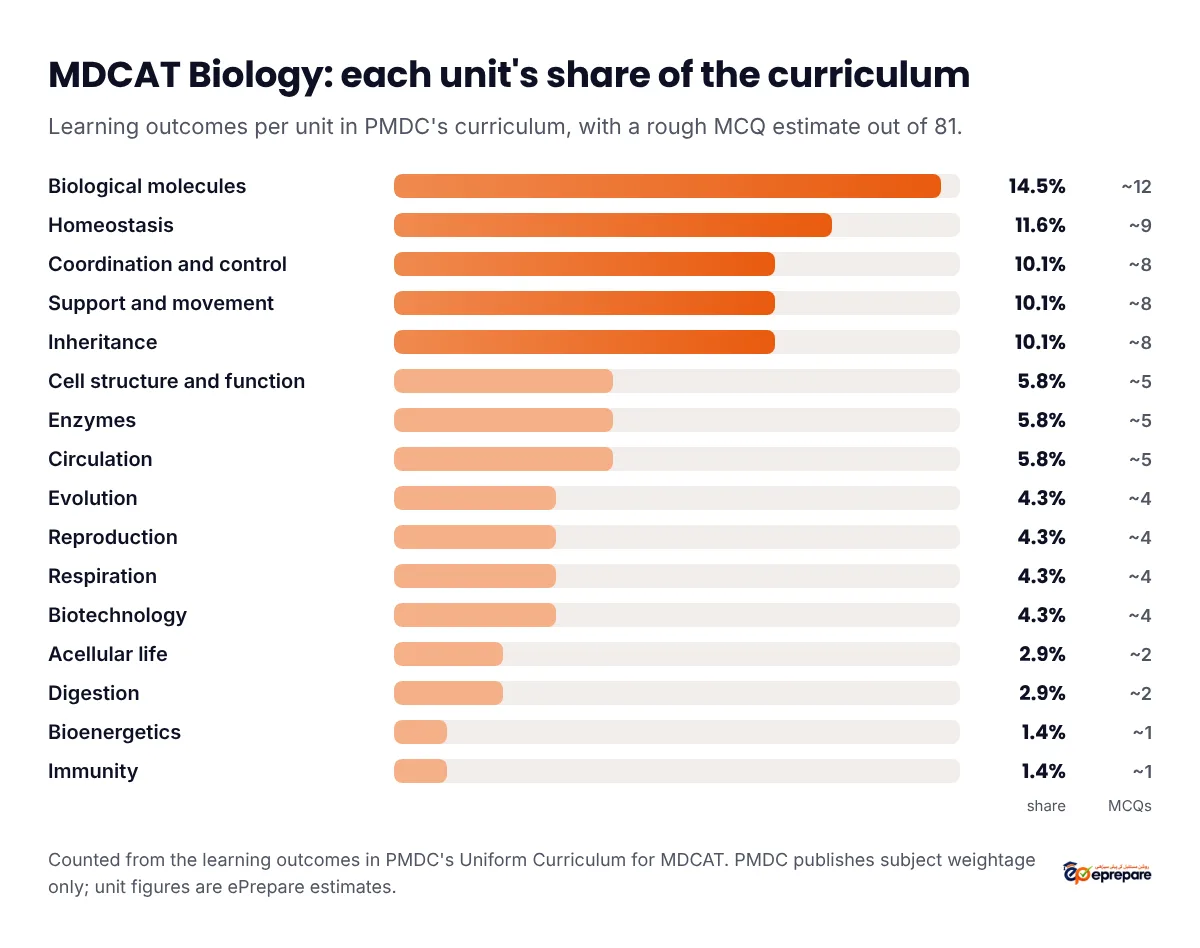
PMDC publishes only subject-level weightage, not how many questions come from each unit. A fair way to judge a unit's weight is how much of the official curriculum it takes up. We counted the learning outcomes PMDC lists for each Biology unit; the more outcomes, the more material there is for examiners to ask about.
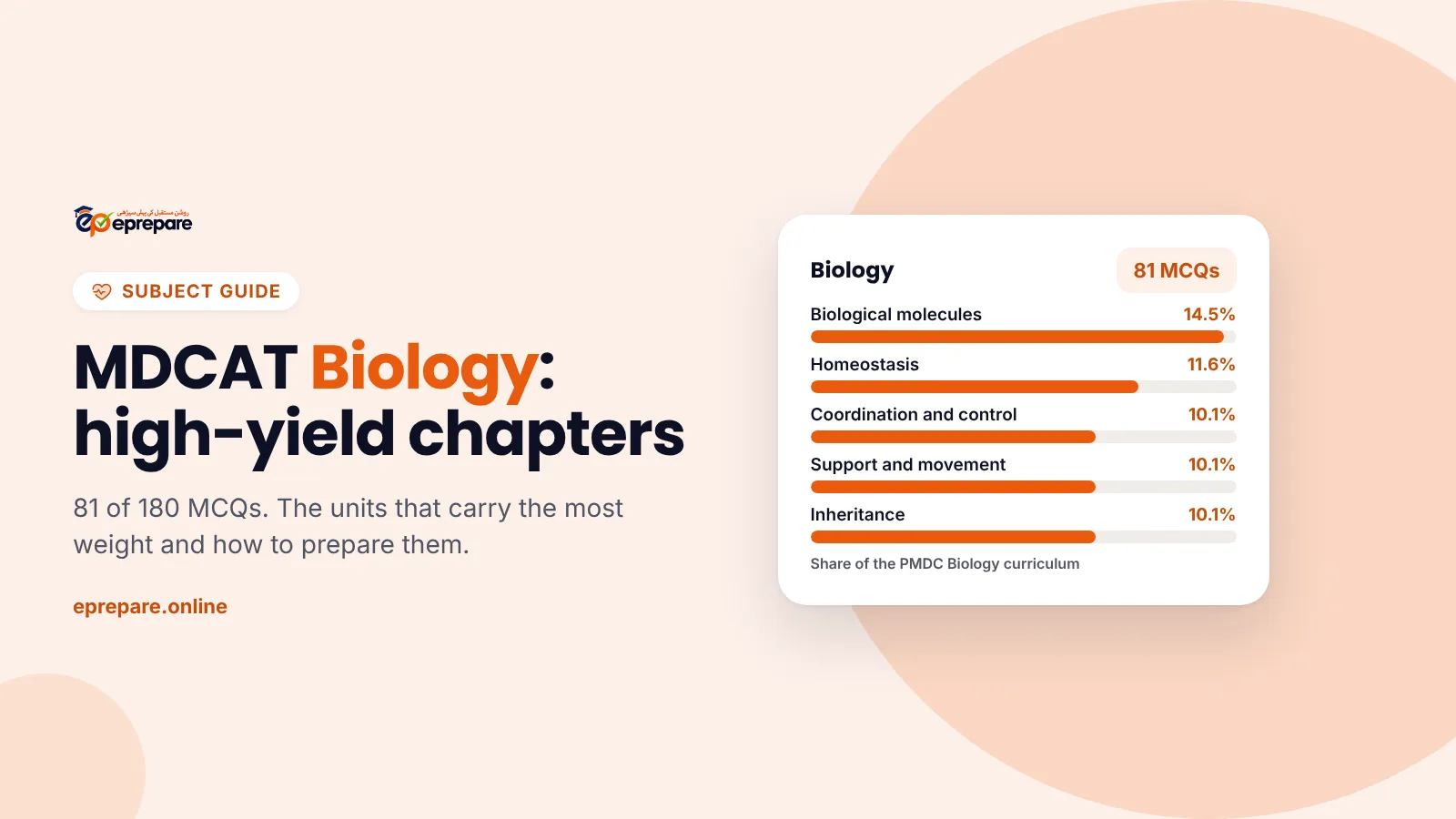
On that basis, these five units deserve the most time:
| Unit | Share of curriculum | Focus on |
|---|---|---|
| Biological molecules | 14.5% | Properties of water, carbohydrates, amino acids and protein structure, lipids, RNA, conjugated molecules, the DNA double helix |
| Homeostasis | 11.6% | Kidney and nephron structure, filtration, reabsorption and secretion, osmoregulation, kidney stones and failure, thermoregulation |
| Coordination and control | 10.1% | Receptors, neuron structure, nerve impulse, reflex arc, parts of the brain and their functions |
| Support and movement | 10.1% | Cartilage and bone, the three muscle types, muscle ultrastructure, sliding filament contraction, joints, arthritis |
| Inheritance | 10.1% | Mendel's laws, independent assortment, linkage and crossing over, sex-linkage, haemophilia crosses |
High-yield does not mean "skip the rest". Small units such as Immunity, Bioenergetics and Digestion have only a few outcomes each, which makes them quick to finish. A unit with two outcomes can still give you two questions, and it might take an evening to cover.
For every unit and its estimated share of questions in all three science subjects, see MDCAT chapter-wise weightage.
What PMDC's Biology curriculum does and does not include
The PMDC curriculum is focused on human biology, and it is narrower than the FSc textbooks in places that surprise students:
- Bioenergetics has a single learning outcome: cellular respiration of proteins and fats compared with glucose. Photosynthesis, the Calvin cycle and the Krebs cycle are not listed.
- Cell division (mitosis and meiosis), ecology, and DNA replication and protein synthesis do not appear anywhere in the PMDC Biology curriculum, although they are in the textbooks.
- Chromosomes appear only as structure, chemical composition and function, inside Cell structure.
- Plant biology, animal diversity and bacteria are not PMDC units.
- Biotechnology is short and practical: vaccines, DNA and RNA probes, monoclonal antibodies and products for treatment.
Give the units PMDC lists your first priority, and check PMDC's notice each year in case anything changes. We update our guides on the same pages when it does. The unit-by-unit list is in the MDCAT syllabus explained.
If you are also taking NUMS MDCAT
NUMS Biology overlaps with PMDC but is not the same. Our line-by-line comparison found:
- Only in PMDC: the whole Homeostasis unit (kidney, osmoregulation, thermoregulation, excretion), the whole Biotechnology unit, the DNA double helix and genes, chromosomes, and the effect of smoking.
- Only in NUMS: photosynthesis and the respiration pathways, bacteria, animal phyla, plant transport and carnivorous plants, spinal cord, synapse, hormones and endocrine glands, surfactant, Neo-Darwinism, multiple alleles and probability in genetics.
- Identical in both: Enzymes and Reproduction.
NUMS also cut Biology from 65 to 55 of its 150 MCQs in 2026. See the full table in PMDC MDCAT vs NUMS MDCAT.
How to prepare Biology so it sticks
1. Read the textbook line by line, with MCQs straight after
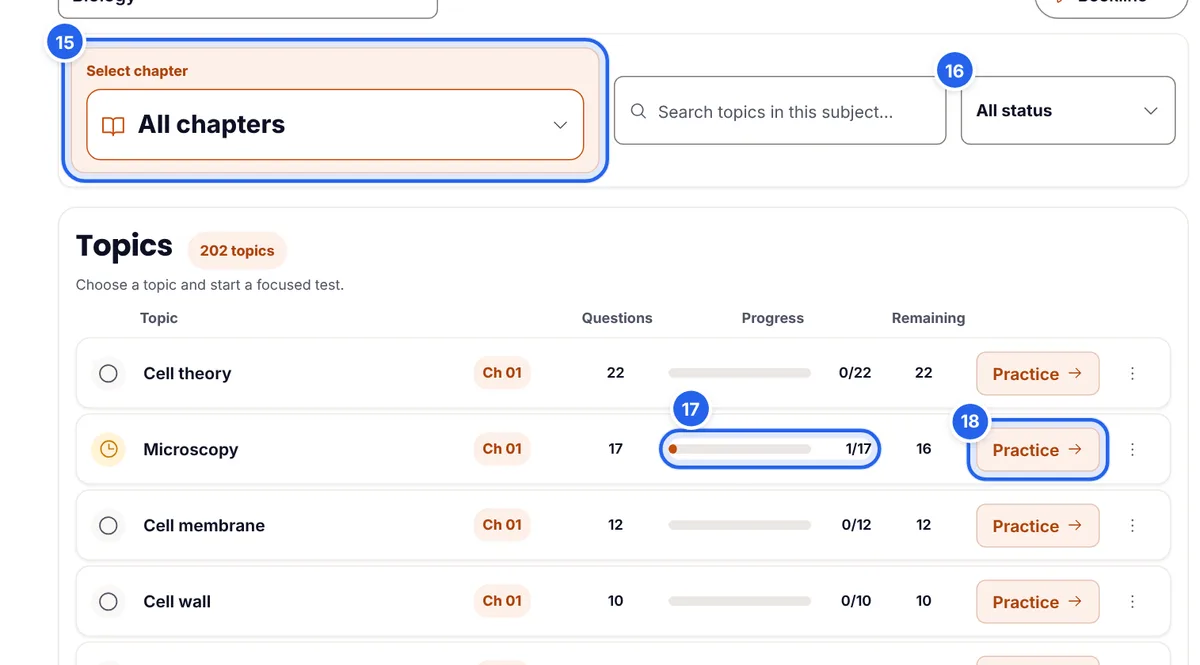
Biology questions are built from textbook lines: a number, an exception, a named scientist, a "which of these is not" list. Read one topic carefully, then solve MCQs on that same topic the same day. On ePrepare, Bookline MCQs follow the KPK textbooks topic by topic, so you test exactly what you just read.
2. Learn diagrams as questions, not pictures
The nephron, the neuron, the sarcomere, the heart and the brain come up again and again. For each diagram, ask yourself what each part does, what happens if it fails, and how it compares with its neighbour. That is how examiners turn a diagram into an MCQ.
3. Make comparison tables
Many Biology MCQs are about differences: prokaryotic and eukaryotic cells, smooth, cardiac and skeletal muscle, arteries, veins and capillaries, Lamarck and Darwin. Write each comparison as a small table in your notes. They are also perfect for last-week revision.
4. Revise before you forget
Biology facts fade fast. Revisit each unit a few days after you study it, again after a week or two, and again before your full-length papers. ePrepare's Wrong MCQs and smart revision bring back the questions you missed on a schedule, so you are not relying on memory to decide what to revise.
"The revision MCQs reminded me that one visit to a chapter isn't enough. Things I thought I remembered would disappear after a week. ePrepare made it easy to catch that and revise those points again."
Gul E Nayab, 174 in MDCAT 2026
Common Biology traps
- Numbers and exceptions. Normal values, counts and "except" statements are favourite targets. Underline them while reading.
- Similar terms. Filtration and secretion, linkage and crossing over, receptor and effector. Know exactly where one ends and the next begins.
- "Not" and "except" questions. Read the stem twice. Most careless Biology mistakes come from missing one word.
- Studying only the high-yield units. A missed small unit costs the same marks as a missed big one.
How much time to give Biology
A simple rule: give Biology close to half of your study time, matching its share of the paper. On a six-hour study day that is about two and a half to three hours, split between new reading, MCQs and revision. In the exam, plan roughly 65 minutes for the 81 Biology MCQs, so you have time left for Physics. Our guide to preparing for MDCAT at home shows a full sample day.
Frequently asked questions
How many Biology MCQs are in MDCAT?
81 out of 180, which is 45% of the paper.
Which Biology chapters are most important for MDCAT?
By share of the official curriculum: Biological molecules, Homeostasis, Coordination and control, Support and movement, and Inheritance. Together they make up more than half of the Biology curriculum.
Is photosynthesis included in MDCAT Biology?
Not in the current PMDC curriculum, whose Bioenergetics unit covers respiration of proteins and fats. The NUMS syllabus does include photosynthesis.
Are cell division and ecology in the MDCAT syllabus?
No. Mitosis, meiosis, ecology, DNA replication and protein synthesis are not listed in PMDC's Biology curriculum or in the NUMS 2026 syllabus.
Should I study from the textbook or from notes?
The textbook first. MDCAT Biology questions come from textbook lines. Use notes and comparison tables for revision.
How can I score 75+ in Biology?
Cover every unit, read line by line, solve topic-wise MCQs the same day, revise on a schedule, and practise full-length papers so your Biology accuracy holds up under time pressure.
Make Biology your strongest subject
Biology rewards steady, careful work more than any other subject. Start with the high-yield units, but finish all sixteen. Register on ePrepare for Biology lectures, Bookline MCQs that follow the KPK textbooks line by line, past papers and full-length papers that show your Biology score as you improve.