Students lose months to one avoidable problem: studying things that are not in the MDCAT, or skipping things that are. The fix is simple. Read the official syllabus once, properly, and keep it beside you for the whole year.
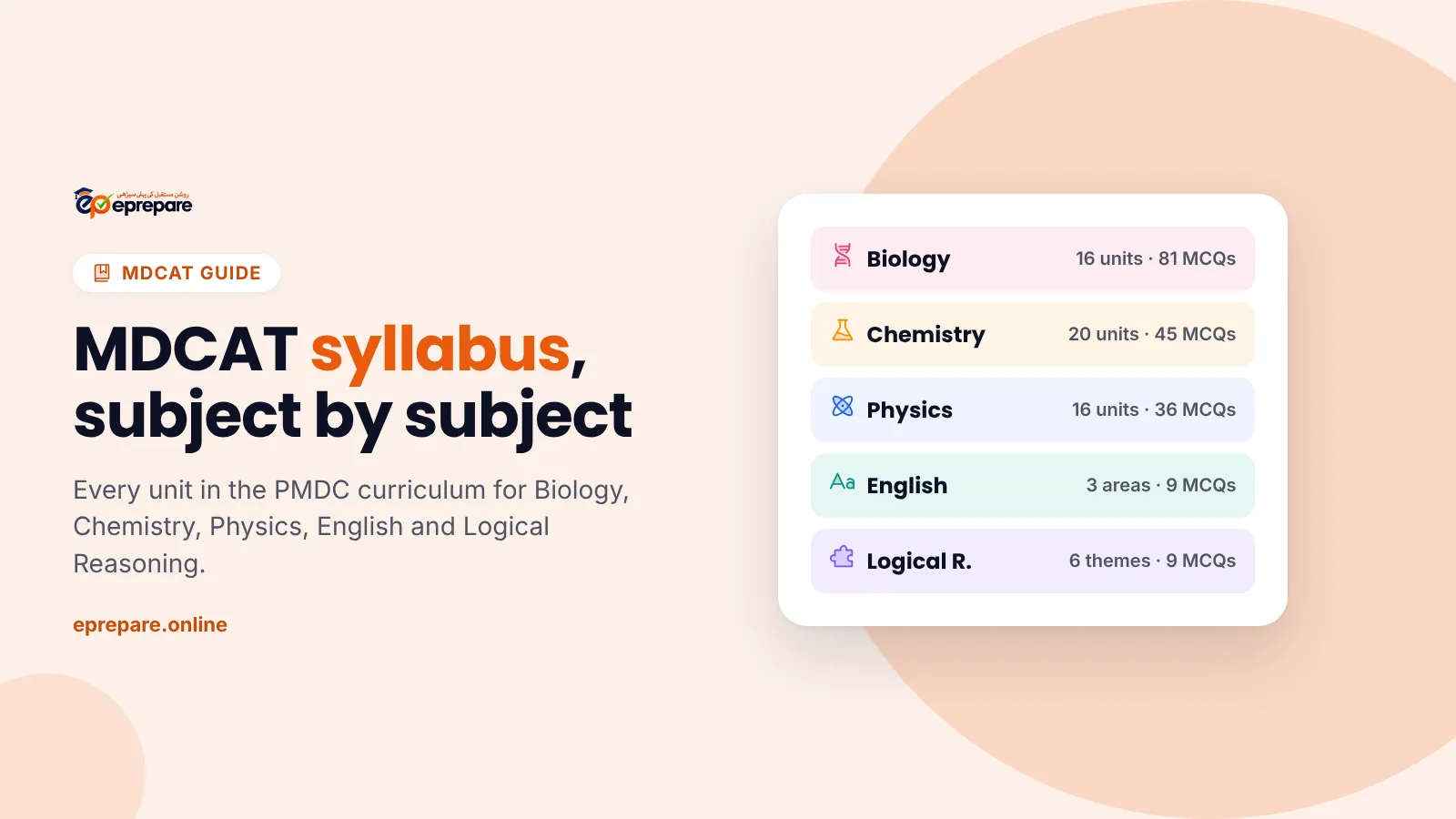
The MDCAT syllabus is set by the Pakistan Medical and Dental Council (PMDC) as a single national curriculum for Biology, Chemistry, Physics, English and Logical Reasoning. Below, every unit is explained in plain words with what you are expected to know, so you can plan your preparation around what actually gets tested.
One syllabus for 2025, 2026 and 2027: MDCAT 2025, 2026 and 2027 follow the same PMDC curriculum. If PMDC announces any change, we will update this page. You can read the official document as published on KMU's site: PMDC MDCAT curriculum (PDF).
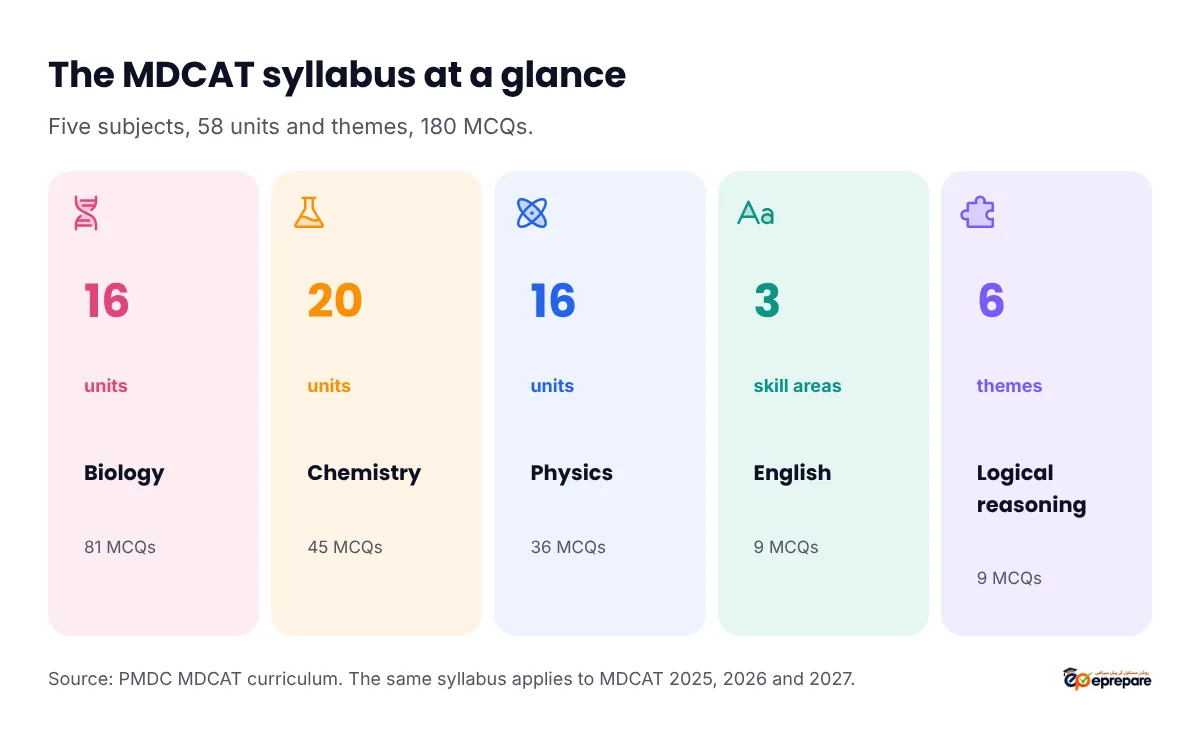
How the syllabus is weighted
| Subject | Units | MCQs | Weightage |
|---|---|---|---|
| Biology | 16 | 81 | 45% |
| Chemistry | 20 | 45 | 25% |
| Physics | 16 | 36 | 20% |
| English | 3 skill areas | 9 | 5% |
| Logical Reasoning | 6 themes | 9 | 5% |
For the time, marking and difficulty mix, see the MDCAT paper pattern.
Biology (16 units, 81 MCQs)
Biology is the biggest section, and its questions stay close to textbook lines, diagrams and definitions.
| Unit | What you need to know |
|---|---|
| 1. Acellular life | Classifying viruses by structure, strands, disease and host; AIDS and HIV: symptoms, transmission and cause |
| 2. Bioenergetics | Cellular respiration of proteins and fats, compared with glucose |
| 3. Biological molecules | Water and its properties, carbohydrates, proteins and amino acids, lipids, RNA, conjugated molecules, the Watson–Crick DNA double helix, genes |
| 4. Cell structure and function | Animal vs plant cells, prokaryotes vs eukaryotes, nucleus, ER, Golgi apparatus, mitochondria, chromosomes |
| 5. Coordination and control | Receptors, neuron structure, nerve impulse, reflexes and the reflex arc, parts of the brain and their functions |
| 6. Enzymes | Characteristics, mechanism of action, effect of temperature, pH and concentration, inhibitors |
| 7. Evolution | Origin of life, Lamarckism, Darwinism and natural selection |
| 8. Reproduction | Male and female reproductive systems and hormones, the menstrual cycle, common sexually transmitted diseases |
| 9. Support and movement | Cartilage and bone, smooth, cardiac and skeletal muscle, muscle ultrastructure and contraction, joints, arthritis |
| 10. Inheritance | Mendel's laws, independent assortment, gene linkage and crossing over, sex-linkage, haemophilia |
| 11. Circulation | Structure of the heart, cardiac cycle, arteries, veins and capillaries, the lymphatic system |
| 12. Immunity | Specific defence mechanisms and their importance |
| 13. Respiration | The respiratory system, gas exchange in the lungs, effects of smoking |
| 14. Digestion | Parts of the digestive system and associated glands, and their functions |
| 15. Homeostasis | Kidney structure and function, filtration, reabsorption and secretion, osmoregulation, kidney stones and failure, thermoregulation, excretion |
| 16. Biotechnology | Vaccines, DNA/RNA probes, monoclonal antibodies and products for treatment |
Where students lose marks: homeostasis (kidney), coordination and control, and inheritance usually produce the trickiest questions. Biological molecules and cell structure are full of small facts that are easy to forget.
Chemistry (20 units, 45 MCQs)
Chemistry mixes concepts, reactions and short calculations across physical, inorganic and organic chemistry.
| Unit | What you need to know |
|---|---|
| 1. Fundamental concepts | Moles, Avogadro's number, stoichiometric calculations, limiting and excess reactants, theoretical, actual and percentage yield |
| 2. Atomic structure | Discovery of the proton, Planck's quantum theory, orbitals and their shapes, quantum numbers, hydrogen spectrum, electronic configuration (Aufbau, Pauli, Hund) |
| 3. Gases | Kinetic molecular theory, STP, Boyle's and Charles's laws, absolute zero, the ideal gas equation and units of R, real vs ideal gases |
| 4. Liquids | Properties from kinetic theory, evaporation, vapour pressure, boiling point, hydrogen bonding, anomalous behaviour of water |
| 5. Solids | Crystalline solids, ionic and molecular crystals, crystal lattice, lattice energy |
| 6. Chemical equilibrium | Reversible reactions, Le Chatelier's principle, solubility product, common ion effect, buffers, the Haber process |
| 7. Reaction kinetics | Rate of reaction, rate law and order, activation energy and activated complex, the rate constant |
| 8. Thermochemistry | Exothermic and endothermic reactions, system and state functions, internal energy, the first law, Hess's law, enthalpy |
| 9. Electrochemistry | Redox reactions, oxidation numbers, balancing redox equations, electrodes and the standard hydrogen electrode |
| 10. Chemical bonding | VSEPR theory, sigma and pi bonds, hybridisation, dipole moment and polarity, bond energy |
| 11. s- and p-block elements | Periodic trends, blocks of the periodic table, reactions of Group I, II and IV elements |
| 12. Transition elements | Electronic structure of d-block elements and their ions |
| 13. Fundamentals of organic chemistry | Classification of organic compounds, functional groups, isomerism |
| 14. Hydrocarbons | Alkanes, alkenes, alkynes and benzene: naming, structure, free-radical and electrophilic substitution, addition reactions, resonance |
| 15. Alkyl halides | Naming, structure and reactivity, nucleophilic substitution and elimination |
| 16. Alcohols and phenols | Naming, structure, reactivity, ethers and esters, alcohol vs phenol |
| 17. Aldehydes and ketones | Preparation, reactivity, nucleophilic addition, reduction and oxidation |
| 18. Carboxylic acids | Naming, preparation, reactivity and conversion to acid derivatives |
| 19. Macromolecules | Proteins: classification, structure and function, enzymes as biocatalysts |
| 20. Industrial chemistry | Adhesives, dyes, condensation and addition polymers |
Where students lose marks: organic reaction mechanisms, equilibrium and stoichiometry calculations. Practise calculations with a timer, since they eat time on exam day.
Physics (16 units, 36 MCQs)
Physics carries the fewest science marks but takes the most time per question, because of numericals.
| Unit | What you need to know |
|---|---|
| 1. Vectors and equilibrium | Adding vectors by rectangular components, scalar and vector products |
| 2. Force and motion | Displacement, velocity, acceleration, graphs, projectile motion (height, range, time of flight), Newton's laws, momentum and collisions |
| 3. Work and energy | Work, kinetic and potential energy, power, energy losses and efficiency |
| 4. Rotational and circular motion | Angular displacement and velocity, radians, relations between linear and angular quantities |
| 5. Fluid dynamics | Terminal velocity, fluid drag, laminar and turbulent flow, equation of continuity, Bernoulli's equation and its uses |
| 6. Waves | Wave properties, v = fλ, transverse and longitudinal waves, speed of sound and Laplace's correction, interference, stationary waves, organ pipes, simple harmonic motion |
| 7. Thermodynamics | Heat and thermal equilibrium, specific and molar specific heats, work in volume change, the first law, Cp − Cv = R |
| 8. Electrostatics | Coulomb's law, electric field and field lines, potential and potential energy, charging and discharging a capacitor |
| 9. Current electricity | Ohm's law, resistivity and temperature, internal resistance, maximum power transfer |
| 10. Electromagnetism | Magnetic flux and flux density, force on and path of a charged particle in a magnetic field |
| 11. Electromagnetic induction | Faraday's and Lenz's laws, transformers |
| 12. Alternating current | Phase, AC through resistors, capacitors and inductors, the electromagnetic spectrum |
| 13. Electronics | Rectification with diodes, the PN junction and biasing |
| 14. Dawn of modern physics | The photon model of light |
| 15. Atomic spectra | Line spectra |
| 16. Nuclear physics | The nucleus, radioactive decay, half-life, biological and medical uses of radiation |
Where students lose marks: projectile motion, waves and electrostatics, mostly through slow working rather than not knowing. Learn the key formulas cold and practise numericals daily.
English (3 skill areas, 9 MCQs)
| Skill area | What it covers |
|---|---|
| Reading and thinking skills | Scanning a passage to answer short questions, meaning from context, figurative language |
| Formal and lexical aspects of language | Vocabulary from context, synonyms, pronoun-antecedent agreement, tenses, infinitives and gerunds, adverbs, prepositions, transitional devices, punctuation, sentence structure, active and passive voice, direct and indirect speech |
| Writing skills | Finding errors of usage and style, faulty sentence structure, subject-verb agreement, spelling |
Logical Reasoning (6 themes, 9 MCQs)
| Theme | What you will be asked |
|---|---|
| Critical thinking | Deciding whether statements are true or false and giving reasons |
| Letter and symbol series | Finding the rule in a series of letters, numbers or symbols |
| Logical deductions | Drawing the most accurate conclusion from a short passage |
| Logical problems | Puzzles solved by combining several pieces of information |
| Course of action | Choosing which suggested action logically follows from a situation |
| Cause and effect | Identifying causes, effects and false reasoning |
No textbook covers Logical Reasoning, so the only preparation is practice with a wide variety of questions.
How to use the syllabus while you study
- Print or save this list and tick units as you finish learning and practising them.
- Study from your textbook, using the syllabus to know which parts of each chapter matter most.
- Test each unit straight after studying it. On ePrepare, MCQs are organised by subject, chapter and topic so you can practise exactly the unit you just covered.
- Weight your time like the paper: about 45% Biology, 25% Chemistry, 20% Physics, 10% English and Logical Reasoning.
Ready to turn the syllabus into a timetable? Read how to prepare for MDCAT at home.
Does the syllabus follow the KPK textbooks?
The PMDC curriculum is national, so it is written as topics and learning outcomes rather than textbook chapters. Every topic is covered in the FSc textbooks, though sometimes spread across more than one chapter. Our MDCAT syllabus page lists chapters as they appear in the KPK textbooks, and Bookline MCQs follow those books line by line.
Frequently asked questions
Is the MDCAT 2027 syllabus the same as 2026?
Yes. MDCAT 2025, 2026 and 2027 follow the same PMDC curriculum. We will update this page if PMDC announces a change.
Who sets the MDCAT syllabus?
The Pakistan Medical and Dental Council (PMDC), as one national curriculum for all provinces.
How many units are in the MDCAT syllabus?
Biology has 16 units, Chemistry 20 and Physics 16. English has 3 skill areas and Logical Reasoning 6 themes.
Which subject has the most weight?
Biology, with 81 of the 180 MCQs (45%).
Where can I download the official syllabus?
The PMDC curriculum is available as a PDF; a copy is published on KMU's admission test site, linked at the top of this page.
Is Logical Reasoning part of the syllabus?
Yes, 9 MCQs across six themes: critical thinking, series, deductions, logical problems, course of action, and cause and effect.
Cover every unit, then test every unit
The syllabus tells you what to study; practice tells you whether you have learned it. On ePrepare, lectures, notes and MCQs follow the same subjects and topics, so you can learn a unit and test it the same day. Register for MDCAT and start with the first unit on your list.