Your MDCAT score alone does not decide your medical college. Admissions are made on aggregate: a single percentage that combines your Matric, FSc and MDCAT marks. Two students with the same MDCAT score can end up at different colleges because of their board marks, and a few MDCAT marks can lift you past hundreds of other applicants.
This guide explains the MDCAT aggregate formula used for MBBS and BDS admissions in Khyber Pakhtunkhwa, shows exactly how to calculate it with worked examples, and explains what it means for how you prepare.
The MDCAT aggregate formula
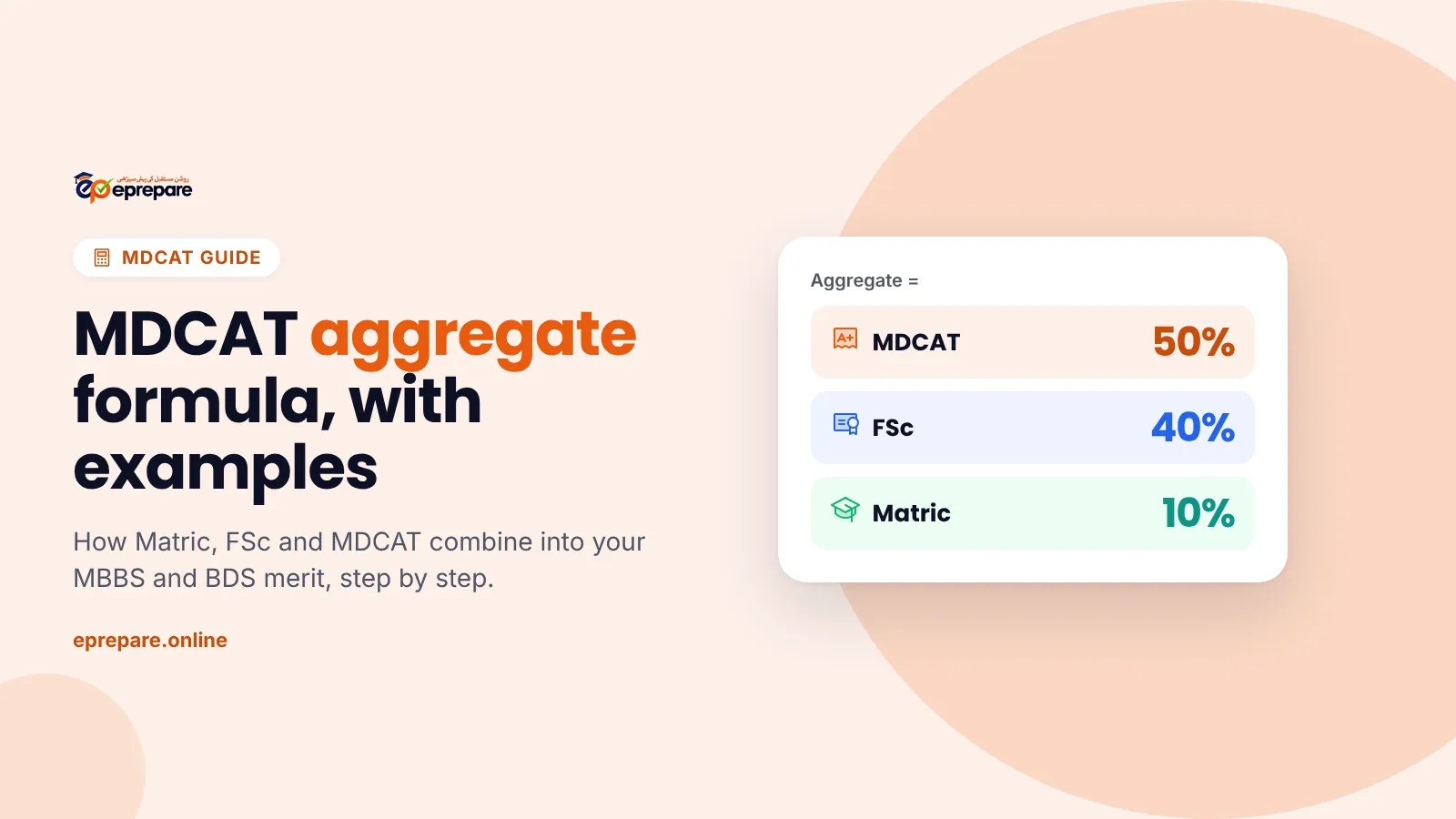
For MBBS and BDS admissions in Khyber Pakhtunkhwa, Khyber Medical University (KMU) calculates aggregate with these weights, for both public colleges (cas.kmu.edu.pk) and private colleges (caspr.kmu.edu.pk):
- MDCAT: 50%
- FSc (Pre-Medical) or HSSC equivalent: 40%
- Matric (SSC) or equivalent: 10%
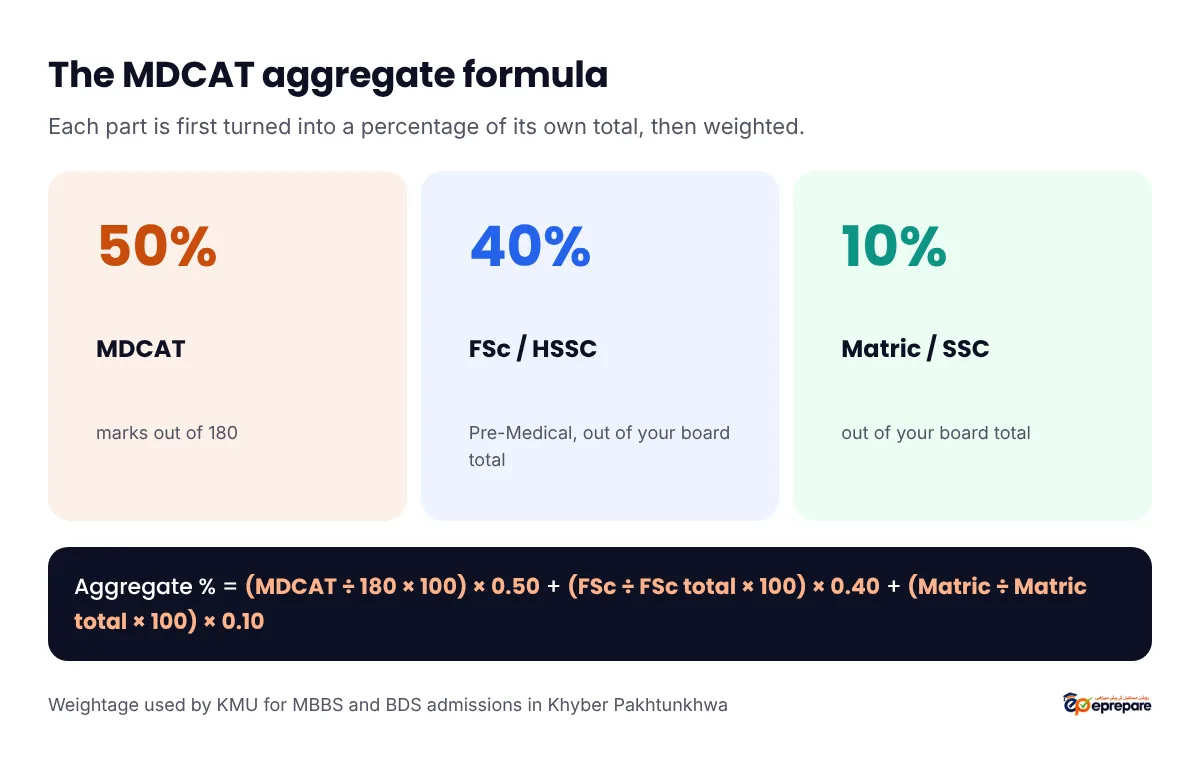
Written out in full:
Aggregate % = (MDCAT marks ÷ 180 × 100) × 0.50 + (FSc marks ÷ FSc total × 100) × 0.40 + (Matric marks ÷ Matric total × 100) × 0.10
MDCAT is out of 180 (the current 180-MCQ paper). For Matric and FSc, use the total printed on your own result card: totals differ by board and year, for example 1100 or 1200.
How to calculate your aggregate, step by step
- Turn each result into a percentage. Divide your marks by the total and multiply by 100.
- Apply the weights. Multiply the MDCAT percentage by 0.50, the FSc percentage by 0.40 and the Matric percentage by 0.10.
- Add the three numbers. The total is your aggregate percentage.
Example 1: a strong all-round student
Ayesha has Matric 1050/1100, FSc 1020/1100 and MDCAT 170/180.
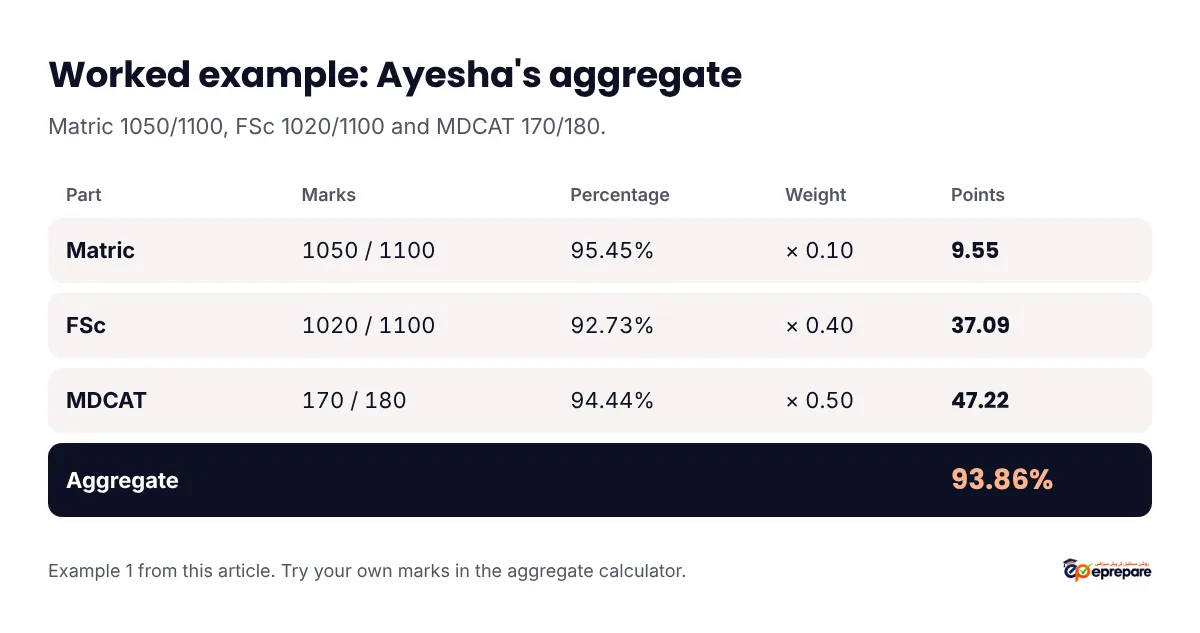
- Matric: 1050 ÷ 1100 × 100 = 95.45% → × 0.10 = 9.55
- FSc: 1020 ÷ 1100 × 100 = 92.73% → × 0.40 = 37.09
- MDCAT: 170 ÷ 180 × 100 = 94.44% → × 0.50 = 47.22
- Aggregate = 9.55 + 37.09 + 47.22 = 93.86%
Example 2: a board with a 1200 total
Bilal's Matric total is 1200. He has Matric 1120/1200, FSc 1000/1100 and MDCAT 160/180.
- Matric: 1120 ÷ 1200 × 100 = 93.33% → 9.33
- FSc: 1000 ÷ 1100 × 100 = 90.91% → 36.36
- MDCAT: 160 ÷ 180 × 100 = 88.89% → 44.44
- Aggregate = 90.14%
Always use your own board total. Using 1100 for a 1200 result would wrongly raise Bilal's Matric percentage above 100%.
Example 3: what MDCAT score do I need?
Your board marks are fixed once results are out, so the useful question becomes: what MDCAT score gets me to my target? Sana has Matric 1000/1100 (9.09 points) and FSc 990/1100 (36.00 points), 45.09 points in total. To reach:
| Target aggregate | MDCAT needed (out of 180) |
|---|---|
| 88% | 155 |
| 90% | 162 |
| 92% | 169 |
The method: subtract your Matric and FSc points from the target, divide by 0.50 to get the MDCAT percentage you need, then multiply by 1.8 to turn it into marks out of 180. Round up, since you cannot score a fraction of a mark.
Why MDCAT matters most
MDCAT carries half the aggregate, and each MDCAT mark is worth far more than a board mark:
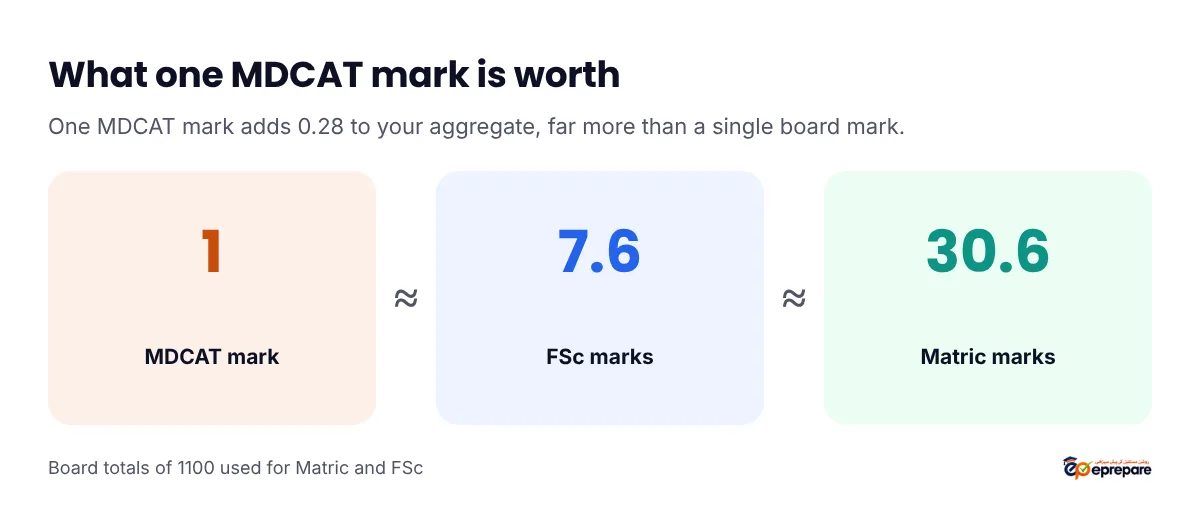
One MDCAT mark adds about 0.28 percentage points to your aggregate. One FSc mark (out of 1100) adds about 0.036, and one Matric mark about 0.009. That is why your Matric is already fixed by the time you start MDCAT preparation, your FSc is nearly fixed, and the one number you can still change a lot is MDCAT. Five extra correct MCQs on exam day can move you past many students who had better board results.
Use the aggregate calculator
You do not need to do this by hand. Our free MDCAT aggregate calculator does it instantly:
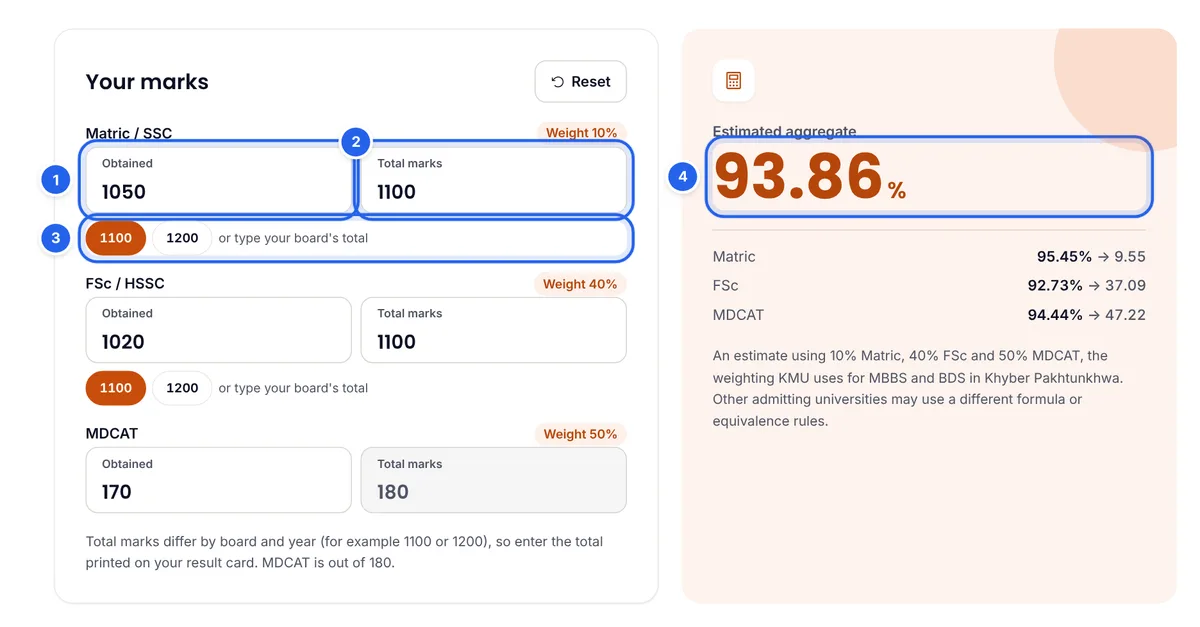
- Enter your obtained marks (1) for Matric and FSc.
- Enter the total marks (2) from your result card, or tap 1100 or 1200 (3).
- Enter your MDCAT score out of 180 (or the score you are aiming for).
- Read your estimated aggregate (4) and the points from each part.
Minimum eligibility in Khyber Pakhtunkhwa
Before aggregate even counts, you must meet KMU's minimums:
| Requirement | Public colleges | Private colleges |
|---|---|---|
| FSc (Pre-Medical) or equivalent | At least 65% | At least 60% |
| MDCAT for MBBS | At least 55% | At least 55% |
| MDCAT for BDS | At least 50% | At least 50% |
These are the figures on KMU's admission sites for the current session. Students with foreign qualifications also need an IBCC equivalence certificate. Rules can change from one session to the next, so always check cas.kmu.edu.pk (public) and caspr.kmu.edu.pk (private) when admissions open. Read more in MDCAT passing marks.
What aggregate do I need for a government college in KPK?
Closing merit is the aggregate of the last student admitted to a college. It changes every year with the number of seats, the number of applicants and, most of all, how hard that year's MDCAT paper was. Last year's figures are still the best guide to the level you are competing at.
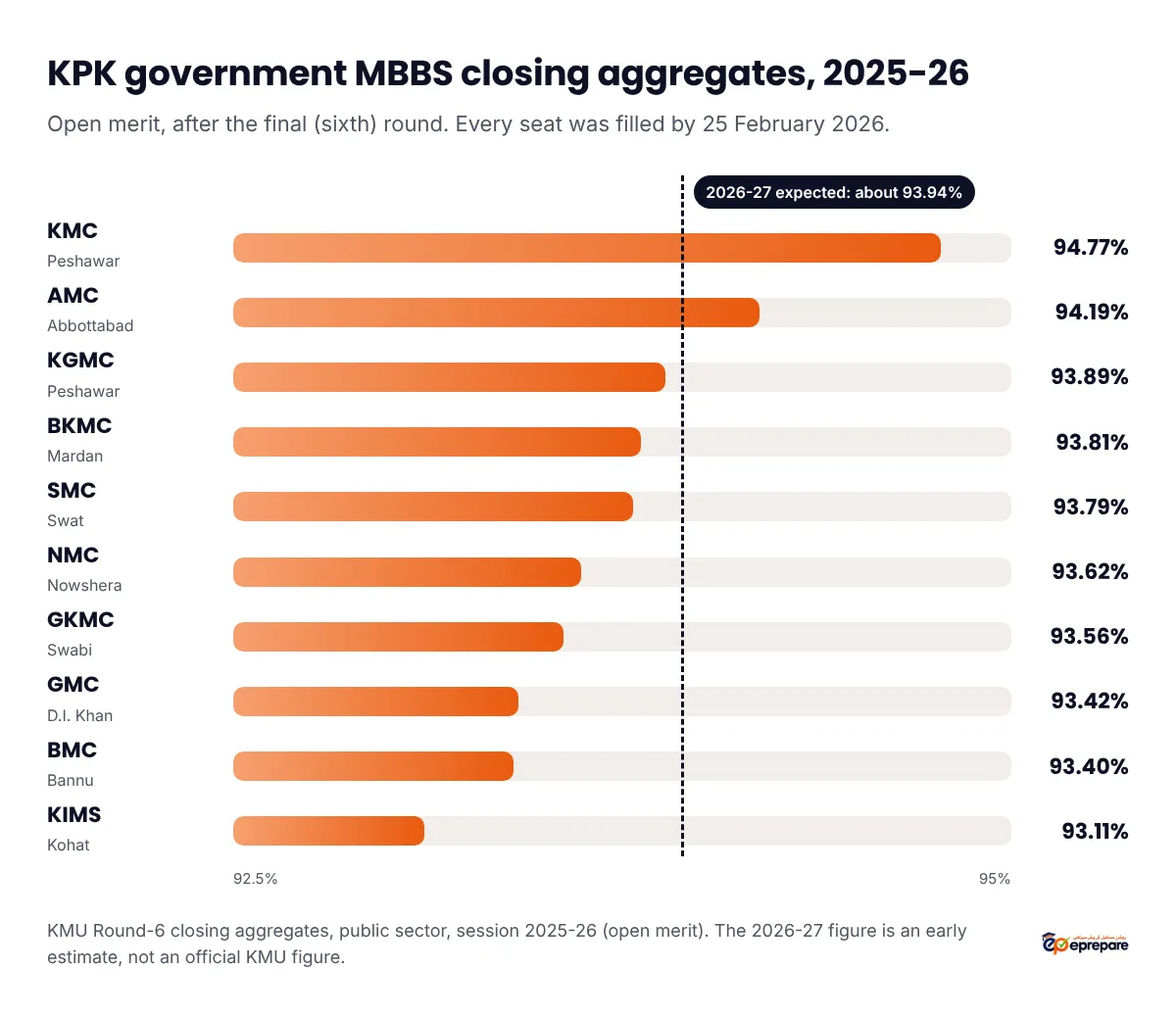
Closing aggregates for 2025-26
These are KMU's closing aggregates for public-sector colleges after the sixth and final round of admissions. Every open-merit and self-finance seat was filled by 25 February 2026.
| MBBS college | Open merit | Self-finance |
|---|---|---|
| KMC, Peshawar | 94.7727% | 93.2748% |
| AMC, Abbottabad | 94.1909% | 92.9313% |
| KGMC, Peshawar | 93.8899% | 92.9162% |
| BKMC, Mardan | 93.8111% | 93.0131% |
| SMC, Swat | 93.7859% | 92.9253% |
| NMC, Nowshera | 93.6182% | 92.8293% |
| GKMC, Swabi | 93.5626% | 92.8253% |
| GMC, D.I. Khan | 93.4152% | 92.6061% |
| BMC, Bannu | 93.4020% | 92.6343% |
| KIMS, Kohat | 93.1131% | 92.6283% |
| BDS college | Open merit | Self-finance |
|---|---|---|
| KCD, Peshawar | 93.0232% | 92.5788% |
| ADS, Abbottabad | 92.9717% | 92.5697% |
| BKDS, Mardan | 92.8748% | 92.4859% |
| SCD, Swat | 92.8030% | 92.4859% |
| KIDS, Kohat | 92.5535% | 92.3919% |
For scale: 832 open-merit and 117 self-finance MBBS seats, and 195 open-merit and 43 self-finance BDS seats, were filled in these colleges.
What to expect for 2026-27
Early estimates put the closing for the last government MBBS college in 2026-27 at around 93.94% or higher, well above last year's 93.11%. Treat that as a guide, not a promise. KMU's official merit lists decide, and the number rises when the paper is easier and falls when it is harder. We will add the official 2026-27 figures here once they are final.
What that means in MDCAT marks
Here is the MDCAT score three students with different board marks would need to reach last year's last MBBS closing (93.11%) and the expected 2026-27 closing (93.94%):
| Board marks (out of 1100) | For 93.11% | For 93.94% |
|---|---|---|
| Matric 1080, FSc 1050 | 163 | 166 |
| Matric 1050, FSc 1020 | 168 | 171 |
| Matric 1030, FSc 980 | 174 | 177 |
This is why we tell students to make 170+ their MDCAT target, and why FSc matters so much. With strong board marks, 166 can be enough. With weaker FSc marks, even 175 can fall short of an open-merit government seat. Private colleges usually close lower. Put your own marks into the calculator to see exactly where you stand.
How to use this in your preparation
- Set your MDCAT target from your aggregate goal. Use Example 3 or the calculator to turn "I want a government seat" into a score out of 180.
- Treat every MCQ as 0.28 aggregate points. Careless mistakes and blank answers are the most expensive marks you can lose.
- Track your predicted score. Your predicted MDCAT score on ePrepare shows how close you are to your target and which topics to fix next.
Frequently asked questions
What was the closing merit for MBBS in KPK last year?
In 2025-26, open-merit MBBS in government colleges closed between 94.77% (KMC, Peshawar) and 93.11% (KIMS, Kohat) after the final round. For 2026-27, the last government MBBS college is expected to close at around 93.94% or higher.
What is the MDCAT aggregate formula in KPK?
KMU uses 50% MDCAT, 40% FSc (Pre-Medical) and 10% Matric for MBBS and BDS admissions.
Is MDCAT out of 180 or 200 for the aggregate?
Out of 180, because the current MDCAT paper has 180 MCQs. Older papers had 200 MCQs, so older calculators may use 200.
My board's total is 1200, not 1100. What do I do?
Use your own board's total. The formula works on percentages, so the total must match your result card.
Which matters more, FSc or MDCAT?
MDCAT. It carries 50% of the aggregate and one MDCAT mark is worth about 7.6 FSc marks.
What are the minimum marks to apply?
For KMU admissions: at least 65% in FSc for public colleges or 60% for private colleges, and at least 55% in MDCAT for MBBS or 50% for BDS.
Can I use an older MDCAT result?
KMU's current admission sites accept MDCAT 2024, 2025 and 2026 results. Check the notice for your session, since this can change.
Turn your target into a plan
Once you know the MDCAT score you need, the rest is preparation. Follow our guide to preparing for MDCAT at home, and when you are ready, register on ePrepare for lectures, Bookline MCQs, past papers and full-length papers that show your predicted score as you go.