

Before you plan a single study day, you should know exactly what the MDCAT paper looks like: how many MCQs, how much time, how many questions from each subject and how hard they are. Every good preparation decision, from how many hours you give Biology to how fast you work in the exam hall, comes from these numbers.
This guide explains the current MDCAT paper pattern set by the Pakistan Medical and Dental Council (PMDC), what each section tests, and how to use the pattern to plan your preparation and your three hours on exam day.
Same pattern for 2026 and 2027: MDCAT 2026 and MDCAT 2027 follow the same paper pattern. If PMDC announces any change, we will update this page straight away.
MDCAT paper pattern at a glance
| Feature | MDCAT |
|---|---|
| Total questions | 180 MCQs |
| Total marks | 180 (one mark per MCQ) |
| Time | 3 hours |
| Format | Paper-based MCQs |
| Negative marking | None |
| Minimum to qualify | 55% for MBBS, 50% for BDS |
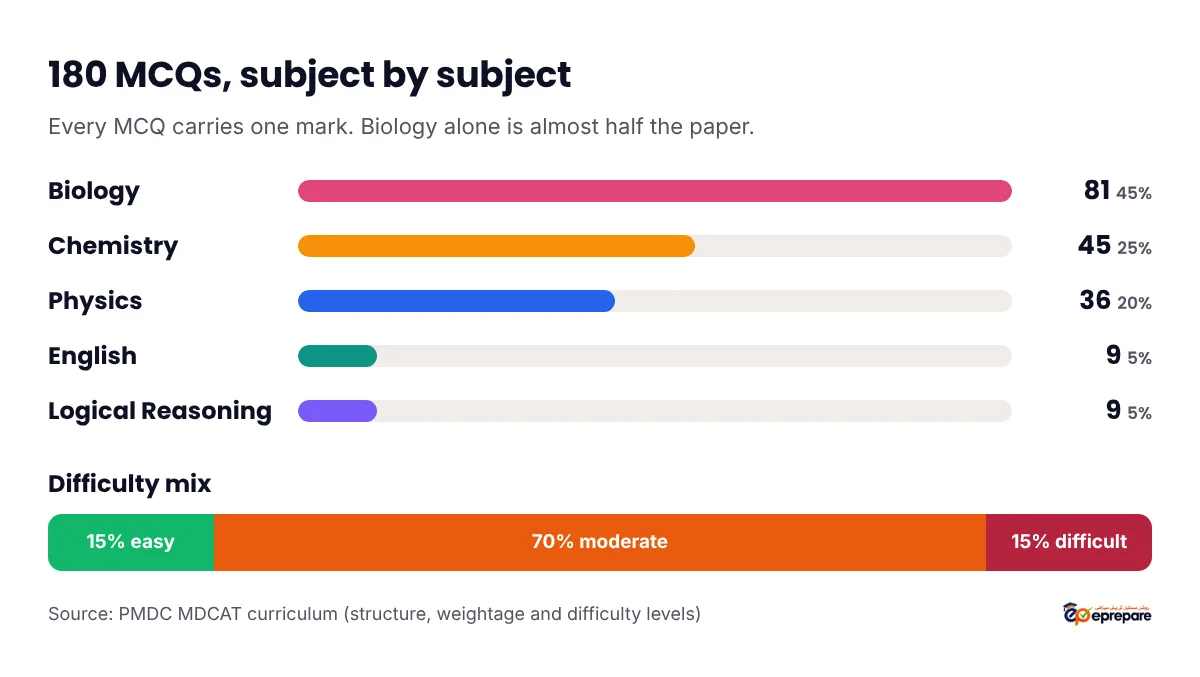
| Difficulty | 15% easy, 70% moderate, 15% difficult |
How many MCQs from each subject?
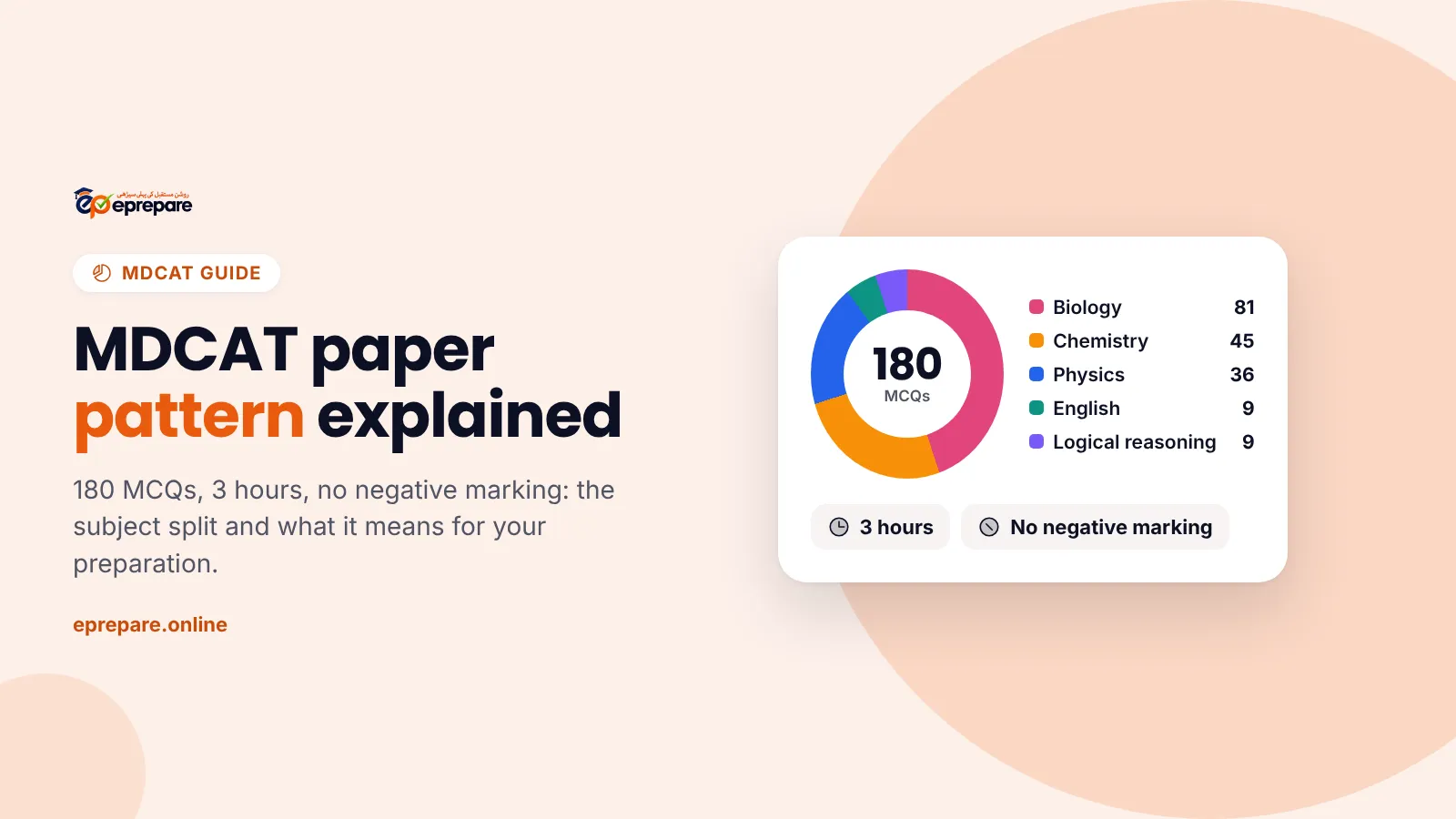
The 180 MCQs are split across five subjects. Biology alone carries 81 marks, almost half the paper.
| Subject | MCQs | Weightage |
|---|---|---|
| Biology | 81 | 45% |
| Chemistry | 45 | 25% |
| Physics | 36 | 20% |
| English | 9 | 5% |
| Logical Reasoning | 9 | 5% |
| Total | 180 | 100% |
What each section tests
Biology (81 MCQs)
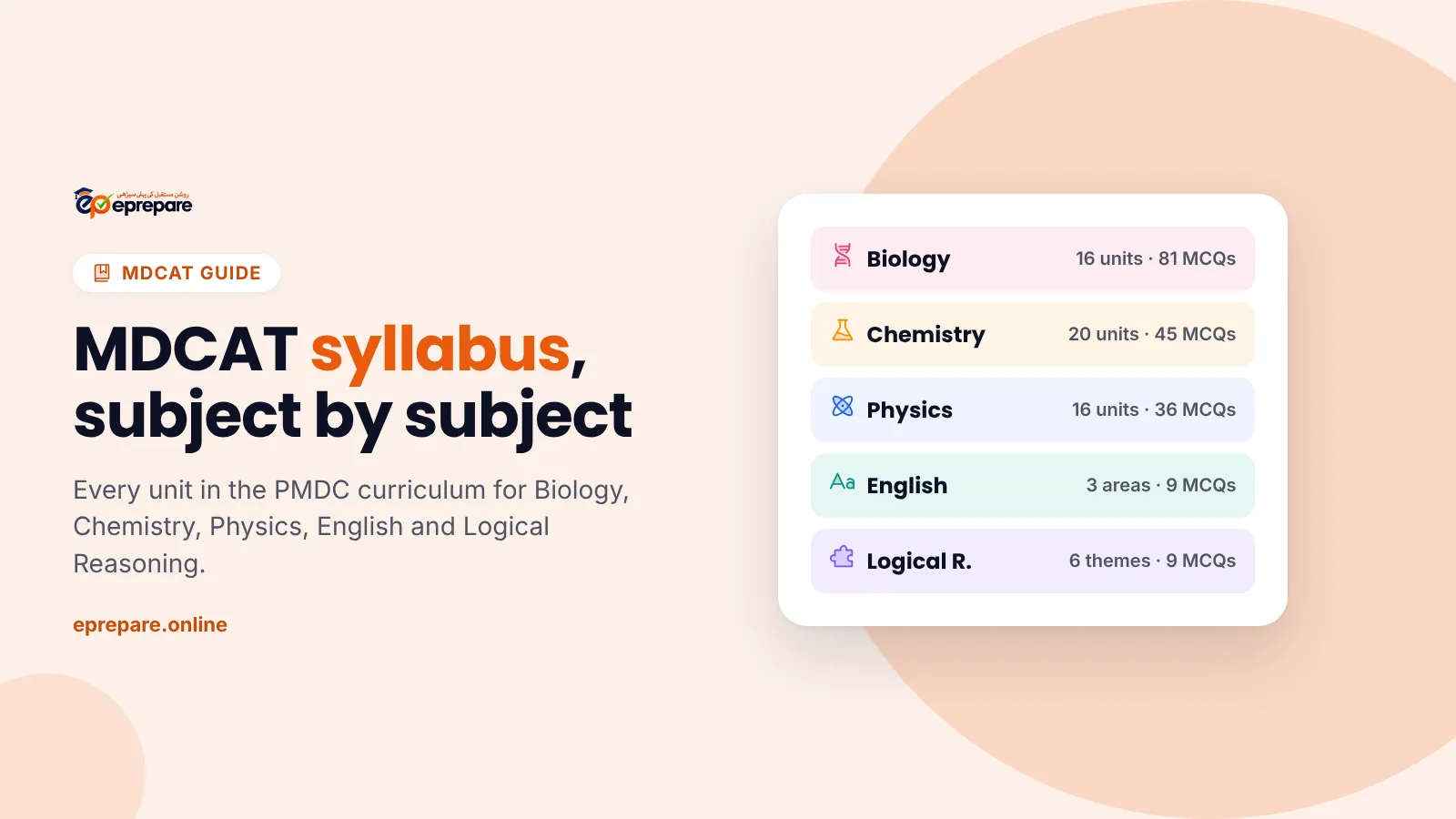
Sixteen units, from acellular life and biological molecules to circulation, immunity, homeostasis, inheritance and biotechnology. Questions are mostly concept and recall based, closely tied to textbook lines, diagrams and definitions.
Chemistry (45 MCQs)
Twenty units across physical, inorganic and organic chemistry: stoichiometry, atomic structure, gases, equilibrium, kinetics, thermochemistry, electrochemistry, bonding, s- and p-block elements, and organic chemistry from hydrocarbons to carboxylic acids. Expect a mix of concepts, reactions and short calculations.
Physics (36 MCQs)
Sixteen units including vectors, force and motion, work and energy, fluid dynamics, waves, thermodynamics, electrostatics, current electricity, electromagnetism, electronics and nuclear physics. Physics has the most numericals, so it needs the most time per question.
English (9 MCQs)
Reading and vocabulary in context, and grammar and usage: tenses, prepositions, subject-verb agreement, active and passive voice, direct and indirect speech, punctuation and sentence errors.
Logical Reasoning (9 MCQs)
Six themes: critical thinking, letter and symbol series, logical deductions, logical problems (puzzles), course of action, and cause and effect. No textbook covers it, which is why practice matters more here than anywhere else.
For every unit and learning outcome, read our guide to the MDCAT syllabus, subject by subject.
Is there negative marking in MDCAT?
No. A wrong answer and a blank answer both score zero. This has one simple consequence: never leave an MCQ blank. If you cannot work out an answer, rule out what you can and choose the best remaining option.
How hard is the paper?
PMDC sets the paper at 15% easy, 70% moderate and 15% difficult questions. In practice this means:
- About 27 easy questions that almost every prepared student gets right. Missing them costs you more than anything else.
- About 126 moderate questions. This is where merit is decided: students who know their textbooks closely score high here.
- About 27 difficult questions that separate the top scores. Do not spend so long on them that you rush the moderate ones.
How to manage your 3 hours
180 MCQs in 180 minutes is one minute per question on average. You will not spend one minute on each: recall questions take seconds, numericals take longer. Here is a time plan to start from, then adjust to your own speed:
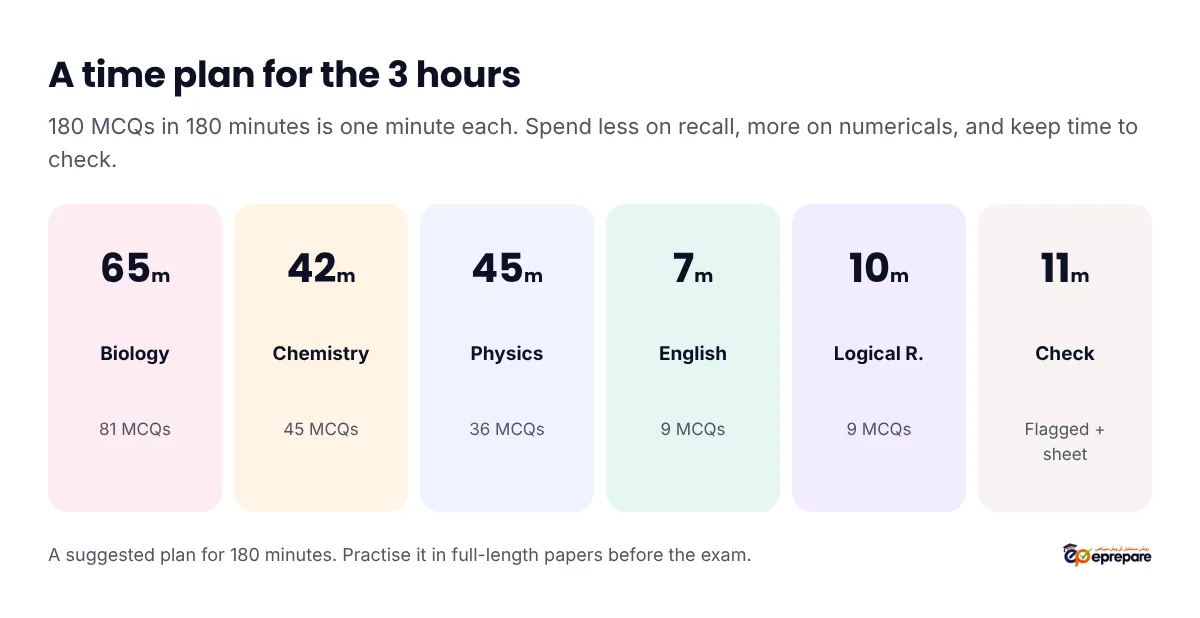
- Answer what you know first. Move quickly through recall questions and flag anything that needs thought.
- Do not get stuck. If a question takes more than about two minutes, mark your best guess, flag it and move on.
- Come back to flagged questions at the end, then check that your answer sheet matches your choices.
The only way to make this plan work on the day is to practise it in full-length papers under a 3-hour timer. Read how to use MDCAT past papers for a step-by-step method.
How the pattern should shape your preparation
- Give subjects time in proportion to their marks: roughly 45% Biology, 25% Chemistry, 20% Physics and 10% English and Logical Reasoning together.
- Stick to the textbook. With 70% moderate questions, close knowledge of textbook lines and concepts wins most marks.
- Practise Physics numericals daily, because they are where most students lose time.
- Do not skip English and Logical Reasoning. Together they are 18 marks, and they need far less study time than science subjects.
- Train for 3 hours. Concentration over a full paper is a skill you build with regular full-length tests.
Our guide on how to prepare for MDCAT at home turns this into a full plan.
Has the MDCAT pattern changed?
Yes, over the years. Earlier MDCAT papers (including 2023 and 2024) had 200 MCQs. PMDC's revised curriculum moved the paper to 180 MCQs in 3 hours with the subject split above, and MDCAT 2026 and 2027 follow that same 180-MCQ pattern. When you practise older past papers, keep this in mind: the topics are still useful, but the number of questions and the time are different.
Frequently asked questions
How many MCQs are in MDCAT?
180 MCQs: 81 Biology, 45 Chemistry, 36 Physics, 9 English and 9 Logical Reasoning.
How much time do you get in MDCAT?
3 hours for all 180 MCQs.
What are the total marks of MDCAT?
180. Each MCQ carries one mark.
Is there negative marking in MDCAT?
No. Wrong answers do not cut marks, so attempt every question.
What are the passing marks of MDCAT?
55% (99 out of 180) for MBBS and 50% (90 out of 180) for BDS. Read MDCAT passing marks for what these mean for admission.
Is MDCAT computer-based or paper-based?
PMDC's curriculum describes MDCAT as a paper-based MCQ test.
Is the pattern the same for MDCAT 2026 and 2027?
Yes, both follow the 180-MCQ pattern. We will update this page if PMDC announces any change.
Practise in the real pattern
Knowing the pattern is step one; getting used to it is step two. On ePrepare, every subject's practice follows the PMDC curriculum, and full-length papers give you 180 MCQs in the real subject split under a 3-hour timer, with your rank and percentile afterwards. New to ePrepare? Register for MDCAT and start practising in the real pattern today.