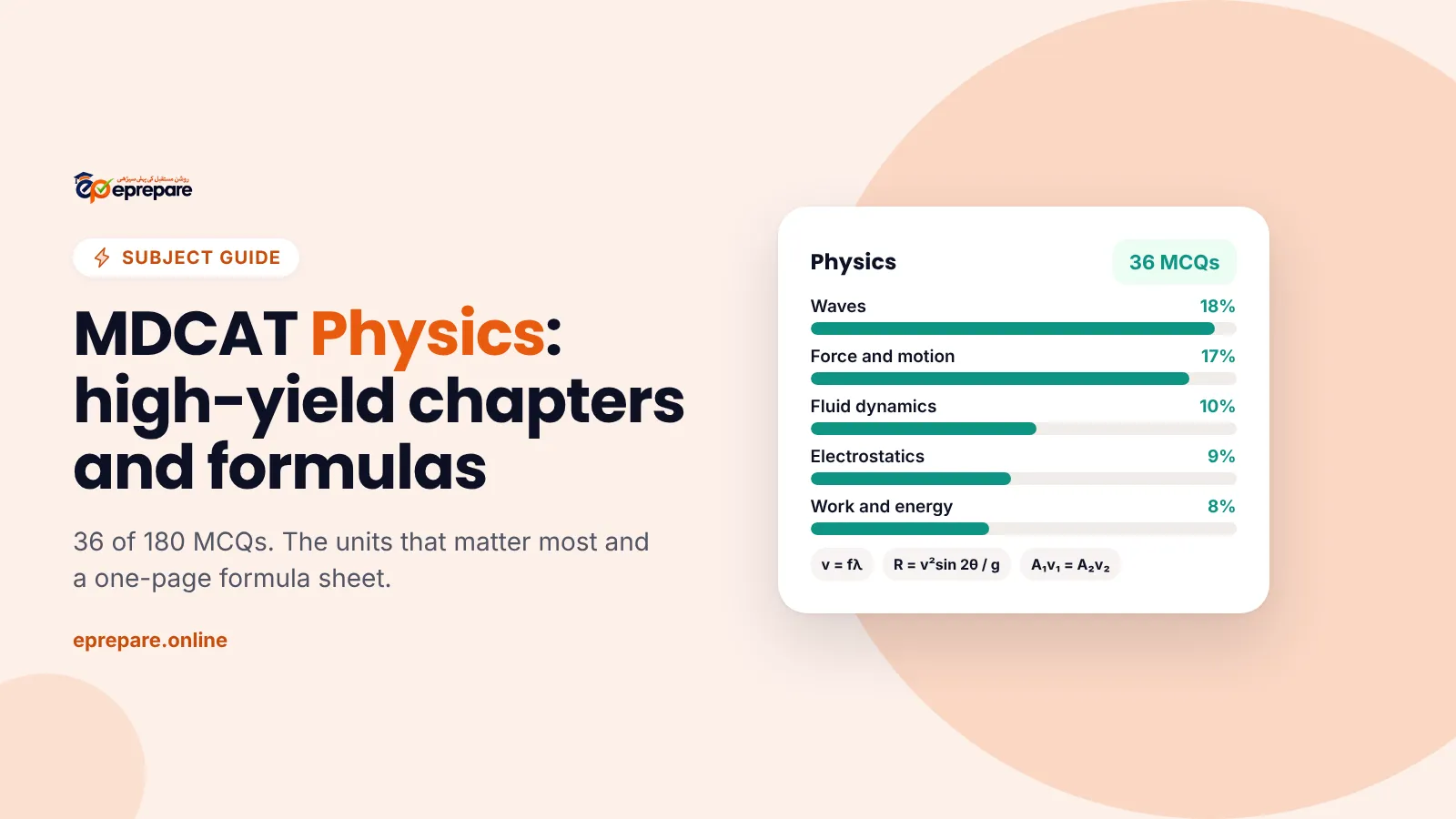
Physics has 36 of the 180 MDCAT questions, a fifth of the paper. It is the subject students fear most, mainly because of numericals, and the one where time disappears fastest on exam day. But MDCAT Physics is narrower than the FSc textbook: PMDC's curriculum lists exactly what can be asked, and much of it is concept-based rather than long calculation.
This guide shows which Physics units carry the most weight, the formulas the curriculum actually uses, and how to win Physics marks without letting it eat your time.
Which Physics units are high-yield?
PMDC publishes subject weightage only. To judge each unit, we counted the learning outcomes PMDC lists for it: more outcomes means more material for examiners to ask about.

| Unit | Share | Focus on |
|---|---|---|
| Waves (with SHM) | 18.0% | v = fλ, transverse vs longitudinal, Newton's formula and Laplace's correction, interference, stationary waves in strings and organ pipes, SHM as the projection of circular motion |
| Force and motion | 17.0% | Displacement-time graphs, projectile height, range and time of flight, launch angle for maximum range, Newton's laws, momentum, elastic and inelastic collisions |
| Fluid dynamics | 10.0% | Terminal velocity, drag, laminar vs turbulent flow, equation of continuity, Bernoulli's equation and its use in blood flow |
| Electrostatics | 9.0% | Coulomb's law in a medium, field of two charges, field lines, field of a charged plate, potential of a point charge, charging and discharging a capacitor |
| Work and energy | 8.0% | Work, kinetic and potential energy, absolute potential energy, power as F·v, energy lost to friction, efficiency |
The last three units are tiny. Dawn of modern physics, Atomic spectra and Nuclear physics have six learning outcomes between them: photons, line spectra, the nucleus, random decay, half-life and the medical uses of radiation. They take an evening and are some of the cheapest marks in the paper.
See every unit's estimated MCQs in MDCAT chapter-wise weightage.
The formulas MDCAT Physics actually uses
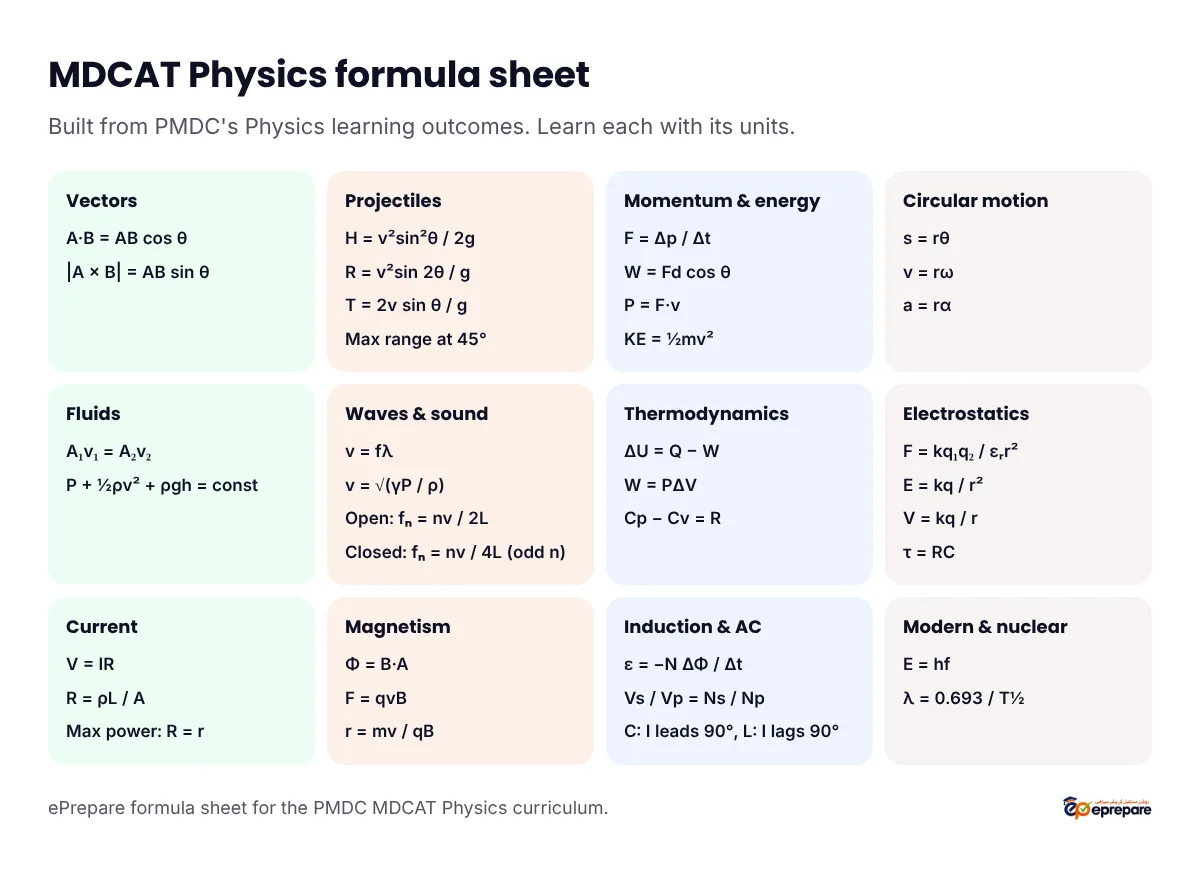
These are the relationships named in PMDC's learning outcomes, or directly needed to meet them. Learn each with its units and the conditions where it applies.
| Unit | Formulas |
|---|---|
| Vectors | A·B = AB cos θ; |A × B| = AB sin θ |
| Projectile motion | H = v²sin²θ ÷ 2g; R = v²sin 2θ ÷ g; T = 2v sin θ ÷ g; maximum range at 45°; θ and (90° − θ) give the same range |
| Momentum | F = Δp ÷ Δt; in a perfectly elastic collision, relative speed of approach = relative speed of separation |
| Work and power | W = Fd cos θ; KE = ½mv²; PE = mgh; P = F·v |
| Circular motion | s = rθ; v = rω; a = rα; 1 revolution = 2π rad = 360° |
| Fluids | A₁v₁ = A₂v₂; P + ½ρv² + ρgh = constant |
| Waves and sound | v = fλ; Newton: v = √(P ÷ ρ); Laplace: v = √(γP ÷ ρ); string or open pipe fₙ = nv ÷ 2L; closed pipe fₙ = nv ÷ 4L (odd n only) |
| Thermodynamics | ΔU = Q − W (W done by the gas); W = PΔV; Cp − Cv = R |
| Electrostatics | F = kq₁q₂ ÷ r² (divided by εᵣ in a medium); E = kq ÷ r²; V = kq ÷ r; capacitor time constant τ = RC |
| Current electricity | V = IR; R = ρL ÷ A; ρ rises with temperature in metals; maximum power when the load resistance equals the internal resistance |
| Magnetism and induction | Φ = B·A; F = qvB; r = mv ÷ qB; ε = −N ΔΦ ÷ Δt; Vs ÷ Vp = Ns ÷ Np |
| AC and electronics | Resistor: V and I in phase; capacitor: current leads by 90°; inductor: current lags by 90°; half-wave and full-wave rectification |
| Modern and nuclear | E = hf; λ = 0.693 ÷ T½ |
How to prepare Physics
1. Concept first, then numericals
Many Physics MCQs test understanding without any calculation: why horizontal velocity stays constant in projectile motion, why flow becomes turbulent at high speed, what Lenz's law says about energy. Make sure you can explain each idea in a sentence before drilling numericals on it.
2. Learn the shortcuts the paper rewards
MDCAT numericals are short. Knowing that complementary launch angles give the same range, or that a closed pipe has only odd harmonics, turns a two-minute calculation into a ten-second answer.
3. Practise with a timer from early on
In the exam, plan about 45 minutes for the 36 Physics MCQs, a little over a minute each. Timed Physics sets every week build that speed. See the time plan in the MDCAT paper pattern.
4. Keep a formula and mistakes notebook
Write every formula with its units and one solved example, and add each mistake you make as a one-line rule. Revise it weekly.
"Eprepare helped me immensely in understanding concepts more clearly, especially Physics, which was my weakest subject."
Saddaf Illahi, Google review (2026)
If you are also taking NUMS MDCAT
NUMS made Physics much more important in 2026, raising it from 30 to 40 of its 150 MCQs. Every NUMS Physics objective also appears in PMDC's curriculum, but the coverage differs:
- Only in PMDC: the whole Vectors unit, the whole Fluid Dynamics unit (including Bernoulli and blood flow), the whole Alternating Current unit, SHM as the projection of circular motion, and the PN junction.
- Only in NUMS (listed as subtopics): the Doppler effect, capacitance and energy stored in a capacitor, the field between parallel plates, electric power and kilowatt-hours, the AC generator, velocity-time graphs and centripetal force.
Topics in neither syllabus include measurements, gravitation, optics, deformation of solids, the second law of thermodynamics, Kirchhoff's laws, transistors and the photoelectric effect. See the full comparison in PMDC MDCAT vs NUMS MDCAT.
Common Physics traps
- Units: cm vs m, g vs kg, °C vs K. Convert before you substitute.
- Angles: sin and cos swapped in projectile and vector questions.
- Signs in thermodynamics: work done by the gas vs on the gas.
- Open vs closed pipes: closed pipes have odd harmonics only.
- Getting stuck: one long numerical should never cost you three easy questions. Mark it and come back.
Frequently asked questions
How many Physics MCQs are in MDCAT?
36 out of 180, which is 20% of the paper.
Which Physics chapters are most important for MDCAT?
By share of the PMDC curriculum: Waves (including simple harmonic motion) and Force and motion, then Fluid dynamics, Electrostatics and Work and energy.
Is MDCAT Physics mostly numerical?
No. There are numericals, especially in projectile motion, waves, fluids and electricity, but many questions test concepts and definitions from the curriculum.
Is optics or gravitation in the MDCAT syllabus?
No. Neither PMDC's curriculum nor the NUMS 2026 syllabus lists optics, gravitation, measurements or deformation of solids.
How much time should I spend on Physics in the exam?
About 45 minutes for 36 MCQs. Answer the quick conceptual ones first and come back to long numericals.
Make Physics manageable
Physics becomes much less scary once you know exactly what the curriculum asks and have practised it under time. Register on ePrepare for Physics lectures, chapter-wise and past-paper MCQs with worked explanations, and full-length papers that train your Physics timing.