

If you are reading this after a disappointing MDCAT result, take a breath first. A lot of doctors you will one day work beside took MDCAT twice. Repeating is not starting over: you already know the syllabus, the paper and the pressure of exam day. What you need now is an honest look at what went wrong and a plan that fixes exactly that.
This guide walks you through deciding whether to repeat, finding where your marks went, and a year-long plan built for repeaters, not first-timers.
Step 1: Decide with numbers, not emotions
Start by checking where your current score actually puts you. In Khyber Pakhtunkhwa, admission is decided on aggregate: 50% MDCAT, 40% FSc and 10% Matric. Put your marks into the aggregate calculator and compare the result with last year's closing merit.
In 2025-26, the last open-merit MBBS seat in a KPK government college closed at an aggregate of 93.11%, and early estimates for 2026-27 are around 93.94% or higher. With good board marks, that means roughly 166 to 171 in MDCAT; with weaker FSc marks, it can mean 175 or more. See every college's closing merit in the aggregate guide.
Then ask yourself honestly:
- How far is my score from the seat I want?
- Do I have a realistic reason to believe another year will close that gap?
- Do I still want medicine, or am I repeating because of pressure from others?
If the answers point to repeating, commit fully. Half-hearted repeat years are the ones that fail.
Step 2: Find out where your marks went
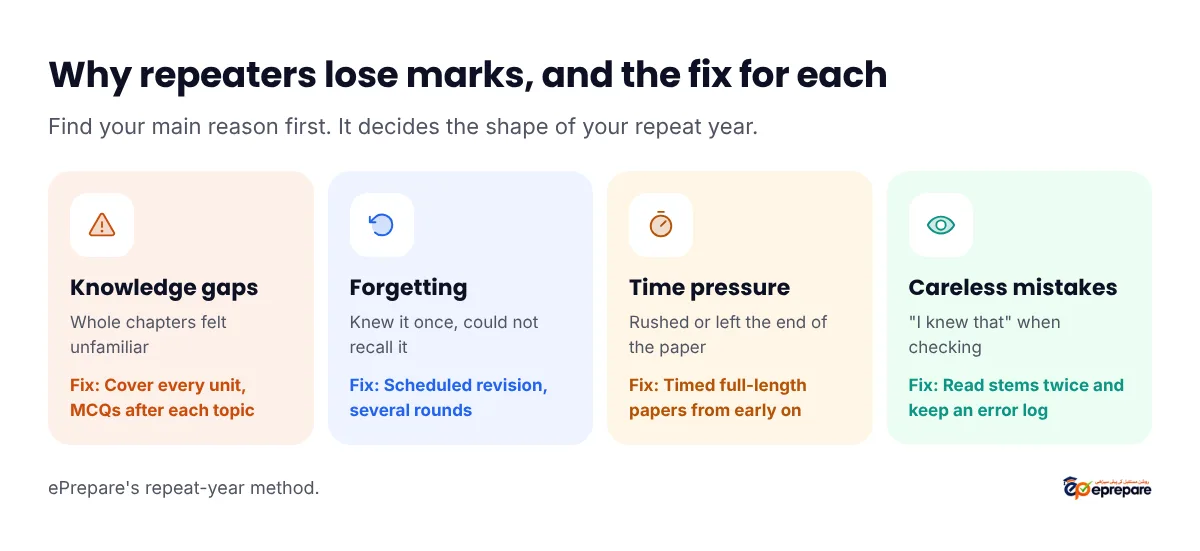
Most repeaters lose marks for one or two main reasons. Each needs a different fix:
| Main reason | Signs | Fix |
|---|---|---|
| Knowledge gaps | Whole chapters felt unfamiliar in the paper | Cover every unit properly this time, with MCQs after each topic |
| Forgetting | You knew it once but could not recall it on the day | Scheduled revision of every unit, several times |
| Time pressure | You rushed or left the end of the paper | Regular timed full-length papers from early on |
| Careless mistakes | "I knew that" when checking answers | Read stems twice, watch for "not" and "except", keep an error log |
Be specific. "I was weak in Biology" is not enough. "I lost marks in Homeostasis, Inheritance and organic Chemistry, and ran out of time in Physics" gives you a plan.
Step 3: Do not restart from zero
The biggest repeater mistake is opening the first chapter of the first book and reading everything again at the same pace. You already know a lot. Instead:
- Test before you study. Take a chapter test in each unit. If you score well, revise it lightly and move on. If you score poorly, study it fully.
- Spend most of your time on weak units, while keeping strong units fresh with short revision sets.
- Start full-length papers much earlier than you did last year.
"My problem was i was not consistent in study. But sir daily task make me consistent … last time my bio mcqs and concepts was not good. But biology slides make it more easier to understand book lines"
Fatih Khan, Google review (2025)
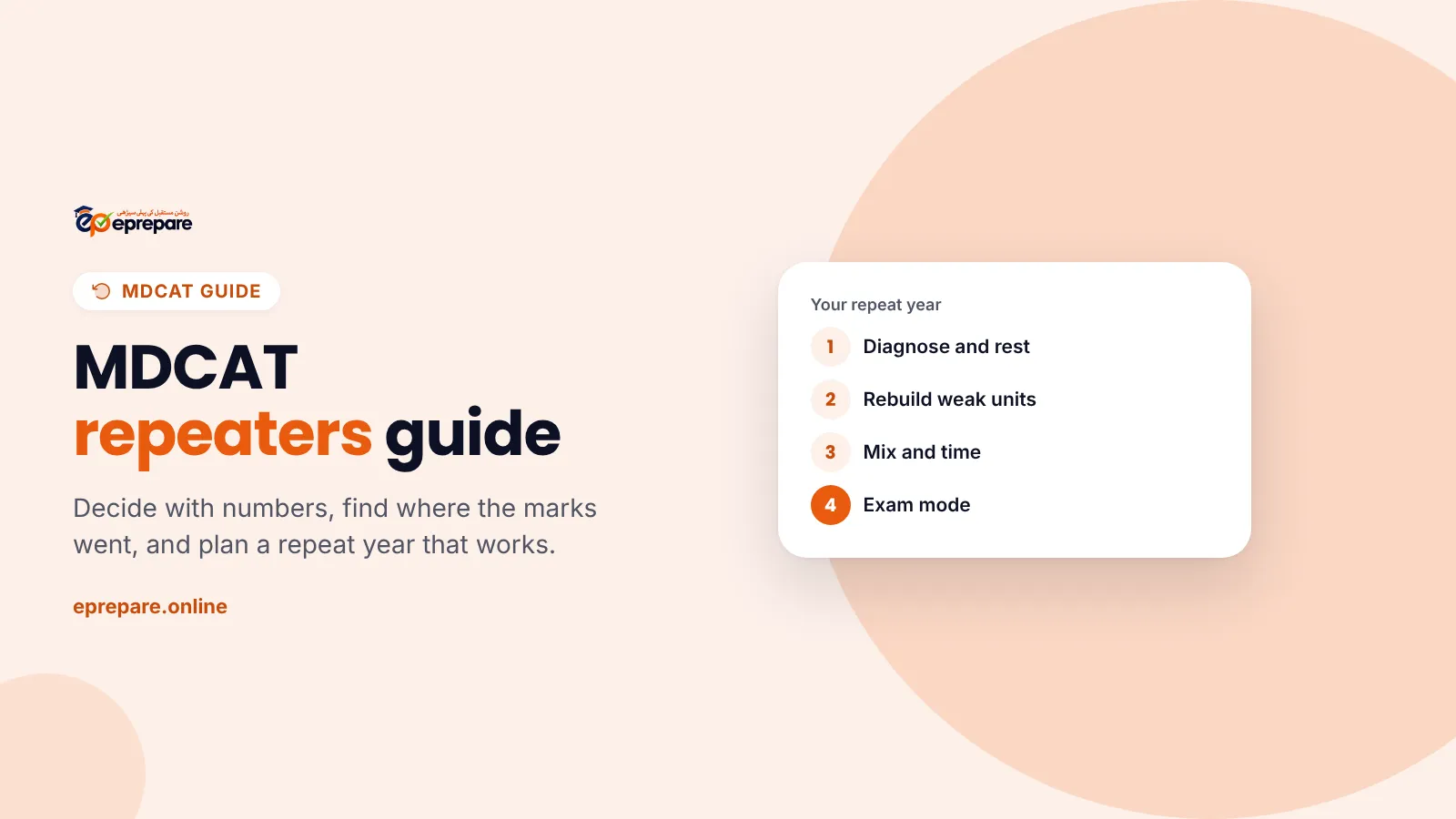
A repeat year in four stages
- Stage 1, first month: diagnose and rest. Take a short break, then test every unit to map your strengths and gaps.
- Stage 2, months 2 to 6: rebuild. Study weak units thoroughly, line by line, with topic-wise MCQs. Revise strong units every week or two.
- Stage 3, months 7 to 9: mix and time. Mixed chapter tests, past papers and one full-length paper every one to two weeks.
- Stage 4, final two to three months: exam mode. One or two full-length papers a week, deep review of every mistake, and no new material in the last two weeks.
Our guide to preparing for MDCAT at home has a sample day you can adapt, and how to analyse your mock tests shows how to get the most from each full-length paper.
Look after your mind as well as your marks
- Keep a routine. A fixed study time, a fixed sleep time and one day a week that is lighter.
- Limit social media, especially result posts and rumours. They cost time and confidence.
- Track progress, not just effort. Watching your test scores rise is the best motivation a repeater can have.
- Talk to someone when it gets heavy: a parent, a friend, a mentor. Repeating can feel lonely, and it should not.
"From struggling in MCQs to gaining confidence 📈 … If you're serious about MDCAT, stop scrolling and start solving MCQs daily in eprepare … Consistency > Motivation."
Muhammad Talha, Google review (2026)
Which MDCAT result counts?
For the current session, KMU's admission sites accept MDCAT results from 2024, 2025 and 2026. When you sit MDCAT again, your new result is what you apply with for the next session. Always check the admission notice for your session on cas.kmu.edu.pk (public colleges) or caspr.kmu.edu.pk (private colleges).
Frequently asked questions
Is it worth repeating MDCAT?
It is worth it if you know why you fell short and have a plan to fix it, and if the gap to your target seat is realistic. Use the aggregate calculator and last year's closing merit to decide.
How much can a repeater improve?
It depends on the reason for the first score. Students whose main problem was coverage, revision or timing often improve a lot, because those are fixable. A clear diagnosis is what makes the difference.
Should repeaters study the whole syllabus again?
Cover all of it, but not at the same depth. Test every unit first, then study weak units fully and revise strong ones.
When should a repeater start preparing?
After a short break, as soon as possible. A full year gives you time to rebuild weak areas and practise many full-length papers.
Make this the year it works
A repeat year is a second chance with an advantage: you know what the real paper feels like. Register on ePrepare for chapter tests to find your gaps, a study plan around your exam date, Wrong MCQs and smart revision so nothing slips away again, and full-length papers that show your progress week by week.