Full-length papers (FLPs) are where MDCAT preparation turns into an MDCAT score. They train your timing, your focus over three hours and your ability to switch between subjects. But the paper itself is only half the value. The other half is what you do in the hour after you finish it.
This guide answers the two questions students ask most: how many mock tests should I take, and how do I analyse them so my score actually goes up?
Mock test, FLP, chapter test: what is the difference?
- Chapter or topic tests check one part of the syllabus. Use them throughout your preparation.
- Mixed tests combine several chapters or subjects. They show whether older chapters have faded.
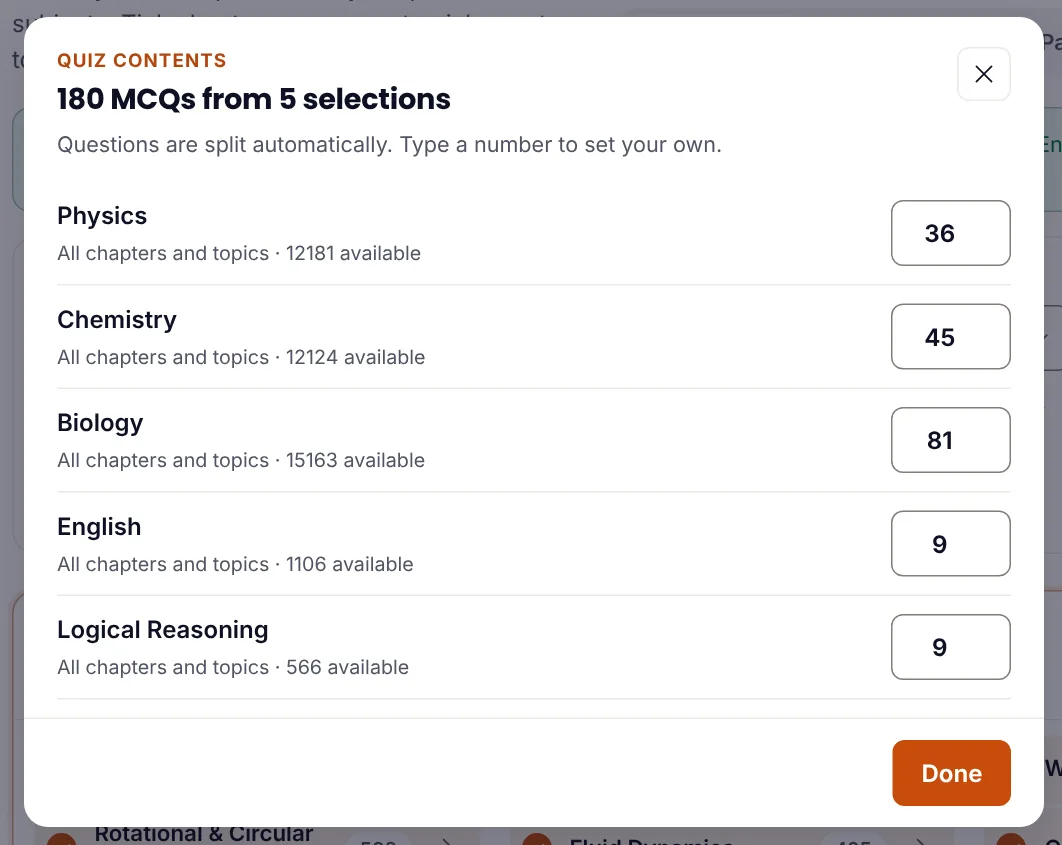
- Full-length papers copy the real test: 180 MCQs in 3 hours with the real subject split of 81 Biology, 45 Chemistry, 36 Physics, 9 English and 9 Logical Reasoning.
How many FLPs should you take?
There is no magic number, but a pattern that works for most students is:
| Time before MDCAT | Full-length papers |
|---|---|
| More than 3 months | One a month, mainly to practise timing |
| 3 months to 1 month | One every week |
| Final month | Two a week, with the last one 3 to 4 days before the test |
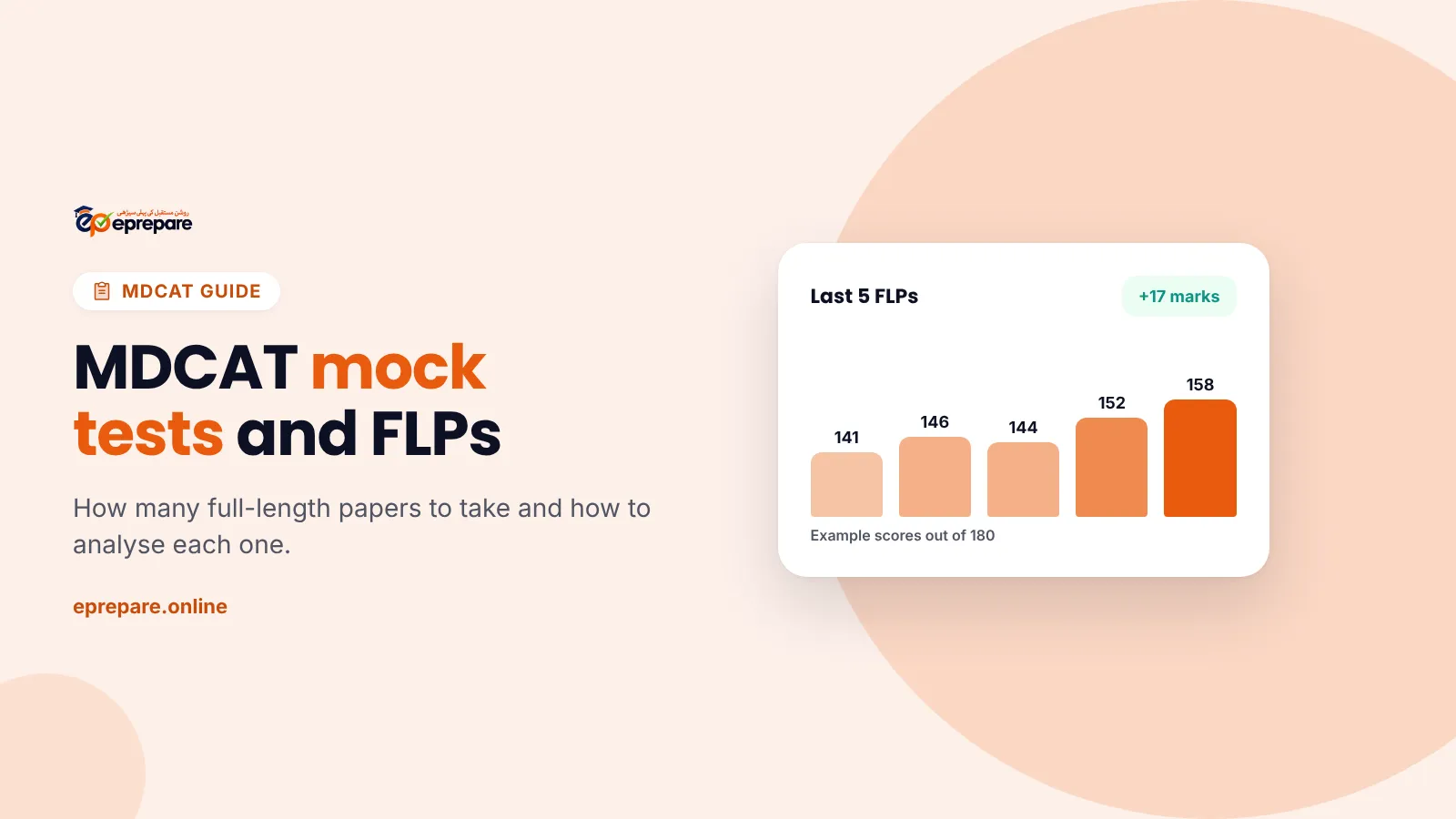
That adds up to roughly 15 to 20 full-length papers. Taking more is only useful if you review each one properly. Ten papers reviewed carefully will do more for your score than thirty solved and forgotten.
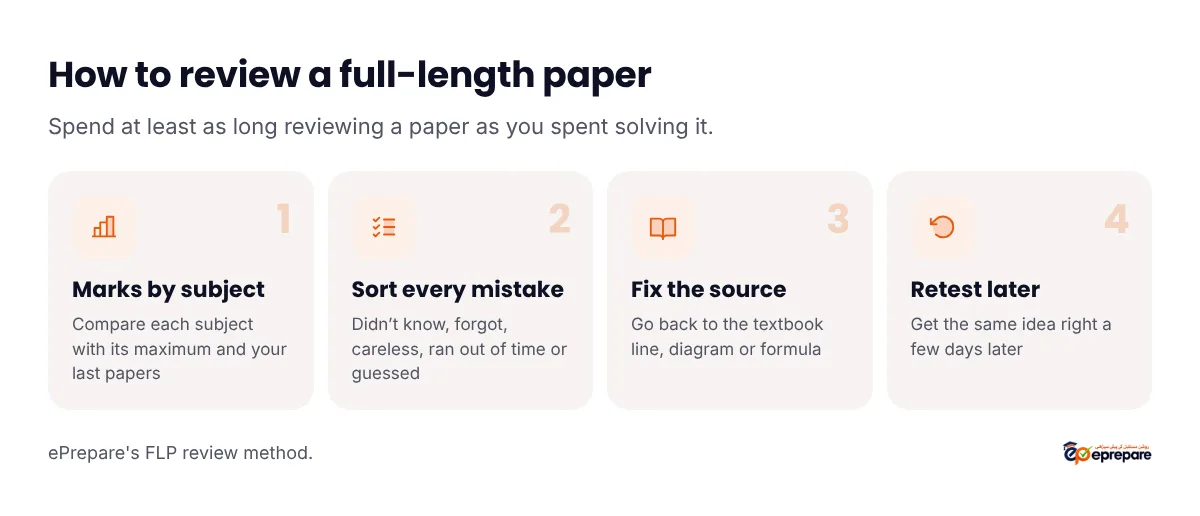
Rule of thumb: spend at least as long reviewing an FLP as you spent solving it. A three-hour paper deserves a review of an hour or more.
Take each FLP like the real test
- One sitting, 3 hours, at the same time of day as the real MDCAT if you can.
- Phone in another room, no notes, no pausing.
- Use your exam time plan and two-pass method (see exam-day tips).
On ePrepare, the Advance package includes the FLP series, with your rank and percentile after each paper, and the Quiz Builder can make a 180-MCQ full-length paper with the real subject split in one tap.
How to analyse a mock test in four steps
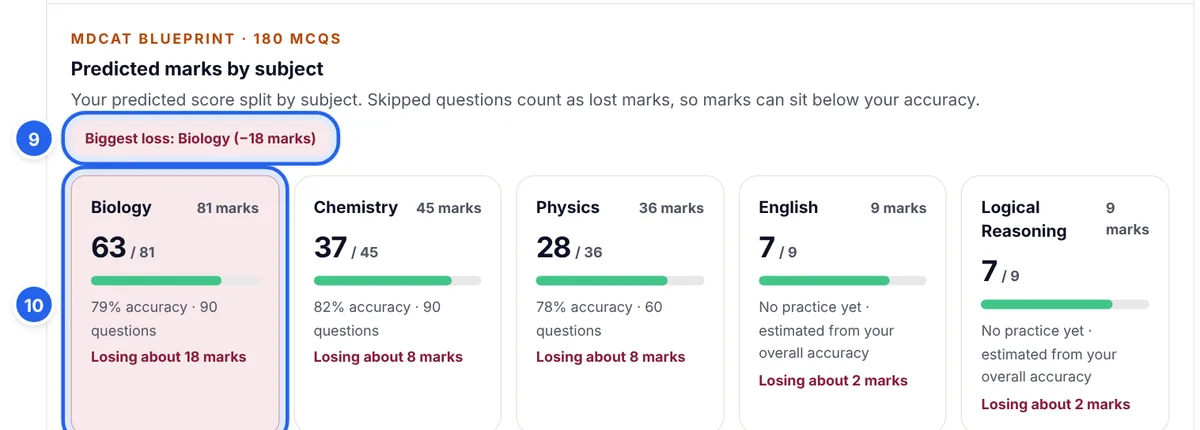
Step 1: Look at marks by subject
Your total hides the story. Compare each subject with its maximum and with your last few papers. A Biology score of 66 out of 81 tells you much more than a total of 150.
Step 2: Sort every mistake by reason
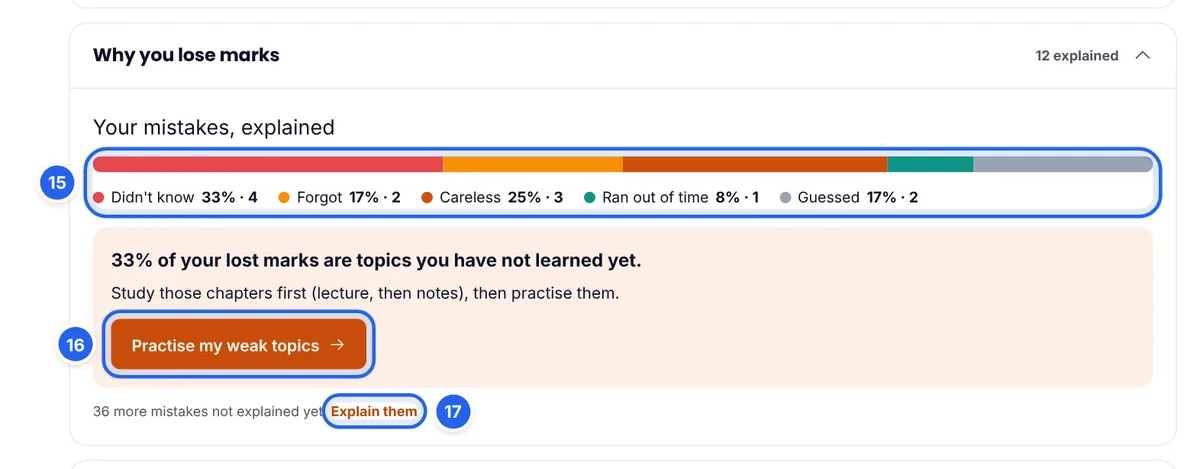
For every wrong answer, and every right answer you guessed, write down why: didn't know, forgot, careless, ran out of time or guessed. The pattern tells you what to change. Lots of "didn't know" means more study; lots of "careless" means slower reading; lots of "ran out of time" means more timed practice.
Step 3: Fix the source
Go back to the textbook line, diagram or formula behind each mistake. Write a one-line note in your own words. Do not just read the correct option and move on.
"The answer explanations were really helpful. When I got something wrong, I could tell whether I'd forgotten a fact or misunderstood the concept. That mattered, because the fix wasn't always reading the whole chapter again."
Iftikhar Ahmad, 177 in MDCAT 2026
Step 4: Retest a few days later
A mistake is only fixed when you get the same idea right later. On ePrepare, wrong answers go to Wrong MCQs automatically, and smart revision brings them back on a schedule. See turning every mistake into marks.
Track your trend, not one paper
Scores go up and down. One bad paper means little; three in a row means something needs to change. Watch your average over the last three to five papers, and your predicted score as it moves towards your target. Read how the predicted score works.
"The FLPs are well-designed, challenging, and very helpful for MDCAT preparation. They cover important concepts and help me identify my weak areas and improve my overall performance."
Sayed Haroon Shah, Google review (2026)
Common FLP mistakes
- Starting FLPs too late. If the first full paper you sit is in the final month, timing problems appear when there is no time left to fix them.
- Checking only the score. The review is where improvement happens.
- Pausing or using notes. It makes the score look better and the practice worse.
- Comparing yourself with everyone else after every paper. Compare with your own last papers.
- A full paper the day before MDCAT. Keep the last few days for light revision and rest.
Frequently asked questions
How many FLPs should I take before MDCAT?
About 15 to 20 in the last three to four months is a good target: weekly from three months out, and twice a week in the final month, each one properly reviewed.
When should I start full-length papers?
Take an occasional one early for timing practice, and start regular weekly papers about three months before the test.
My FLP scores are not improving. What should I do?
Look at the reasons behind your mistakes. If most are "didn't know" or "forgot", spend more time on study and scheduled revision between papers rather than taking more papers.
Are FLP scores close to the real MDCAT score?
They are a useful guide, especially as an average of several recent papers. The real score also depends on that year's paper and how you handle the day.
Make every paper count
Full-length papers only raise your score when each one teaches you something. Register on ePrepare for the FLP series with ranks and percentiles, one-tap full-length papers, and Wrong MCQs and smart revision that turn every mistake into a mark for the real test.