


Logical Reasoning is the one MDCAT subject you cannot learn from a textbook. It has 9 questions out of 180, and it tests how you think rather than what you remember. Students who have never practised it often lose four or five of these marks; students who have solved a few hundred LR questions usually get eight or nine.
This guide explains all six types of Logical Reasoning question in PMDC's curriculum, with a worked example and a method for each, so you know exactly what to expect.
The six question types
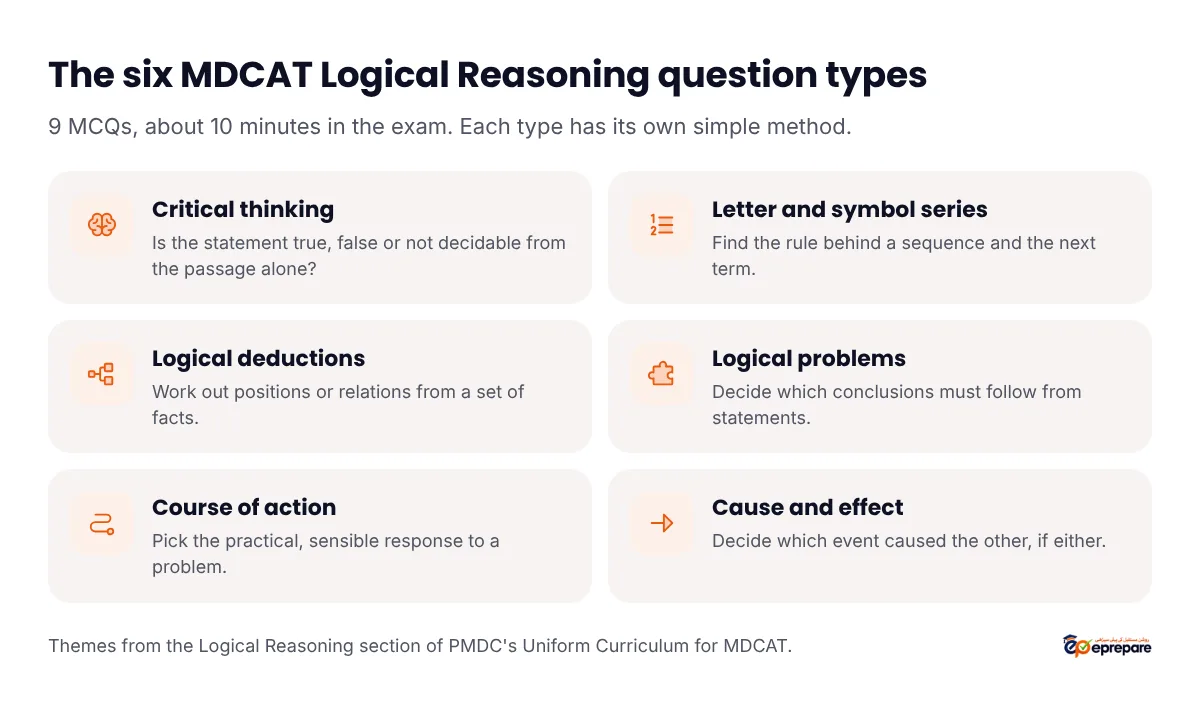
PMDC lists six themes: critical thinking, letter and symbol series, logical deductions, logical problems, course of action, and cause and effect. The examples below are our own, written in the same style as the official sample questions.
1. Critical thinking
You read a short passage and decide whether a statement is true, false, or cannot be decided from the information given. The key is to use only the passage, not your own knowledge.
Passage: "Sara has scored above 90% in every Biology test this term. Her teacher has selected her for the school's science quiz team."
Statement: "Sara is the best Biology student in her class."
Answer: insufficient information. The passage tells us Sara scores highly, not how she compares with everyone else.
Method: ask "does the passage actually say this, or am I assuming it?"
2. Letter and symbol series
A sequence of numbers, letters or symbols follows a rule. Find the rule and the next term.
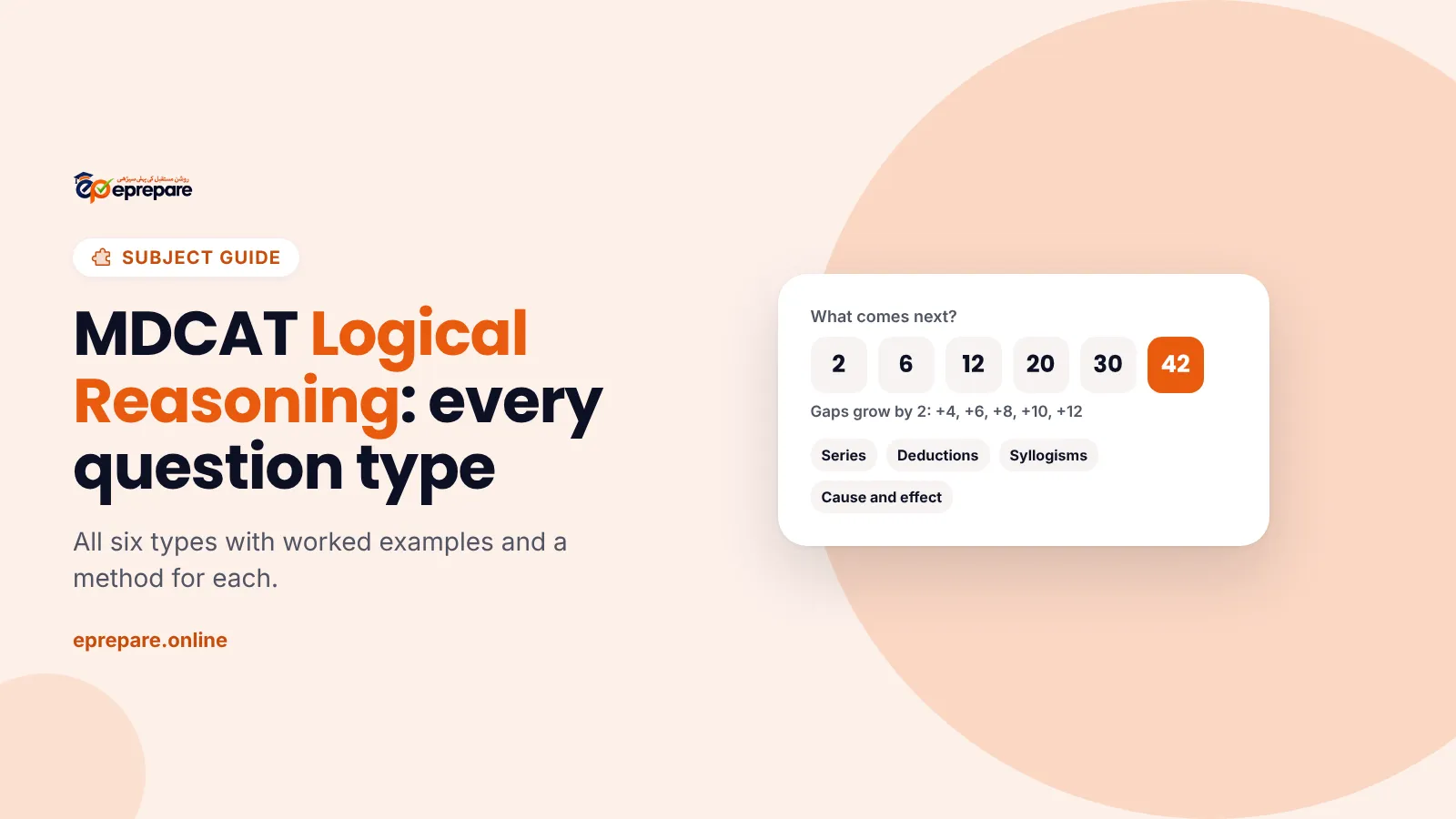
Example: 2, 6, 12, 20, 30, ?
Answer: 42. The gaps are 4, 6, 8, 10, so the next gap is 12.
Example: B, E, H, K, ?
Answer: N. Each letter moves three places forward in the alphabet.
Method: write the differences between terms first. If that does not work, try multiplication, alternate terms, or letter positions (A = 1, B = 2 and so on).
3. Logical deductions
You are given a set of facts, often about people, positions or relationships, and must work out a conclusion.
Example: Five students, A, B, C, D and E, sit in a row. C is in the middle. A sits immediately to the left of C. E sits at the right end. B does not sit next to E. Who sits at the left end?
Answer: B. C is in seat 3, A in seat 2 and E in seat 5. B cannot be in seat 4 (next to E), so B is in seat 1 and D in seat 4.
Method: draw it. Five boxes on paper solve this in under a minute; doing it in your head takes three.
4. Logical problems (syllogisms)
Two or three statements are followed by conclusions. Decide which conclusions must be true if the statements are true.
Statements: All doctors are graduates. Some graduates are teachers.
Conclusions: I. Some doctors are teachers. II. All teachers are graduates.
Answer: neither follows. The teachers who are graduates may not be doctors, and "some graduates are teachers" says nothing about all teachers.
Method: draw quick circles (Venn diagrams). A conclusion follows only if it is true in every possible drawing.
5. Course of action
You read a problem and decide which suggested actions are sensible, practical responses to it.
Statement: "Many students in a district could not finish the MDCAT paper in time."
Courses of action: I. Schools should hold regular timed practice tests. II. MDCAT should be cancelled in that district.
Answer: only I follows. It addresses the problem directly. Cancelling the test is extreme and does not solve it.
Method: a good course of action is practical, addresses the cause, and is not extreme.
6. Cause and effect
Two statements are given. Decide whether one causes the other, both are effects of a common cause, or they are unrelated.
Statements: I. The price of tomatoes rose sharply this week. II. Heavy rain destroyed tomato crops in several districts last week.
Answer: II is the cause and I is the effect. Less supply after the rain led to higher prices.
Method: check the time order (a cause comes first) and ask whether one event can really explain the other.
Official sample questions, solved
The NUMS syllabus document reprints sample questions for each type under the heading "Logical Reasoning for National MDCAT". They show the style examiners use. Here are the ones with clear answers, solved step by step.
Sample: logical deduction
Question: "There is a family of six persons G, J, B, E, T and Z. Their professions are teacher, writer, actor, singer, dancer and lawyer, but not respectively in the same order. G is a teacher. Z is a dancer. B is neither writer nor actor. E is neither singer nor lawyer. T is an actor. J is a lawyer. Who among them has a profession of lawyer?"
Answer: J. The statement says so directly. The rest of the information is there to distract you. Read the question before untangling the whole puzzle: often you need only one line.
Sample: logical problem (syllogism)
Statements: "A lullaby is a song. No song is prose. Some proses are epics."
Conclusions: I. Some proses are songs. II. Some epics are lullabies. III. Some songs are lullabies.
Answer: only III. Every lullaby is a song, so some songs are lullabies (III follows). No song is prose, so I is false. II does not follow, because nothing in the statements links epics to lullabies: we only know that some prose is epic. Draw the circles: the song circle (with lullabies inside) never touches the prose circle, and the epic circle only has to overlap prose.
Sample: cause and effect
Statements: I. "The standard of living of people of the average income group has been rising since the last two years." II. "Pakistani economy has been showing a significant growth."
Answer: II is the cause and I is the effect. Economic growth can raise living standards; rising living standards in one income group do not by themselves create national economic growth.
Sample: critical thinking
Passage: "Ahmed's company has been successful for the past 5 years. Reported profits have been rising each year, with 2018 being the strongest year yet. To celebrate, Ahmed treated his staff to a meal at a 5-star restaurant in the city."
The statement "Ahmed's company performed well in 2017" is true: profits rose every year for five years, which includes 2017. By contrast, "Ahmed is rich" and "Ahmed's staff are happy" cannot be decided from the passage alone, because the passage describes the company's profits and a meal, not Ahmed's personal wealth or how his staff feel. This is the key skill: separate what the text says from what seems likely.
How to prepare Logical Reasoning
- Learn one type at a time. Spend a few days on each of the six types until the method feels automatic.
- Then mix them. In the exam the types come one after another, so practise mixed sets of 10 to 20.
- Always use rough paper for deductions, seating puzzles and syllogisms.
- Time yourself. Aim for about a minute per question, roughly 10 minutes for all nine in the exam.
- Review every mistake. In LR, a wrong answer almost always means a step in the method was skipped.
"One of the best platform for aptitude tests covering all the syllabus plus practice tests helps alot in time management"
Syeda Mahnoor, Google review (2024)
Is Logical Reasoning in NUMS MDCAT?
No. The NUMS MDCAT paper has Biology, Chemistry, Physics and English, plus a separate psychological test. The NUMS syllabus document itself labels its Logical Reasoning section "for National MDCAT only". Read PMDC MDCAT vs NUMS MDCAT for all the differences.
Frequently asked questions
How many Logical Reasoning MCQs are in MDCAT?
9 out of 180, which is 5% of the paper.
What types of Logical Reasoning questions come in MDCAT?
Critical thinking, letter and symbol series, logical deductions, logical problems, course of action, and cause and effect.
Can I prepare Logical Reasoning in a few weeks?
Yes. Because it depends on methods rather than memory, three to four weeks of daily practice is usually enough. Keep practising inside full-length papers afterwards.
Which is the hardest Logical Reasoning type?
Most students find logical deductions and syllogisms hardest at first. Drawing diagrams makes both much easier.
Practise until the methods are automatic
Logical Reasoning is the fastest subject to improve, because the same six methods solve almost every question. Register on ePrepare for Logical Reasoning MCQs with step-by-step explanations and full-length papers that include all five subjects. For the other short section, see MDCAT English grammar topics.