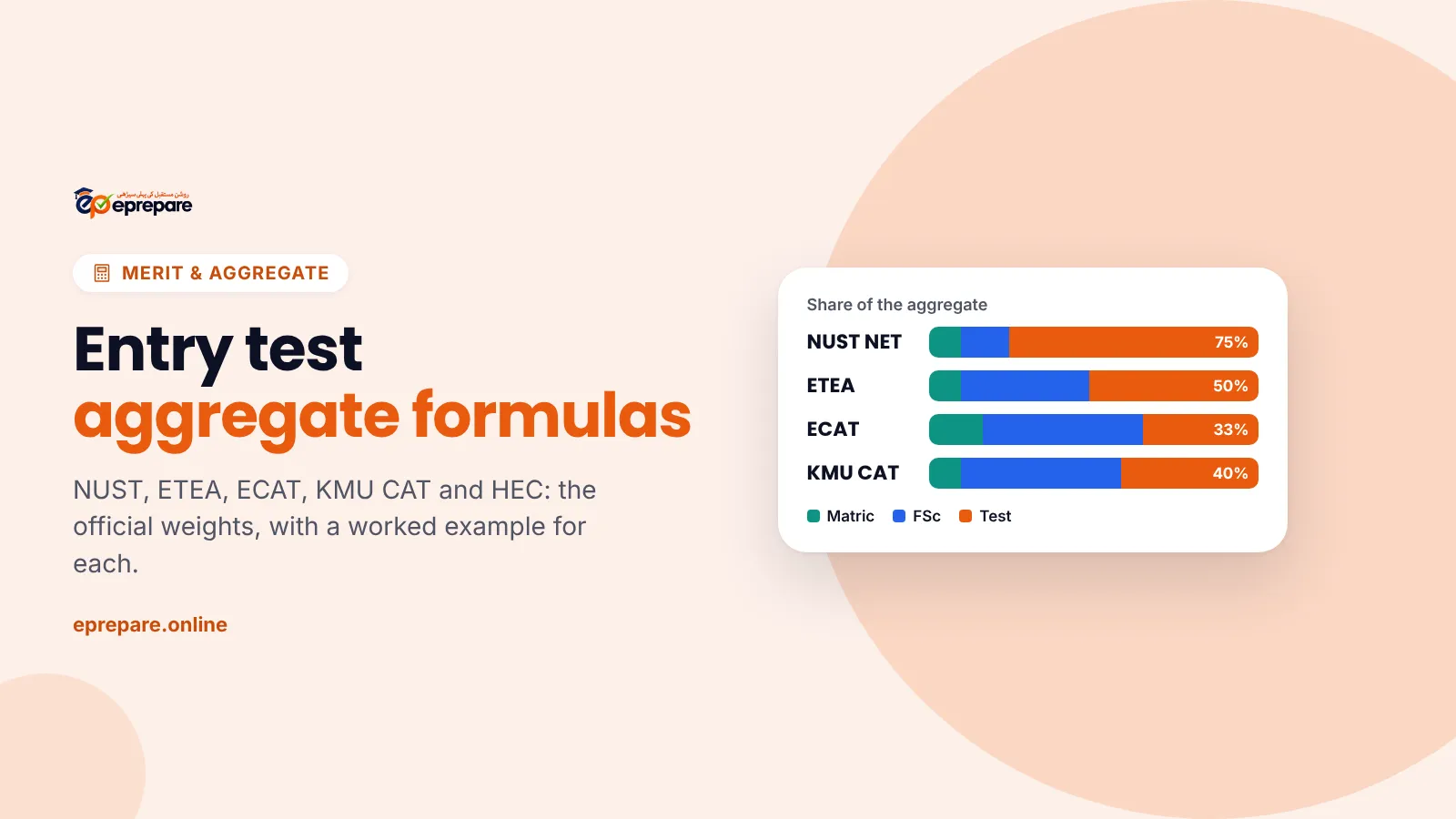
Every entry test in Pakistan ends the same way: your test score is mixed with your Matric and FSc marks into one aggregate, and that aggregate decides the merit list. What changes from one university to the next is the mix. NUST gives its test three quarters of the aggregate. UET Lahore gives ECAT only a third. KMU's allied health test sits in between. If you use the wrong weights, your "aggregate" can be several points away from the number the university will actually print.
This guide collects the formulas we could confirm from each university's own prospectus, admission portal or official website, with a worked example for each and a link to the source.
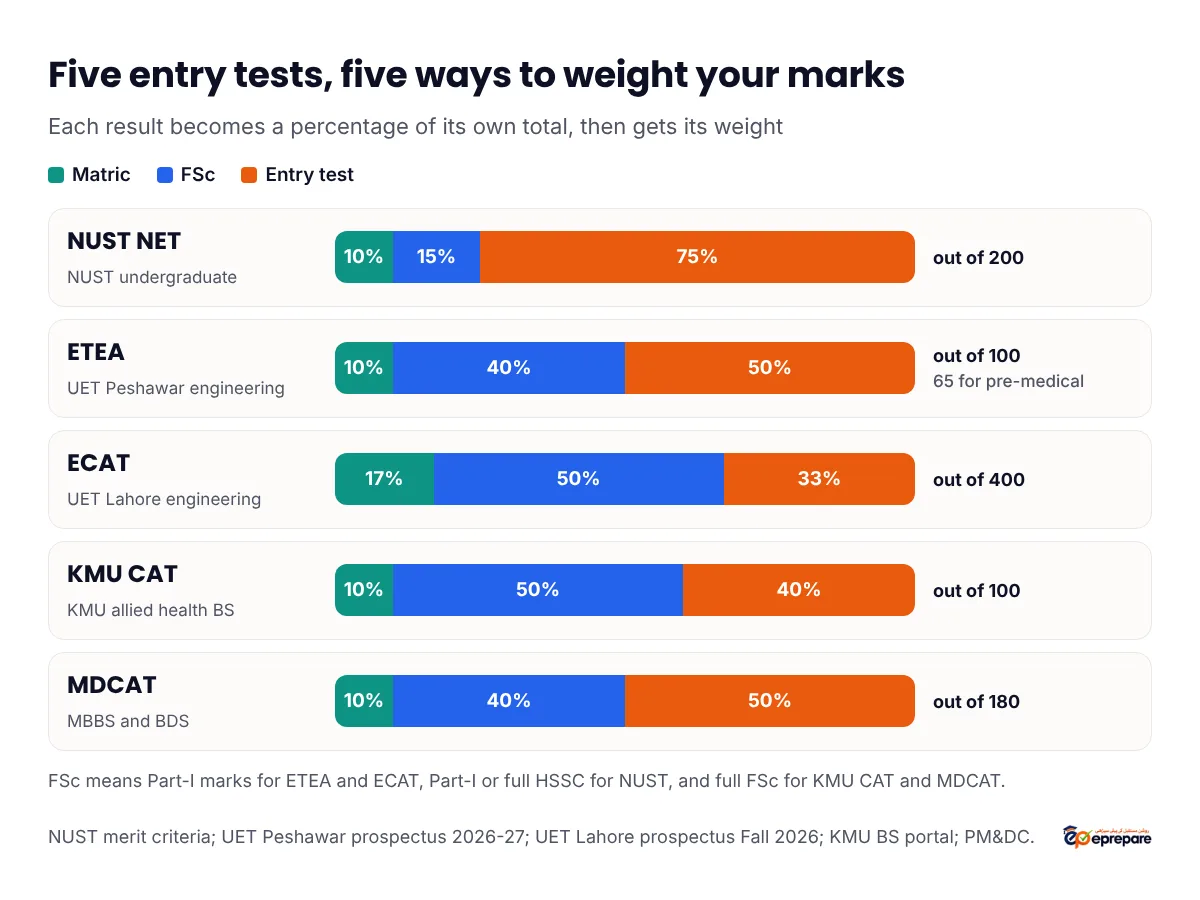
The short answer: NUST NET is 75% test, 15% FSc and 10% Matric. ETEA for UET Peshawar engineering is 50% test, 40% FSc Part-I and 10% Matric. UET Lahore's ECAT is 33% test, 50% FSc Part-I and 17% Matric. KMU CAT for allied health is 40% test, 50% FSc and 10% Matric. MDCAT for MBBS and BDS is 50% test, 40% FSc and 10% Matric. In every case, each result is first turned into a percentage of its own total, then multiplied by its weight.
Entry test aggregate formulas compared
Here are the formulas side by side. "FSc Part-I" means the university uses your first-year (Part-I) marks for merit; the prospectus explains when the full result is used instead.
| Test (admission) | Matric | FSc | Test | Test out of |
|---|---|---|---|---|
| NUST NET (NUST undergraduate) | 10% | 15% (Part-I or full) | 75% | 200 |
| ETEA (UET Peshawar engineering) | 10% | 40% (Part-I, adjusted) | 50% | 100 (65 for pre-medical) |
| ECAT (UET Lahore engineering) | 17% | 50% (Part-I) | 33% | 400 |
| KMU CAT (KMU allied health BS) | 10% | 50% | 40% | 100 |
| MDCAT (MBBS and BDS) | 10% | 40% | 50% | 180 |
The method is the same for all of them:
- Turn each result into a percentage. Divide your marks by the total printed on your result card or score card, and multiply by 100.
- Multiply each percentage by its weight. For NUST that is 0.10 for Matric, 0.15 for FSc and 0.75 for NET.
- Add the three parts. The total is your aggregate percentage.
Use your own board total. Matric and FSc totals differ by board and year (1100, 1200, or a Part-I total). The formula works on percentages, so always divide by the total on your own DMC.
How to calculate NUST aggregate (NET)
NUST's merit generation criteria for admission on the basis of NET give these weights: NUST Entry Test 75%, HSSC (Part-1) / HSSC / A level / equivalent / DAE 15%, and SSC / O level / equivalent 10%. NUST's FAQ says the NET has 200 MCQs to be attempted in three hours, so your NET percentage is your score out of 200.
NUST aggregate = (NET marks ÷ 200 × 100) × 0.75 + (FSc marks ÷ FSc total × 100) × 0.15 + (Matric marks ÷ Matric total × 100) × 0.10
Worked example: NUST
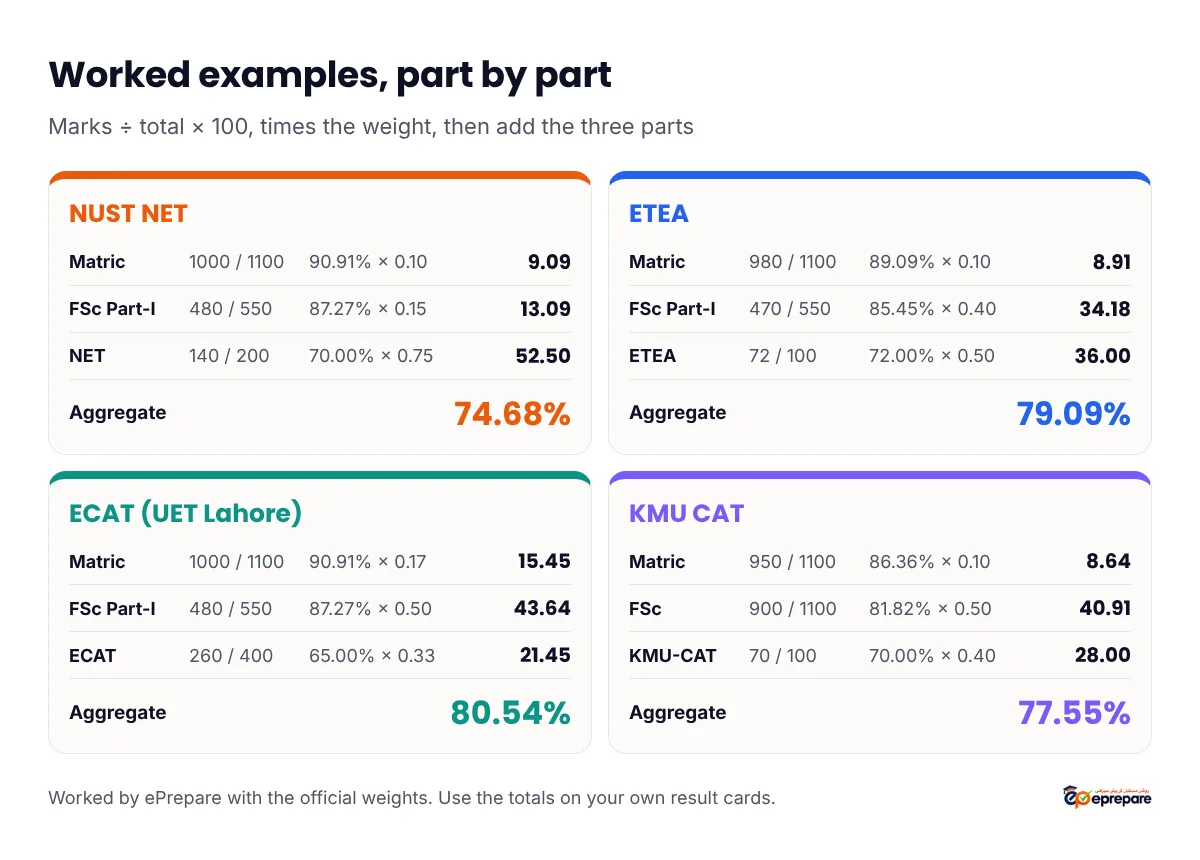
A student has Matric 1000/1100, FSc Part-I 480/550 and NET 140/200.
- Matric: 1000 ÷ 1100 × 100 = 90.91% → × 0.10 = 9.09
- FSc Part-I: 480 ÷ 550 × 100 = 87.27% → × 0.15 = 13.09
- NET: 140 ÷ 200 × 100 = 70.00% → × 0.75 = 52.50
- Aggregate = 9.09 + 13.09 + 52.50 = 74.68%
The 480/550 Part-I total is only an example; use the total on your own Part-I result card. Other points from NUST's undergraduate brochure:
- You need at least 60% marks in both SSC and HSSC (or equivalent) to be eligible.
- HSSC candidates can apply on their Part-I result, but admission is confirmed only when the complete HSSC result is provided.
- You can sit more than one NET in an admission cycle, and the best score counts. A NET result is valid for the current admission cycle only.
- O and A level students apply on IBCC equivalence certificates, and NUST's merit criteria page sets out separately how their O level marks are weighted.
How to calculate ETEA aggregate (UET Peshawar engineering)
The Educational Testing and Evaluation Agency (ETEA) of Khyber Pakhtunkhwa (KP) conducts the centralised entrance test for public and private engineering universities and colleges in KPK. UET Peshawar's undergraduate prospectus for 2026-27 sets merit as:
- 10% weightage to SSC marks
- 40% weightage to marks in Part-I of Intermediate or equivalent (adjusted marks)
- 50% weightage to entrance test marks
The ETEA engineering test is 100 MCQs for Pre-Engineering, Computer Science, DAE and B.Tech candidates (Physics 40, Mathematics 35, English 15, Chemistry or Computer Science 10). Pre-medical candidates take 65 MCQs (Physics 40, English 15, Chemistry 10), and the prospectus says "65 marks to be considered as 100% marks for determining merit". Each correct answer carries one mark, and there is no negative marking.
ETEA aggregate = (ETEA marks ÷ 100 × 100) × 0.50 + (FSc Part-I marks ÷ Part-I total × 100) × 0.40 + (Matric marks ÷ Matric total × 100) × 0.10. Pre-medical candidates divide their test marks by 65 instead of 100.
Worked example: ETEA
A pre-engineering student has Matric 980/1100, FSc Part-I 470/550 and 72/100 in ETEA.
- Matric: 980 ÷ 1100 × 100 = 89.09% → × 0.10 = 8.91
- FSc Part-I: 470 ÷ 550 × 100 = 85.45% → × 0.40 = 34.18
- ETEA: 72 ÷ 100 × 100 = 72.00% → × 0.50 = 36.00
- Aggregate = 8.91 + 34.18 + 36.00 = 79.09%
If the same student were in the pre-medical group and scored 52 out of 65, the test part would be 52 ÷ 65 × 100 = 80% → 40.00, and the aggregate 83.09%.
What else the prospectus says:
- You need at least 60% unadjusted marks in Intermediate (or DAE/B.Tech) to be eligible.
- At least two entrance tests are held each session, and you may submit your best result. The result is valid for one academic year only. For 2026, ETEA held Test-I on 4 and 5 July and Test-II on 25 and 26 July as computer-based tests.
- For a pre-medical student with additional Mathematics, the Mathematics marks replace Biology in the merit calculation.
- Candidates from other provinces can apply only for the five seats reserved in each discipline at UET Peshawar on a non-subsidised basis.
How to calculate ECAT aggregate (UET Lahore)
UET Lahore conducts ECAT for admission to engineering institutions in Punjab. Its undergraduate prospectus for Fall 2026 gives the merit for ECAT-based programmes (Intermediate stream) as:
- Entrance test (ET) percentage marks: 33%
- First-year (Part-I) percentage marks: 50%
- Matric percentage marks: 17%
ECAT has 100 questions in 100 minutes: 10 on English and 90 divided equally among the other three subjects. Each correct answer is worth four points, so the maximum is 400. There is no negative marking.
ECAT aggregate = (ECAT marks ÷ 400 × 100) × 0.33 + (FSc Part-I marks ÷ Part-I total × 100) × 0.50 + (Matric marks ÷ Matric total × 100) × 0.17
Worked example: ECAT
A student has Matric 1000/1100, FSc Part-I 480/550 and ECAT 260/400.
- Matric: 1000 ÷ 1100 × 100 = 90.91% → × 0.17 = 15.45
- FSc Part-I: 480 ÷ 550 × 100 = 87.27% → × 0.50 = 43.64
- ECAT: 260 ÷ 400 × 100 = 65.00% → × 0.33 = 21.45
- Aggregate = 15.45 + 43.64 + 21.45 = 80.54%
UET Lahore also says the minimum aggregate for admission is 50%, that you may take ECAT more than once with the best score counting for merit, and that O and A level students use 33% ECAT and 67% O level (equivalence) marks instead.
How to calculate KMU CAT aggregate (allied health)
Khyber Medical University's Centralized Admission Test (KMU-CAT) is used for BS Allied Health Sciences programmes, including paramedics, public health, nursing, DPT and Pharm-D, in KMU's constituent and affiliated institutes. KMU's BS admission portal gives the merit criteria as: SSC or equivalent 10%, Intermediate Pre-Medical (HSSC) or equivalent 50%, and entrance test 40%. The aggregate calculator on KMU's CAT site uses the same weights.
KMU-CAT is 100 MCQs in 90 minutes: Biology 35, Chemistry 30, Physics 20 and English/Islamiyat/Pakistan Studies 15. The total is 100 marks, there is no negative marking, and the result is valid for one year only.
KMU CAT aggregate = (CAT marks ÷ 100 × 100) × 0.40 + (FSc marks ÷ FSc total × 100) × 0.50 + (Matric marks ÷ Matric total × 100) × 0.10
Worked example: KMU CAT
A student has Matric 950/1100, FSc 900/1100 and 70/100 in KMU-CAT.
- Matric: 950 ÷ 1100 × 100 = 86.36% → × 0.10 = 8.64
- FSc: 900 ÷ 1100 × 100 = 81.82% → × 0.50 = 40.91
- KMU-CAT: 70 ÷ 100 × 100 = 70.00% → × 0.40 = 28.00
- Aggregate = 8.64 + 40.91 + 28.00 = 77.55%
To sit KMU-CAT you need FSc (Pre-Medical) or equivalent with at least 50% marks, or be awaiting the result. KMU's BS portal asks for at least 60% for DPT. Test and admissions for KMU's Institute of Health Sciences, Islamabad are held separately, so check that institute's own notice.
HEC and USAT: is there an HEC aggregate formula?
Not for university admission in general. HEC's Education Testing Council runs the Undergraduate Studies Admission Test (USAT), but HEC has clarified that "while HEC recommends USAT to universities, it is not mandatory for institutions to accept USAT scores. Each university retains the autonomy to decide whether to adopt USAT or conduct its own admission tests." So if a university accepts USAT, its own prospectus sets the weights. Look there, not for a single "HEC formula".
USAT's published pattern for Pre-Medical (USAT-M) and Pre-Engineering (USAT-E) candidates has 75 MCQs in 100 minutes (verbal reasoning, quantitative reasoning and subject questions), plus a 40-minute essay part with a 15-mark argument essay and a 10-mark narrative essay, in English or Urdu.
HEC scholarship merit (one example HEC does publish)
For one HEC programme, the undergraduate scholarships for students of Balochistan and the erstwhile FATA (Phase-III), HEC's FAQs state: "Academic record will have 50% weightage (20% SSC and 30% HSSC) and HEC/ETC Aptitude test will have 50% weightage." The same FAQs say applicants must score at least 50% in that test.
Worked example: SSC 85%, HSSC 80% and test 60% give (85 × 0.20) + (80 × 0.30) + (60 × 0.50) = 17 + 24 + 30 = 71%. This applies only to that scholarship programme.
MDCAT aggregate for MBBS and BDS
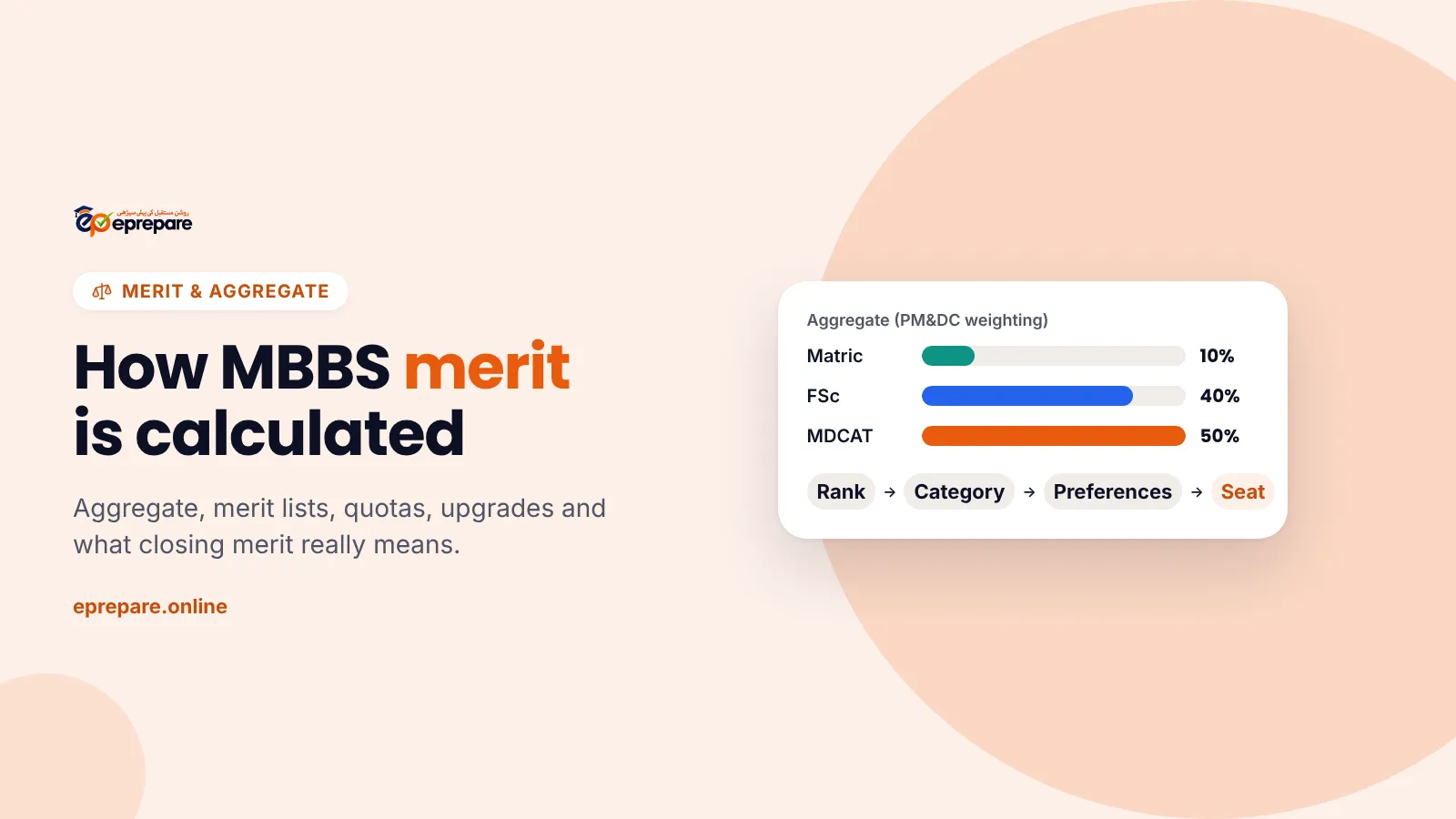
For medical and dental colleges, PM&DC's admission regulations set Matric 10%, FSc 40% and MDCAT 50%, and every admitting university (KMU, UHS, Sindh's universities, Balochistan, SZABMU and NUMS) uses that split. MDCAT is out of 180, while NUMS announces its result as a percentage. The university-by-university details, worked examples and decimals are in our full guide on how to calculate MDCAT aggregate, and the MDCAT aggregate calculator does the sum for you.
Same marks, different aggregates
Because the weights differ, the same student can end up with quite different aggregates. Take Matric 1000/1100 (90.91%), FSc 81.82% (900/1100, assuming the same percentage in Part-I) and 70% in each test:
| Formula | Matric part | FSc part | Test part | Aggregate |
|---|---|---|---|---|
| NUST NET (10/15/75) | 9.09 | 12.27 | 52.50 | 73.86% |
| MDCAT and ETEA (10/40/50) | 9.09 | 32.73 | 35.00 | 76.82% |
| KMU CAT (10/50/40) | 9.09 | 40.91 | 28.00 | 78.00% |
| UET Lahore ECAT (17/50/33) | 15.45 | 40.91 | 23.10 | 79.46% |
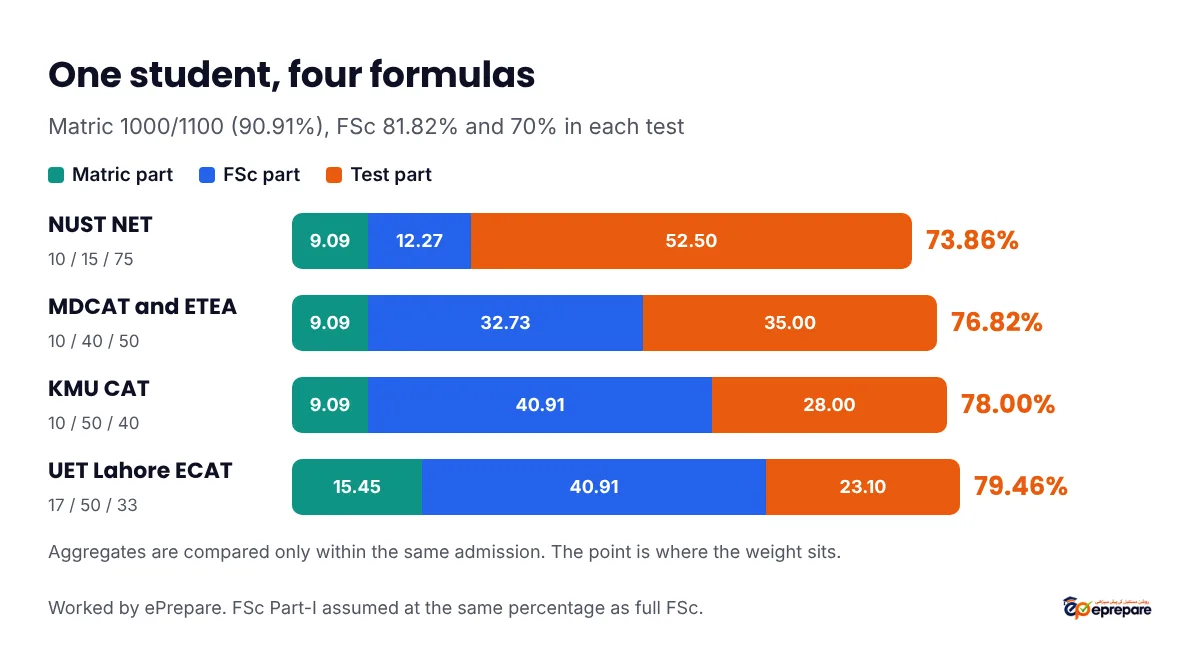
The lesson is not that one formula is "easier". Aggregates are only compared within the same admission, so a 79% under ECAT and a 74% under NUST mean nothing side by side. What matters is where the weight sits. For NUST, the test is almost everything. For ECAT and KMU CAT, your FSc Part-I or FSc marks carry more of the aggregate than the test.
What one test mark is worth
Divide the test's weight by its total marks and you get the aggregate points one mark adds:
| Test | Weight ÷ total | Aggregate points per mark |
|---|---|---|
| ETEA (pre-medical group) | 50 ÷ 65 | 0.769 |
| ETEA (100 MCQs) | 50 ÷ 100 | 0.500 |
| KMU CAT | 40 ÷ 100 | 0.400 |
| NUST NET | 75 ÷ 200 | 0.375 |
| MDCAT | 50 ÷ 180 | 0.278 |
| ECAT | 33 ÷ 400 | 0.0825 per point (0.33 per correct answer) |
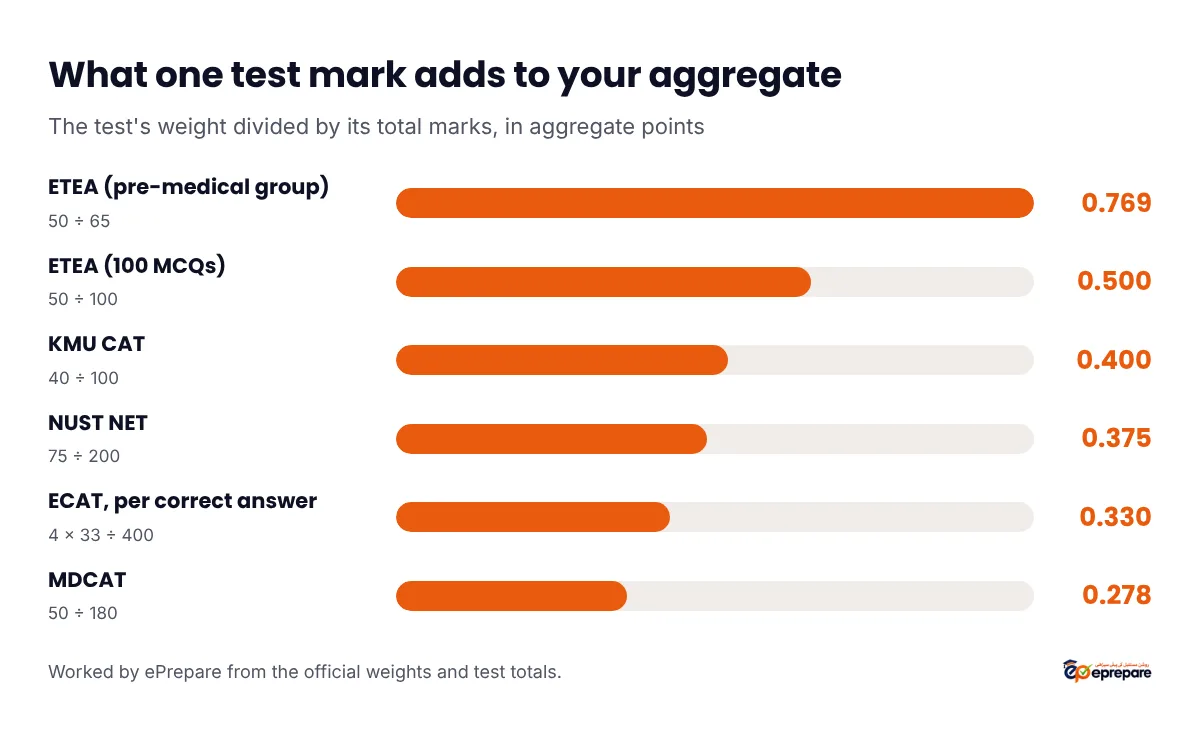
An ECAT correct answer is worth four points, so each right answer adds 4 × 0.0825 = 0.33 aggregate points. In every test, a single careless mistake costs more than a lot of board marks, which is why steady practice under timed conditions pays off.
Common mistakes when calculating aggregate
- Using full FSc when the university uses Part-I. UET Peshawar and UET Lahore both use first-year marks for most applicants. NUST accepts Part-I or the full HSSC.
- Using the wrong test total. NET is out of 200, ECAT out of 400, ETEA out of 100 (65 for pre-medical), KMU CAT out of 100 and MDCAT out of 180.
- Using another university's weights. A "10/40/50" calculator gives a wrong answer for NUST or UET Lahore.
- Forgetting the eligibility minimums. NUST asks for 60% in both SSC and HSSC, UET Peshawar for 60% unadjusted marks in Intermediate, and KMU CAT for 50% in FSc (60% for DPT). Below these, your aggregate is not considered.
- Relying on last year's prospectus. Weights can change. Check the current year's prospectus before you apply.
Frequently asked questions
How do I calculate my ETEA aggregate?
For UET Peshawar engineering admissions, take 10% of your Matric percentage, 40% of your FSc Part-I percentage (adjusted marks) and 50% of your ETEA percentage, and add them. ETEA is out of 100 for pre-engineering candidates; pre-medical candidates' 65 marks count as 100%.
How do I calculate my NUST aggregate?
NET 75%, HSSC (Part-I or full) 15% and SSC 10%. NET is out of 200, so 140 in NET is 70%, which adds 52.5 to your aggregate.
Is there an HEC aggregate formula?
No single one. HEC recommends USAT, but each university decides whether to accept it and sets its own weights. HEC's own Balochistan and FATA (Phase-III) undergraduate scholarships use SSC 20%, HSSC 30% and the HEC/ETC test 50%.
What is the KMU CAT aggregate formula?
For admission to KMU's BS allied health programmes, SSC 10%, Intermediate (Pre-Medical) 50% and KMU-CAT 40%. KMU-CAT is out of 100.
What is the UET Lahore ECAT aggregate formula?
ECAT 33%, FSc Part-I 50% and Matric 17% for the Intermediate stream. ECAT is out of 400 (100 questions, four points each), and the minimum aggregate for admission is 50%.
Is the aggregate for university admission the same everywhere?
No. The test's weight ranges from 33% (UET Lahore ECAT) to 75% (NUST NET) among the formulas in this guide. Always use the formula in the prospectus of the university you are applying to.
Can I use my best score if I take a test twice?
For NUST NET, ETEA (UET Peshawar) and ECAT (UET Lahore), yes: each says the best score counts for merit within the admission cycle.
Your next step
If medicine is your goal, the formula you need is MDCAT's, and the score you need comes from last year's closing merit. Work it out in the MDCAT aggregate calculator, compare it on the MDCAT closing merit page, and when you are ready to prepare, register on ePrepare for lectures, chapter-wise MCQs and full-length papers that show your predicted score as you go.
Sources: NUST merit generation criteria (NET basis); NUST FAQ on NET duration and MCQs; NUST guide to UG admissions (brochure); UET Peshawar undergraduate prospectus 2026-27; ETEA computer-based entrance test 2026 advertisement; UET Lahore undergraduate prospectus Fall 2026; About ECAT (UET Lahore); KMU BS undergraduate admission portal; KMU-CAT; HEC: USAT optional for university admissions; HEC USAT content weightages; HEC Balochistan and FATA (Phase-III) scholarship FAQs.