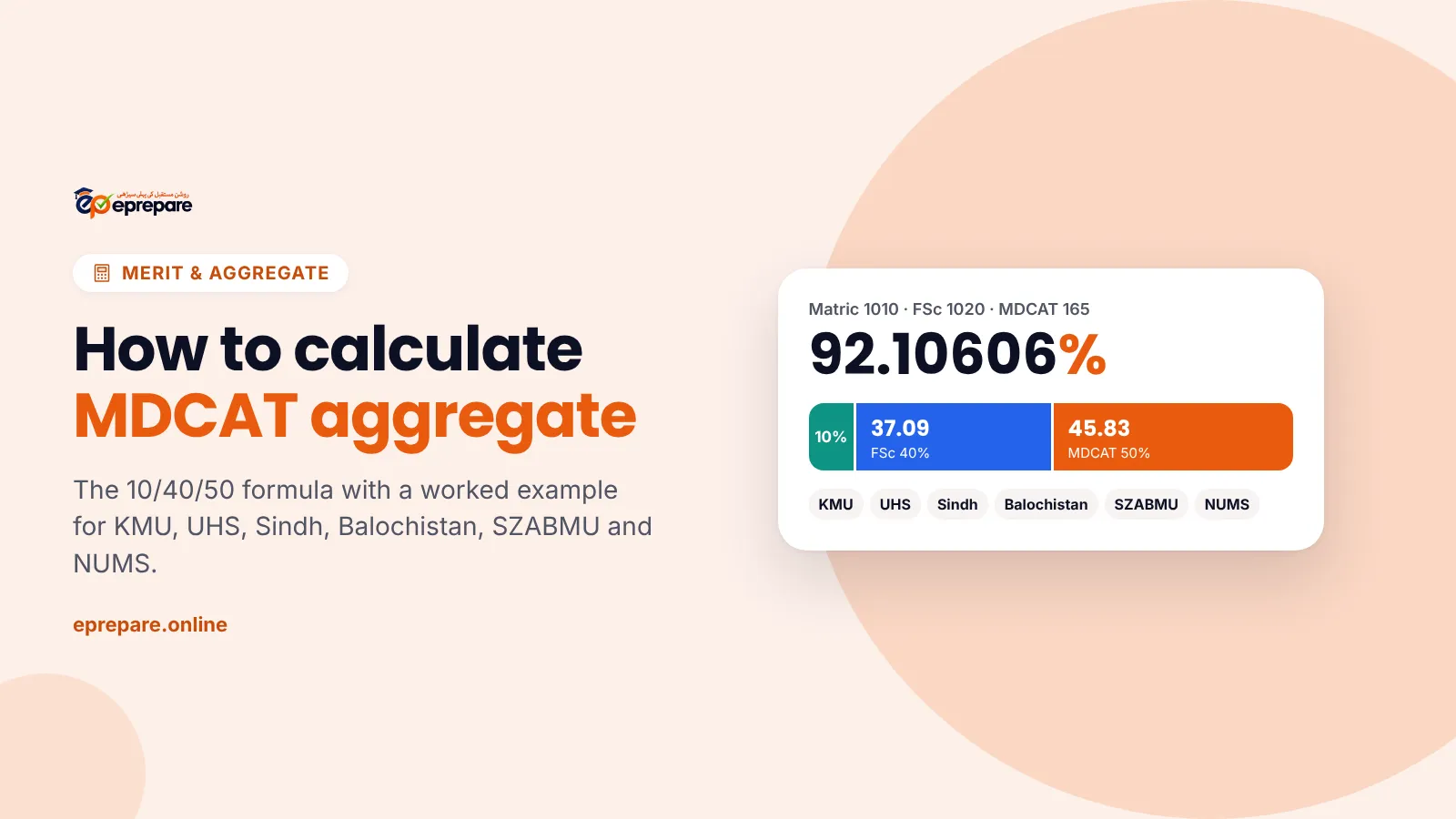
Every medical and dental college in Pakistan ranks applicants by one number: the aggregate. It joins your Matric, FSc and entry test results into a single percentage, and seats are filled from the top of that list down. If you can calculate it yourself, you know exactly where you stand and what MDCAT score you still need.
This guide shows the formula step by step and works through a real example for each admitting university: KMU, UHS, Sindh, Balochistan, SZABMU (Islamabad) and NUMS. It also covers the small rules that differ between them, the mistakes students make most often, and how to work backwards from the aggregate you want to the MDCAT score you need.
The short answer: Aggregate = 10% of your Matric percentage + 40% of your FSc percentage + 50% of your MDCAT percentage. Every admitting university in Pakistan uses this split. For example, Matric 1010/1100, FSc 1020/1100 and MDCAT 165/180 give 9.18182 + 37.09091 + 45.83333 = 92.10606%.
The MDCAT aggregate formula: 10%, 40% and 50%
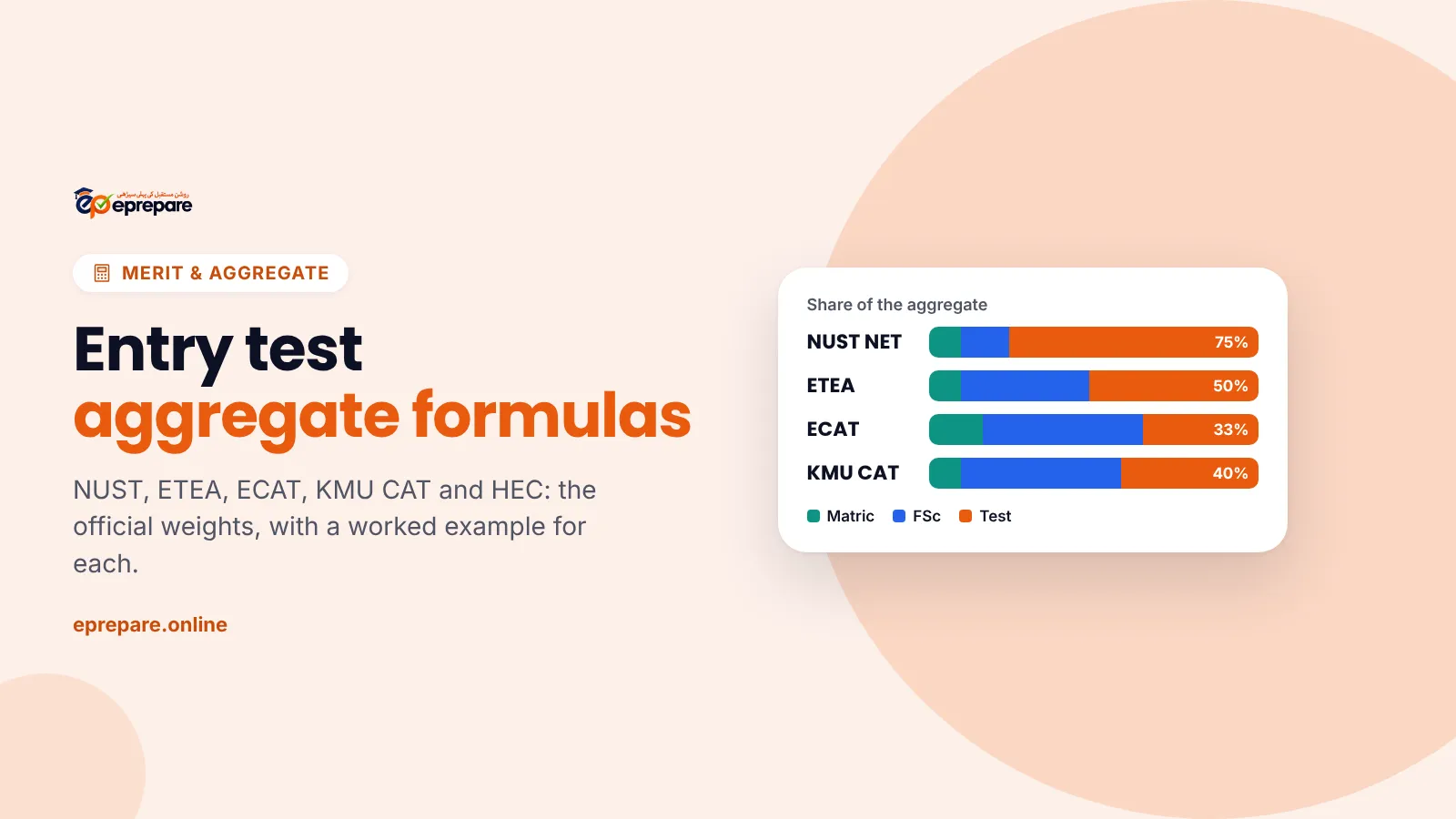
PM&DC's admission regulations set the weighting, and every admitting university follows it: Matric (SSC or equivalent) counts 10%, FSc (HSSC pre-medical or equivalent) counts 40%, and the entry test counts 50%. The test alone weighs as much as Matric and FSc together.
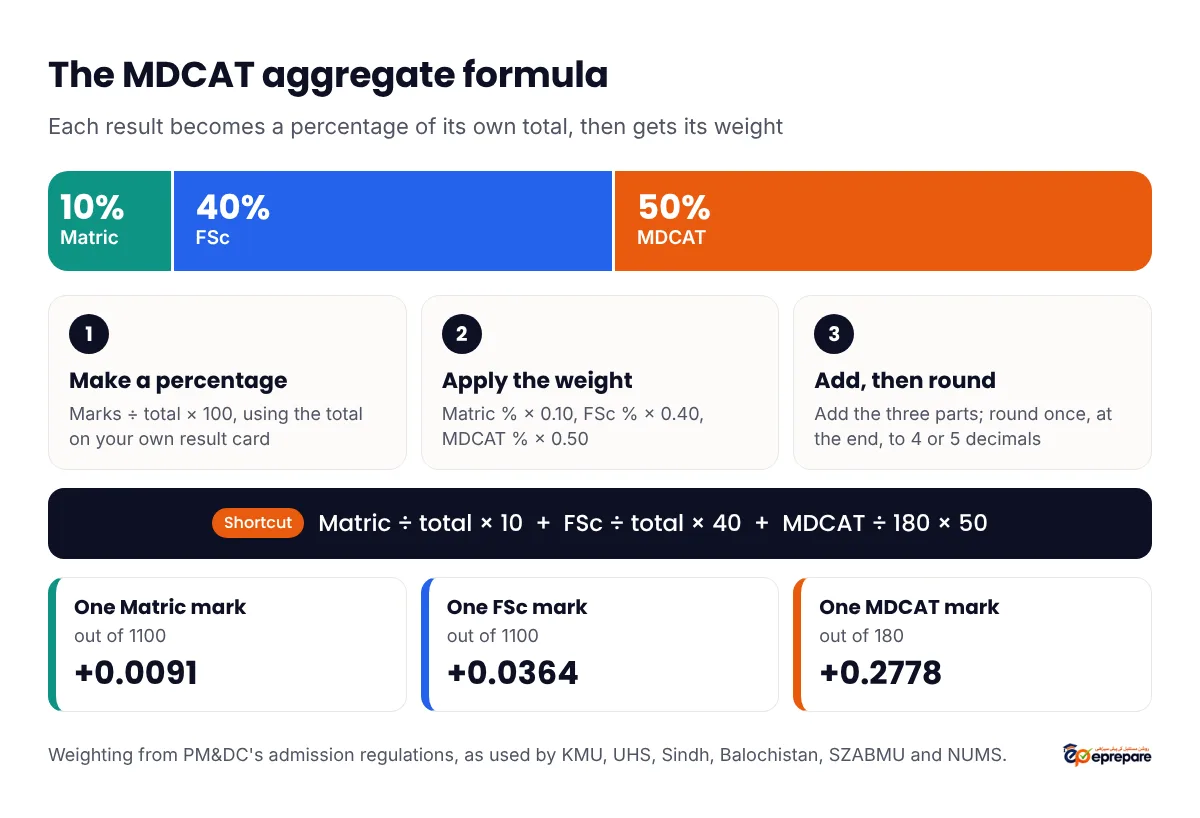
Aggregate % = (Matric marks ÷ Matric total × 100) × 0.10 + (FSc marks ÷ FSc total × 100) × 0.40 + (MDCAT marks ÷ 180 × 100) × 0.50
How to calculate it, step by step
- Write down each result with its own total. Take the totals from your result cards, for example 1100 or 1200 for Matric and FSc. The PM&DC MDCAT is out of 180.
- Turn each result into a percentage. Divide the marks by the total and multiply by 100.
- Apply the weights. Multiply the Matric percentage by 0.10, the FSc percentage by 0.40 and the MDCAT percentage by 0.50.
- Add the three parts. The total is your aggregate, already a percentage because the weights add up to 100.
- Round once, at the end, to the number of decimals your university uses (four or five; see the table below).
There is a shortcut that does steps 2 and 3 in one go. Divide each result by its total and multiply by its weight as a whole number:
- Matric part = Matric marks ÷ Matric total × 10
- FSc part = FSc marks ÷ FSc total × 40
- MDCAT part = MDCAT marks ÷ 180 × 50
So 1020 out of 1100 in FSc is 1020 ÷ 1100 × 40 = 37.09091, the same answer as 92.72727% × 0.40.
Worked examples for every university
The formula is the same everywhere, but each university has its own test format, rounding and seat rules. The examples below use the same marks as our university calculators, so you can open the calculator and check each one.
KMU (Khyber Pakhtunkhwa)
Khyber Medical University (KMU) admits students to the public medical and dental colleges of Khyber Pakhtunkhwa (KP), and runs a separate portal for KPK's private colleges on the same formula. KMU works the aggregate to five decimal places. A student has Matric 1010/1100, FSc 1020/1100 and MDCAT 165/180:
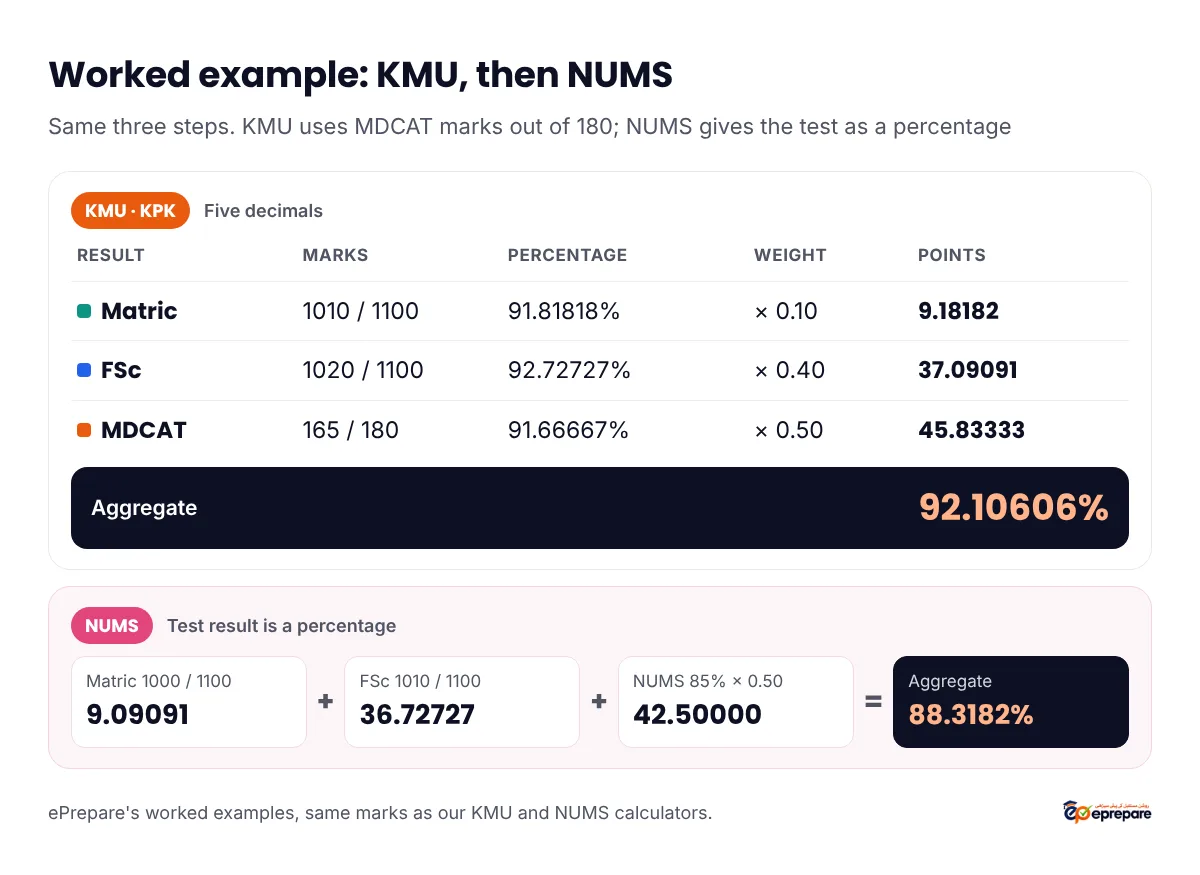
- Matric: 1010 ÷ 1100 × 10 = 9.18182
- FSc: 1020 ÷ 1100 × 40 = 37.09091
- MDCAT: 165 ÷ 180 × 50 = 45.83333
- Aggregate = 9.18182 + 37.09091 + 45.83333 = 92.10606%
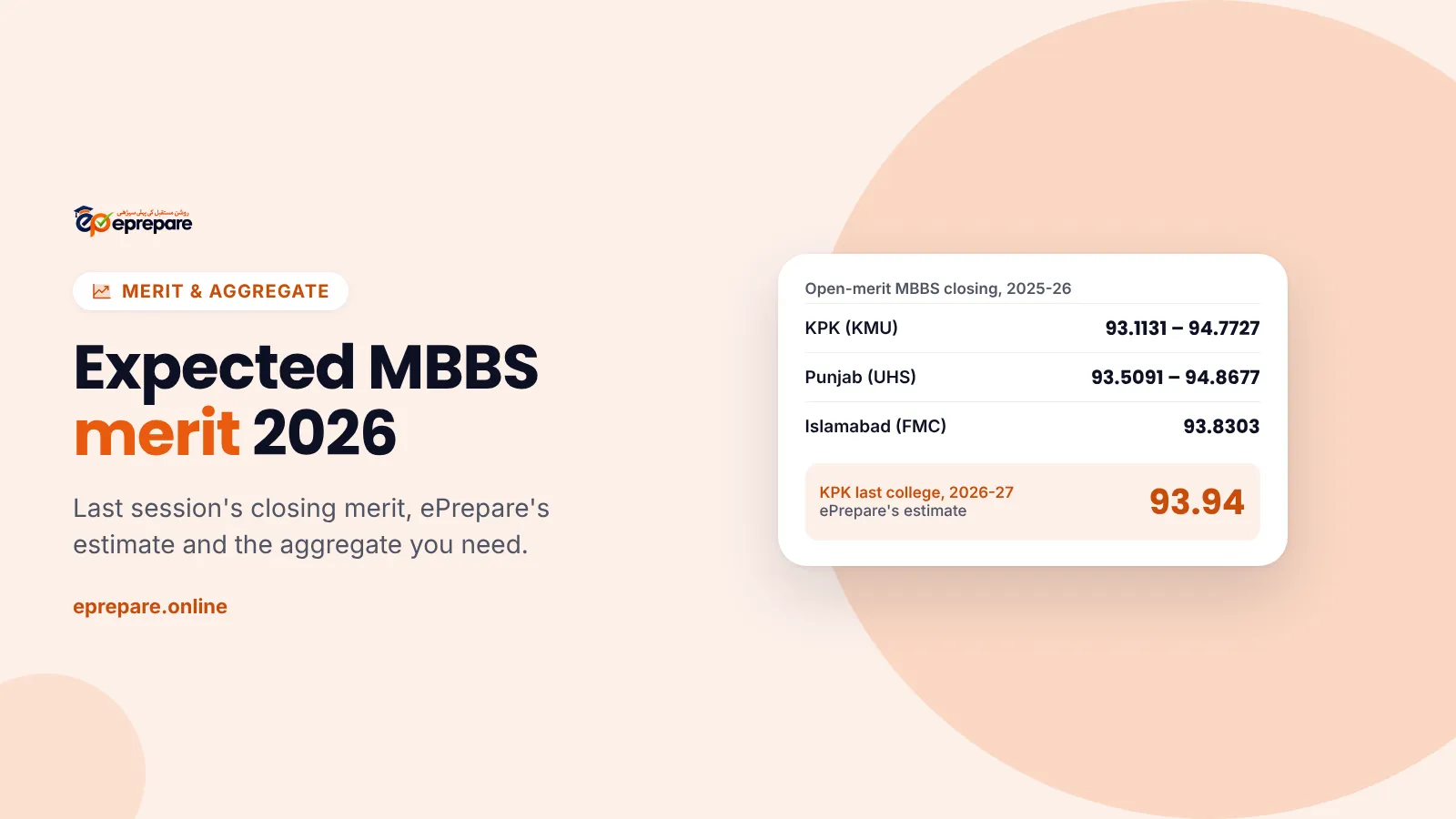
For context, KPK's last open-merit MBBS seat in 2025-26 closed at 93.107. This student was about one aggregate point short, which is roughly four MDCAT marks: with the same board marks, 169 out of 180 would have reached it. Our KPK aggregate formula guide goes deeper into KMU's rules and every college's closing merit, and the KMU merit calculator does the sum for you.
UHS (Punjab)
The University of Health Sciences (UHS), Lahore runs centralised admission to Punjab's public and private medical and dental colleges. Its prospectus says: "Final calculation in percentage will be rounded up to four decimal points." A student has Matric 1050/1100, FSc 1040/1100 and MDCAT 170/180:
- Matric: 1050 ÷ 1100 × 10 = 9.54545
- FSc: 1040 ÷ 1100 × 40 = 37.81818
- MDCAT: 170 ÷ 180 × 50 = 47.22222
- Aggregate = 94.585859…, rounded to four decimals = 94.5859%
In UHS's final list for 2025-26, that would have been above the open-merit closing of Allama Iqbal Medical College, Lahore (94.4530) and below King Edward Medical University (94.8677). Try your own marks in the UHS merit calculator.
Sindh (JSMU, LUMHS and SMBBMU)
Sindh's public colleges admit through processing universities: Jinnah Sindh Medical University (JSMU) for Karachi Division in 2026-27, Liaquat University (LUMHS) in Jamshoro and SMBBMU in Larkana. Sindh's prospectus uses Matric (or O level equivalence) 10%, HSC (or A level equivalence) 40% and MDCAT 50%, and says: "All calculation in percentages will be rounded up to five decimal points."
The prospectus even gives its own example: Matric 650/850, HSC 660/1100 and MDCAT 99/180 give 7.647 + 24.000 + 27.500 = 59.147%. Notice the Matric total of 850: whatever total your certificate shows is the one you divide by. Here is a more typical applicant, with Matric 980/1100, FSc 1000/1100 and MDCAT 158/180:
- Matric: 980 ÷ 1100 × 10 = 8.90909
- FSc: 1000 ÷ 1100 × 40 = 36.36364
- MDCAT: 158 ÷ 180 × 50 = 43.88889
- Aggregate = 89.16162%
In Sindh, you compete only with candidates of your own district, so the same aggregate can be inside merit in one district and short in another. The Sindh merit calculator works to five decimals.
Balochistan (Bolan Medical College and the Selection Committee)
In Balochistan, Bolan Medical College in Quetta takes the applications and a provincial Selection Committee makes the merit lists; BUMHS conducts the MDCAT in the province. The prospectus says merit "will be calculated as an Aggregate" of Matriculation 10%, HSSC pre-medical 40% and MDCAT 50%. A student has Matric 950/1100, FSc 980/1100 and MDCAT 150/180:
- Matric: 950 ÷ 1100 × 10 = 8.63636
- FSc: 980 ÷ 1100 × 40 = 35.63636
- MDCAT: 150 ÷ 180 × 50 = 41.66667
- Aggregate = 85.93939, shown to four decimals = 85.9394%
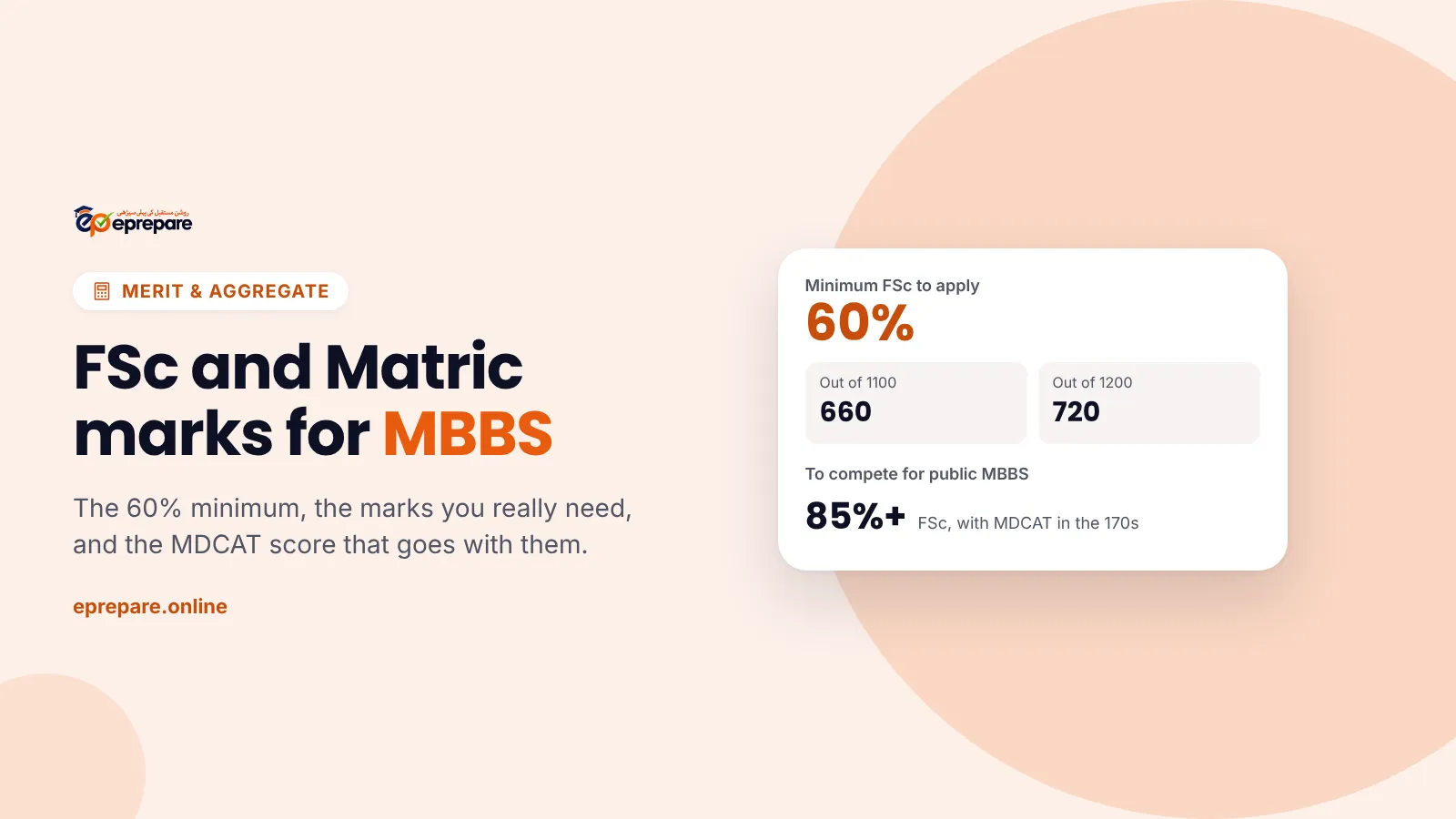
Balochistan's 2025-26 prospectus asked for 65% in FSc, above PM&DC's national minimum of 60%, so check the current one before you apply. Use the Balochistan merit calculator for your own marks.
Islamabad (SZABMU)
Shaheed Zulfiqar Ali Bhutto Medical University (SZABMU) admits students to the federal public colleges: Federal Medical College, Islamabad, its School of Dentistry, and Shaikh Khalifa Bin Zayed Al-Nahyan Medical and Dental College in Lahore. Its merit lists print the aggregate to five decimals. A student has Matric 1010/1100, FSc 1030/1100 and MDCAT 166/180:
- Matric: 1010 ÷ 1100 × 10 = 9.181818
- FSc: 1030 ÷ 1100 × 40 = 37.454545
- MDCAT: 166 ÷ 180 × 50 = 46.111111
- Aggregate = 92.747474, rounded to five decimals = 92.74747%
This example shows why you round only at the end. If you round each part to five decimals first (9.18182 + 37.45455 + 46.11111), you get 92.74748, one step too high. At five decimals, that can decide who is placed above whom.
Everyone competes on open merit and on their own domicile quota. In 2025-26 this aggregate would have been below Federal Medical College's open-merit closing (93.8303) but above the Islamabad (ICT) quota's closing (92.4051). The Islamabad merit calculator shows every quota.
NUMS (Army Medical College, CMH and other NUMS colleges)
The National University of Medical Sciences (NUMS) uses the same weighting: its advert lists the entrance test 50%, HSSC/FSc 40% and SSC/Matric 10%. The difference is the test. The NUMS MDCAT has 200 MCQs (150 subject MCQs in Paper I and a 50-MCQ psychological test in Paper II), and NUMS announces the result as a percentage. So the test part is simply half of that percentage. A student has Matric 1000/1100, FSc 1010/1100 and 85% in the NUMS test:
- Matric: 1000 ÷ 1100 × 10 = 9.09091
- FSc: 1010 ÷ 1100 × 40 = 36.72727
- NUMS test: 85 × 0.50 = 42.50000
- Aggregate = 88.31818, shown to four decimals = 88.3182%
Do not turn your NUMS percentage into marks out of 200 or 180 first. NUMS has not published how Paper II is scored into the total, so the percentage printed on your result is the figure to use. Enter it in the NUMS merit calculator, and see NUMS colleges, fees and admission for last session's selection lists.
What differs between universities
The weighting never changes. What changes is the test total, the decimals the list is ranked by, and what happens when two students have the same aggregate.
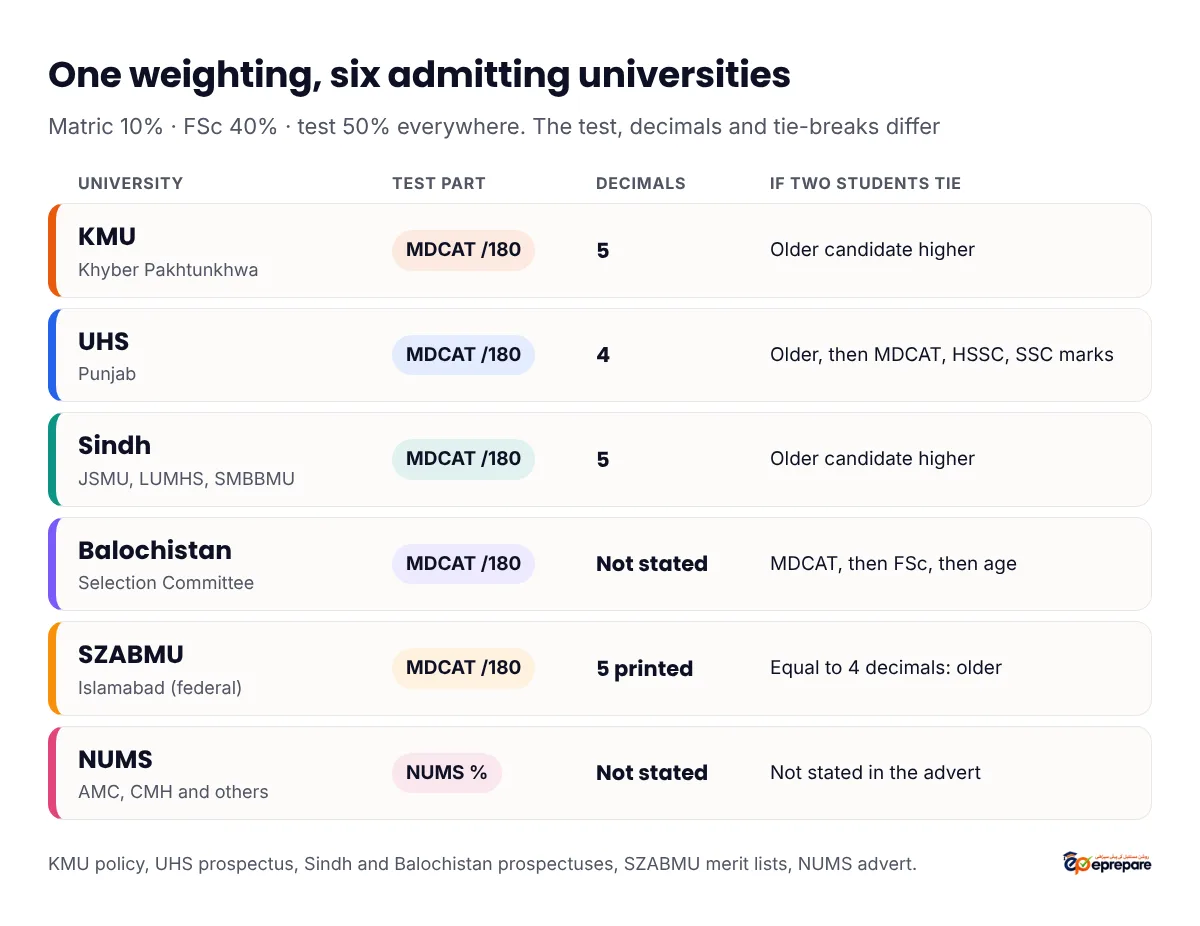
| University | Test part | Decimals | If two students tie |
|---|---|---|---|
| KMU (KPK) | MDCAT out of 180 | 5 | The older candidate is placed higher |
| UHS (Punjab) | MDCAT out of 180 | 4 | Older candidate, then more MDCAT marks, then more HSSC marks, then more SSC marks |
| Sindh | MDCAT out of 180 | 5 | The older candidate is placed higher |
| Balochistan | MDCAT out of 180 | Not stated in the prospectus | Higher MDCAT marks, then higher FSc marks, then age |
| SZABMU (Islamabad) | MDCAT out of 180 | 5 printed | Equal up to four decimals: the older candidate |
| NUMS | NUMS test percentage | Not stated in the advert | Not stated in the advert |
If your MDCAT result is from an earlier year and was out of 200, divide by 200 instead of 180. KMU's policy says an MDCAT result "shall be valid for the entire country and shall be valid for a period of three years", and UHS's prospectus scales an older result on its own total.
Quick-reference table
Keep this table handy when you fill in an application or check a merit list.
| Applying to | Admitting university | Test part of your aggregate | Calculator |
|---|---|---|---|
| KPK public and private colleges | KMU | MDCAT ÷ 180 × 50 | KMU |
| Punjab public and private colleges | UHS | MDCAT ÷ 180 × 50 | UHS |
| Sindh public colleges | JSMU, LUMHS, SMBBMU | MDCAT ÷ 180 × 50 | Sindh |
| Balochistan public colleges | Selection Committee (via Bolan Medical College) | MDCAT ÷ 180 × 50 | Balochistan |
| Federal public colleges, Islamabad | SZABMU | MDCAT ÷ 180 × 50 | Islamabad |
| Army Medical College and NUMS colleges | NUMS | NUMS % × 0.50 | NUMS |
And what one mark is worth in your aggregate:
| One mark of | Adds to your aggregate |
|---|---|
| MDCAT (out of 180) | 0.2778 |
| NUMS test (1 percentage point) | 0.5000 |
| FSc (out of 1100) | 0.0364 |
| FSc (out of 1200) | 0.0333 |
| Matric (out of 1100) | 0.0091 |
| Matric (out of 1200) | 0.0083 |
One MDCAT mark is worth about 7.6 FSc marks out of 1100. That is why the MDCAT is the part to work on once your board results are fixed.
Which formula is mine?
Your formula depends on where you apply, not on where you took the test. Follow the college you want to the university that admits to it:
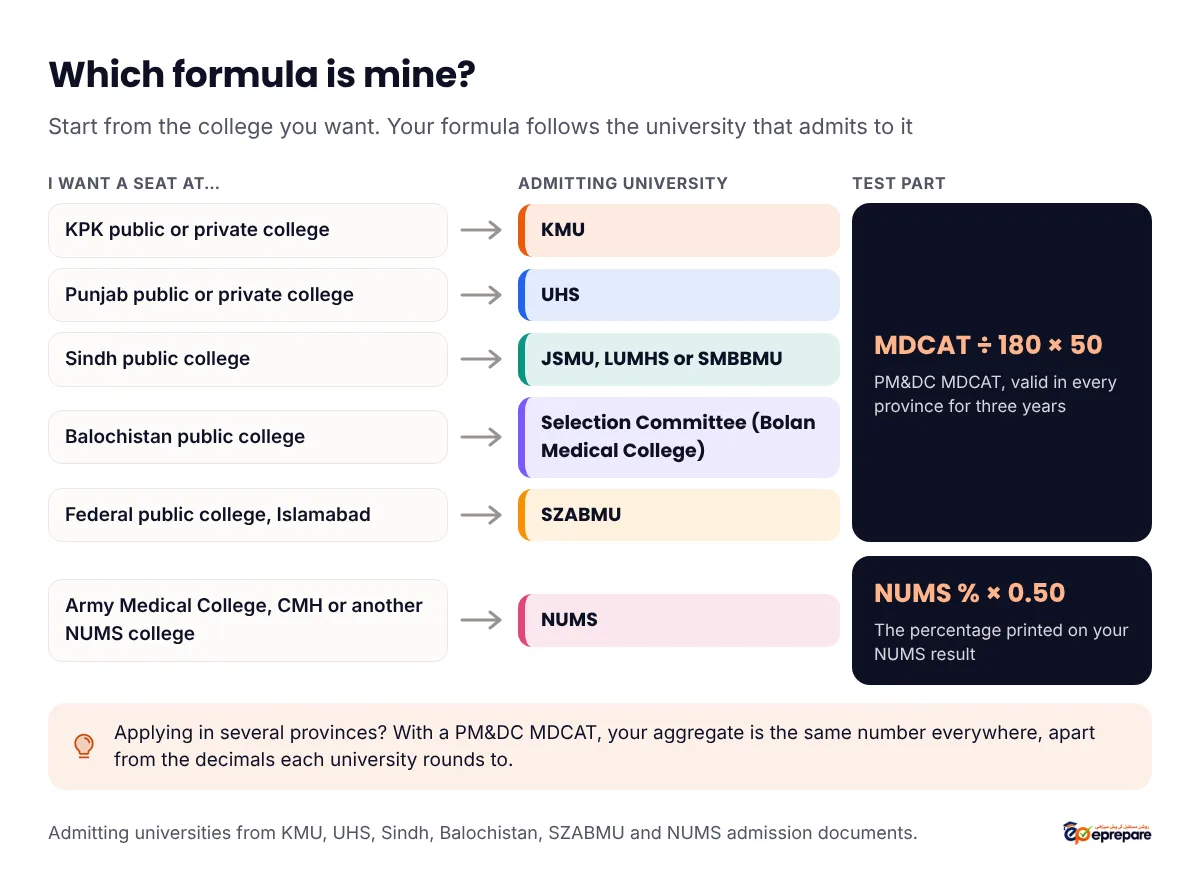
- Applying in more than one province? Your aggregate is the same number at KMU, UHS, Sindh, Balochistan and SZABMU, apart from the decimals each one rounds to. A PM&DC MDCAT result counts in every province. What changes is who you compete with and which seats you are eligible for.
- Applying to NUMS as well? You need a separate aggregate from your NUMS test percentage. NUMS also accepts a valid MCAT (USA) or UCAT (UK) score in place of its own test.
- Private colleges in KPK and Punjab use the same aggregate, through KMU's private portal and UHS. Islamabad's private colleges admit separately, so read their own notice.
- O and A level students use the marks and totals on their IBCC equivalence certificates, not their grades. Our guide to IBCC equivalence for MBBS explains how.
Common mistakes when calculating your aggregate
- Dividing by the wrong total (1100 vs 1200). Boards have used both totals. If your FSc is 1080 out of 1200, that is 90%. Divide by 1100 by mistake and you get 98.18%, which overstates your FSc part by 3.27 aggregate points. Always use the total printed on your own result card.
- Using FSc Part 1 marks as if they were final. Before your final result comes out, you can estimate by scaling your Part 1 percentage to the full total: divide your Part 1 marks by the Part 1 total printed on your card, then multiply by the full total. Treat that as an estimate. Your real aggregate uses the final result you submit by the closing date, and universities set rules about late or improved results: Balochistan's prospectus, for example, says improved marks or results declared after the closing date are not accepted for that session. If you are improving FSc, read KMU's rules for improvers and repeaters.
- Using 200 for a 180-mark MDCAT. The PM&DC MDCAT is 180 MCQs. Use 200 only if your older result was out of 200.
- Turning a NUMS percentage into marks. Enter the percentage as it appears on your NUMS result and take half of it.
- Averaging the three percentages. (90 + 92 + 88) ÷ 3 is not your aggregate. Each part has its own weight.
- Rounding too early. Keep every decimal until the final step, as the SZABMU example shows.
- Adding marks for Hifz-e-Quran. Calculators that add 20 marks are out of date. Punjab's admission policy says: "The marks for Hifz-e-Quran shall not be granted for admission to Medical and Dental Colleges."
Quick check: if any of your three percentages comes out above 100, or your aggregate is higher than your best single percentage, you have used the wrong total somewhere.
How to work backwards to the MDCAT score you need
Once your Matric and FSc results are out, they are fixed. The useful question becomes: what MDCAT score takes me to the aggregate I want? Our calculators answer it with one rearrangement of the formula:
MDCAT marks needed = (target aggregate − Matric part − FSc part) ÷ 50 × 180
- Work out your Matric part and FSc part as above.
- Subtract both from your target aggregate. What is left is the share the test must supply.
- Divide by 50 to get the fraction of the test you need, then multiply by the test total (180 for the MDCAT).
- Round up to a whole mark, because you cannot score part of an MCQ.
Read the answer like this: above 180 means the target is out of reach with your board marks; zero or below means your board marks alone already reach it; anything in between is your MDCAT target.
Example. Matric 1000/1100 and FSc 1000/1100 give 9.09091 + 36.36364 = 45.45455. To reach 93.107, KPK's last open-merit MBBS closing in 2025-26: (93.107 − 45.45455) ÷ 50 × 180 = 171.55, so the target is 172.
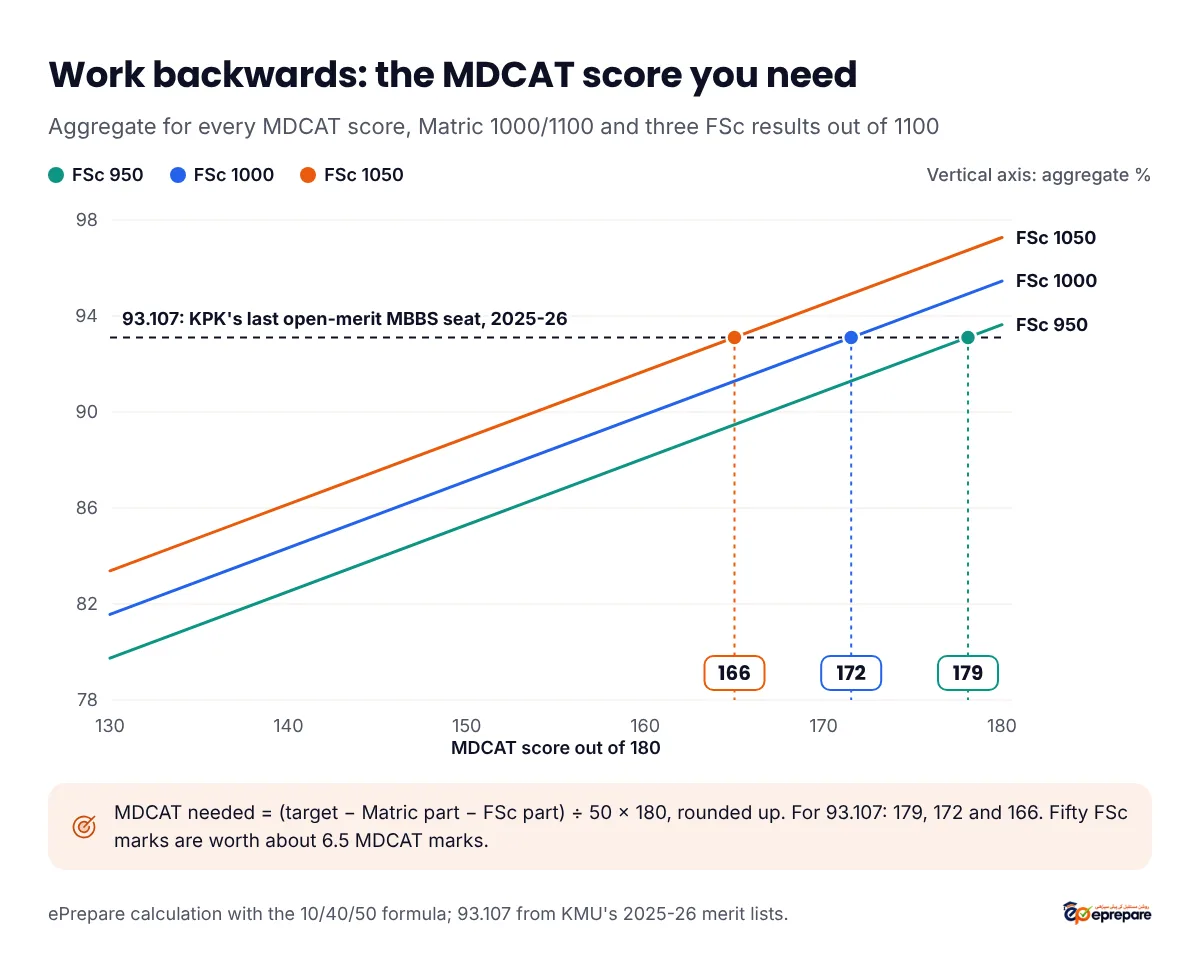
The chart shows the same idea for three students with Matric 1000/1100 and different FSc marks. Each FSc mark out of 1100 moves the line by 0.0364 aggregate points, so 50 FSc marks are worth about 6.5 MDCAT marks. Here are the targets in numbers:
| Target aggregate | FSc 950/1100 | FSc 1000/1100 | FSc 1050/1100 |
|---|---|---|---|
| 88 | 160 | 154 | 147 |
| 90 | 167 | 161 | 154 |
| 92 | 175 | 168 | 162 |
| 93.107 | 179 | 172 | 166 |
MDCAT marks out of 180, rounded up, with Matric 1000/1100 in every column.
For 93.107 with FSc 1050, the sum gives 165.003. A score of 165 gives 93.10606, just short, which is why you always round up.
For NUMS, work in percentages: NUMS % needed = (target − Matric part − FSc part) ÷ 0.5. With Matric 1000/1100 and FSc 1010/1100 (45.81818 together), reaching 86.5380, the lowest aggregate on CMH Multan's sixth MBBS open-merit list in 2025-26, takes (86.5380 − 45.81818) ÷ 0.5 = 81.44%.
Every university calculator on ePrepare has a target box that does this for you: enter the aggregate you want and it shows the score you need, using the same formula.
Frequently asked questions
How do I calculate my aggregate for MDCAT?
Turn your Matric, FSc and MDCAT marks into percentages of their own totals, then add 10% of the Matric percentage, 40% of the FSc percentage and 50% of the MDCAT percentage. Matric 1010/1100, FSc 1020/1100 and MDCAT 165/180 give 92.10606%.
How is MBBS aggregate calculated in Pakistan?
The same way for every admitting university: Matric 10%, FSc 40% and the entry test 50%, following PM&DC's admission regulations. KMU, UHS, Sindh, Balochistan, SZABMU and NUMS all use it. BDS uses the same aggregate too.
How is the NUMS aggregate calculated?
SSC/Matric 10%, HSSC/FSc 40% and the NUMS test 50%. NUMS gives your test result as a percentage, so the test part is half of it: 85% adds 42.5 to your aggregate.
Is the aggregate formula different in each province?
No. The weighting is the same in every province. What differs is the number of decimals, the tie-break rules and who you compete with, for example district-wise competition in Sindh.
Is MDCAT out of 180 or 200 for the aggregate?
Out of 180 for the current PM&DC MDCAT. Divide by 200 only if you are using an older result that was out of 200. For NUMS, use the percentage on your result.
My Matric or FSc total is 1200, not 1100. What do I do?
Divide by 1200. The formula works on percentages, so the total must match your own result card.
Can I calculate my aggregate with FSc Part 1 marks?
Only as an estimate. Scale your Part 1 percentage to the full total to see roughly where you stand. Admission uses your final FSc result, submitted by the university's closing date.
How much does one MDCAT mark add to my aggregate?
About 0.2778 aggregate points (50 ÷ 180). Ten more correct MCQs add about 2.78 points, often the gap between one college's closing merit and the next.
Turn your aggregate into a target
Once you know the MDCAT score you need, the rest is preparation. Put your marks into the aggregate calculator, compare the result with the closing merit in every province, and then build towards your score with ePrepare's question bank and full-length papers, which show your predicted score as you go. Create your free ePrepare account to start.
Sources: KMU admission policy, public colleges; UHS prospectus, MBBS and BDS; Punjab admission policy for MBBS and BDS; UHS final selection list 2025-26; Sindh MBBS/BDS admission prospectus (JSMU); Balochistan admission prospectus (Bolan Medical College); SZABMU MBBS admission and merit lists; NUMS centralised admissions advert; NUMS MDCAT table of specifications; KMU merit lists (cas.kmu.edu.pk).