Is the NUMS aggregate formula different from MDCAT's?
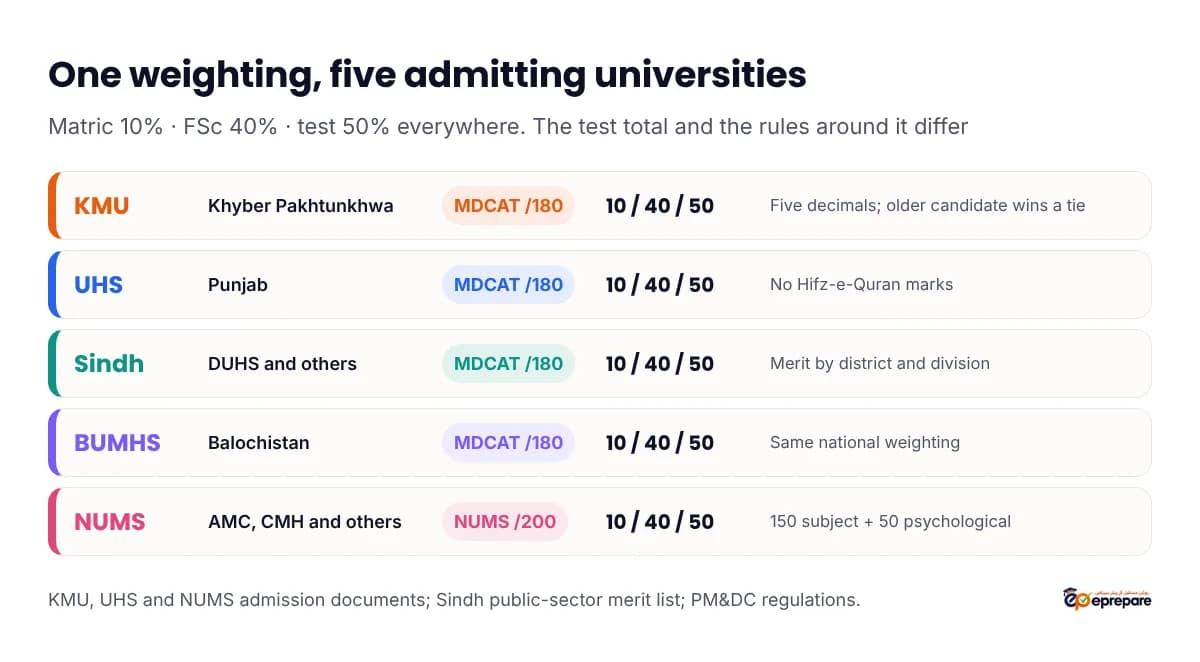
No. NUMS uses the same weighting, SSC 10%, HSSC 40% and entrance test 50%. The difference is that NUMS gives you the test result as a percentage, so the test part is simply half of it: 85% in the NUMS test adds 42.5 to your aggregate.
My NUMS result shows a percentage, not marks. What do I enter?
Enter the percentage exactly as it appears on your NUMS result, for example 82.5. You don't need to turn it into marks first: the calculator takes 50% of it for the test part.
Does NUMS count Matric in the aggregate?
Yes. NUMS gives SSC/Matric or equivalent a 10% weight. Claims that NUMS uses only FSc and the test are wrong.
How many MCQs are in the NUMS test?
200: Paper I has 150 subject MCQs (Biology 55, Chemistry 40, Physics 40, English 15) and Paper II is a 50-MCQ psychological test. There is no negative marking.
Can I apply to NUMS with an MCAT or UCAT score?
Yes. NUMS's admission advert accepts a valid MCAT (USA) or UCAT (UK) with 50% marks in the prescribed subjects as the entrance test.
How is merit calculated for MBBS in Pakistan?
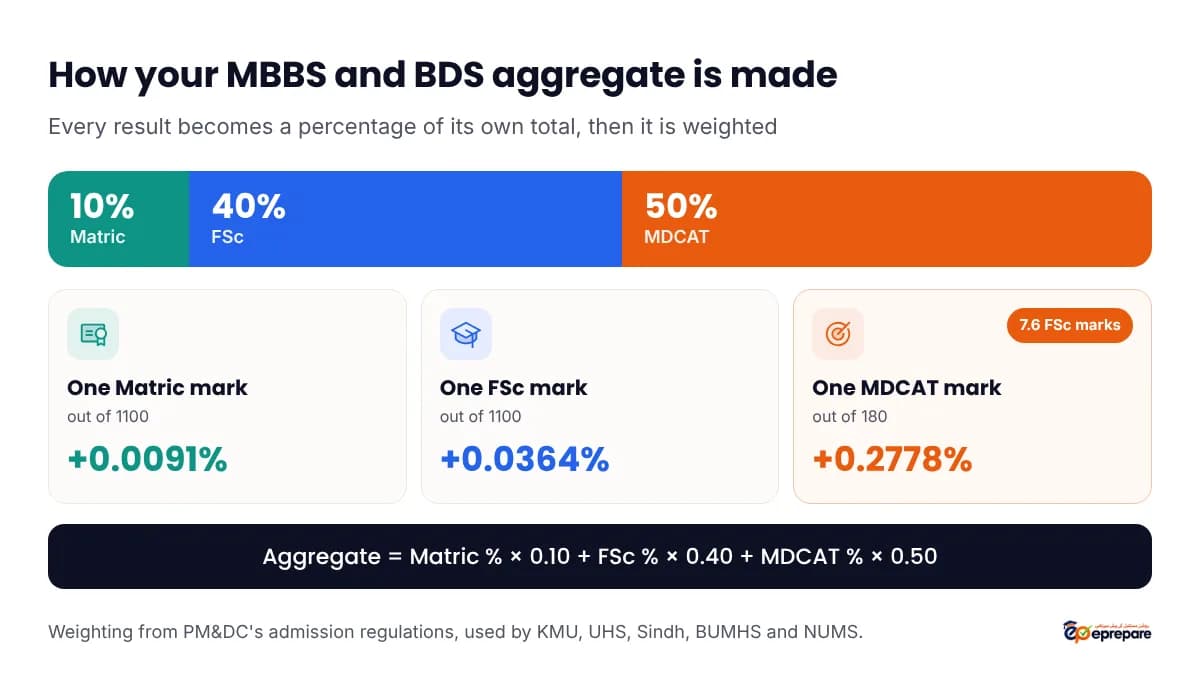
Merit for MBBS and BDS is your aggregate: 10% of your Matric percentage, 40% of your FSc percentage and 50% of your MDCAT percentage. KMU, UHS, the Sindh universities, Balochistan and NUMS all use this formula, then rank every applicant by it and fill seats in that order. Compare your merit with last session's closing merit for each college.
How do I calculate my MDCAT aggregate?
Turn each mark into a percentage of its own total, then add 10% of your Matric percentage, 40% of your FSc percentage and 50% of your MDCAT percentage. For example, Matric 990/1100 (90%), FSc 1010/1100 (91.82%) and MDCAT 160/180 (88.89%) give 9 + 36.7273 + 44.4444 = 90.1717%.
Is MDCAT out of 180 or 200?
PM&DC's MDCAT is 180 MCQs, one mark each. An MDCAT result stays valid for three years, so if you are using an older result that was out of 200, enter 200 as the total. NUMS is different: it announces its test result as a percentage, so on the NUMS calculator you enter that percentage instead of marks.
Is the aggregate formula different in each province?
No. KMU (KPK), UHS (Punjab), Sindh's universities, Balochistan's Selection Committee and NUMS all use 10% Matric, 40% FSc and 50% for the entry test, following PM&DC's admission regulations. What differs is the test total, the seat categories and who you compete with.
Do Hafiz-e-Quran students get extra marks?
No. Under PM&DC's admission regulations and a 2023 suo motu judgment, no additional marks are given for Hifz-e-Quran. Calculators that still add 20 marks are out of date.
What are the minimum marks to apply for MBBS and BDS?
At least 60% in HSSC (FSc pre-medical or equivalent), and at least 55% in MDCAT for MBBS or 50% for BDS (99 or 90 out of 180). In April 2026 PM&DC allowed a one-time relaxation of up to 3% only to fill seats left vacant in the 2025-26 session; the standard minimums are unchanged.
Which marks matter most in the aggregate?
MDCAT, by far. With a 1100-mark FSc, one MDCAT mark (out of 180) is worth about 7.6 FSc marks and about 30.6 Matric marks.
I did O and A levels. How do I calculate my aggregate?
Get your IBCC equivalence certificates and enter the equivalent marks and totals for Matric (O level) and FSc (A level). Universities use the IBCC figures, not your grades.
My FSc result has not come yet. Can I still estimate?
Yes. Enter the marks you expect, or your Part I marks scaled to the full total, to get an estimate. Your real aggregate will use the final result you submit before the closing date.
Is improving FSc or MDCAT better for my aggregate?
Usually MDCAT. Raising FSc by 50 marks (out of 1100) adds about 1.82% to your aggregate; raising MDCAT by 10 marks (out of 180) adds about 2.78%.