If you studied O and A levels, applying to Khyber Pakhtunkhwa's public medical and dental colleges has one extra step that FSc students never think about: the IBCC equivalence certificate. Your Cambridge or Edexcel grades mean nothing to KMU's merit formula until the Inter Board Committee of Chairmen (IBCC) turns them into Matric and FSc marks. Every year, some A level students with excellent grades miss admission because the equivalence came late, a required O level subject was missing, or the name on one certificate did not match the others.
This guide covers both sides: what KMU's latest admission policy asks of O and A level students, and what IBCC's own rules say about subjects, grades, marks and how to apply, taken from IBCC's official website, ibcc.edu.pk. It ends with a worked example that shows how your equivalence marks become a KMU aggregate.
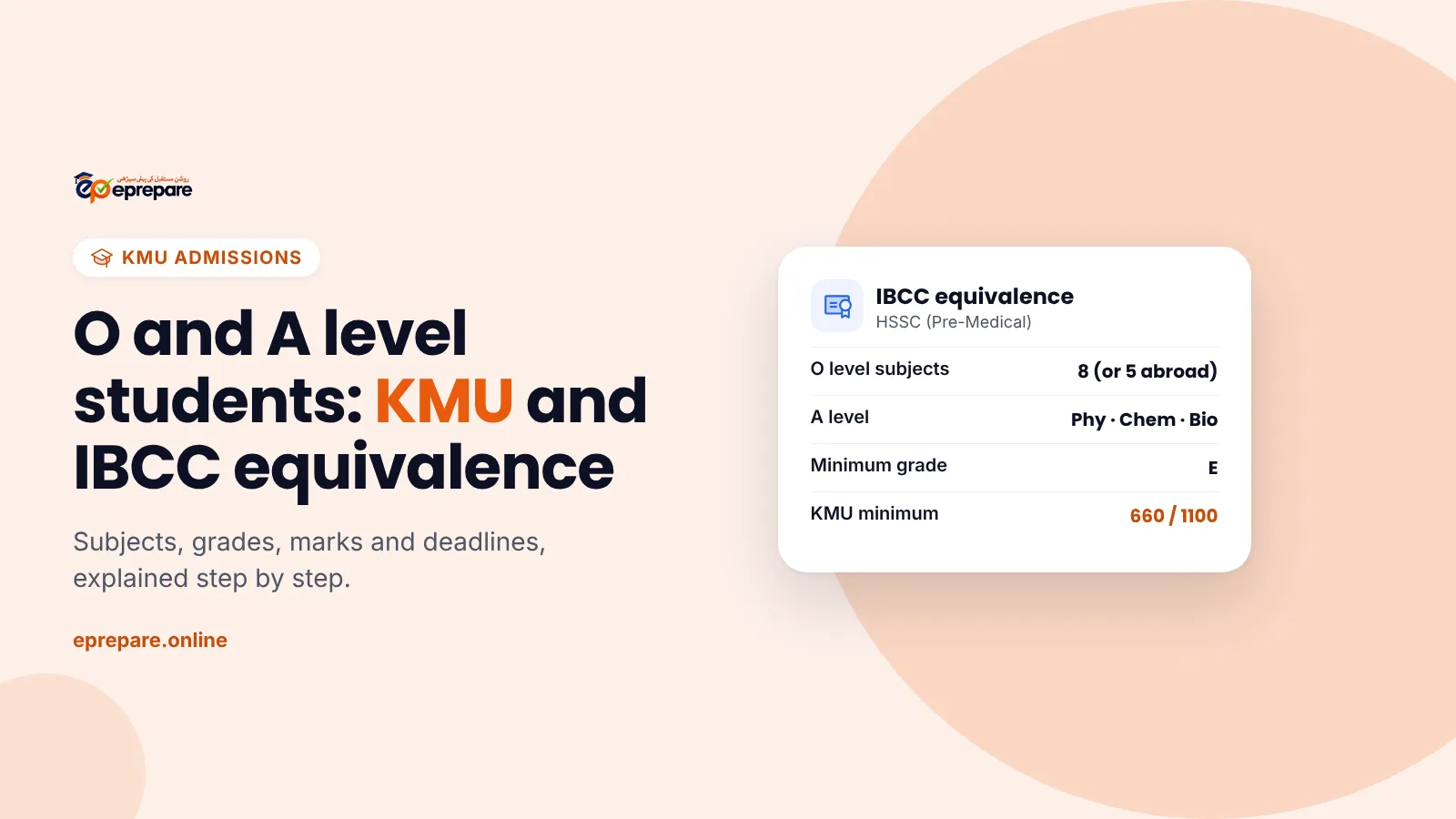
The short answer: KMU needs an IBCC equivalence certificate attached to your online form before the closing date, showing at least 60% of FSc total marks by IBCC's formula. You must have studied physics or maths, chemistry and biology through O and A levels, and passed English at O or A level. For a pre-medical equivalence, IBCC asks for physics, chemistry and biology at A level (grade E or better) on top of the required O level subjects, with biology compulsory for medicine. IBCC converts each grade into marks and issues SSC and HSSC equivalent marks, which KMU then uses for the 10% and 40% parts of your aggregate. Apply to IBCC as soon as your results are out; a provisional equivalence can be issued on a statement of results.
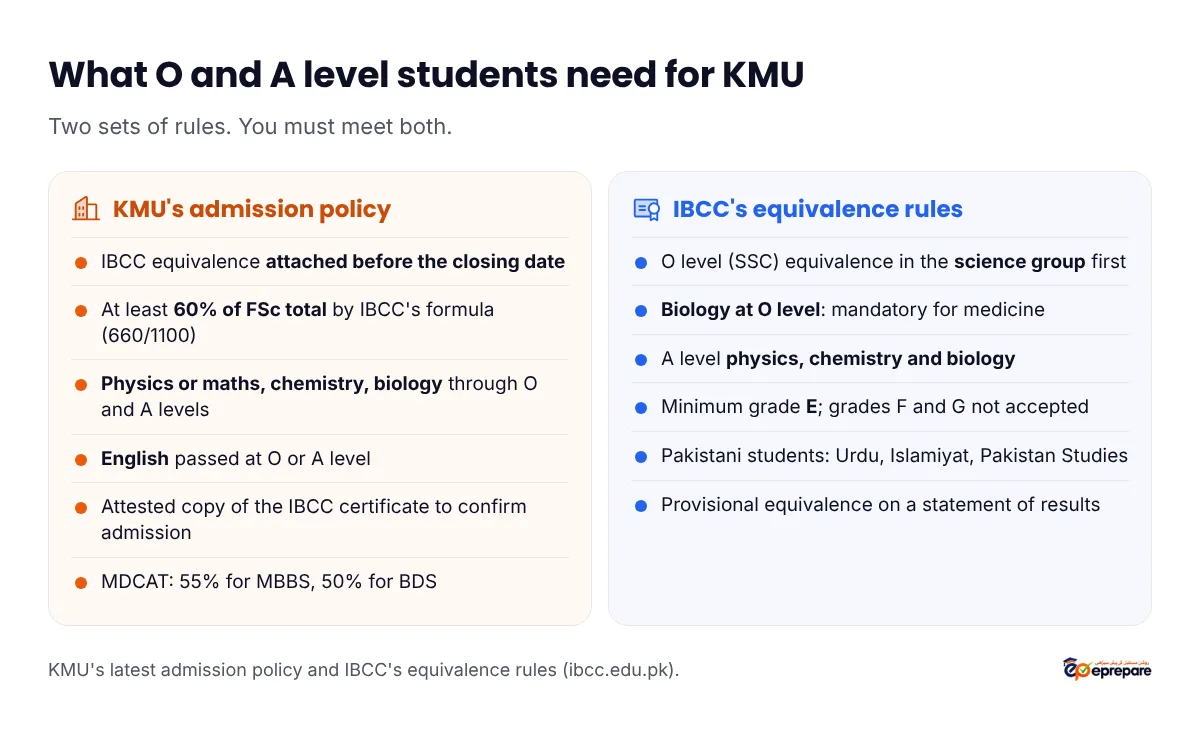
What KMU's policy says about O and A levels
KMU's policy does not have a separate O and A level section. Its rules sit inside the basic eligibility criteria and apply to anyone with a foreign qualification. These are the lines that matter, word for word:
"The equivalence certificate must be attached with the application form before the closing date. Confirmation of candidate's admission will be subject to production of attested photocopy of equivalence certificate issued by the IBCC Islamabad. The candidate has obtained marks equivalent to unadjusted 60% of FSc total marks according to the formula laid down by the IBCC, Islamabad."
"The equivalence certificates of such candidates will not be accepted if he/she has not studied and passed the subjects of Physics/Maths, Chemistry and Biology in his/her 9th, 10th, 11thand 12th Grade / O & A levels or other equivalent examination recognized by the IBCC. He/She must have passed English as a subject at O or A level."
In plain words, KMU checks five things:
| KMU rule | What it means for you |
|---|---|
| Equivalence attached before the closing date | Upload IBCC's certificate (or provisional letter) with your online form, not later |
| At least 60% of FSc total by IBCC's formula | Your HSSC equivalent marks must be at least 660 out of 1,100 |
| Physics or maths, chemistry and biology | Studied and passed through O and A levels |
| English at O or A level | An English pass on your certificates |
| Attested copy at confirmation | Keep attested photocopies of the IBCC certificate ready |
Two more rules in the policy hit O and A level students hardest. Certificates "issued after the closing date for admission, shall not be considered for the purpose of calculation of merit", and documents once submitted on the portal "cannot be changed and shall be considered as final". An equivalence that arrives a week late does not count.
Everything else is the same as for FSc students: an MDCAT pass of at least 55% for MBBS or 50% for BDS, and the domicile your seat category needs. See our full guide to KMU MBBS and BDS eligibility criteria.
What IBCC requires for a pre-medical equivalence
IBCC's British system (O and A levels) page sets the subject rules. IBCC treats A levels as equivalent to HSSC "subject to the completion of SSC-level qualifications", so you need an O level (SSC) equivalence in the science group first.
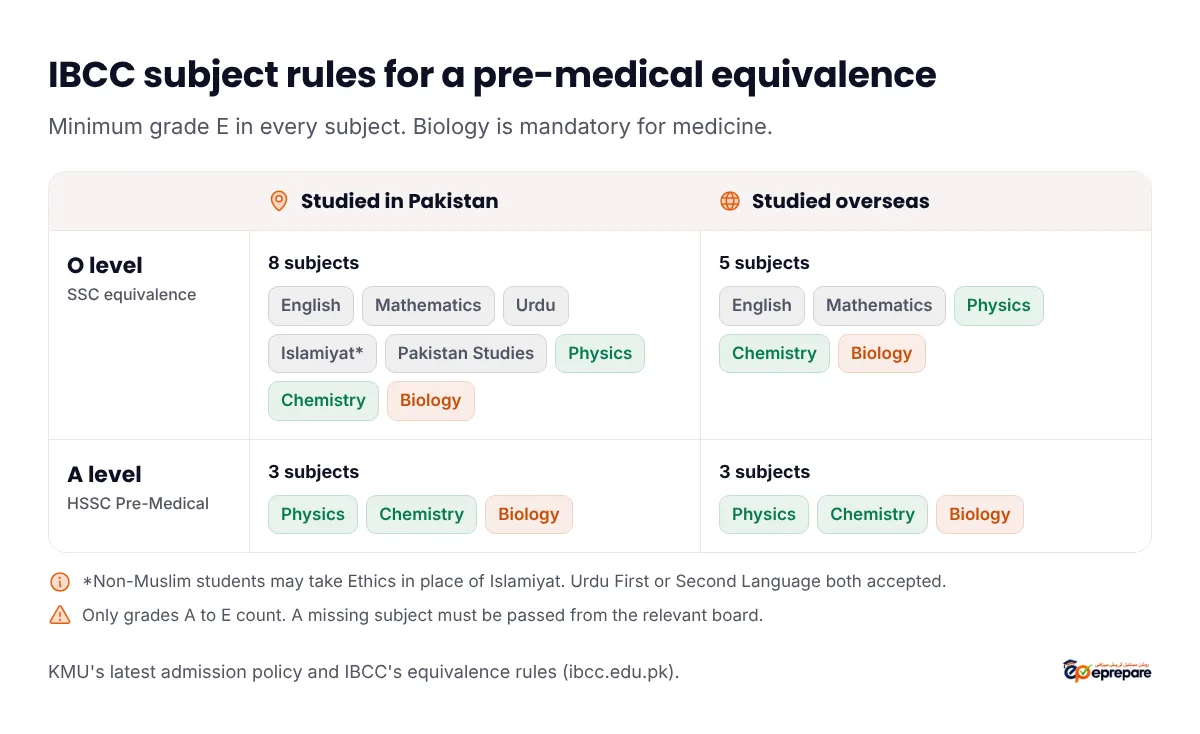
| Level | Studied in Pakistan | Studied overseas |
|---|---|---|
| O level (SSC) | 8 subjects: English, Mathematics, Urdu, Islamiyat, Pakistan Studies, plus physics, chemistry and biology | 5 subjects: English and Mathematics, plus physics, chemistry and biology |
| A level (HSSC pre-medical) | Physics, chemistry and biology | Physics, chemistry and biology |
| Minimum grade | E in every subject | E in every subject |
A few points from IBCC's equivalence FAQs that catch students out:
- Biology is compulsory for medicine. IBCC's British system page says biology "is mandatory for students pursuing Medicine", and IBCC's application form for British qualifications adds that "the student must study the subject of Biology at SSC level for equivalence of HSSC (Pre-Medical Group)." Without O level biology there is no pre-medical equivalence.
- Only grades A to E count. IBCC says it considers "grades A to E" and that F and G grades "did not meet the minimum threshold".
- Pakistani students need Urdu, Islamiyat and Pakistan Studies at IGCSE or O level. IBCC accepts both Urdu First Language and Urdu Second Language, and non-Muslim students may take Ethics in place of Islamiyat.
- A missing subject can be made up. If you are short of a required subject, IBCC says you must "pass the required subject from the relevant examination board". A subject studied at a higher level "may be considered" for a lower-level gap if the subject combination criteria are met.
- Different boards can be combined. IBCC says it "will consider all subjects for equivalence" if you took subjects with different UK boards.
How IBCC turns grades into marks
IBCC does not use one fixed grade-to-marks table. Its FAQs say grades are "converted to equivalent marks following IBCC's predefined formula", and that "Equivalence is calculated on a session-by-session basis", so the same grade can earn different marks in different exam sessions. That is why we cannot give you a universal conversion table, and why you should be wary of anyone who claims to.
What IBCC does publish is a worked example, in its example for calculating A level equivalence. It shows how the total is built:
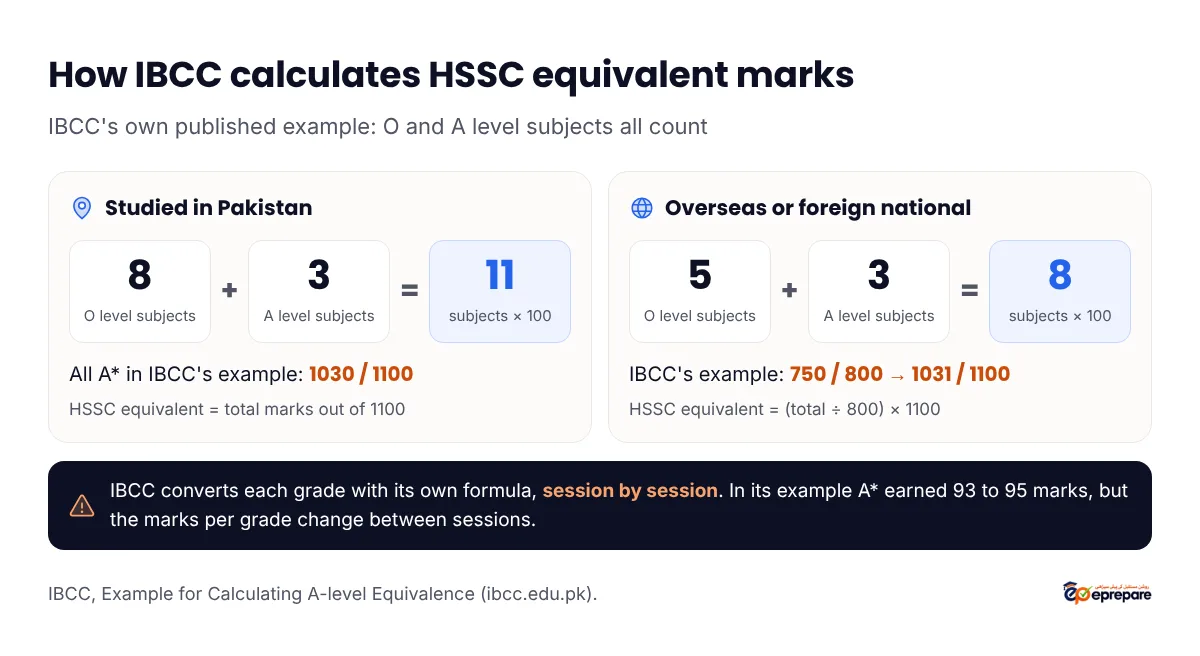
| Student | Subjects counted | IBCC's example |
|---|---|---|
| Pakistani, studied in Pakistan | 8 O level + 3 A level, each out of 100 | 1030 out of 1100 = HSSC equivalent marks |
| Studied overseas, or a foreign national | 5 O level + 3 A level, out of 800 | (750 ÷ 800) × 1100 = 1031 out of 1100 |
In IBCC's example, A* grades were worth 93 to 95 marks each. The lesson is important: your O level grades count towards your HSSC equivalent marks, not only your A levels. A weak O level result pulls down the FSc-equivalent figure that carries 40% of your KMU aggregate.
How your equivalence becomes a KMU aggregate
KMU's merit formula is 10% Matric (SSC) or equivalent, 40% FSc (HSSC) or equivalent, and 50% MDCAT, calculated to five decimal places. For an O and A level student, the "equivalent" marks are the ones on your IBCC certificates. Here is an example with made-up but realistic figures:
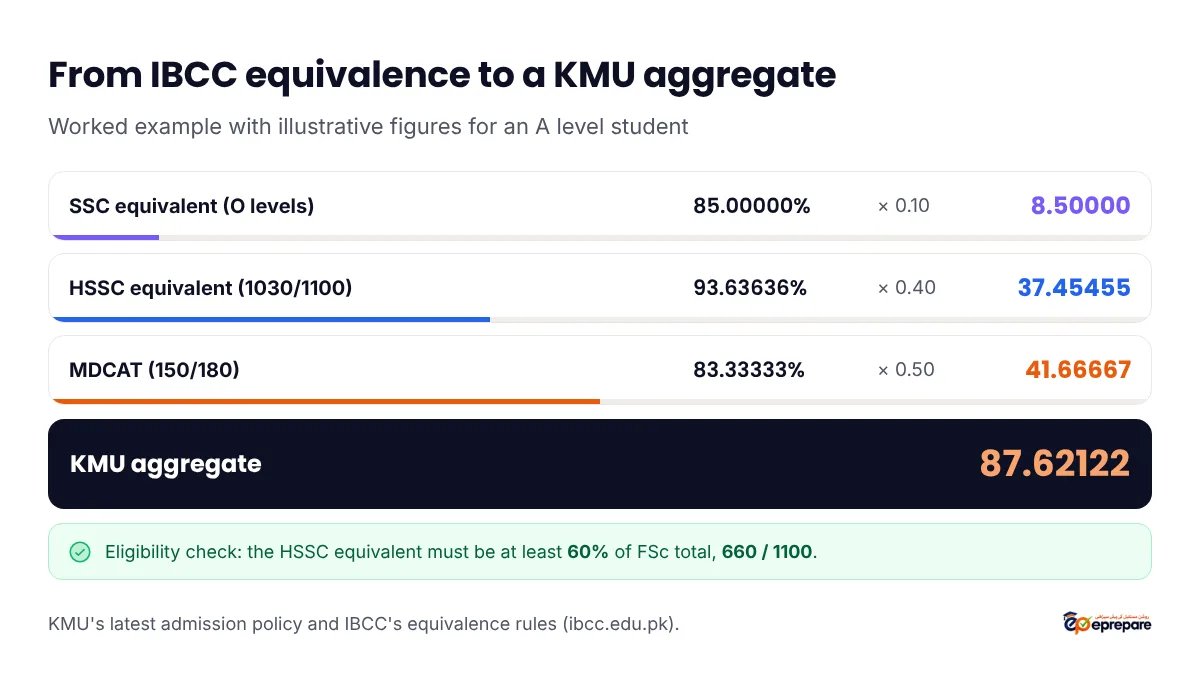
| Part | Example figure | × weight | Points |
|---|---|---|---|
| SSC equivalent (O levels) | 85.00000% | 0.10 | 8.50000 |
| HSSC equivalent (1030/1100) | 93.63636% | 0.40 | 37.45455 |
| MDCAT (150/180) | 83.33333% | 0.50 | 41.66667 |
| Aggregate | Sum of the three | 87.62122 | |
Try your own figures in our aggregate calculator, which accepts any total, and compare with the KMU closing merit of each college. Because the MDCAT carries half the aggregate, it is the biggest lever you have once your A level results are fixed. Our aggregate formula guide shows more examples.
Timing: get the equivalence before KMU's closing date
This is where most O and A level students lose time. A level results arrive in August, and KMU's application window opens after the MDCAT result, so the gap can be short. IBCC's FAQs give these timings and rules:
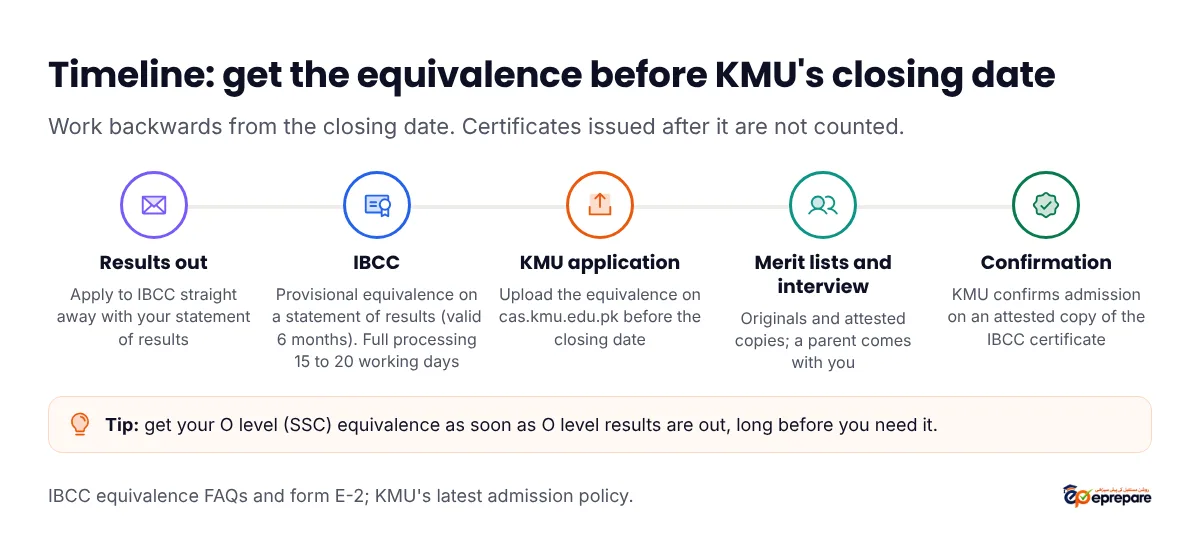
- Provisional equivalence. IBCC's FAQs describe a provisional certificate as "temporary, issued pending final verification", and IBCC's application form for British qualifications says: "Provisional equivalence will be issued on the basis of Statement of Results."
- Statement of results has a time limit. IBCC says a statement of result is "valid for a maximum of six (6) months only"; after that the original certificate is required.
- Processing time. IBCC's FAQs say full processing takes "(15-20) working days", and an urgent service is available for O and A level equivalence. Check IBCC's website for the current fee.
- Verification. IBCC says it can verify Cambridge International certificates online for the past five years, which speeds things up. Other qualifications may take longer because IBCC has to verify them with the institution.
Our advice: apply for your O level (SSC) equivalence as soon as your O level results are out, years before you need it, and apply for the A level (HSSC) equivalence the day your A level results arrive. Our KMU admission schedule shows when KMU's window usually falls.
How to apply to IBCC
- Register on IBCC's equivalence portal and fill the online application. IBCC lists three ways to submit: walk-in by appointment, courier, and online (its FAQs say online submission is only for photocopies).
- Prepare your documents. IBCC's FAQs list original GCE certificates for both levels, photocopies attested by a government officer of grade 17 or above, a photograph, an attested CNIC or birth certificate, any earlier IBCC equivalence certificate, and proof of study abroad (passport and visas) for students who studied outside Pakistan.
- Check names and dates of birth. IBCC requires the same name and date of birth on all certificates and your CNIC or passport.
- Avoid laminated certificates. IBCC does not accept certificates with plastic coating, and it accepts "only qualification certificates issued by recognized British Examination Boards", not school report cards.
- Track your application on IBCC's equivalence portal with your application number or CNIC or passport number.
- Upload the equivalence on KMU's portal at cas.kmu.edu.pk before the closing date, and keep attested copies for confirmation. The full list of KMU uploads is in our KMU documents checklist.
IBCC's procedures and fees change from time to time, so read the current instructions on ibcc.edu.pk before you submit.
Students who studied abroad, and foreign nationals
If you did O and A levels outside Pakistan, IBCC's overseas route needs 5 O level subjects (English, Mathematics and three electives) rather than 8, and scales your 8 subjects to a total of 1,100. Which KMU seats you can apply for depends on your nationality and domicile:
- Pakistani with a KP domicile, living in Pakistan: open merit, self-finance and other KP seats.
- Pakistani living abroad permanently, or a dual national, with a KP domicile: foreign self-finance seats. See our KMU foreign self-finance guide.
- Child of an overseas Pakistani registered with OPF: the OPF seats. See KMU OPF seats.
- Afghan national: the Afghan national seats, which need HSSC with three sciences and 60% "as certified by" IBCC. See KMU Afghan national seats.
Every one of these routes needs the IBCC equivalence and an MDCAT pass under KMU's policy.
Mistakes that cost O and A level students their seats
- No O level biology. IBCC makes biology mandatory for medicine. Without it there is no pre-medical equivalence.
- Missing Urdu, Islamiyat or Pakistan Studies (Pakistani students who studied in Pakistan). Fix the gap early by sitting the subject.
- Applying to IBCC late. If the equivalence is issued after KMU's closing date, it is not counted.
- Ignoring O level grades. They count in your HSSC equivalent marks, which carry 40% of the aggregate.
- Name or date-of-birth mismatches between certificates, CNIC and passport.
- Laminated certificates or school report cards, which IBCC does not accept.
- Skipping the MDCAT. KMU's policy requires an MDCAT pass for Pakistani students on every seat.
Frequently asked questions
Can A level students apply for MBBS in KMU's public colleges?
Yes. A level students apply on the same KMU portal as FSc students, with an IBCC equivalence certificate attached before the closing date, at least 60% of FSc total marks by IBCC's formula, physics or maths, chemistry and biology, English at O or A level, and an MDCAT pass.
What is the minimum IBCC equivalence for KMU?
KMU's policy asks for marks "equivalent to unadjusted 60% of FSc total marks according to the formula laid down by the IBCC". On a total of 1,100 that is 660 marks on your HSSC equivalence.
Do O level grades count in my KMU merit?
Yes, twice. Your O level (SSC) equivalence gives the 10% Matric part of the aggregate, and IBCC's own example counts O level subjects together with A levels to calculate HSSC equivalent marks, which give the 40% part.
Is there a fixed grade-to-marks table for IBCC equivalence?
No. IBCC says grades are converted "following IBCC's predefined formula" and that equivalence "is calculated on a session-by-session basis", so the same grade can earn different marks in different sessions.
My A level results are not final yet. Can I still apply to KMU?
IBCC can issue a provisional equivalence on a statement of results, which is valid for six months. KMU needs the equivalence attached before its closing date, so apply to IBCC as soon as your statement of results is available.
Is biology compulsory at O level for MBBS?
Yes. IBCC says biology is mandatory for students pursuing medicine, and KMU's policy requires biology to have been studied through O and A levels.
Do O and A level students have to take the MDCAT?
Yes. KMU's policy requires an MDCAT pass of at least 55% for MBBS or 50% for BDS. The only exception in the policy is for foreign students on special Federal Government programme seats.
How long does IBCC take to issue an equivalence?
IBCC's FAQs say full processing takes 15 to 20 working days, and an urgent service is available for O and A levels. Check IBCC's website for current timings and fees.
Your A level grades are fixed once results are out, but your MDCAT is still yours to improve, and it carries half your KMU aggregate. Prepare with ePrepare for KPK textbook-based MCQs, full-length tests and a predicted score, wherever you are studying.
Sources: Khyber Medical University, latest Admission Policy for Public Sector Medical and Dental Colleges of Khyber Pakhtunkhwa (basic eligibility criteria, warnings and merit formula); Inter Board Committee of Chairmen, British System (O and A levels), Equivalence FAQs and Example for Calculating A-level Equivalence and its application form for British qualifications (E-2); Pakistan Medical and Dental Council admission regulations on pmdc.pk. The example aggregate uses illustrative figures. IBCC and KMU procedures can change; check their current notices before you apply.