Every admission season, some students with good merit lose their MBBS or BDS seat. The reason is not a low MDCAT score. It is a missing certificate, a domicile in the wrong name, or a paper issued one day after the closing date. KMU's policy is strict about this. Once you submit a document on the portal, you cannot change it later.
This guide lists every document that Khyber Medical University's latest admission policy for public sector medical and dental colleges asks for. It says who needs each one, who signs it, when you need it, and the warnings that can cancel an admission even after classes start. Keep this page open while you prepare your file. Tick each item only when the document is in your hands.
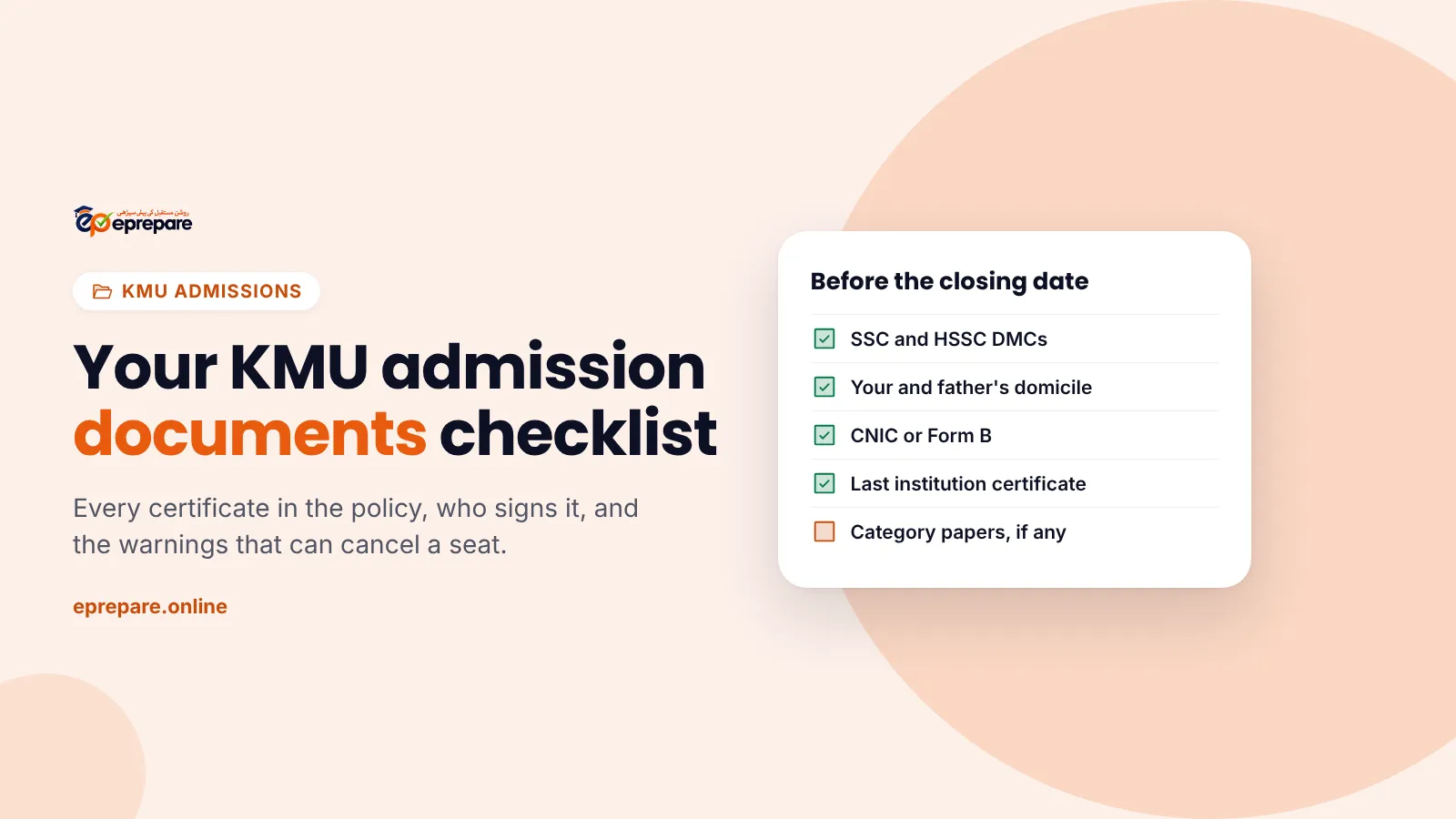
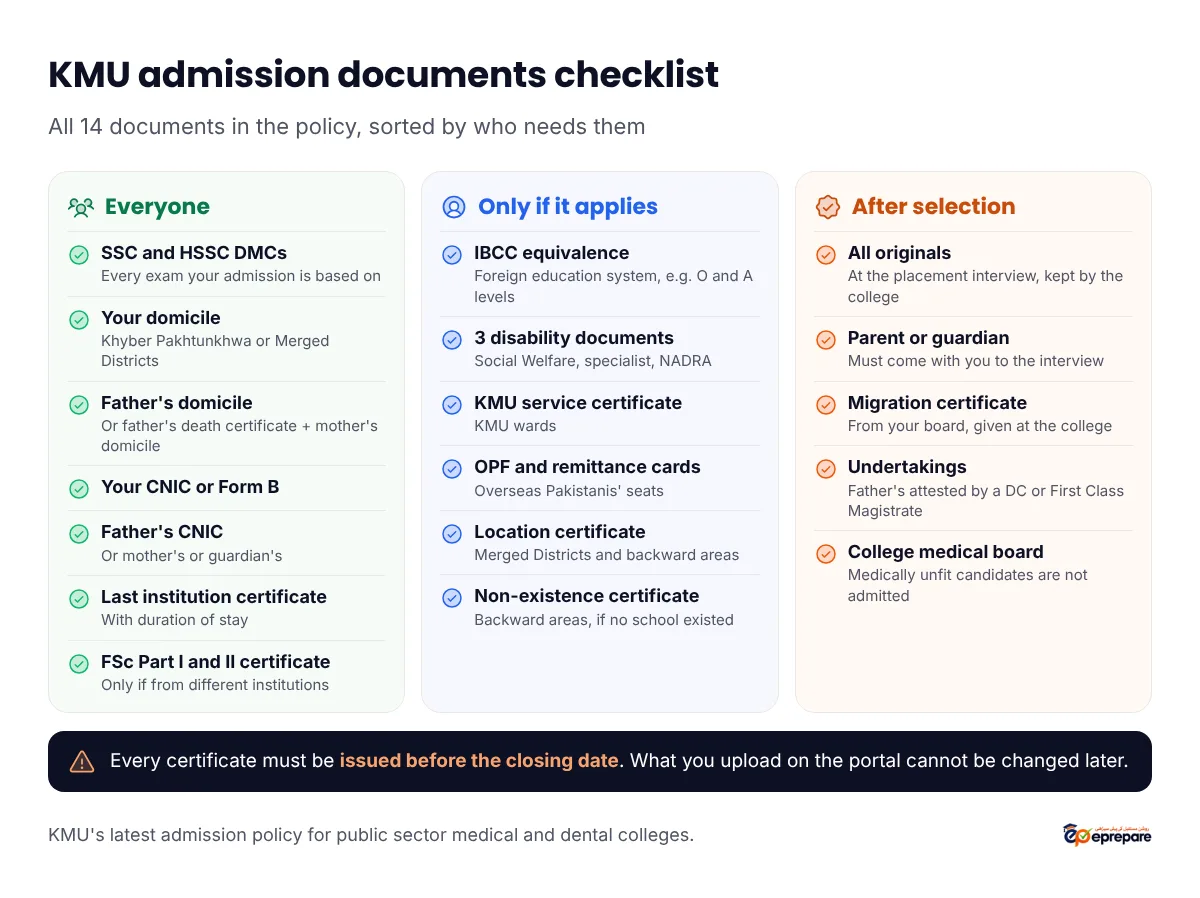
The short answer: every applicant needs their detailed marks certificates (DMCs), their own and their father's domicile of Khyber Pakhtunkhwa or the Merged Districts, their own and their father's CNIC or Form B, and a certificate from the last institution attended. Extra papers depend on your seat category: an IBCC equivalence, disability certificates, location certificates, OPF cards and so on. Everything must be issued before the closing date and uploaded with the online form. You must bring the originals to the placement interview, with a parent or legal guardian.
Before you start: three rules that decide everything
Read these three rules before you collect a single paper. Most rejected files break one of them.
1. Only certificates issued before the closing date count
The policy says it plainly: “Any certificate issued after the closing date for admission, shall not be considered for the purpose of calculation of merit.” The warnings section repeats it: “All the above-mentioned certificates issued after the dates fixed for receipt of application forms shall not be entertained.” A domicile or equivalence certificate dated after the last date is treated as if you never had it. Apply for slow documents, such as domicile, IBCC equivalence and location certificates, weeks before KMU's advertisement comes out.
2. What you upload is final
According to the policy, “The domicile, DMC of HSSC (Pre-Medical)/Equivalent Examination, SSC and other certificates once submitted in the online Admission portal cannot be changed and shall be considered as final.” The same rule covers a revised result or improved marks that your board or IBCC declares after the closing date. Check every name, roll number and date before you press submit.
3. Incomplete or false forms are rejected
The policy warns that “Incomplete application forms will be rejected” and “Application forms with any false statement by the candidate will be rejected.” A missing page or an empty field can cost you the whole year.
The application itself is online only, at cas.kmu.edu.pk or through kmu.edu.pk. You upload “scanned copies of all educational certificates / documents”. Do not post a hard copy: forms sent by post, courier or any other means are not accepted. The policy also asks for an email address and “at least three different telephone numbers (including landline and mobile) which must be active and contactable”. KMU uses these to reach you during the merit lists, so give numbers your family will actually answer.
The complete list: all 14 documents in the policy
The policy lists 14 items under "Documents required with application form". Here they are in plain English, sorted by who needs them. The number in brackets is the item number in the policy, so you can check it yourself.
Documents every applicant needs
| Document | Details |
|---|---|
| Detailed marks certificates (i) | DMCs of every exam your admission is based on: SSC (Matric) and HSSC (FSc pre-medical) or equivalent. |
| Your domicile (v) | A valid domicile certificate of Khyber Pakhtunkhwa or the Merged Districts. |
| Father's domicile (vi) | Your father's domicile. If your father is not alive, attach his death certificate and your mother's domicile. |
| Your CNIC or Form B (vii) | Computerised National Identity Card or NADRA's computerised Form B. |
| Father's CNIC (viii) | If your father is not alive, a copy of your mother's or guardian's CNIC. |
| Last institution certificate (xiii) | A certificate from the institution you last attended, showing how long you studied there. |
| FSc Part I and II certificate (xiv) | Only if you did Part I and Part II at different institutions: a certificate showing where you did each part. |
The domicile rule is the one families get wrong most often. For provincial seats, the policy checks your father's domicile, not only yours. In the policy's words, “his/her father must be Bonafide national of Pakistan with a valid domicile of Khyber Pakhtunkhwa, and if father is not alive then the mother valid domicile of Khyber Pakhtunkhwa will be considered.” Open merit seats accept a KP domicile, including the backward areas. General self-finance seats also accept the Merged Districts. Our self-finance vs open merit guide explains that difference.
Documents only some applicants need
| Document | Who needs it |
|---|---|
| IBCC equivalence certificate (ii) | Anyone whose qualification is from a foreign education system, such as O and A levels or a foreign 12th grade. |
| Disability certificate (iv-a) | Applicants for seats for persons with special abilities. Issued by the Social Welfare Department, Government of Khyber Pakhtunkhwa. |
| Disability medical certificate (iv-b) | The same applicants. On the prescribed proforma, from the relevant certified specialist. |
| CNIC or Form B with disability logo (iv-c) | The same applicants. Issued by NADRA. |
| KMU service certificate (ix) | KMU wards applying for the general self-finance seats for KMU wards. Issued by KMU's establishment section, showing length of service and nature of job (regular, fixed pay or retired). |
| OPF membership and remittance cards (x) | Applicants for overseas Pakistanis' seats. Your parent's OPF membership card and Foreign Exchange Remittance Card, valid on the closing date. |
| Location certificate (xi) | Applicants for Merged Districts and backward area seats. It shows where each of your schools and colleges is located. |
| Non-existence certificate (xii) | Backward area applicants whose area had no school or college for some classes. Countersigned by the DEO and the DC, like the location certificate. |
What happens after selection
- Originals at the placement interview. The policy says selected candidates “shall have to submit all original certificates at the time of interviews/admission.” The college keeps your original documents and returns them when you leave the institution. Make attested photocopies of everything for your own file before you hand them over.
- Migration certificate from your board (iii). This one is only for admitted candidates. You submit it at the college that admits you, not with the online form.
- Undertakings. These are signed at the college. See the section below.
- The college medical board. “The Medical Board of the respective medical colleges will examine selected candidates. If a candidate is disqualified medically, he/she will not be admitted.”
Extra papers for special categories
Some seat categories ask for more than the 14 standard documents. The policy mentions these in each category's own section, so they are easy to miss.
| Seat category | Extra papers in the policy |
|---|---|
| Backward areas | Domicile of that backward area (yours and your father's), location certificate year by year, non-existence certificate if needed, proof of separation where parents are separated, and a surety bond to serve five years in your home district if selected. See our backward area seats guide. |
| Merged Districts (ex-FATA) | MDs domicile “showing clearly date of issue and serial number”, father's MDs domicile, attempt certificate(s), location certificate, and a photocopy of the admission form and documents submitted to the Home & Tribal Affairs Department. See our Merged Districts seats guide. |
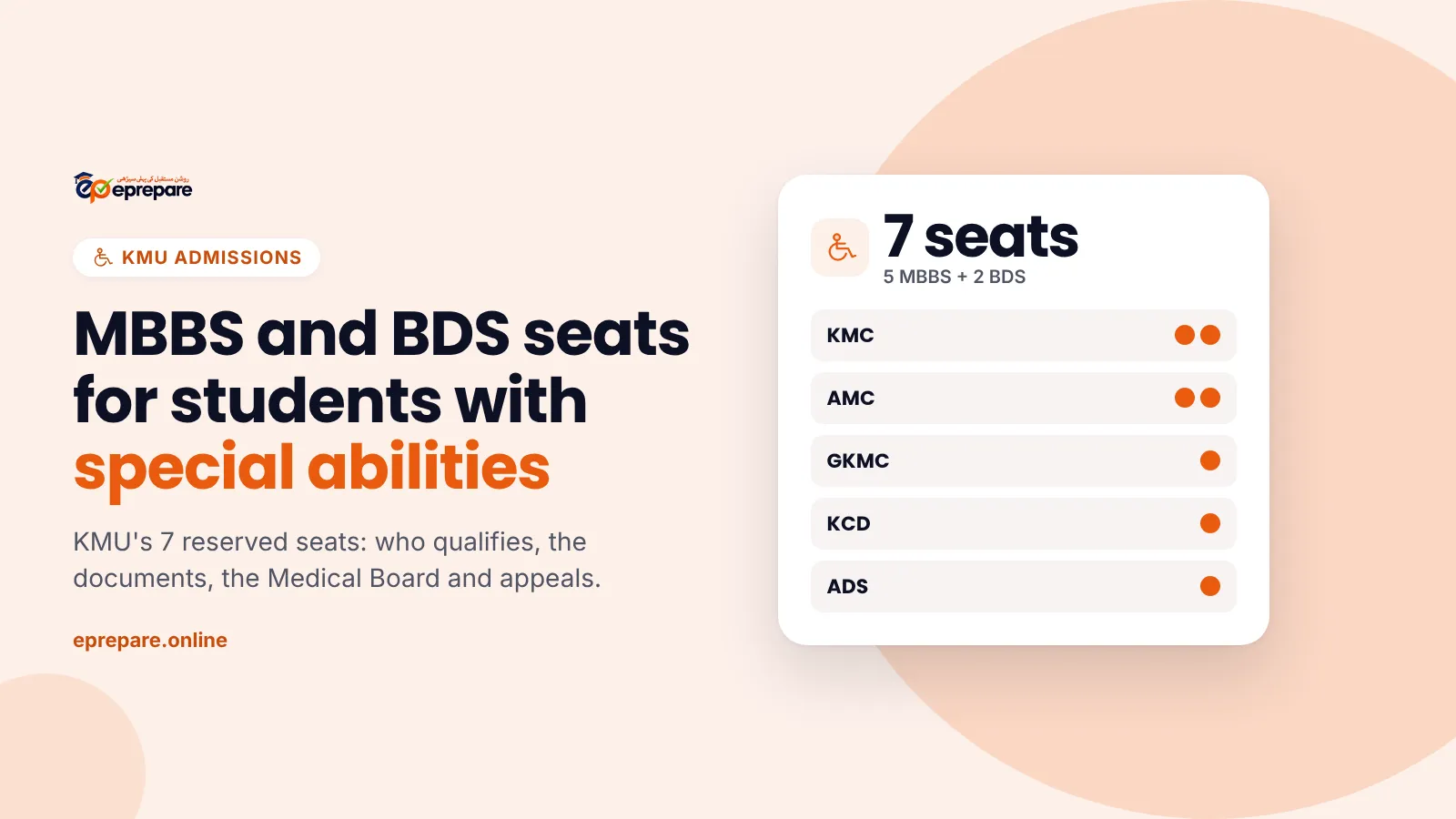
| Special abilities | The three disability documents above. The Social Welfare registration certificate must state that you are specially abled but mentally fit and physically able to study and to work after MBBS or BDS. See our special ability seats guide. |
| Overseas Pakistanis (OPF) | OPF membership and Foreign Exchange Remittance (Sohni Dharti) cards, and a recommendation letter from the OPF office in Islamabad obtained before the closing date. |
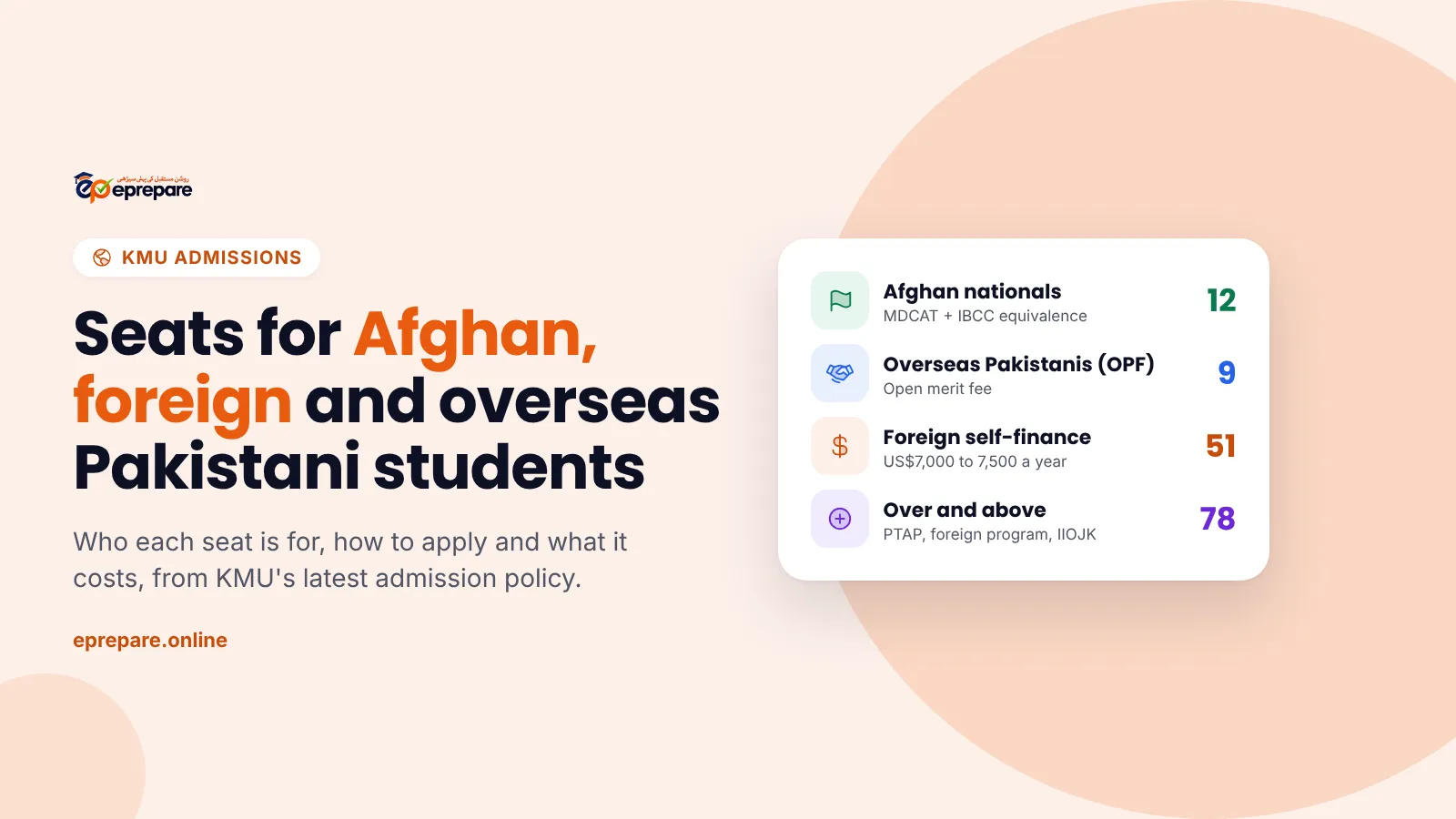
| Afghan nationals | IBCC-certified HSSC with at least 60%, and a one-year English language proficiency certificate if your previous studies were not in English. After an offer, holders of a POR or ACC card must get an Afghan passport and a student visa. See our foreign and overseas seats guide. |
| Foreign self-finance | An undertaking or bond that you will pay the fee in foreign exchange. |
Who signs what
Half the stress of admission paperwork is knowing which office to visit. This chart shows the authority behind each document named in the policy.
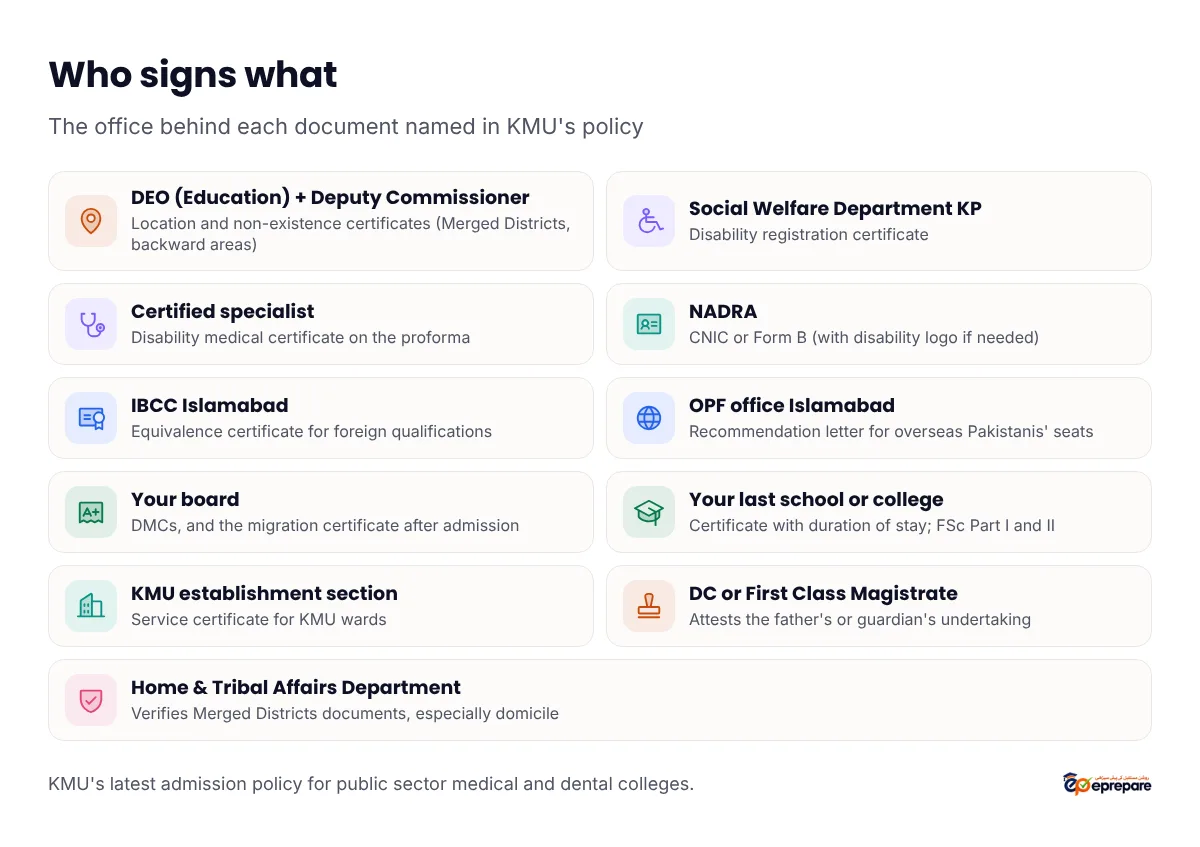
The location and non-existence certificates, explained
These two forms matter only if you apply for Merged Districts or backward area seats. They are also the documents most often filled in wrongly. The policy prints a specimen of each at the end.
Certificate of location of educational institutes
The specimen is headed “To be submitted by the candidates applying against Backward Areas and Merged Districts inner seats only”. It comes from the office of the District Education Officer (Education) and has one row for each class from Class 1 to Class 12. Each row asks for:
- the full name of the school or college,
- its location, and whether it is inside or outside the area,
- the years you studied there (from and to),
- the board.
You attach the DMCs for Class 9, 10, 11 and 12, with a separate DMC for each class. The DEO (Education) signs with an official stamp. The Deputy Commissioner of the district verifies it (for an FR or agency, the DC or Political Agent). The backward area rules in the policy say the same thing: the certificate is “duly verified by the concerned DEO (Education) and countersigned by the Deputy Commissioner of the concerned district.”
One point can confuse people. The policy's list of documents describes the location certificate as coming “from Principals/ Head Masters of the concerned institutions”, and the next item says it must be countersigned by the DEO and the DC. To be safe, collect confirmation from your school heads where you need it. Your final document should be on the policy's form, signed by the DEO and countersigned by the DC.
Certificate of non-existence of educational institutes
This is for backward area applicants whose area had no school or college for some classes. The DEO certifies that no institution or facility existed for Primary (1–5), Middle (6–8), Matric (9–10), FSc Part I (11) or FSc Part II (12), for male or female students, in that tehsil or district during that session. The Deputy Commissioner verifies it with an official stamp. Without this certificate, studying outside your area counts against you. The policy says that a candidate with any part of their education outside the area, where facilities existed, “will not be considered as inside candidate.”
The undertaking your father or guardian signs
The policy includes an undertaking “to be filled by father/guardian of the candidate”, which you submit to your college. Read it before you sign, because it carries real money:
- Your father or guardian endorses the undertaking you give as a student, and promises you will follow it while you are at the college.
- They accept liability to pay Rs 1,00,000 (one hundred thousand) per year of study if that undertaking is breached.
- They promise that you “will not indulge in politics of any type and will not be a member of any political party/ organization/students Federation”, nor attend any meeting that may lead to expulsion. The Principal's decision on this is final.
- Two witnesses sign, with their full name, father's name, CNIC number and present address.
- It must be attested by a Deputy Commissioner or First Class Magistrate, with signature and stamp.
Plan the attestation in advance. Getting it done on the day of joining is stressful, and you will already be dealing with fees and hostel forms.
When you need each document
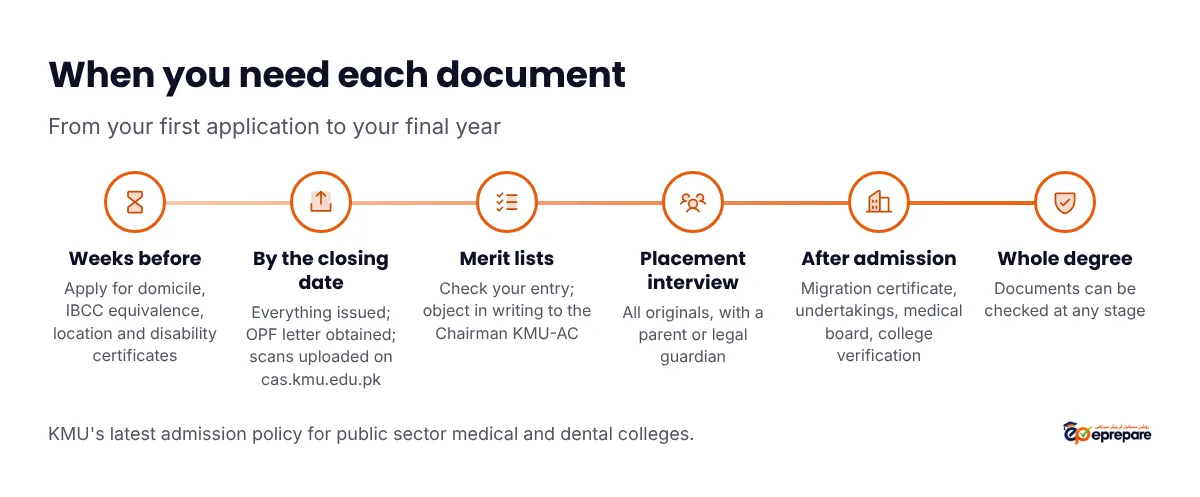
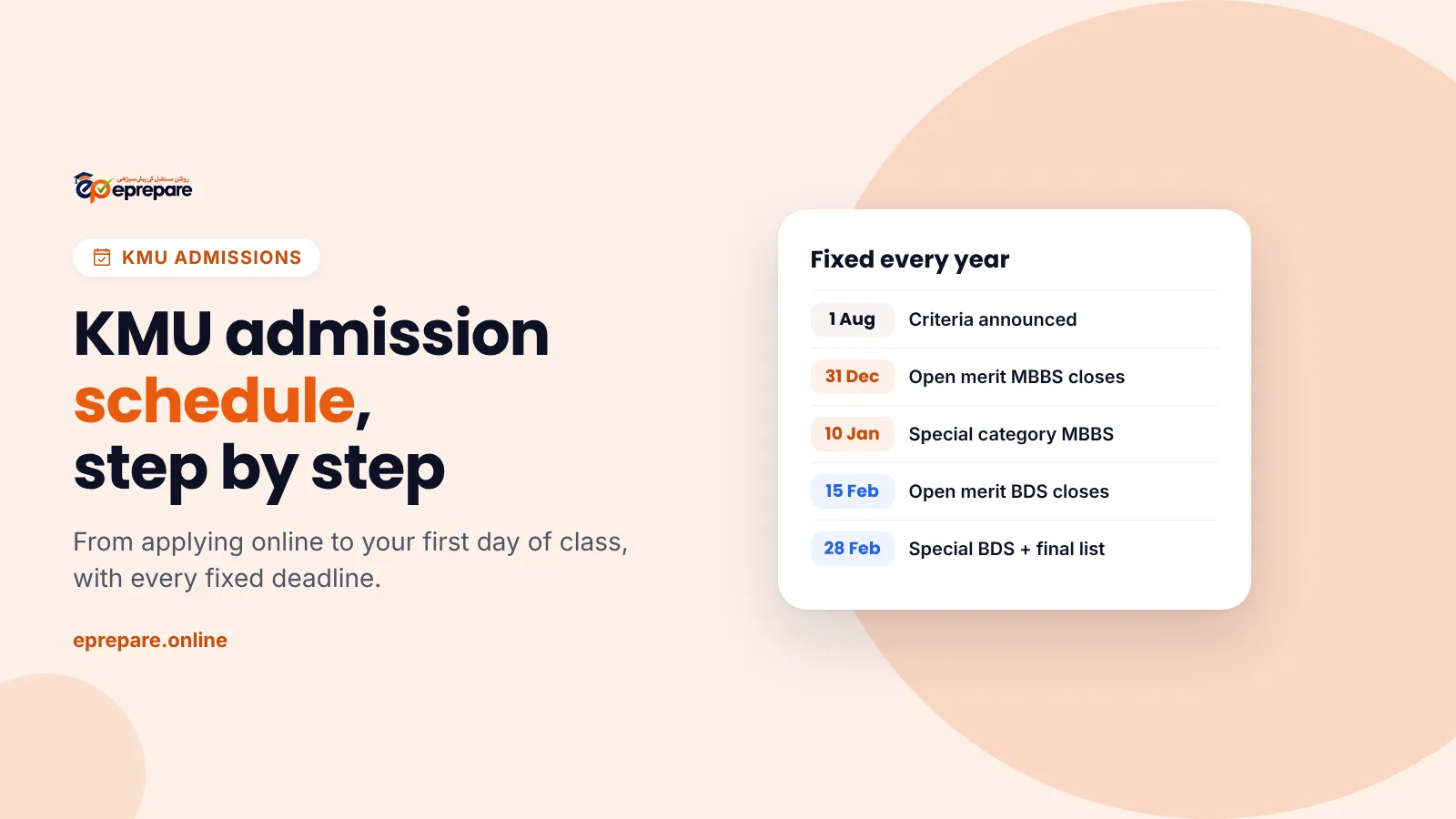
Two moments matter most. The first is the closing date: everything must be issued and uploaded by then. The second is the placement interview, where you show the originals. The policy says that “The parent(s) or legal guardians must accompany all the candidates at the time of placement interview.” Plan travel for a parent as well as yourself. Our KMU admission schedule guide shows where each step falls, and our guide to merit lists, upgrades and the waiting list explains the interviews and fee deadline in detail.
Warnings: when an admission is cancelled
Every admission under this policy is provisional. In the policy's words, “All admissions will be provisional. All certificates or any other documents submitted with the application form will be subject to verification.” Colleges must verify each admitted student's Matric and HSSC credentials and send a certificate to KMU within 30 days after admissions close, for onward submission to PM&DC.
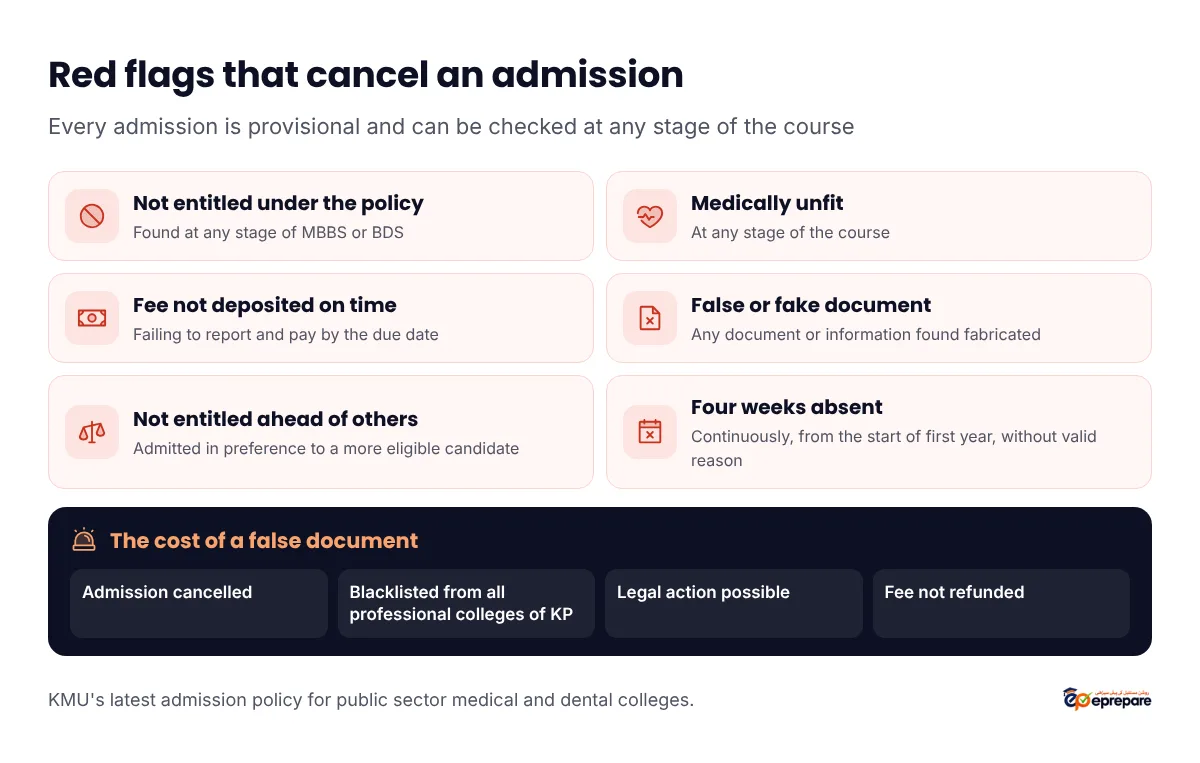
Under the heading "Admission of the candidate will be cancelled if", the policy gives these reasons:
- At any stage of the course, it is found that you were not entitled to admission under the policy.
- You are found medically unfit at any stage of the MBBS or BDS course.
- You fail to report for admission and fail to deposit the fee on the due date.
- Any document or information you gave is found false, fake or fabricated at any stage, in a way that would have made you ineligible.
- It is found that you were not entitled to admission ahead of other candidates who applied.
The same section also requires every college to verify its students' credentials and certify them to KMU within 30 days, as mentioned above.
The penalty for a false document
The warnings section leaves no doubt. If any document or information is found false, fake or fabricated at any stage, “the admission will be cancelled, he/she shall be blacklisted for admission to any professional colleges in Khyber Pakhtunkhwa. Further legal action can be taken against the student under the existing criminal laws.” The Principal can remove a student from the college roll at any time if wrong data was given at admission. The policy says no show-cause notice is needed for this. If KMU or the college goes to court and the candidate is found at fault, the candidate or their parents pay the legal costs.
Fees are not refunded
The policy says the admission fee and other dues are not refunded if an admission is cancelled for forged documents, if you are expelled or removed from the roll for any reason, or if you willingly discontinue your studies. Its general notes also state that “The admission fee submitted by the candidate to KMU shall be forfeited in favor of the University and will not be refunded to the candidate as a penalty.”
The four-week absence rule
Once you join, attend. The policy says a first-year student who is “continuously absent from the beginning of the academic session for a period of four weeks without any valid reason shall be struck off from the college roll”, and that seat goes to the next candidate on the waiting list.
Leaving for another college
If you take a KP public seat but want to move to a college in another province or country, you must apply before the closing date of admission. Students admitted in earlier years cannot do this. Your fee is not refunded, any scholarship you received is recovered, and your financial undertaking is enforced. A student who resigns or withdraws pays the college's prescribed penalty before leaving. For moving between colleges later in the degree, read our KMU migration policy guide.
Printable checklist
Copy this list into your notebook or take a screenshot. Tick an item only when you have the document and have checked every detail on it.
Everyone
- ☐ SSC (Matric) DMC
- ☐ HSSC (FSc pre-medical) or equivalent DMC
- ☐ My domicile of KP or the Merged Districts, issued before the closing date
- ☐ Father's domicile (or father's death certificate and mother's domicile)
- ☐ My CNIC or Form B
- ☐ Father's CNIC (or mother's or guardian's)
- ☐ Certificate from my last institution, with duration of stay
- ☐ Certificate for FSc Part I and Part II, if they were from different institutions
- ☐ A working email address and three active phone numbers (landline and mobile)
- ☐ A list of every college I would accept, in order of preference
Only if it applies to me
- ☐ IBCC equivalence certificate (foreign education system)
- ☐ Social Welfare disability certificate, specialist's medical certificate on the proforma, and NADRA CNIC or Form B with disability logo
- ☐ KMU service certificate (KMU wards)
- ☐ Parent's OPF membership card and remittance card, plus OPF recommendation letter
- ☐ Location certificate signed by the DEO and countersigned by the DC (Merged Districts or backward areas)
- ☐ Non-existence certificate, if a level of school was not available in my area
- ☐ Merged Districts: attempt certificate(s) and a copy of my file for the Home & Tribal Affairs Department
- ☐ Afghan nationals: English proficiency certificate if needed
For the placement interview
- ☐ All originals, plus two attested photocopy sets
- ☐ A parent or legal guardian coming with me
- ☐ The first-year fee ready to deposit within three working days of the offer letter
- ☐ Undertaking forms, with time booked for attestation by a DC or First Class Magistrate
- ☐ Migration certificate from my board (submitted at the college)
Frequently asked questions
Do I need to send a hard copy of my KMU application form?
No. The policy says the entire application is online, at cas.kmu.edu.pk or kmu.edu.pk, and that there is no need to submit a hard copy. Forms received by post, courier or other means are not accepted. You upload scanned copies, and you bring the originals to the placement interview if you are selected. The one exception is Merged Districts applicants, who must also submit a photocopy of the form and documents to the Home & Tribal Affairs Department.
My domicile was issued after the closing date. Will KMU accept it?
No. The policy says certificates issued after the closing date are not considered for merit, and that certificates issued after the last date for application forms "shall not be entertained". Apply for your domicile, and your father's if needed, well before KMU advertises admissions.
Can I change a document after I submit my KMU form?
No. The policy states that the domicile, HSSC and SSC DMCs and other certificates "once submitted in the online Admission portal cannot be changed and shall be considered as final." This also covers a revised result or improved marks declared after the closing date.
My father has passed away. Which documents do I submit?
Submit your father's death certificate and your mother's valid domicile in place of his domicile, and your mother's or guardian's CNIC in place of his CNIC. The policy applies this rule to provincial, Merged Districts, backward area, minority and special ability seats. For backward area seats, the policy also asks for proof of separation where parents are separated.
Do O and A level students need an IBCC equivalence certificate?
Yes. The policy requires an IBCC equivalence certificate for any qualification from a foreign education system, and says it must be attached before the closing date. The equivalence must show marks equivalent to at least 60% of FSc under IBCC's formula. IBCC will not accept it unless you studied physics or maths, chemistry and biology in Grades 9 to 12 (or O and A levels) and passed English at O or A level.
Who signs the location certificate for backward area and Merged Districts seats?
The District Education Officer (Education) signs and stamps it, and the Deputy Commissioner of the district countersigns it. For an FR or agency, the DC or Political Agent verifies it. It lists every class from 1 to 12, with the school's name, location, inside or outside status, years and board. You attach your DMCs for Classes 9 to 12.
Do my parents have to come to the KMU placement interview?
Yes. The policy says "The parent(s) or legal guardians must accompany all the candidates at the time of placement interview."
Is my admission final once I pay the fee?
Not fully. Every admission is provisional, and your documents can be checked at any stage of the course. If a document turns out false, your admission is cancelled, you are blacklisted from all professional colleges in KP, legal action can follow, and your fee is not refunded.
Get your file right, then focus on merit
Documents decide whether your merit counts. Your MDCAT score decides how far it takes you. Use our aggregate calculator to see where you stand. Check last year's cut-offs on our KMU closing merit page. Read our guide to every KMU quota and reserved seat to find every category you can apply for. If you are still preparing for the MDCAT, ePrepare's MDCAT courses help you build the score that makes all this paperwork worth it.
Source: Khyber Medical University's latest admission policy for public sector medical and dental colleges of Khyber Pakhtunkhwa, including the sections on documents required, warnings, admission procedure and the specimen undertaking, location and non-existence certificates. The latest policy is available on KMU's admission portal, cas.kmu.edu.pk. Rules can change, so check KMU's current notice before you apply.