Every year, thousands of students in Khyber Pakhtunkhwa (KP) apply to Khyber Medical University (KMU) for MBBS and BDS seats in the province's public colleges. Most of them only think about open merit. But KMU's admission policy splits the seats into more than a dozen categories: self-finance, Merged Districts, backward areas, special abilities, minorities, Afghan nationals, overseas Pakistanis and more.
If you qualify for even one extra category, your chances can change a lot. Many students never find out, because the rules are spread over 35 pages of the policy. This guide puts every category in one place: how many seats it has, who can apply, where you apply, what fee you pay, and which detailed guide to read next.
Everything here comes from KMU's latest admission policy for public sector medical and dental colleges, published on KMU's admission portal, cas.kmu.edu.pk.
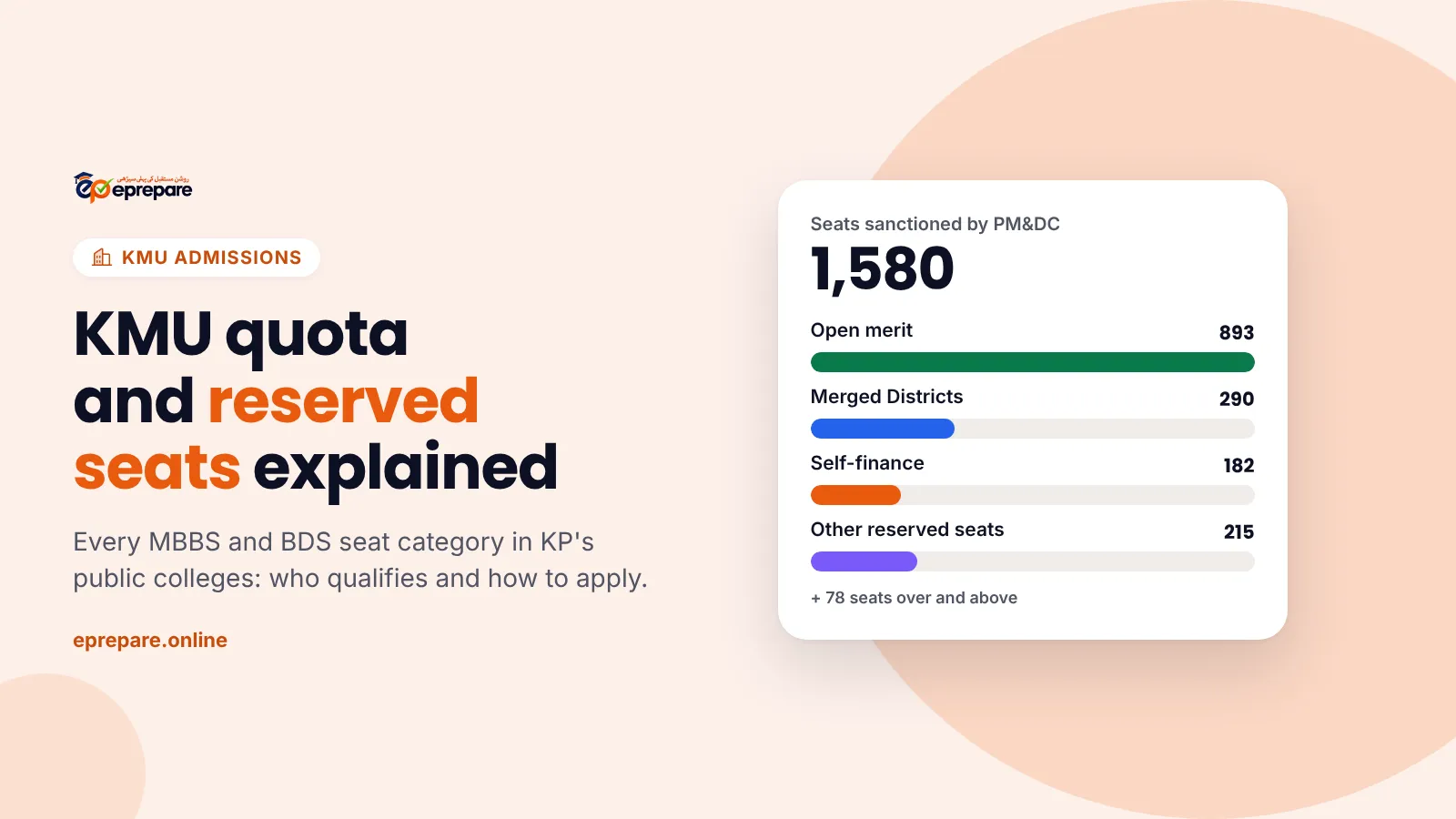
The short answer: PM&DC has sanctioned 1,580 seats in KMU's 13 public colleges (1,320 MBBS and 260 BDS), and the policy adds 78 seats over and above them. 893 seats (57%) are open merit. The rest are split across reserved and self-finance categories, the biggest being Merged Districts (290), general self-finance (128) and the MDs/Balochistan project (99). You can apply in more than one category, and you should apply in every one you qualify for. Most categories need only the KMU online form; a few go through HEC, the Economic Affairs Division or a nomination board.
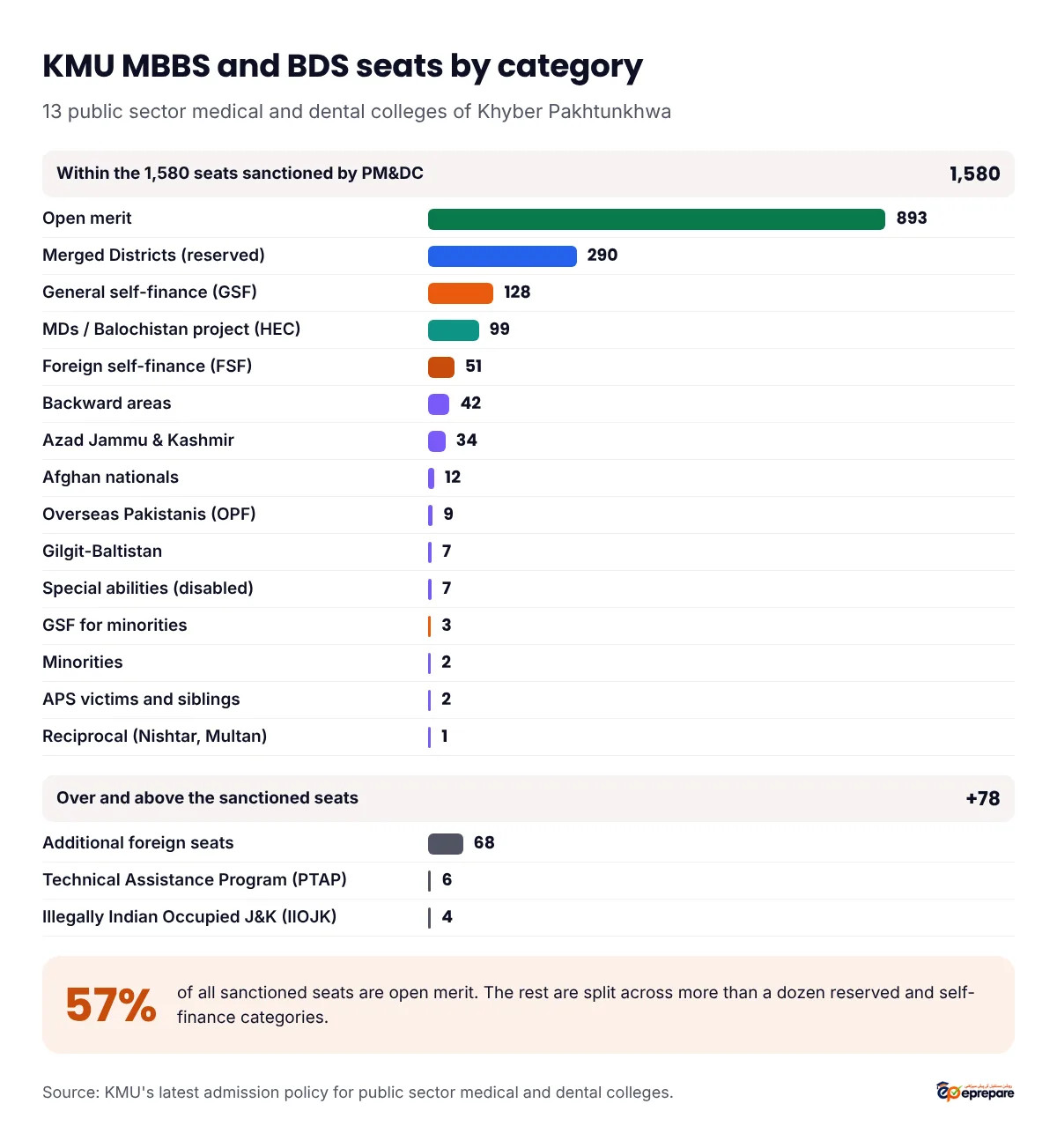
How many seats are there, and how are they split?
KMU admits students to nine public medical colleges and four public dental colleges:
- MBBS (5 years): Khyber Medical College (KMC) Peshawar, Ayub Medical College (AMC) Abbottabad, Saidu Medical College (SMC) Swat, Gomal Medical College (GMC) D.I. Khan, Khyber Girls Medical College (KGMC) Peshawar, Bannu Medical College (BMC), Bacha Khan Medical College (BKMC) Mardan, Nowshera Medical College (NMC) and Gajju Khan Medical College (GKMC) Swabi.
- BDS (4 years): Khyber College of Dentistry (KCD) Peshawar, Ayub Dental Section (ADS) Abbottabad, Bacha Khan Dental Section (BKDS) Mardan and Saidu College of Dentistry (SCD) Swat.
This is how the policy divides the 1,580 sanctioned seats:
| Seat category | MBBS | BDS | Total |
|---|---|---|---|
| Open merit | 739 | 154 | 893 |
| Merged Districts (reserved) | 254 | 36 | 290 |
| General self-finance (GSF) | 100 | 28 | 128 |
| MDs / Balochistan project (HEC) | 86 | 13 | 99 |
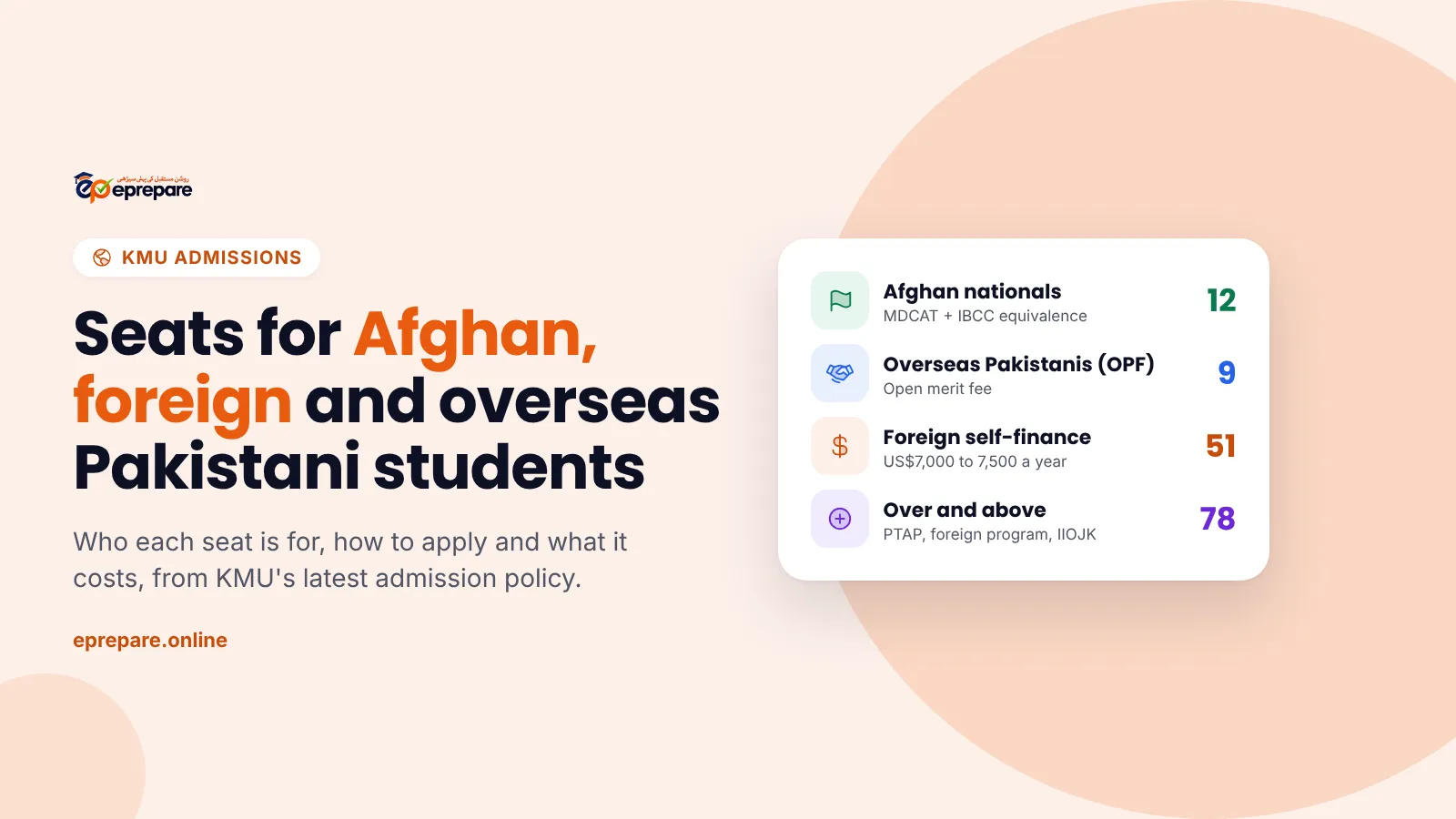
| Foreign self-finance (FSF) | 40 | 11 | 51 |
| Backward areas | 35 | 7 | 42 |
| Azad Jammu & Kashmir (AJK) | 33 | 1 | 34 |
| Afghan nationals | 10 | 2 | 12 |
| Overseas Pakistanis (OPF) | 5 | 4 | 9 |
| Gilgit-Baltistan (GB) | 7 | 0 | 7 |
| Special abilities (disabled) | 5 | 2 | 7 |
| GSF reserved for minorities | 1 | 2 | 3 |
| Minorities | 2 | 0 | 2 |
| APS victims and siblings | 2 | 0 | 2 |
| Reciprocal seat (Nishtar, Multan) | 1 | 0 | 1 |
| Total sanctioned by PM&DC | 1,320 | 260 | 1,580 |
On top of these, the policy lists 78 seats over and above the sanctioned total:
| Over-and-above category | MBBS | BDS | Total |
|---|---|---|---|
| Additional foreign seats | 56 | 12 | 68 |
| Pakistan Technical Assistance Program (PTAP) | 5 | 1 | 6 |
| Illegally Indian Occupied Jammu & Kashmir (IIOJK) | 4 | 0 | 4 |
| Grand total with over-and-above seats | 1,385 | 273 | 1,658 |
One thing in the policy is unclear: its written rules call the MDs/Balochistan project seats "Over and Above the allocated sanctioned seats", but its seat table counts those 99 seats inside the 1,580. We follow the seat table. It does not change how you apply for these seats, which is through HEC.
Why only these reserved categories exist
You may hear people talk about quotas that no longer exist. The policy explains why. Following the Supreme Court's decision in the Attiya Inayat case, reserved quotas in medical colleges were declared to be without authority, except for these categories (quoted from the policy):
"(a) Disabled persons (b) Students domiciled in Merged Districts (c) Students domiciled in under developed backward districts/Tehsils/areas (d) Students domiciled in Azad Jummu & Kashmir (e) Students domiciled in Gilgit Baltistan/ Northern areas (f) Afghan refugees"
The policy also sets one rule that protects merit in every category: "No category shall be created which permits a student who has not qualified the MDCAT or be admitted in violation of the fundamental principle of merit". In other words, no seat at KMU, reserved or not, is available without passing the MDCAT.
For every category you also need the basic eligibility: at least 60% marks in HSSC (FSc pre-medical or equivalent) and at least 55% in the MDCAT for MBBS or 50% for BDS. Your merit is calculated as 10% Matric + 40% FSc + 50% MDCAT. Our aggregate formula guide and aggregate calculator show how.
The domicile rule behind most seats
For most categories, your domicile is not enough. Your father's domicile counts too. For open merit seats, the policy says:
"These Seats are open to applicants possessing valid domicile certificate of Khyber Pakhtunkhwa including the backward areas of Khyber Pakhtunkhwa. The applicant's father shall also possess valid domicile certificate of Khyber Pakhtunkhwa including the backward areas of Khyber Pakhtunkhwa and if father is not alive then the mother's valid domicile of Khyber Pakhtunkhwa including the backward areas of Khyber Pakhtunkhwa will be considered."
The same rule (you and your father, or your mother if your father has died, with his death certificate) applies to general self-finance, backward area, Merged Districts, minority and special-ability seats. Each category names the domicile it accepts:
- Open merit: KP, including the backward areas.
- General self-finance, minorities and special abilities: KP, including the backward areas and the Merged Districts.
- Backward area seats: the domicile of that particular backward area.
- Merged Districts seats: a Merged District domicile.
The open merit wording does not mention the Merged Districts by name. But other parts of the policy (the minority and OPF sections) say candidates with a Merged District domicile can apply on open merit too. If you hold a Merged District domicile, apply for both open merit and Merged Districts seats, and confirm with KMU if you are unsure.
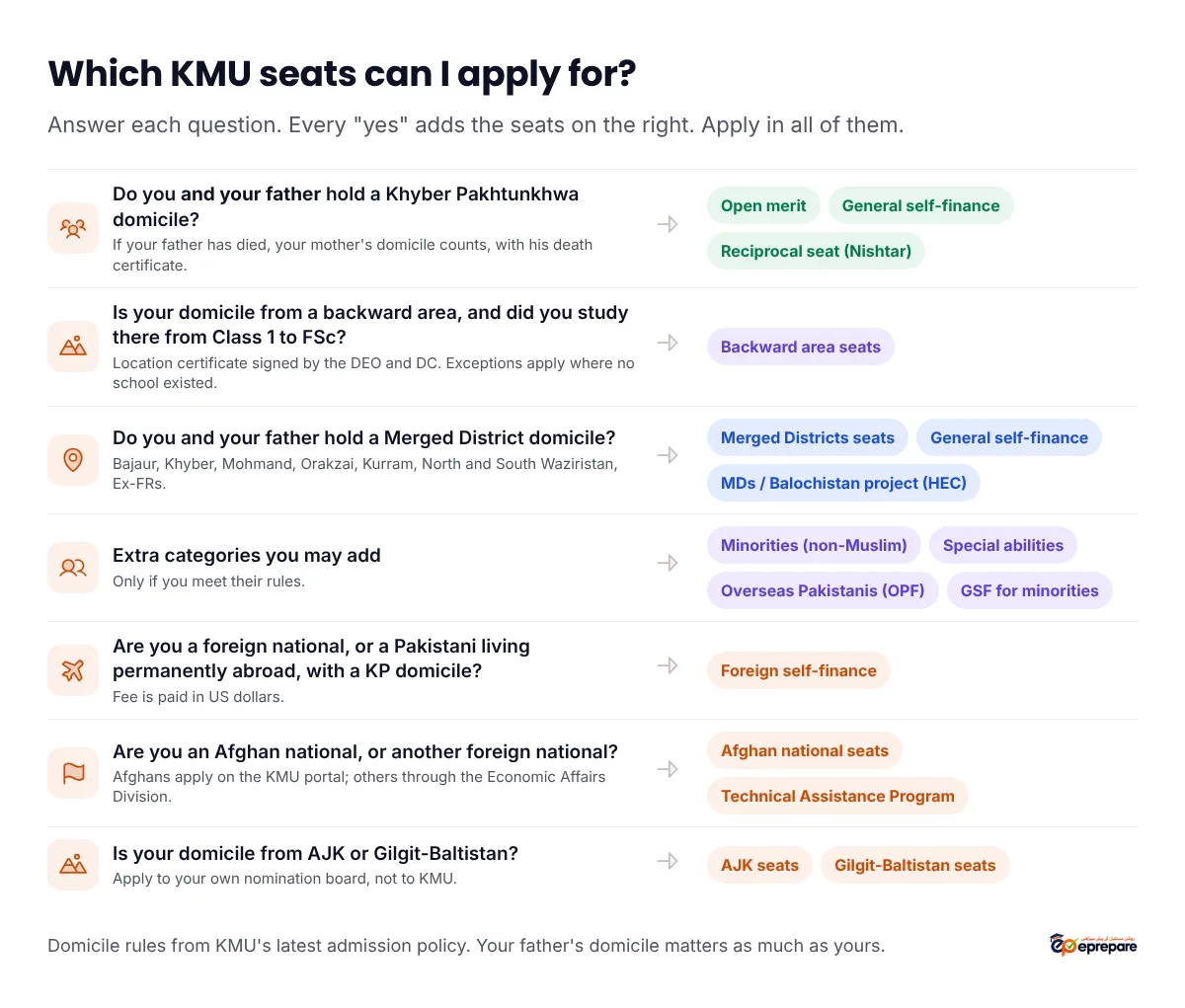
Every seat category explained
Here is each category, in order of size, with the details you need.
1. Open merit: 893 seats
Who: KP domicile holders (you and your father). Where to apply: the KMU portal. Fee: the normal (open merit) fee, Rs 87,000 to Rs 102,000 in the first year depending on the college. Open merit is filled on merit-cum-choice, college by college, across at least three merit lists. See how KMU merit lists and upgrades work and the KMU closing merit of each college.
2. Merged Districts (ex-FATA): 290 seats in KP colleges
Who: candidates whose own domicile and father's domicile are from the Merged Districts: Bajaur, Khyber, Mohmand, Orakzai, Kurram, North Waziristan, South Waziristan and the former Frontier Regions (Ex-FRs). Where to apply: the KMU portal, and a photocopy of the form and documents to the Home & Tribal Affairs Department, Peshawar. Ninety percent of these seats are shared by all Merged Districts candidates; ten percent are kept for candidates who studied from primary to FSc inside the Merged Districts. Merged Districts candidates also have 43 more seats in Punjab, Sindh, Balochistan and AJK colleges, for 333 in total. Full details: Merged Districts MBBS and BDS seats.
3. General self-finance (GSF): 128 seats, plus 3 for minorities
Who: KP domicile holders, including the backward areas and the Merged Districts. A self-finance seat is a seat in the same public college, in the same classes as open merit students; only the fee is different. The policy names three kinds of GSF seat: general, GSF for minority candidates (3 seats: one each at GMC, KCD and BKDS) and GSF for KMU wards. The seat table gives no separate number for KMU wards; for them, the policy asks for a service certificate from KMU's establishment section. Fee: Rs 11.6 lakh to Rs 12.6 lakh in the first year of MBBS, Rs 8.1 lakh for BDS. Read self-finance vs open merit at KMU.
4. MDs / Balochistan project: 99 seats
These seats come from the federal project "Provision of Higher Education Opportunities for Balochistan & Merged Districts". Where to apply: not to KMU. You apply directly to the Higher Education Commission (HEC) on its prescribed form; HEC finalises the list under its own project policy and sends the names to KMU through the Secretary Health, KP. Fee: the normal fee.
5. Foreign self-finance (FSF): 51 seats
Who: applicants with a KP domicile who are not Pakistani students and hold a permanent foreign nationality, or overseas Pakistanis permanently living abroad, including green card, iqama and maple card holders, with at least 60% in HSSC or equivalent. Where to apply: the KMU portal. Fee: US$7,500 a year at KMC, KGMC and AMC or US$7,000 at other colleges, plus some charges in rupees; you pay as a foreign student for the whole degree, even if your status changes. If an FSF seat stays empty, it becomes a general self-finance seat. Details in our foreign and overseas seats guide.
6. Backward areas: 42 seats
The policy names these backward areas: "Upper & Lower Dir, Chitral, Kohistan, Gadoon, Amazai, Tor Ghar (Kala Dhaka) and Upper Tanawal, Batagram district and Allai, Shangla, Buner, Tank and Hangu and Tehsils of Balakot and Kalam." Who: candidates who hold that area's domicile (with their father) and studied there from Class 1 to FSc, proved by a location certificate signed by the DEO and the Deputy Commissioner. Selected students sign a surety bond to serve in their home district for at least five years. Fee: the normal fee. Full rules: KP backward area seats.
7. Azad Jammu & Kashmir: 34 seats, and Gilgit-Baltistan: 7 seats
These seats in KP colleges are for candidates from AJK and Gilgit-Baltistan. Where to apply: not to KMU. AJK candidates apply to the Secretary Nomination Board, Muzaffarabad; GB candidates apply to the Director of Education, Gilgit-Baltistan. Most AJK seats are at Ayub Medical College (22). KP students also have 12 open merit seats of their own in AJK's three medical colleges: see KP students' seats in AJK colleges.
8. Afghan nationals: 12 seats
Who: applicants who, with their father, hold valid Afghan nationality at the time of admission, have at least 60% in HSSC with Biology, Chemistry and Physics or Maths (certified by IBCC), and have passed the MDCAT. Where to apply: the KMU portal. The policy is clear that "Admission shall not be granted as per nomination of Embassy of Afghanistan". Holders of PoR or ACC cards must get an Afghan passport and a student visa once offered admission. Fee: the open merit fee.
9. Overseas Pakistanis (OPF): 9 seats
Who: children of overseas Pakistanis with a KP or Merged District domicile, whose father or mother has valid OPF membership and a Foreign Exchange Remittance Card (Sohni Dharti card). Where to apply: the KMU portal and through the Ministry of Labour, Manpower and Overseas Pakistanis; you need an OPF recommendation letter before the closing date. Fee: the open merit fee. OPF candidates can apply separately on open merit, GSF and Merged Districts seats too.
10. Special abilities (disabled): 7 seats
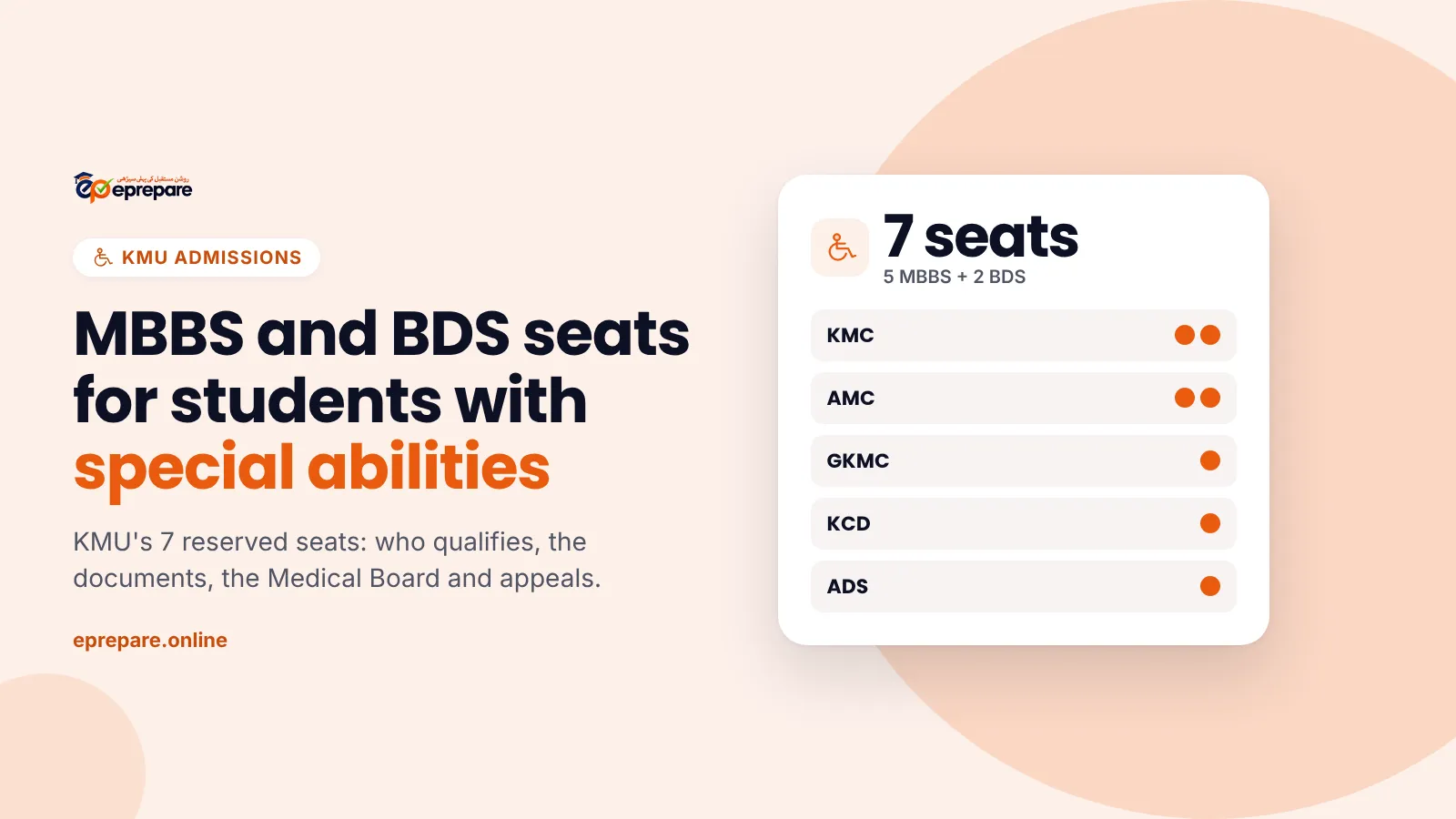
Who: candidates with a permanent physical disability who are otherwise able to study and practise, certified by KMU's Medical Board, with a KP or Merged District domicile. The seats are at KMC (2), AMC (2), GKMC (1), KCD (1) and ADS (1). You must apply for both open merit and the special-ability seats to be considered for both. Fee: the normal fee. Full guide: MBBS and BDS seats for students with special abilities.
11. Minorities: 2 seats (plus 3 GSF)
Who: only non-Muslim candidates with a KP or Merged District domicile (you and your father). They can apply for the minority seats (one at KMC, one at SMC), open merit, backward area seats (with that area's domicile), general self-finance and the GSF seats reserved for minorities, and then choose which seat to take. Fee: the normal fee on minority seats; the GSF fee on GSF seats.
12. APS victims and siblings: 2 seats
The KP Health Department reserves two seats at Khyber Medical College for the victims of the Army Public School Peshawar attack of 16 December 2014, if they otherwise meet PM&DC's criteria. Selection follows the priority set by the Peshawar High Court: first, injured students from the list provided by 11 Corps; second, injured students who fall below the merit of the martyred students' siblings; third, siblings of the martyred students.
13. Reciprocal seat at Nishtar Medical College, Multan: 1 seat
The policy's seat table counts one KMC seat under "Reciprocal for N.M.C (Multan)", and lists one open merit seat at Nishtar Medical College, Multan, for a KP candidate. KMU fills the KP seat from the open merit list on merit-cum-choice, and the student keeps the right to be upgraded to a higher preference later.
14. Over-and-above seats: PTAP, IIOJK and additional foreign seats
- Pakistan Technical Assistance Program (6 seats): for foreign nationals, who apply through their own government or embassy to the Economic Affairs Division, Islamabad. EAD selects and sends the names to KMU. Fee: equal to the open merit fee.
- IIOJK (4 seats): at KMC and AMC. Candidates are recommended by the respective nominating department, not through the KMU form.
- Additional foreign seats (68): spread across all 13 colleges. The policy allows special foreign-student seats under Federal Government programmes and bilateral agreements to be admitted over and above, up to 5% of a college's seats. Our foreign seats guide explains the requirements.
Where you apply for each category
This is where many students go wrong. Most seats need only the online form on cas.kmu.edu.pk. Two categories need the KMU form plus another office. Five categories are filled by a nominating agency, and KMU does not select you for them at all.
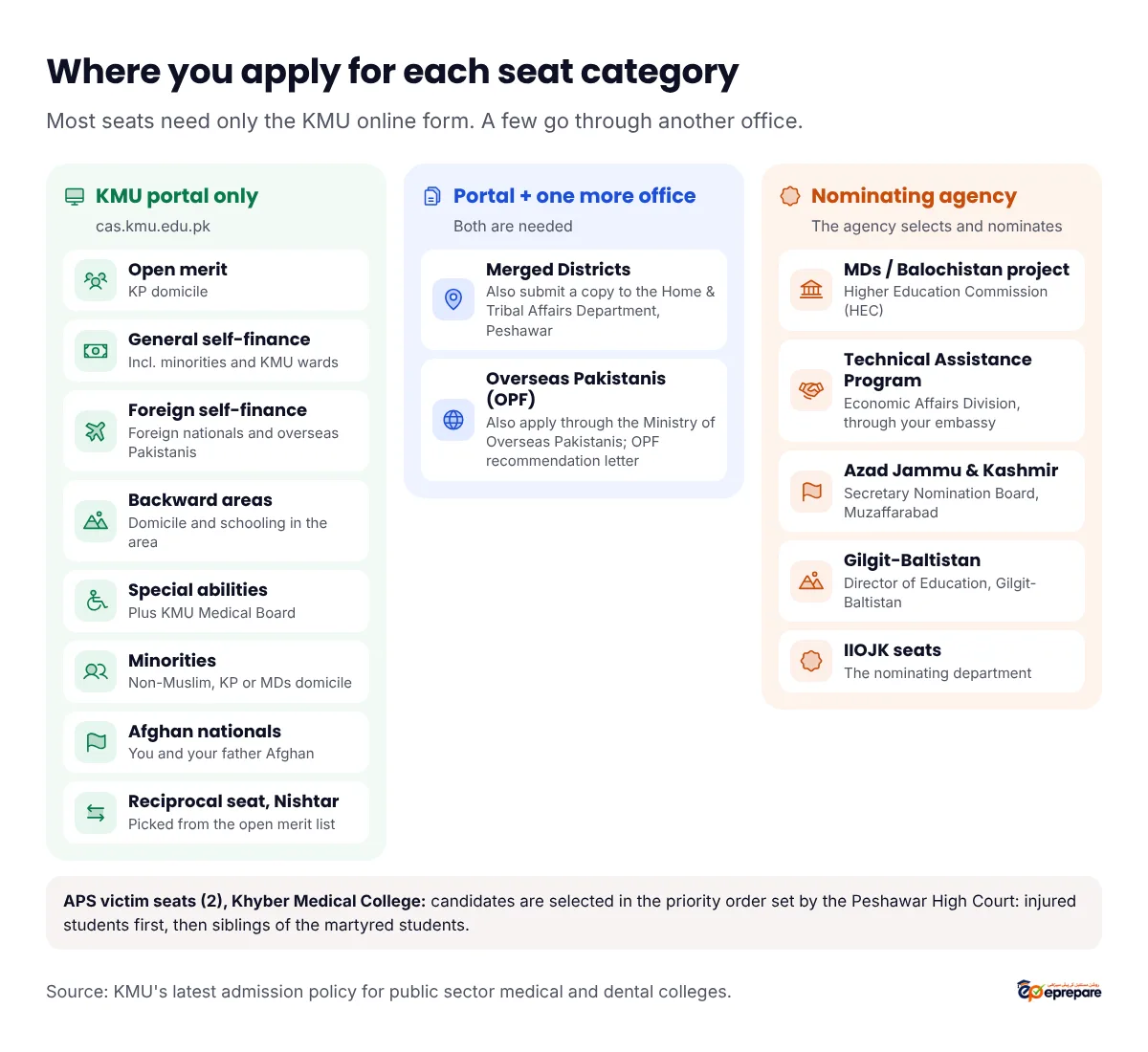
| Category | Apply on KMU portal? | Also needed |
|---|---|---|
| Open merit, GSF, FSF, backward areas, special abilities, minorities, Afghan nationals | Yes | Not required |
| Merged Districts | Yes | Copy of form and documents to Home & Tribal Affairs Department, Peshawar |
| Overseas Pakistanis (OPF) | Yes | Application through the Ministry of Overseas Pakistanis and an OPF recommendation letter |
| MDs / Balochistan project | No | Apply to HEC |
| Technical Assistance Program | No | Apply through your embassy to the Economic Affairs Division |
| AJK / Gilgit-Baltistan | No | Secretary Nomination Board, Muzaffarabad / Director of Education, GB |
| IIOJK | No | Recommendation by the nominating department |
Can you apply for more than one category?
Yes, and you should. The policy repeatedly says you must apply in each category to be considered in it. For backward areas, for example: "To be considered on open merit as well as quota seats, the candidates must apply against both categories. However, it will be the choice of the candidate to avail open merit or backward area seat or GSF." It says the same for special-ability seats, and gives minority and OPF candidates the same choice.
Three rules decide how this works:
- Each category has its own merit list. "Selection under each category of seats shall be done on the basis of inter se merit amongst the eligible applicants." You compete only with the other applicants in that category.
- You choose the seat. If you are selected in more than one category, you decide which seat to take at the placement interview, held on merit-cum-choice.
- Tick it, or you are not considered. If you do not apply for a category, or do not list a college in your preferences, you will not be offered that seat or that college.
Also remember that MBBS and BDS are separate. The policy says each student "shall be required to apply separately to a medical or dental program". If you want both, apply for both.
Seats in each college
The split is very different from college to college. Khyber Medical College has the most open merit seats (181), while Ayub Medical College carries most of the AJK seats and a large share of the HEC project seats. This view shows every college at a glance:
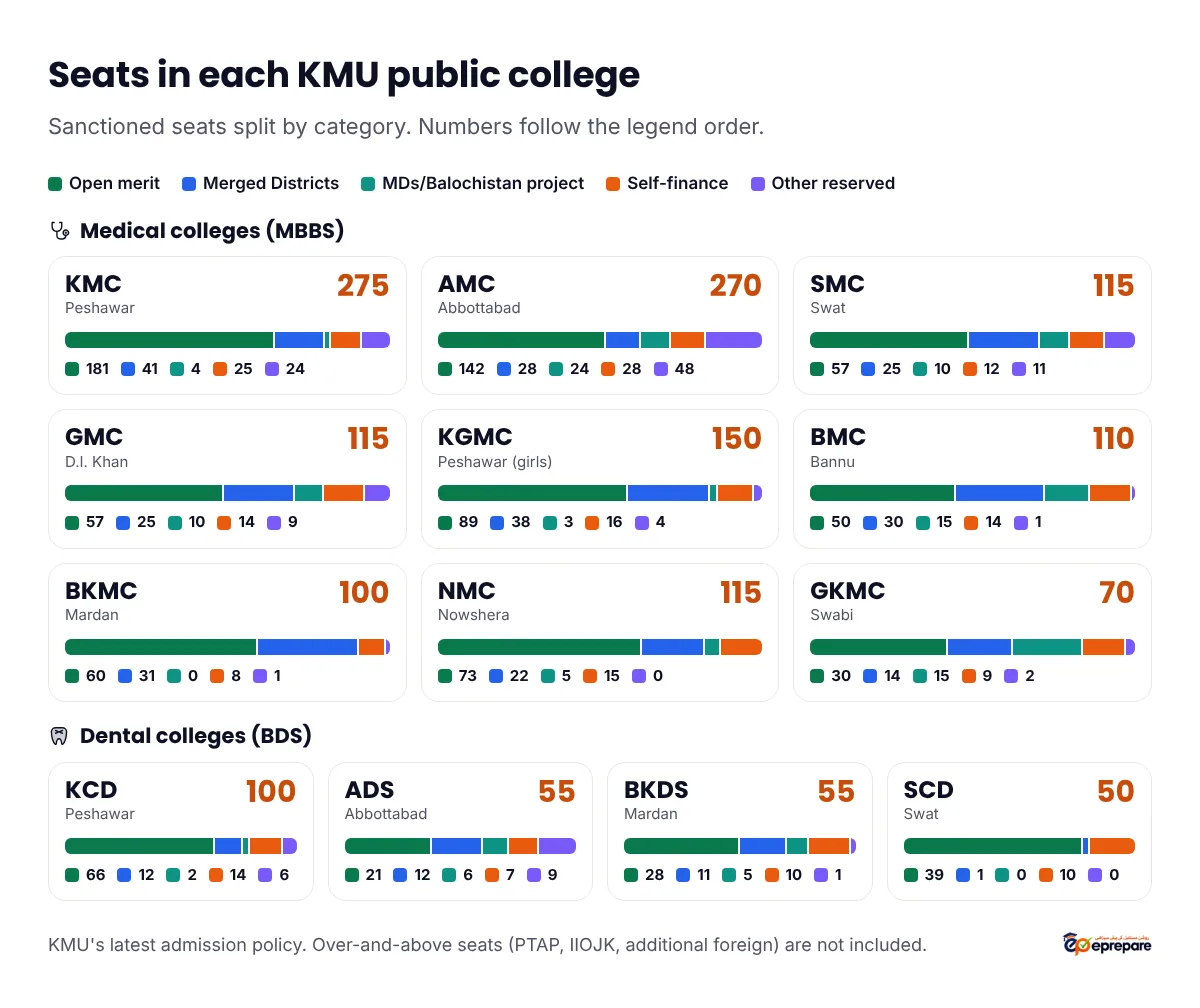
| College | Total | Open merit | Self-finance (GSF + FSF) | Reserved |
|---|---|---|---|---|
| KMC, Peshawar | 275 | 181 | 25 | 69 |
| AMC, Abbottabad | 270 | 142 | 28 | 100 |
| SMC, Swat | 115 | 57 | 12 | 46 |
| GMC, D.I. Khan | 115 | 57 | 14 | 44 |
| KGMC, Peshawar | 150 | 89 | 16 | 45 |
| BMC, Bannu | 110 | 50 | 14 | 46 |
| BKMC, Mardan | 100 | 60 | 8 | 32 |
| NMC, Nowshera | 115 | 73 | 15 | 27 |
| GKMC, Swabi | 70 | 30 | 9 | 31 |
| KCD, Peshawar | 100 | 66 | 14 | 20 |
| ADS, Abbottabad | 55 | 21 | 7 | 27 |
| BKDS, Mardan | 55 | 28 | 10 | 17 |
| SCD, Swat | 50 | 39 | 10 | 1 |
"Self-finance" here includes GSF, GSF for minorities and FSF. "Reserved" covers every other category (Merged Districts, the HEC project, backward areas, AJK, GB, OPF, Afghan nationals, special abilities, minorities, APS and the reciprocal seat). To see which colleges your aggregate can reach, try the KPK college predictor.
What fee each category pays
Most reserved seats pay the normal fee, the same as open merit. The policy lists these as paying the normal fee: open merit, KP backward areas, Merged Districts seats in KP colleges, AJK and Gilgit-Baltistan seats, disabled students' seats, minority seats, overseas Pakistanis' seats, PTAP students and foreign nationals ("Equal to Open Merit Fee"), MDs/Balochistan project seats and Afghan national seats.
| Fee type | Seats | First year (MBBS) |
|---|---|---|
| Normal (open merit) fee | Open merit and the reserved seats listed above | Rs 102,000 (KMC, KGMC, AMC) or Rs 87,000 (other colleges) |
| General self-finance fee | GSF, including GSF for minorities and KMU wards | Rs 1,262,000 (KMC, KGMC, AMC) or Rs 1,162,000 (other colleges) |
| Foreign self-finance fee | FSF | US$7,500 (KMC, KGMC, AMC) or US$7,000 (other colleges), plus Rs 50,500 |
Every year's fee for MBBS and BDS, college by college, is in our KMU fee structure guide.
What happens to seats that stay empty
Reserved seats do not simply go to waste. The policy says that any allocated seat which remains vacant after admissions, when "there is no eligible candidate available", shall be "converted to open merit seats, expect foreign self-finance seats which will be converted to general self-finance seats." So a quiet year in a reserved category can mean a few more open merit or self-finance seats.
Two more limits apply. Seats are not carried forward to the next year, and the policy caps foreign plus general self-finance seats at 15% of a college's allocated seats.
Before you apply: a short checklist
- Check your domicile and your father's (or your mother's, with your father's death certificate, if he has died).
- List every category you qualify for, using the questions above, and tick all of them on the KMU form.
- List every college you would accept in your preferences, in the order you really want them.
- Start early on the extra paperwork: location certificates, Social Welfare and NADRA disability documents, OPF letters, Home & Tribal Affairs copies. Our KMU documents checklist lists every certificate.
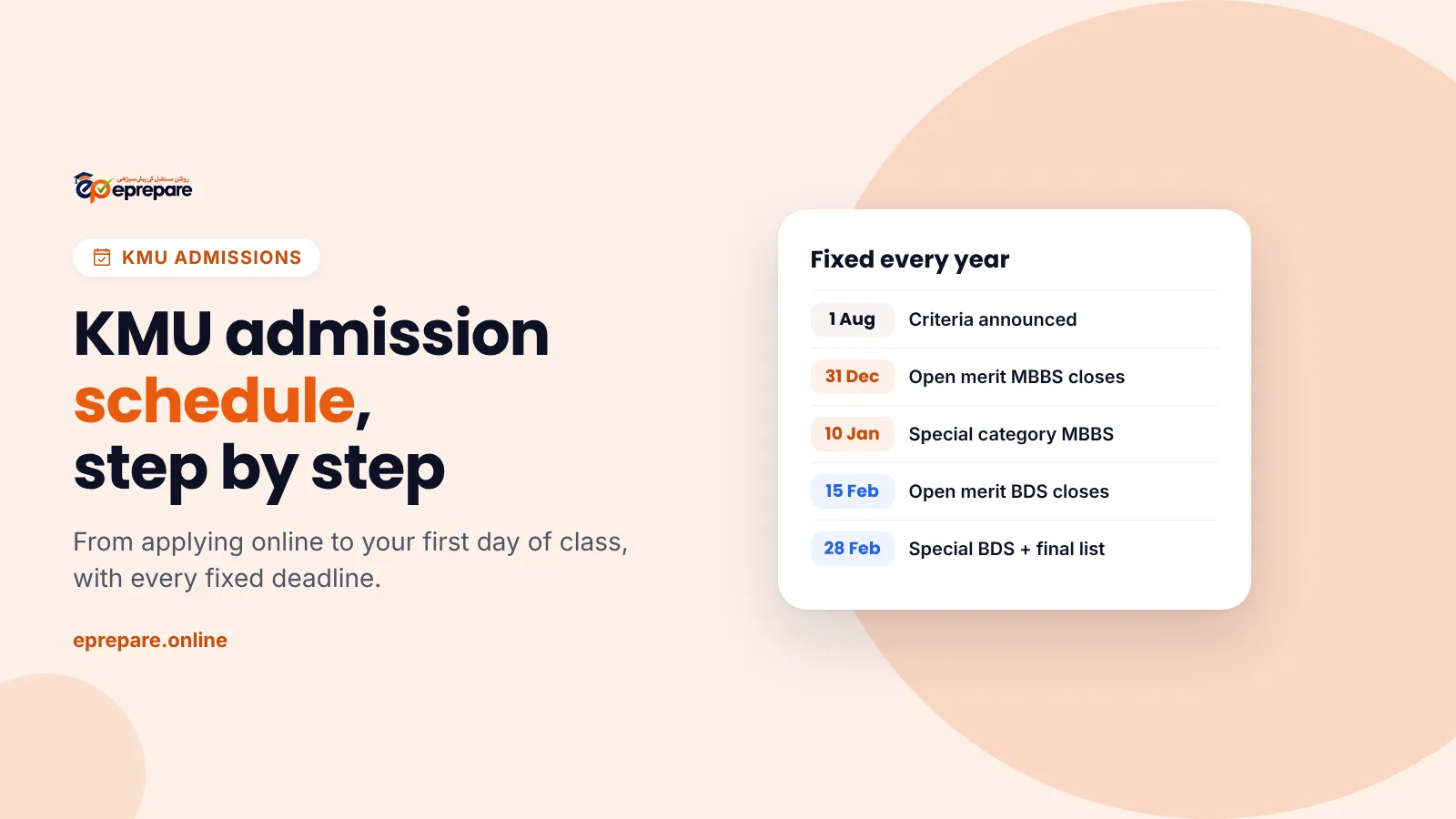
- Note every deadline in the KMU admission schedule. Certificates issued after the closing date are not counted.
Frequently asked questions
How many MBBS and BDS seats does KMU have in public colleges?
PM&DC has sanctioned 1,580 seats in KMU's 13 public colleges: 1,320 MBBS and 260 BDS. The policy adds 78 seats over and above (68 additional foreign seats, 6 PTAP and 4 IIOJK), for 1,658 in total.
How many open merit seats are there at KMU?
893: 739 for MBBS and 154 for BDS. That is 57% of the sanctioned seats. Khyber Medical College has the most open merit seats (181), followed by Ayub Medical College (142).
Can I apply for open merit and a quota seat at the same time?
Yes. You must tick both categories on the KMU form to be considered in both. Each category has its own merit list, and if you are selected in more than one, you choose which seat to take.
My father has died. Whose domicile do I use?
The policy accepts your mother's valid domicile in place of your father's, along with your father's death certificate. In a case of separation, the backward area rules ask for proof of separation.
Is a quota seat a lower-quality seat?
No. Reserved and self-finance students study in the same college, in the same classes, with the same teachers as open merit students. Only the way you are selected, and for self-finance the fee, is different.
Do quota seats need MDCAT?
Yes. The policy forbids any category that admits a student who has not passed the MDCAT. You need at least 55% for MBBS or 50% for BDS, and 60% in HSSC.
What happens if a reserved seat is not filled?
It is converted to an open merit seat. The one exception is foreign self-finance: an empty FSF seat becomes a general self-finance seat.
Is there an age limit for KMU admission?
No. The policy says there is no lower or upper age limit for admission to KP's public medical and dental colleges. If two candidates have equal merit, the older one is placed higher.
Knowing your categories is half the battle. The other half is your MDCAT score, because every seat, reserved or open, is filled on merit. If you are preparing for the MDCAT, join ePrepare for KPK textbook MCQs, full-length mocks and a study plan built around the seats you are aiming for.
Source: Khyber Medical University, latest Admission Policy for Public Sector Medical and Dental Colleges of Khyber Pakhtunkhwa (seat distribution, eligibility for each category of seats, admission procedure and fee schedule). Seats and rules can change when KMU issues a new policy; always check the latest version on cas.kmu.edu.pk.