

If your family is from Chitral, Kohistan, Dir, Shangla, Buner, Battagram, Tor Ghar, Tank, Hangu or another of KP's backward areas, there are MBBS and BDS seats in public colleges that only students of your area can compete for. Very few students compete for each of these seats, but the rules are strict. A single year of school outside your area, or a missing signature on a certificate, can rule you out.
This guide explains everything KMU's latest admission policy says about backward area seats: which areas qualify, how many seats each area has and in which colleges, who is eligible, how the location certificate works, the five-year service bond, and how to apply without losing your open merit chance.
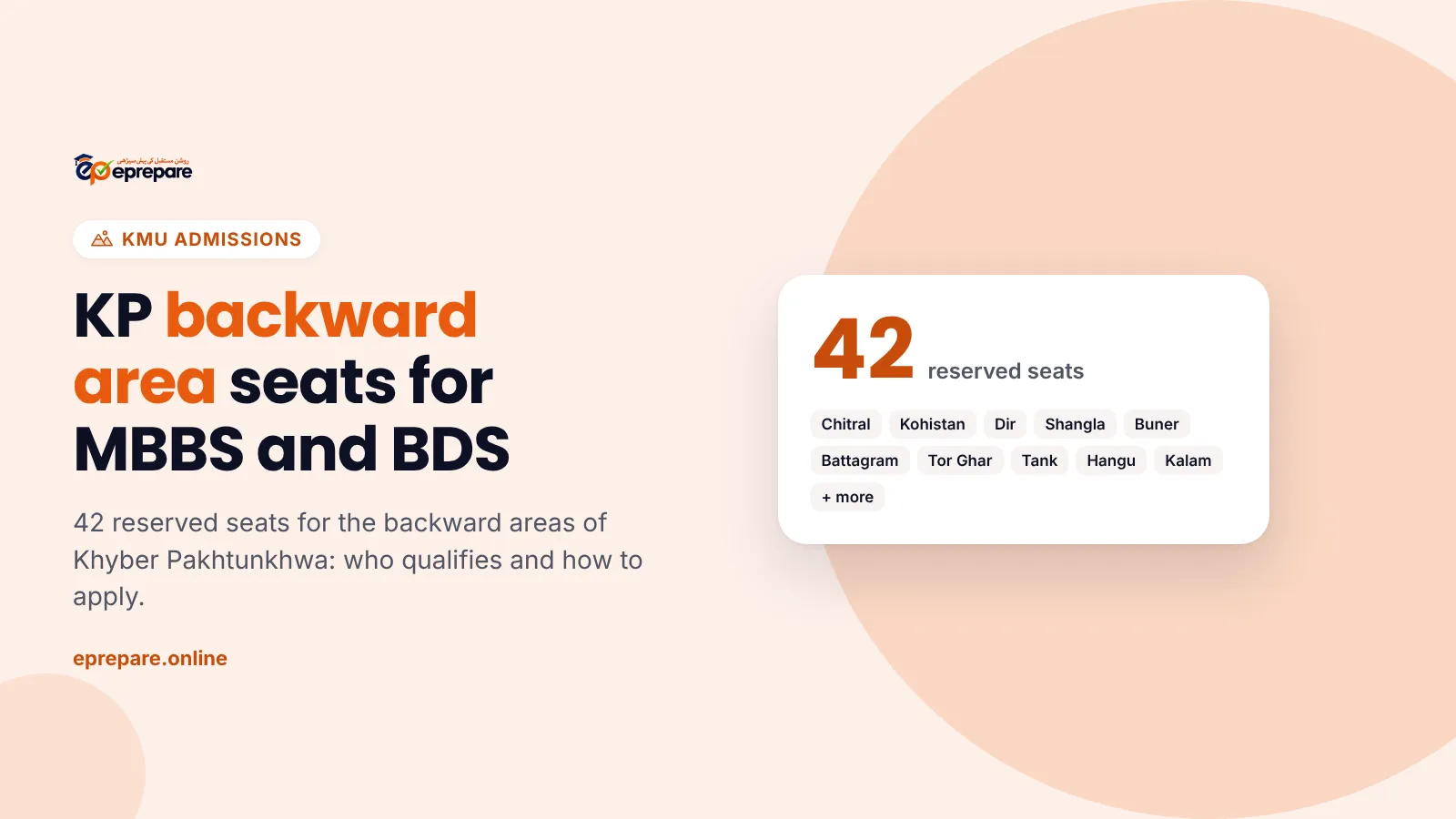
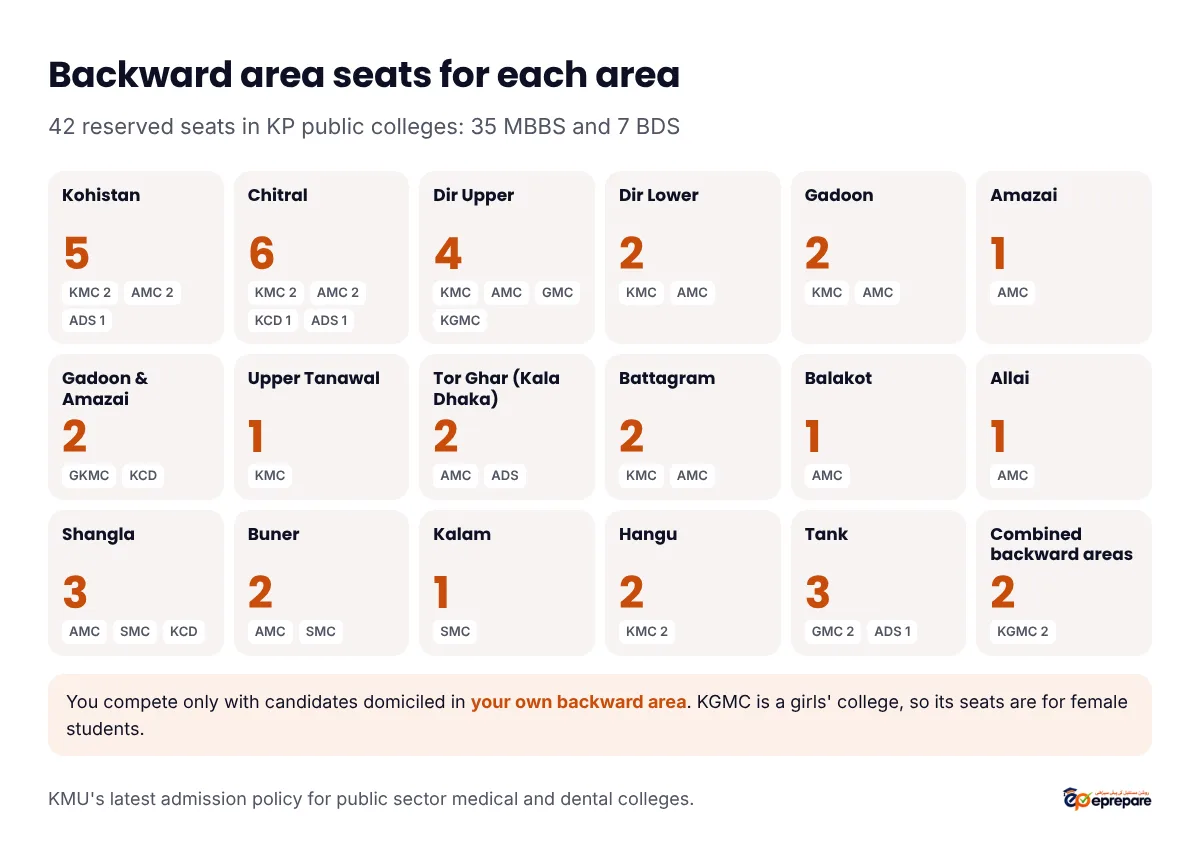
The short answer: KMU's policy reserves 42 seats (35 MBBS, 7 BDS) for candidates of KP's backward areas, spread over 18 area listings. To qualify, you and your father must hold a domicile of that backward area, and you must have studied from class 1 to FSc inside that area, proved by a location certificate verified by the DEO and countersigned by the Deputy Commissioner. You compete only with candidates of your own area. Tick both backward area and open merit on the KMU form. If you are selected, you sign a bond to serve in your home district for at least five years.
Which areas count as backward areas?
The policy names them exactly like this:
"The backward areas are identified as Upper & Lower Dir, Chitral, Kohistan, Gadoon, Amazai, Tor Ghar (Kala Dhaka) and Upper Tanawal, Batagram district and Allai, Shangla, Buner, Tank and Hangu and Tehsils of Balakot and Kalam."
For two of these, only a tehsil counts: Balakot (in Mansehra district) and Kalam (in Swat district). If your domicile is from another part of Mansehra or Swat, you do not qualify for these seats.
The Merged Districts (former FATA) are a separate category with their own 333 seats and rules. If you are from Bajaur, Khyber, Mohmand, Orakzai, Kurram, the Waziristans or the Ex-FRs, read our guide to Merged Districts MBBS and BDS seats instead.
How many seats does each area have?
| Backward area | Seats | Colleges |
|---|---|---|
| Chitral | 6 | KMC 2, AMC 2, KCD 1 (BDS), ADS 1 (BDS) |
| Kohistan | 5 | KMC 2, AMC 2, ADS 1 (BDS) |
| Dir Upper | 4 | KMC 1, AMC 1, GMC 1, KGMC 1 |
| Shangla | 3 | AMC 1, SMC 1, KCD 1 (BDS) |
| Tank | 3 | GMC 2, ADS 1 (BDS) |
| Dir Lower | 2 | KMC 1, AMC 1 |
| Gadoon | 2 | KMC 1, AMC 1 |
| Gadoon & Amazai (joint) | 2 | GKMC 1, KCD 1 (BDS) |
| Tor Ghar (Kala Dhaka) | 2 | AMC 1, ADS 1 (BDS) |
| Battagram | 2 | KMC 1, AMC 1 |
| Buner | 2 | AMC 1, SMC 1 |
| Hangu | 2 | KMC 2 |
| Combined backward areas | 2 | KGMC 2 |
| Amazai | 1 | AMC 1 |
| Upper Tanawal | 1 | KMC 1 |
| Balakot (tehsil) | 1 | AMC 1 |
| Allai | 1 | AMC 1 |
| Kalam (tehsil) | 1 | SMC 1 |
| Total | 42 | 35 MBBS, 7 BDS |
A few points that save confusion:
- Gadoon and Amazai each have their own seats (Gadoon 2, Amazai 1), plus 2 joint seats at GKMC and KCD that candidates from either area compete for.
- The policy lists 2 "Combined Backward Areas" seats at Khyber Girls Medical College without naming one area. They read as seats open to eligible candidates from the backward areas together. KGMC is a girls' college, so these seats, like Dir Upper's KGMC seat, are for female candidates. Confirm the exact pool in KMU's merit list notice.
- The policy's table spells Hangu as "Hungu"; it is the same area.
Backward area seats in each college
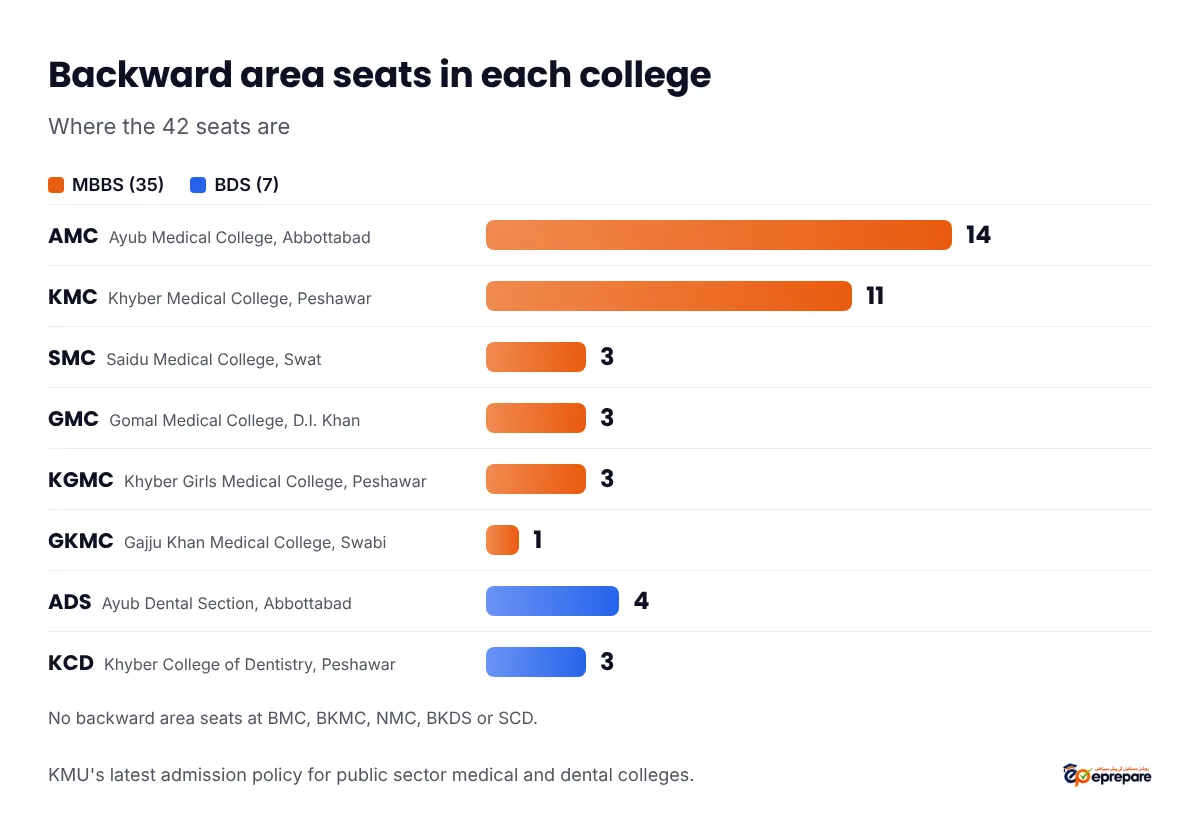
Most seats are at Ayub Medical College, Abbottabad (14) and Khyber Medical College, Peshawar (11). Bannu, Bacha Khan (Mardan) and Nowshera medical colleges have no backward area seats, and neither do Bacha Khan Dental Section and Saidu College of Dentistry.
| College | Seats | For which areas |
|---|---|---|
| Ayub Medical College, Abbottabad (AMC) | 14 | Kohistan 2, Chitral 2, Dir Upper, Dir Lower, Gadoon, Amazai, Tor Ghar, Battagram, Balakot, Allai, Shangla, Buner (1 each) |
| Khyber Medical College, Peshawar (KMC) | 11 | Kohistan 2, Chitral 2, Hangu 2, Dir Upper, Dir Lower, Gadoon, Upper Tanawal, Battagram (1 each) |
| Saidu Medical College, Swat (SMC) | 3 | Shangla, Buner, Kalam (1 each) |
| Gomal Medical College, D.I. Khan (GMC) | 3 | Tank 2, Dir Upper 1 |
| Khyber Girls Medical College, Peshawar (KGMC) | 3 | Combined backward areas 2, Dir Upper 1 |
| Gajju Khan Medical College, Swabi (GKMC) | 1 | Gadoon & Amazai |
| Ayub Dental Section, Abbottabad (ADS) | 4 | Kohistan, Chitral, Tor Ghar, Tank (1 each) |
| Khyber College of Dentistry, Peshawar (KCD) | 3 | Chitral, Gadoon & Amazai, Shangla (1 each) |
Who is eligible for a backward area seat?
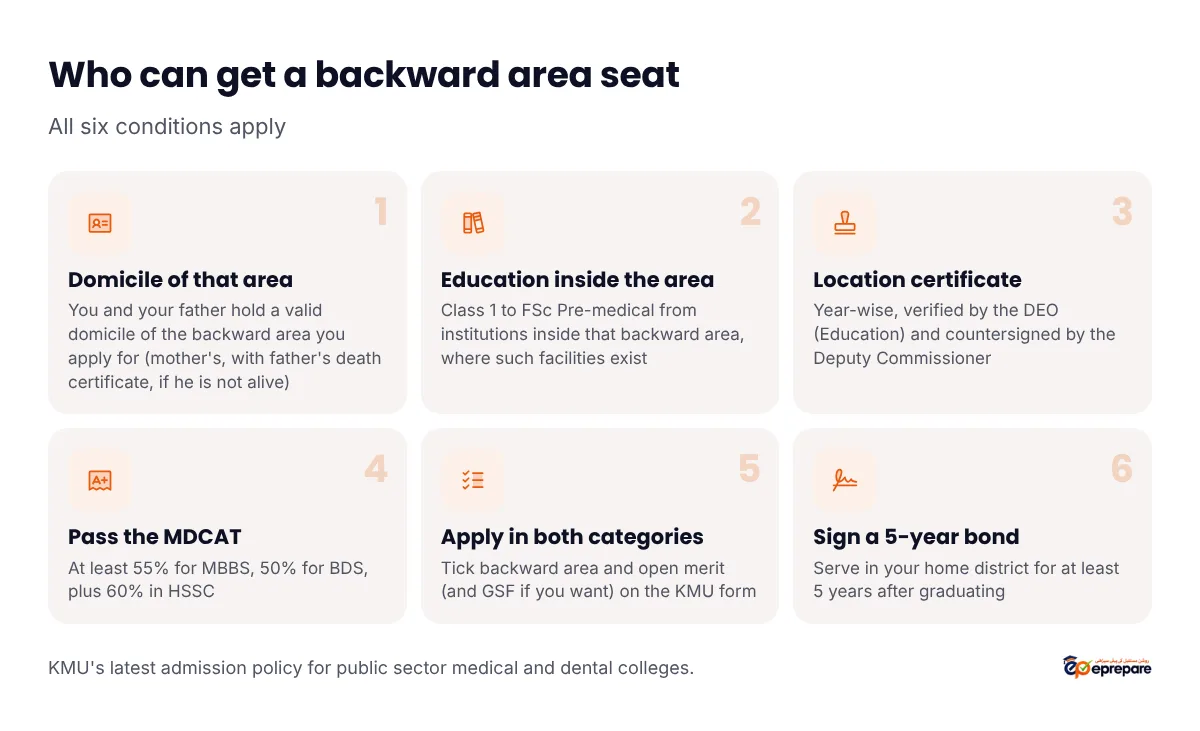
These are the rules from the policy, word for word, with what each one means for you.
1. Domicile: yours and your father's
"The candidate and his/her father must be having a valid domicile certificate of the Backward area against which he/she is submitting the application and if father is not alive then the mother's valid domicile of the backward area will be considered along with the death certificate of the father. In case of separation, a proof of separation shall be provided."
A KP domicile is not enough. The domicile must be of the specific backward area you are applying for. If your parents are separated, attach proof of separation.
2. Education from class 1 to FSc inside the area
"The candidates must have obtained education from class-I till FSc (complete sessions) including SSC with science and FSc premedical from the institutions within the concerned backward area of Khyber Pakhtunkhwa and have passed examinations from the same institutions, provided such facilities exist in the area"
This is the strictest rule. "Complete sessions" means every year, not just the board exams.
3. Studied part of your education outside? You are not an inside candidate
"In case any candidate who has obtained part of his/her education from outside the concerned backward area or area of domicile, provided such facilities exist, will not be considered as inside candidate."
So if your area had a good science school but you did Class 9 and 10 in Peshawar or Abbottabad, you lose inside status. You can still compete on open merit and self-finance.
4. Pass the MDCAT
The policy requires candidates to have "passed in the prescribed Entrance Test". That means the PM&DC MDCAT with at least 55% for MBBS and 50% for BDS, plus the general KMU conditions such as 60% in HSSC. Read MDCAT passing marks for the exact scores out of 180.
5. Merit within your own area
Selection in every category is on "inter se merit amongst the eligible applicants". You are ranked only against other eligible candidates of your own backward area, using the normal aggregate: 10% Matric, 40% FSc and 50% MDCAT. Calculate yours with the aggregate calculator.
What if your area had no science school or college?
Many backward areas, especially for girls, do not have a higher secondary college with Pre-medical. The policy handles this:
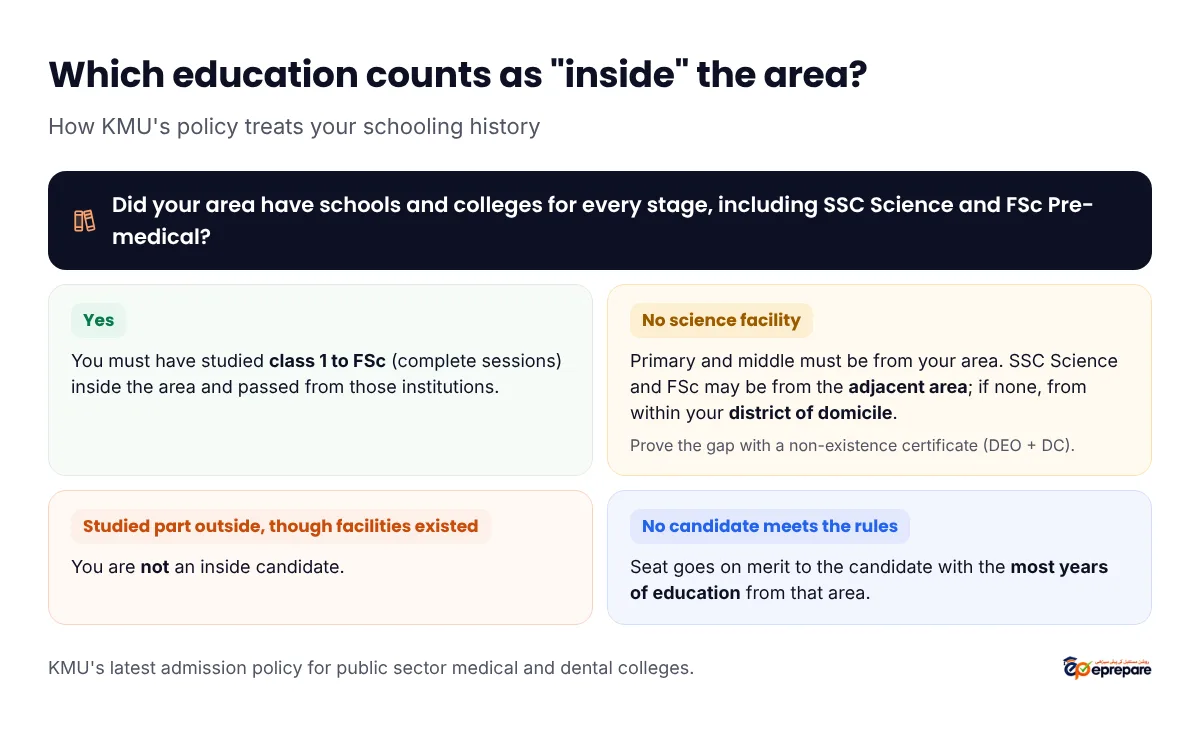
"In case where there are no facilities within the concerned Backward area of SSC with science and FSc Pre Medical, the candidate must have obtained his/her primary and middle education from the respective backward area, provided the candidate has obtained SSC with Science and FSc Pre-medical from the area (adjacent to) their backward area and in case no candidate is available from the area nearest to that backward area, then from within the District of domicile."
In plain words:
- Primary and middle (class 1 to 8) must still be from your backward area.
- SSC Science and FSc Pre-medical can be from the area next to yours if your area had no such facility.
- If no candidate is available from the nearest area, schooling from within your district of domicile is considered.
- You must prove that the facility did not exist with a certificate verified by the District Education Officer (DEO) and countersigned by the Deputy Commissioner (see the non-existence certificate below).
And if nobody meets the full rules? The policy says: "In case of non-availability of candidates fulfilling the above-mentioned criteria, the selection will be made on merit from amongst the candidates on the basis of maximum education obtained from the concerned backward area." The seat is not wasted. It goes to the candidates with the most years of schooling from that area.
The location certificate and the non-existence certificate
All admissions on backward area seats are decided on these papers. The policy says: "All admissions on backward area seats will be based on the location certificate provided by the concerned DC and DEO. KMU-AC will not be responsible for omission or commission if any in the location certificate." If there is a mistake on your certificate, it is your loss, so check every line before you submit.
| Certificate | What it shows | Who signs |
|---|---|---|
| Certificate of location of educational institutes | Every class from 1 to 12: the full name of the school or college, its location, whether it is inside or outside the area, the years (from and to) and the board. Attach DMCs for classes 9, 10, 11 and 12. | District Education Officer (Education) with official stamp, verified by the Deputy Commissioner |
| Certificate of non-existence of educational institutes | That no institute or facility existed for primary, middle, Matric, FSc-I or FSc-II (for male or female students) in the tehsil or district of your backward area in that session | DEO (Education) with official stamp, verified by the Deputy Commissioner |
| Certificates from your schools | Location certificates from the principals or headmasters of the institutions you attended | Principal or headmaster |
The policy's specimen forms for both certificates are printed at the end of KMU's admission policy. Note that the non-existence form asks whether the facility existed for male or female students. A girls' college may be missing in an area that has a boys' college, and the certificate can show that.
The policy also says the year-wise location certificate "shall be verified on the recommendation of Scrutiny Committee if required, before issuing the final merit for admission." Keep your original school records ready in case the committee asks.
Start early: you need the DEO's signature and stamp, then the DC's countersignature, and a certificate issued after the closing date for applications is not accepted. Begin as soon as your FSc result is out, well before KMU opens applications.
The five-year service bond
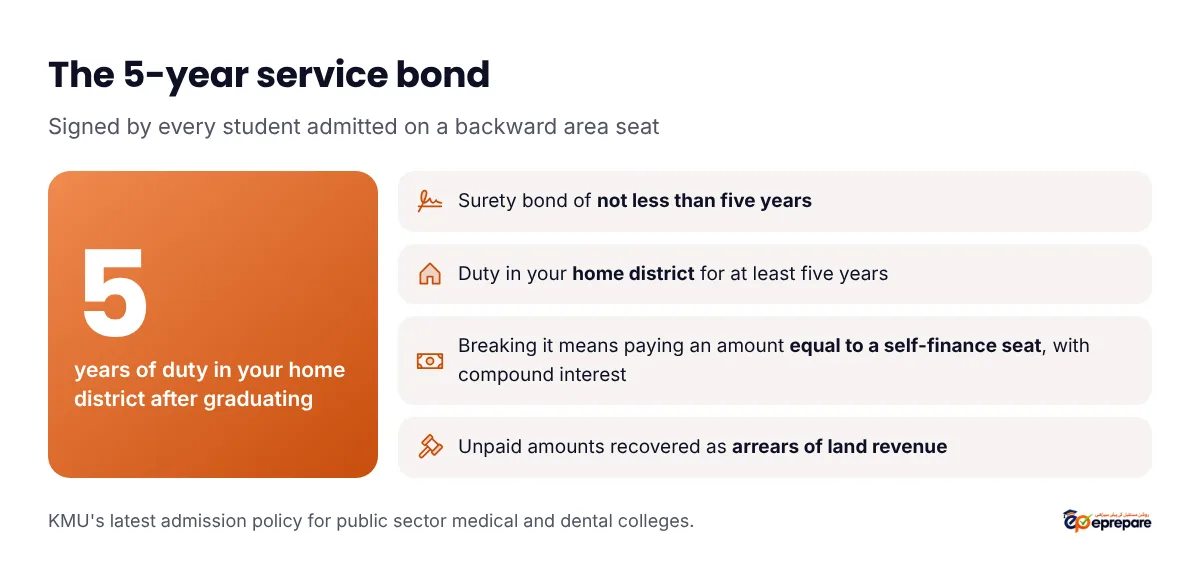
"Students selected on Backward Areas quota seats should sign surety bond of not less than five years, stating that after completion of education, they shall perform duty in their home districts for at least 5 years. Any violation will result in their payment of an amount equal to self-finance seat, with compounding interest rate. This money will be recovered as arrears of land revenue, in case of non-payment."
This is a serious commitment, so discuss it with your family before you accept a backward area seat. The policy does not spell out exactly how the penalty is calculated. For scale, self-finance MBBS fees in KMU's policy total about Rs 67.6 lakh to Rs 72.6 lakh over five years (see the KMU fee structure). If you would rather not be bound, an open merit seat carries no such bond.
Apply for both: backward area and open merit
Students from backward areas are also KP domicile holders, so they can compete on open merit and general self-finance. The policy is clear that you must tick both:
"Candidates from these areas can also apply against Open merit seats and general-self-finance seats. To be considered on open merit as well as quota seats, the candidates must apply against both categories. However, it will be the choice of the candidate to avail open merit or backward area seat or GSF."
If your merit is high enough for open merit, you may prefer that seat, because it comes without the five-year bond. If not, the backward area seat is your safety net. Non-Muslim candidates holding a valid domicile of a backward area can apply for backward area seats too, alongside minority seats. See every KMU quota and reserved seat explained.
How to apply, step by step
- Get your documents ready first: your and your father's domicile of the backward area, both CNICs or your Form B, DMCs, the location certificate (DEO + DC), a non-existence certificate if needed, and a certificate from your last institution. Use our KMU documents checklist.
- Apply online on cas.kmu.edu.pk when KMU opens admissions. Select the backward area seats for your area, and open merit, and self-finance if you want it.
- List every college you would accept, in order of preference. You will not be offered a college you did not list.
- Check the merit lists. KMU displays a merit list for each category. Objections go in writing to the Chairman of KMU's Admission Committee before placement interviews. See how KMU merit lists and upgrades work.
- Attend the placement interview with a parent or legal guardian, and bring all original certificates.
- Deposit the fee within three working days of your offer, or the seat goes to the next candidate. Backward area seats pay the normal open merit fee: Rs 102,000 in the first year at KMC, KGMC and AMC, and Rs 87,000 at other colleges.
- Sign the five-year surety bond when you are admitted.
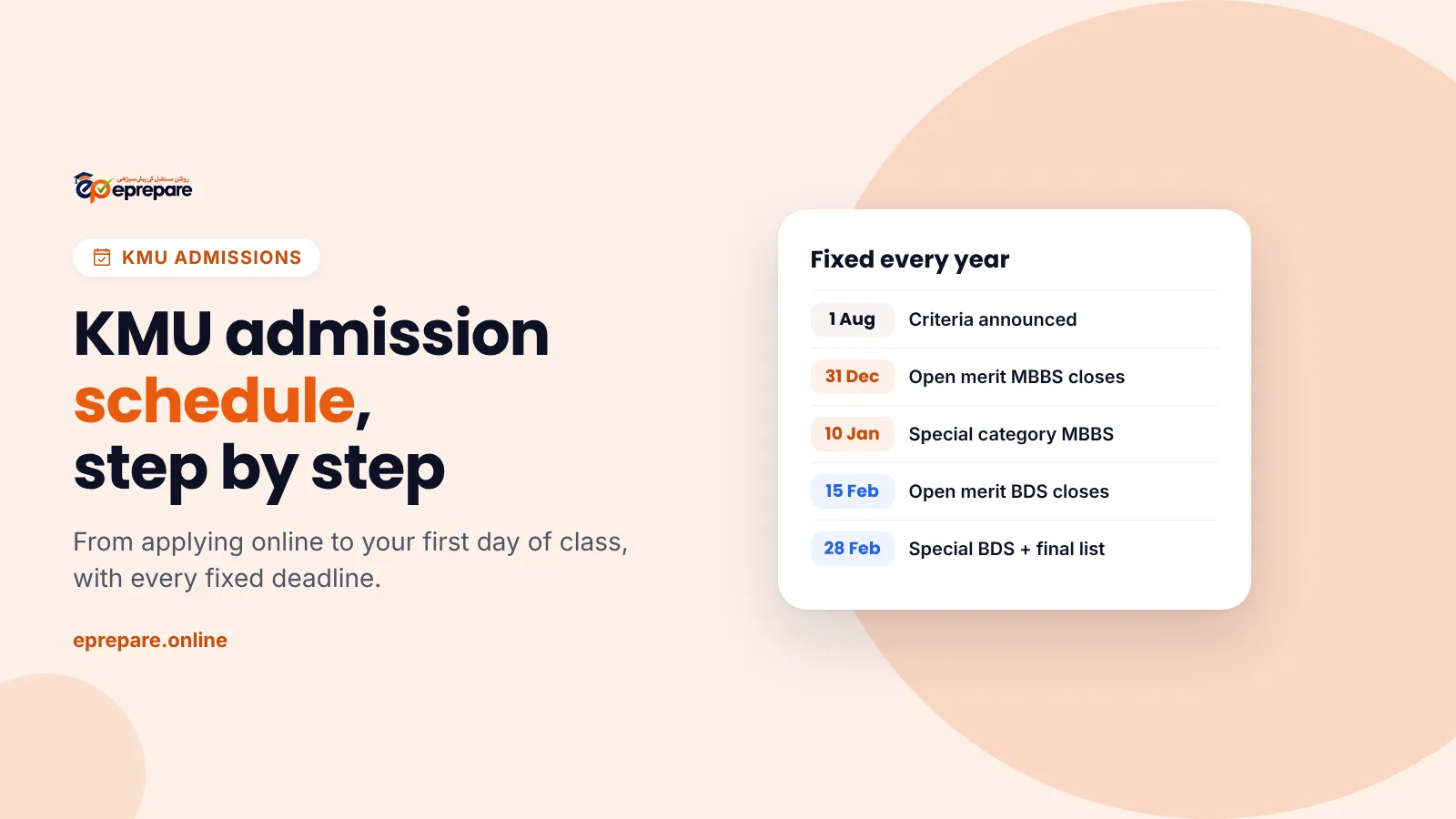
Backward area seats are a special category, so KMU must complete these admissions by 10 January for medical colleges and 28 February for dental colleges. The full sequence is in our KMU admission schedule.
A strict warning about false certificates
The policy is unforgiving here: "If any certificate submitted by the candidate is found false, or forged during his/her study period, his/her admission shall be cancelled forthwith and he/she shall be blacklisted for admission to any professional colleges in Khyber Pakhtunkhwa. Further legal action can be taken against the student under the existing criminal laws." This applies even in your final year. Never accept a location certificate that does not match your real schooling.
After admission: migration
KMU's migration rules are category-wise. A student on a backward area seat can migrate to another college only after passing the 2nd Professional (MBBS) or 1st Professional (BDS), and only into a vacant backward area seat. Details are in our KMU migration policy guide.
Frequently asked questions
How many backward area seats are there in KP medical colleges?
KMU's latest policy has 42 backward area seats: 35 MBBS seats in six medical colleges and 7 BDS seats in two dental colleges. Chitral has the most (6), followed by Kohistan (5) and Dir Upper (4).
Is Swat or Mansehra a backward area for KMU admissions?
Only specific tehsils: Kalam tehsil of Swat and Balakot tehsil of Mansehra. The rest of Swat and Mansehra districts are not listed as backward areas.
I studied in my area until Matric and did FSc in Peshawar. Can I apply?
Only as an inside candidate if your area had no FSc Pre-medical facility, proved by a non-existence certificate. Even then, the policy expects FSc from the adjacent area, or from within your district if no candidate from the nearest area is available. If a Pre-medical college existed in your area, studying FSc outside means you are not an inside candidate. You can still compete on open merit and self-finance.
My father is not alive. Whose domicile is needed?
Your mother's valid domicile of the same backward area, along with your father's death certificate. In case of separation, attach proof of separation.
Do backward area students pay a higher fee?
No. Backward area seats pay the normal open merit fee, not the self-finance fee.
Can I apply for backward area and open merit seats at the same time?
Yes, and you should. The policy says you must apply against both categories to be considered on both, and the choice of which seat to take is yours.
What happens if I don't serve five years in my home district?
You must pay an amount equal to a self-finance seat with compound interest. If you don't pay, it can be recovered as arrears of land revenue.
What if no student from my area meets every condition?
The seat is then given on merit to the candidate with the most years of education obtained from that backward area.
A reserved seat still needs a strong MDCAT, because even a small pool is competitive. If you are preparing from Chitral, Kohistan or any area far from big-city academies, our online MDCAT courses bring KPK textbook-based practice, full-length tests and smart revision to your phone.
Sources: Khyber Medical University, latest Admission Policy for Public Sector Medical and Dental Colleges of Khyber Pakhtunkhwa (college-wise seat distribution, sections on KP backward area seats and their eligibility criteria, documents required, admission procedure, migration policy, fee schedule, and the specimen certificates of location and non-existence of educational institutes). Always check the current notice on cas.kmu.edu.pk.