"How much will MBBS cost me at a government college in KP?" It sounds like a simple question, but the honest answer depends on two things: which college you get and which category of seat you are admitted on. A student on an open merit seat and a student on a self-finance seat can sit in the same lecture hall and pay very different fees.
Khyber Medical University (KMU) admits students to all public sector medical and dental colleges of Khyber Pakhtunkhwa, and its admission policy contains the official fee schedule for every seat. We have gone through that schedule line by line. This guide puts it into plain tables: the fee for each year, what each charge is for, the total for the whole degree, and the rules about paying and refunds that catch students out every year.
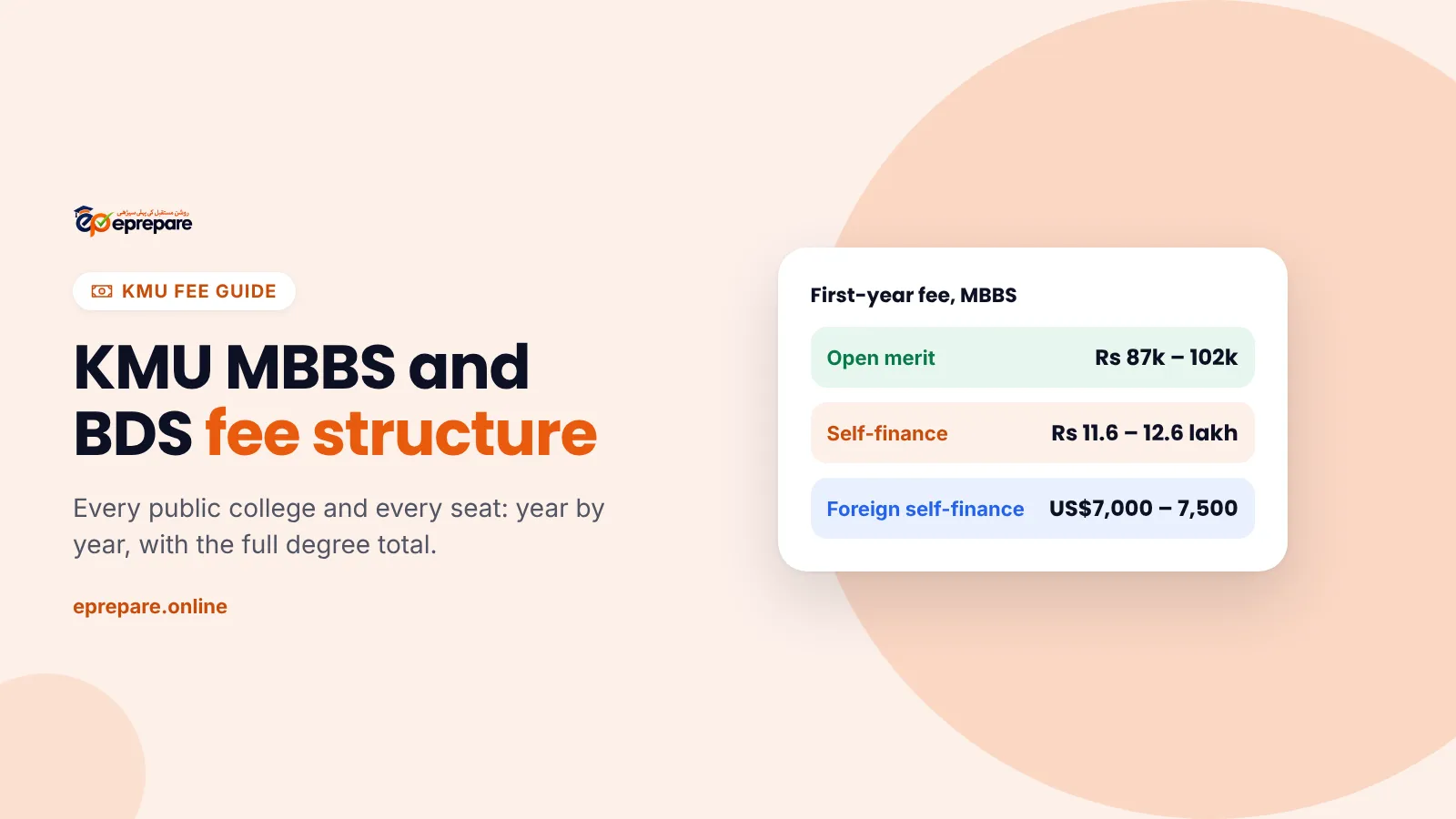
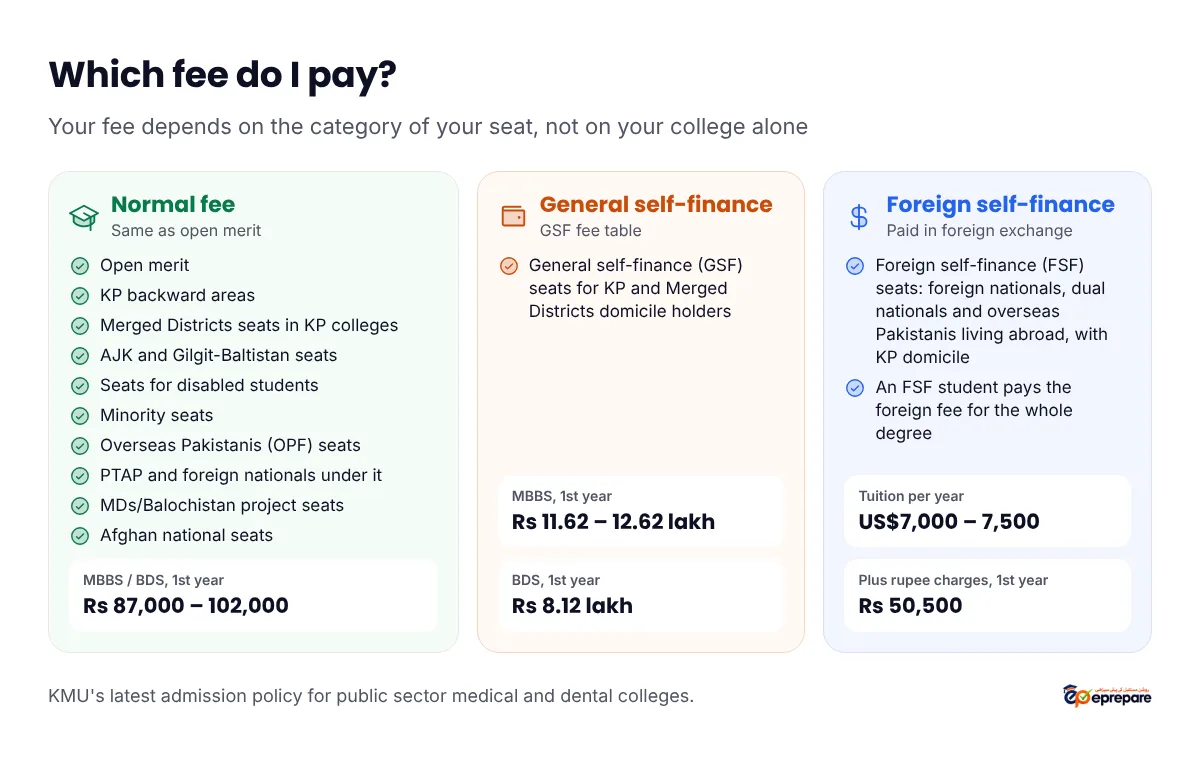
The short answer: under KMU's latest admission policy, an open merit MBBS or BDS seat costs Rs 87,000 to Rs 102,000 in the first year, and about Rs 4.7 lakh to Rs 5.7 lakh for the whole MBBS degree. A general self-finance (GSF) MBBS seat costs Rs 11.62 lakh to Rs 12.62 lakh in the first year (about Rs 67.6 lakh to Rs 72.6 lakh in total), and GSF BDS costs Rs 8.12 lakh in the first year (Rs 35.12 lakh in total). A foreign self-finance (FSF) seat costs US$7,000 to US$7,500 a year in tuition, paid in foreign exchange, plus a small rupee charge. Most reserved seats pay the same fee as open merit.
Two rates: KMC, KGMC and AMC vs the other colleges
For open merit, self-finance MBBS and foreign self-finance seats, KMU's fee schedule has two rates:
- The higher rate applies to Khyber Medical College (KMC), Peshawar, Khyber Girls Medical College (KGMC), Peshawar and Ayub Medical College (AMC), Abbottabad.
- The lower rate applies to "all other medical colleges", in the policy's words: Saidu Medical College (Swat), Gomal Medical College (D.I. Khan), Bannu Medical College, Bacha Khan Medical College (Mardan), Nowshera Medical College and Gajju Khan Medical College (Swabi).
For dental colleges, the open merit and foreign self-finance tables are headed "MBBS/BDS", but the policy does not say which rate each dental college pays. Khyber College of Dentistry (KCD), Ayub Dental Section (ADS), Bacha Khan Dental Section (BKDS) and Saidu College of Dentistry (SCD) are not named under either rate. So in this guide we show the open merit BDS fee as a range, from the lower rate to the higher rate. Self-finance BDS has a single rate for all dental colleges, so there is no confusion there.
Which seats pay the normal (open merit) fee?
Many students on reserved seats assume they will pay a special fee. In most cases they don't. KMU's policy lists these categories under "Normal Fee":
a. Open Merit seats
b. Khyber Pakhtunkhwa Backward areas
c. MDs Seats in Khyber Pakhtunkhwa Medical & Dental colleges
d. Federal Reserved Seats for AJK/Gilgit Baltistan (Northern Areas).
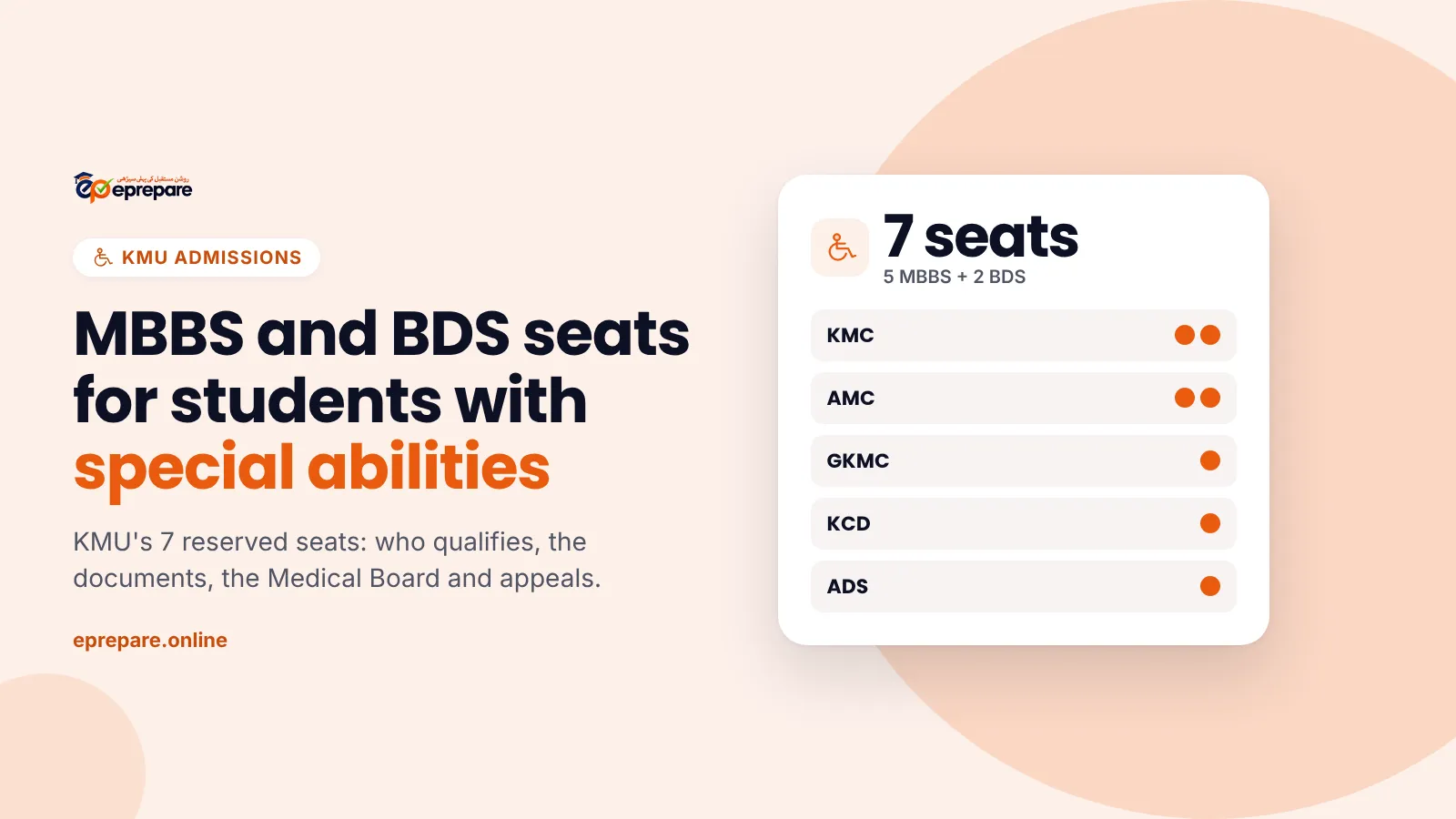
e. Seats for the Disabled Students
f. Minority Seats
g. Federal Seats for Overseas Pakistanis of Khyber Pakhtunkhwa origin
h. Students under Pakistan Technical Assistance Program and Foreign Nationals/Equal to Open Merit Fee.
i. MDs/ Baluchistan Project seats.
j. Afghan National Seats
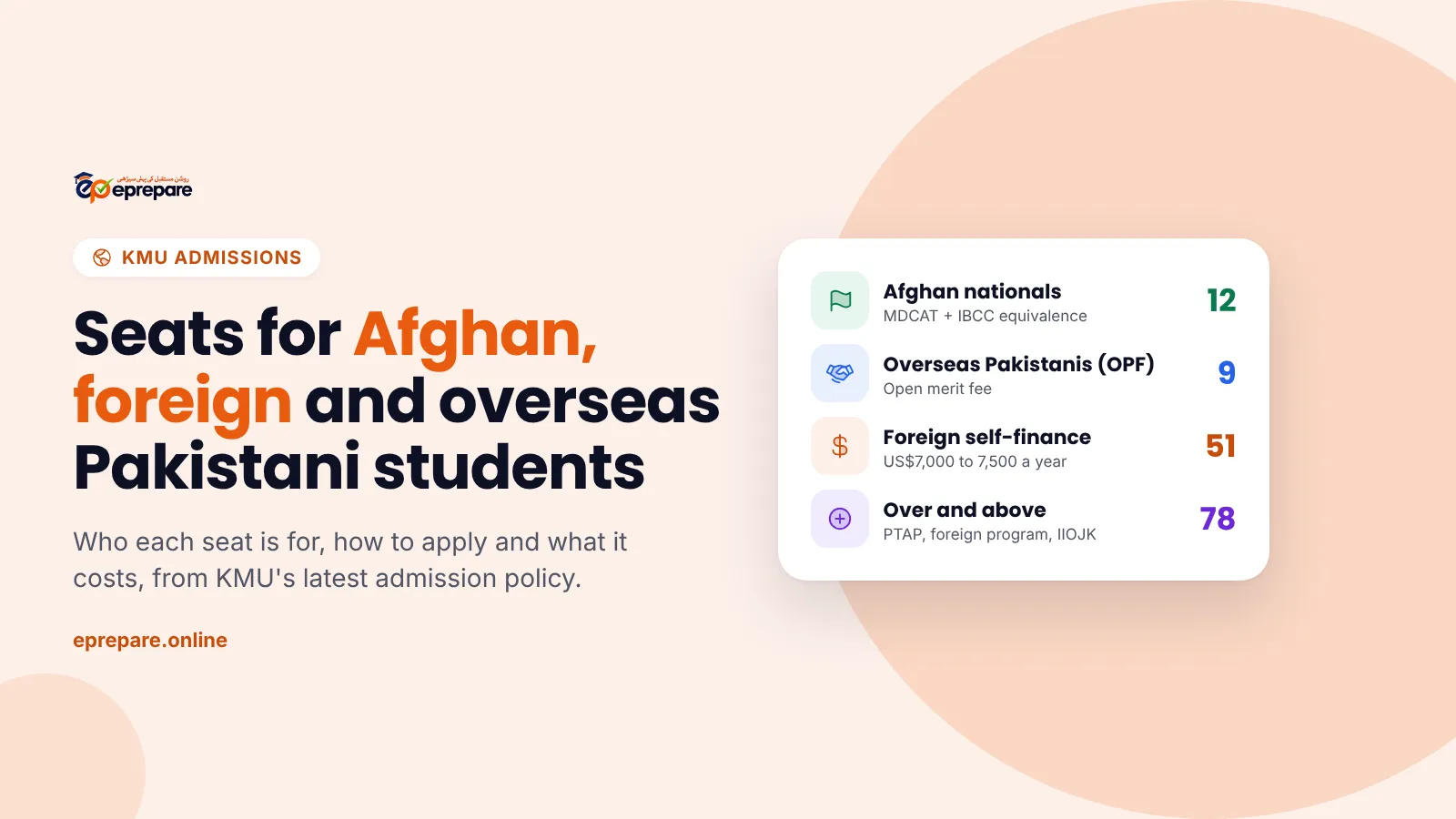
The fee table itself is titled "Fee for Open Merit Category (MBBS/BDS) and Afghan National seats", and a separate note confirms that candidates on the nine Overseas Pakistani Foundation (OPF) seats "shall pay fee equivalent to Open Merit Fee".
Two points to keep clear:
- Item h covers students under the Pakistan Technical Assistance Program (PTAP). A foreign or dual national who applies on a foreign self-finance seat pays the FSF fee instead (see below).
- Only two fee tables sit outside the normal fee: general self-finance and foreign self-finance.
If you are not sure which category your seat falls in, our guide to every KMU reserved and quota seat explains each one.
Open merit fee, year by year
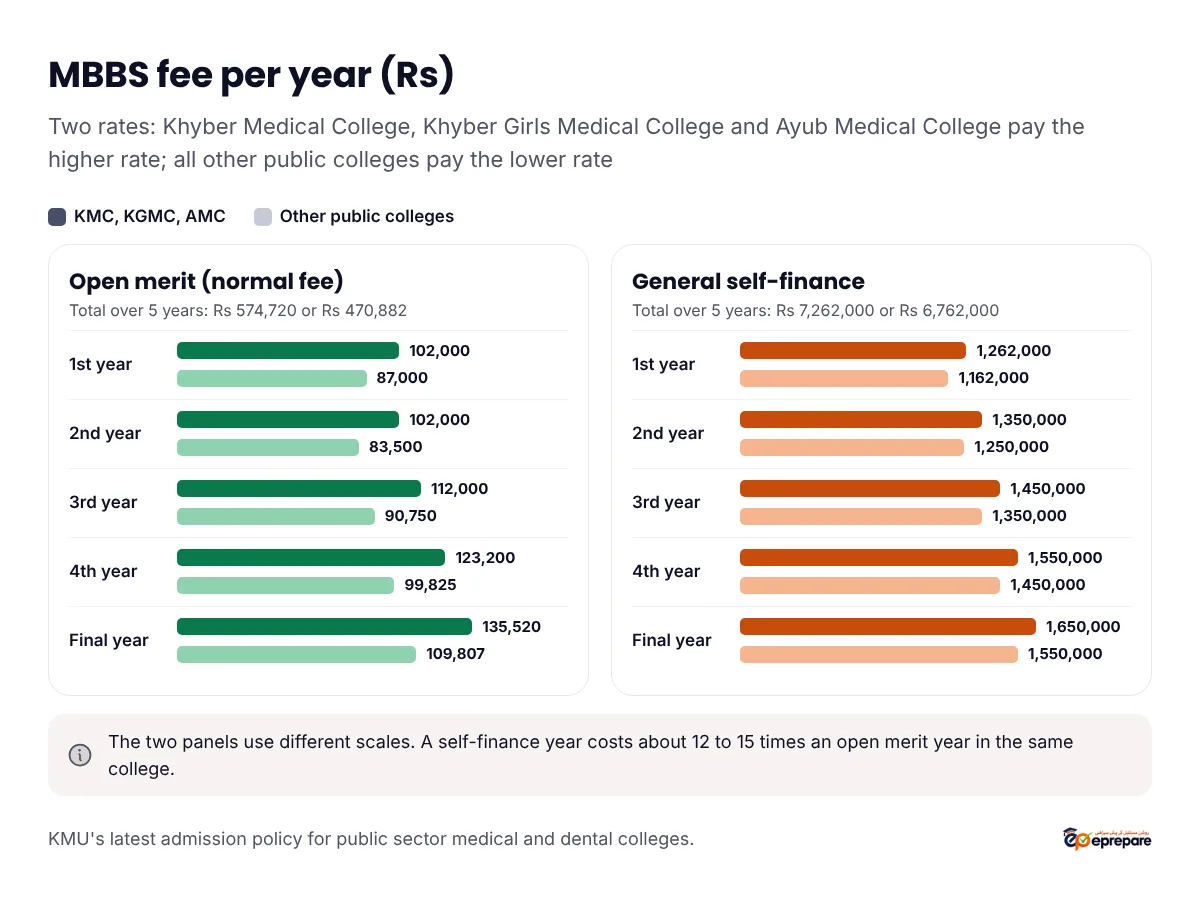
Open merit MBBS (Rs per year)
| Year | KMC, KGMC, AMC | Other public colleges |
|---|---|---|
| 1st year | 102,000 | 87,000 |
| 2nd year | 102,000 | 83,500 |
| 3rd year | 112,000 | 90,750 |
| 4th year | 123,200 | 99,825 |
| Final year | 135,520 | 109,807 |
| Total, 5 years | 574,720 | 470,882 |
Open merit BDS (Rs per year)
BDS is a four-year degree, so it uses the first four rows of the same table.
| Year | Lower rate | Higher rate |
|---|---|---|
| 1st year | 87,000 | 102,000 |
| 2nd year | 83,500 | 102,000 |
| 3rd year | 90,750 | 112,000 |
| 4th year | 99,825 | 123,200 |
| Total, 4 years | 361,075 | 439,200 |
The 2nd-year fee at the lower rate (Rs 83,500) is slightly less than the 1st-year fee (Rs 87,000). That is because the one-time admission, litigation and higher exam charges are only paid in the first year.
What each charge is for
Every year's fee is the sum of a few separate charges. Knowing them helps you read your fee challan and spot mistakes.
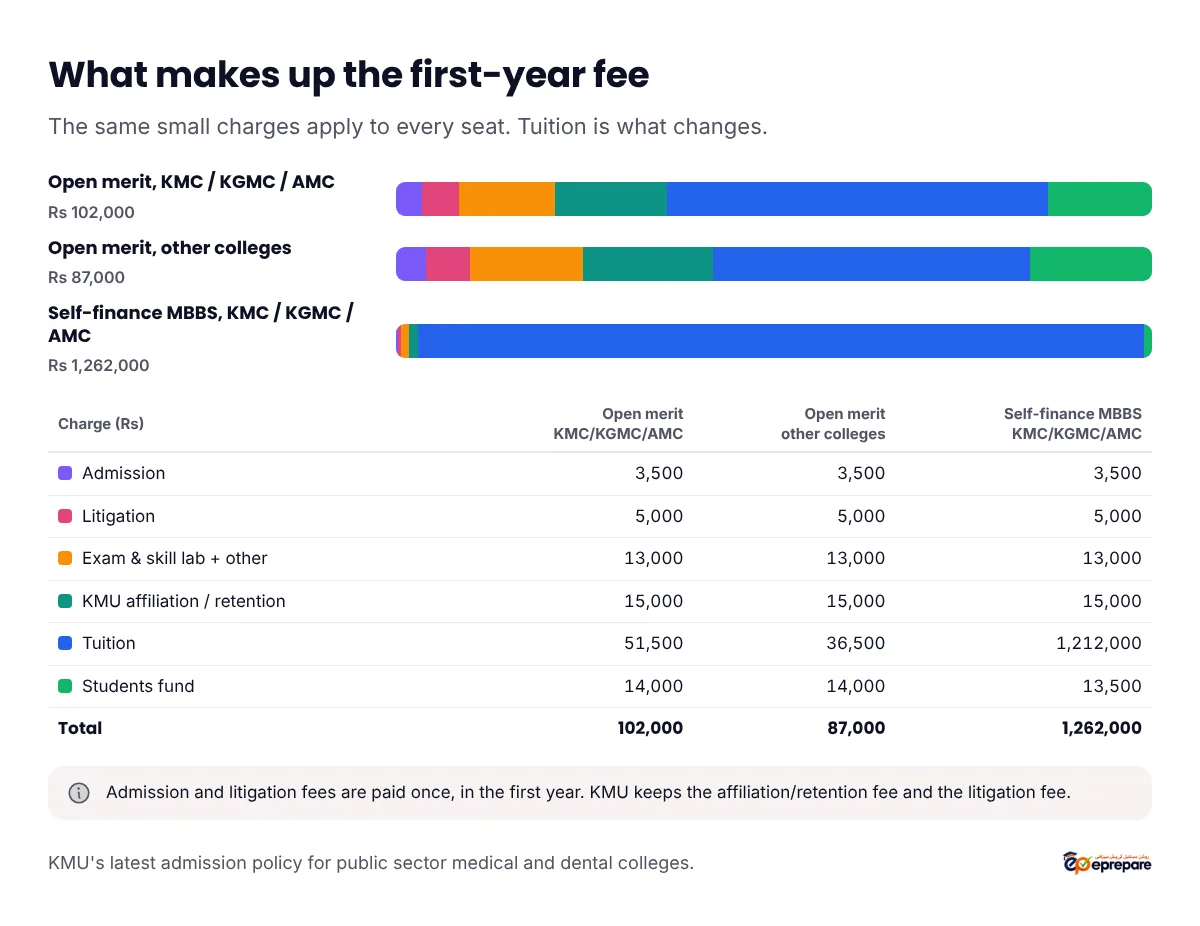
- Admission fee (Rs 3,500): paid once, in the first year.
- Litigation fee (Rs 5,000): paid once, in the first year. Under the policy, KMU is responsible for defending court cases about admissions.
- Exam and skill lab + other: Rs 13,000 in the first year, then a smaller amount each year.
- KMU affiliation/retention fee (Rs 15,000): paid every year. Under a decision of the Provincial Admission Committee, KMU keeps this fee and the litigation fee itself.
- Tuition fee: the main part of the fee. It rises every year and is what makes self-finance so much more expensive.
- Students fund: paid every year. It rises each year on open merit seats.
Open merit charges for each year (Rs)
| Year | Exam, skill lab + other | KMU affiliation | Tuition (higher / lower rate) | Students fund |
|---|---|---|---|---|
| 1st year | 13,000 | 15,000 | 51,500 / 36,500 | 14,000 |
| 2nd year | 2,000 | 15,000 | 69,000 / 50,500 | 16,000 |
| 3rd year | 1,000 | 15,000 | 78,000 / 56,750 | 18,000 |
| 4th year | 2,000 | 15,000 | 68,200 / 62,825 | 20,000 |
| Final year | 2,000 | 15,000 | 96,520 / 70,807 | 22,000 |
The first year also includes the admission fee (Rs 3,500) and litigation fee (Rs 5,000).
One figure in the policy doesn't add up. For the 4th year at KMC, KGMC and AMC, the charges printed in the policy (2,000 + 15,000 + 68,200 + 20,000) come to Rs 105,200, but the printed total is Rs 123,200. Every other row adds up. We show the printed total in this guide; confirm the exact 4th-year amount with your college's fee challan.
General self-finance (GSF) fee
General self-finance seats are in the same public colleges as open merit, with the same classes and teachers, but the tuition is far higher. If you are deciding between the two, read our full comparison of self-finance vs open merit at KMU colleges.
Self-finance MBBS (Rs per year)
| Year | KMC, KGMC, AMC | Other public colleges |
|---|---|---|
| 1st year | 1,262,000 | 1,162,000 |
| 2nd year | 1,350,000 | 1,250,000 |
| 3rd year | 1,450,000 | 1,350,000 |
| 4th year | 1,550,000 | 1,450,000 |
| Final year | 1,650,000 | 1,550,000 |
| Total, 5 years | 7,262,000 | 6,762,000 |
The 1st year includes admission (3,500), litigation (5,000), exam and skill lab (13,000), KMU affiliation (15,000), tuition (1,212,000 or 1,112,000) and students fund (13,500). From the 2nd year, the charges are exam and skill lab 6,000, KMU affiliation 15,000 and students fund 17,000, and tuition rises by Rs 100,000 each year.
Self-finance BDS (Rs per year)
| Year | Tuition | Total fee |
|---|---|---|
| 1st year | 762,000 | 812,000 |
| 2nd year | 817,000 | 850,000 |
| 3rd year | 867,000 | 900,000 |
| 4th year | 917,000 | 950,000 |
| Total, 4 years | 3,363,000 | 3,512,000 |
The other BDS charges are the same small items: in the 1st year admission 3,500, litigation 5,000, exam and skill lab 13,000, KMU affiliation 15,000 and students fund 13,500; after that, exam and skill lab 1,000, KMU affiliation 15,000 and students fund 17,000.
The policy says general self-finance has three categories: general self-finance seats, GSF seats for minority candidates and GSF seats for KMU wards. It gives one GSF fee table and does not list a separate fee for the minority or KMU-ward GSF seats.
Foreign self-finance (FSF) fee
Foreign self-finance seats are for applicants with KP domicile who hold a permanent foreign nationality, or are overseas Pakistanis permanently living abroad, including Green Card, Iqama and Maple Card holders. Their tuition is charged in US dollars.
| Year | Tuition (KMC, KGMC, AMC / other colleges) | Rupee charges |
|---|---|---|
| 1st year | US$7,500 / US$7,000 | Rs 50,500 |
| 2nd year | US$7,500 / US$7,000 | Rs 32,000 |
| 3rd year | US$7,500 / US$7,000 | Rs 31,000 |
| 4th year | US$7,500 / US$7,000 | Rs 29,000 |
| Final year (MBBS) | US$7,500 / US$7,000 | Rs 27,500 |
The rupee charges are the admission, litigation, exam and skill lab, KMU affiliation and students fund charges. Over a full MBBS, an FSF student pays US$35,000 to US$37,500 in tuition plus Rs 170,000. For BDS, the total is US$28,000 to US$30,000 plus Rs 142,500, with the same caveat that the policy doesn't say which dental college pays which rate.
The policy sets four rules for FSF students:
- Paid in foreign exchange: "The fee for students admitted under this quota will be collected in foreign exchange and to this effect, an undertaking / bond shall be provided by the student."
- Fixed for the whole degree: FSF students "must complete their entire period of study under this quota/category", and "a student admitted on foreign seat shall pay the fee as a foreign students regardless of any change in status of such student during the program of study."
- Empty FSF seats: if no eligible candidate takes an FSF seat, it becomes a general self-finance seat, and the student admitted to it pays the GSF fee.
- The 15% cap: foreign plus general self-finance admissions in a public college cannot be more than 15% of its allocated seats.
Overseas Pakistanis have another option that is much cheaper: the nine OPF seats, which pay the open merit fee. See our guide to seats for Afghan nationals, foreign students and overseas Pakistanis.
Total fee for the whole degree
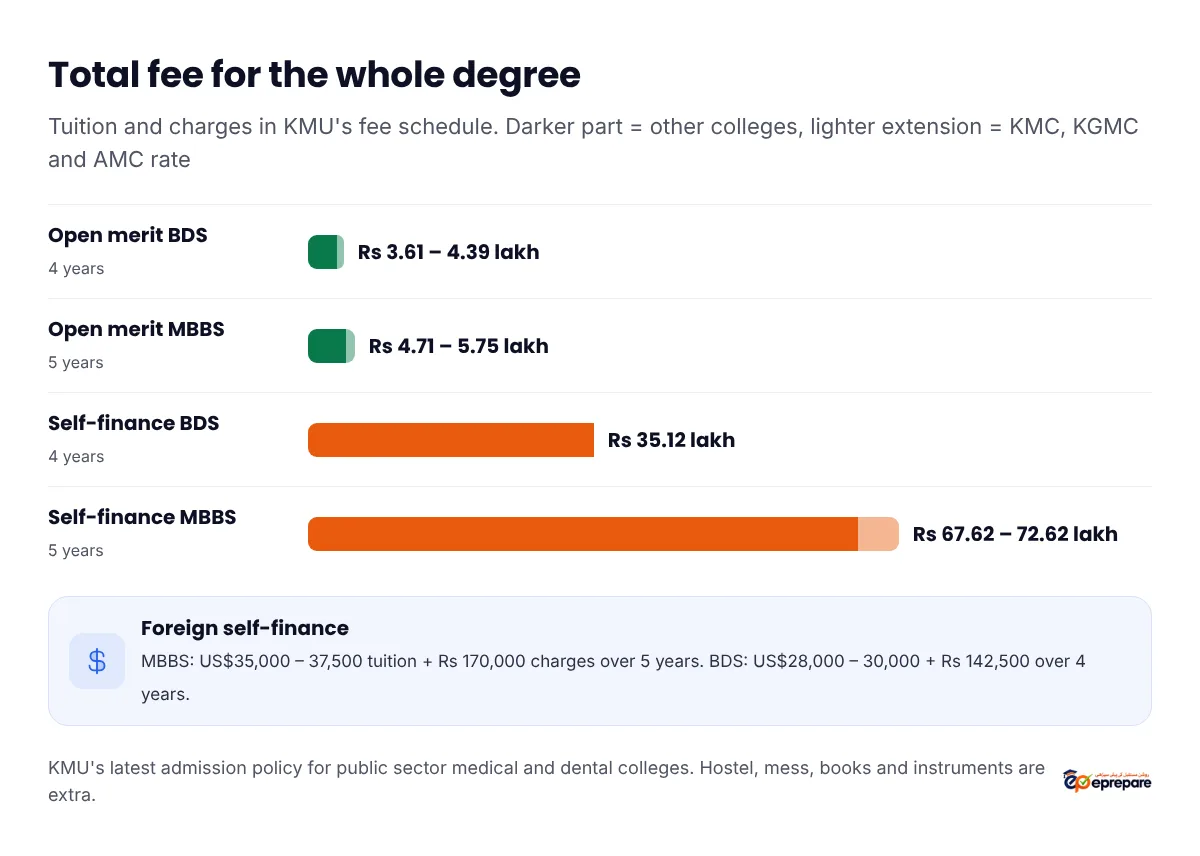
| Seat | MBBS (5 years) | BDS (4 years) |
|---|---|---|
| Open merit and normal-fee seats | Rs 470,882 to 574,720 | Rs 361,075 to 439,200 |
| General self-finance | Rs 6,762,000 to 7,262,000 | Rs 3,512,000 |
| Foreign self-finance | US$35,000 to 37,500 + Rs 170,000 | US$28,000 to 30,000 + Rs 142,500 |
These are the totals at today's rates. The policy states: "Revised fees structure will be applicable to all the candidates from time to time." The fee can change during your degree, so plan for it to go up rather than stay the same.
How and when you pay
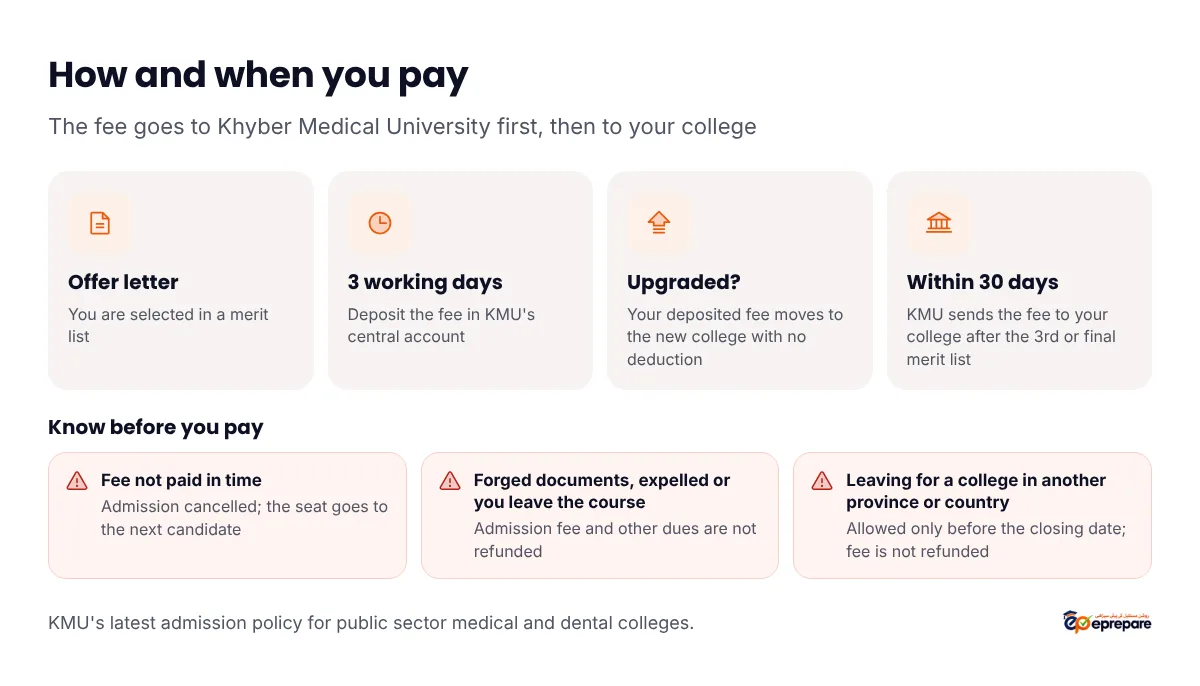
- Pay KMU, not the college. The policy requires "a centralized account of admitting university, where the students have to deposit their admission and tuition fee etc. within the due date notified by the university."
- Pay within three working days. If you don't deposit the fee within three working days of receiving the admission offer letter, "their admissions shall stand cancelled", and the seat goes to the next candidate on merit.
- Upgrades don't cost you twice. If you are moved up to a college higher on your preference list in a later merit list, "the fee deposited by upgraded candidates in the previous institution shall be transferred to new institution without any deduction." Read how KMU merit lists and upgrades work.
- KMU passes the fee on. KMU transfers the fee to your college within 30 days of the 3rd or final merit list.
Refunds, penalties and bonds
This is the part most families don't read until it is too late. The policy is strict:
- The admission fee is forfeited. The general rules state: "The admission fee submitted by the candidate to KMU shall be forfeited in favor of the University and will not be refunded to the candidate as a penalty." It sits right after the rule on false documents and does not spell out other cases, so treat the admission fee as non-refundable.
- No refund after cancellation or leaving: "Admission fee and other dues will not be refunded to those students whose admission has been cancelled due to his/her forged documents or rusticated/expelled/removed from the college roll for any reason or he /she willfully discontinues studies."
- Leaving for another province or country: a first-year student may leave for a college elsewhere only if they apply before the closing date of admission. "Fee once paid shall not be refunded and any scholarship amount paid shall be recovered."
- Resigning: a student who resigns or withdraws "shall pay the prescribed penalty to the respective college before leaving the college."
- Parent's undertaking: the father or guardian signs an undertaking that makes them liable to pay Rs 1,00,000 per year of study if the student breaches it, for example by taking part in politics.
- Backward area bond: students on backward area seats sign a bond to serve in their home district for at least five years. Breaking it means paying "an amount equal to self-finance seat, with compounding interest rate". See our guide to KP backward area seats.
Migration fee
If you later move from one college to another, KMU charges a migration fee, deposited in KMU's accounts:
| Colleges | Migration within KP | Migrating from other provinces |
|---|---|---|
| Public sector medical and dental colleges of KP | Rs 50,000 | Rs 100,000 |
| Private sector medical and dental colleges of KP | Rs 200,000 | Rs 250,000 |
When a student migrates partway through a session, the college they leave must refund fee and dues in proportion to the rest of the session. Migration has strict conditions; our KMU migration policy guide explains them.
Costs that are not in this fee schedule
KMU's schedule covers only the charges above. Budget separately for:
- Hostel and mess, if you live away from home. These are charged by the college.
- Books, notes and a laptop.
- Instruments and lab coats. BDS students in particular buy their own dental instruments and materials.
- Travel and living costs.
- Document costs before admission, such as attested copies, an IBCC equivalence certificate if you studied a foreign system, and board migration certificates. Our KMU admission documents checklist lists everything.
Frequently asked questions
What is the fee for open merit MBBS at KMU colleges?
Under KMU's latest policy, open merit MBBS costs Rs 102,000 in the first year at KMC, KGMC and AMC, and Rs 87,000 at the other public medical colleges. It rises each year, and the five-year total is Rs 574,720 or Rs 470,882.
How much is the self-finance MBBS fee in KP public colleges?
General self-finance MBBS costs Rs 1,262,000 in the first year at KMC, KGMC and AMC and Rs 1,162,000 at other public colleges, rising by about Rs 1 lakh a year. The full degree costs Rs 72.62 lakh or Rs 67.62 lakh.
What is the BDS fee at Khyber College of Dentistry and other public dental colleges?
Open merit BDS costs Rs 87,000 to Rs 102,000 in the first year and Rs 361,075 to Rs 439,200 over four years; the policy doesn't say which dental college pays which rate. Self-finance BDS costs Rs 812,000 in the first year and Rs 35.12 lakh over four years at every public dental college.
Do reserved seats like Merged Districts or backward areas pay a different fee?
No. Backward area, Merged Districts, disabled, minority, AJK and Gilgit-Baltistan, OPF, PTAP, MDs/Balochistan project and Afghan national seats all pay the normal fee, the same as open merit.
Do I pay the fee to the college or to KMU?
To KMU. The policy requires the admission and tuition fee to be deposited in KMU's central account within the due date, usually three working days of your offer letter. KMU then transfers it to your college.
If I am upgraded to another college, do I pay again?
No. The fee you deposited moves to the new college without any deduction.
Is the KMU admission fee refundable?
Treat it as non-refundable. The policy says the admission fee deposited with KMU is forfeited, and fee is not refunded if admission is cancelled for forged documents, if a student is expelled or leaves the course, or if a student leaves for a college in another province.
Will the fee stay the same for all five years?
Not necessarily. The tables already rise each year, and the policy says a revised fee structure can apply to all students from time to time.
Knowing the fee is half of the planning. The other half is the merit you need to get the seat you can afford. Check last year's cut-offs on our KMU closing merit page, see where your aggregate could take you with the college predictor, and if you are still preparing for MDCAT, start practising with ePrepare.
Source: Khyber Medical University, Admission Policy for Public Sector Medical and Dental Colleges of Khyber Pakhtunkhwa, the latest available policy (annual fee schedule, normal fee categories, foreign self-finance rules, fee deposit, refund and migration rules). Totals are our own sums of the yearly fees in the policy. Fees can be revised; always check the latest policy and notices on cas.kmu.edu.pk.