Every year after the MDCAT result, the same question fills our inbox: what is the real difference between open merit MBBS and self-finance MBBS at KMU? Some students think a self-finance seat is a lower-quality seat, a separate class or some kind of private admission. It is none of those.
This guide explains it clearly, using Khyber Medical University's latest admission policy for public sector colleges, KMU's latest final merit list, and what our own students tell us about life inside these colleges.
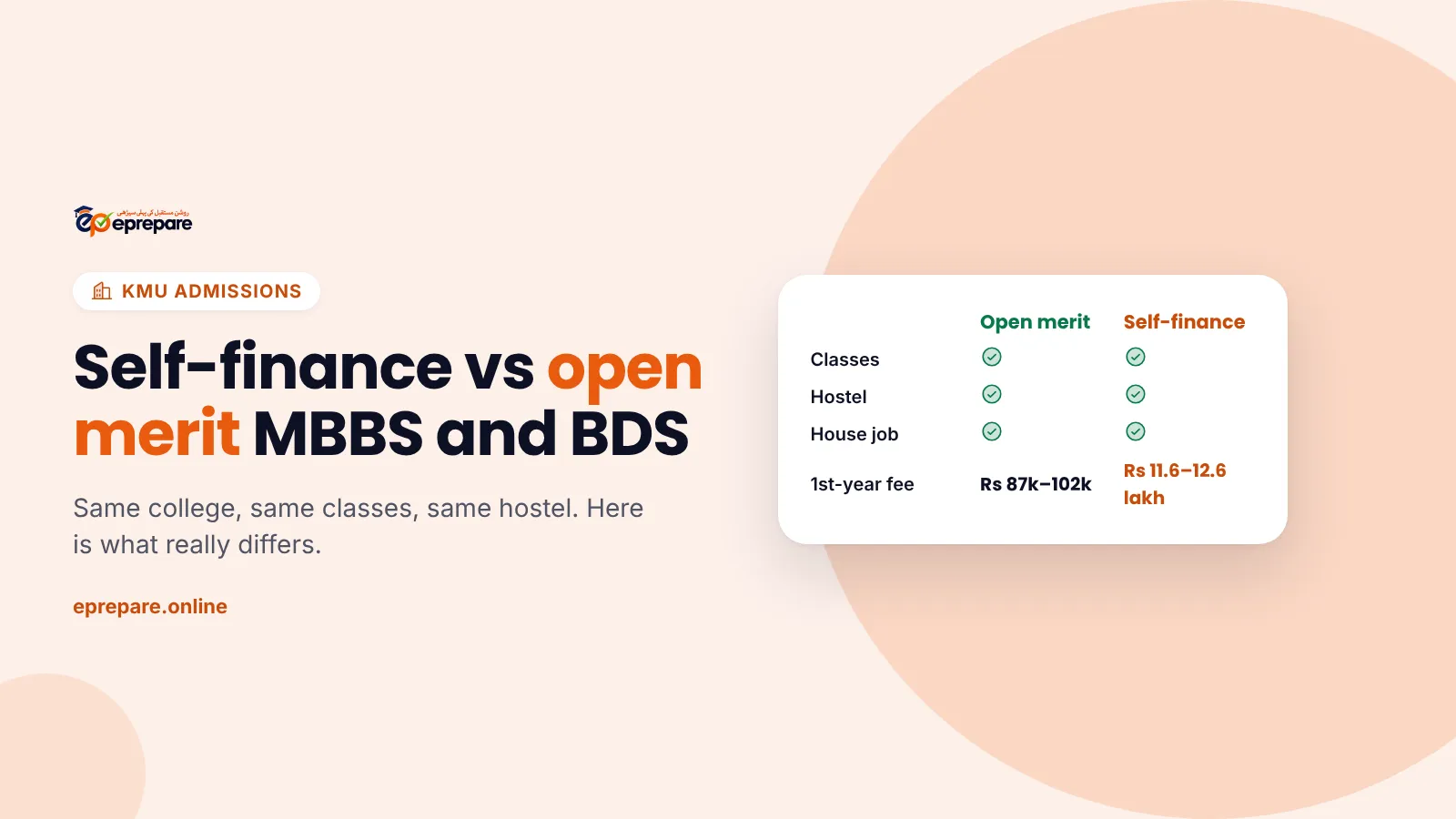
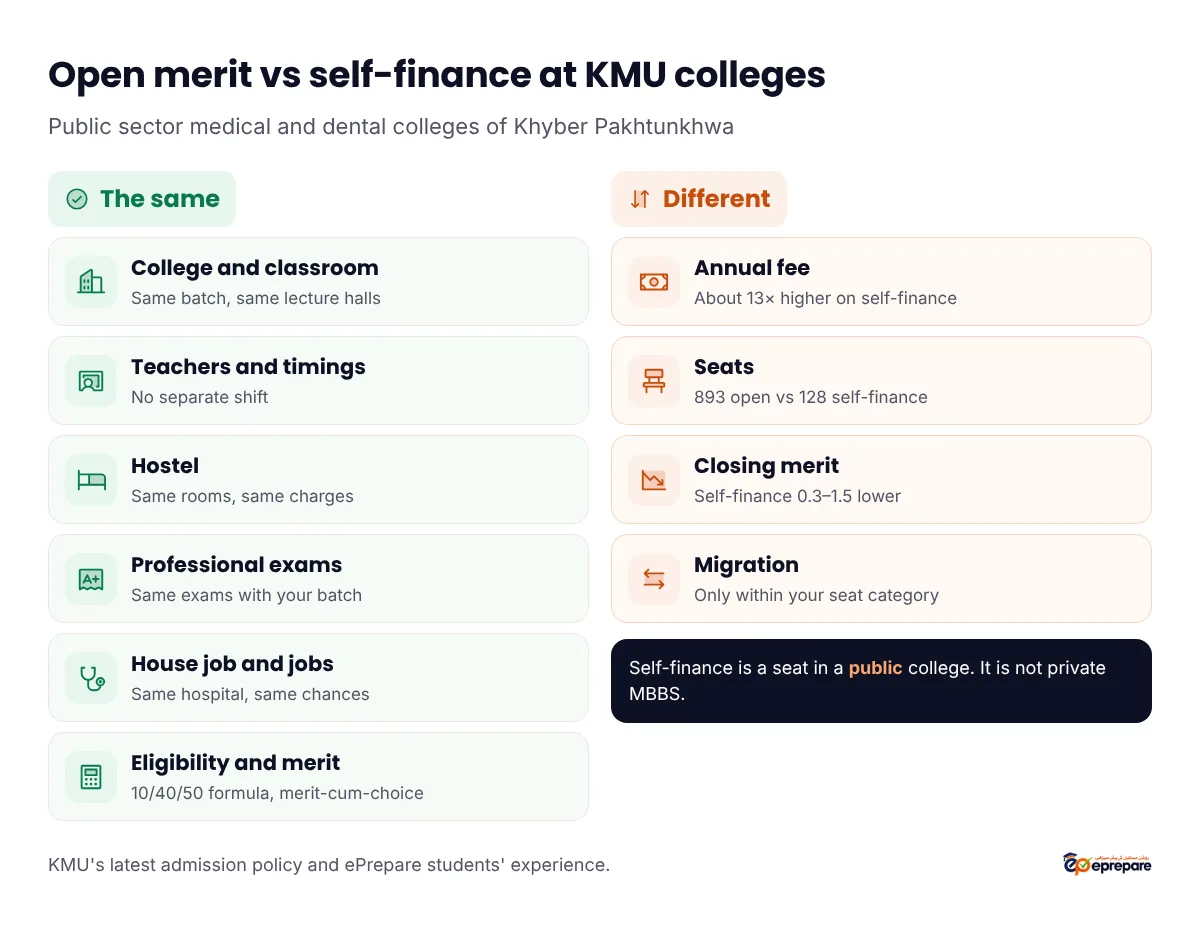
The short answer: open merit and self-finance (GSF) students study in the same college, in the same classes, with the same teachers, at the same time. They live in the same hostels and get the same house jobs. The big difference is the fee: self-finance MBBS costs about 13 times as much per year. Self-finance seats also close a little lower on merit, and there are far fewer of them.
First: self-finance is not private MBBS
This is the most common confusion. A General Self-Finance (GSF) seat is a seat inside a public sector college such as Khyber Medical College, Ayub Medical College or Saidu Medical College. The government allocates a small share of each public college's seats as self-finance seats, and students on those seats pay a higher fee.
A private medical college is a different institution altogether, with its own fee and its own admission process.
| Point | KMU self-finance (GSF) seat | Private MBBS |
|---|---|---|
| Which college | A public sector college (KMC, AMC, KGMC, SMC, GMC, BMC, BKMC, NMC, GKMC and the public dental colleges) | A private medical or dental college |
| Where you apply | KMU's public admission portal, cas.kmu.edu.pk, on the same form as open merit | KMU's private admission portal, caspr.kmu.edu.pk |
| Fee | Fixed in KMU's public admission policy | Set by the private college |
| Classmates | The same batch as open merit students | That college's own students |
What is exactly the same
1. Same college, same classes, same teachers
Open merit and self-finance students are admitted to the same college and the same batch. There is no separate section for self-finance students. They sit in the same lecture halls, are taught by the same faculty and attend the same practicals and wards.
2. Same class timings
There is no morning shift for open merit and evening shift for self-finance. Both attend classes at the same time, all through the degree.
3. Same hostel
Students on both seats live in the same hostels and the same rooms, and pay the same hostel charges. Nothing in the hostel marks who came on which seat.
4. Same exams and degree path
Both sit the same professional examinations with their batch and go through the same five years of MBBS (four years of BDS).
5. Same house job and job opportunities
After graduation, both get house jobs at the same teaching hospital and compete for the same jobs. In the words of our team: either both are looking for work together, or both are working together. What decides a good post later is your skill and hard work, not the seat you were admitted on.
6. Same eligibility and merit formula
- At least 60% marks in FSc (HSSC) or an equivalent qualification, with Biology, Chemistry and Physics or Mathematics.
- A pass in MDCAT with at least 55% for MBBS and 50% for BDS. See MDCAT passing marks.
- The same aggregate: Matric 10%, FSc 40%, MDCAT 50%. Work yours out with the aggregate calculator.
- Admission on merit-cum-choice, in the order of the colleges you list.
What is different
1. The fee: the main difference
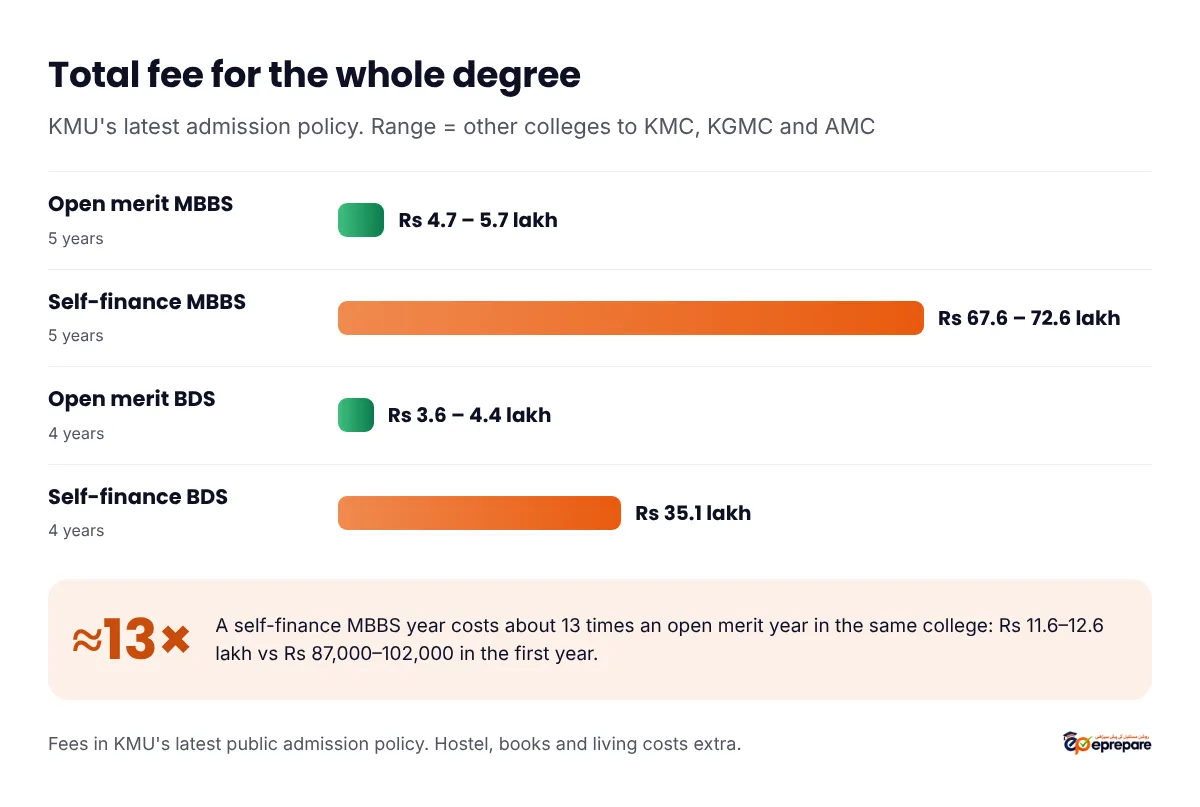
This is the real difference. KMU's policy sets two rates for open merit and for MBBS self-finance: a higher rate for Khyber Medical College, Khyber Girls Medical College and Ayub Medical College, and a lower rate for all other colleges.
MBBS fee per year (Rs)
| Year | Open merit (KMC, KGMC, AMC) | Open merit (other colleges) | Self-finance (KMC, KGMC, AMC) | Self-finance (other colleges) |
|---|---|---|---|---|
| 1st year | 102,000 | 87,000 | 1,262,000 | 1,162,000 |
| 2nd year | 102,000 | 83,500 | 1,350,000 | 1,250,000 |
| 3rd year | 112,000 | 90,750 | 1,450,000 | 1,350,000 |
| 4th year | 123,200 | 99,825 | 1,550,000 | 1,450,000 |
| Final year | 135,520 | 109,807 | 1,650,000 | 1,550,000 |
| Total, 5 years | 574,720 | 470,882 | 7,262,000 | 6,762,000 |
So over five years, a self-finance MBBS seat costs about Rs 62.9 lakh to Rs 66.9 lakh more than an open merit seat in the same college.
BDS fee per year (Rs)
| Year | Open merit | Self-finance |
|---|---|---|
| 1st year | 87,000 to 102,000 | 812,000 |
| 2nd year | 83,500 to 102,000 | 850,000 |
| 3rd year | 90,750 to 112,000 | 900,000 |
| 4th year | 99,825 to 123,200 | 950,000 |
| Total, 4 years | 361,075 to 439,200 | 3,512,000 |
The open merit fee table in the policy covers MBBS and BDS together, with the two rates shown above. These totals are the fees in the policy only. Books, hostel and living costs are extra and the same for both seats. KMU's policy also says a revised fee structure can apply from time to time, so check the policy for your session.
2. Far fewer self-finance seats
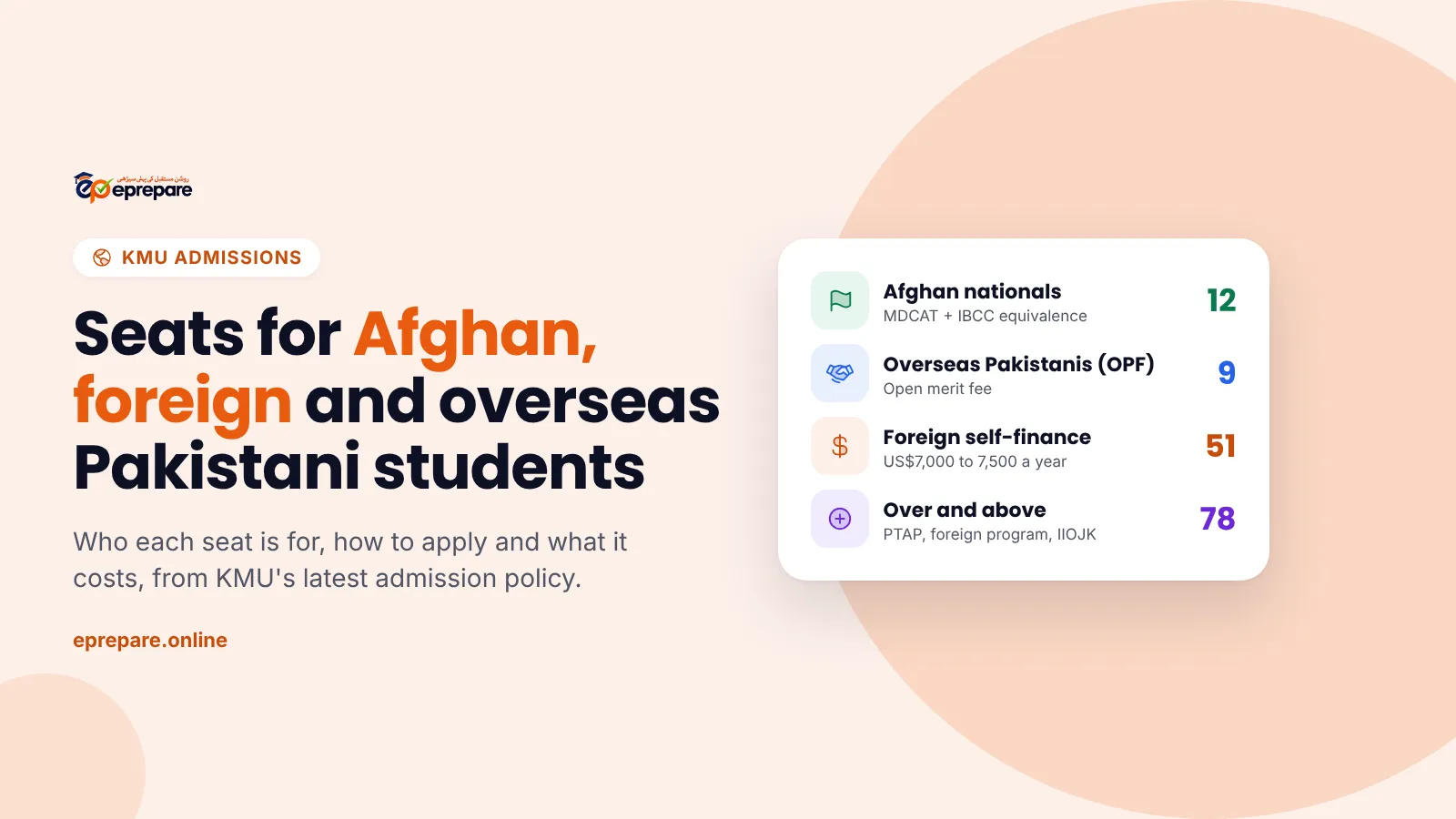
Under the latest policy, KMU's public colleges have 893 open merit seats but only 128 general self-finance seats, plus 3 GSF seats reserved for minorities and 51 foreign self-finance seats.
| College | Open merit | General self-finance |
|---|---|---|
| Khyber Medical College, Peshawar (KMC) | 181 | 17 |
| Ayub Medical College, Abbottabad (AMC) | 142 | 20 |
| Khyber Girls Medical College, Peshawar (KGMC) | 89 | 12 |
| Nowshera Medical College (NMC) | 73 | 8 |
| Bacha Khan Medical College, Mardan (BKMC) | 60 | 5 |
| Saidu Medical College, Swat (SMC) | 57 | 10 |
| Gomal Medical College, D.I. Khan (GMC) | 57 | 11, plus 1 for minorities |
| Bannu Medical College (BMC) | 50 | 12 |
| Gajju Khan Medical College, Swabi (GKMC) | 30 | 5 |
| Khyber College of Dentistry, Peshawar (KCD) | 66 | 10, plus 1 for minorities |
| Saidu College of Dentistry, Swat (SCD) | 39 | 7 |
| Bacha Khan Dental Section, Mardan (BKDS) | 28 | 7, plus 1 for minorities |
| Ayub Dental College, Abbottabad (ADC) | 21 | 4 |
| Total | 893 | 128, plus 3 for minorities |
By rule, general and foreign self-finance seats together cannot exceed 15% of a college's allocated seats. Any foreign self-finance seat left empty is converted to a general self-finance seat, which is why the number of self-finance seats in the final merit lists can be a little higher than in this table. For every other seat category, see our guide to KMU reserved and quota seats.
3. Self-finance closes a little lower on merit
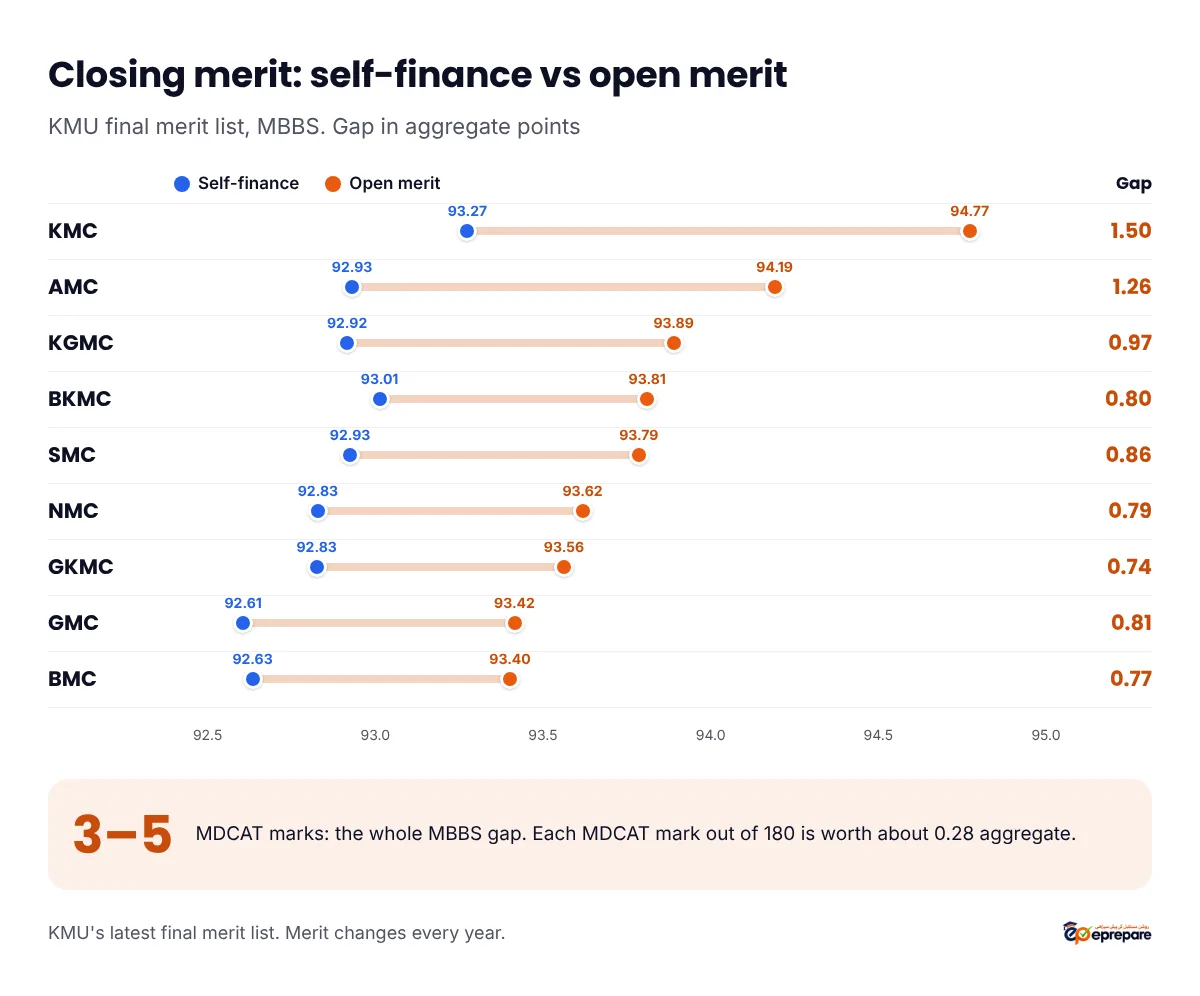
Because the fee keeps many students away, self-finance seats close at a lower aggregate than open merit in the same college. But the gap is smaller than most students think.
| College | Open merit closing | Self-finance closing | Gap |
|---|---|---|---|
| KMC | 94.7727 | 93.2748 | 1.50 |
| AMC | 94.1909 | 92.9313 | 1.26 |
| KGMC | 93.8899 | 92.9162 | 0.97 |
| BKMC | 93.8111 | 93.0131 | 0.80 |
| SMC | 93.7859 | 92.9253 | 0.86 |
| NMC | 93.6182 | 92.8293 | 0.79 |
| GKMC | 93.5626 | 92.8253 | 0.74 |
| GMC | 93.4152 | 92.6061 | 0.81 |
| BMC | 93.4020 | 92.6343 | 0.77 |
| KCD (BDS) | 93.0232 | 92.5788 | 0.44 |
| ADS (BDS) | 92.9717 | 92.5697 | 0.40 |
| BKDS (BDS) | 92.8748 | 92.4859 | 0.39 |
| SCD (BDS) | 92.8030 | 92.4859 | 0.32 |
What the gap means in MDCAT marks: MDCAT is 50% of your aggregate, so each MDCAT mark out of 180 is worth about 0.28 aggregate. A gap of 0.7 to 1.5 aggregate is only about 3 to 5 MDCAT marks. In other words, a student who just missed open merit at a college is often only a few MCQs short, and a student who can afford it may get the self-finance seat at that same college.
See every college's figures, including the predicted closing for the next admissions, on the KMU closing merit page, and check your own chances with the college predictor.
4. Domicile wording
Both seats need a valid Khyber Pakhtunkhwa domicile for the candidate and the father (or the mother, if the father is not alive), including the backward areas. For general self-finance seats, the policy also names the Merged Districts explicitly.
5. Migration stays within your seat category
KMU allows migration between colleges only after the 2nd Professional in MBBS (1st Professional in BDS), and only category-wise: a self-finance student can move only to a vacant self-finance seat, and an open merit student only to a vacant open merit seat. The full rules and fees are in our KMU migration policy guide.
Foreign self-finance (FSF) is a third category
Do not confuse general self-finance with foreign self-finance. FSF seats (51 under the latest policy) are for foreign nationals and overseas Pakistanis, such as green card, iqama or maple card holders, who have a Khyber Pakhtunkhwa domicile and at least 60% in FSc or equivalent.
- The tuition fee is charged in foreign currency: US $7,500 a year at KMC, KGMC and AMC, and US $7,000 at other colleges, plus some charges in rupees.
- Students admitted on FSF must complete the whole degree on that seat.
- Seats left empty are converted to general self-finance seats.
How to apply for open merit and self-finance
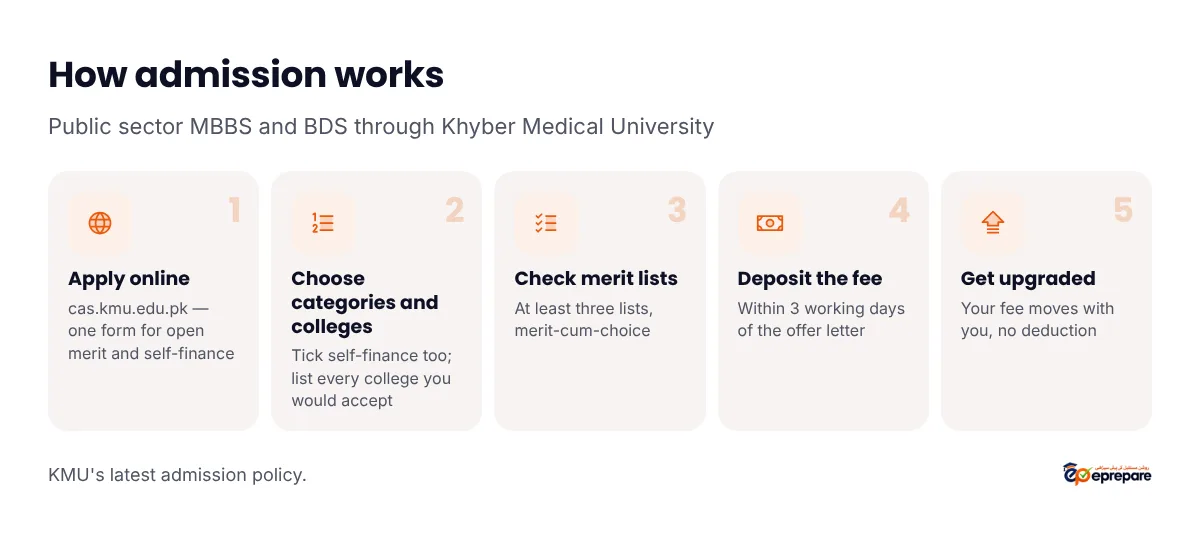
- Apply online at cas.kmu.edu.pk. There is no paper form; forms sent by post or courier are not accepted.
- Choose every category you want to be considered for. Selection in each category is made on merit among the candidates who applied for it, so if you want a self-finance seat as a backup, make sure you apply for it.
- List all the colleges you would accept, in order of preference. KMU only offers you a college that is in your list.
- Watch the merit lists. KMU displays at least three merit lists. If two candidates have the same merit up to five decimals, the older candidate is placed higher.
- Deposit the fee within three working days of your admission offer letter, or the admission is cancelled and the seat goes to the next candidate.
- Upgrading: you can be upgraded to a college higher in your preference list in a later merit list. The fee you deposited moves to the new college without any deduction. You cannot be moved down to a college you already refused.
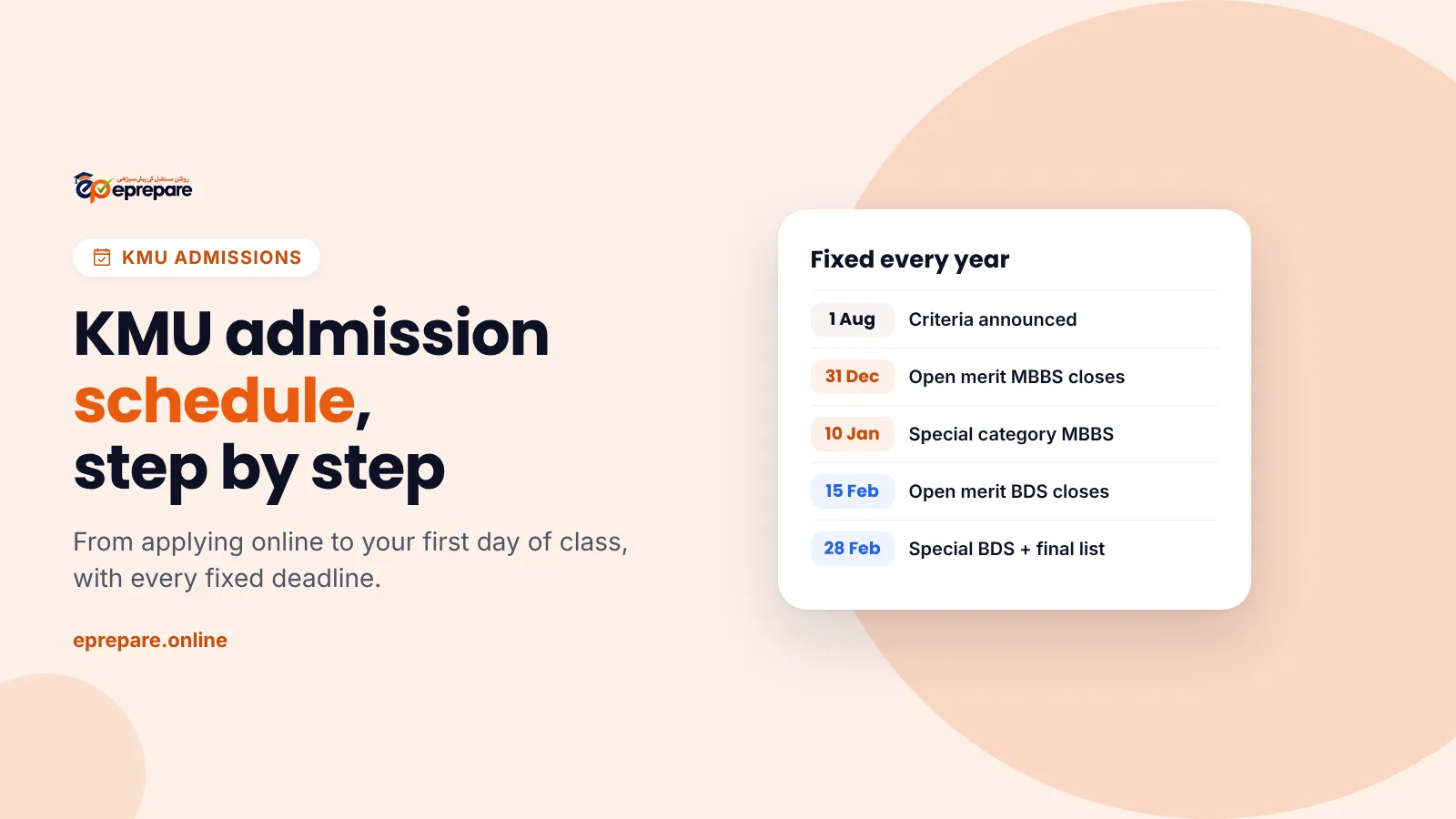
Deadlines in the policy: admissions to open merit seats in public medical colleges close by 31 December, and to all other categories, including self-finance, by 10 January. For dental colleges, open merit closes by 15 February and other categories by 28 February. See every step in our KMU admission schedule, and how the lists and upgrades work in KMU merit lists explained.
Should you take a self-finance seat?
Since the education, the hostel and the house job are all the same, the decision is really about money.
- If your family can afford Rs 11.6 lakh to Rs 16.5 lakh a year for MBBS (Rs 8.1 lakh to Rs 9.5 lakh for BDS), which rises every year, without strain, a self-finance seat gives you exactly the same education as open merit. Go for it.
- If it would be a heavy burden, open merit is the better choice. That could mean open merit in another college or in BDS, or improving your MDCAT. Remember the gap is often only 3 to 5 MDCAT marks, and an MDCAT result is valid for three years. Read our repeaters guide before you decide.
- Apply for both anyway. Selecting self-finance on the form keeps the option open while you wait for the open merit lists.
Frequently asked questions
Do self-finance and open merit MBBS students study in separate classes?
No. They are admitted to the same college and the same batch, and attend the same classes with the same teachers at the same time.
Is a self-finance MBBS degree different from an open merit degree?
No. Both complete the same course, sit the same professional exams with their batch and get house jobs at the same hospital. The only real difference is the fee they pay.
How much is the self-finance MBBS fee at KMU colleges?
Under the latest policy, first-year self-finance MBBS costs Rs 1,262,000 at KMC, KGMC and AMC and Rs 1,162,000 at other public colleges, rising each year. The five-year total is about Rs 67.6 lakh to Rs 72.6 lakh. Self-finance BDS costs Rs 812,000 in the first year and about Rs 35.1 lakh over four years. Every category's fee is in our KMU MBBS and BDS fee structure guide.
Is self-finance the same as private MBBS?
No. A self-finance seat is a seat in a public sector college, applied for on KMU's public portal, cas.kmu.edu.pk. Private colleges are separate institutions, with their own fee and admission through caspr.kmu.edu.pk.
How much lower is the self-finance closing merit?
In KMU's latest final merit list, self-finance MBBS seats closed 0.7 to 1.5 aggregate below open merit in the same college, which is about 3 to 5 MDCAT marks. In BDS the gap was 0.3 to 0.4 aggregate.
Can I apply for both open merit and self-finance?
Yes. Apply for every category you want to be considered for on the KMU form. You are selected on merit-cum-choice, and you can be upgraded in later merit lists.
Can I move from a self-finance seat to an open merit seat later?
KMU's migration rules are category-wise: after the 2nd Professional (MBBS) or 1st Professional (BDS), a student can only move to a vacant seat of the same category.
Sources: Khyber Medical University, latest Admission Policy for Public Sector Medical and Dental Colleges (seats, fees, eligibility, admission and migration rules), and KMU's latest final merit list (closing merit). Fees and seats can change each session; always check the latest policy on cas.kmu.edu.pk.