If you live with a physical disability and dream of becoming a doctor or a dentist, KMU's admission policy has seats reserved for you in Khyber Pakhtunkhwa's public medical and dental colleges. Very few students know these seats exist, and even fewer know exactly what KMU asks for. That is why some of them stay empty, and why some eligible students miss out.
This guide explains everything about the special-ability (disabled) seats: how many there are, who counts as eligible, which documents you need, how the KMU Medical Board works, how to appeal, and what fee you pay. Everything comes from KMU's latest admission policy for public sector medical and dental colleges, and we quote the policy word for word wherever a rule decides your eligibility.
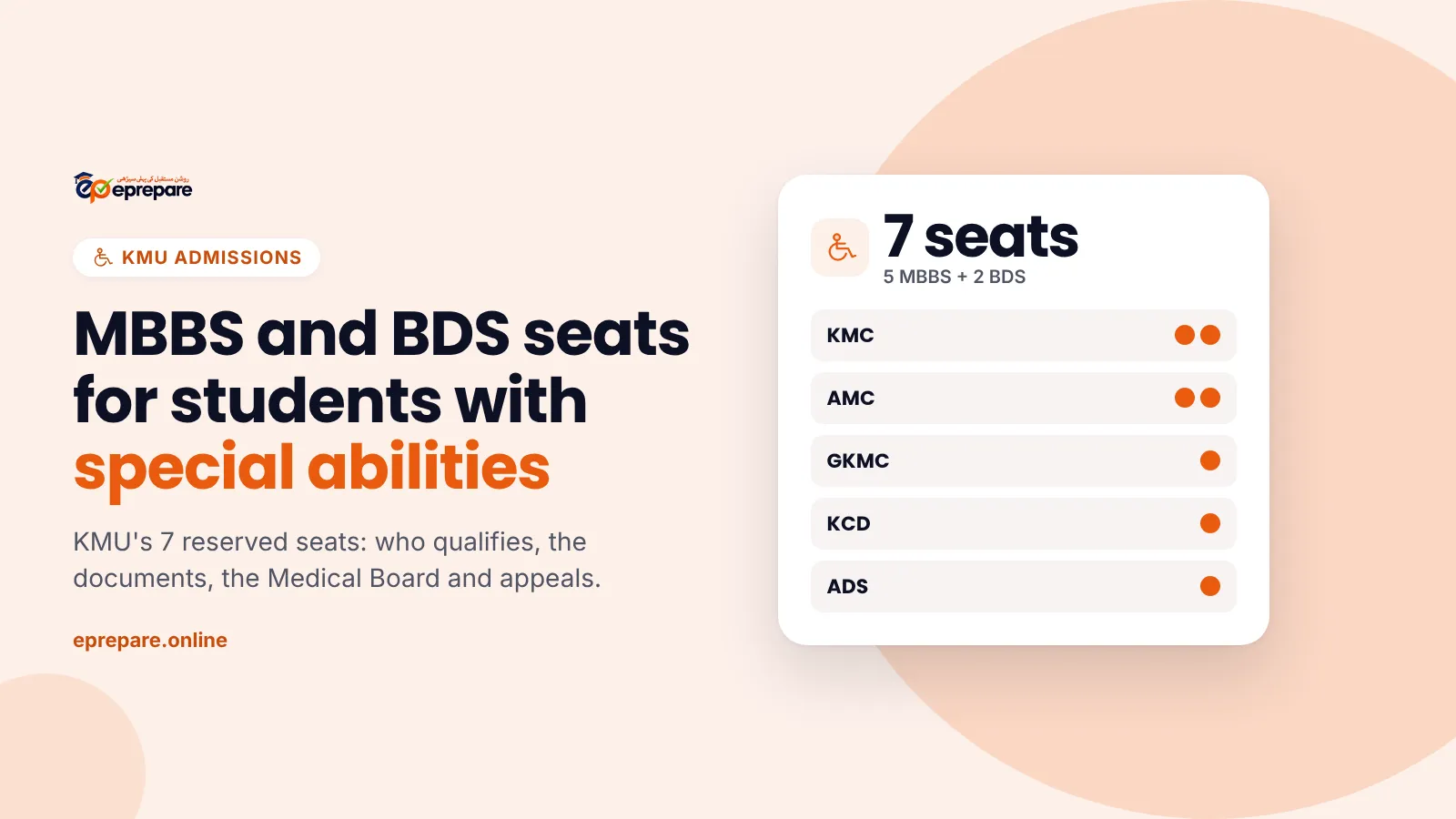
The short answer: KMU reserves 7 seats for candidates with special abilities: 5 MBBS (2 at Khyber Medical College, 2 at Ayub Medical College, 1 at Gajju Khan Medical College) and 2 BDS (1 at Khyber College of Dentistry, 1 at Ayub Dental Section). Your disability must be physical and permanent, but not severe, and you must be fit to study and later practise. You need a KP or Merged District domicile (you and your father), the usual MDCAT and HSSC minimums, three disability documents, and a decision from KMU's Medical Board. Apply for open merit as well, so you keep both chances. These seats pay the normal (open merit) fee.
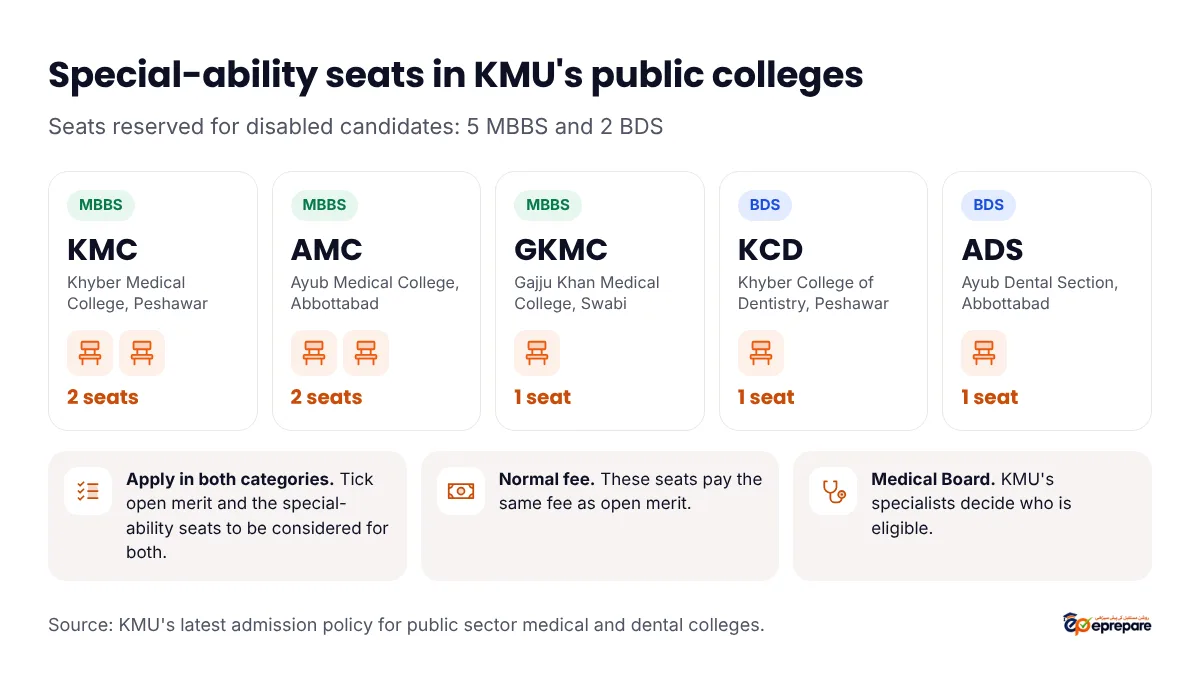
How many seats are there, and where?
| College | Programme | Seats |
|---|---|---|
| Khyber Medical College (KMC), Peshawar | MBBS | 2 |
| Ayub Medical College (AMC), Abbottabad | MBBS | 2 |
| Gajju Khan Medical College (GKMC), Swabi | MBBS | 1 |
| Khyber College of Dentistry (KCD), Peshawar | BDS | 1 |
| Ayub Dental Section (ADS), Abbottabad | BDS | 1 |
| Total | 5 MBBS + 2 BDS | 7 |
The other public colleges (SMC, GMC, KGMC, BMC, BKMC, NMC, BKDS and SCD) have no special-ability seat. You can still be admitted to any of them on open merit or in any other category you qualify for. Seats for disabled persons are one of the few reserved categories kept after the Supreme Court's Attiya Inayat decision, which the policy lists as "(a) Disabled persons". You can see every other category in our guide to all KMU quota and reserved seats.
Who counts as "specially abled" under KMU's policy?
This is the most important part, so here is the policy's own definition:
"Special ability for the purpose of admission to Medical & Dental Colleges in Khyber Pakhtunkhwa is defined as that degree of physical impairment which puts the candidate at disadvantage as compared to a normal person for acquiring education before entering Medical/Dental College, but otherwise is capable of performing his/her duties satisfactorily as a Medical/Dental student and later on as Medical/Dental Practitioner."
In plain words, the policy looks for a balance:
- A real physical disability. It must have made your education harder than it is for other students.
- But not so severe that you cannot study medicine or dentistry and later work as a doctor or dentist. The policy says plainly: "A severely disable person is ineligible."
- Permanent. "The Special ability shall be of permanent nature." A temporary injury or illness does not count.
- Certified by KMU. "The candidate shall be declared specially able by the Medical Board."
The policy also says disabilities are not ranked against each other: "Disease/ disabilities affecting different organ systems are in no way comparable." So the Medical Board does not decide who is "more disabled". It decides whether you meet the definition and are fit to study.
Eligibility checklist
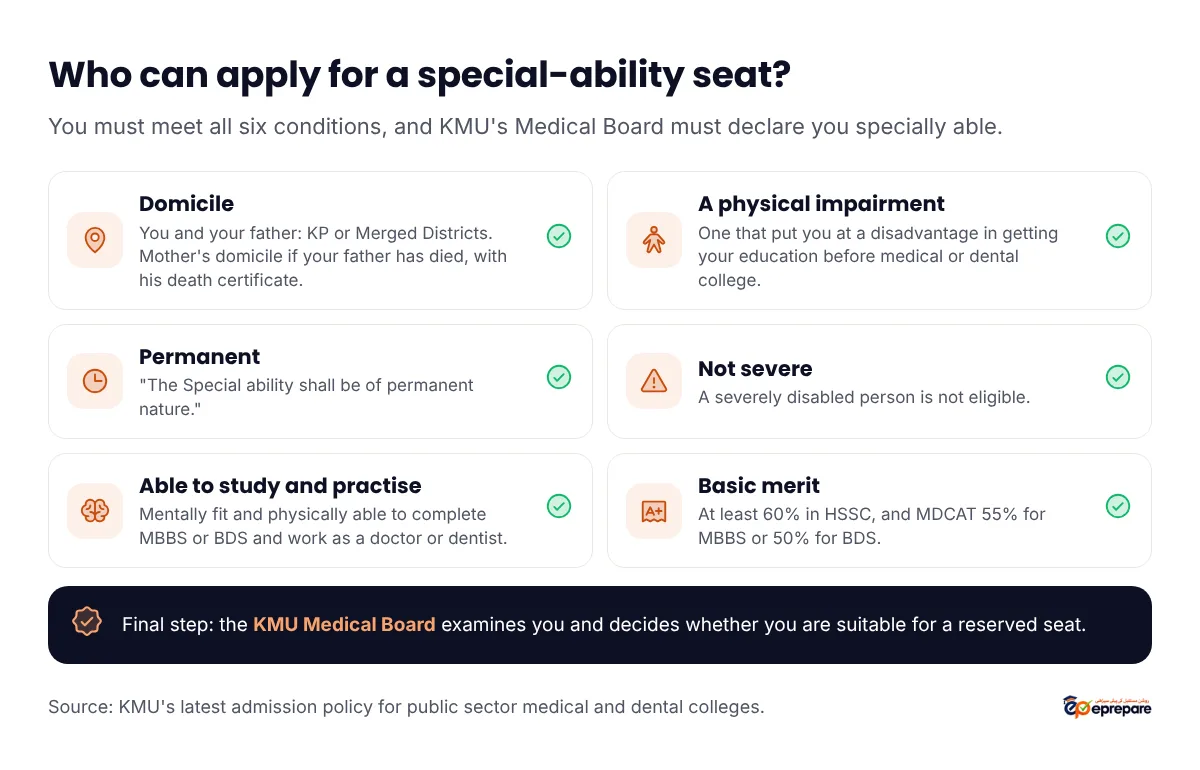
You can apply if all of these are true:
- Domicile. You and your father hold a valid domicile of Khyber Pakhtunkhwa or the Merged Districts. If your father is not alive, "the mother's valid domicile certificate of Khyber Pakhtunkhwa / Merged Districts (MD) along with death certificate of father will be considered."
- A permanent physical impairment that matches the definition above.
- Not severely disabled.
- Fit to study and practise. Your Social Welfare certificate must state that you are "mentally fit and physically able to carry out his/her studies and can perform professional duties after qualifying MBBS/BDS."
- Basic merit. At least 60% in HSSC (FSc pre-medical or equivalent) and at least 55% in the MDCAT for MBBS or 50% for BDS. There is no relaxation of these minimums for reserved seats. See MDCAT passing marks.
- All other KMU admission criteria. The policy says candidates must be "fulfilling all the other criteria for admission to Khyber Pakhtunkhwa Medical/ Dental colleges".
The documents you need
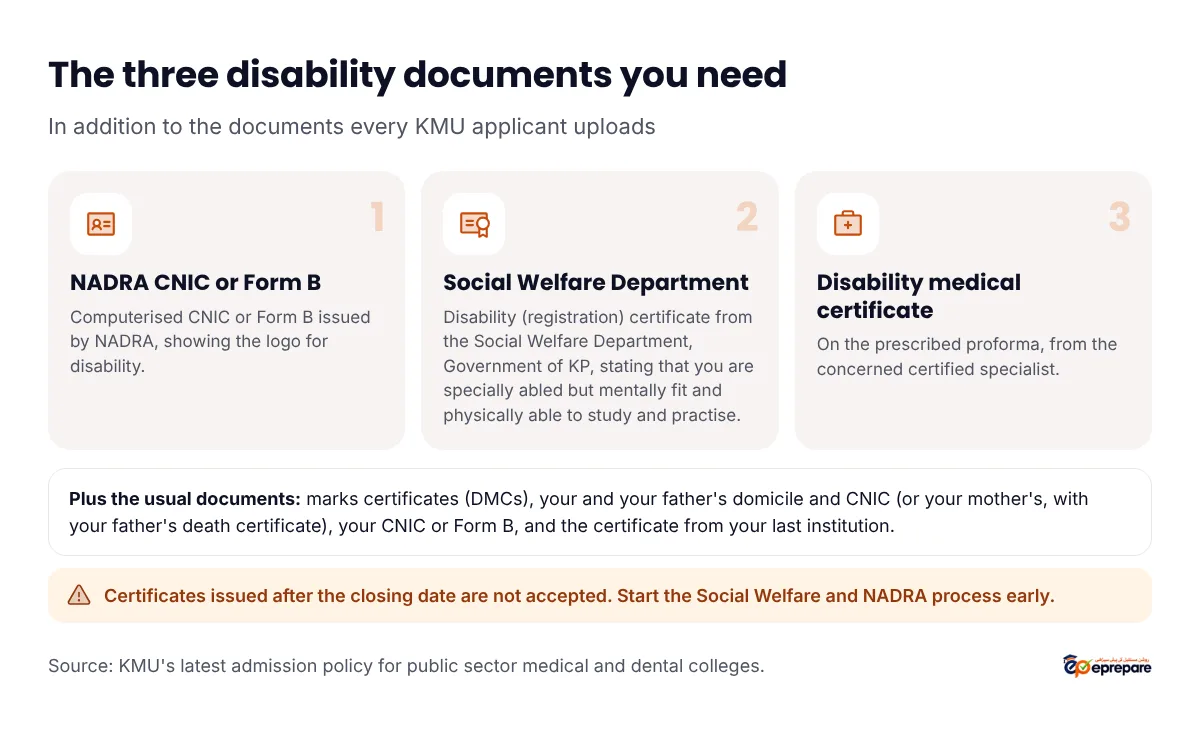
KMU asks for three documents specific to these seats. The policy lists them as:
| Document | Issued by | What it must show |
|---|---|---|
| Computerised CNIC or Form B with the disability logo | NADRA | The logo for disability |
| Disability (registration) certificate | Social Welfare Department, Government of KP | That you are specially abled, but mentally fit and physically able to study and to perform professional duties |
| Disability medical certificate on the prescribed proforma | The concerned certified specialist | Your disability, on KMU's form |
You also need every document a normal applicant uploads: detailed marks certificates (DMCs), your and your father's domicile and CNIC, your CNIC or Form B, and the certificate from the institution you last attended. Our KMU admission documents checklist lists them all.
Start early. Getting a Social Welfare registration certificate and a NADRA card with the disability logo takes time. The policy warns that certificates "issued after the dates fixed for receipt of application forms shall not be entertained", and once you submit documents on the portal they cannot be changed. Apply for these documents well before KMU opens its admission form.
The KMU Medical Board
Your documents get you into the process; the Medical Board decides. KMU sets up a Medical Board to examine special-ability candidates, made up of:
- a medical specialist;
- a surgical specialist;
- an ENT (ear, nose and throat) specialist;
- an eye specialist;
- an orthopaedic specialist;
- a psychiatrist;
- any other specialist relevant to your disability, whom the Chairman of the KMU Admission Committee may add when needed.
The policy gives the Board the deciding role: "A Medical Board constituted by Chairman KMU-AC will make final decision about the suitability of the candidate for admission against the reserved seats." Bring your medical records, reports and any previous certificates when you appear before the Board, so the specialists have the full picture.
How the seats are given out
Being certified does not give you a seat by itself. The seats then go on merit. In the policy's words: "Selection against these seats shall be finalized by the KMU-AC on the recommendation of Medical Board on merit from amongst the certified Special able candidates."
That means:
- You compete only with other certified special-ability candidates, not with the whole open merit list.
- Among them, your normal aggregate (10% Matric, 40% FSc, 50% MDCAT) decides the order. Check yours with our aggregate calculator.
- Seats are offered on merit-cum-choice at the placement interview, so list the colleges with these seats in your preferences.
Apply for open merit too
This is the single most useful tip in this guide. The policy says: "To be considered on open merit as well as the specially abled candidate's seats, the candidates must apply against both the categories. However, it will be the choice of the candidate to avail open merit or disabled seat."
So tick both categories on the KMU form. If your aggregate is high enough for open merit, you can take an open merit seat, possibly in a college without a special-ability seat. If not, you still compete for the 7 reserved seats. Depending on your domicile and background, you may also qualify for other categories, such as Merged Districts, backward areas or self-finance. Tick every one you are eligible for.
If you disagree with the decision: appeals
The policy describes two appeal routes, in two different sections, and it is worth knowing both:
- The Appellate Medical Board. The policy says: "The Appellate Board will comprise of the serving / retired Professors of all the concerned specialties and will be constituted by the Chairman KMU Admission Committee. The decision of the Appellate Medical Board shall be final, after approval of Chairman KMU Admission Committee."
- An appeal to the Chairman PAC. In its section on these seats, the policy also says: "Candidates shall have the right to appeal against the decisions made by the Medical Board of KMU to the 'Chairman PAC'. However, the decision made by Chairman PAC shall be final." PAC is the Provincial Admission Committee, chaired by KMU's Vice Chancellor.
The policy does not explain how these two routes fit together. If the Medical Board's decision goes against you, write to the KMU Admission Committee straight away, ask which appeal route applies to your case and what the deadline is, and keep a copy of everything you submit. Act quickly: KMU's admission deadlines are tight, and for general admission complaints the policy allows a review before the Chairman PAC "within 03 working days after the final selection".
Step by step: from the form to your seat
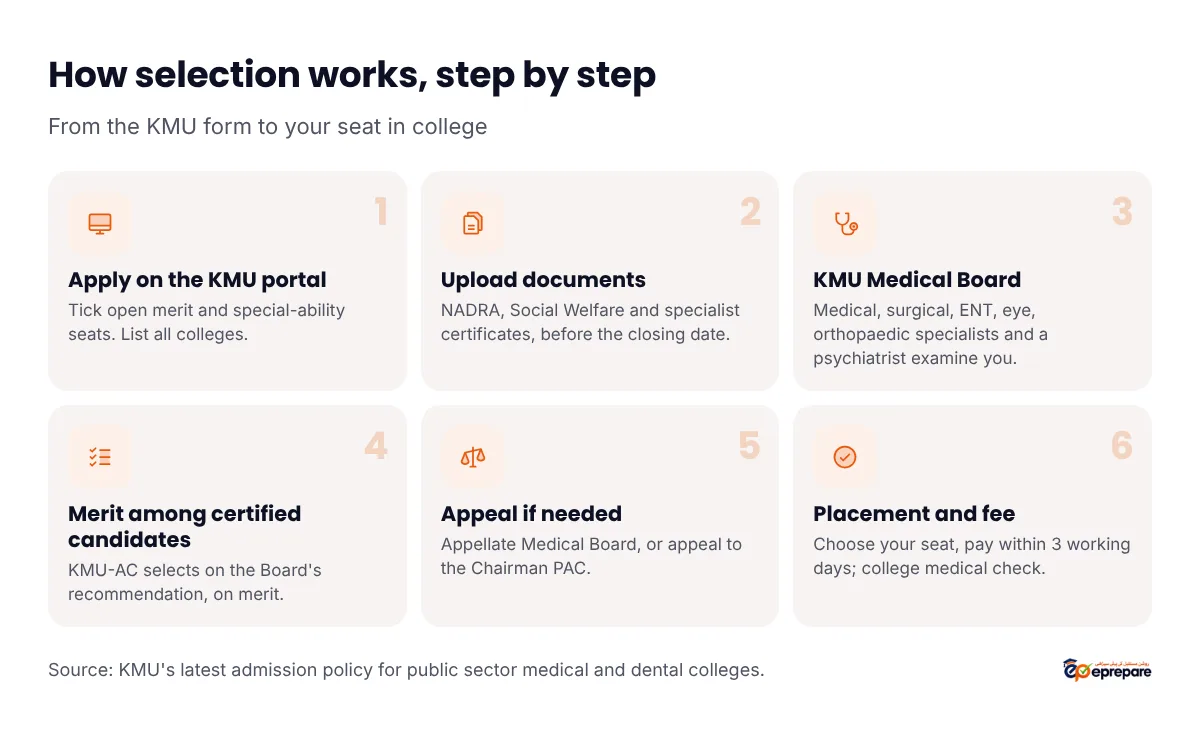
- Prepare documents early: NADRA CNIC or Form B with the disability logo, the Social Welfare certificate and the specialist's certificate on KMU's proforma.
- Apply online on cas.kmu.edu.pk. Tick open merit, the special-ability seats and any other category you qualify for. List every college you would accept, in order.
- Upload everything before the closing date. Incomplete forms are rejected.
- Appear before the KMU Medical Board when called, with your medical records.
- Check the merit lists. KMU displays a merit list for each category and accepts written objections before the placement interviews. Read how KMU merit lists and upgrades work.
- Attend the placement interview with a parent or legal guardian; the policy requires one to accompany every candidate.
- Pay the fee within three working days of your offer, or the seat goes to the next candidate.
- Pass the college's medical examination. Every selected candidate is examined by the college's Medical Board; "If a candidate is disqualified medically, he/she will not be admitted."
What fee do special-ability seats pay?
The same as open merit. The policy lists "Seats for the Disabled Students" among the seats that pay the normal fee.
| Year | KMC, KGMC, AMC | Other colleges |
|---|---|---|
| 1st year | Rs 102,000 | Rs 87,000 |
| 2nd year | Rs 102,000 | Rs 83,500 |
| 3rd year | Rs 112,000 | Rs 90,750 |
| 4th year | Rs 123,200 | Rs 99,825 |
| Final year (MBBS) | Rs 135,520 | Rs 109,807 |
| MBBS total (5 years) | Rs 574,720 | Rs 470,882 |
BDS is four years, so it costs the first four rows; the policy does not say which of the two rates each dental college pays, so expect Rs 361,075 to Rs 439,200 over four years. Hostel, books and living costs are extra. Full details are in our KMU MBBS and BDS fee structure guide.
After admission: what else to know
- Migration: students on disabled seats can migrate to another college later, but only category-wise, to a vacant special-ability seat, after the 2nd Professional (MBBS) or 1st Professional (BDS). See the KMU migration policy.
- Medical fitness during the course: the policy says admission will be cancelled if "The candidate is found medically unfit at any stage of MBBS/BDS course."
- Honest documents: all admissions are provisional until documents are verified. A false or forged certificate means cancellation, blacklisting from professional colleges in KP and possible legal action.
- Empty seats: if no eligible candidate is found, a special-ability seat is converted to open merit.
Frequently asked questions
How many disabled quota seats are there in KMU colleges?
Seven: 5 MBBS (KMC 2, AMC 2, GKMC 1) and 2 BDS (KCD 1, ADS 1), in KP's public medical and dental colleges.
Is there any relaxation in MDCAT marks for disabled candidates?
No. You need at least 55% in the MDCAT for MBBS or 50% for BDS, and 60% in HSSC, like every other candidate. The difference is that you compete for the reserved seats only with other certified special-ability candidates.
Can a student with a severe disability apply?
According to the policy, no: "A severely disable person is ineligible." The disability must be permanent but still allow you to study and later practise as a doctor or dentist. KMU's Medical Board decides this for each candidate.
Does a temporary injury or illness count?
No. The policy says the special ability "shall be of permanent nature."
Can I apply for open merit and the disabled seats together?
Yes, and you should. You must apply in both categories to be considered in both, and if you are selected in both, you choose which seat to take.
Who decides whether I am eligible?
KMU's Medical Board, made up of medical, surgical, ENT, eye and orthopaedic specialists and a psychiatrist, plus any other relevant specialist. The KMU Admission Committee then selects candidates on merit on the Board's recommendation.
Can students with a Merged District domicile apply?
Yes. The policy accepts a valid domicile of Khyber Pakhtunkhwa or the Merged Districts, for both you and your father (or your mother, with your father's death certificate, if he has died).
What fee do I pay on a disabled seat?
The normal (open merit) fee: Rs 87,000 to Rs 102,000 in the first year, depending on the college.
A disability should never stop a capable student from becoming a doctor. If you are preparing for the MDCAT, every mark still counts, because these seats go on merit. You can study with ePrepare from home, at your own pace, with KPK textbook MCQs, mock tests and a plan built around your target.
Source: Khyber Medical University, latest Admission Policy for Public Sector Medical and Dental Colleges of Khyber Pakhtunkhwa (seat distribution, quota seats and eligibility for persons with special ability, Medical Board, documents, admission procedure and fee schedule). Rules can change when KMU issues a new policy; always check the latest version on cas.kmu.edu.pk.