Many MBBS and BDS students in Khyber Pakhtunkhwa want to move closer to home after a year or two. Some want a better hospital, and some have family reasons. The good news is that migration between medical and dental colleges in KP is allowed. The catch is that it comes with strict rules about when you can move, which seat you can move into, and what it costs.
This guide explains all 23 rules of the migration policy in plain language, grouped so they are easy to follow. It is based on Khyber Medical University's (KMU's) latest admission policy, published on the KMU admission portal. We also explain a separate rule that students often confuse with migration: leaving your college in first year.
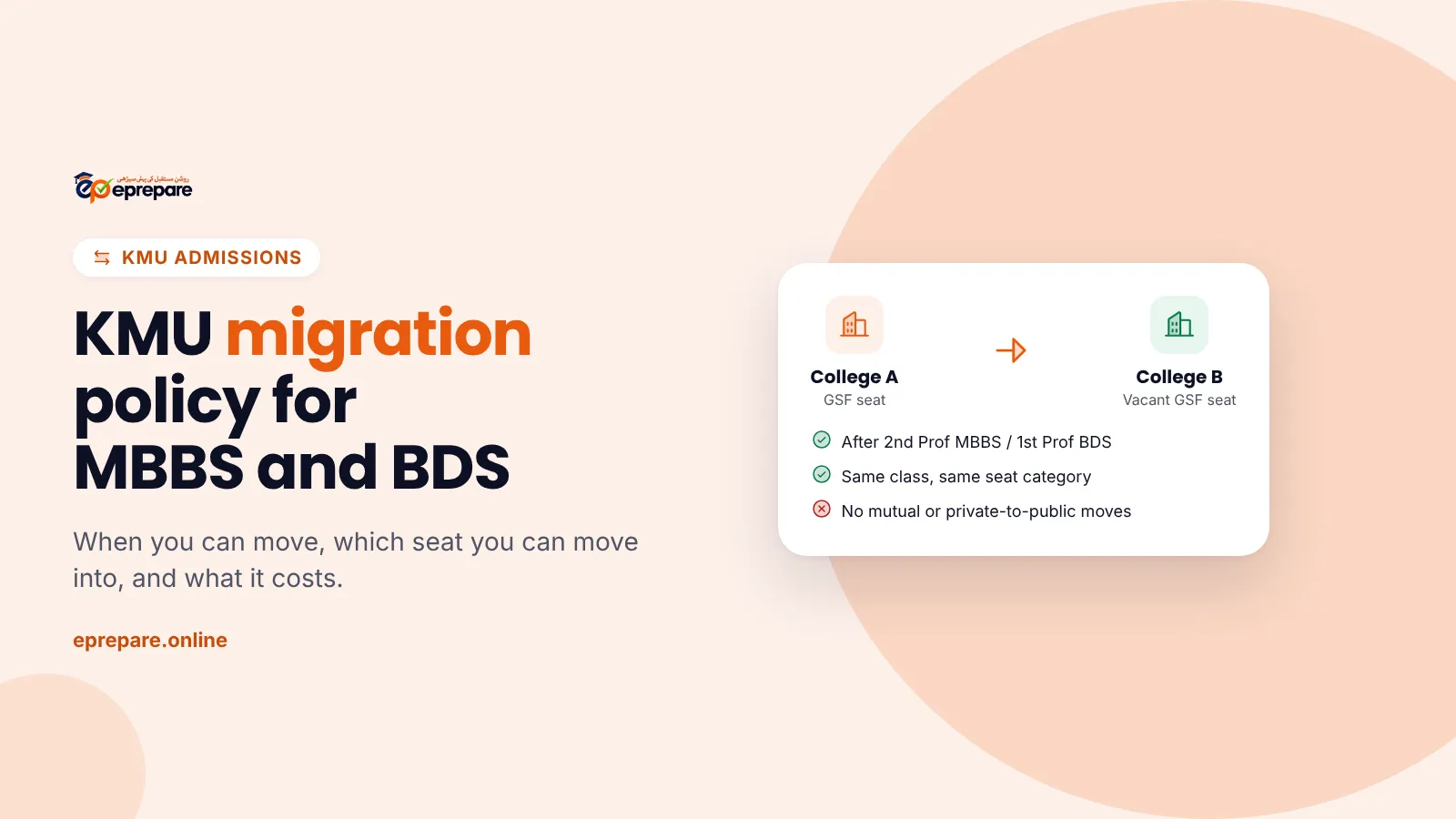
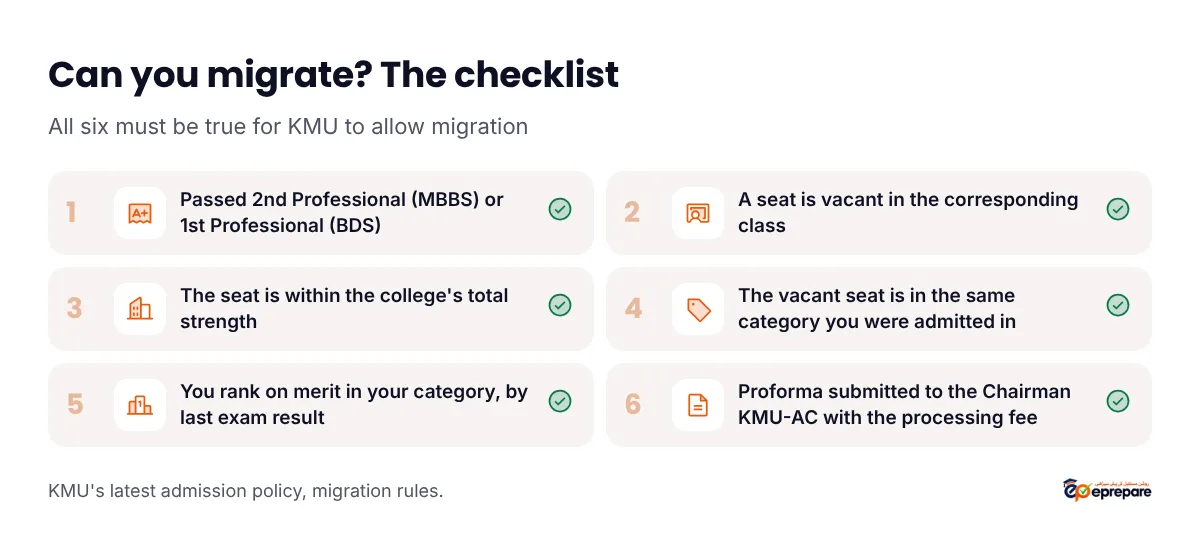
The short answer: you can apply to migrate only after passing the 2nd Professional (MBBS) or 1st Professional (BDS). A seat must be vacant in the same class and the same seat category you were admitted in, such as open merit to open merit or self-finance to self-finance. Mutual (swap) migration is not allowed, and neither is moving from a private college to a public one. You apply to the Chairman of the KMU Admission Committee with the proforma and fee. Applicants are ranked on their last exam result, and the migration fee is Rs 50,000 to Rs 250,000 depending on where you move from and to.
What migration means at KMU
Migration means moving from one medical or dental college to another while you are studying, keeping your place in your class. The policy says that migration from one public or private sector medical or dental college to another in Khyber Pakhtunkhwa "will be governed by the following rules & regulations." It also says that "No college shall restrict a student's right to leave a college and transfer to another college." Your college cannot block you, but you still have to meet every rule below.
Only one forum handles migration. The policy says: "Migration will be recommended by the KMU-AC to the Provincial Admission Committee and no other forum will entertain any such request." KMU-AC is the KMU Admission Committee, and the Provincial Admission Committee (PAC) is chaired by KMU's Vice Chancellor.
When you can migrate
The policy sets the timing clearly: "Migration will only be allowed after passing 2nd Professional in MBBS and 1st Professional in BDS examination."
- MBBS: you can apply once you have passed the 2nd Professional exam, so for a seat in 3rd year or later.
- BDS: you can apply once you have passed the 1st Professional exam, so for a seat in 2nd year or later.
The policy also tells colleges to report vacant seats in exactly these classes. Any public or private college with a vacant seat must inform the admitting university (KMU) "within 14 day in 3rd, 4th and Final Professional of MBBS and 2nd, 3rd and Final Professional BDS class." A vacant seat for migration "means, any seat that becomes vacant due to any reason."
What is not allowed
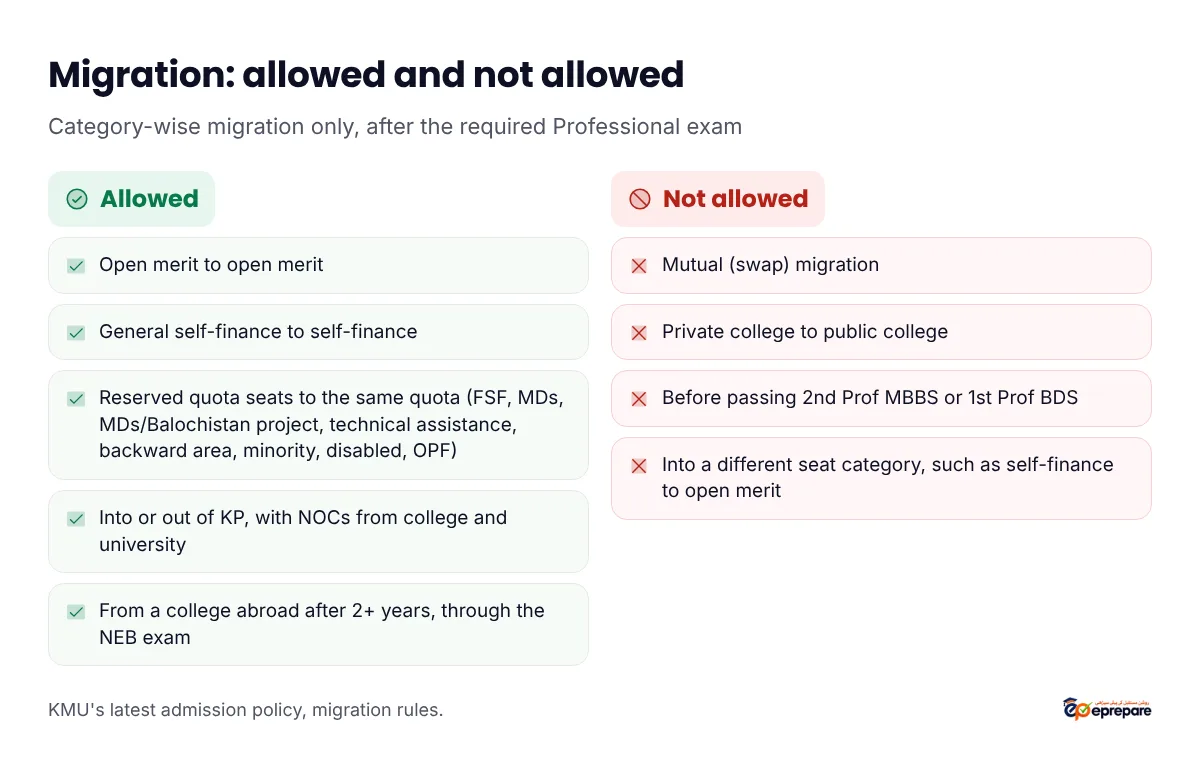
- No mutual migration. The policy says simply: "Mutual migration is not allowed." Two students cannot swap colleges with each other.
- No private to public. "Migration from private sector to public sector medical college is not allowed." A student in a private college cannot migrate into a public college.
- No early migration. You cannot migrate before passing the 2nd Professional (MBBS) or 1st Professional (BDS).
- No change of seat category. You cannot use migration to move from a self-finance seat to an open merit seat, or from a quota seat to open merit. See the next section.
The seat must be vacant, in your class and in your category
This is the rule that decides most cases. The policy sets three conditions, and all three must be met at the same time:
- A vacant seat must exist in the corresponding class, such as 3rd year MBBS if you are moving into 3rd year.
- The seat must be vacant within the overall strength of the college, the total number of students it is allowed.
- The seat must be in the same category of seat you were admitted against.
The policy explains: "Category wise migration means that a student will only have the right to migrate if the seat in the same category is lying vacant in which he/she was admitted." It applies category-wise migration "to the students admitted against open seats, general self-finance and against the reserved quota seats." The reserved quota seats it names are:
- foreign self-finance
- Merged Districts (MDs)
- MDs/Balochistan project
- technical assistance programme
- backward area
- minority
- disabled
- overseas Pakistani (OPF) seats
So a general self-finance (GSF) student can only move into a vacant GSF seat, and a Merged Districts student only into a vacant MDs seat. This is one of the real differences between open merit and self-finance seats; read more in our self-finance vs open merit guide. If you are not sure which category your seat is, our guide to KMU quota and reserved seats explains every one.
How applicants are ranked
If more than one student applies for the same vacant seat, KMU does not use your MDCAT or entry aggregate. The policy says: "Migration will be allowed on merit in their respective category among the applicants based on last examination result." Your most recent professional exam result decides your place, which is one more reason to do well in your professional exams.
How to apply for migration
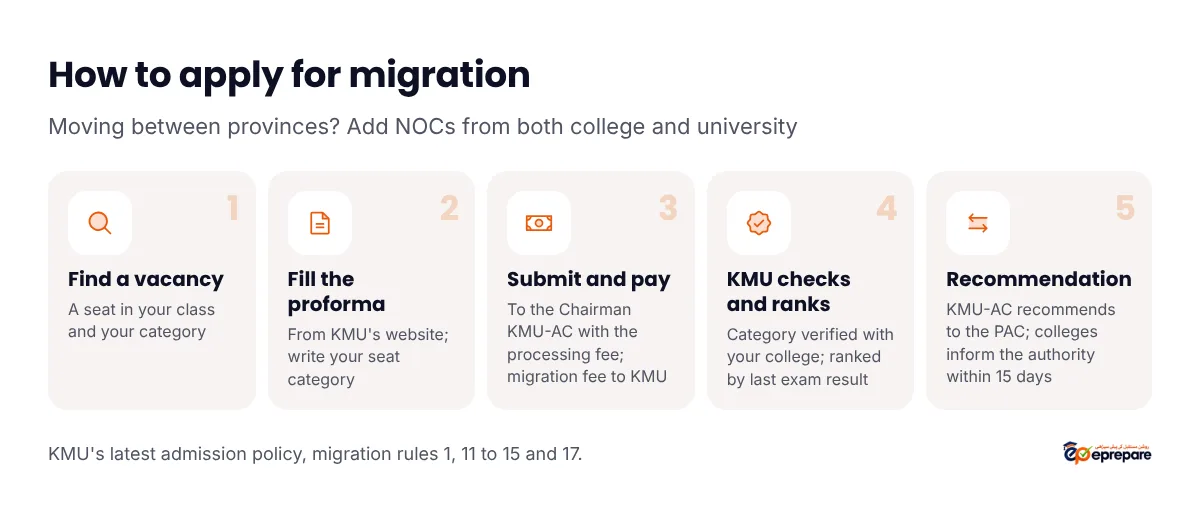
- Fill the proforma. "Students seeking migration from one college to other shall fill the proforma as per specimen given on KMU website along with the application for migration."
- State your seat category. In your application, say whether you were admitted on open merit, self-finance, an MDs reserved seat or another category. KMU verifies it with your college.
- Submit to the Chairman KMU-AC. "All the applications along with the proforma shall be submitted to Chairman KMU-AC along with application process fee."
- Pay the migration fee into KMU's accounts (see the fee table below).
- Get your NOCs if you are moving between provinces. A student migrating into or out of KP must provide a no-objection certificate (NOC) "from both the respective college and university." For a student leaving a KP college, the NOC is issued by the Registrar, KMU.
- Wait for the decision. KMU-AC recommends migration to the Provincial Admission Committee. The policy adds that "the rules of PM&DC must not be violated in any way."
After the move, both colleges, the one you leave and the one you join, must "inform the authority within 15 days of such transfer."
Migration fee
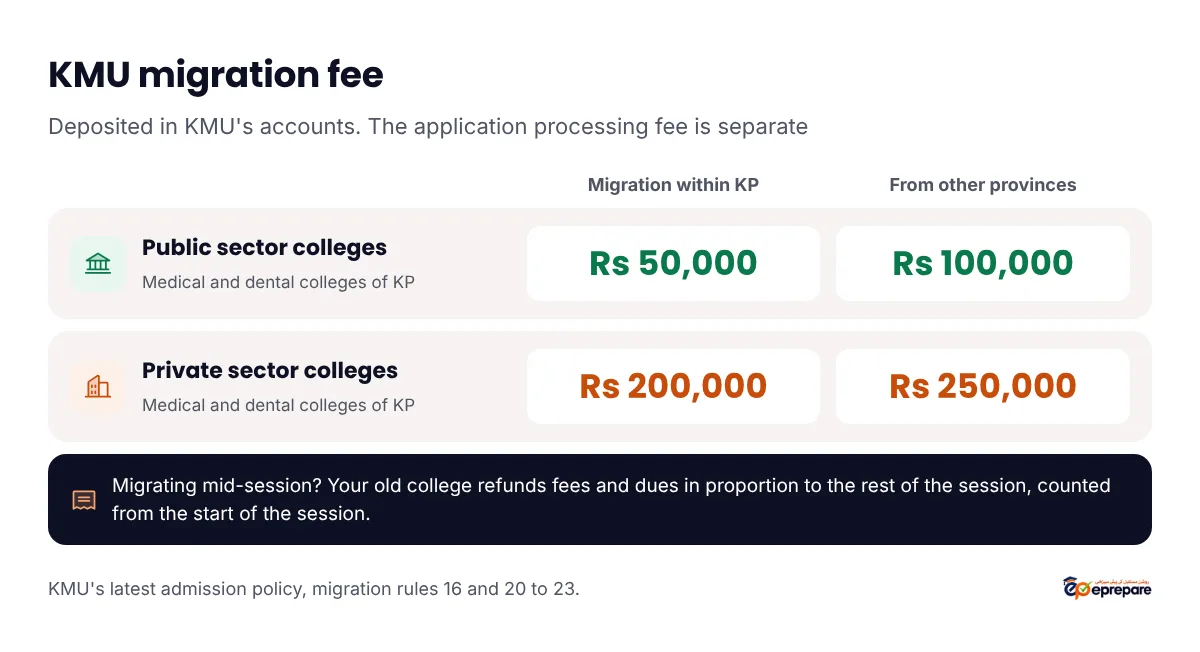
| Colleges | Migration within KP | Migrating from other provinces |
|---|---|---|
| Public sector medical and dental colleges of KP | Rs 50,000 | Rs 100,000 |
| Private sector medical and dental colleges of KP | Rs 200,000 | Rs 250,000 |
The amount is deposited in KMU's accounts. It is separate from the application processing fee that goes with your proforma, which the policy does not state as an amount.
Your fee at the old college
If you migrate in the middle of an academic session, you don't lose a full year's fee. The policy says the college "shall be bound to refund all dues and fee charged proportionate to remaining period of academic session, to be counted from start of session."
Transferring from a medical college abroad
The policy also covers Pakistani students studying medicine or dentistry abroad who want to come back. A student enrolled in a college outside Pakistan who "has completed more than two years of the program may seek transfer and admission to a medical or dental college in Pakistan." This depends on passing the National Equivalence Board (NEB) examination at the required standard. Once you qualify, you can be admitted "in the immediately subsequent year." You must take the NEB "within twelve months of having left his program of study outside Pakistan."
Leaving in first year is a different rule
Students often confuse migration with another rule in the admission procedure: leaving a KP public college for a college in another province or country during first-year admissions. This is not migration and follows its own conditions. The policy says a candidate admitted in a public sector KP medical or dental college "may be allowed to leave for another Medical/ Dental College in other province/ country provided he/she applies for this purpose before the closing date of admission." It then adds:
- "Those admitted in previous year(s) will not be allowed to do so." This only applies during the admission year.
- "Fee once paid shall not be refunded and any scholarship amount paid shall be recovered in such cases."
- "The undertaking given by the candidate on account of financial penalty shall also be enforced."
In addition, a student who resigns or withdraws admission "shall pay the prescribed penalty to the respective college before leaving the college." If you are thinking of leaving during admissions, decide before the closing date. After that, your only route to another college is migration after the 2nd Professional (MBBS) or 1st Professional (BDS).
| Point | Migration | Leaving in first year |
|---|---|---|
| When | After 2nd Prof (MBBS) or 1st Prof (BDS) | Before the closing date of admission only |
| Where to | Another college, into a vacant seat of your category | A college in another province or country |
| Fee | Migration fee; proportionate refund of current session fee | Fee paid is not refunded; scholarship recovered |
| Who can use it | Students who passed the required Professional exam | Students admitted in the current admission year only |
All 23 migration rules at a glance
| Rule | What it says, in plain words |
|---|---|
| 1 | KMU-AC recommends migration to the PAC; no other forum hears requests |
| 2 | Mutual migration is not allowed |
| 3 | Private to public migration is not allowed |
| 4 | Only after passing 2nd Professional MBBS or 1st Professional BDS |
| 5 | Colleges report vacant seats to KMU within 14 days (3rd, 4th, final year MBBS; 2nd, 3rd, final year BDS) |
| 6 | A vacant seat must exist in the college's total strength and in the corresponding class |
| 7 | The vacant seat must also be in your seat category |
| 8 | Merit among applicants of your category, on your last exam result |
| 9 | Category-wise migration for open merit, GSF and all reserved quota seats |
| 10 | No college can stop a student from leaving and transferring |
| 11 | Fill the proforma from KMU's website with your application |
| 12 | Submit to the Chairman KMU-AC with the processing fee |
| 13 | State your seat category; KMU verifies it with your college |
| 14 | PM&DC rules must not be violated |
| 15 | Both colleges inform the authority within 15 days of the transfer |
| 16 | Fee refunded in proportion to the rest of the session |
| 17 | Inter-provincial moves need NOCs from college and university (Registrar KMU for leaving KP) |
| 18 | From abroad: more than two years completed, then the NEB exam |
| 19 | Take the NEB within twelve months of leaving the foreign programme |
| 20 | Public colleges of KP: Rs 50,000 from within KP |
| 21 | Public colleges: Rs 100,000 from other provinces, paid to KMU |
| 22 | Private colleges of KP: Rs 200,000 from within KP |
| 23 | Private colleges: Rs 250,000 from other provinces, paid to KMU |
Our advice before you apply
- Find the vacancy first. Migration is only possible when a seat of your category is vacant in your class. Ask the college you want to join, and watch KMU's notices.
- Keep your professional results strong. Applicants are ranked on their last exam result, not their MDCAT.
- Know your seat category. It is written in your admission record. If you were admitted on self-finance, you can only move into a self-finance seat.
- Choose your college carefully at admission. Since you cannot migrate in the first two years of MBBS, your preference list matters a lot. Our guide to how KMU merit lists and upgrades work explains how to order your colleges.
- Budget for the fee. Check the full KMU MBBS and BDS fee structure, since your annual fee at the new college will follow your seat category.
Frequently asked questions
When can I migrate from one KP medical college to another?
Only after passing the 2nd Professional exam in MBBS or the 1st Professional exam in BDS, and only when a seat of your category is vacant in the corresponding class of the college you want to join.
Can I migrate from a self-finance seat to an open merit seat?
No. KMU allows category-wise migration only. A self-finance student can move into a vacant self-finance seat, and an open merit student into a vacant open merit seat.
Is mutual migration allowed at KMU?
No. The policy says mutual migration is not allowed, so two students cannot swap their seats.
Can I migrate from a private medical college to a public one?
No. Migration from a private sector to a public sector medical college is not allowed.
What is the KMU migration fee?
For public sector colleges of KP it is Rs 50,000 for migration within the province and Rs 100,000 for students from other provinces. For private colleges it is Rs 200,000 within the province and Rs 250,000 from other provinces. The fee is deposited in KMU's accounts.
How are migration applicants selected?
On merit among applicants of the same seat category, using each applicant's last examination result.
Can I migrate from a college outside Pakistan to a KP college?
Yes, if you have completed more than two years abroad and pass the National Equivalence Board (NEB) examination. You must take the NEB within twelve months of leaving your foreign programme.
Can I leave my KP college in first year for another province?
Only if you apply before the closing date of admission in your admission year. The fee you paid is not refunded, any scholarship is recovered, and the financial penalty in your undertaking is enforced. After that, only migration rules apply.
Migration is possible, but it is narrow and slow. The best way to end up in the college you want is still a strong MDCAT score and a well-ordered preference list. Prepare with ePrepare and give yourself the best choice of colleges from day one.
Sources: Khyber Medical University, latest Admission Policy for Public Sector Medical and Dental Colleges of Khyber Pakhtunkhwa: Migration Policy for MBBS/BDS students of Khyber Pakhtunkhwa (rules 1 to 23) and the admission procedure. Rules and fees can change; always check the latest policy and notices on cas.kmu.edu.pk and kmu.edu.pk.