Every admission season we hear the same questions from three groups of families: Afghan students who grew up in Peshawar, Mardan or Swat; Pakistani families working in the Gulf, Europe or North America; and dual nationals who want their child to study medicine at home. They all ask the same thing: can I get an MBBS or BDS seat in a government medical college of Khyber Pakhtunkhwa, and which seat is mine?
The answer is yes. Khyber Medical University (KMU), which runs admissions for all public sector medical and dental colleges of KP, keeps separate seats for these students. But there are six different kinds, each with its own rules, its own application route and, in one case, a fee in US dollars. Mixing them up is the most common reason good candidates lose a seat they could have had.
This guide explains each one clearly, using KMU's latest admission policy for public sector colleges, available on the KMU admission portal.
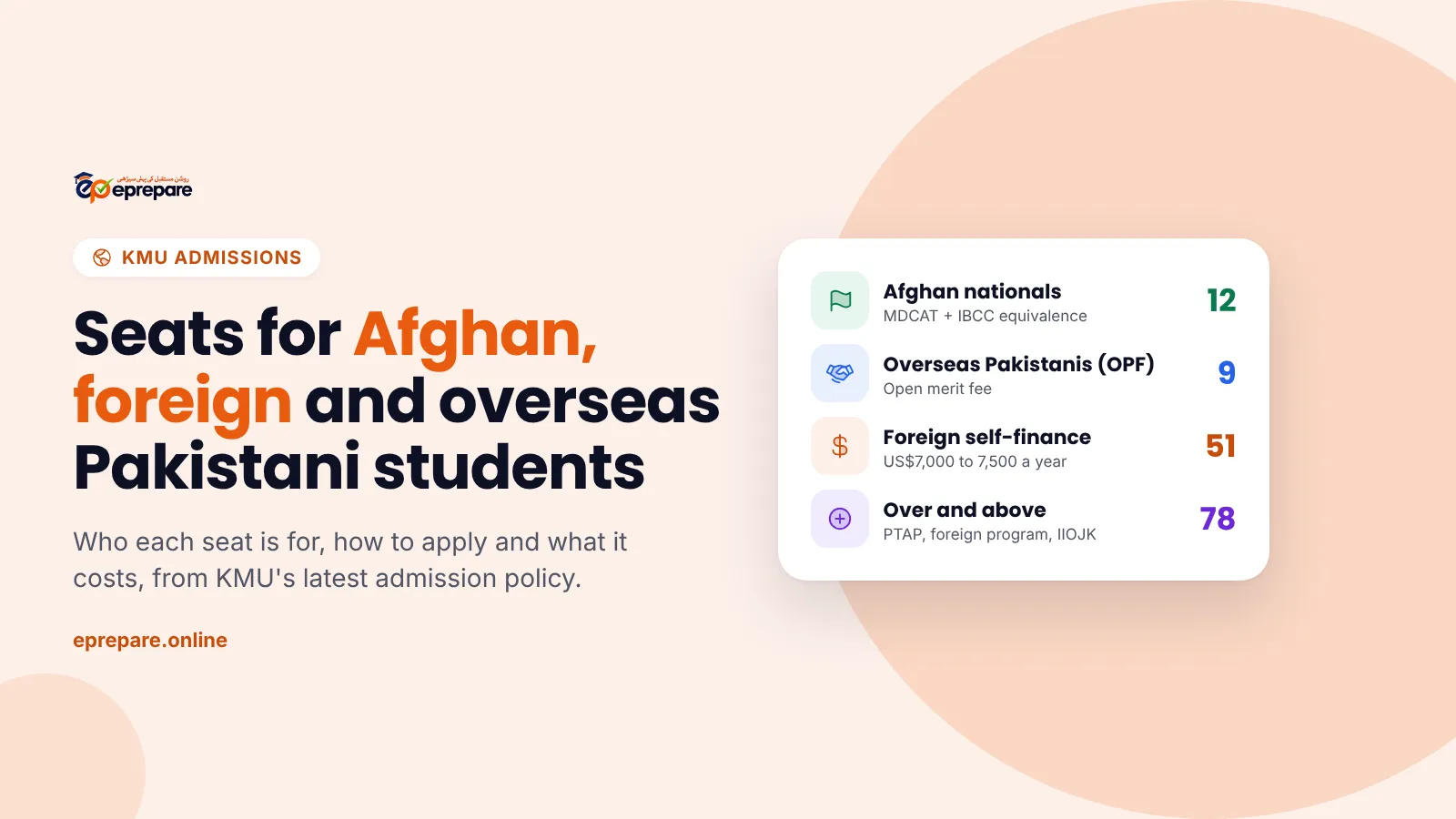
The short answer: KMU's latest policy keeps 12 Afghan national seats, 9 Overseas Pakistanis Foundation (OPF) seats and 51 foreign self-finance (FSF) seats inside the 1,580 seats that PM&DC has sanctioned for KP's public colleges. On top of those, there are 78 over-and-above seats: 6 under the Pakistan Technical Assistance Program (PTAP), 68 additional foreign seats and 4 seats for Illegally Indian Occupied Jammu & Kashmir (IIOJK). Afghan, OPF and PTAP students pay the normal open merit fee. FSF students pay US$7,000 to US$7,500 a year plus rupee charges.
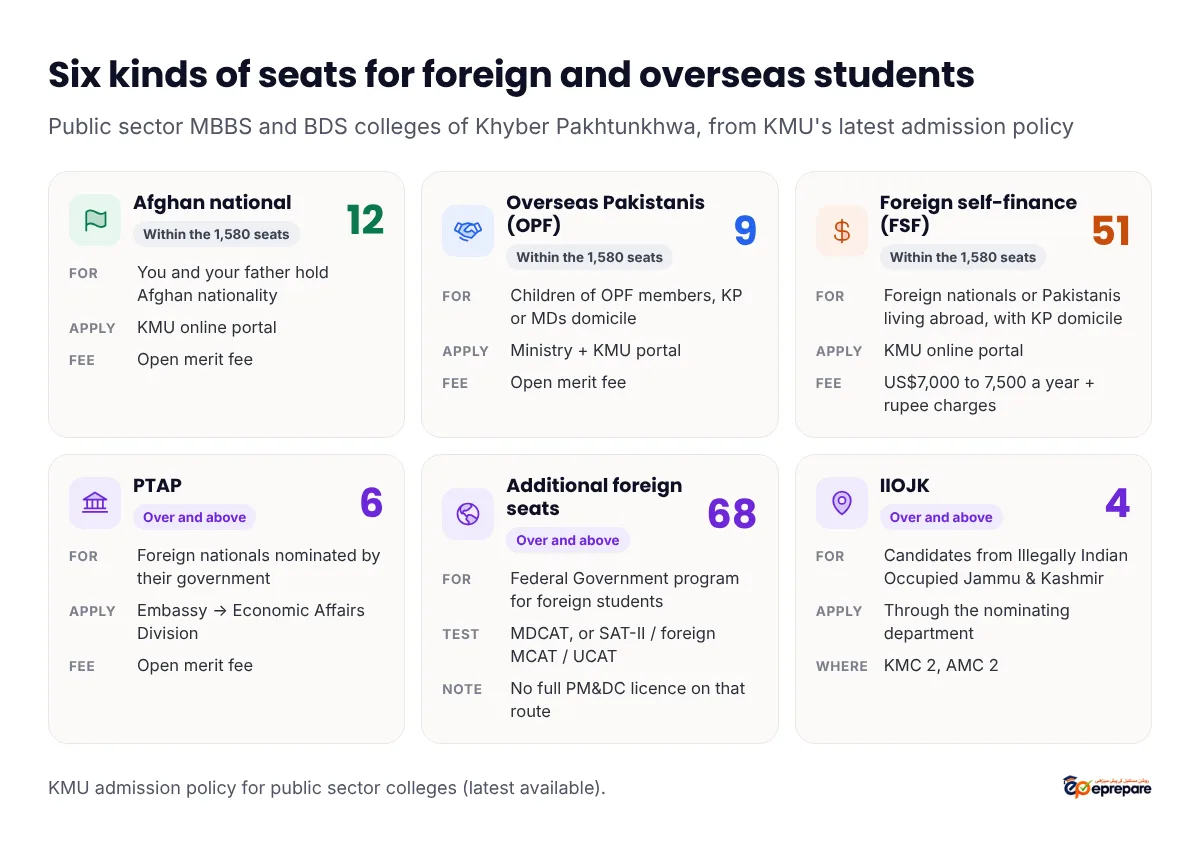
The six seats at a glance
Here is every seat type in one table. The details, eligibility rules and application steps for each one follow below.
| Seat | Seats | Who can apply | Fee |
|---|---|---|---|
| Afghan national | 12 (10 MBBS, 2 BDS) | You and your father hold Afghan nationality | Open merit fee |
| Overseas Pakistanis (OPF) | 9 (5 MBBS, 4 BDS) | Child of an OPF member with a Sohni Dharti remittance card, with KP or Merged Districts domicile | Open merit fee |
| Foreign self-finance (FSF) | 51 (40 MBBS, 11 BDS) | Foreign national, dual national or Pakistani living abroad permanently, with KP domicile | US$7,000 to 7,500 a year plus rupee charges |
| PTAP | 6, over and above | Foreign national nominated through Pakistan's Economic Affairs Division | Open merit fee |
| Additional foreign seats | 68, over and above | Foreign students under a Federal Government program | Not set out separately; confirm with KMU |
| IIOJK | 4, over and above | Candidates from IIOJK recommended by the nominating department | Confirm with KMU |
"Within the seats" vs "over and above": why it matters
PM&DC sanctions 1,580 seats for KP's 13 public medical and dental colleges (1,320 MBBS and 260 BDS). The Afghan, OPF and FSF seats are part of those 1,580. The PTAP, additional foreign and IIOJK seats are over and above: they are added on top, which brings the grand total to 1,658. So if you are a KP student worried that these over-and-above seats take away open merit seats, they don't: they are extra, and the policy's seat table labels them as the 5% allowed above the sanctioned seats.
The policy also says what happens to seats left empty at the end. Any category seat that stays vacant because no eligible candidate is available is converted to open merit, except foreign self-finance seats, which become general self-finance (GSF) seats and are charged the GSF fee.
Seats by college
Not every college has every seat type. If you are applying on one of these seats, list every college that has your seat type in your preference order, because KMU only offers a college that you have listed.
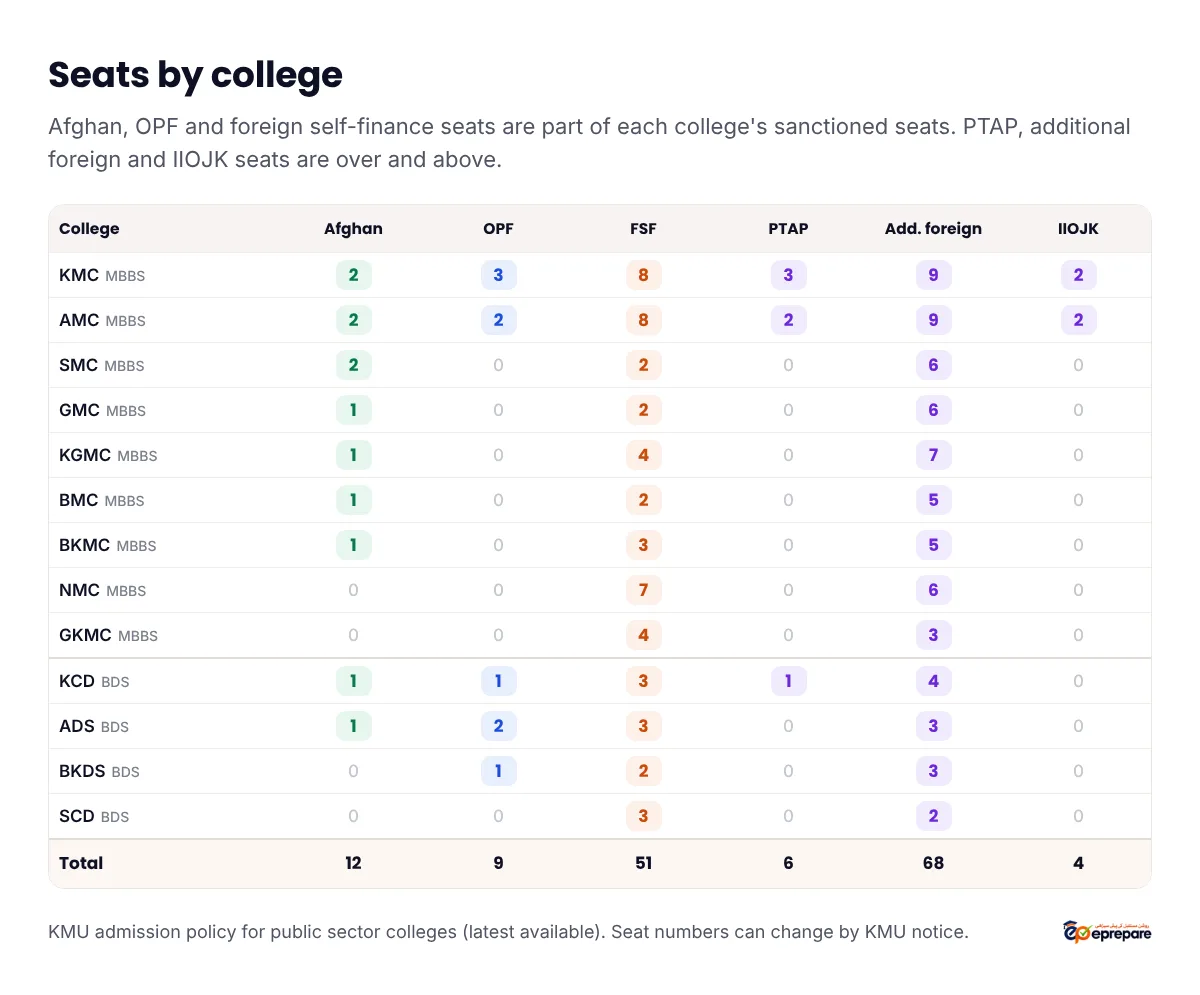
The college names in short: KMC is Khyber Medical College, Peshawar; AMC, Ayub Medical College, Abbottabad; SMC, Saidu Medical College, Swat; GMC, Gomal Medical College, D.I. Khan; KGMC, Khyber Girls Medical College, Peshawar; BMC, Bannu Medical College; BKMC, Bacha Khan Medical College, Mardan; NMC, Nowshera Medical College; GKMC, Gajju Khan Medical College, Swabi. The dental colleges are KCD, Khyber College of Dentistry, Peshawar; ADS, Ayub Dental Section, Abbottabad; BKDS, Bacha Khan Dental Section, Mardan; and SCD, Saidu College of Dentistry, Swat.
Which seat fits you?
Start with one question: are you a Pakistani citizen? Then follow the line that describes you.
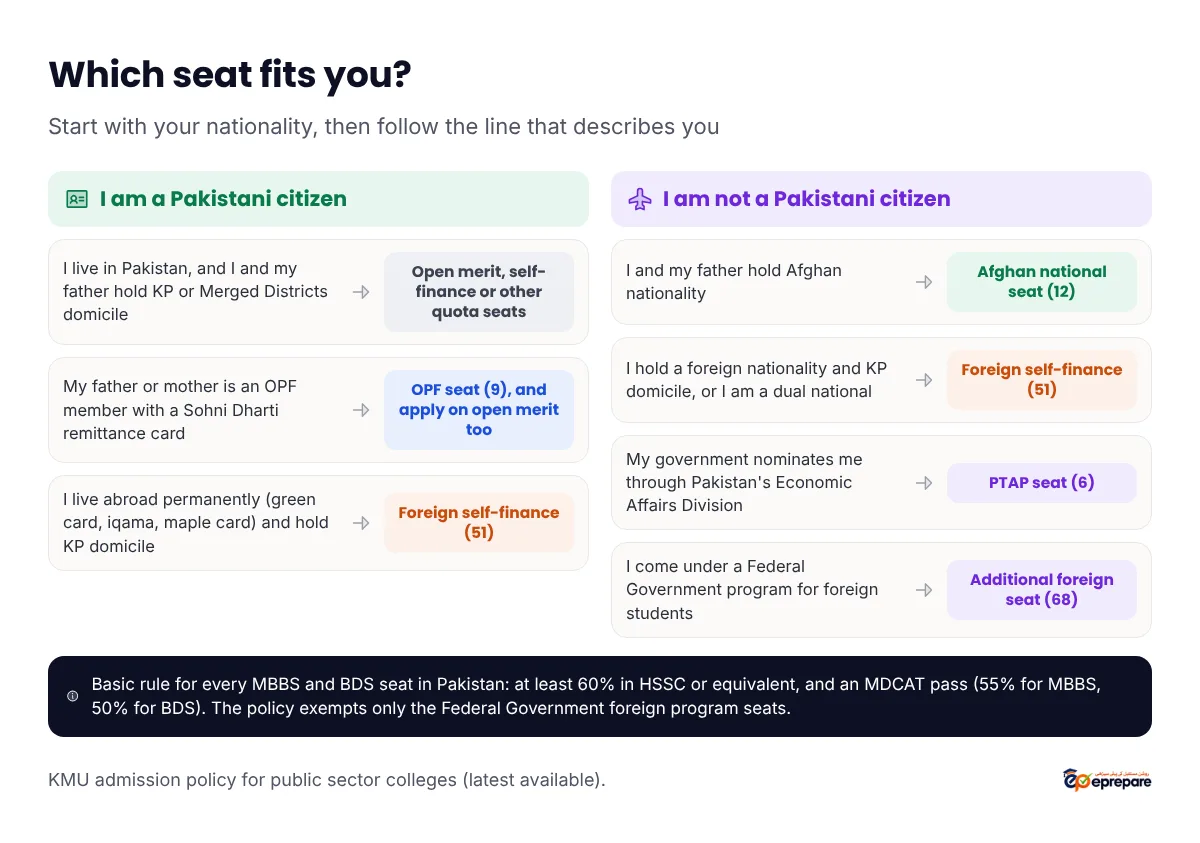
- Pakistani, living in Pakistan, KP or Merged Districts domicile: you belong on open merit, general self-finance or another quota seat, not on these seats. Our guides to self-finance vs open merit seats and to every KMU reserved and quota seat explain those.
- Pakistani, and a parent is an OPF member: the OPF seat, and apply on open merit, GSF and Merged Districts seats as well if you qualify.
- Pakistani living abroad permanently, or a dual national, with KP domicile: foreign self-finance.
- Afghan national (you and your father): Afghan national seat.
- Foreign national nominated by your own government: PTAP.
- Foreign student under a Federal Government program: additional foreign seats.
Afghan national seats (12)
There are 12 seats for Afghan nationals: 10 MBBS and 2 BDS.
| College | Programme | Afghan seats |
|---|---|---|
| KMC, Peshawar | MBBS | 2 |
| AMC, Abbottabad | MBBS | 2 |
| SMC, Swat | MBBS | 2 |
| GMC, D.I. Khan | MBBS | 1 |
| KGMC, Peshawar (girls) | MBBS | 1 |
| BMC, Bannu | MBBS | 1 |
| BKMC, Mardan | MBBS | 1 |
| KCD, Peshawar | BDS | 1 |
| ADS, Abbottabad | BDS | 1 |
Who is eligible
The policy lists these criteria for Afghan national seats, word for word:
1. The applicant and his/her father hold a valid Afghan nationality at the time of admission.
2. The applicant must have passed Higher Secondary School or equivalent examination with three science subjects (Biology, Chemistry and Physic/Maths) with minimum 60% marks as certified by Inter Board Committee of Chairmen (IBCC) Islamabad.
3. Any candidate seeking admission in any medical or dental college shall mandatorily be required to have passed the MDCAT examination held by Pakistan Medical & Dental Council. The passing marks for the MDCAT examination shall be 55% for MBBS and 50% for BDS.
4. The applicant is required to present a valid one year English language Proficiency Certificate, if the medium of instruction of study prior to application for admission/entry test is not English.
5. Admission shall not be granted as per nomination of Embassy of Afghanistan, Islamabad.
6. Afghan students on reserved seats shall be required to procure Afghan passports and study on student visa once offered admissions, if they are holders of POR, ACC etc.
7. All procedures and rules applicable to foreign students may be observed shall apply to these candidates as well.
In plain words:
- Both you and your father must hold Afghan nationality when you are admitted.
- You need at least 60% in HSSC (FSc or equivalent) with Biology, Chemistry and Physics or Maths, and IBCC must certify it.
- You must pass the MDCAT: 55% for MBBS, 50% for BDS. On the current 180-mark paper, that is 99 marks for MBBS and 90 for BDS. Our guide to MDCAT passing marks explains this in detail.
- If you did not study in English before, you need a one-year English language proficiency certificate.
- Selection is on merit, not by embassy nomination. The embassy cannot place you on a seat.
- If you hold a Proof of Registration (PoR) card or Afghan Citizen Card (ACC), you will have to get an Afghan passport and a Pakistani student visa once you are offered admission. Start on this early so it does not hold up your admission.
How to apply and how selection works
You apply on the KMU online portal, like everyone else. The policy says selection under each category is made "on the basis of inter se merit amongst the eligible applicants", so you compete only with other Afghan applicants, using the same aggregate formula: 10% Matric, 40% FSc and 50% MDCAT. You can check where you stand with our aggregate calculator.
Can an Afghan student apply on open merit? No. Open merit and general self-finance seats require a valid KP domicile for both the candidate and the father, which Afghan nationals do not have. Your seats are the Afghan national seats.
Fee: Afghan national seats pay the open merit fee, the same as KP students on open merit: Rs 102,000 in the first year at KMC, KGMC and AMC, and Rs 87,000 at the other colleges. See our full KMU fee structure for every year.
One more piece of context: the policy notes that the Supreme Court of Pakistan, in the Attiya Inayat case, declared reserved quotas in medical colleges to be without authority, with a few exceptions. Afghan refugees are one of the categories kept.
Overseas Pakistanis Foundation (OPF) seats (9)
These 9 seats (5 MBBS and 4 BDS) are for the children of overseas Pakistanis who are registered with the Overseas Pakistanis Foundation. They are federal seats in KP colleges, and they pay the normal open merit fee.
| College | Programme | OPF seats |
|---|---|---|
| KMC, Peshawar | MBBS | 3 |
| AMC, Abbottabad | MBBS | 2 |
| KCD, Peshawar | BDS | 1 |
| ADS, Abbottabad | BDS | 2 |
| BKDS, Mardan | BDS | 1 |
Who is eligible
The policy's eligibility criteria for OPF seats, word for word:
I. The candidates seeking admission against the reserved seats must fulfill the requirements laid down by the Ministry of Labor and Manpower, Government of Pakistan and KMU.
II. The students who have studied and passed HSSC 12th grade examination or equivalent with physics or maths, Chemistry and Biology recognized in Pakistan and have obtained a minimum of sixty percent (60%) marks therein, or a higher percentage as may be notified by the Pakistan Medical and Dental Council.
III. Have passed MDCAT examination score with minimum 55% marks for admission MBBS and 50% marks for admission BDS.
IV. Only those candidates will be considered for admission, whose application are recommended by OPF office Islamabad. Recommendation letter from OPF must be obtained by the candidate before closing date for admission. The application should be recommended to the Chairman KMU-AC through the concerned Ministry.
V. The candidate must have domicile of Khyber Pakhtunkhwa/MDs.
VI. The candidate's Father / Mother must have valid OPF Membership and Foreign Exchange Remittance Card (Sohni Dharty Card).
VII. The KMU-AC will finalize the admission on merit cum-choice basis.
VIII. The OPF candidates from Khyber Pakhtunkhwa and Merged Districts (MDs) applying for these seats can also apply on open merit, GSF and MDs seats separately.
How to apply: two applications, one letter
This is where most OPF candidates go wrong. The policy asks for two applications:
- An application through the Ministry of Labour, Manpower and Overseas Pakistanis in Islamabad (the policy's name for the ministry now known as the Ministry of Overseas Pakistanis and Human Resource Development), and
- Your direct online application on the KMU portal.
You also need a recommendation letter from the OPF office in Islamabad before the closing date. Your parent's OPF membership card and Foreign Exchange Remittance Card (the Sohni Dharti card) must both be valid on the closing date of the application form. If either one expires before that date, you are not eligible.
Because the OPF seats are so few, always apply on open merit and general self-finance as well, and on Merged Districts seats if you hold that domicile. The policy allows it, and it costs you nothing to be considered on every seat you qualify for.
OPF seat vs foreign self-finance seat: don't confuse them
Both are for families with a link abroad, but they are very different seats.
| Point | OPF seat | Foreign self-finance (FSF) |
|---|---|---|
| Seats | 9 | 51 |
| Meant for | Children of overseas Pakistanis registered with OPF | Foreign nationals, dual nationals and Pakistanis permanently living abroad |
| Domicile | KP or Merged Districts | KP |
| Where you apply | Ministry and the KMU portal, plus an OPF letter | KMU portal |
| Fee | Open merit fee in rupees | US$7,000 to 7,500 a year plus rupee charges |
| MDCAT | 55% MBBS, 50% BDS | 55% MBBS, 50% BDS |
Foreign self-finance seats (51)
Foreign self-finance (FSF) is the largest of these categories, with 51 seats (40 MBBS and 11 BDS). Every one of KP's 13 public colleges has some.
| College | Programme | FSF seats |
|---|---|---|
| KMC, Peshawar | MBBS | 8 |
| AMC, Abbottabad | MBBS | 8 |
| NMC, Nowshera | MBBS | 7 |
| KGMC, Peshawar (girls) | MBBS | 4 |
| GKMC, Swabi | MBBS | 4 |
| BKMC, Mardan | MBBS | 3 |
| SMC, Swat | MBBS | 2 |
| GMC, D.I. Khan | MBBS | 2 |
| BMC, Bannu | MBBS | 2 |
| KCD, Peshawar | BDS | 3 |
| ADS, Abbottabad | BDS | 3 |
| SCD, Swat | BDS | 3 |
| BKDS, Mardan | BDS | 2 |
Who is eligible
The policy defines the FSF seats like this:
These seats are for applicants who are not Pakistani students and hold a permanent foreign nationality or is an overseas (being a Pakistani citizen permanently resident in a foreign country) Pakistani, Green card holder, Iqama holder, Maple card holder, as elaborated under regulations 4(7), having domicile of Khyber Pakhtunkhwa.
So FSF is open to:
- Foreign nationals and dual nationals, and
- Pakistani citizens who live abroad permanently, for example holders of a US green card, a residence permit (iqama) in Saudi Arabia or the Gulf, or a Canadian permanent residence ("maple") card,
- who hold a Khyber Pakhtunkhwa domicile.
You need at least 60% marks in Intermediate, FSc, HSSC or an equivalent 12th-grade qualification, from inside or outside Pakistan. Like nearly every MBBS and BDS seat in Pakistan, you also need to pass the MDCAT: 55% for MBBS and 50% for BDS.
The rules that bind you for the whole degree
Read these carefully before you accept an FSF seat, because they last for all five years of MBBS or four years of BDS:
- "Students admitted under this quota must complete their entire period of study under this quota/category." You cannot move to open merit or GSF later.
- The fee is collected in foreign exchange, and you must sign an undertaking or bond to that effect.
- "A student admitted on foreign seat shall pay the fee as a foreign students regardless of any change in status of such student during the program of study." Even if your family moves back to Pakistan, your fee stays the FSF fee.
- If you later want to migrate to another college, you can only move into a vacant seat in the same category. See our guide to the KMU migration policy.
FSF fee per year
The FSF fee has two parts: tuition in US dollars, and university, exam and student fund charges in rupees. The higher dollar rate applies at KMC, KGMC and AMC.
| Year | KMC, KGMC, AMC | Other colleges |
|---|---|---|
| 1st year | US$7,500 + Rs 50,500 | US$7,000 + Rs 50,500 |
| 2nd year | US$7,500 + Rs 32,000 | US$7,000 + Rs 32,000 |
| 3rd year | US$7,500 + Rs 31,000 | US$7,000 + Rs 31,000 |
| 4th year | US$7,500 + Rs 29,000 | US$7,000 + Rs 29,000 |
| Final year (MBBS) | US$7,500 + Rs 27,500 | US$7,000 + Rs 27,500 |
| MBBS, 5 years | US$37,500 + Rs 170,000 | US$35,000 + Rs 170,000 |
BDS runs for four years, so it is four years of tuition plus Rs 142,500 in rupee charges. The policy's footnote names only KMC, KGMC and AMC for the higher rate and does not name the dental colleges, so confirm the dollar rate for your dental college with KMU before you apply. Hostel, books and living costs are extra.
The 15% limit and vacant FSF seats
The policy says foreign plus general self-finance admissions in a public college "shall not exceed fifteen percent of total allocated seats", and that unused seats are not carried forward to the next year. If an FSF seat stays vacant because there is no eligible candidate, it is transferred to general self-finance and filled at the GSF fee. Our guide to self-finance vs open merit covers GSF in full.
Pakistan Technical Assistance Program (PTAP) seats (6)
The PTAP seats are 6 over-and-above seats for foreign students nominated by their own government: 3 at KMC, 2 at AMC and 1 at KCD. Pakistan offers them to friendly countries under its technical assistance program.
The policy's conditions, word for word:
i. The applicant holds a valid foreign nationality.
ii. The applicant must have passed HSSC/ equivalent (Pre-medical) examination, having a certificate from the Institution last attended.
iii. The applicant must also fulfill the criteria laid down by Economic Affairs Division, Ministry of Economic Affairs & Statistics, and Government of Pakistan Islamabad.
iv. Nomination of the candidates must be routed through Economic Affairs Division, Ministry of Economic Affairs & Statistics, Government of Pakistan Islamabad.
How it works: you do not apply to KMU directly. You apply through your own government or embassy to the Economic Affairs Division in Islamabad, which makes the selection on merit. The Division then sends the names of selected candidates to KMU, with a copy to the Secretary Health, Government of KP, for endorsement. Candidates sent by nominating agencies after the closing date can still be admitted, subject to PM&DC's prior approval.
Fee: the policy lists PTAP students under the normal fee, "Equal to Open Merit Fee".
Additional foreign seats (68)
The policy's seat table lists 68 "additional foreign seats" as over and above: KMC 9, AMC 9, KGMC 7, SMC 6, GMC 6, NMC 6, BMC 5, BKMC 5, GKMC 3, KCD 4, ADS 3, BKDS 3 and SCD 2. Together with the PTAP and IIOJK seats they make 78 over-and-above seats, labelled in the table as the 5% allowed above each college's sanctioned seats.
Be careful here, because this is the category most often misunderstood. The policy's general notes describe over-and-above admissions for foreign students under bilateral agreements:
Provided that any students admitted on a special category seat pre-defined exclusively for a Federal Government Program for foreign students under bilateral agreements with other countries who have not taken the MDCAT exam may be admitted over and above the allocated seats subject to such over and above admissions not being more than five percent of the total allocated seats of the college. Such students shall qualify SAT-II with minimum score of 550 in each subject or a foreign MCAT examination or UCAT examination with 50% marks in the subject as prescribed in PM&DC regulations […]
And in the basic eligibility rules:
Such students shall also not be entitled to apply for a Full License to practice in Pakistan after having obtained their degree and will have to apply as foreign graduate's subject to applicable licensing pathways.
What this means for you:
- These are seats for foreign students under a Federal Government program with other countries. They are not for Pakistani students, and you cannot simply apply for one on the KMU portal.
- Students on that program can be admitted without the MDCAT if they have SAT-II with at least 550 in each subject, or 50% in a foreign MCAT or UCAT.
- They cannot get a full licence to practise in Pakistan through that route; they apply as foreign graduates.
- The policy does not set out a separate application route or fee for these 68 seats. If you think you may come under such a program, ask your country's embassy in Pakistan and KMU's admission office before relying on it.
IIOJK seats (4)
There are 4 over-and-above seats, 2 at KMC and 2 at AMC, for candidates from Illegally Indian Occupied Jammu & Kashmir (IIOJK). Like the PTAP and Azad Kashmir seats, candidates for these seats are recommended by the respective nominating department, not selected directly through KMU's open application. For Azad Jammu & Kashmir and Gilgit-Baltistan seats, see our guide to KP students' seats in AJK colleges and AJK and GB seats in KP.
Where each application goes
Here is the route for each seat in one picture. The key difference: the Afghan and FSF seats start and end on the KMU portal; OPF needs the ministry as well; PTAP, the additional foreign seats and IIOJK start outside KMU.
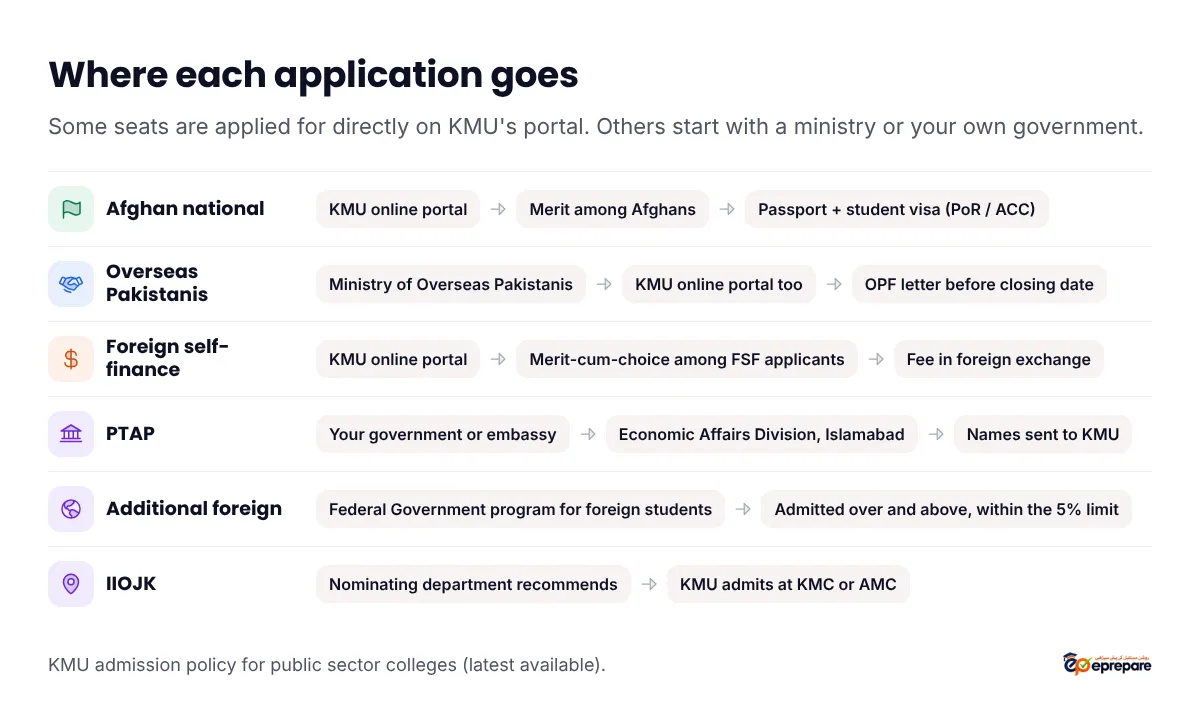
For the seats you apply for on the KMU portal, the process is the same as for every other candidate:
- Apply online at cas.kmu.edu.pk before the closing date. KMU does not accept forms by post or courier.
- Choose your category and list every college you would accept, in order of preference.
- Check the merit lists. KMU displays at least three. If you think there is an error, you can object in writing to the Chairman of the KMU Admission Committee before the placement interviews.
- Attend the placement interview with a parent or legal guardian, which the policy requires.
- Deposit the fee within three working days of your offer letter, or the seat goes to the next candidate.
Our guide to how KMU merit lists, upgrades and the waiting list work explains steps 3 to 5 in detail.
Documents to prepare
Foreign qualifications are where most of these applications get stuck. Prepare these well before the closing date:
- Detailed marks certificates of every examination your admission is based on.
- IBCC equivalence certificate if your Matric or FSc is from a foreign system (O and A levels, American high school, Gulf or Afghan boards). It must be attached before the closing date. The policy warns that equivalence "will not be accepted if he/she has not studied and passed the subjects of Physics/Maths, Chemistry and Biology in his/her 9th, 10th, 11th and 12th Grade / O & A levels", and that "He/She must have passed English as a subject at O or A level."
- Domicile certificates of you and your father (OPF and Pakistani FSF candidates). If your father has passed away, his death certificate and your mother's domicile.
- CNIC or Form B of you and your father's CNIC (Pakistani candidates).
- OPF membership card and Foreign Exchange Remittance Card of your parent, valid on the closing date (OPF candidates), plus the OPF recommendation letter.
- English proficiency certificate, if needed (Afghan candidates).
- Certificate from the institution you last attended, with your duration of stay.
Any certificate issued after the closing date is not counted, and documents found false at any stage mean cancellation and a ban from KP's professional colleges. Our KMU admission documents checklist covers every certificate and warning.
Mistakes that cost seats
- Applying only on the special seat. OPF candidates who don't also apply on open merit, GSF or Merged Districts seats give up chances they were entitled to.
- Getting the OPF letter too late. The recommendation letter must be in hand before the closing date, and both of your parent's cards must still be valid on that date.
- Applying for IBCC equivalence late. Without the equivalence certificate attached before the closing date, a foreign qualification is not counted.
- Not planning the passport and visa. Afghan PoR and ACC holders need an Afghan passport and a student visa once admitted. Leaving this until after the offer letter is risky.
- Expecting the FSF fee to change. The foreign fee stays the same for the whole degree, whatever happens to your residence status.
- Leaving colleges off the preference list. KMU will not offer you a college you did not list, even if a seat of your type is free there.
Key dates
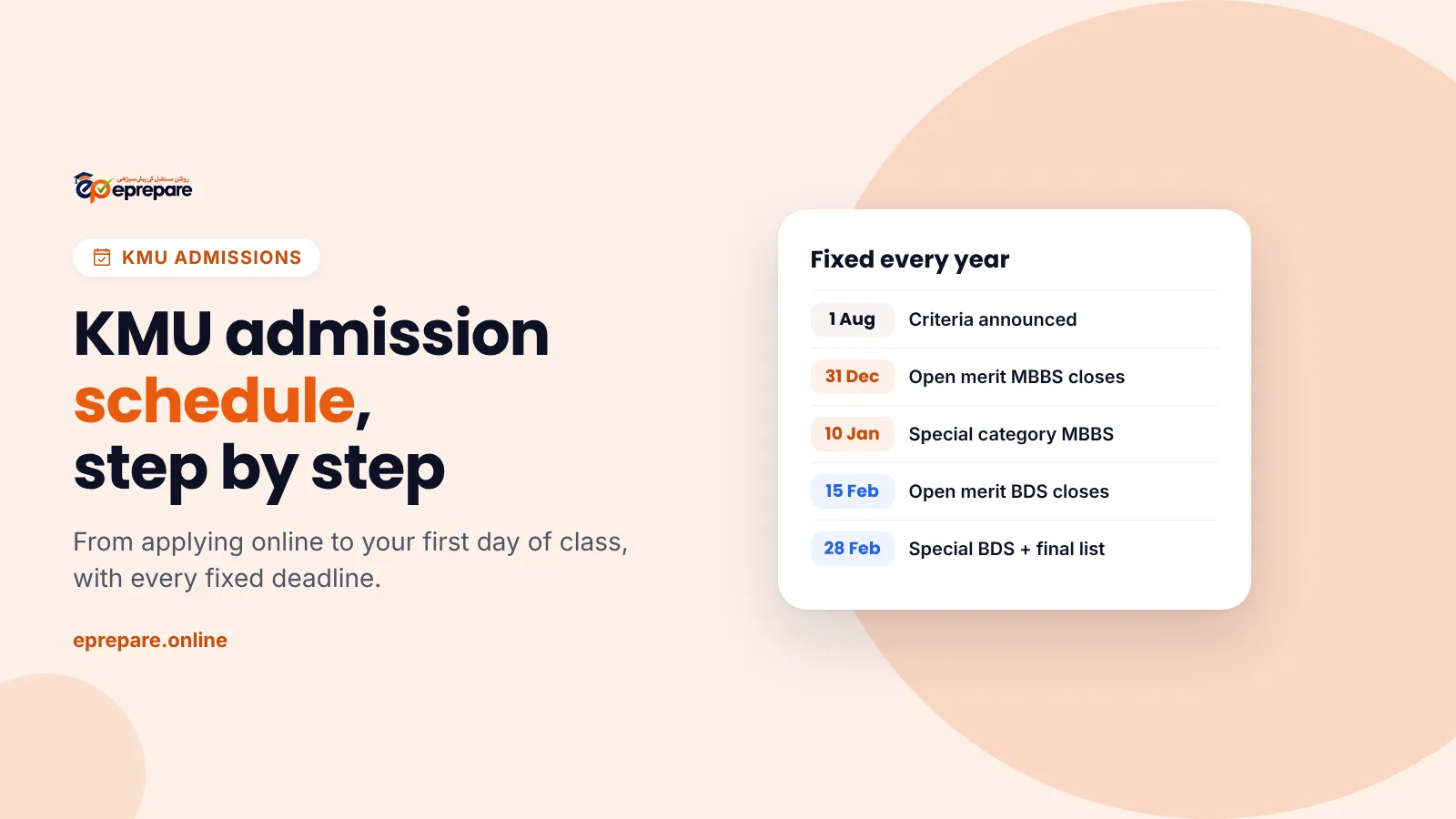
The policy sets these yearly limits: admissions to special category (non-open-merit) seats in public medical colleges must be completed by 10 January, and in dental colleges by 28 February. The final list of admitted students is published by 28 February. KMU announces exact dates for applications and merit lists in newspapers, on its website and on its Facebook page. See our KMU admission schedule for every step in order.
Frequently asked questions
Can Afghan students get admission in MBBS in KP government medical colleges?
Yes. KMU keeps 12 Afghan national seats (10 MBBS and 2 BDS) across 9 public colleges. You and your father must hold Afghan nationality, you need at least 60% in HSSC certified by IBCC, and you must pass the MDCAT with 55% for MBBS or 50% for BDS. You apply on the KMU portal and compete on merit with other Afghan applicants.
Can Afghan refugees with a PoR card apply?
Yes, as long as you and your father hold Afghan nationality and meet the other criteria. Once you are offered admission, the policy requires PoR and ACC holders to get an Afghan passport and study on a student visa.
Does the Afghan Embassy nominate students for these seats?
No. The policy states that "Admission shall not be granted as per nomination of Embassy of Afghanistan, Islamabad." Seats are filled on merit through KMU's portal.
Who can apply on OPF seats at KMU?
The children of overseas Pakistanis whose father or mother holds valid OPF membership and a Foreign Exchange Remittance Card (Sohni Dharti card), who hold a KP or Merged Districts domicile, have at least 60% in HSSC and have passed the MDCAT. You need an OPF recommendation letter before the closing date, and you apply through the ministry as well as on the KMU portal.
What is the fee for foreign self-finance MBBS at KMU colleges?
US$7,500 a year at KMC, KGMC and AMC, and US$7,000 a year at the other colleges, plus rupee charges of Rs 27,500 to Rs 50,500 a year. Over five years of MBBS, that is US$35,000 to US$37,500 plus Rs 170,000. Hostel and living costs are extra.
Can I switch from a foreign self-finance seat to open merit later?
No. FSF students must complete the whole degree in the same category and keep paying the foreign fee, even if their residence status changes. Migration is also only allowed into a vacant seat of the same category.
Do foreign seats reduce open merit seats for KP students?
The Afghan, OPF and FSF seats are part of the 1,580 seats that PM&DC sanctions. The PTAP, additional foreign and IIOJK seats (78 in total) are over and above, so they do not take any seat away from KP candidates. Also, a vacant FSF seat becomes a general self-finance seat, and other vacant category seats become open merit seats.
Can foreign students get admission without the MDCAT?
Only on the special over-and-above seats for a Federal Government program for foreign students under bilateral agreements. Those students need SAT-II with at least 550 in each subject, or 50% in a foreign MCAT or UCAT, and they cannot get a full licence to practise in Pakistan through that route. Every other seat in this guide needs an MDCAT pass.
Your next step
Whichever seat you are aiming for, almost every route runs through the MDCAT, and on the Afghan, OPF and FSF seats you compete on aggregate with others in the same category. A few MDCAT marks can decide the seat. If you are preparing, ePrepare's MDCAT preparation gives you KPK textbook-based MCQs, full-length tests and a predicted score, from anywhere in Pakistan or abroad. And when your result is out, the aggregate calculator and KPK college predictor help you plan your preferences.
Sources: Khyber Medical University, admission policy for public sector medical and dental colleges of Khyber Pakhtunkhwa (latest available on the KMU admission portal): general policy notes, basic eligibility, foreign self-finance, PTAP, Overseas Pakistanis Foundation and Afghan national seats, admission procedure, annual fee schedule and the college-wise seat distribution. Quoted text keeps the policy's own spelling. Seats, fees and rules can change by KMU or PM&DC notice, so always check the current notice before you apply.