Getting a good MDCAT score is only half of the admission story in Khyber Pakhtunkhwa. The other half happens after the result, when Khyber Medical University (KMU) starts publishing merit lists. Every year we hear from students who had enough aggregate for a college but still lost the seat. They forgot to list the college, missed the fee deadline, or turned down an offer and then could not go back to it.
This guide explains, step by step, how KMU turns your marks into a seat in a public sector medical or dental college. It is based on KMU's latest admission policy for public sector colleges, published on the KMU admission portal. It covers how your aggregate is calculated, how merit-cum-choice works, what happens in each merit list, how upgrades and the waiting list work, and the mistakes that cost students their seats.
The short answer: KMU ranks every applicant by aggregate (10% Matric, 40% FSc, 50% MDCAT, calculated to five decimals). Then it goes down the list from the top and gives each student the highest college on their own preference list that still has a seat. This is called merit-cum-choice. KMU shows at least three merit lists. If you are offered a seat, you must deposit the fee within three working days or lose it. Once you have paid, you can still be upgraded to a college you placed higher in later lists, and your fee moves with you with no deduction.
Step 1: How KMU calculates your aggregate
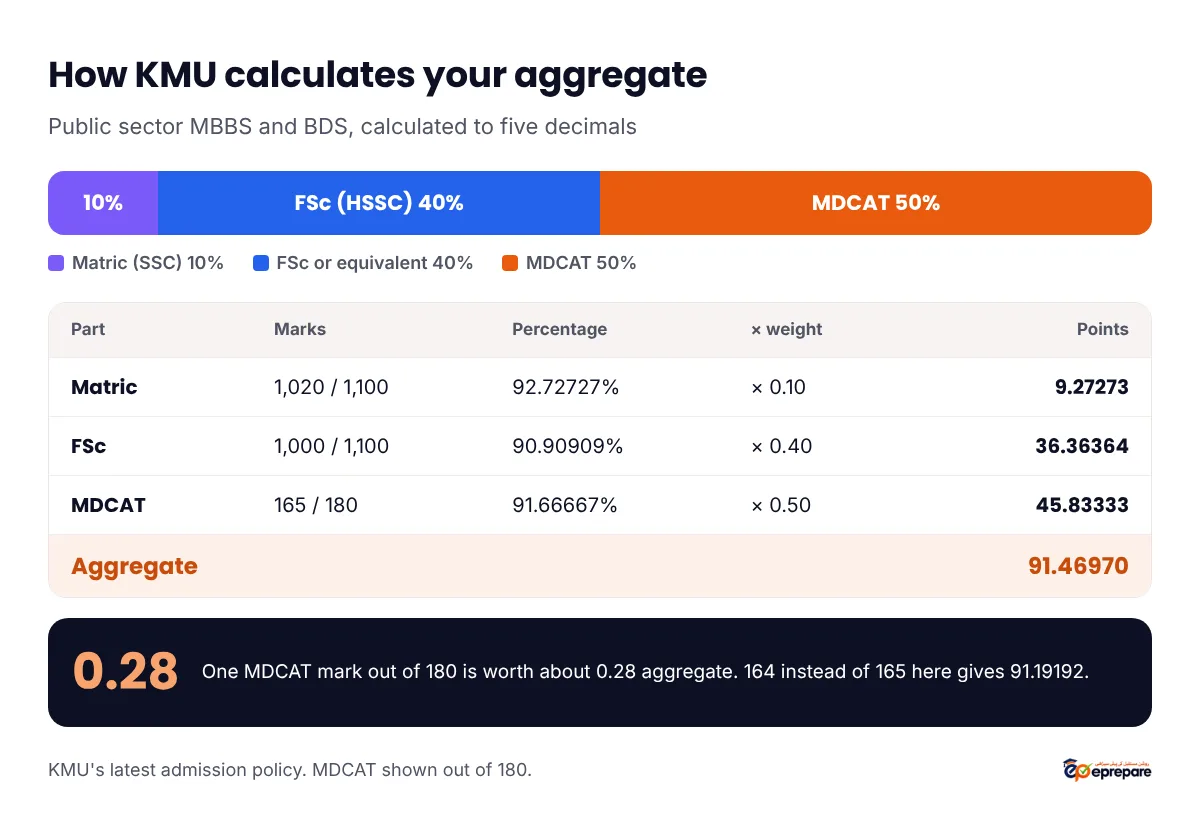
KMU follows the merit formula set by the Pakistan Medical and Dental Council (PM&DC). Your final merit, called the aggregate, is made of three parts:
| Part | What it is | Weight |
|---|---|---|
| SSC | Matric or equivalent | 10% |
| HSSC | FSc Pre-Medical or equivalent (adjusted marks) | 40% |
| MDCAT | PM&DC entry test | 50% |
Before any of this counts, you must meet the minimums. You need at least 60% in HSSC (FSc or equivalent), with biology, chemistry and either physics or mathematics. In the MDCAT you need at least 55% for MBBS or 50% for BDS. If your qualification is foreign, such as A levels, you need an IBCC equivalence certificate attached before the closing date. You can read more in our guide to MDCAT passing marks.
A worked example, using MDCAT out of 180
Say a student has these marks:
- Matric: 1,020 out of 1,100 = 92.72727%
- FSc: 1,000 out of 1,100 = 90.90909%
- MDCAT: 165 out of 180 = 91.66667%
Each percentage is multiplied by its weight:
- Matric: 92.72727 × 0.10 = 9.27273
- FSc: 90.90909 × 0.40 = 36.36364
- MDCAT: 91.66667 × 0.50 = 45.83333
Aggregate = 9.27273 + 36.36364 + 45.83333 = 91.46970.
The policy says the final percentage is "rounded up to five decimal points", which is why you see merit lists with numbers like 93.27480. The small details matter. In this example, one MDCAT mark less (164 instead of 165) drops the aggregate to 91.19192, a loss of about 0.28. In a competitive year, 0.28 can be the gap between two or three colleges. Try your own marks in our aggregate calculator, and read the full MDCAT aggregate formula guide for more examples.
When two students have the same aggregate
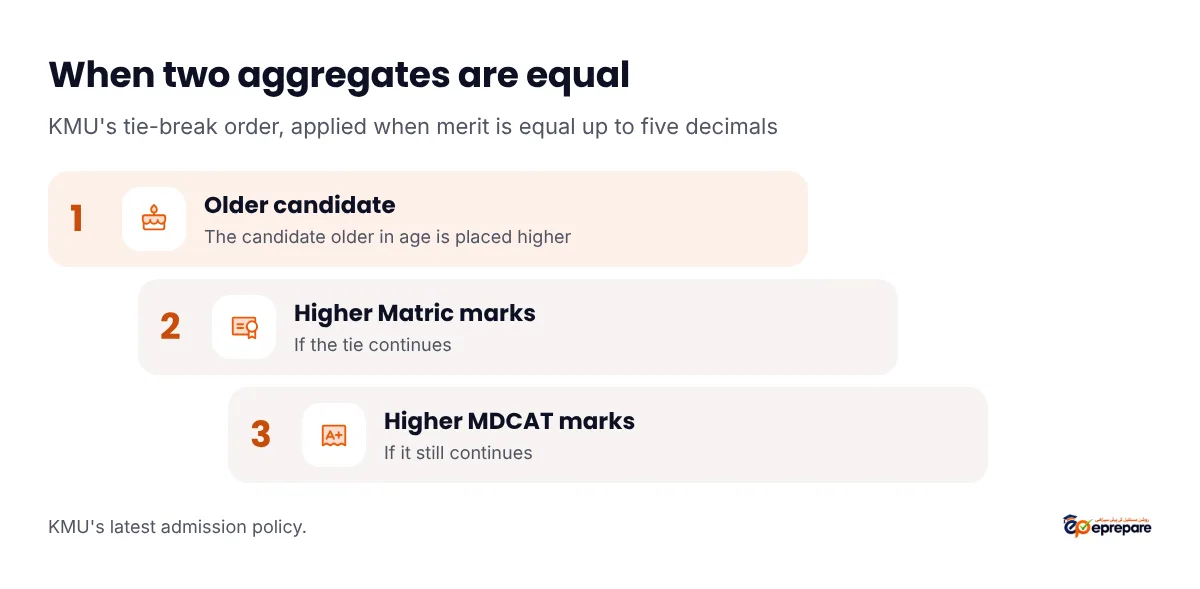
Ties are more common than you think, so the policy sets a clear order. If two or more candidates are equal in the final merit list, KMU uses these tie-breaks in turn:
- The older candidate gets preference.
- If the tie continues, the candidate with higher Matric marks.
- If it still continues, the candidate with higher entrance test (MDCAT) marks.
The policy also says that if the final merit of more than one candidate "is equal up to five decimals, the candidate older in age shall stand higher in merit." Your date of birth on your documents therefore matters, so make sure it is correct on your application.
Step 2: One merit list for each seat category
KMU does not make one giant list for everyone. The policy says: "Selection under each category of seats shall be done on the basis of inter se merit amongst the eligible applicants." In plain words, you compete only with the other applicants in the same category. Open merit applicants compete with open merit applicants, backward area applicants with applicants from the same backward area, and so on.
KMU-AC (the KMU Admission Committee) "will display a merit list for each category of candidates." That is why you will see separate lists for open merit, general self-finance, Merged Districts, backward areas, disabled seats, minorities, overseas Pakistanis and others. To learn which categories you can apply for, read our guide to KMU reserved and quota seats.
Two rules here catch many students out:
- You must apply for each category separately. For example, a backward area student who wants to be considered for open merit as well must apply against both. The policy says: "To be considered on open merit as well as quota seats, the candidates must apply against both categories." The same rule applies to the seats for students with special abilities.
- Medical and dental are separate applications. The policy says each student must apply separately to a medical or dental programme, and "a student having not applied to a given program shall not be entitled to admission to such program." If you would accept BDS as a backup, apply for BDS too.
Step 3: Merit-cum-choice, explained with an example
Admission to all provincial seats is finalised "strictly on the basis of merit-cum-choice." Merit decides the order in which students are placed. Choice, meaning your own preference list, decides which college you get.
KMU starts with the highest aggregate in a category. That student gets their first preference. Then it moves to the next student, who gets the highest college on their list that still has a seat, and so on down the list.
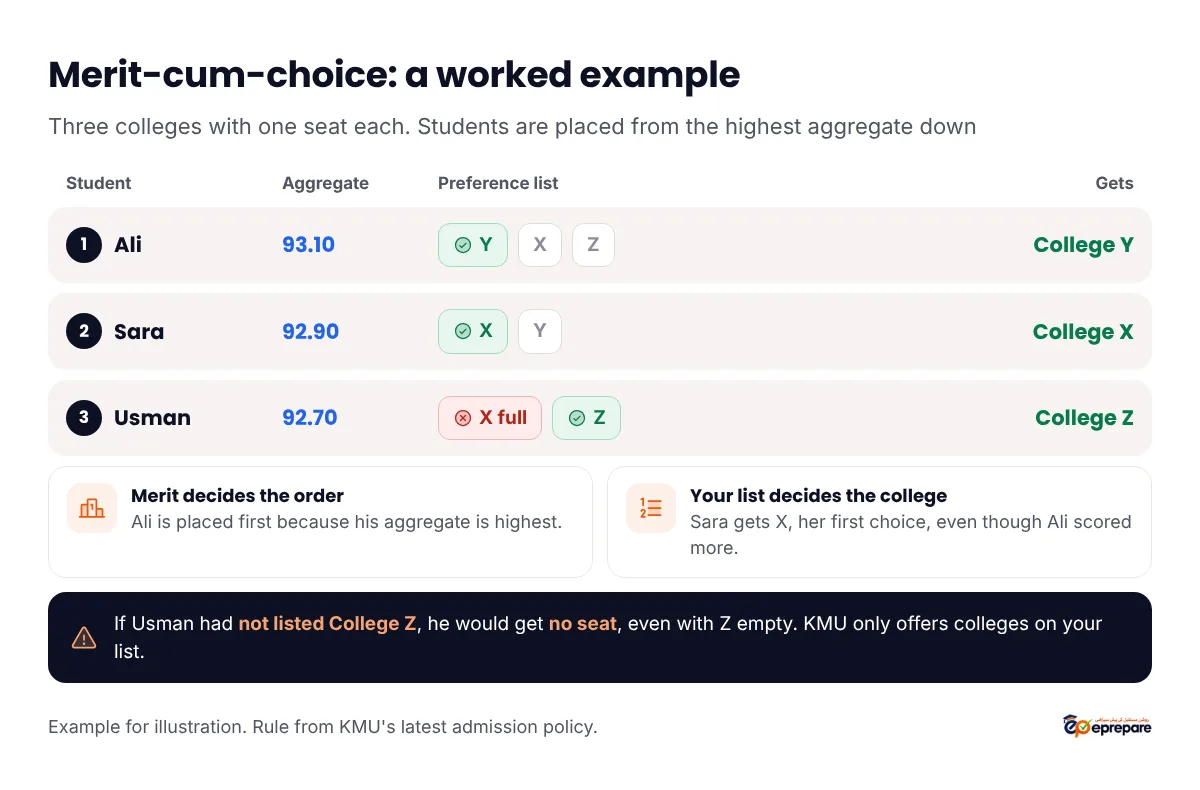
Here is the example in the image, step by step. Imagine three colleges with one seat each and three students:
| Student | Aggregate | Preferences | Result |
|---|---|---|---|
| Ali | 93.10 | Y, X, Z | College Y |
| Sara | 92.90 | X, Y | College X |
| Usman | 92.70 | X, Z | College Z |
- Ali has the highest aggregate, so he is placed first and gets his first choice, College Y.
- Sara is next. Her first choice, College X, is still free, so she gets it.
- Usman wanted College X, but it is now full. His next choice, College Z, is free, so he gets College Z.
Notice two things. First, Sara got College X even though Ali had more marks, because Ali preferred College Y. The colleges are not ranked by KMU; your list ranks them for you. Second, Usman got a seat only because he listed College Z. The policy is clear: "If a college is not mentioned in his/her preferences, admission shall not be offered in that particular college." If Usman had left College Z off his list, he would get no seat even though one was free.
Step 4: What happens in each merit list
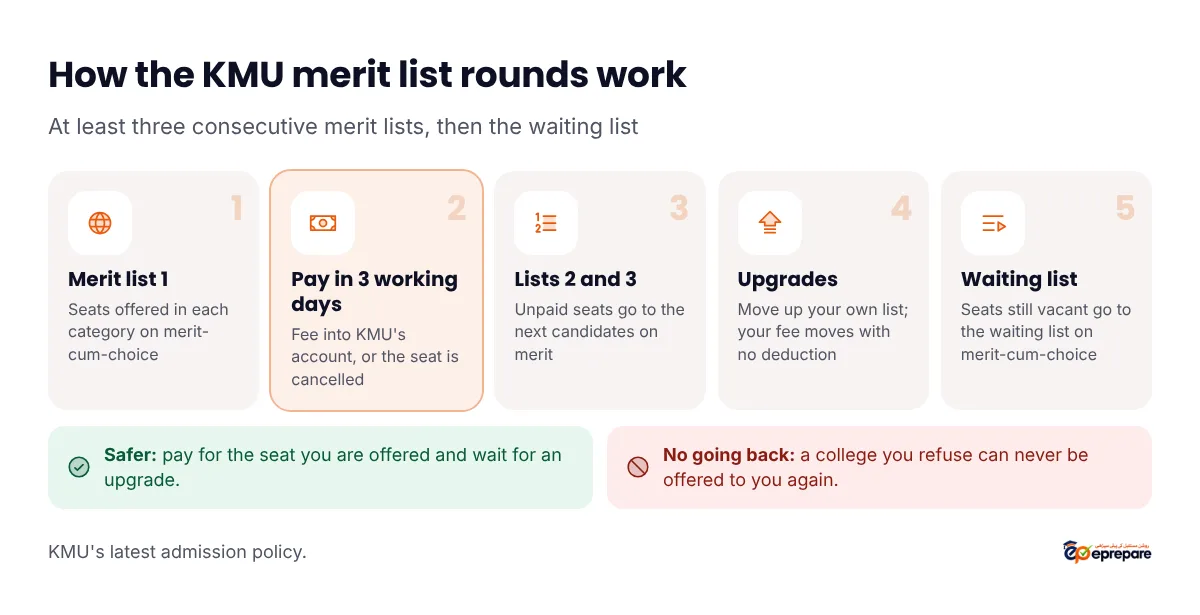
The policy requires KMU to complete admissions "by displaying at least three consecutive merit lists." Institution-wise lists of selected candidates are shown on KMU's website. Here is how the rounds work.
Before the lists: objections and the final merit list
KMU-AC first displays a merit list for each category. If you see an error, such as wrong marks or a wrong category, you can submit an objection in writing to the Chairman KMU-AC. The Chairman can correct "any error or omission before the interviews for placement are held." The policy says the final merit list will be displayed two days before the start of interviews, so check your entry as soon as the first list appears.
Placement interview
KMU-AC interviews candidates on merit-cum-choice for open merit, backward areas, special quota seats, the reciprocal seat at Nishtar Medical College Multan, general self-finance, foreign self-finance, Merged Districts and overseas Pakistani seats. Remember this rule: "The parent(s) or legal guardians must accompany all the candidates at the time of placement interview." Bring your original documents too. Our KMU admission documents checklist lists every one.
The fee deadline: three working days
This is the rule that costs students the most seats. The policy says that if a selected candidate fails "to deposit the prescribed admission fee within three working days of receipt of Admission offer letter, their admissions shall stand cancelled." It adds that such candidates "shall have no vested right of admission in that year on that particular seat in that particular institute."
Fees are paid into KMU's central account, not to the college, by the due date KMU notifies. KMU then transfers the money to your college within 30 days of the third or final merit list. If you are not sure which fee applies to your seat, read our KMU MBBS and BDS fee structure guide.
Second and third lists: seats from students who did not pay
When selected students in the first or second list do not deposit the fee, their seats do not disappear. They go to the candidates "who are next in merit" in the next list, again on merit-cum-choice.
Upgrades: moving to a college you preferred
Once you have paid for a seat, you are not stuck with it. The policy says candidates "may be upgraded to another institution in the subsequent merit list based on merit and preference." Your money is protected too: "the fee deposited by upgraded candidates in the previous institution shall be transferred to new institution without any deduction."
In our example above, suppose Sara does not deposit her fee for College X. In the next list, College X is vacant. Usman placed College X above College Z and has already paid at College Z, so he is upgraded to College X, and his fee moves with him.
There is one important limit. "Down-gradation to an institute which was already refused shall not be allowed." If you refuse a college, you cannot ask for it back later.
The waiting list
Some students are offered a college they don't want, and choose not to pay so they can wait for a better one. The policy covers this: "Fresh candidates who have not deposited fee and opted to be on waiting list for high merit institutions shall be offered admission on merit cum choice basis. However, the candidates shall not be offered admission in the institutions which was already refused."
Think carefully before you choose this. If you do not pay and you join the waiting list, you have given up the college you were offered, and you cannot get it back. For most students, the safer path is to pay for the seat offered and wait for an upgrade, because the fee moves with you.
Vacant seats after the lists
After the placement interviews, each college's Institutional Admission Committee (IAC) displays and sends KMU a list of seats that were vacated or not filled. The general rules say this happens within five working days, while the IAC section says three working days. KMU-AC then fills these seats by upgrading admitted students and by taking candidates from the waiting list on merit-cum-choice.
If a seat in any category is still empty at the end and no eligible candidate is left, the policy says it "shall be converted to open merit seats, expect foreign self-finance seats which will be converted to general self-finance seats."
Step 5: After you are admitted
- All admissions are provisional. Your college verifies every certificate. If any document is found false or forged, you are struck off the college roll and can face legal action.
- Medical examination. The college's medical board examines selected candidates. A candidate who is "disqualified medically" will not be admitted.
- Do not miss the start of classes. A first-year student who is continuously absent from the start of the session "for a period of four weeks without any valid reason shall be struck off from the college roll." The seat is then filled from the waiting list.
- The final list. The final list of admitted students is made public by 28 February. See the full KMU admission schedule for every deadline in between.
If you disagree with a decision
KMU-AC decides all admission cases. You can challenge its decision before the Appellate KMU Admission Committee. A review against the appellate committee's decision can be filed before the Chairman of the Provincial Admission Committee (PAC) within three working days after the final selection. The PAC's decision is final.
Our strategy for KMU merit lists
Here is the advice our team gives students every admission season:
- List every college you would really join, in your real order. Put your dream college first, even if your aggregate looks too low. Being placed in a lower college does not hurt your chance at a higher one, because upgrades go by your list. Leaving a college off your list does hurt, because you will never be offered it.
- Apply in every category you are eligible for, such as open merit plus self-finance, or open merit plus backward area or Merged Districts. Each needs its own application.
- Apply for BDS too if you would accept it. Medical and dental are separate programmes.
- Check last year's closing merit on our KMU closing merit page, and see where your aggregate fits with the KP college predictor.
- Pay on time, every time. Keep the fee ready before the first list comes out. Three working days pass very fast.
- Don't refuse a seat lightly. A refused college cannot be offered to you again.
- Keep your phones and email active. The policy asks for an email address and "at least three different telephone numbers (including landline and mobile) which must be active and contactable."
- Check KMU's website and Facebook page every day while the lists are running. KMU announces schedules there and in national newspapers.
Frequently asked questions
How many merit lists does KMU display?
At least three. KMU's policy says admissions are completed by displaying at least three consecutive merit lists. Vacant seats after that are filled from the waiting list on merit-cum-choice.
How many days do I have to pay the fee after selection?
Three working days from receiving the admission offer letter, unless KMU's office order sets another date. If you don't pay in time, your admission is cancelled and the seat goes to the next candidate on merit.
If I pay the fee at one college, can I still get a better college later?
Yes. Paid candidates can be upgraded to a college higher on their preference list in later merit lists. The fee you paid is transferred to the new college without any deduction.
Can I go back to a college I refused?
No. The policy says down-gradation to an institute that was already refused is not allowed, and waiting list candidates are not offered an institution they already refused.
What if two students have exactly the same aggregate?
The older candidate gets preference. If the tie continues, the candidate with higher Matric marks is preferred, and then the one with higher MDCAT marks.
Will I be considered for a college I did not list?
No. KMU only considers you for colleges in your preference list, even if a seat there is empty and your merit is high enough.
What happens to seats that stay empty at the end?
If no eligible candidate is available, reserved seats are converted to open merit seats. Foreign self-finance seats are converted to general self-finance seats instead.
Can I lose my seat after admission?
Yes. Your admission can be cancelled if your documents are false, if you are found medically unfit, if you were not actually eligible, or if you are absent for four continuous weeks from the start of first year without a valid reason.
Merit lists can feel stressful, but they follow clear rules. If you understand them, you won't lose a seat you have earned. If you are still preparing for the MDCAT, every extra mark adds about 0.28 to your aggregate. Start preparing with ePrepare to give yourself more choices when the lists come out.
Sources: Khyber Medical University, latest Admission Policy for Public Sector Medical and Dental Colleges of Khyber Pakhtunkhwa: general policy notes, eligibility, merit determination, admission procedure and warnings. Rules can change each session; always check the latest policy and notices on cas.kmu.edu.pk and kmu.edu.pk.