Thousands of Afghan students have grown up and studied in Khyber Pakhtunkhwa, in Peshawar, Mardan, Swat, Kohat and the refugee villages around them. Many of them score well in FSc and want to become doctors. The question we hear from these families every year is simple: can an Afghan student get an MBBS or BDS seat in a government medical college of KP, and how?
The answer is yes. Khyber Medical University (KMU), which runs admissions for all public sector medical and dental colleges in KP, keeps 12 seats only for Afghan nationals. This guide explains every rule for those seats in detail: who qualifies, which colleges have them, what IBCC certification means for you, what the policy says about PoR and ACC card holders, how to apply, how the merit works, what you pay, and the mistakes that cost students their seats.
Everything here comes from KMU's latest admission policy for public sector medical and dental colleges, published on the KMU admission portal, with official information from IBCC and the Government of Pakistan's online visa system where the policy points to them. For an overview of every seat for foreign and overseas students, see our guide to KMU seats for Afghan nationals, foreign students and overseas Pakistanis.
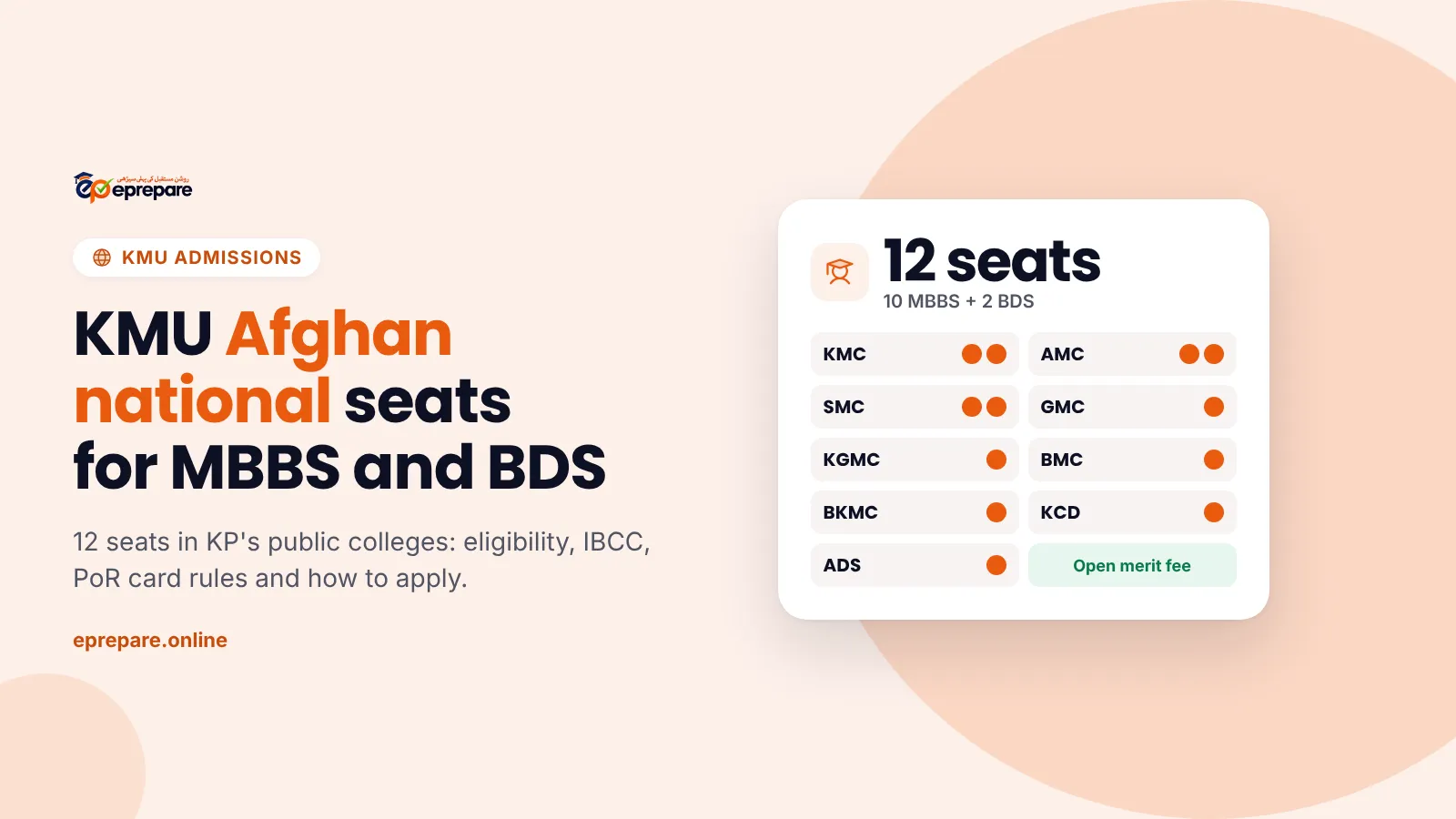
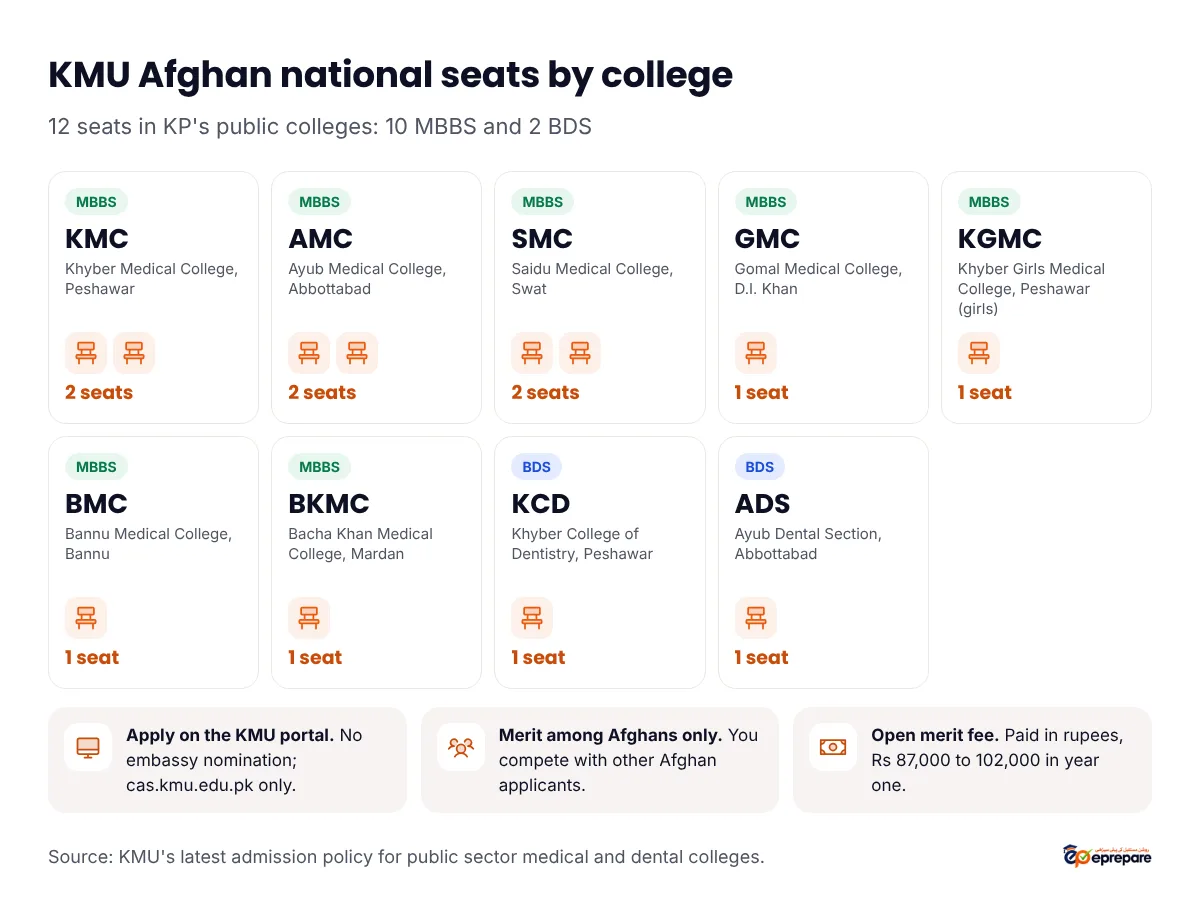
The short answer: KMU's latest policy has 12 Afghan national seats: 10 MBBS (KMC 2, AMC 2, SMC 2, GMC 1, KGMC 1, BMC 1, BKMC 1) and 2 BDS (KCD 1, ADS 1). You and your father must hold Afghan nationality at the time of admission. You need at least 60% in HSSC with Biology, Chemistry and Physics or Maths, certified by IBCC, and an MDCAT pass of 55% for MBBS or 50% for BDS. You apply on the KMU online portal and compete only with other Afghan applicants. The embassy cannot nominate you. If you hold a PoR or ACC card, you must get an Afghan passport and a student visa once you are offered admission. These seats pay the open merit fee.
Why these seats exist
Most reserved quotas in Pakistan's medical colleges were struck down by the Supreme Court in the Attiya Inayat case. KMU's policy lists the few categories that were kept, and Afghan refugees are one of them:
"(a) Disabled persons (b) Students domiciled in Merged Districts (c) Students domiciled in under developed backward districts/Tehsils/areas (d) Students domiciled in Azad Jummu & Kashmir (e) Students domiciled in Gilgit Baltistan/ Northern areas (f) Afghan refugees"
So the Afghan national seats are a lawful, protected category in KP's public colleges, not a temporary favour. The policy also says that no category may admit "a student who has not qualified the MDCAT", which is why the MDCAT is compulsory for these seats too.
How many seats, and in which colleges?
| College | Programme | Afghan seats |
|---|---|---|
| Khyber Medical College (KMC), Peshawar | MBBS | 2 |
| Ayub Medical College (AMC), Abbottabad | MBBS | 2 |
| Saidu Medical College (SMC), Swat | MBBS | 2 |
| Gomal Medical College (GMC), D.I. Khan | MBBS | 1 |
| Khyber Girls Medical College (KGMC), Peshawar | MBBS | 1 |
| Bannu Medical College (BMC) | MBBS | 1 |
| Bacha Khan Medical College (BKMC), Mardan | MBBS | 1 |
| Khyber College of Dentistry (KCD), Peshawar | BDS | 1 |
| Ayub Dental Section (ADS), Abbottabad | BDS | 1 |
| Total | 10 MBBS + 2 BDS | 12 |
Four public colleges have no Afghan national seat: Nowshera Medical College, Gajju Khan Medical College (Swabi), Bacha Khan Dental Section (Mardan) and Saidu College of Dentistry (Swat). Khyber Girls Medical College admits only female students, so its one Afghan seat is for a girl. All 12 seats are part of the 1,580 seats that PM&DC has sanctioned for KP's public colleges.
Twelve seats across the whole province is a small number, so every detail of your application matters. Medical and dental are separate programmes in KMU's process: if you would accept BDS, apply for BDS as well, because the policy says "a student having not applied to a given program shall not be entitled to admission to such program."
Who is eligible: the policy's seven rules
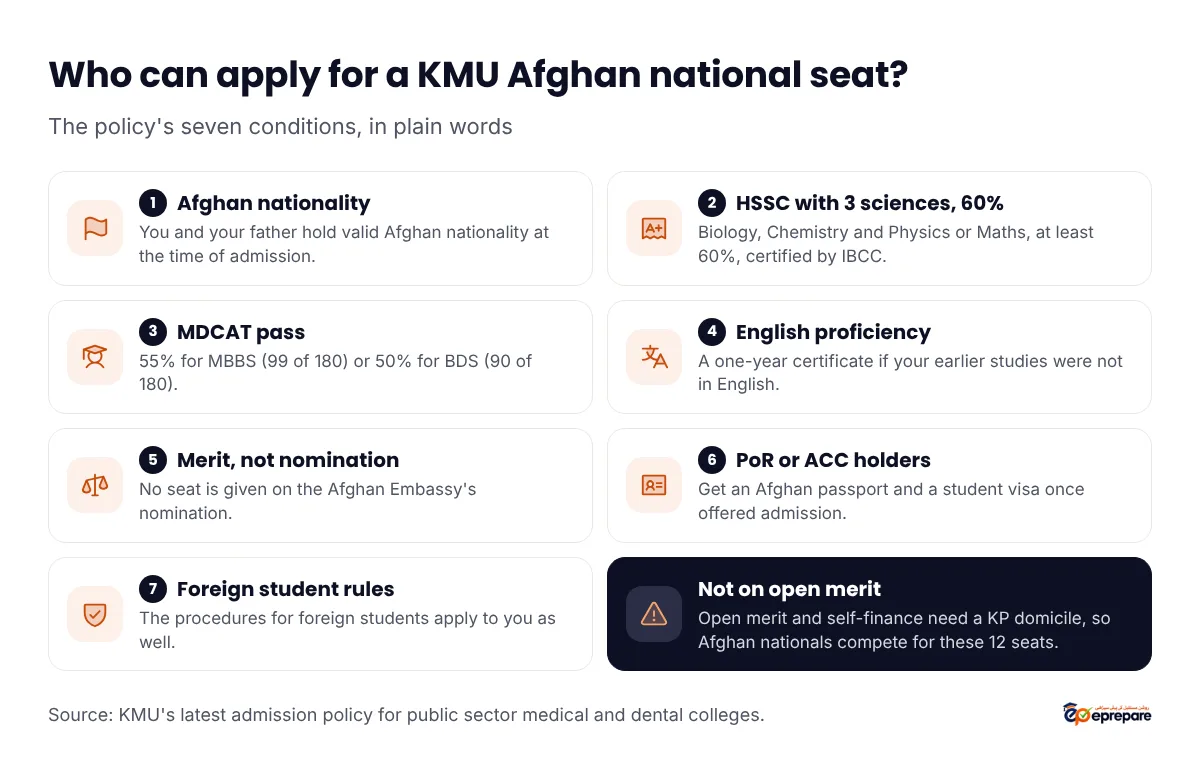
The policy sets these criteria for the Afghan national seats, word for word:
1. The applicant and his/her father hold a valid Afghan nationality at the time of admission.
2. The applicant must have passed Higher Secondary School or equivalent examination with three science subjects (Biology, Chemistry and Physic/Maths) with minimum 60% marks as certified by Inter Board Committee of Chairmen (IBCC) Islamabad.
3. Any candidate seeking admission in any medical or dental college shall mandatorily be required to have passed the MDCAT examination held by Pakistan Medical & Dental Council. The passing marks for the MDCAT examination shall be 55% for MBBS and 50% for BDS.
4. The applicant is required to present a valid one year English language Proficiency Certificate, if the medium of instruction of study prior to application for admission/entry test is not English.
5. Admission shall not be granted as per nomination of Embassy of Afghanistan, Islamabad.
6. Afghan students on reserved seats shall be required to procure Afghan passports and study on student visa once offered admissions, if they are holders of POR, ACC etc.
7. All procedures and rules applicable to foreign students may be observed shall apply to these candidates as well.
Here is what each rule means in practice.
1. You and your father must be Afghan nationals
Both of you must hold valid Afghan nationality at the time of admission, not only when you apply. The policy does not mention the mother for these seats, unlike the KP domicile categories, where the mother's domicile is accepted if the father has died. If your father has passed away, contact KMU's admission office before the closing date and ask what proof of his nationality they will accept, because the policy does not cover that case.
2. At least 60% in HSSC with three sciences, certified by IBCC
You need FSc pre-medical, or an equivalent 12th-grade qualification, with Biology, Chemistry and either Physics or Maths, and at least 60% marks. The policy says these marks must be "certified by" IBCC, the body in Islamabad that decides equivalence for foreign qualifications and coordinates Pakistan's education boards. We explain what that means for students from Afghan and Pakistani boards below.
3. Pass the MDCAT
Like every candidate for every public seat in KP, you must pass the MDCAT held by PM&DC: 55% for MBBS and 50% for BDS. On the current 180-mark paper, that is 99 marks for MBBS and 90 marks for BDS. Passing only makes you eligible; the seat goes to the highest merit among Afghan applicants. KMU's policy says an MDCAT result is valid for three years. Read our guides to MDCAT passing marks and MDCAT dates and registration.
4. English proficiency, if you didn't study in English
If the medium of instruction of your earlier studies was not English, you must show "a valid one year English language Proficiency Certificate". The policy does not name a particular test or institute. If you studied in Pakistan on an English-medium FSc, this rule does not apply to you. If your schooling was in Dari or Pashto, arrange this certificate early and ask KMU which certificates it accepts.
5. Merit, not embassy nomination
The policy is explicit: "Admission shall not be granted as per nomination of Embassy of Afghanistan, Islamabad." No embassy letter, recommendation or list can place you on one of these seats. Be very careful with anyone who claims they can arrange an Afghan seat for money. The seats go on merit through KMU's portal, and nothing else.
6. Passport and student visa for PoR and ACC holders
If you live in Pakistan on a PoR card or an ACC, you will have to get an Afghan passport and study on a Pakistani student visa once you are offered admission. We explain this step in detail below.
7. Foreign student rules apply
The last rule says the procedures and rules for foreign students apply to Afghan students as well. In practice, this is why the passport and visa step exists, and why you should expect the same document checks that any foreign student faces.
Why Afghan nationals can't apply on open merit or self-finance
Students often ask whether they can try open merit as well, like KP students who apply in several categories. Under the policy, the answer is no. KMU's open merit and general self-finance seats require a valid domicile of Khyber Pakhtunkhwa (or the Merged Districts for GSF) for both the candidate and the father, and a domicile certificate is issued to Pakistani citizens. Afghan nationals therefore compete only for the 12 Afghan national seats.
There is one exception worth knowing about: if you are a Pakistani citizen of Afghan origin, you are not on these seats at all. You apply like any other Pakistani on open merit, self-finance or any quota you qualify for, using your own and your father's domicile. Our guide to every KMU quota and reserved seat explains those categories.
IBCC certification: what it means for you
The policy asks for HSSC marks "as certified by" IBCC, and its general eligibility rules add that an equivalence certificate for a foreign qualification "must be attached with the application form before the closing date." How this works depends on where you studied.
| Where you did FSc | What to do |
|---|---|
| In Afghanistan, or another foreign system | Get an IBCC equivalence certificate for your 12th grade before KMU's closing date. Without it, your marks are not counted. |
| On a Pakistani board (for example BISE Peshawar) | Your board's DMC is a Pakistani qualification. Because the policy says "certified by IBCC" for Afghan seats, ask KMU's admission office in writing which IBCC document, if any, it needs from you, well before the closing date. |
IBCC's requirements for foreign qualifications
IBCC's own website lists what it needs to assess a foreign qualification. In summary, its "Requirements for Equivalence" page asks for:
- a completed equivalence application form;
- proof that the awarding institution or board is officially recognised;
- official transcripts and certificates, and "complete academic record from Grades 9 to 12";
- certified translations "from the concerned embassy OR NUML" if your documents are not in English or Urdu;
- a copy of the curriculum or syllabus, especially for qualifications IBCC hasn't assessed before;
- a copy of your passport "including visa details and exit and entry stamps covering the duration of the study", if you studied abroad.
IBCC's website says you can apply online through its equivalence portal, by courier, or by booking an appointment at its offices in Islamabad, Lahore, Karachi, Bahawalpur, Quetta or Peshawar (University Town). Check the current fee, documents and processing time on ibcc.edu.pk before you apply, because they can change.
KMU's policy adds two more conditions for equivalence. You must have "studied and passed the subjects of Physics/Maths, Chemistry and Biology" in Grades 9 to 12, and your marks must equal at least an "unadjusted 60% of FSc total marks according to the formula laid down by the IBCC". Translation and verification take time, so start this process as soon as you have your final result.
PoR and ACC card holders: the passport and visa step
Many Afghan students in KP live on one of two registration documents issued by the Government of Pakistan:
- PoR card (Proof of Registration): the biometric identity card of registered Afghan refugees, issued by NADRA. UNHCR describes it as "legally recognized proof of identity", issued through an exercise run by the Ministry of States and Frontier Regions (SAFRON) with UNHCR.
- ACC (Afghan Citizen Card): a card issued to Afghans who were registered later but are not recognised as refugees.
KMU's policy says that Afghan students on reserved seats who hold a PoR card, an ACC or a similar document "shall be required to procure Afghan passports and study on student visa once offered admissions." In other words, the card alone is not enough to study on one of these seats. After your offer, you need:
- a valid Afghan passport, and
- a Pakistani student visa.
Important: the Government of Pakistan has changed the validity and status of PoR and ACC cards several times, and has at times asked card holders to leave the country. Before you plan your admission, check the latest official notice from the Ministry of Interior and the Ministry of SAFRON on your card's current status, and seek advice from UNHCR or the Chief Commissionerate for Afghan Refugees if you are unsure. Don't rely on old news or social media posts.
What the student visa involves
Pakistan's visas are issued through the Ministry of Interior's online visa system at visa.nadra.gov.pk. Its Student Visa page says the visa is for "prospective students who wish to pursue higher education in Pakistan" and is granted for two years, with an option to apply for an extension from inside Pakistan. The documents it lists are:
| Document | Notes |
|---|---|
| Photograph | Following the portal's photo guidelines |
| Passport | Your valid Afghan passport |
| Admission or bonafide letter | From your college, after KMU offers you admission |
| NOC | The page lists an NOC from HEC, the Economic Affairs Division, IPC, the Health Ministry or the Education Ministry; ask your college and KMU which applies to you |
| Sponsorship or bank statement | Only if family members are coming with you |
The portal says applicants applying from a third country must also upload proof of legal residence there, and gives a processing time of about two weeks (working days), adding that "Issuance of Visa is the prerogative of the Government of Pakistan." It also lists which nationalities are eligible to apply online, so check that page for the current position for Afghan nationals. Because you only get the admission letter after your offer, and KMU gives you just three working days to deposit the fee, get your passport sorted before the merit lists so the visa step doesn't delay you.
How to apply, step by step
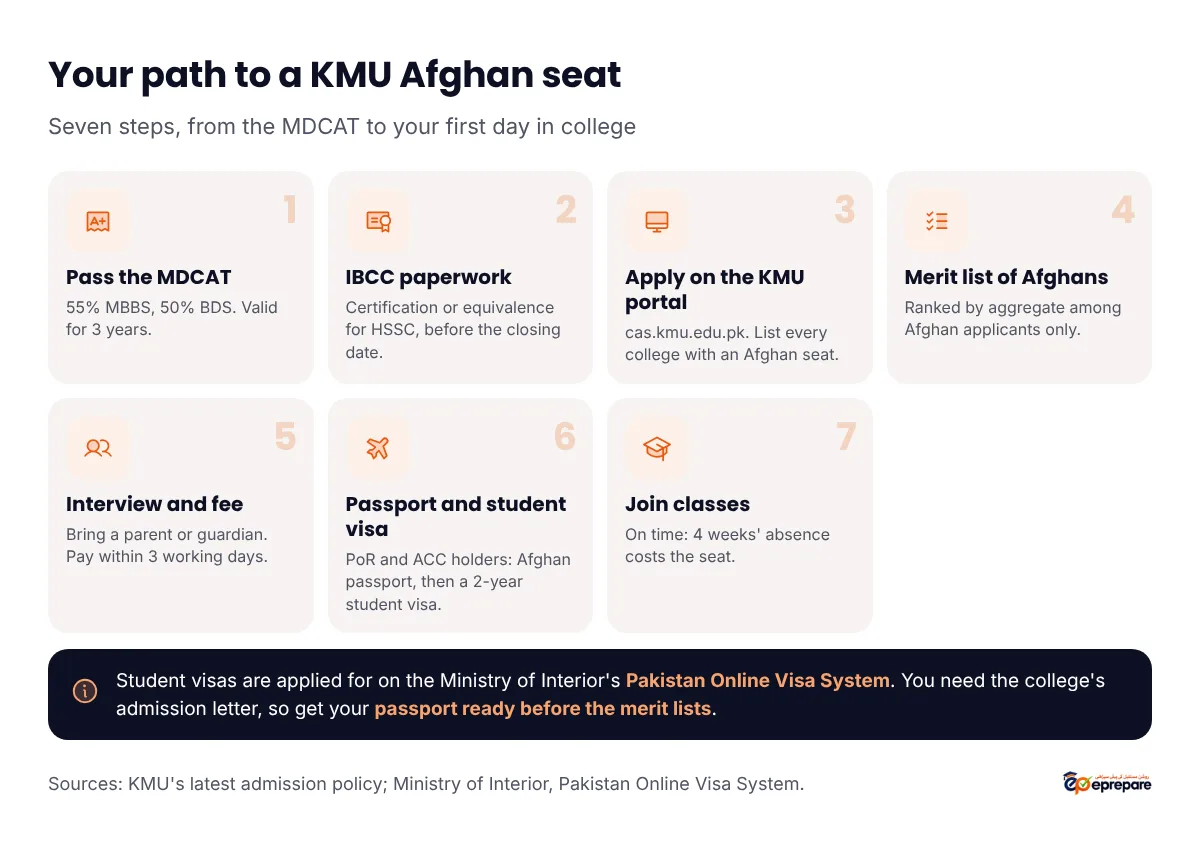
The policy says Afghan candidates "shall submit their applications to the Khyber Medical University online portal", as directed by the Ministry of Foreign Affairs. There is no separate form and no embassy route.
- Pass the MDCAT and keep your result card. It stays valid for three years.
- Get your IBCC paperwork ready before KMU's closing date, and your English proficiency certificate if you need one.
- Watch for KMU's admission advertisement in national newspapers and on KMU's website and Facebook page. It gives the last date to apply.
- Apply online at cas.kmu.edu.pk. Choose the Afghan national seats, apply for MBBS and BDS if you would accept either, and upload clear scans of every document.
- List every college you would accept, in your real order. KMU only offers a college you listed. List all nine colleges that have Afghan seats if you would join any of them.
- Check the merit list for Afghan candidates. If something is wrong, object in writing to the Chairman of the KMU Admission Committee before the placement interviews. The final merit list is shown two days before interviews.
- Attend the placement interview with a parent or legal guardian, as the policy requires, and bring your original documents.
- Deposit the fee within three working days of your offer letter, or the seat goes to the next candidate.
- Arrange your passport and student visa if you hold a PoR card or an ACC.
- Pass the college medical examination and join classes on time. A first-year student absent for four continuous weeks without a valid reason is struck off the roll.
Our guides to how KMU merit lists, upgrades and the waiting list work and the KMU admission schedule explain steps 6 to 10 in more detail.
How the merit works
The policy says selection in every category is made "on the basis of inter se merit amongst the eligible applicants." For you, that means you are ranked only against other Afghan applicants, not against KP's open merit list. Your merit is the same aggregate used for every KMU candidate:
- 10% Matric (SSC) or equivalent,
- 40% FSc (HSSC) or equivalent,
- 50% MDCAT,
calculated to five decimal places. If two candidates are equal, the older one is placed higher, then the one with higher Matric marks, then higher MDCAT marks. Work out your own figure with our aggregate calculator.
Seats are then given on merit-cum-choice: the highest-ranked Afghan candidate gets their first choice of college, the next gets the highest college still free on their list, and so on. Once you have paid, you can still be upgraded to a college higher on your list in a later merit list, and your fee moves with you without any deduction.
What you pay
Afghan national seats pay the normal open merit fee, not a foreign or dollar fee. The policy's fee table is titled "Fee for Open Merit Category (MBBS/BDS) and Afghan National seats".
| Year | KMC, KGMC, AMC | Other colleges |
|---|---|---|
| 1st year | Rs 102,000 | Rs 87,000 |
| 2nd year | Rs 102,000 | Rs 83,500 |
| 3rd year | Rs 112,000 | Rs 90,750 |
| 4th year | Rs 123,200 | Rs 99,825 |
| Final year (MBBS) | Rs 135,520 | Rs 109,807 |
| MBBS total (5 years) | Rs 574,720 | Rs 470,882 |
BDS is four years, so it costs the first four rows; the policy doesn't say which of the two rates each dental college pays, so expect Rs 361,075 to Rs 439,200 over four years. You pay into KMU's central account within three working days of your offer. Hostel, books, living costs and your passport and visa costs are extra. The policy also says a revised fee structure can apply from time to time. See our full KMU MBBS and BDS fee structure.
Documents to prepare
KMU's general document list is written mainly for Pakistani applicants (domicile, CNIC and so on). It does not list separate identity documents for Afghan candidates, so prepare everything the Afghan rules imply and follow any extra instruction on KMU's online form.
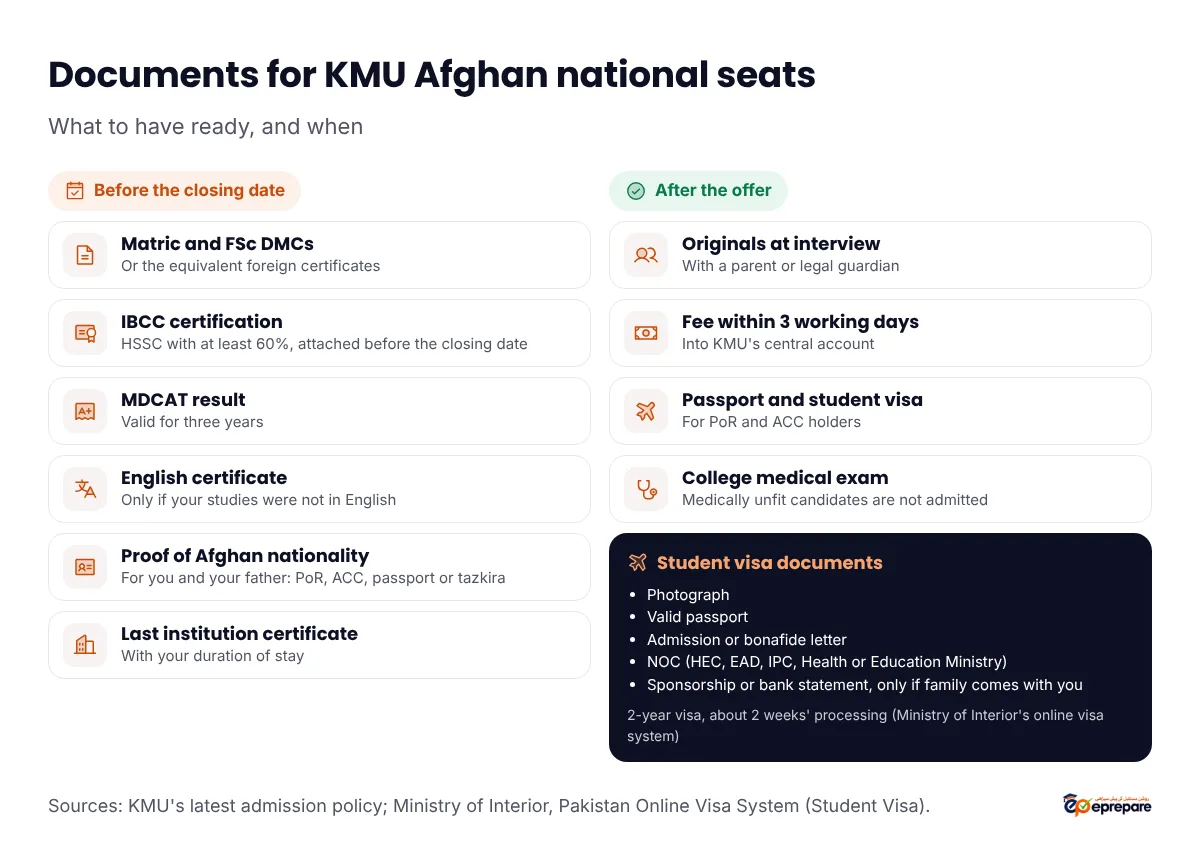
- Detailed marks certificates (DMCs) for Matric and FSc or their equivalents.
- IBCC certification or equivalence certificate, attached before the closing date.
- MDCAT result.
- English proficiency certificate, if your earlier studies were not in English.
- Proof of your and your father's Afghan nationality, such as a PoR card, an ACC, a passport or a tazkira. The policy doesn't name the exact document, so use what KMU's form asks for.
- Certificate from the institution you last attended, with your duration of stay, and a certificate for FSc Part I and II if they were from different institutions.
- An email address and three active phone numbers, which the policy asks every applicant to give.
Two rules apply to every KMU applicant: certificates issued after the closing date are not counted, and documents you upload "cannot be changed and shall be considered as final." A false document means cancellation, blacklisting from KP's professional colleges and possible legal action. Our KMU admission documents checklist lists every warning.
After admission
- Admission is provisional until your college verifies your documents.
- Keep your visa valid for your whole degree. The student visa is granted for two years at a time, and the visa portal allows extensions from inside Pakistan.
- Migration: KMU's migration rules allow category-wise migration for open merit, self-finance and a list of reserved categories. The Afghan national seats are not named in that list, so if you might need to move colleges later, ask KMU before you rely on it. See our KMU migration policy guide.
- Empty seats: if no eligible Afghan candidate takes a seat, the policy converts it to an open merit seat for KP students.
Key deadlines
Afghan national seats are special category seats. The policy says admissions to special category seats in public medical colleges must be completed by 10 January, and in public dental colleges by 28 February. KMU announces the exact application and merit list dates each year in its advertisement.
Mistakes that cost Afghan students their seats
- Leaving the IBCC paperwork too late. Translation, verification and equivalence take time, and a certificate dated after the closing date doesn't count.
- Waiting for an embassy nomination. The policy rules it out. Apply yourself on KMU's portal.
- Not planning the passport. PoR and ACC holders need an Afghan passport and a student visa after the offer. Start early so you are not stuck after paying the fee.
- Applying for MBBS only. With just 12 seats, adding BDS doubles the routes to a seat if you would accept dentistry.
- Leaving colleges off the list. KMU won't offer you a college you didn't list, even if its Afghan seat is free.
- Missing the three-working-day fee deadline. Have the first-year fee ready before the merit lists start.
- Trusting agents. Every seat is given on merit. Anyone asking for money to arrange a seat is not telling the truth.
Frequently asked questions
How many Afghan seats are there in KMU's medical colleges?
Twelve: 10 MBBS seats (KMC 2, AMC 2, SMC 2, GMC 1, KGMC 1, BMC 1, BKMC 1) and 2 BDS seats (KCD 1, ADS 1), under KMU's latest admission policy.
Do Afghan students need to pass the MDCAT for KMU colleges?
Yes. The policy makes the PM&DC MDCAT compulsory: at least 55% for MBBS and 50% for BDS, which is 99 and 90 marks out of 180.
Can PoR card holders apply for KMU's Afghan seats?
Yes, if you and your father hold Afghan nationality and meet the other rules. Once you are offered admission, the policy requires PoR and ACC holders to get an Afghan passport and study on a student visa. Check the current official status of your card before you apply.
Can the Afghan embassy nominate me for a KMU seat?
No. The policy says "Admission shall not be granted as per nomination of Embassy of Afghanistan, Islamabad." The seats are filled on merit through KMU's portal.
What fee do Afghan students pay at KMU colleges?
The open merit fee: Rs 102,000 in the first year at KMC, KGMC and AMC, and Rs 87,000 at other colleges, rising each year. It is paid in rupees, not dollars.
Can an Afghan student apply on open merit in KP?
No. Open merit and self-finance seats need a KP domicile for you and your father, which is issued to Pakistani citizens. Afghan nationals compete for the 12 Afghan national seats.
I studied FSc in Peshawar. Do I still need IBCC?
The policy asks for HSSC marks "certified by" IBCC for Afghan seats. A Pakistani board DMC is not a foreign qualification, so ask KMU's admission office in writing which IBCC document it needs from you, well before the closing date.
Is there a seat for Afghan girls?
Yes. Khyber Girls Medical College, Peshawar, which admits only female students, has one Afghan national seat. Girls can also compete for the other 11 seats in co-education colleges.
Twelve seats means a strong MDCAT score makes all the difference, because you compete with the best Afghan students in the province. If you are preparing, ePrepare's MDCAT preparation gives you KPK textbook-based MCQs, full-length tests and a predicted score from home. When your result is out, use the aggregate calculator to see where you stand.
Sources: Khyber Medical University, latest Admission Policy for Public Sector Medical and Dental Colleges of Khyber Pakhtunkhwa (Afghan national seats, basic eligibility, college-wise seat distribution, admission procedure, migration policy and fee schedule), available on cas.kmu.edu.pk; IBCC, "Requirements for Equivalence" and "Submission Modes" pages on ibcc.edu.pk; Ministry of Interior, Pakistan Online Visa System, Student Visa page on visa.nadra.gov.pk; UNHCR, report on the Government of Pakistan's PoR smartcards. Rules on PoR and ACC cards, visas and IBCC procedures can change; always check the current official notice.