

Many Pakistani families living in the Gulf, the UK, Canada or the USA want their children to study medicine at home, in a government college in Khyber Pakhtunkhwa. Families who hold a foreign passport want the same thing. For both, Khyber Medical University (KMU) keeps a special category: foreign self-finance (FSF) seats. These are seats in the same public colleges and the same classes as everyone else. The difference is the fee, which is charged in US dollars, and a set of rules that stay with you for the whole degree.
This guide explains everything KMU's latest admission policy says about FSF seats: how many there are and where, who qualifies, the full fee in dollars and rupees, the rules that bind you, how FSF compares with general self-finance and overseas Pakistani (OPF) seats, and how to apply. Where PM&DC's own admission regulations say something different, we point it out so you are not caught off guard. For a quick overview of every seat for foreign and overseas students, see our guide to KMU seats for Afghan, foreign and overseas Pakistani students.
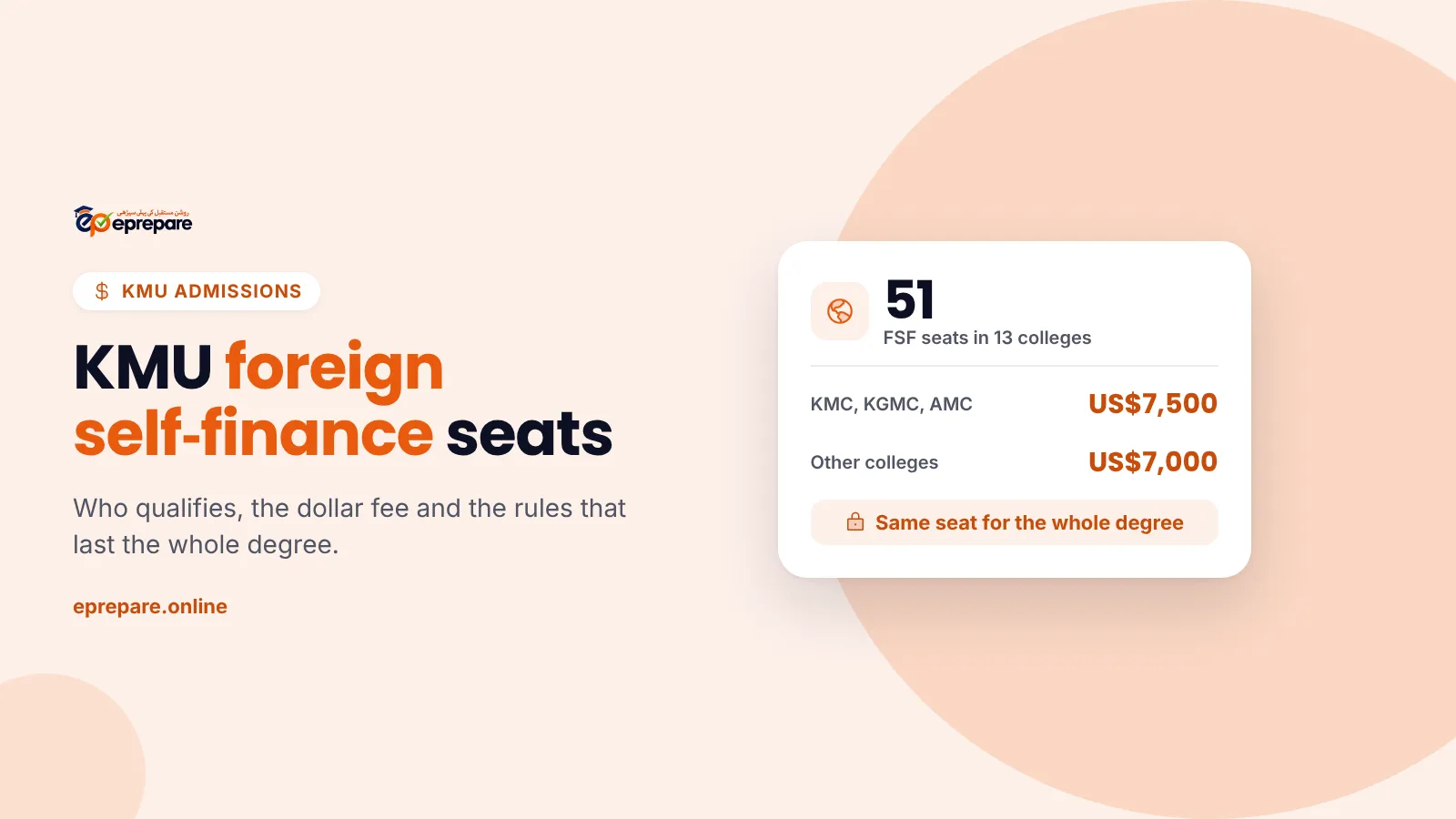
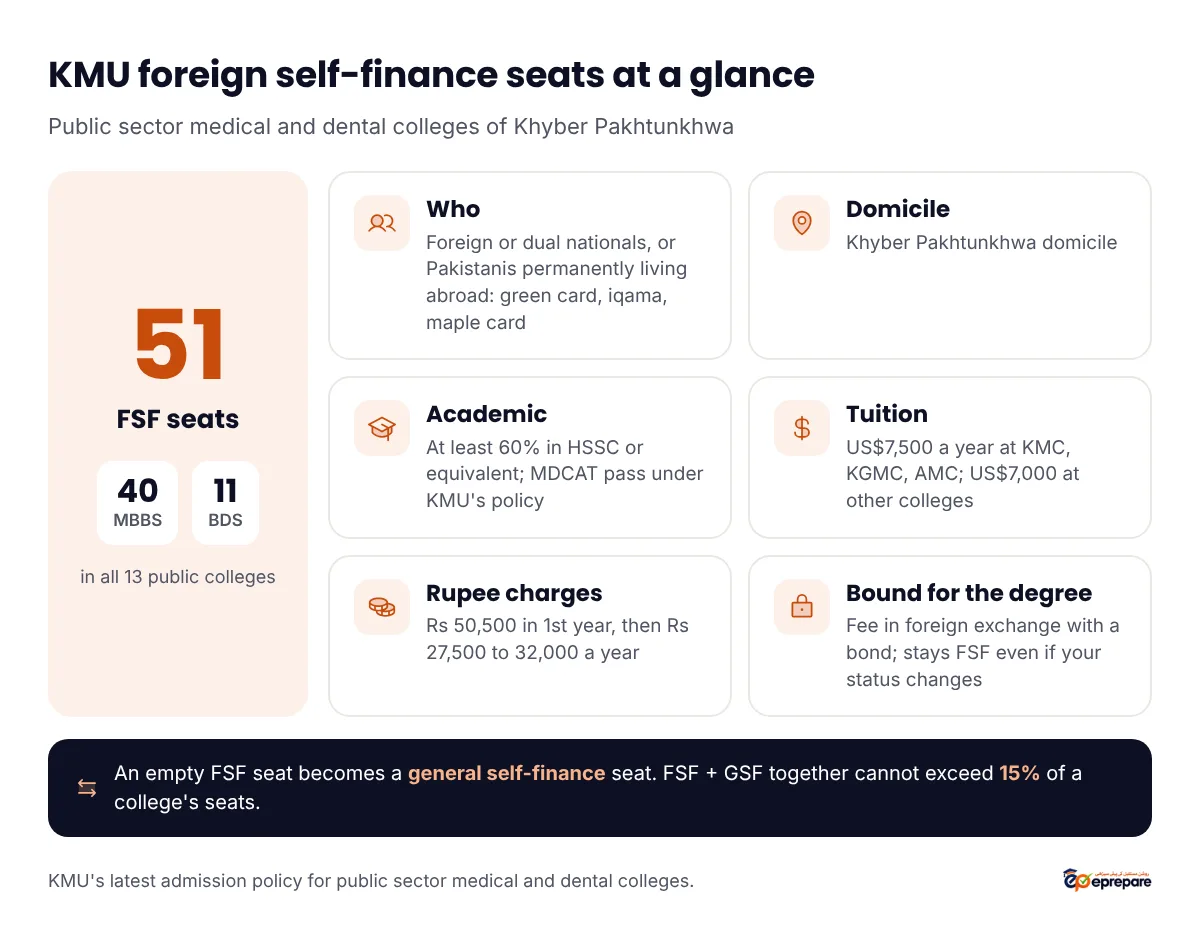
The short answer: KMU's latest policy has 51 FSF seats (40 MBBS, 11 BDS) spread over all 13 public medical and dental colleges of KP. They are for applicants with a Khyber Pakhtunkhwa domicile who hold a permanent foreign nationality or are overseas Pakistanis permanently living abroad, such as green card, iqama or maple card holders, with at least 60% in HSSC or equivalent. Tuition is US$7,500 a year at KMC, KGMC and AMC and US$7,000 at other colleges, plus Rs 27,500 to Rs 50,500 a year in rupee charges. You pay in foreign exchange, you stay on the FSF seat for the whole degree, and your fee does not change even if your residence status changes. You apply on KMU's admission portal.
What is a foreign self-finance seat?
An FSF seat is a seat in a public sector medical or dental college of Khyber Pakhtunkhwa, filled by KMU, that is set aside for foreign nationals and overseas Pakistanis. You study in the same college, in the same batch, with the same teachers as open merit and general self-finance students, and you sit the same professional exams. What makes it different is who can apply and how the fee is paid.
Do not confuse FSF with three other seats that sound similar:
- General self-finance (GSF): for KP domicile holders living in Pakistan, with the fee in rupees. Read our self-finance vs open merit guide.
- Overseas Pakistanis Foundation (OPF) seats: 9 seats for children of OPF members, at the normal open merit fee.
- Additional foreign seats and PTAP: over-and-above seats for foreign students nominated under Federal Government programmes, not applied for like FSF.
How many FSF seats are there, and where?
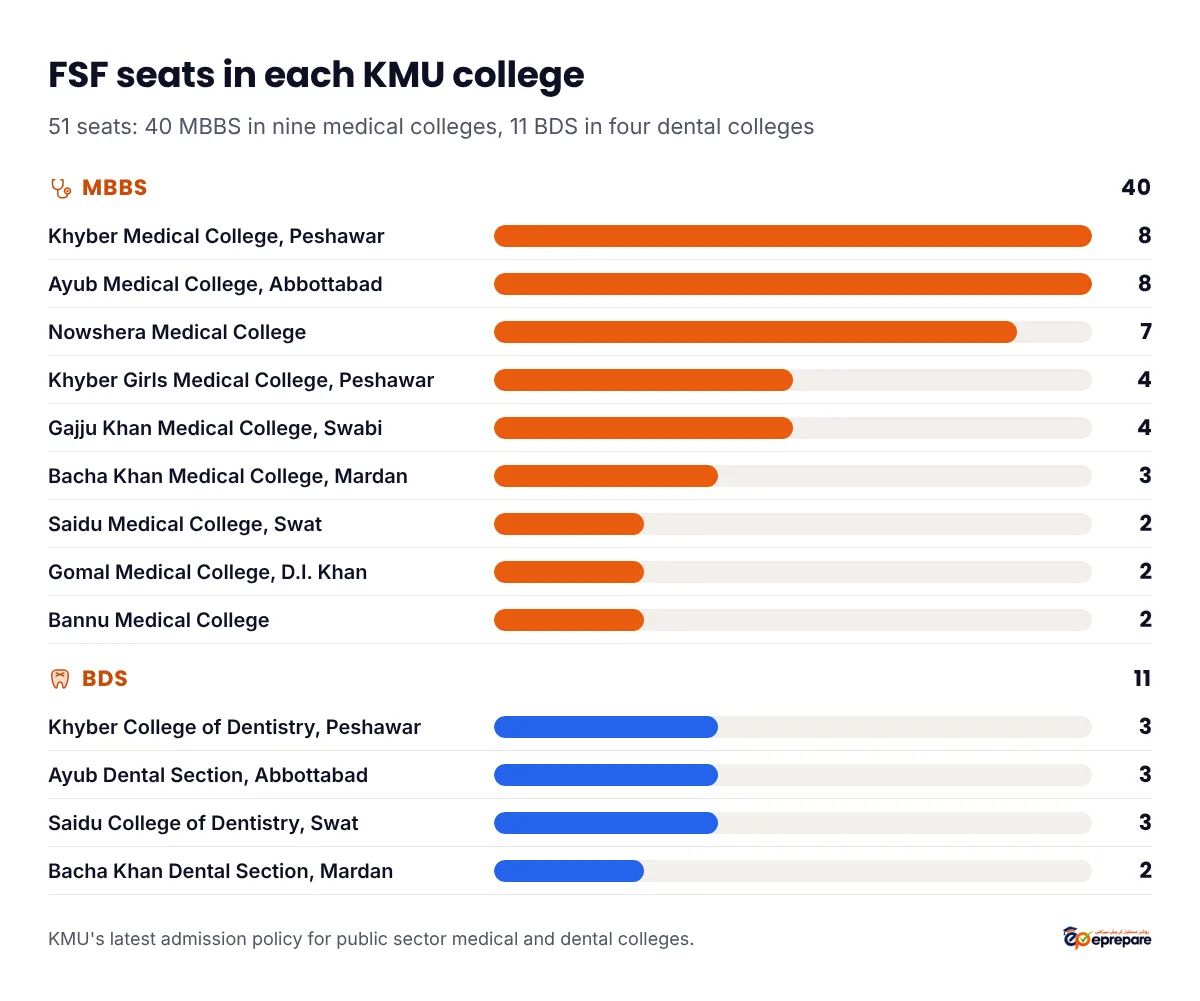
Every one of KMU's 13 public colleges has some FSF seats. Khyber Medical College and Ayub Medical College have the most.
| College | Programme | FSF seats | Tuition rate |
|---|---|---|---|
| Khyber Medical College (KMC), Peshawar | MBBS | 8 | US$7,500 |
| Ayub Medical College (AMC), Abbottabad | MBBS | 8 | US$7,500 |
| Khyber Girls Medical College (KGMC), Peshawar | MBBS | 4 | US$7,500 |
| Nowshera Medical College (NMC) | MBBS | 7 | US$7,000 |
| Gajju Khan Medical College (GKMC), Swabi | MBBS | 4 | US$7,000 |
| Bacha Khan Medical College (BKMC), Mardan | MBBS | 3 | US$7,000 |
| Saidu Medical College (SMC), Swat | MBBS | 2 | US$7,000 |
| Gomal Medical College (GMC), D.I. Khan | MBBS | 2 | US$7,000 |
| Bannu Medical College (BMC) | MBBS | 2 | US$7,000 |
| Khyber College of Dentistry (KCD), Peshawar | BDS | 3 | Confirm with KMU |
| Ayub Dental Section (ADS), Abbottabad | BDS | 3 | Confirm with KMU |
| Saidu College of Dentistry (SCD), Swat | BDS | 3 | Confirm with KMU |
| Bacha Khan Dental Section (BKDS), Mardan | BDS | 2 | Confirm with KMU |
| Total | 40 MBBS + 11 BDS | 51 | US$7,000 to 7,500 |
The policy's fee note names only Khyber Medical College, Khyber Girls Medical College and Ayub Medical College for the higher US$7,500 rate, and "all other medical colleges" for US$7,000. It does not name the dental colleges under either rate, so confirm your dental college's rate with KMU before you apply. Khyber Girls Medical College admits female students only, so its 4 FSF seats are for girls.
Who qualifies for an FSF seat?
This is the rule that decides everything, so here it is word for word from KMU's policy:
"These seats are for applicants who are not Pakistani students and hold a permanent foreign nationality or is an overseas (being a Pakistani citizen permanently resident in a foreign country) Pakistani, Green card holder, Iqama holder, Maple card holder, as elaborated under regulations 4(7), having domicile of Khyber Pakhtunkhwa."
The "regulations 4(7)" it refers to are PM&DC's admission regulations. PM&DC's current regulations, published on pmdc.pk, use the same idea. They define an "Overseas / Dual National (Expatriate)" student as one who "holds a permanent foreign nationality or is an overseas (being a Pakistani citizen permanently resident in a foreign country) Pakistani, Green Card Holder, Iqama Holder, Maple Card Holder."
In plain words, you can apply if you have a KP domicile and at least one of these:
- a permanent foreign nationality, including dual nationals;
- permanent residence abroad as a Pakistani citizen, for example a US green card, a Saudi or Gulf iqama, or a Canadian permanent residence ("maple") card.
The policy then sets the academic rule:
"Such candidates must have studied and passed Intermediate/FSc/HSSC 12th grade examination or equivalent from inside or outside Pakistan and obtained a minimum of sixty percent (60%) marks therein."
So your FSc or 12th grade can be from Pakistan or from abroad. If it is from a foreign system, you also need an IBCC equivalence certificate (see the documents section below).
Do FSF candidates need the MDCAT?
Under KMU's policy, yes. The basic eligibility rules apply to "any person seeking admission in any undergraduate medical or dental college", and require a pass in the MDCAT conducted by PM&DC: at least 55% for MBBS and 50% for BDS. The policy's only exception is for special seats under Federal Government programmes for foreign students. It also says no category may admit "a student who has not qualified the MDCAT". On the current 180-mark paper, 55% is 99 marks and 50% is 90 marks. See MDCAT passing marks.
Where PM&DC's regulations differ: PM&DC's current admission regulations, as amended, allow candidates for overseas and dual national (expatriate) seats to qualify through the MDCAT, or SAT-II with at least 550 in each subject, a foreign MCAT, or UCAT with at least 50% in the required subjects. KMU's latest policy for its public colleges still requires the MDCAT for FSF seats. If you have SAT-II, MCAT or UCAT instead of the MDCAT, confirm with KMU's admission office before the closing date. Do not assume either way. The safest route is to sit the MDCAT, which is held in Pakistan.
The FSF fee, year by year
The fee has two parts: tuition in US dollars, and other charges in rupees (admission, litigation, exam and skill lab, KMU affiliation and students fund).
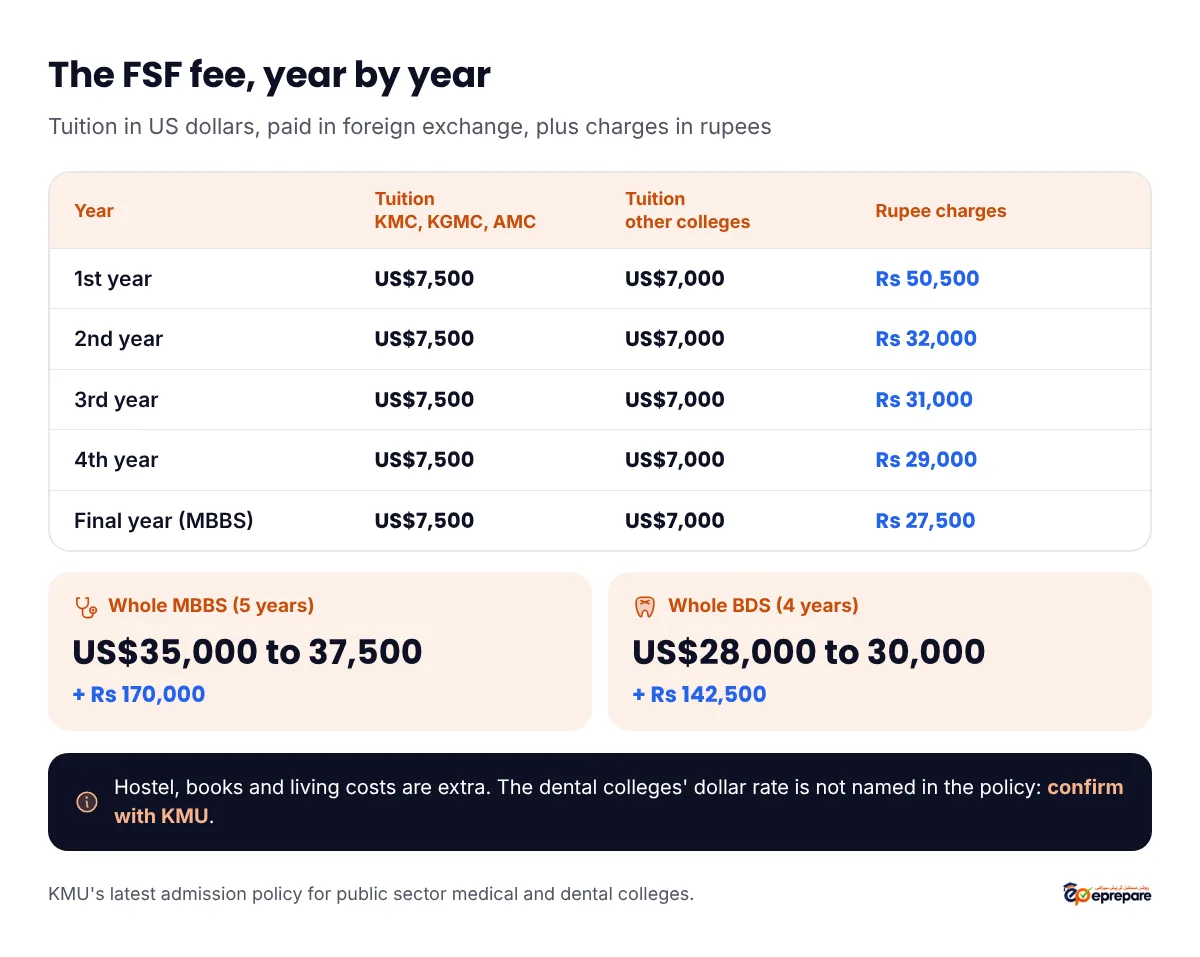
| Year | Tuition (KMC, KGMC, AMC) | Tuition (other colleges) | Rupee charges |
|---|---|---|---|
| 1st year | US$7,500 | US$7,000 | Rs 50,500 |
| 2nd year | US$7,500 | US$7,000 | Rs 32,000 |
| 3rd year | US$7,500 | US$7,000 | Rs 31,000 |
| 4th year | US$7,500 | US$7,000 | Rs 29,000 |
| Final year (MBBS) | US$7,500 | US$7,000 | Rs 27,500 |
| MBBS, 5 years | US$37,500 | US$35,000 | Rs 170,000 |
| BDS, 4 years | US$30,000 at the higher rate | US$28,000 at the lower rate | Rs 142,500 |
What the rupee charges are made of
| Charge | 1st year | Later years |
|---|---|---|
| Admission fee | Rs 3,500 | First year only |
| Litigation fee | Rs 5,000 | First year only |
| Exam and skill lab + other | Rs 13,000 | Rs 1,000 (2nd, 3rd), Rs 2,000 (4th, final) |
| KMU affiliation / retention | Rs 15,000 | Rs 15,000 every year |
| Students fund | Rs 14,000 | Rs 16,000, 15,000, 12,000, 10,500 |
| Total rupee charges | Rs 50,500 | Rs 32,000, 31,000, 29,000, 27,500 |
Hostel, mess, books, instruments and living costs are extra. The policy also says "Revised fees structure will be applicable to all the candidates from time to time", so budget for possible increases. For every category's fee, see our KMU MBBS and BDS fee structure guide.
For context, PM&DC's current regulations allow tuition of up to US$15,000 a year for the overseas Pakistani category (or up to US$20,000 if PM&DC approves). KMU's public colleges charge well below that cap.
The rules that bind you for the whole degree
Before you accept an FSF seat, read these four rules carefully. They do not end after first year.
- You stay on the FSF seat. "Students admitted under this quota must complete their entire period of study under this quota/category." You cannot switch to open merit or GSF later.
- You pay in foreign exchange, with a bond. "The fee for students admitted under this quota will be collected in foreign exchange and to this effect, an undertaking / bond shall be provided by the student."
- Your fee does not change if your status changes. "A student admitted on foreign seat shall pay the fee as a foreign students regardless of any change in status of such student during the program of study." If your family moves back to Pakistan in your third year, you still pay the FSF fee.
- Migration stays within FSF. KMU's migration rules are category-wise, and foreign self-finance is named as one of those categories. After the 2nd Professional (MBBS) or 1st Professional (BDS), you can only move to a vacant FSF seat in your class. See our KMU migration policy guide.
The 15% cap, and what happens to empty FSF seats
The policy limits self-finance seats in each college: "Cumulative seats for Foreign plus General Self-finance seats admissions in a public medical and dental institution shall not exceed fifteen percent of total allocated seats." Seats are not carried forward to the next year.
If an FSF seat stays empty, it does not go to waste: "Where any seat of foreign self-finance quota remains vacant due to unavailability of eligible candidates or otherwise, it shall be transferred to General Self Finance (GSF) and the student shall be charged fee and charges prescribed against GSF seats." That is why the final number of GSF seats in KMU's merit lists can be a little higher than in the seat table.
Note that PM&DC's current regulations say a vacant overseas or dual national seat goes to open merit. KMU's policy for its public colleges sends vacant FSF seats to general self-finance. KMU's admission notice decides how the seats are filled each year.
FSF vs general self-finance vs OPF seats
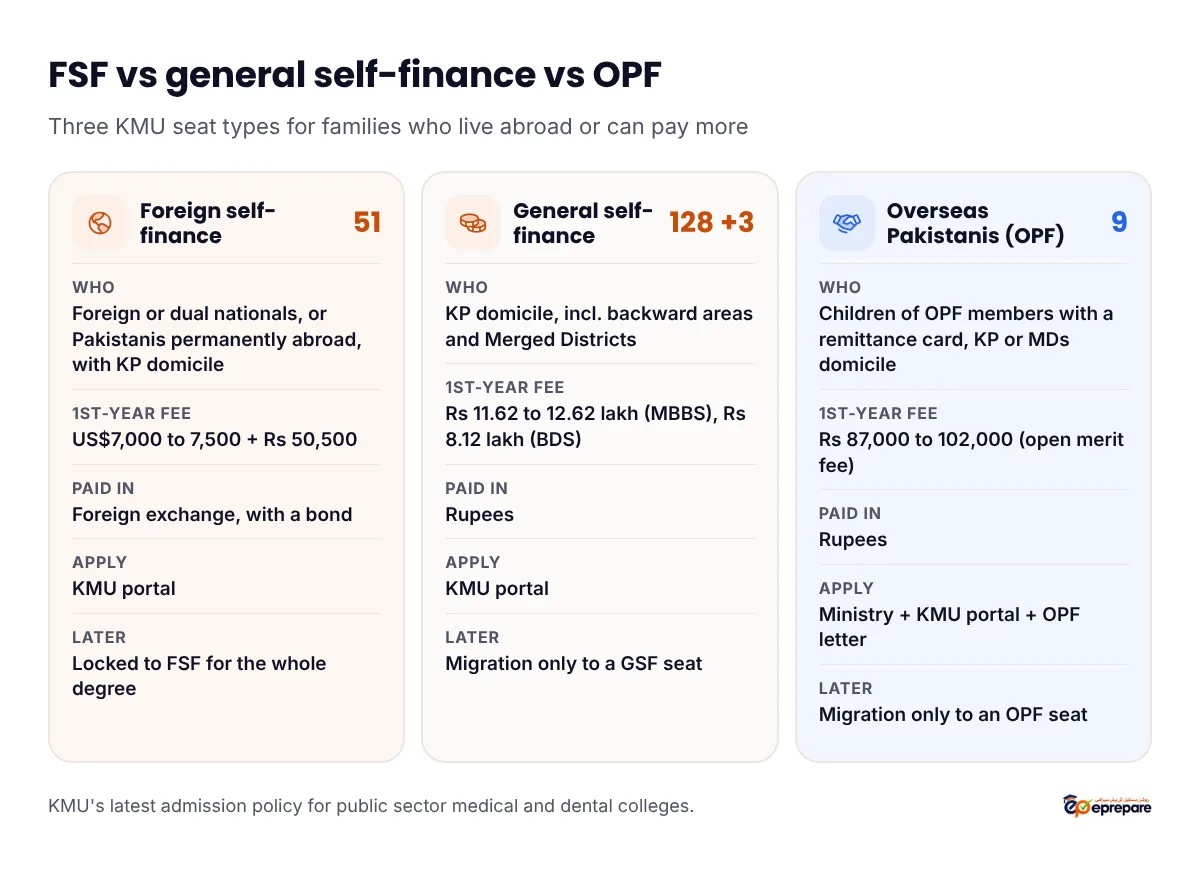
| Point | Foreign self-finance | General self-finance | OPF seat |
|---|---|---|---|
| Seats | 51 | 128 (+3 for minorities) | 9 |
| Who | Foreign or dual nationals, or Pakistanis permanently abroad, with KP domicile | KP domicile, including backward areas and Merged Districts | Children of OPF members, KP or Merged Districts domicile |
| 1st-year fee (MBBS) | US$7,000 to 7,500 + Rs 50,500 | Rs 11.62 to 12.62 lakh | Rs 87,000 to 102,000 |
| Paid in | Foreign exchange | Rupees | Rupees |
| Where you apply | KMU portal | KMU portal | Ministry and KMU portal, plus OPF letter |
If a parent is a registered OPF member with a valid remittance card, check the OPF seats too, because they pay the much lower open merit fee. Read our guide to KMU OPF seats. Afghan nationals have their own seats; see KMU Afghan national seats.
Documents to prepare
KMU's policy asks every applicant to upload scanned copies of all certificates with the online form, and to bring originals to the placement interview. For FSF candidates, prepare:
- Detailed marks certificates of Matric (or O levels) and FSc (or A levels / 12th grade).
- IBCC equivalence certificate if your qualification is from a foreign education system. KMU's policy says it "must be attached with the application form before the closing date".
- KP domicile. The FSF rule asks for a Khyber Pakhtunkhwa domicile, and the policy's document list asks for the domicile of the candidate and the father (or the mother's, with the father's death certificate).
- CNIC or Form B, and your father's CNIC (Pakistani applicants). Foreign nationals should keep their passport ready.
- Proof of the status you are applying under, such as your foreign passport, green card, iqama or maple card. The policy does not list this as a separate item, but your eligibility rests on it, so have it ready.
- Certificate from the institution you last attended, showing your duration of stay.
- The undertaking or bond about paying the fee in foreign exchange, which you sign on admission.
Any certificate issued after the closing date is not counted, and a document found false at any stage means cancellation and blacklisting from KP's professional colleges. Our KMU admission documents checklist has every item.
Getting IBCC equivalence for a foreign qualification
The Inter Board Committee of Chairmen (IBCC) issues equivalence for qualifications up to HSSC level. Here is what IBCC's website says for students coming from abroad:
- A levels for pre-medical: Physics, Chemistry and Biology at A level, each with at least an E grade. For exams taken overseas, IBCC also asks for five O level subjects, with English and Mathematics compulsory, plus three electives (Physics, Chemistry and Biology).
- SSC first: IBCC requires SSC or equivalent (science group) before it processes HSSC equivalence, and Biology must have been studied at SSC level for pre-medical equivalence.
- Applying: you can apply online for photocopy submission, and IBCC says processing takes 15 to 20 working days. Documents usually need verification by the issuing board.
KMU's policy adds its own conditions: the equivalence must show marks equivalent to an unadjusted 60% of FSc under IBCC's formula, you must have studied Physics or Maths, Chemistry and Biology in grades 9 to 12 (or O and A levels), and you must have passed English at O or A level. Start early: equivalence and board verification can take weeks, and nothing issued after KMU's closing date counts.
How to apply for an FSF seat, step by step
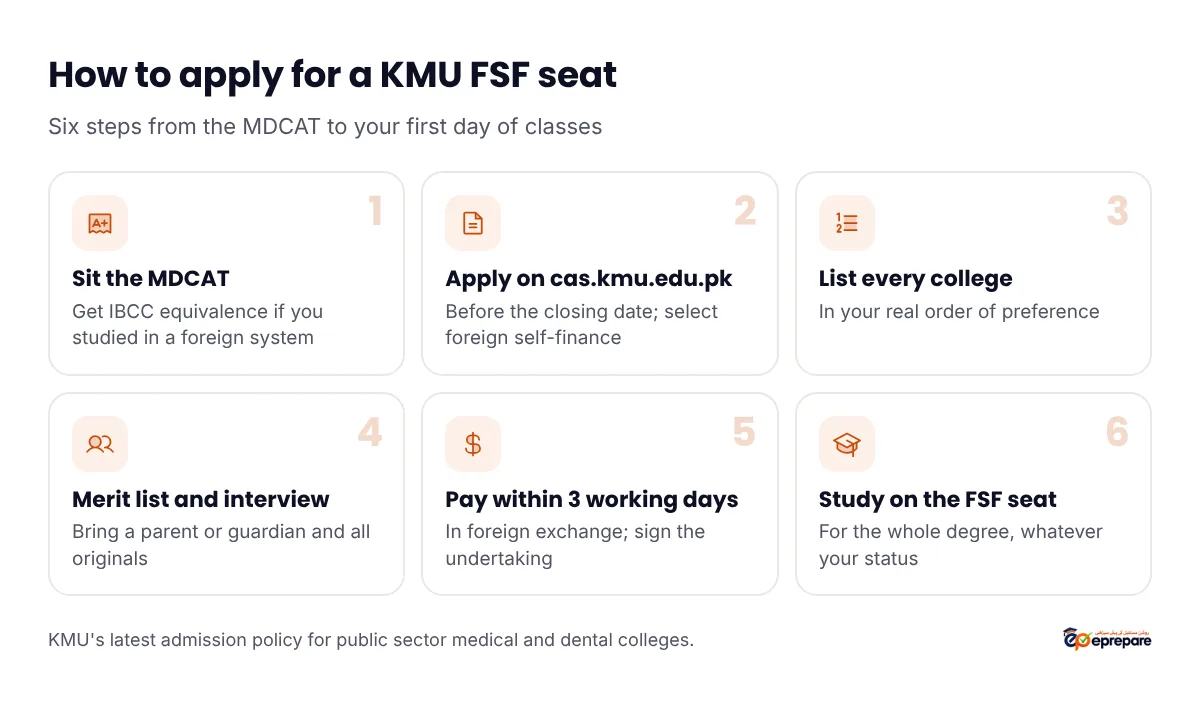
- Sit the MDCAT and get your IBCC equivalence if you studied in a foreign system.
- Apply online on cas.kmu.edu.pk before the closing date and select foreign self-finance. The policy says FSF candidates "shall apply directly to KMU online portal".
- List every college you would accept, in order. KMU only offers colleges on your list.
- Check the merit list. Selection is on merit among FSF applicants, using the normal aggregate (10% Matric, 40% FSc, 50% MDCAT). Interviews are held on merit-cum-choice for FSF seats along with other categories.
- Attend the placement interview with a parent or legal guardian and your original documents.
- Pay within three working days of the offer letter, or the seat goes to the next candidate. Read how KMU merit lists and upgrades work.
FSF is a special category, so admissions must be completed by 10 January for medical colleges and 28 February for dental colleges. The exact application dates are in KMU's advertisement; see our KMU admission schedule.
Is an FSF seat right for you?
- It suits you if you are a foreign or dual national, or a Pakistani permanently living abroad, with a KP domicile, and your family can pay about US$35,000 to US$37,500 in tuition over five years of MBBS.
- Check OPF first if a parent is a registered OPF member with a valid remittance card, because OPF seats pay the open merit fee.
- Consider open merit or GSF if you are a Pakistani citizen living in Pakistan. FSF is not meant for you, and open merit is far cheaper. See every KMU seat category explained and which KMU category to choose if you qualify for more than one.
Frequently asked questions
How many foreign self-finance seats does KMU have?
51 under KMU's latest policy: 40 MBBS and 11 BDS, spread across all 13 public medical and dental colleges of Khyber Pakhtunkhwa. KMC and AMC have 8 each.
What is the FSF fee at KMU colleges?
Tuition is US$7,500 a year at KMC, KGMC and AMC and US$7,000 at the other colleges, plus rupee charges of Rs 50,500 in the first year and Rs 27,500 to Rs 32,000 in later years. Over five years of MBBS, that is US$35,000 to US$37,500 plus Rs 170,000.
Can a Pakistani living in Saudi Arabia or the UAE apply for FSF?
Yes, if you are a Pakistani citizen permanently resident abroad (for example an iqama holder), hold a KP domicile and have at least 60% in HSSC or equivalent. The policy names iqama holders directly.
Can dual nationals apply for FSF seats?
Yes. The seats are for applicants who hold a permanent foreign nationality, which includes dual nationals, provided they have a KP domicile.
Is the MDCAT required for FSF seats?
KMU's policy requires an MDCAT pass (55% for MBBS, 50% for BDS) for every category except special Federal Government programme seats for foreign students. PM&DC's own regulations allow SAT-II, a foreign MCAT or UCAT for expatriate seats, so if you do not have the MDCAT, confirm with KMU before you apply.
Can I switch from FSF to open merit later?
No. FSF students must complete the whole degree in the same category and keep paying the foreign fee, even if their residence status changes. Migration is also only into a vacant FSF seat.
What happens if no one takes an FSF seat?
It becomes a general self-finance seat, and the student admitted to it pays the GSF fee in rupees.
Do I pay the FSF fee to the college?
KMU's policy requires fees to be deposited in KMU's central account by the due date it notifies, within three working days of the offer letter. FSF fees are collected in foreign exchange. KMU then transfers the fee to your college.
An FSF seat still goes on merit, so your MDCAT score decides which college you get. If you are preparing from abroad, ePrepare's online MDCAT preparation gives you KPK textbook-based MCQs, full-length tests and a predicted score wherever you live. When your result is out, use the aggregate calculator and the KPK college predictor to plan your list.
Sources: Khyber Medical University, latest Admission Policy for Public Sector Medical and Dental Colleges of Khyber Pakhtunkhwa (college-wise seat distribution, foreign self-finance seats, basic eligibility, documents required, admission procedure, migration policy and annual fee schedule). PM&DC Medical and Dental Undergraduate Education (Admissions, Curriculum and Conduct) Regulations, as amended, published on pmdc.pk (definition of overseas / dual national students and regulation 4(7) on expatriate seats). IBCC equivalence pages on ibcc.edu.pk (British system and equivalence FAQs). Fees and rules can change; always check the current notice on cas.kmu.edu.pk.