Many students in Khyber Pakhtunkhwa qualify for more than one kind of seat without realising it. A student from Chitral can compete on open merit and for Chitral's backward area seats. A student from Bajaur can try Merged Districts seats, self-finance and the separate HEC project seats. A Christian student from Peshawar can apply for minority seats as well as open merit. Each extra category is another chance at a seat, but each one also comes with its own conditions.
This guide explains how Khyber Medical University (KMU) handles students who qualify for several categories, what the policy says about your right to choose, and how to compare the options: fee, bonds, which colleges have seats, and what happens later in the degree. Everything comes from KMU's latest admission policy for public sector medical and dental colleges, published on the KMU admission portal.
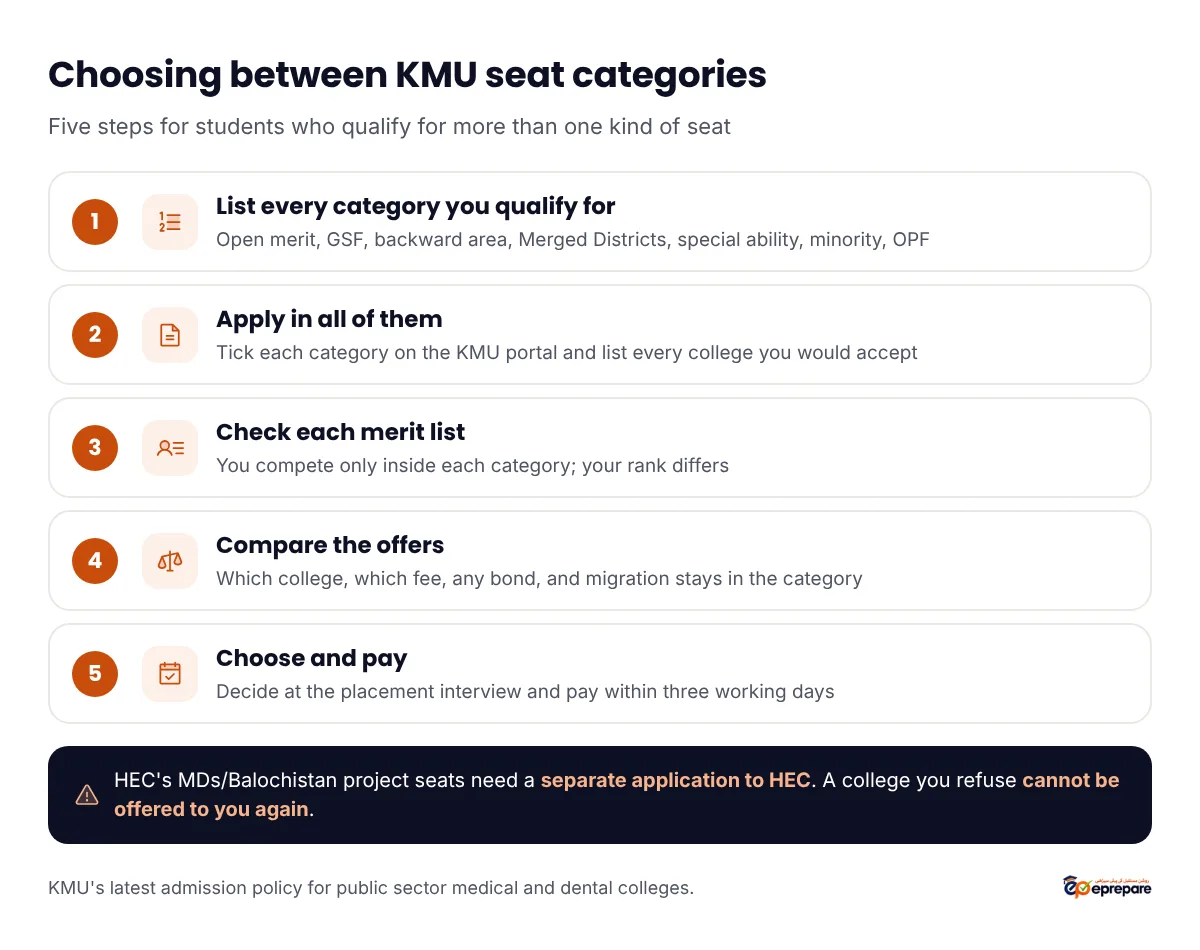
The short answer: apply in every category you qualify for, because KMU only considers you in a category you applied for. Each category has its own merit list, and you compete only with applicants of that category. If you are offered seats in more than one, the policy repeatedly says the choice is yours. Before you choose, compare four things: the college each seat gives you, the fee (normal fee or self-finance), any bond (backward area seats carry a five-year service bond), and the fact that later migration stays within the category you were admitted in.
Three rules that decide how this works
1. You must apply in each category separately
KMU does not move you from one category to another on its own. The policy repeats this for each quota. For backward areas it says: "To be considered on open merit as well as quota seats, the candidates must apply against both categories." It says the same for special-ability seats. If you don't tick a category, you are not considered for it, however strong your merit.
2. You compete only inside each category
"Selection under each category of seats shall be done on the basis of inter se merit amongst the eligible applicants." In plain words, a backward area seat for Kohistan is decided among eligible Kohistan applicants only, and open merit among open merit applicants. Your aggregate is the same in every list (10% Matric, 40% FSc, 50% MDCAT), but your rank can be very different, because the pool is different. Check yours with the aggregate calculator.
3. When you qualify for more than one seat, the choice is yours
The policy says this in so many words, category after category:
- Backward areas: "Candidates from these areas can also apply against Open merit seats and general-self-finance seats. To be considered on open merit as well as quota seats, the candidates must apply against both categories. However, it will be the choice of the candidate to avail open merit or backward area seat or GSF."
- Special ability: "To be considered on open merit as well as the specially abled candidate's seats, the candidates must apply against both the categories. However, it will be the choice of the candidate to avail open merit or disabled seat."
- Minorities: non-Muslim candidates with a KP or Merged Districts domicile "can apply for minority seats, Open Merit seats, Backward Area seats (holding valid domicile of the respective backward area) and General Self Finance Seats, and GSF seats reserved for minorities candidates. However, it will be the choice of the candidate to avail any category of seat as per merit."
- Overseas Pakistanis (OPF): "The OPF candidates from Khyber Pakhtunkhwa and Merged Districts (MDs) applying for these seats can also apply on open merit, GSF and MDs seats separately."
Compare the categories side by side
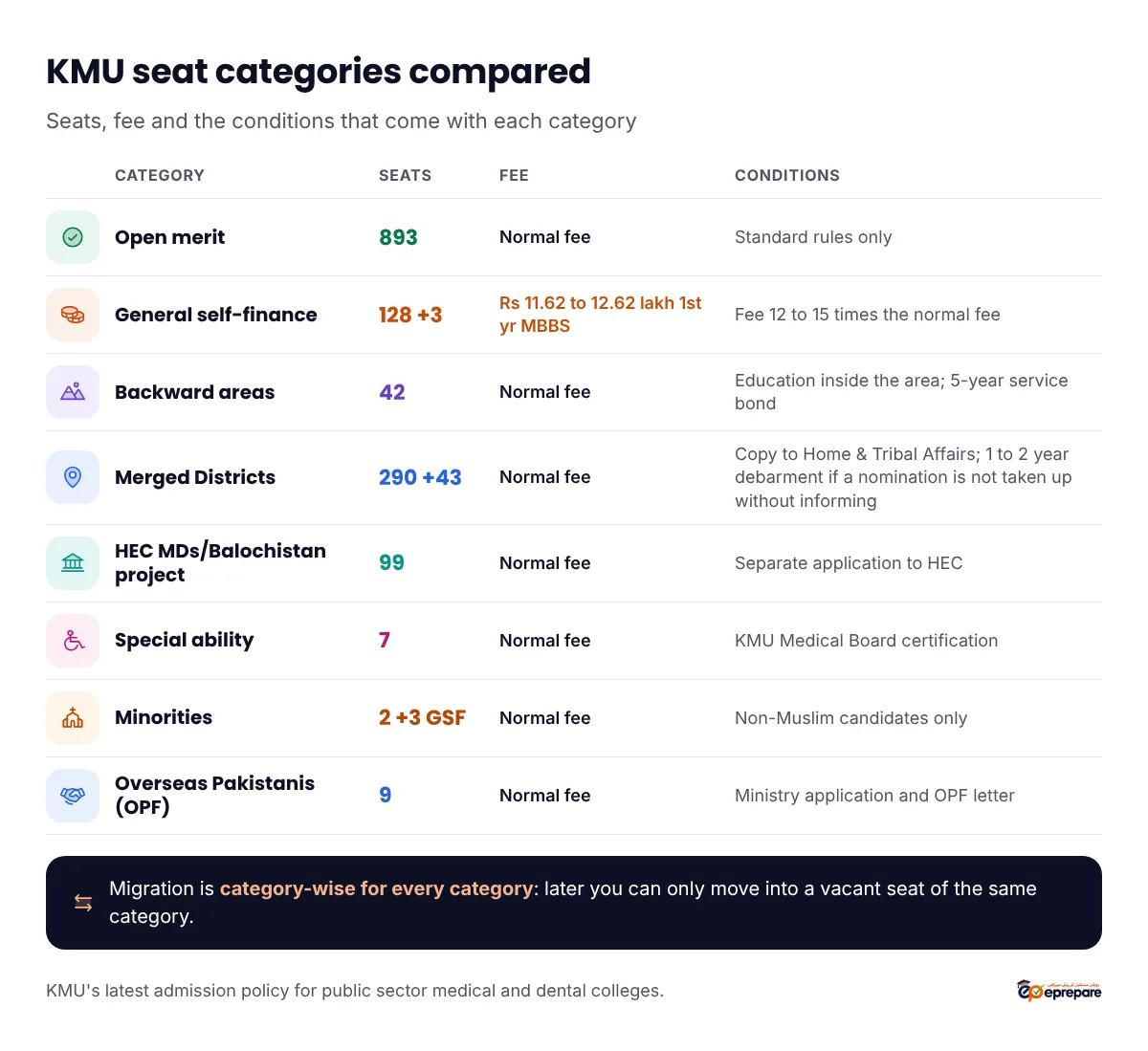
| Category | Seats | Fee | Extra conditions |
|---|---|---|---|
| Open merit | 893 | Normal fee | Standard KMU rules only |
| General self-finance (GSF) | 128 (+3 for minorities) | Self-finance fee: Rs 11.62 to 12.62 lakh in 1st year MBBS, Rs 8.12 lakh BDS | Fee about 12 to 15 times the normal fee |
| Backward areas | 42 | Normal fee | Education inside the area; five-year service bond in your home district |
| Merged Districts | 290 in KP colleges (+43 outside KP) | Normal fee | Copy of form to Home & Tribal Affairs; debarment of one or two years if you don't take up a nomination without informing |
| MDs / Balochistan project (HEC) | 99 | Normal fee | Separate application to HEC |
| Special ability | 7 | Normal fee | Certification by KMU's Medical Board |
| Minorities | 2 | Normal fee | Non-Muslim candidates only |
| Overseas Pakistanis (OPF) | 9 | Normal fee | Application through the Ministry and an OPF recommendation letter |
The "normal fee" is the open merit fee: Rs 102,000 in the first year at KMC, KGMC and AMC and Rs 87,000 at other colleges. Full details are in our KMU fee structure guide.
Which colleges have seats in each category?
This is the factor students forget. A category only helps you if it has seats in colleges you would actually join. Open merit, general self-finance and Merged Districts seats exist in all 13 colleges, but the smaller categories are concentrated in a few.
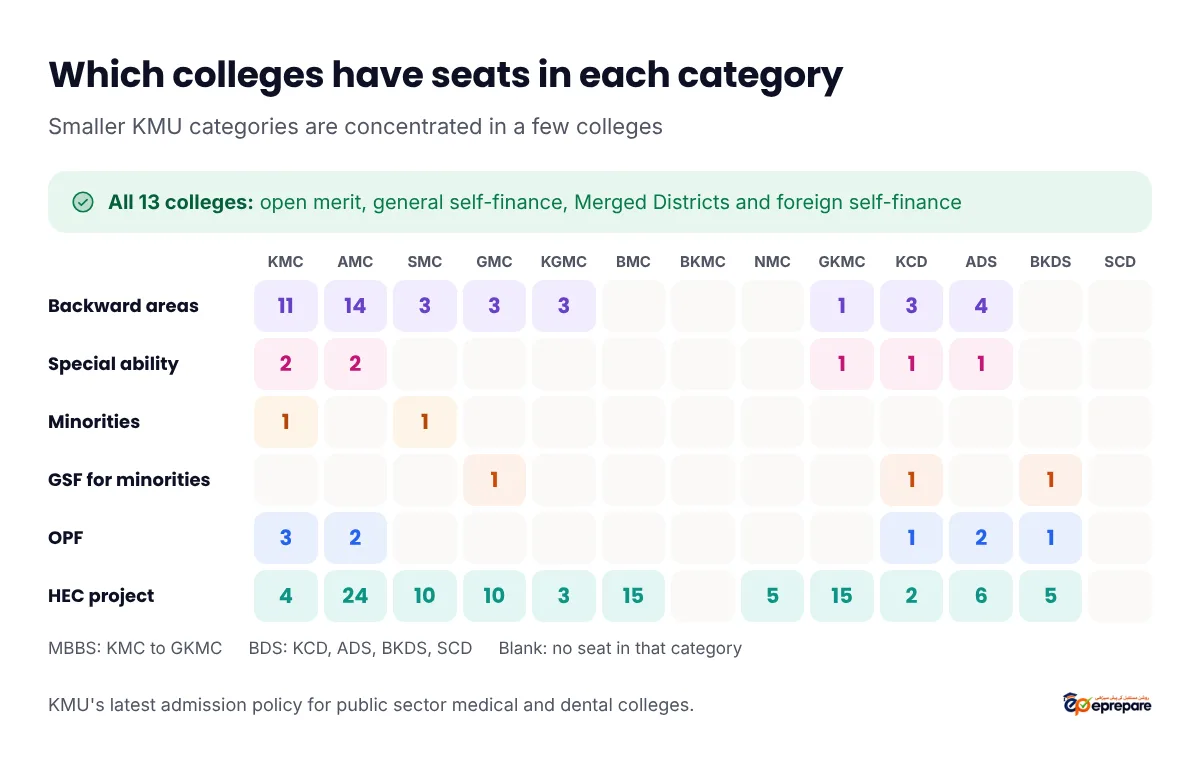
| Category | Colleges with seats |
|---|---|
| Open merit, GSF, Merged Districts | All 13 public colleges |
| Backward areas | KMC 11, AMC 14, SMC 3, GMC 3, KGMC 3, GKMC 1, KCD 3, ADS 4 |
| Special ability | KMC 2, AMC 2, GKMC 1, KCD 1, ADS 1 |
| Minorities | KMC 1, SMC 1 (GSF minority seats: GMC 1, KCD 1, BKDS 1) |
| OPF | KMC 3, AMC 2, KCD 1, ADS 2, BKDS 1 |
| HEC project | AMC 24, BMC 15, GKMC 15, SMC 10, GMC 10, ADS 6, NMC 5, BKDS 5, KMC 4, KGMC 3, KCD 2 |
Within backward area and Merged Districts seats, each area or district has its own seats in particular colleges. See the full tables in our guides to KP backward area seats and Merged Districts seats, and every college's breakdown in KMU college-wise seats.
Four questions to ask before you choose
- Which college does each seat give me? A quota seat at a college you love may beat an open merit seat at a college you only half want, and the reverse can also be true. Your preference list decides what you are offered in each category, so list colleges honestly.
- What will it cost over the whole degree? Open merit and every reserved seat pay the normal fee, about Rs 4.7 lakh to Rs 5.7 lakh for five years of MBBS. General self-finance costs about Rs 67.6 lakh to Rs 72.6 lakh. If you can get the same college on a normal-fee seat, that is a large saving.
- Does the seat carry a bond? Backward area seats do: "Students selected on Backward Areas quota seats should sign surety bond of not less than five years, stating that after completion of education, they shall perform duty in their home districts for at least 5 years." Breaking it means paying "an amount equal to self-finance seat, with compounding interest rate". Open merit carries no such bond.
- What happens later in the degree? Migration between colleges is category-wise for open merit, GSF and every reserved category: you can only move into a vacant seat of the same category, after the 2nd Professional (MBBS) or 1st Professional (BDS). A small category has few seats, so a vacancy in your class is rarer. See the KMU migration policy.
Worked scenarios
These examples show how the rules play out. The students are illustrative; the seat numbers are from KMU's policy.
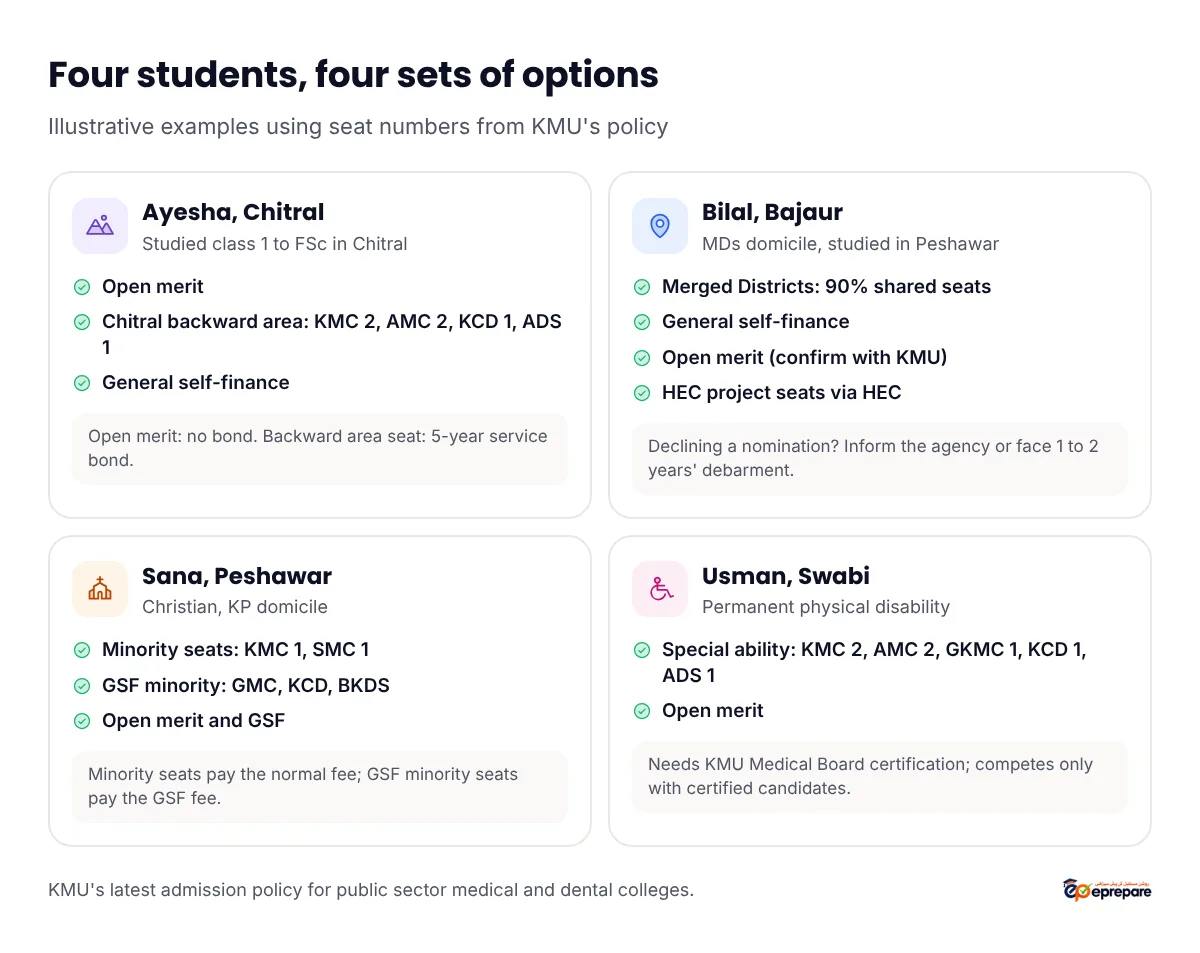
Ayesha, from Chitral
Ayesha and her father hold a Chitral domicile, and she studied in Chitral from class 1 to FSc. She applies for open merit, Chitral's backward area seats (6 seats: KMC 2, AMC 2, KCD 1, ADS 1) and, because her family can afford it, general self-finance. If her merit reaches open merit at a college she wants, she can take it without a bond. If not, a backward area seat at KMC or AMC keeps her in a public college at the normal fee, with the five-year commitment to serve in her home district. Self-finance gives a wider choice of colleges but costs about 12 to 15 times more each year.
Bilal, from Bajaur
Bilal holds a Bajaur domicile, as does his father, but did Matric and FSc in Peshawar. That means he is not an "inside" candidate, but he still competes for the 90% of Bajaur's Merged Districts seats that are shared between inside and outside students. He also applies for general self-finance, which the policy opens explicitly to Merged Districts domicile holders, and ticks open merit, confirming his eligibility with KMU because the open merit wording names KP and its backward areas but not the Merged Districts. Separately, he applies to HEC for the MDs/Balochistan project seats when HEC advertises them. One warning: if he is nominated on a Merged Districts seat and does not take it up, he must inform the nominating agency at once, or face "a penalty of debarring for one/two years".
Sana, a Christian student from Peshawar
Sana and her father hold a KP domicile. She applies for the minority seats (KMC 1, SMC 1), open merit, general self-finance and the GSF seats reserved for minorities (GMC, KCD and BKDS, one each). The minority seats pay the normal fee, while the GSF minority seats pay the self-finance fee. With only two minority seats, competition can be close, so open merit and GSF are important backups. Read more in our guide to KMU minority seats.
Usman, from Swabi
Usman has a permanent physical disability that made school harder but does not stop him from studying medicine. He applies for special-ability seats (KMC 2, AMC 2, GKMC 1, KCD 1, ADS 1) and open merit. He needs certification from KMU's Medical Board, and then competes only with other certified candidates for the 7 seats. If his merit is high enough for open merit, he can take that instead, possibly at a college with no special-ability seat. See KMU special-ability seats.
Upgrades, refusals and timing
- Upgrades follow your preferences. Candidates "may be upgraded to another institution in the subsequent merit list based on merit and preference", and the fee you paid moves "without any deduction". The policy does not spell out how an upgrade across categories works, so ask at your placement interview whether you remain in the running in your other categories after accepting a seat.
- A refused college is gone. "Down-gradation to an institute which was already refused shall not be allowed." Waiting list candidates are also never offered an institution they refused.
- Pay on time. If you accept a seat, deposit the fee within three working days of the offer letter, or the seat goes to the next candidate.
- Special categories close later. Open merit MBBS admissions must finish by 31 December, special category MBBS by 10 January, open merit BDS by 15 February and special category BDS by 28 February. See the KMU admission schedule.
Read how KMU merit lists, upgrades and the waiting list work for the full mechanics.
Our advice in one list
- Make a list of every category you might qualify for, using our guide to every KMU reserved and quota seat.
- Check the domicile rule for each one: yours and your father's (or your mother's, with your father's death certificate).
- Collect the extra documents early: location certificates, disability certificates, OPF letters, the Home & Tribal Affairs copy. See our KMU documents checklist.
- Apply in every category, and list every college you would accept in your true order.
- When offers come, compare college, fee, bond and migration, then decide calmly. Discuss a backward area bond or a self-finance fee with your family before the interview.
Frequently asked questions
Can I apply for open merit and a quota seat at the same time?
Yes. You must apply against both categories to be considered in both. The policy then leaves the choice of seat to you.
Will KMU automatically consider me for a quota I qualify for?
No. KMU only considers you in categories you applied for. If you don't tick backward area or special-ability seats, for example, you won't be considered for them.
Is my aggregate different in different categories?
No. Your aggregate is the same everywhere. Only the pool you compete against changes, so your rank and your chances can be very different in each category.
Should I take a backward area seat or wait for open merit?
It depends on the college each offers and on the five-year bond. An open merit seat has no bond; a backward area seat requires you to serve in your home district for at least five years after graduation, or pay an amount equal to a self-finance seat with compound interest.
Can a Merged Districts student also apply for self-finance?
Yes. KMU's policy opens general self-finance seats to domicile holders of KP "including the backward areas and Merged Area Districts (MDs)".
Are HEC project seats part of the KMU application?
No. The MDs/Balochistan project seats are applied for directly to HEC, which sends its nominations to KMU through the Secretary Health, KP. Apply to both if you are eligible.
Can I change my seat category after admission?
No route in the policy lets you switch categories later. Migration is category-wise, so you can only move into a vacant seat of the same category in another college.
Does a reserved seat need a lower MDCAT score?
No. Every category needs at least 55% in the MDCAT for MBBS or 50% for BDS, and 60% in HSSC. Only the competition is different.
Whichever categories you qualify for, a higher MDCAT score widens every one of your options. If you are still preparing, start with ePrepare, and when your result is out, check your chances with the KPK college predictor and last year's cut-offs on our KMU closing merit page.
Source: Khyber Medical University, latest Admission Policy for Public Sector Medical and Dental Colleges of Khyber Pakhtunkhwa (college-wise seat distribution, eligibility for different categories of seats, open merit, self-finance, backward area, special ability, minority, Merged Districts, MDs/Balochistan project and OPF seats, admission procedure, migration policy and fee schedule). Rules can change when KMU issues a new policy; always check the current notice on cas.kmu.edu.pk.