Christian, Hindu, Sikh and other non-Muslim students in Khyber Pakhtunkhwa often ask us the same question: are there MBBS and BDS seats in KP's government colleges reserved for minority students, and can I still compete on open merit? The answer to both is yes, and knowing exactly how the rules work can make a real difference to where you end up.
Khyber Medical University (KMU), which runs admissions for all public sector medical and dental colleges in KP, keeps two kinds of seats for minority candidates: minority seats, which pay the normal open merit fee, and general self-finance (GSF) seats reserved for minorities, which pay the self-finance fee. Minority candidates can also apply on open merit, general self-finance and, in some cases, backward area seats, and then choose the seat they want.
This guide explains every rule, using KMU's latest admission policy for public sector medical and dental colleges, published on the KMU admission portal. We quote the policy word for word wherever a rule decides your eligibility.
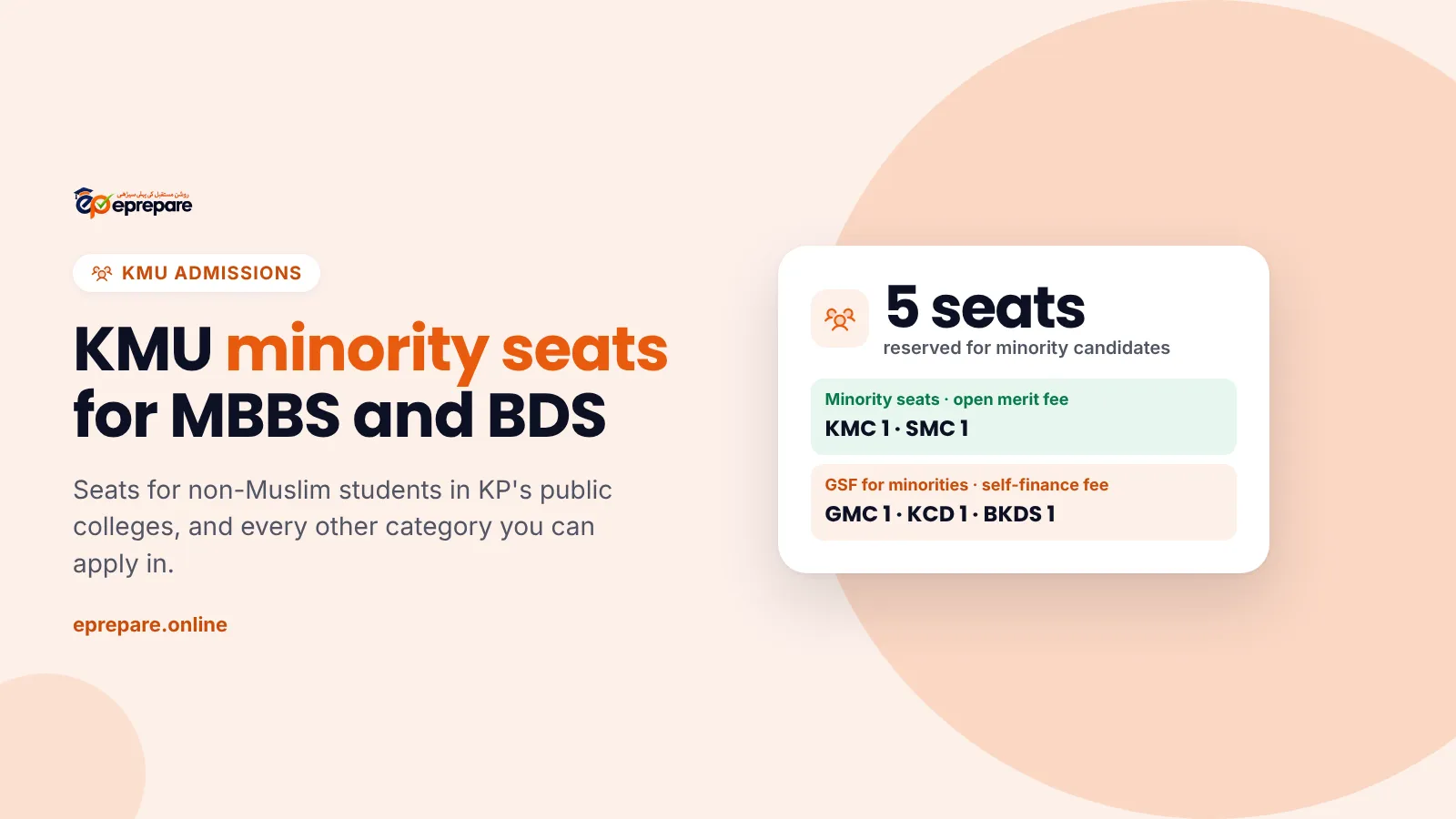
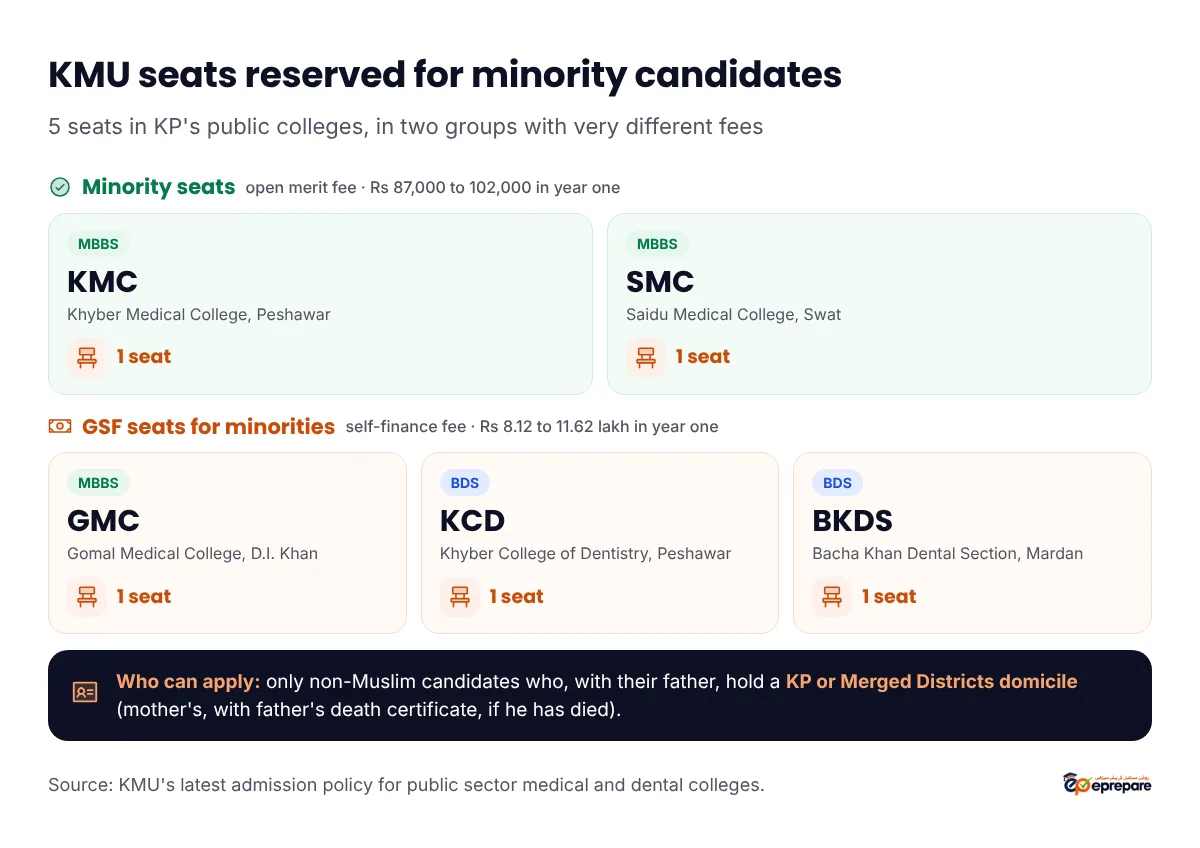
The short answer: KMU's latest policy has 5 seats reserved for minority candidates: 2 minority seats (1 MBBS at Khyber Medical College, 1 MBBS at Saidu Medical College) at the open merit fee, and 3 GSF seats for minorities (1 MBBS at Gomal Medical College, 1 BDS at Khyber College of Dentistry, 1 BDS at Bacha Khan Dental Section) at the self-finance fee. Only non-Muslim candidates who, with their father, hold a KP or Merged Districts domicile can apply. You can also apply on open merit, general self-finance and, with that area's domicile, backward area seats, and you choose which seat to take on merit. You compete for the minority seats only with other qualified minority candidates.
Who counts as a minority candidate?
The policy's section on minority seats is short and clear. Here it is in full:
"Only Non-Muslim candidates, who are domicile holders of KP / MDs, can apply for minority seats, Open Merit seats, Backward Area seats (holding valid domicile of the respective backward area) and General Self Finance Seats, and GSF seats reserved for minorities candidates. However, it will be the choice of the candidate to avail any category of seat as per merit.
Admission against this seat will be made by the KMU-AC from amongst the merit list of the qualified minority candidates.
The candidate and his/her father must be domiciled of Khyber Pakhtunkhwa / MDs. In case father of the candidate is not alive then the mother's valid domicile of Khyber Pakhtunkhwa/ MDs along with death certificate of father will be considered."
In plain words, you qualify if all of these are true:
- You are non-Muslim. The policy does not list particular faiths; it covers all non-Muslim candidates.
- You hold a domicile of Khyber Pakhtunkhwa or the Merged Districts (the former FATA).
- Your father holds a KP or Merged Districts domicile too. If he has passed away, your mother's valid KP or MDs domicile is accepted, with your father's death certificate.
- You meet every normal KMU requirement: at least 60% in HSSC (FSc pre-medical or equivalent) with Biology, Chemistry and Physics or Maths, and an MDCAT pass of at least 55% for MBBS or 50% for BDS. There is no relaxation for minority seats.
The seats reserved for minority candidates
There are two separate kinds of reserved seat, with very different fees. Don't confuse them.
| Seat type | College | Programme | Seats |
|---|---|---|---|
| Minority seat (open merit fee) | Khyber Medical College (KMC), Peshawar | MBBS | 1 |
| Minority seat (open merit fee) | Saidu Medical College (SMC), Swat | MBBS | 1 |
| GSF for minorities (self-finance fee) | Gomal Medical College (GMC), D.I. Khan | MBBS | 1 |
| GSF for minorities (self-finance fee) | Khyber College of Dentistry (KCD), Peshawar | BDS | 1 |
| GSF for minorities (self-finance fee) | Bacha Khan Dental Section (BKDS), Mardan | BDS | 1 |
| Total | 5 colleges | 3 MBBS + 2 BDS | 5 |
The minority seats are a reserved category of their own. The GSF seats for minorities are part of KMU's self-finance seats: the policy says general self-finance "have the following three categories, 1) General Self Finance Seats, 2) GSF for monitories candidates and 3) GSF for KMU wards." All five seats are within the 1,580 seats that PM&DC has sanctioned for KP's public colleges.
Five seats across the province is a small number. That is exactly why the policy lets you apply in several categories at once, and why you should.
Every category a minority candidate can apply for
The policy names five categories for non-Muslim candidates with a KP or MDs domicile. Each has its own merit list, so applying in more of them gives you more chances.
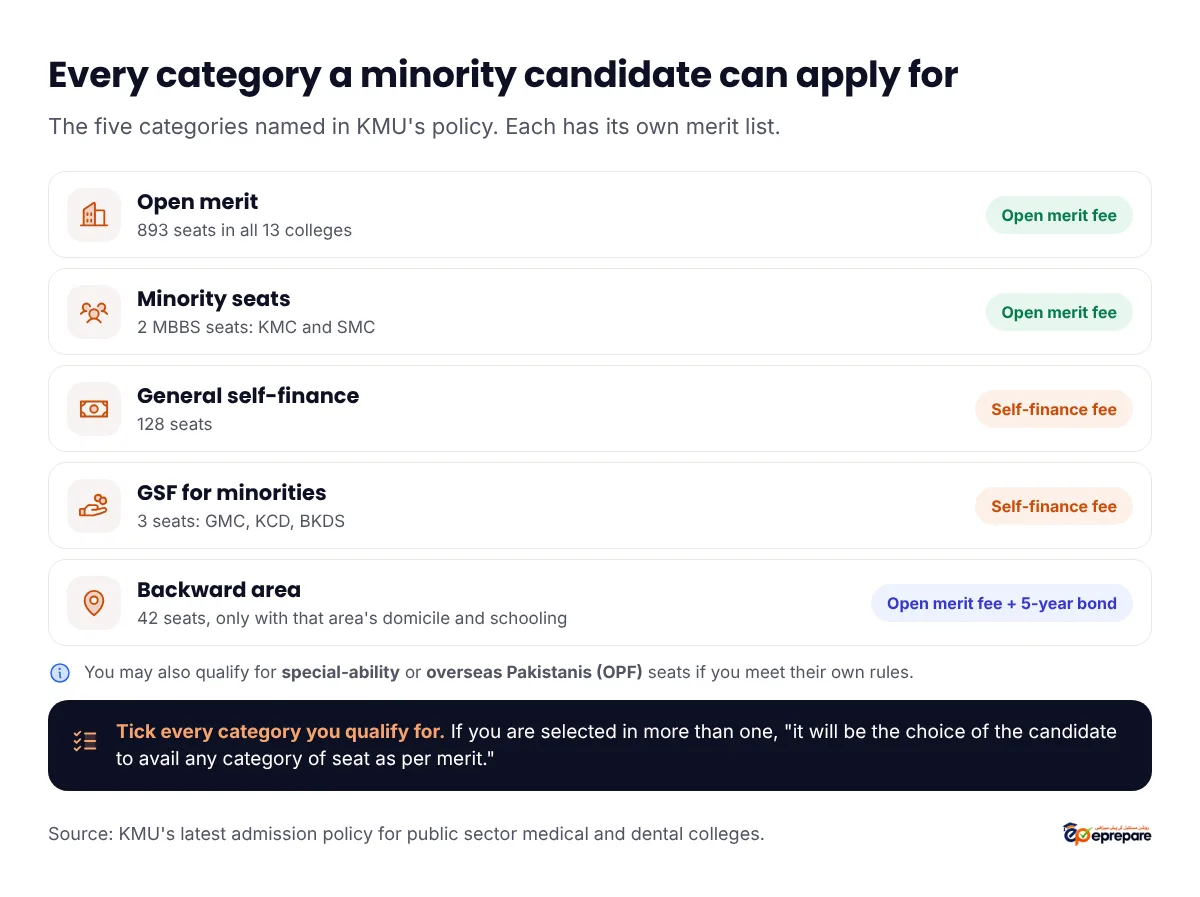
| Category | Seats | Fee | Who you compete with |
|---|---|---|---|
| Open merit | 893, in all 13 colleges | Open merit fee | All KP open merit applicants |
| Minority seats | 2 (KMC, SMC) | Open merit fee | Qualified minority candidates only |
| General self-finance | 128 | Self-finance fee | All GSF applicants |
| GSF for minorities | 3 (GMC, KCD, BKDS) | Self-finance fee | Minority candidates who apply for these seats |
| Backward area | 42, by area | Open merit fee, plus a 5-year service bond | Candidates of your own backward area |
Open merit
Minority candidates compete on open merit exactly like everyone else, in all 13 public colleges. If your aggregate is high enough for open merit, you can take that seat and leave the minority seat for another student. See KMU closing merit to see where open merit closed last time.
Backward area seats
If you hold the domicile of one of KP's backward areas, such as Chitral, Kohistan or Dir, you can also apply for that area's seats. You must meet all the backward area rules, including the domicile of that area for you and your father, education from class 1 to FSc inside the area, a location certificate from the DEO countersigned by the Deputy Commissioner, and a bond to serve in your home district for at least five years. Read our full guide to KP backward area seats.
General self-finance and GSF for minorities
A self-finance seat is a seat in the same public college, in the same classes as open merit students; only the fee is much higher. Read self-finance vs open merit at KMU before you decide whether self-finance is right for your family.
Other categories, if you qualify
The minority section does not mention every other category, but nothing in the policy stops a minority candidate from applying where they meet that category's own rules. For example, the special-ability seats and the overseas Pakistanis (OPF) seats accept KP or MDs domicile holders. The Merged Districts reserved seats are based on domicile and schooling, and the minority section doesn't mention them; if you hold an MDs domicile, apply for them too and confirm with KMU. See our guide to every KMU quota and reserved seat.
How the merit works
The policy says admission against the minority seats "will be made by the KMU-AC from amongst the merit list of the qualified minority candidates." So:
- KMU makes a separate merit list of qualified minority candidates, and you compete for the minority seats only with them.
- Your rank uses the normal aggregate: 10% Matric, 40% FSc, 50% MDCAT, to five decimal places. If two candidates are equal, the older one stands higher, then the one with higher Matric marks, then higher MDCAT marks. Check yours with our aggregate calculator.
- Seats are offered on merit-cum-choice: you only get a college you listed in your preferences.
- If you are selected in more than one category, you choose: "it will be the choice of the candidate to avail any category of seat as per merit."
Which seat should you take? Comparing your options
If you are lucky enough to be offered more than one seat, these are the main things to weigh.
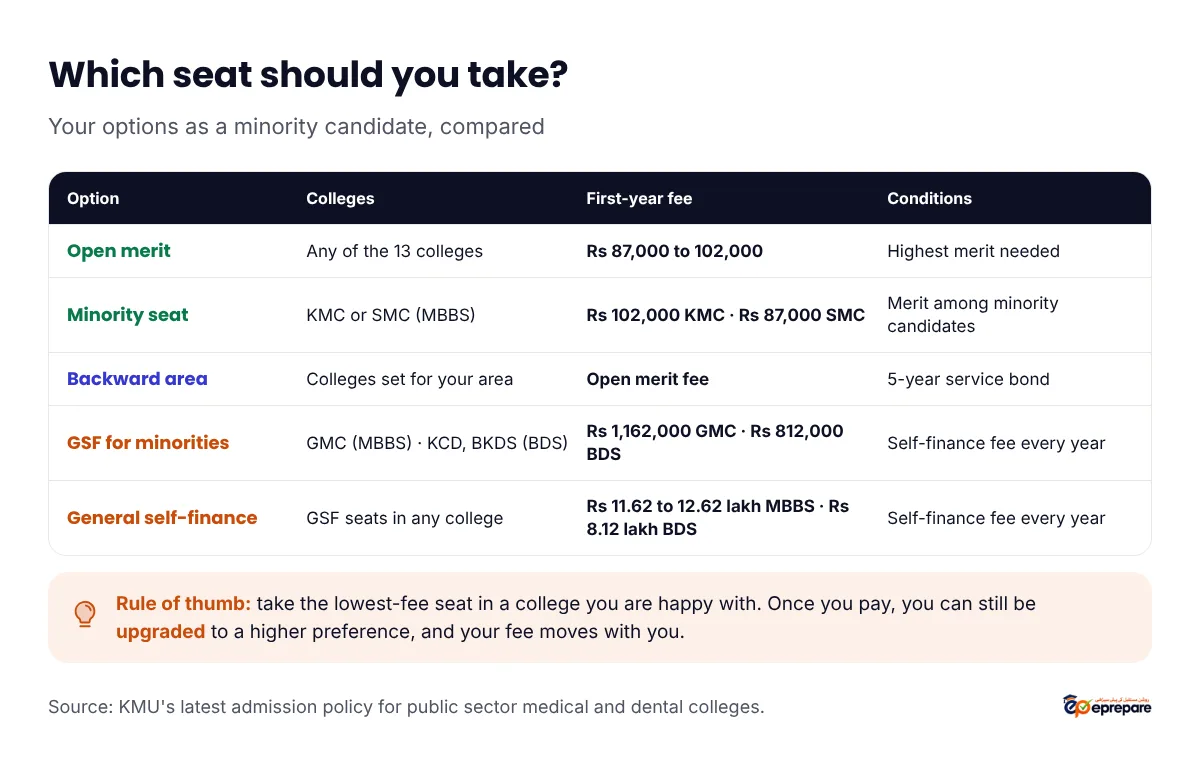
| Option | Colleges | First-year fee | Conditions |
|---|---|---|---|
| Open merit | Any of the 13 | Rs 87,000 to Rs 102,000 | Highest merit needed |
| Minority seat | KMC or SMC (MBBS) | Rs 102,000 (KMC) or Rs 87,000 (SMC) | Merit among minority candidates |
| Backward area seat | Colleges set for your area | Open merit fee | 5-year service bond |
| GSF for minorities | GMC (MBBS), KCD or BKDS (BDS) | Rs 1,162,000 (GMC) or Rs 812,000 (BDS) | Self-finance fee every year |
| General self-finance | Any college's GSF seats | Rs 1,162,000 to Rs 1,262,000 (MBBS), Rs 812,000 (BDS) | Self-finance fee every year |
A sensible rule of thumb: take the lowest-fee seat in a college you are happy with. Over the whole MBBS degree, an open merit or minority seat costs less than a tenth of a self-finance seat. A backward area seat also pays the open merit fee, but it comes with the five-year service bond, and breaking that bond costs "an amount equal to self-finance seat, with compounding interest rate". Once you have paid for a seat, you can still be upgraded to a college higher on your preference list in a later merit list, with your fee transferred without deduction. Our guide to KMU merit lists and upgrades explains how. For more on weighing categories, read which KMU seat category to take.
What you pay
Minority seats: the open merit fee
The policy lists "Minority Seats" among the seats that pay the normal fee, the same as open merit.
| Year | KMC | SMC |
|---|---|---|
| 1st year | Rs 102,000 | Rs 87,000 |
| 2nd year | Rs 102,000 | Rs 83,500 |
| 3rd year | Rs 112,000 | Rs 90,750 |
| 4th year | Rs 123,200 | Rs 99,825 |
| Final year | Rs 135,520 | Rs 109,807 |
| Total, 5 years | Rs 574,720 | Rs 470,882 |
KMC pays the higher rate, which the policy applies to Khyber Medical College, Khyber Girls Medical College and Ayub Medical College; Saidu Medical College pays the lower rate of "all other medical colleges".
GSF seats for minorities: the self-finance fee
The policy gives one general self-finance fee table and does not list a separate fee for the GSF seats reserved for minorities, so expect the normal GSF fee.
| Year | GMC (MBBS) | KCD or BKDS (BDS) |
|---|---|---|
| 1st year | Rs 1,162,000 | Rs 812,000 |
| 2nd year | Rs 1,250,000 | Rs 850,000 |
| 3rd year | Rs 1,350,000 | Rs 900,000 |
| 4th year | Rs 1,450,000 | Rs 950,000 |
| Final year (MBBS) | Rs 1,550,000 | Not applicable (BDS is 4 years) |
| Total | Rs 6,762,000 | Rs 3,512,000 |
Fees are paid into KMU's central account within three working days of your offer letter. Hostel, books and living costs are extra, and the policy says a revised fee structure can apply from time to time. See the full KMU MBBS and BDS fee structure.
Documents you need
Minority candidates upload the same documents as every other KMU applicant. Our KMU admission documents checklist lists them all. The main ones are:
- detailed marks certificates (DMCs) for Matric and FSc, and an IBCC equivalence certificate if you studied in a foreign system;
- your own KP or Merged Districts domicile, and your father's (or your mother's domicile and your father's death certificate, if he has died);
- your CNIC or Form B, and your father's CNIC (or your mother's or guardian's);
- a certificate from the institution you last attended, with your duration of stay;
- for backward area seats, the location certificate and any non-existence certificate, signed by the DEO and countersigned by the DC.
A point the policy doesn't cover: KMU's list of documents does not name a separate proof of religion or minority status. Check KMU's online form when admissions open, and if it asks for a document or a declaration, follow its instructions exactly. If you are unsure, ask KMU's admission office before the closing date, because certificates issued after the closing date are not counted and what you upload cannot be changed later.
How to apply, step by step
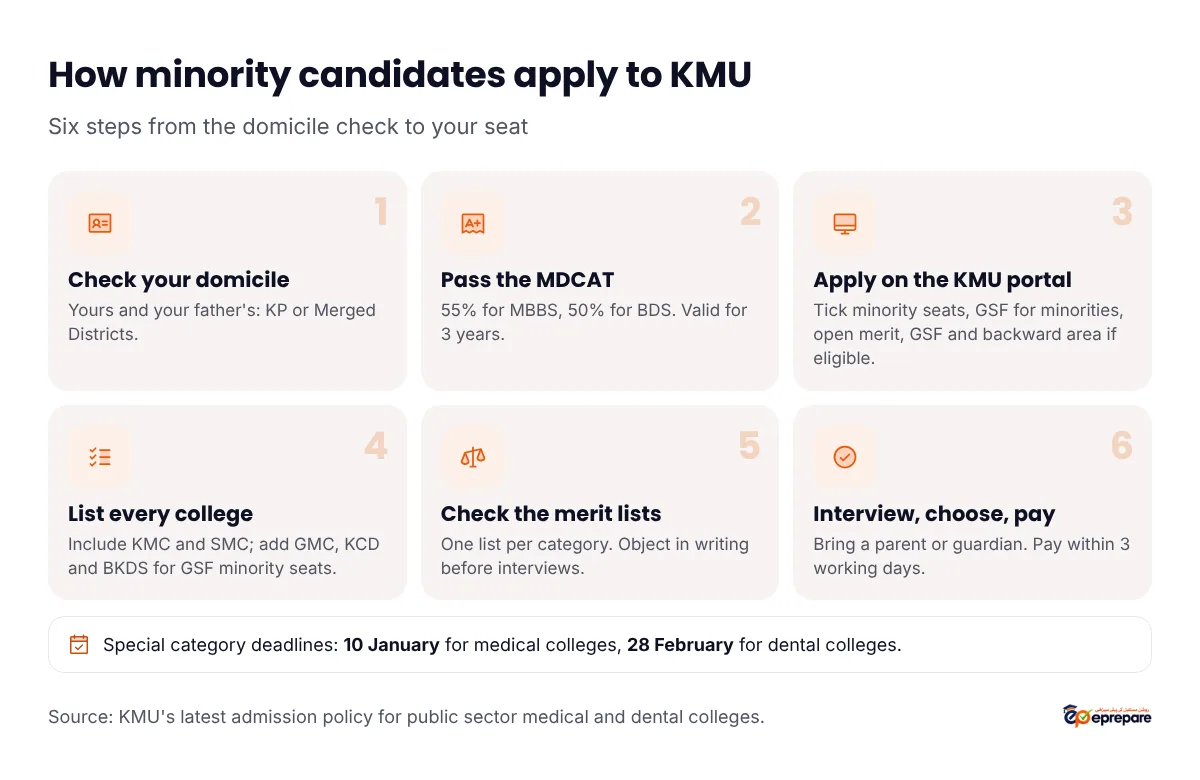
- Check your domicile and your father's. Both must be of KP or the Merged Districts. Apply early if either is missing; certificates issued after the closing date are not counted.
- Pass the MDCAT with at least 55% for MBBS or 50% for BDS. Your result stays valid for three years.
- Apply online at cas.kmu.edu.pk when KMU advertises admissions. Tick minority seats, and every other category you qualify for: GSF for minorities, open merit, general self-finance and backward area if you hold that domicile. Apply for BDS as well if you would accept it, because MBBS and BDS are separate applications.
- List every college you would accept, in your real order. Include KMC and SMC for the minority seats, and GMC, KCD and BKDS if you would take a GSF minority seat.
- Check every merit list. KMU shows a list for each category. If something is wrong, object in writing to the Chairman of the KMU Admission Committee before the placement interviews.
- Attend the placement interview with a parent or legal guardian, as the policy requires, bring your originals, choose your seat, and pay the fee within three working days of your offer letter.
Minority and self-finance seats are not open merit seats, so the policy's deadline for these "special category" admissions applies: 10 January for medical colleges and 28 February for dental colleges. Exact dates are announced in KMU's advertisement each year; see the KMU admission schedule.
After admission
- Migration is category-wise. KMU's migration rules list the "Minority Seat" among the categories that can migrate, but only into a vacant seat of the same category, and only after the 2nd Professional (MBBS) or 1st Professional (BDS). General self-finance is also listed; the policy doesn't separately mention the GSF seats for minorities, so confirm with KMU if you might need to move. See our KMU migration policy guide.
- Empty seats: if no eligible minority candidate takes a reserved seat, the policy converts it to an open merit seat.
- Admission is provisional until your college verifies your documents. A false document means cancellation, blacklisting from KP's professional colleges and possible legal action.
Frequently asked questions
How many minority seats are there in KMU colleges?
Five seats are reserved for minority candidates: 2 minority seats (MBBS at KMC and SMC) at the open merit fee, and 3 GSF seats for minorities (MBBS at GMC, BDS at KCD and BKDS) at the self-finance fee.
Who can apply for KMU minority seats?
Only non-Muslim candidates who, with their father, hold a domicile of Khyber Pakhtunkhwa or the Merged Districts. If your father has died, your mother's domicile is accepted with his death certificate. You also need 60% in HSSC and an MDCAT pass.
Can minority students also apply on open merit?
Yes. The policy says non-Muslim candidates can apply for minority seats, open merit, backward area seats (with that area's domicile), general self-finance and the GSF seats for minorities, and choose any seat they win on merit.
Is the MDCAT passing mark lower for minority candidates?
No. You need at least 55% for MBBS or 50% for BDS, and 60% in HSSC, like every candidate. You compete for the minority seats only with other qualified minority candidates.
What fee do I pay on a minority seat?
The open merit fee: Rs 102,000 in the first year at KMC and Rs 87,000 at SMC. The GSF seats for minorities pay the self-finance fee: Rs 1,162,000 in the first year at GMC and Rs 812,000 for BDS.
Do I need a certificate to prove I belong to a minority?
KMU's policy doesn't list one among the required documents. Check KMU's online form when admissions open and follow any instruction it gives, and ask KMU's admission office before the closing date if you are unsure.
Can a minority student with a Merged Districts domicile apply?
Yes. The minority section accepts a KP or Merged Districts domicile for you and your father, for minority seats and the other categories it names.
What happens to a minority seat nobody takes?
If no eligible minority candidate is available, the policy converts it to an open merit seat.
Whichever seat you aim for, your MDCAT score does most of the work, especially with only a handful of reserved seats. If you are preparing, ePrepare's MDCAT preparation gives you KPK textbook MCQs, full-length tests and a predicted score, so you can aim for open merit and keep the reserved seats as your safety net.
Source: Khyber Medical University, latest Admission Policy for Public Sector Medical and Dental Colleges of Khyber Pakhtunkhwa (minorities seats, general self-finance categories, college-wise seat distribution, eligibility, migration policy and fee schedule), available on cas.kmu.edu.pk. Quoted text keeps the policy's own spelling. Seats and rules can change when KMU issues a new policy; always check the latest version.