


KMU merit calculator for KPK.
Khyber Medical University ranks every applicant for KPK's public medical and dental colleges by one aggregate. Enter your marks to see yours, worked out the way KMU does it.
Checked against the official documents on 25 October 2026. Other universities: all merit calculators.
Your marks
Enter the totals printed on your result cards (for example 1100 or 1200). O and A level students: use your IBCC equivalence marks. MDCAT is out of 180. A result stays valid for three years, so if yours is an older result out of 200, choose 200.
Your merit report
Khyber Medical University, MBBS. Closing figures are what it took last time; merit moves every year, so treat them as a guide, not a promise.
Can you apply?
- At least 60% in FSc / HSSCYours: 91.82%
- MDCAT at least 55% for MBBSNeeds 100 out of 180. Yours: 88.89%
Where your marks went
- Matric1.00of 10 lost
- FSc3.27of 40 lost
- MDCAT5.56of 50 lost
One mark in MDCAT adds 0.2778 to your aggregate, as much as 8 FSc marks. To raise your aggregate by 1, you need about 4 more MDCAT marks.
You against every college's last meritEstimate for 2026-27
- Khyber Medical CollegePeshawarClosing95.2585You−5.0868MDCAT needed179 / 180Below
- Ayub Medical CollegeAbbottabadClosing94.8414You−4.6697MDCAT needed177 / 180Below
- Khyber Girls Medical CollegePeshawarClosing94.6000You−4.4283MDCAT needed176 / 180Below
- Bacha Khan Medical CollegeMardanClosing94.5474You−4.3757MDCAT needed176 / 180Below
- Saidu Medical CollegeSwatClosing94.4272You−4.2555MDCAT needed176 / 180Below
- Nowshera Medical CollegeNowsheraClosing94.3626You−4.1909MDCAT needed176 / 180Below
- Gajju Khan Medical CollegeSwabiClosing94.3222You−4.1505MDCAT needed175 / 180Below
- Gomal Medical CollegeD.I. KhanClosing94.2000You−4.0283MDCAT needed175 / 180Below
- Bannu Medical CollegeBannuClosing94.1818You−4.0101MDCAT needed175 / 180Below
- KMU Institute of Medical SciencesKohatClosing93.9414You−3.7697MDCAT needed174 / 180Below
Early tentative estimates for open merit, before KMU's official merit lists. The real closing depends on seats, applicants and how hard the MDCAT paper was.
What if you scored differently in MDCAT?
Aggregate 90.17172% (+0.000). That would be at or above the estimate for 0 of 10 colleges.
What MDCAT score do I need?
Pick the aggregate you are aiming for. We use the Matric and FSc marks above.
You need at least 160 out of 180 in MDCAT (88.5%).
Open the KPK college predictor with this aggregateHow KMU (KPK) calculates merit.
KMU's admission policy for public sector colleges sets the weighting as MDCAT 50%, FSc (pre-medical, HSSC or equivalent) 40% and SSC (Matric or equivalent) 10%. Each part is first turned into a percentage of its own total, multiplied by its weight, and the three are added.
KMU calculates the final figure to five decimal places. If two candidates are still equal at five decimals, the older candidate stands higher in merit. Your aggregate is the same in every seat category, but your rank changes with the pool you compete in.
| Rule | KMU (KPK) |
|---|---|
| Admitting university | Khyber Medical University (KMU), Peshawar |
| Colleges | Public sector medical and dental colleges of Khyber Pakhtunkhwa |
| Test | PM&DC MDCAT, 180 MCQs |
| Weighting | Matric 10%, FSc 40%, MDCAT 50% |
| Decimals | Five decimal places |
| Tie-break | The older candidate stands higher |
| Minimum to apply | 60% in HSSC, MDCAT 55% for MBBS or 50% for BDS |
| MDCAT validity | Valid in every province for three years |
Facts we checked
- Weighting 10/40/50, five decimals, older candidate in a tie, three-year MDCAT validity. KMU admission policy (public colleges)
- 60% HSSC, MDCAT 55% (MBBS) and 50% (BDS). PM&DC on FSc and MDCAT minimums (The Nation)
Last checked against the official documents on 25 October 2026.
The aggregate formula.
Three results, each turned into a percentage of its own total, then weighted and added.
The weights add up to 100, so your aggregate is a percentage too. The entry test alone carries half the weight, as much as Matric and FSc put together, and it is the one result you can still change.
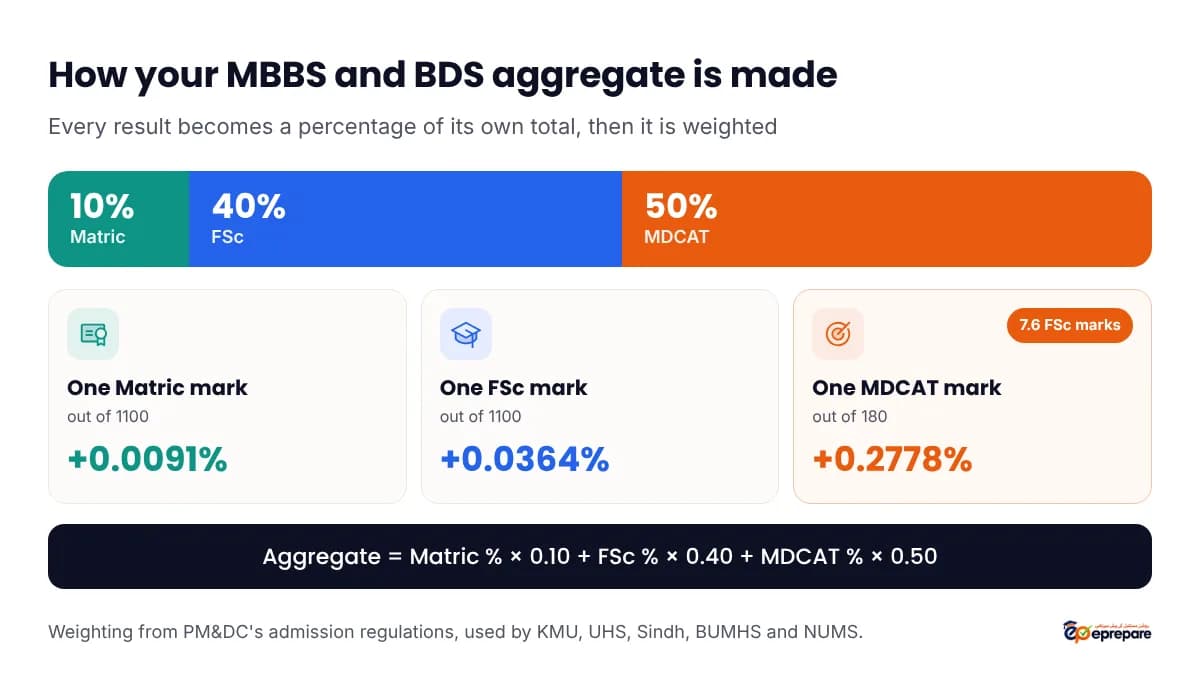
Worked example, line by line.
Matric 1010/1100, FSc 1020/1100 and MDCAT 165/180.
Keep four decimal places while you work and round only at the end. KMU, for example, ranks students to five decimal places, so a rounding slip of 0.01 can move you past hundreds of students.
Formula by university.
The weighting is the same everywhere. The test total and the merit lists are not.
| University | Province / colleges | Test and total | Weighting | Calculator |
|---|---|---|---|---|
| KMU (KPK) | Khyber Pakhtunkhwa | MDCAT, out of 180 | 10% / 40% / 50% | KMU (KPK) calculator |
| UHS (Punjab) | Punjab | MDCAT, out of 180 | 10% / 40% / 50% | UHS (Punjab) calculator |
| Sindh | Sindh | MDCAT, out of 180 | 10% / 40% / 50% | Sindh calculator |
| Balochistan | Balochistan | MDCAT, out of 180 | 10% / 40% / 50% | Balochistan calculator |
| Islamabad | Federal public colleges in Islamabad | MDCAT, out of 180 | 10% / 40% / 50% | Islamabad calculator |
| NUMS | Army Medical College, CMH and other NUMS colleges | NUMS MDCAT, result in % | 10% / 40% / 50% | NUMS calculator |
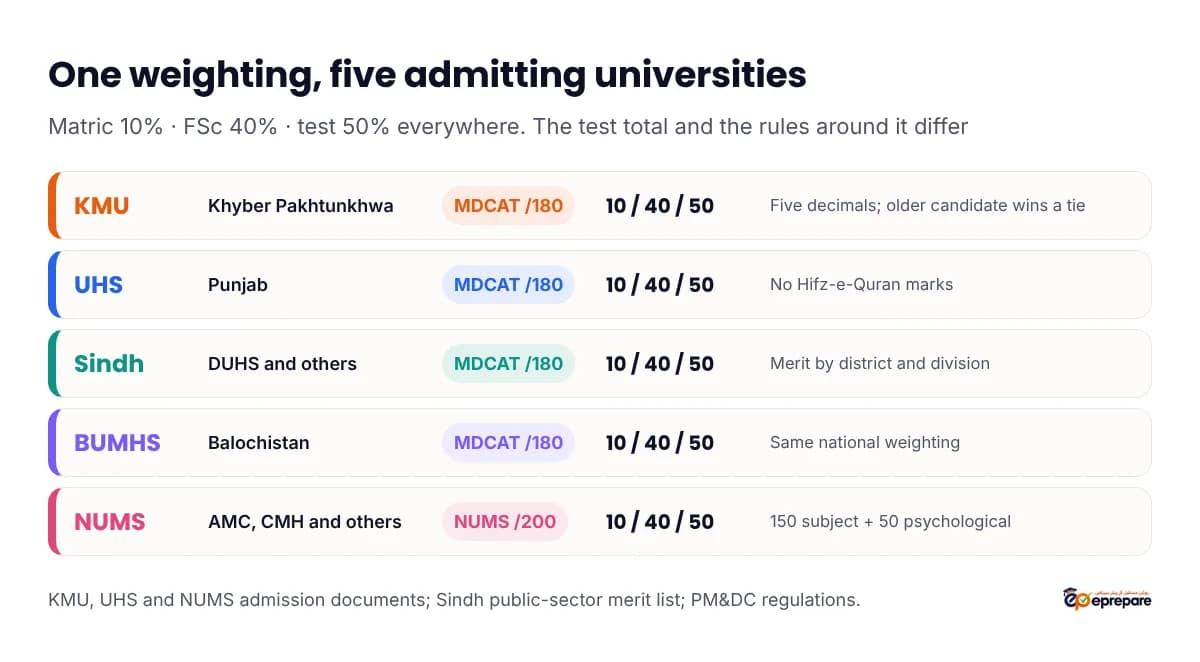
Which marks count most.
How much one mark adds to your aggregate, with 1100-mark Matric and FSc.
| One mark in | Adds to aggregate | Compared with one FSc mark |
|---|---|---|
| MDCAT (out of 180) | 0.2778% | 7.6 times |
| FSc (out of 1100) | 0.0364% | 1 time |
| Matric (out of 1100) | 0.0091% | 0.25 times |
Aggregate for every MDCAT score.
For a student with Matric 990/1100 and FSc 1010/1100.
| MDCAT score | Test % | Aggregate |
|---|---|---|
| 120 / 180 | 66.7% | 79.0606% |
| 130 / 180 | 72.2% | 81.8384% |
| 140 / 180 | 77.8% | 84.6162% |
| 150 / 180 | 83.3% | 87.3939% |
| 160 / 180 | 88.9% | 90.1717% |
| 170 / 180 | 94.4% | 92.9495% |
| 180 / 180 | 100.0% | 95.7273% |
Rules that change your aggregate.
- Use the totals on your result cards. Boards print 1100 or 1200 (and other totals); using the wrong total changes your percentage.
- Minimums to apply: 60% in HSSC, and 55% in MDCAT for MBBS or 50% for BDS.
- Older MDCAT results: a result stays valid for three years in every province. Use the total it was marked out of.
- No Hifz-e-Quran marks are added under PM&DC's current admission regulations.
- O and A levels: use the marks on your IBCC equivalence certificates. Read how IBCC equivalence works.
- Improved results count only if declared before the closing date. See rules for improvers and repeaters.
- Ties: KMU works to five decimal places and places the older candidate higher.
Wrong formulas you will see online.
Claims we found on other calculators, checked against the official documents.
| What some sites say | What the official documents say |
|---|---|
| KMU uses 20% Matric, 40% FSc and 40% MDCAT | KMU's policy: Matric 10%, FSc 40%, MDCAT 50%. |
| NUMS counts only FSc and its test, 50% each | NUMS's advert: SSC 10%, HSSC 40%, entrance test 50%. |
| Hafiz-e-Quran students get 20 extra marks | No extra marks under PM&DC's current admission regulations. |
| MDCAT is out of 200 | MDCAT is 180 MCQs; only older results were out of 200. |
| You need 60% in MDCAT to pass | 60% is the FSc minimum. MDCAT needs 55% (MBBS) or 50% (BDS). |
Facts we checked
- KMU: 10/40/50, five decimals, older candidate in a tie. KMU admission policy (public colleges)
- UHS: 10/40/50, MDCAT results from the last three years. UHS public-sector admission notice
- Sindh: Matric 10%, Inter 40%, MDCAT 50%. DUHS final merit list (Sindh public sector)
- NUMS: SSC 10%, HSSC 40%, test 50%. NUMS centralised admissions advert
- MDCAT: 180 MCQs. PM&DC uniform MDCAT curriculum
- 60% HSSC; MDCAT 55% (MBBS) and 50% (BDS). PM&DC on FSc and MDCAT minimums (The Nation)
Last checked against the official documents on 25 October 2026.
Questions students ask
What is KMU's aggregate formula?
KMU uses 10% of your Matric percentage, 40% of your FSc percentage and 50% of your MDCAT percentage, added together and worked to five decimal places.
How does KMU break a tie in aggregate?
If two candidates have the same merit up to five decimal places, KMU places the older candidate higher.
Can I use an MDCAT result from another province or an earlier year for KMU?
Yes. KMU's policy says an MDCAT result from one province is valid for the entire country for three years. If your older result was out of 200, choose 200 as the MDCAT total in the calculator.
What does adjusted FSc marks mean in KMU's policy?
KMU's merit table calls the 40% part adjusted FSc marks. For most students it is simply their FSc (or IBCC equivalent) marks. KMU's policy has special rules for some cases, for example the 2021 HSSC batch, where only the elective science subjects' marks count unless the result was improved.
What aggregate do I need for a KPK public medical college?
It depends on the college and your seat category. Check last year's closing aggregate for every college on our KMU closing merit page, or put your aggregate into the KPK college predictor.
How is merit calculated for MBBS in Pakistan?
Merit for MBBS and BDS is your aggregate: 10% of your Matric percentage, 40% of your FSc percentage and 50% of your MDCAT percentage. KMU, UHS, the Sindh universities, Balochistan and NUMS all use this formula, then rank every applicant by it and fill seats in that order. Compare your merit with last session's closing merit for each college.
How do I calculate my MDCAT aggregate?
Turn each mark into a percentage of its own total, then add 10% of your Matric percentage, 40% of your FSc percentage and 50% of your MDCAT percentage. For example, Matric 990/1100 (90%), FSc 1010/1100 (91.82%) and MDCAT 160/180 (88.89%) give 9 + 36.7273 + 44.4444 = 90.1717%.
Is MDCAT out of 180 or 200?
PM&DC's MDCAT is 180 MCQs, one mark each. An MDCAT result stays valid for three years, so if you are using an older result that was out of 200, enter 200 as the total. NUMS is different: it announces its test result as a percentage, so on the NUMS calculator you enter that percentage instead of marks.
Is the aggregate formula different in each province?
No. KMU (KPK), UHS (Punjab), Sindh's universities, Balochistan's Selection Committee and NUMS all use 10% Matric, 40% FSc and 50% for the entry test, following PM&DC's admission regulations. What differs is the test total, the seat categories and who you compete with.
Do Hafiz-e-Quran students get extra marks?
No. Under PM&DC's admission regulations and a 2023 suo motu judgment, no additional marks are given for Hifz-e-Quran. Calculators that still add 20 marks are out of date.
What are the minimum marks to apply for MBBS and BDS?
At least 60% in HSSC (FSc pre-medical or equivalent), and at least 55% in MDCAT for MBBS or 50% for BDS (99 or 90 out of 180). In April 2026 PM&DC allowed a one-time relaxation of up to 3% only to fill seats left vacant in the 2025-26 session; the standard minimums are unchanged.
Which marks matter most in the aggregate?
MDCAT, by far. With a 1100-mark FSc, one MDCAT mark (out of 180) is worth about 7.6 FSc marks and about 30.6 Matric marks.
I did O and A levels. How do I calculate my aggregate?
Get your IBCC equivalence certificates and enter the equivalent marks and totals for Matric (O level) and FSc (A level). Universities use the IBCC figures, not your grades.
My FSc result has not come yet. Can I still estimate?
Yes. Enter the marks you expect, or your Part I marks scaled to the full total, to get an estimate. Your real aggregate will use the final result you submit before the closing date.
Is improving FSc or MDCAT better for my aggregate?
Usually MDCAT. Raising FSc by 50 marks (out of 1100) adds about 1.82% to your aggregate; raising MDCAT by 10 marks (out of 180) adds about 2.78%.
Next, plan your admission.
Half your aggregate is one test.
Prepare for MDCAT with chapter-wise MCQs, past papers and full-length tests.