
NUMS held its MDCAT on Sunday, 13 September 2026, for admission to Army Medical College and the NUMS, CMH and armed-forces medical and dental colleges. This page has the complete Paper I: all 150 MCQs with their options, a full answer key, an explanation for every answer, and a chapter-by-chapter analysis of what NUMS tested.
The short answer: NUMS 2026 Paper I had 150 MCQs in 2 hours 45 minutes: Biology 55, Chemistry 40, Physics 40 and English 15, with no negative marking, plus a separate 50-MCQ psychological test. About 43,000 candidates sat it at 16 centres. The answer key below was worked out and checked by ePrepare's teachers; it is not an official NUMS key. Attempt Paper I online with a timer and instant marking.
NUMS 2026 at a glance
| What | Details |
|---|---|
| Test date | Sunday, 13 September 2026 |
| Conducted by | National University of Medical Sciences (NUMS), Rawalpindi |
| Paper I | 150 MCQs in 2 hours 45 minutes |
| Subjects (in order) | Biology Q1–55, Chemistry Q56–95, Physics Q96–135, English Q136–150 |
| Paper II | 50-MCQ psychological test in 15 minutes (not included here) |
| Negative marking | No negative marking |
| Candidates | About 43,000, at 15 centres in Pakistan and one in Saudi Arabia |
| Pass marks | 55% for MBBS, 50% for BDS |
NUMS weights the test 50% in your aggregate, with HSSC 40% and SSC 10%. Work out yours with the NUMS aggregate calculator.
NUMS 2026 answer key (Paper I)
Every answer with its subject and chapter. These answers were worked out and checked by ePrepare's teachers; read the explanation for any answer you want to verify.
| Q | Answer | Subject | Chapter |
|---|---|---|---|
| 1 | B | Biology | Acellular life (viruses) |
| 2 | B | Biology | Acellular life (viruses) |
| 3 | A | Biology | Immunity |
| 4 | B | Biology | Acellular life (viruses) |
| 5 | A | Biology | Bioenergetics |
| 6 | A | Biology | Bioenergetics |
| 7 | A | Biology | Bioenergetics |
| 8 | B | Biology | Bioenergetics |
| 9 | B | Biology | Bioenergetics |
| 10 | C | Biology | Bioenergetics |
| 11 | D | Biology | Bioenergetics |
| 12 | D | Biology | Biological molecules |
| 13 | C | Biology | Biological molecules |
| 14 | B | Biology | Biological molecules |
| 15 | B | Biology | Biological molecules |
| 16 | A | Biology | Biological molecules |
| 17 | D | Biology | Biological molecules |
| 18 | C | Biology | Biological molecules |
| 19 | C | Biology | Cell structure and function |
| 20 | C | Biology | Cell structure and function |
| 21 | A | Biology | Cell structure and function |
| 22 | C | Biology | Cell structure and function |
| 23 | A | Biology | Cell structure and function |
| 24 | B | Biology | Cell structure and function |
| 25 | A | Biology | Cell structure and function |
| 26 | D | Biology | Coordination and control |
| 27 | B | Biology | Coordination and control |
| 28 | B | Biology | Coordination and control |
| 29 | A | Biology | Coordination and control |
| 30 | B | Biology | Coordination and control |
| Q | Answer | Subject | Chapter |
|---|---|---|---|
| 31 | B | Biology | Coordination and control |
| 32 | A | Biology | Coordination and control |
| 33 | B | Biology | Diversity among animals |
| 34 | B | Biology | Enzymes |
| 35 | B | Biology | Enzymes |
| 36 | A | Biology | Circulation |
| 37 | C | Biology | Enzymes |
| 38 | B | Biology | Enzymes |
| 39 | A | Biology | Evolution |
| 40 | D | Biology | Evolution |
| 41 | C | Biology | Inheritance |
| 42 | A | Biology | Evolution |
| 43 | A | Biology | Circulation |
| 44 | B | Biology | Homeostasis |
| 45 | B | Biology | Support and movement |
| 46 | C | Biology | Support and movement |
| 47 | B | Biology | Support and movement |
| 48 | C | Biology | Support and movement |
| 49 | C | Biology | Prokaryotes (bacteria) |
| 50 | A | Biology | Prokaryotes (bacteria) |
| 51 | C | Biology | Reproduction |
| 52 | D | Biology | Reproduction |
| 53 | D | Biology | Respiration |
| 54 | C | Biology | Digestion |
| 55 | D | Biology | Inheritance |
| 56 | B | Chemistry | Fundamental concepts |
| 57 | C | Chemistry | Atomic structure |
| 58 | A | Chemistry | Atomic structure |
| 59 | D | Chemistry | Gases |
| 60 | C | Chemistry | Gases |
| Q | Answer | Subject | Chapter |
|---|---|---|---|
| 61 | D | Chemistry | Liquids |
| 62 | C | Chemistry | Liquids |
| 63 | C | Chemistry | Solids |
| 64 | A | Chemistry | Solids |
| 65 | D | Chemistry | Chemical equilibrium |
| 66 | D | Chemistry | Chemical equilibrium |
| 67 | D | Chemistry | Reaction kinetics |
| 68 | B | Chemistry | Reaction kinetics |
| 69 | A | Chemistry | Thermochemistry |
| 70 | B | Chemistry | Thermochemistry |
| 71 | B | Chemistry | Electrochemistry |
| 72 | C | Chemistry | Electrochemistry |
| 73 | A | Chemistry | Chemical bonding |
| 74 | C | Chemistry | Chemical bonding |
| 75 | B | Chemistry | s- and p-block elements |
| 76 | B | Chemistry | s- and p-block elements |
| 77 | D | Chemistry | s- and p-block elements |
| 78 | A | Chemistry | s- and p-block elements |
| 79 | C | Chemistry | s- and p-block elements |
| 80 | A | Chemistry | Fundamental principles of organic chemistry |
| 81 | C | Chemistry | Fundamental principles of organic chemistry |
| 82 | C | Chemistry | Alcohols and phenols |
| 83 | A | Chemistry | Hydrocarbons |
| 84 | D | Chemistry | Hydrocarbons |
| 85 | A | Chemistry | Hydrocarbons |
| 86 | D | Chemistry | Alkyl halides |
| 87 | C | Chemistry | Alcohols and phenols |
| 88 | D | Chemistry | Alcohols and phenols |
| 89 | B | Chemistry | Aldehydes and ketones |
| 90 | B | Chemistry | Aldehydes and ketones |
| Q | Answer | Subject | Chapter |
|---|---|---|---|
| 91 | C | Chemistry | Carboxylic acids |
| 92 | B | Chemistry | Carboxylic acids |
| 93 | C | Chemistry | Carboxylic acids |
| 94 | A | Chemistry | Macromolecules |
| 95 | C | Chemistry | Macromolecules |
| 96 | C | Physics | Force and motion |
| 97 | B | Physics | Force and motion |
| 98 | C | Physics | Force and motion |
| 99 | C | Physics | Force and motion |
| 100 | D | Physics | Work and energy |
| 101 | D | Physics | Work and energy |
| 102 | D | Physics | Work and energy |
| 103 | C | Physics | Work and energy |
| 104 | B | Physics | Work and energy |
| 105 | B | Physics | Rotational and circular motion |
| 106 | D | Physics | Rotational and circular motion |
| 107 | B | Physics | Rotational and circular motion |
| 108 | B | Physics | Rotational and circular motion |
| 109 | A | Physics | Rotational and circular motion |
| 110 | B | Physics | Waves and simple harmonic motion |
| 111 | B | Physics | Waves and simple harmonic motion |
| 112 | A | Physics | Waves and simple harmonic motion |
| 113 | C | Physics | Waves and simple harmonic motion |
| 114 | B | Physics | Thermodynamics |
| 115 | C | Physics | Thermodynamics |
| 116 | B | Physics | Thermodynamics |
| 117 | C | Physics | Electrostatics |
| 118 | B | Physics | Electrostatics |
| 119 | B | Physics | Nuclear physics |
| 120 | C | Physics | Electrostatics |
| Q | Answer | Subject | Chapter |
|---|---|---|---|
| 121 | B | Physics | Current electricity |
| 122 | D | Physics | Current electricity |
| 123 | B | Physics | Current electricity |
| 124 | C | Physics | Electromagnetism |
| 125 | D | Physics | Electromagnetism |
| 126 | C | Physics | Electromagnetism |
| 127 | B | Physics | Electromagnetic induction |
| 128 | A | Physics | Electromagnetic induction |
| 129 | B | Physics | Electromagnetic induction |
| 130 | B | Physics | Electronics |
| 131 | C | Physics | Electronics |
| 132 | C | Physics | Dawn of modern physics |
| 133 | A | Physics | Dawn of modern physics |
| 134 | D | Physics | Dawn of modern physics |
| 135 | C | Physics | Atomic spectra |
| 136 | C | English | Formal and lexical aspects of language |
| 137 | A | English | Formal and lexical aspects of language |
| 138 | B | English | Formal and lexical aspects of language |
| 139 | C | English | Formal and lexical aspects of language |
| 140 | B | English | Formal and lexical aspects of language |
| 141 | B | English | Formal and lexical aspects of language |
| 142 | C | English | Writing skills |
| 143 | A | English | Formal and lexical aspects of language |
| 144 | D | English | Formal and lexical aspects of language |
| 145 | D | English | Writing skills |
| 146 | B | English | Reading and thinking skills |
| 147 | D | English | Reading and thinking skills |
| 148 | D | English | Reading and thinking skills |
| 149 | A | English | Formal and lexical aspects of language |
| 150 | B | English | Reading and thinking skills |
Which chapters NUMS tested
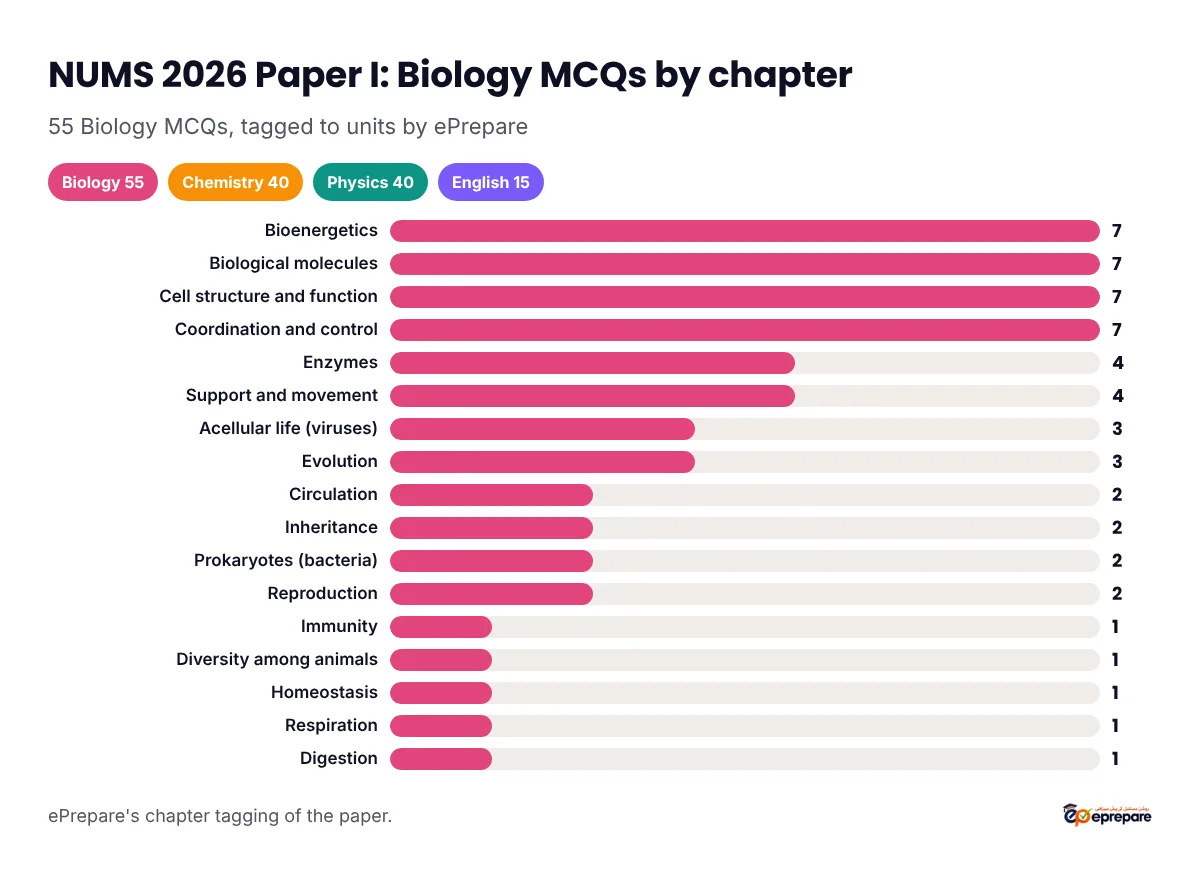
We tagged every question to its unit. In Biology the biggest chapters were Bioenergetics (7), Biological molecules (7), Cell structure and function (7), Coordination and control (7). Note the NUMS-only units: Diversity among animals and Prokaryotes appeared, which PM&DC's MDCAT does not include. Compare both syllabi on the PM&DC vs NUMS guide.
Biology: 55 MCQs
| Chapter | MCQs | Share of Biology |
|---|---|---|
| Bioenergetics | 7 | 13% |
| Biological molecules | 7 | 13% |
| Cell structure and function | 7 | 13% |
| Coordination and control | 7 | 13% |
| Enzymes | 4 | 7% |
| Support and movement | 4 | 7% |
| Acellular life (viruses) | 3 | 5% |
| Evolution | 3 | 5% |
| Circulation | 2 | 4% |
| Inheritance | 2 | 4% |
| Prokaryotes (bacteria) | 2 | 4% |
| Reproduction | 2 | 4% |
| Immunity | 1 | 2% |
| Diversity among animals | 1 | 2% |
| Homeostasis | 1 | 2% |
| Respiration | 1 | 2% |
| Digestion | 1 | 2% |
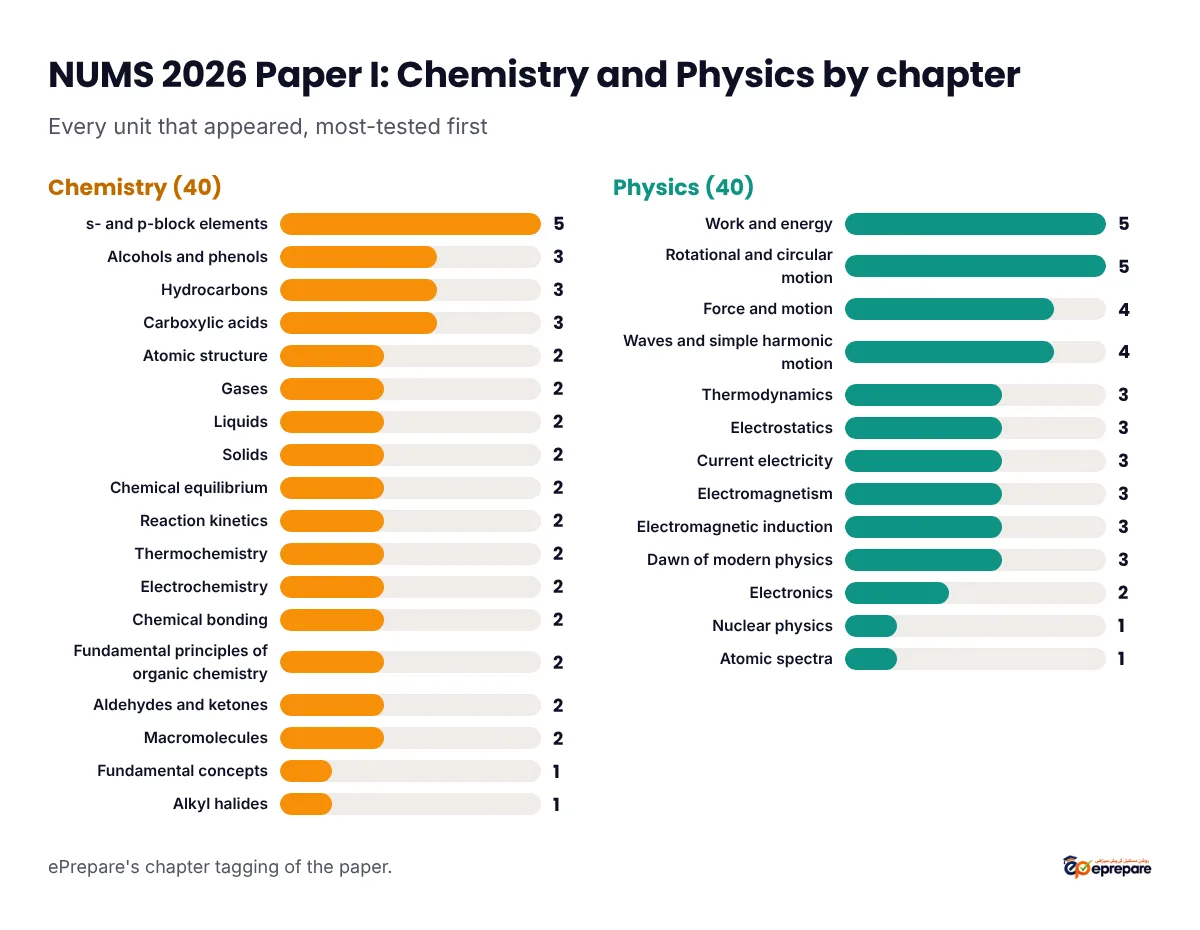
Chemistry: 40 MCQs
| Chapter | MCQs | Share of Chemistry |
|---|---|---|
| s- and p-block elements | 5 | 12% |
| Alcohols and phenols | 3 | 8% |
| Hydrocarbons | 3 | 8% |
| Carboxylic acids | 3 | 8% |
| Atomic structure | 2 | 5% |
| Gases | 2 | 5% |
| Liquids | 2 | 5% |
| Solids | 2 | 5% |
| Chemical equilibrium | 2 | 5% |
| Reaction kinetics | 2 | 5% |
| Thermochemistry | 2 | 5% |
| Electrochemistry | 2 | 5% |
| Chemical bonding | 2 | 5% |
| Fundamental principles of organic chemistry | 2 | 5% |
| Aldehydes and ketones | 2 | 5% |
| Macromolecules | 2 | 5% |
| Fundamental concepts | 1 | 2% |
| Alkyl halides | 1 | 2% |
Physics: 40 MCQs
| Chapter | MCQs | Share of Physics |
|---|---|---|
| Work and energy | 5 | 12% |
| Rotational and circular motion | 5 | 12% |
| Force and motion | 4 | 10% |
| Waves and simple harmonic motion | 4 | 10% |
| Thermodynamics | 3 | 8% |
| Electrostatics | 3 | 8% |
| Current electricity | 3 | 8% |
| Electromagnetism | 3 | 8% |
| Electromagnetic induction | 3 | 8% |
| Dawn of modern physics | 3 | 8% |
| Electronics | 2 | 5% |
| Nuclear physics | 1 | 2% |
| Atomic spectra | 1 | 2% |
English: 15 MCQs
| Chapter | MCQs | Share of English |
|---|---|---|
| Formal and lexical aspects of language | 9 | 60% |
| Reading and thinking skills | 4 | 27% |
| Writing skills | 2 | 13% |
How to use this paper
- Attempt it under time: 150 MCQs in 2 hours 45 minutes on our free online test.
- Read every explanation before moving on.
- Give Physics its due: NUMS has 40 Physics MCQs. Practise more on Physics MCQs.
- See the pattern change and more NUMS MCQs on NUMS past papers.
Biology MCQs with answers and explanations (Q1 to Q55)
Q1. Identify the type of glycoprotein, responsible for cell fusion process in HIV cycle:
Biology · Acellular life (viruses)
- A. gp 40
- B. gp 41
- C. gp 120
- D. gp 121
Show answer and explanation
Answer: B. gp 41
HIV first attaches to a CD4 cell through gp120.
After attachment, gp41 draws the viral envelope and cell membrane together.
Their fusion opens the way for the viral contents to enter the host cell.
The fusion protein asked for here is gp41.
Q2. Which of the following enzymes converts mRNA to complementary DNA (cDNA)?
Biology · Acellular life (viruses)
- A. Integrase
- B. Reverse transcriptase
- C. Protease
- D. DNAase
Show answer and explanation
Answer: B. Reverse transcriptase
Complementary DNA is made by reading an RNA template.
Reverse transcriptase carries out this RNA-to-DNA conversion.
Integrase inserts viral DNA, while protease processes viral proteins.
The required enzyme is reverse transcriptase.
Q3. Edward Jenner used material removed from the lesion on the hand of a milkmaid and vaccinated a boy suffering from which disease?
Biology · Immunity
- A. Small pox
- B. Chicken pox
- C. Cow pox
- D. Measles
Show answer and explanation
Answer: A. Small pox
Jenner collected material from cowpox lesions on a milkmaid's hand.
He used it to protect a boy against the related but more dangerous smallpox virus.
Exposure to cowpox antigens prepared the immune system to recognize smallpox.
The disease named in the question is smallpox.
Q4. Adenovirus are classified as:
Biology · Acellular life (viruses)
- A. Helical capsid
- B. Polyhedral capsid
- C. Enveloped virus
- D. Coupler capsid
Show answer and explanation
Answer: B. Polyhedral capsid
Adenoviruses have an icosahedral capsid.
An icosahedron is a many-sided structure, so it is classified as polyhedral.
Adenoviruses are not helical and generally do not possess a lipid envelope.
Polyhedral capsid is the accurate description.
Q5. If a person is doing strenuous exercise, how many ATPs are produced by cellular respiration?
Biology · Bioenergetics
- A. 2 ATPs
- B. 3 ATPs
- C. 4 ATPs
- D. 6 ATPs
Show answer and explanation
Answer: A. 2 ATPs
During strenuous exercise, oxygen delivery may not satisfy the muscles' demand.
The cells then rely more heavily on anaerobic glycolysis.
Four ATP are formed, but two are used during the early steps.
The net gain is 2 ATP per glucose molecule.
Q6. The end product of non-cyclic electron pathway is:
Biology · Bioenergetics
- A. ATP and NADPH
- B. ATP
- C. FADH₂
- D. NADPH
Show answer and explanation
Answer: A. ATP and NADPH
Non-cyclic electron flow uses both photosystem II and photosystem I.
Electron movement builds the proton gradient needed to produce ATP.
The final electrons reduce NADP⁺ to NADPH, while water splitting also releases oxygen.
Among the listed pairs, ATP and NADPH are the products.
Q7. Pyruvic acid is converted into acetaldehyde through which step?
Biology · Bioenergetics
- A. Decarboxylation
- B. Oxidation
- C. Addition of coenzyme A
- D. Reduction
Show answer and explanation
Answer: A. Decarboxylation
Pyruvic acid contains three carbon atoms.
During alcoholic fermentation, it first loses one carbon as CO₂.
Removal of carbon dioxide is called decarboxylation and leaves two-carbon acetaldehyde.
Acetaldehyde is then reduced to ethanol in the next step.
Q8. Choose the correct sequence of electron carrier in respiratory ETC:
Biology · Bioenergetics
- A. Coenzyme Q → cytochrome a → cytochrome a → cytochrome b → cytochrome c
- B. Coenzyme Q → cytochrome b → cytochrome c → cytochrome a → cytochrome a
- C. Cytochrome a → cytochrome a → cytochrome b → cytochrome c → coenzyme Q
- D. Cytochrome b → cytochrome c → coenzyme Q → cytochrome a → cytochrome a
Show answer and explanation
Answer: B. Coenzyme Q → cytochrome b → cytochrome c → cytochrome a → cytochrome a
Coenzyme Q receives electrons and passes them into the cytochrome chain.
The simplified sequence proceeds through cytochromes b, c, a and a₃.
Oxygen accepts the electrons at the end of the pathway.
The sequence beginning with coenzyme Q followed by b, c, a and a₃ is correct.
Q9. Pumping movement of protons occur from:
Biology · Bioenergetics
- A. Outer membrane and inner membrane
- B. Matrix of mitochondria and mitochondrial intermembrane space
- C. Inner membrane and cisternae
- D. Inner membrane and intermembrane space
Show answer and explanation
Answer: B. Matrix of mitochondria and mitochondrial intermembrane space
Respiratory electron carriers are embedded in the inner mitochondrial membrane.
As electrons move along the chain, H⁺ ions are pumped out of the matrix.
They accumulate in the intermembrane space and create a proton gradient.
The movement asked for is from the matrix to the intermembrane space.
Q10. Net product of Krebs cycle is:
Biology · Bioenergetics
- A. 2CO₂, 3ATP, 6NADH, 2FADH₂
- B. 4CO₂, 3NADH, 6ATP, 3FADH₂
- C. 4CO₂, 2ATP, 6NADH, 2FADH₂
- D. CO₂, NADH, FADH₂
Show answer and explanation
Answer: C. 4CO₂, 2ATP, 6NADH, 2FADH₂
One glucose molecule supplies two acetyl-CoA molecules, so the Krebs cycle turns twice.
Those two turns release 4CO₂ and produce 6NADH.
They also form 2FADH₂ and 2 ATP equivalents.
The complete set is 4CO₂, 2ATP, 6NADH and 2FADH₂.
Q11. The electron carriers of mitochondria are found in the:
Biology · Bioenergetics
- A. Outer mitochondrial membrane
- B. Stroma
- C. Intermembrane space
- D. Inner mitochondrial membrane
Show answer and explanation
Answer: D. Inner mitochondrial membrane
The mitochondrial electron-transport chain lies in the inner membrane.
Its carrier proteins and ATP synthase are arranged along the cristae.
Folding of this membrane provides a large surface for oxidative phosphorylation.
The inner mitochondrial membrane is therefore the correct location.
Q12. Which one of the following is a monosaccharide?
Biology · Biological molecules
- A. Sucrose
- B. Maltose
- C. Lactose
- D. Fructose
Show answer and explanation
Answer: D. Fructose
A monosaccharide contains one sugar unit.
Fructose is a single-unit sugar.
Sucrose, maltose and lactose each contain two linked monosaccharides.
Only fructose belongs to the monosaccharide group.
Q13. What is percentage of water in brain cells?
Biology · Biological molecules
- A. 20%
- B. 70%
- C. 85%
- D. 30%
Show answer and explanation
Answer: C. 85%
Brain tissue contains a particularly high proportion of water.
The approximate textbook value used for brain cells is 85 percent.
This water provides the medium for reactions and movement of dissolved substances.
The expected percentage is 85%.
Q14. Proportion of carbohydrate in bacterial and mammalian cell is:
Biology · Biological molecules
- A. 2%, 4%
- B. 3%, 4%
- C. 4%, 2%
- D. 3%, 2%
Show answer and explanation
Answer: B. 3%, 4%
The question asks for the representative carbohydrate content of two cell types.
Bacterial cells are given as containing about 3 percent carbohydrate.
Mammalian cells are represented by the slightly higher value of 4 percent.
The matching pair is 3% and 4%.
Q15. Water has very high heat capacity due to its:
Biology · Biological molecules
- A. High polarity
- B. Hydrogen bonding
- C. High heat of vaporization
- D. Ionization
Show answer and explanation
Answer: B. Hydrogen bonding
Water molecules form many hydrogen bonds with one another.
Added heat is first used partly to loosen these attractions.
As a result, considerable energy produces only a small rise in temperature.
Hydrogen bonding accounts for water's high heat capacity.
Q16. Which one of the following biomolecule is involved in the transport of oxygen?
Biology · Biological molecules
- A. Protein
- B. Fats
- C. Carbohydrate
- D. Nucleic acid
Show answer and explanation
Answer: A. Protein
Haemoglobin carries oxygen in red blood cells.
Haemoglobin is a protein containing iron-bearing haem groups.
Oxygen binds reversibly to these groups in the lungs and is released in tissues.
The biomolecule involved in this transport is protein.
Q17. Which is the second most abundant organic molecule on earth?
Biology · Biological molecules
- A. Starch
- B. Glycogen
- C. Cellulose
- D. Chitin
Show answer and explanation
Answer: D. Chitin
Cellulose is generally described as the most abundant natural organic polymer.
Chitin is also widespread in arthropod exoskeletons and fungal cell walls.
Its extensive occurrence places it next to cellulose in abundance.
The second most abundant option is chitin.
Q18. Glycerol reacts with fatty acids to produce:
Biology · Biological molecules
- A. Phospholipids
- B. Terpenes
- C. Acyl glycerol
- D. Steroids
Show answer and explanation
Answer: C. Acyl glycerol
Glycerol has three hydroxyl groups available for reaction.
Fatty acids join these groups through ester bonds.
The products are acylglycerols, including triglycerides when all three sites react.
Acyl glycerol is the suitable answer.
Q19. During cell wall formation absence of magnesium results in:
Biology · Cell structure and function
- A. Lack of primary cell wall
- B. Lack of secondary cell wall
- C. Lack of middle lamella
- D. No effect on cell wall formation
Show answer and explanation
Answer: C. Lack of middle lamella
The middle lamella contains pectic material that cements neighboring plant cells.
Calcium and magnesium help stabilize these pectates.
A magnesium shortage therefore interferes most directly with formation of this cementing layer.
The affected structure is the middle lamella.
Q20. Identify the mismatch in the following:
Biology · Cell structure and function
- A. Mitochondria - cellular respiration
- B. Endoplasmic reticulum - detoxification
- C. Mitochondria - deamination
- D. Lysosome - autophagy
Show answer and explanation
Answer: C. Mitochondria - deamination
Mitochondria are primarily responsible for aerobic respiration and ATP formation.
The endoplasmic reticulum participates in processes such as detoxification.
Lysosomes digest damaged organelles during autophagy.
Mitochondria paired with deamination is the mismatched association.
Q21. Which organelle will increase in number, in muscles of athlete?
Biology · Cell structure and function
- A. Mitochondria
- B. Ribosome
- C. Golgi apparatus
- D. Lysosome
Show answer and explanation
Answer: A. Mitochondria
Athletic training raises the muscles' demand for sustained aerobic energy.
Muscle cells adapt by producing more mitochondria.
The additional mitochondria increase the capacity for oxidative ATP production.
Mitochondria are the organelles expected to increase.
Q22. In secretory cells which pathway is followed for the transport of material?
Biology · Cell structure and function
- A. Golgi complex RER SER
- B. RER golgi complex SER
- C. RER SER golgi complex
- D. SER golgi complex RER
Show answer and explanation
Answer: C. RER SER golgi complex
Secretory proteins begin on ribosomes attached to rough ER.
They pass through transitional or smooth ER regions into transport vesicles.
The vesicles then carry them to the Golgi complex for processing and sorting.
The intended pathway is RER, SER and Golgi complex.
Q23. How many number of chromosomes are present in onion?
Biology · Cell structure and function
- A. 16
- B. 8
- C. 14
- D. 26
Show answer and explanation
Answer: A. 16
Ordinary onion somatic cells are diploid.
The diploid chromosome number of Allium cepa is 16.
Only its gametes would carry the reduced haploid number of 8.
The chromosome number requested is 16.
Q24. A cell is treated with a toxin that disrupts Golgi apparatus. Which function is affected?
Biology · Cell structure and function
- A. Lipid metabolism
- B. Protein modification
- C. Chromosome separation during cell division
- D. ATP production
Show answer and explanation
Answer: B. Protein modification
The Golgi apparatus receives proteins made in the endoplasmic reticulum.
It modifies those proteins and sorts them according to their destinations.
A toxin that damages the Golgi will therefore disturb normal protein processing.
Protein modification is the function most directly affected.
Q25. Where modification and packaging occur in secretory cells?
Biology · Cell structure and function
- A. Golgi apparatus
- B. Mitochondria
- C. Endoplasmic reticulum
- D. Nucleus
Show answer and explanation
Answer: A. Golgi apparatus
Products arriving from the ER enter the Golgi apparatus.
Golgi cisternae modify and sort this material.
The material is then packed into vesicles for secretion or delivery inside the cell.
Modification and packaging occur in the Golgi apparatus.
Q26. A person continuously faces water imbalance in body due to damage of which part of the brain?
Biology · Coordination and control
- A. Amygdala
- B. Thalamus
- C. Medulla
- D. Hypothalamus
Show answer and explanation
Answer: D. Hypothalamus
The hypothalamus monitors the concentration of body fluids.
It regulates thirst and helps control the release of ADH.
These responses coordinate water intake with kidney water conservation.
Damage to the hypothalamus can therefore cause persistent water imbalance.
Q27. Which part of the brain is activated to release excess CO₂ from the body during strenuous exercise?
Biology · Coordination and control
- A. Pons
- B. Medulla
- C. Cerebellum
- D. Cerebrum
Show answer and explanation
Answer: B. Medulla
Strenuous exercise produces extra CO₂ and increases acidity in the blood.
Respiratory centers in the medulla detect this change.
They increase breathing rate and depth so that more CO₂ is exhaled.
The brain region involved is the medulla.
Q28. The cerebrospinal fluid (CSF) is present between:
Biology · Coordination and control
- A. Dura mater & arachnoid mater
- B. Arachnoid mater & Pia mater
- C. Dura mater & Pia mater
- D. Arachnoid mater & Dura mater
Show answer and explanation
Answer: B. Arachnoid mater & Pia mater
Cerebrospinal fluid surrounds the brain and spinal cord.
Outside the brain, it occupies the subarachnoid space.
That space lies between the arachnoid mater and the pia mater.
Arachnoid mater and pia mater form the correct pair.
Q29. What is the role of growth hormone after adolescence?
Biology · Coordination and control
- A. Promotes protein synthesis
- B. Inhibits protein synthesis
- C. Decreases amino acid uptake
- D. Inhibits cell division
Show answer and explanation
Answer: A. Promotes protein synthesis
Growth hormone remains active after a person stops growing taller.
It promotes amino-acid uptake and supports protein synthesis.
These effects help maintain and repair adult tissues.
Promotion of protein synthesis is its relevant adult role.
Q30. Which of the following is a correct function of calcitonin?
Biology · Coordination and control
- A. Resorption of calcium in bone matrix
- B. Inhibits Ca²⁺ absorption by intestine
- C. Increases reabsorption by kidneys
- D. Increases blood calcium level
Show answer and explanation
Answer: B. Inhibits Ca²⁺ absorption by intestine
Calcitonin is released when blood calcium is high.
It lowers blood calcium mainly by reducing osteoclast activity.
It can also limit calcium entry from the intestine.
Inhibition of intestinal Ca²⁺ absorption is the matching option.
Q31. What is secreted when the levels of blood glucose get too low?
Biology · Coordination and control
- A. Calcitonin
- B. Glucagon
- C. Insulin
- D. Corticoid hormones
Show answer and explanation
Answer: B. Glucagon
A fall in blood glucose is detected by pancreatic alpha cells.
These cells release glucagon.
Glucagon stimulates the liver to break down glycogen and release glucose.
The hormone secreted in this situation is glucagon.
Q32. Pathway followed by nerve impulse during reflex action is:
Biology · Coordination and control
- A. Interneuron synapse dendrites cell body of motor neuron
- B. Interneuron dendrite synapse cell body of motor neuron
- C. Interneuron synapse cell body of neuron
- D. Interneuron dendrites cell body of neuron
Show answer and explanation
Answer: A. Interneuron synapse dendrites cell body of motor neuron
A reflex signal passes from a sensory pathway to an interneuron.
The interneuron communicates with a motor neuron across a synapse.
The impulse enters the motor neuron's dendrites and cell body before traveling along its axon.
The first sequence reflects this route most closely.
Q33. Identify the animals having both mammalian and reptilian features:
Biology · Diversity among animals
- A. Mice
- B. Spiny ant eater
- C. Opossum
- D. Bat
Show answer and explanation
Answer: B. Spiny ant eater
The spiny anteater, or echidna, is a monotreme mammal.
It has hair and produces milk, which are mammalian traits.
It also lays eggs, a feature traditionally associated with reptiles.
The animal combining both sets of features is the spiny anteater.
Q34. An enzyme which requires a cofactor to become active is called:
Biology · Enzymes
- A. Apoenzyme
- B. Holoenzyme
- C. Prosthetic
- D. Co-enzyme
Show answer and explanation
Answer: B. Holoenzyme
Apoenzyme is the inactive protein part of an enzyme and cannot function alone. When the required cofactor binds to the apoenzyme, the complete and catalytically active enzyme formed is called a holoenzyme.
Apoenzyme + Cofactor = Holoenzyme
So, because the question asks about the enzyme after it becomes active with the help of a cofactor, the best answer is Holoenzyme.
Q35. Which statement best describes competitive inhibitors?
Biology · Enzymes
- A. Denature enzyme permanently
- B. Compete with substrate for active site
- C. Form enzyme-product complex
- D. Alter the shape of enzymes
Show answer and explanation
Answer: B. Compete with substrate for active site
A competitive inhibitor occupies the enzyme\'s active site.
It competes directly with the substrate for access to that site.
Raising substrate concentration can reduce the inhibitor\'s effect.
Competition for the active site is the defining description.
Q36. Due to snake bite a person\'s heart stops working. Which type of venom will be found in his body?
Biology · Circulation
- A. Hemotoxic
- B. Hepatotoxic
- C. Neurotoxic
- D. Cytotoxic
Show answer and explanation
Answer: A. Hemotoxic
Hemotoxic venom → acts on the heart and cardiovascular system
Neurotoxic venom → acts on the nervous system and brain
Cytotoxic venom → localized action at the bite site
Q37. Identify the enzyme which shows absolute specificity:
Biology · Enzymes
- A. Carbonic anhydrase
- B. Hexokinase
- C. Urease
- D. Isomerase
Show answer and explanation
Answer: C. Urease
Absolute specificity means that an enzyme acts on one particular substrate.
Urease catalyzes the hydrolysis of urea.
Its action is much narrower than enzymes that accept several related substrates.
Urease is the standard example of absolute specificity.
Q38. Some industries are continuously polluting aquatic bodies. This can affect metabolic pathway of plants by changing their pH.
Biology · Enzymes
- A. More alkaline
- B. More acidic
- C. Less acidic
- D. Less alkaline
Show answer and explanation
Answer: B. More acidic
Industrial pollutants can add acidic substances to aquatic systems.
More hydrogen ions lower the pH of the water.
The resulting acidic conditions can alter enzyme ionization and disrupt plant metabolism.
The affected water becomes more acidic.
Q39. All flowering plants are thought to be evolved from a common ancestor on the basis of which homologous structures?
Biology · Evolution
- A. Stamen, carpel, sepals, petals
- B. Stamen, carpel, thalamus, sepals
- C. Stamen, carpel, thalamus, sepals, petals, stalk
- D. Stamen, carpel, sepals, thalamus
Show answer and explanation
Answer: A. Stamen, carpel, sepals, petals
Stamens, carpels, sepals and petals are the main floral organs.
Their comparable origin and arrangement across flowering plants allow homologous comparison.
Thalamus and stalk are supporting structures rather than the complete basic organ set being tested.
The first group lists the required homologous floral structures.
Q40. Barriers which affect geographical distribution of life are:
Biology · Evolution
- A. Physical and chemical
- B. Environmental & Physical
- C. Ecological & chemical
- D. Physical, Ecological or Environmental
Show answer and explanation
Answer: D. Physical, Ecological or Environmental
Species distribution can be restricted by several kinds of barriers.
Mountains and oceans act as physical barriers.
Temperature, water and ecological requirements can also prevent survival or dispersal.
Physical, ecological or environmental barriers cover the full range.
Q41. Why are some genes called pseudoautosomal, even though they are present on sex chromosome?
Biology · Inheritance
- A. They are present on X chromosomes only
- B. They are present on Y chromosomes only
- C. They are present on both X and Y
- D. They are absent from both X and Y chromosomes
Show answer and explanation
Answer: C. They are present on both X and Y
Pseudoautosomal genes occupy matching regions of the X and Y chromosomes.
Those regions can pair and exchange material during meiosis.
Their inheritance can therefore resemble that of autosomal genes.
They are described as being present on both X and Y.
Q42. As a result of natural disaster, few species continue to survive due to their characteristics. This results in:
Biology · Evolution
- A. Increase in favorable alleles
- B. Decrease in favorable alleles
- C. Increase in unfavorable alleles
- D. Decrease in unfavorable alleles
Show answer and explanation
Answer: A. Increase in favorable alleles
A natural disaster creates strong selection pressure.
Individuals with helpful inherited traits are more likely to survive and reproduce.
Their alleles appear more frequently in the next generations.
The outcome is an increase in favorable alleles.
Q43. Which of these correctly order the structure of arteries?
Biology · Circulation
- A. Connective tissues Smooth muscle Elastic tissue Endothelium
- B. Connective tissues Smooth muscle Endothelium Elastic tissue
- C. Elastic tissue Smooth muscle Connective tissue Endothelium
- D. Smooth muscle Connective tissues Elastic tissue Endothelium
Show answer and explanation
Answer: A. Connective tissues Smooth muscle Elastic tissue Endothelium
The outer layer of an artery is connective tissue.
Moving inward, the wall contains smooth muscle and elastic tissue.
The lumen is lined by a smooth endothelial layer.
The first sequence follows this outside-to-inside arrangement.
Q44. Epidermis is outer most layer of the skin, which is composed of:
Biology · Homeostasis
- A. Loosely packed cells
- B. Tightly packed cells
- C. Scattered cells
- D. Ciliated cells
Show answer and explanation
Answer: B. Tightly packed cells
The epidermis forms the body's outer protective covering.
Its epithelial cells are closely arranged rather than scattered.
This compact organization limits water loss and blocks physical and biological hazards.
Tightly packed cells correctly describe the epidermis.
Q45. Which type of muscle controls the movement of substance through hollow organs?
Biology · Support and movement
- A. Cardiac muscle
- B. Smooth muscles
- C. Sphincter muscles
- D. Skeleton muscle
Show answer and explanation
Answer: B. Smooth muscles
Smooth muscle occurs in the walls of hollow organs.
Its contractions are involuntary and move material through structures such as the intestine.
Cardiac muscle is confined to the heart, while skeletal muscle moves bones.
The tissue controlling movement through hollow organs is smooth muscle.
Q46. Smallest contractile unit of muscle fibre present between two lines is known as:
Biology · Support and movement
- A. Sarcoplasm
- B. Sarcolemma
- C. Sarcomere
- D. Sarcodina
Show answer and explanation
Answer: C. Sarcomere
Myofibrils are divided into repeating contractile sections.
Each section extends from one Z line to the next.
Actin and myosin slide within this region during contraction.
This smallest functional unit is the sarcomere.
Q47. Which ion initiates exposure of actin-binding sites during a muscle cross-bridge cycle?
Biology · Support and movement
- A. K⁺ ions
- B. Ca²⁺ ions
- C. Na⁺ ions
- D. Mg²⁺ ions
Show answer and explanation
Answer: B. Ca²⁺ ions
Calcium ions bind to troponin when a muscle fibre is stimulated.
Troponin changes shape and moves tropomyosin away from actin's binding sites.
Myosin heads can then attach to actin and form cross-bridges.
Ca²⁺ is the ion that initiates this sequence.
Q48. During muscle contraction which type of events occurs respectively?
Biology · Support and movement
- A. I band shorten H-zone appears
- B. I band strengthen H-zone disappears
- C. I band shorten H-zone disappears
- D. I band strengthen H-zone appears
Show answer and explanation
Answer: C. I band shorten H-zone disappears
Thin filaments slide farther over thick filaments during contraction.
The I band becomes shorter as overlap increases.
The H zone also narrows and may disappear, while the A band remains unchanged.
Shortening of the I band with disappearance of the H zone is correct.
Q49. Which one of the following organism is responsible for transforming nitrogen gas into ammonium?
Biology · Prokaryotes (bacteria)
- A. Cyanobacterium
- B. Nitrobacteria
- C. Rhizobium
- D. Nitrosomonas
Show answer and explanation
Answer: C. Rhizobium
Rhizobium lives in association with the roots of legumes.
Its nitrogenase enzyme reduces atmospheric N₂ to ammonia.
The ammonia can then form ammonium and enter organic nitrogen compounds.
Rhizobium performs the conversion asked for here.
Q50. Identify one of the following chemo-therapeutic agent used to control bacterial infections:
Biology · Prokaryotes (bacteria)
- A. Nitrofurans
- B. Hydrogen peroxide
- C. Sodium hypochlorite
- D. Potassium sorbate
Show answer and explanation
Answer: A. Nitrofurans
Chemotherapeutic agents act inside the body against disease-causing organisms.
Nitrofurans include antibacterial drugs used against susceptible bacteria.
Hydrogen peroxide and hypochlorite are mainly disinfectants, while potassium sorbate is a preservative.
Nitrofurans are the antibacterial chemotherapeutic agents.
Q51. Why male gonads are present outside the body?
Biology · Reproduction
- A. They need a temperature equal to human body temperature
- B. They need a temperature 2°C higher than human body temperature
- C. They need a temperature 2°C lower than human body temperature
- D. They need environmental conditions for sperm production
Show answer and explanation
Answer: C. They need a temperature 2°C lower than human body temperature
Sperm production requires a temperature slightly below core body temperature.
The scrotum keeps the testes outside the abdominal cavity for this reason.
Their temperature is maintained at roughly 2°C below the body's internal temperature.
The third statement describes the required condition.
Q52. Which set of events will occur if fusion of gametes does NOT take place?
Biology · Reproduction
- A. Corpus luteum degenerate, LH increase, progesterone increase
- B. Corpus luteum degenerate, LH decline, progesterone increase
- C. Corpus luteum degenerate, LH increase, progesterone decline
- D. Corpus luteum degenerate, LH decline, progesterone decline
Show answer and explanation
Answer: D. Corpus luteum degenerate, LH decline, progesterone decline
Without fertilization, no pregnancy signal maintains the corpus luteum.
The corpus luteum degenerates and progesterone secretion falls.
LH support also declines as the cycle moves toward menstruation.
Decline of both LH and progesterone matches the expected events.
Q53. Which of the following is correct order of the transport of bicarbonate from blood to lungs?
Biology · Respiration
- A. Capillaries → alveoli → red blood cells
- B. Red blood cells → alveoli → capillaries
- C. Alveoli → capillaries → red blood cells
- D. Red blood cells → capillaries → alveoli
Show answer and explanation
Answer: D. Red blood cells → capillaries → alveoli
Near the lungs, bicarbonate returns from plasma into red blood cells.
It is converted back into CO₂ inside those cells.
CO₂ then crosses the pulmonary capillaries and enters the alveoli for exhalation.
The order is red blood cells, capillaries and alveoli.
Q54. Which set of digestive enzymes play a vital role in breakdown of protein?
Biology · Digestion
- A. Pepsin, maltase, erepsin
- B. Pepsin, trypsin, amylase
- C. Pepsin, trypsin, erepsin
- D. Pepsin, amylase, lipase
Show answer and explanation
Answer: C. Pepsin, trypsin, erepsin
Pepsin begins protein digestion in the stomach.
Trypsin continues peptide breakdown in the small intestine.
Intestinal peptidases, traditionally grouped as erepsin, complete the process.
Pepsin, trypsin and erepsin form the correct enzyme set.
Q55. Gene of one allele which inhibits the effect of other allele at different locus is called as:
Biology · Inheritance
- A. Hypostatic gene
- B. Hylostatic gene
- C. Polystatic gene
- D. Epistatic gene
Show answer and explanation
Answer: D. Epistatic gene
Epistasis occurs when a gene at one locus masks a gene at another locus.
The masking gene is called epistatic.
The gene whose expression is suppressed is called hypostatic.
The description in the question refers to an epistatic gene.
Chemistry MCQs with answers and explanations (Q56 to Q95)
Q56. Which of the following is equal to 1 mole of Na⁺ ions?
Chemistry · Fundamental concepts
- A. 6.02 × 10²³ atoms
- B. 6.02 × 10²³ ions
- C. 3.01 × 10²³ atoms
- D. 6.02 × 10²⁴ ions
Show answer and explanation
Answer: B. 6.02 × 10²³ ions
The notation Na⁺ refers specifically to sodium ions.
One mole contains Avogadro\'s number of the stated particles.
Avogadro\'s number is 6.02 × 10²³.
One mole of Na⁺ therefore contains 6.02 × 10²³ ions.
Q57. The e/m value for positive rays depends upon nature of gas used because:
Chemistry · Atomic structure
- A. Number of electrons
- B. Number of neutrons
- C. Number of protons
- D. Number of electrons and protons
Show answer and explanation
Answer: C. Number of protons
Positive rays are made of positive ions formed from the gas in the discharge tube.
Changing the gas changes the identity and mass of those ions.
The proton number is the listed property that changes from one element to another.
That change affects the charge-to-mass ratio measured for the positive rays.
Q58. Select the correct increasing energy order of orbitals?
Chemistry · Atomic structure
- A. 4s < 3d < 4p < 5s
- B. 3d < 4s < 4p < 5s
- C. 3d < 4p < 4s < 5s
- D. 4p < 3d < 4s < 5s
Show answer and explanation
Answer: A. 4s < 3d < 4p < 5s
Using the (n + l) rule:
4s: 4 + 0 = 4
3d: 3 + 2 = 5
4p: 4 + 1 = 5
5s: 5 + 0 = 5
When (n + l) is the same, the orbital with lower n has lower energy.
Q59. Which of the following expressions represent Boyle's law?
Chemistry · Gases
- A. P₁V₁ = P₂/V₂
- B. P₁/V₁ = P₂V₂
- C. P₁/V₁ = P₂/V₂
- D. P₁V₁ = P₂V₂
Show answer and explanation
Answer: D. P₁V₁ = P₂V₂
Boyle's law applies to a fixed amount of gas at constant temperature.
Pressure rises when volume falls, so the two quantities are inversely related.
Their product remains constant between any two states.
The correct expression is P₁V₁ = P₂V₂.
Q60. Which Celsius temperature represents zero kelvin or absolute zero?
Chemistry · Gases
- A. 0°C
- B. 273.16°C
- C. −273.15°C
- D. 25°C
Show answer and explanation
Answer: C. −273.15°C
Zero kelvin is the lowest point on the thermodynamic temperature scale.
To convert it to Celsius, subtract 273.15 from the kelvin value.
The calculation gives 0 − 273.15 = −273.15°C.
The negative Celsius value in option C is correct.
Q61. An egg takes 5 to boil at sea level while 10 minutes at Murree hills because of:
Chemistry · Liquids
- A. Low vapour pressure
- B. High vapour pressure
- C. High external pressure
- D. Low external pressure
Show answer and explanation
Answer: D. Low external pressure
Water boils when its vapour pressure equals the surrounding pressure.
Atmospheric pressure is lower at the Murree hills than at sea level.
Water therefore boils at a lower temperature and is less hot while boiling.
The egg takes longer because the external pressure is lower.
Q62. Fluorine is a gas and Iodine is a solid at room temperature due to:
Chemistry · Liquids
- A. High electronegativity
- B. Low electronegativity
- C. High polarizability
- D. Low polarizability
Show answer and explanation
Answer: C. High polarizability
Iodine has a much larger electron cloud than fluorine.
Its cloud is easier to distort, so iodine molecules develop stronger London forces.
Those attractions raise iodine's melting and boiling points.
High polarizability explains why iodine is solid while fluorine is gaseous.
Q63. Ionic solids are bad conductors of heat and electricity because:
Chemistry · Solids
- A. They have strong covalent bonds
- B. They have strong intermolecular forces
- C. Ions can only vibrate about their fixed
- D. Ions are free to move
Show answer and explanation
Answer: C. Ions can only vibrate about their fixed
The ions in an ionic solid are locked into a crystal lattice.
They can vibrate about fixed positions but cannot travel through the solid.
Without mobile charged particles, electrical conduction is poor.
The restriction to vibration is the relevant reason.
Q64. If 10% urea is present in aqueous solution of sodium chloride, What will be the shape of crystals obtained?
Chemistry · Solids
- A. Octahedral
- B. Triclinic
- C. Cubic
- D. Hexagonal
Show answer and explanation
Answer: A. Octahedral
A crystal's external shape depends on the relative growth of its faces.
Urea changes the growth pattern of sodium chloride crystals.
The modified crystal habit becomes octahedral even though the internal lattice remains ionic.
Octahedral is the expected shape.
Q65. Kc = Kp when Δn is equal to:
Chemistry · Chemical equilibrium
- A. 1
- B. −1
- C. 2
- D. 0
Show answer and explanation
Answer: D. 0
For gaseous equilibria, Kp = Kc(RT)^Δn.
Here, Δn is the difference between gaseous product and reactant moles.
If Δn is zero, the factor (RT)^0 becomes one.
Kp and Kc are equal when n equals zero.
Q66. The pH of human blood is maintained at:
Chemistry · Chemical equilibrium
- A. 5.37
- B. 5.73
- C. 7.53
- D. 7.35
Show answer and explanation
Answer: D. 7.35
Human arterial blood is maintained within a narrow, slightly alkaline range.
The lower end of the normal range is about 7.35.
Buffers, breathing and kidney function work together to keep the pH stable.
The matching value is 7.35.
Q67. The unit of the rate constant is the same as the unit of reaction rate in:
Chemistry · Reaction kinetics
- A. Third-order reaction
- B. Second-order reaction
- C. First-order reaction
- D. Zero-order reaction
Show answer and explanation
Answer: D. Zero-order reaction
A zero-order rate does not contain a concentration term.
Its rate law is simply rate = k.
The rate constant therefore carries the same units as reaction rate.
This equality of units identifies a zero-order reaction.
Q68. Which of the following represents Arrhenius constant expression?
Chemistry · Reaction kinetics
- A. k = Ae^(−Eₐ/T)
- B. k = Ae^(−Eₐ/RT)
- C. k = Ae^(−RT/Eₐ)
- D. k = e^(−Eₐ/RT)
Show answer and explanation
Answer: B. k = Ae^(−Eₐ/RT)
The Arrhenius equation describes how temperature and activation energy affect k.
Its standard form is k = Ae^(−Eₐ/RT).
The negative exponent shows that a larger activation barrier lowers the rate constant.
The expression in option B is the complete equation.
Q69. Which expression is according to the Hess's law?
Chemistry · Thermochemistry
- A. ΔH_cycle = 0
- B. ΔH = 2
- C. ΔH_cycle = 3
- D. ΔH_cycle = 1
Show answer and explanation
Answer: A. ΔH_cycle = 0
Hess's law works because enthalpy is a state function.
Only the initial and final states determine the overall enthalpy change.
A complete cycle returns to its starting state.
The sum of ΔH around that cycle must be zero.
Q70. Which of the represents the expression of internal energy?
Chemistry · Thermochemistry
- A. ΔU = q + t
- B. ΔU = q + w
- C. ΔU = q + v
- D. ΔU = q + p
Show answer and explanation
Answer: B. ΔU = q + w
The first law tracks heat and work entering or leaving a system.
With the chemistry sign convention, work done on the system is positive.
Internal energy therefore changes according to ΔU = q + w.
The expression containing q and w is correct.
Q71. Which terms must be placed on the product side to balance the oxidation half-equation? HSO₃⁻ + H₂O → HSO₄⁻
Chemistry · Electrochemistry
- A. 1e⁻ and H⁺
- B. 2e⁻ and 2H⁺
- C. 5e⁻
- D. 3e⁻
Show answer and explanation
Answer: B. 2e⁻ and 2H⁺
Begin with HSO₃⁻ + H₂O → HSO₄⁻.
The oxygen atoms are already balanced after adding water on the left.
Place 2H⁺ and 2e⁻ on the product side to balance hydrogen and charge.
The completed oxidation half-equation uses the terms in option B.
Q72. The oxidation state of Mn in KMnO₄ is:
Chemistry · Electrochemistry
- A. +6
- B. +3
- C. +7
- D. +4
Show answer and explanation
Answer: C. +7
Let the oxidation state of manganese in KMnO₄ be x.
Potassium contributes +1, while four oxygen atoms contribute −8.
For a neutral compound, +1 + x − 8 = 0.
Solving the equation gives manganese an oxidation state of +7.
Q73. When atoms approaches each other for chemical bond formation, it leads to:
Chemistry · Chemical bonding
- A. Decrease in energy
- B. Increase in energy
- C. Energy remains same
- D. Increase in bond length
Show answer and explanation
Answer: A. Decrease in energy
Separated atoms have more potential energy than atoms in a stable bond.
As the atoms approach, attractive forces lower the system's energy.
At the equilibrium distance, attraction and repulsion balance.
Bond formation therefore produces a decrease in energy.
Q74. The number and types of bonds in an O₂ molecule are:
Chemistry · Chemical bonding
- A. Two σ bonds
- B. Two π bonds
- C. One σ and one π bond
- D. Two σ and one π bond
Show answer and explanation
Answer: C. One σ and one π bond
The two oxygen atoms in O₂ are joined by a double bond.
A double bond contains one head-on σ bond.
It also contains one sideways π bond.
O₂ therefore has one σ bond and one π bond.
Q75. The decreasing order of ionization energy is:
Chemistry · s- and p-block elements
- A. O < S < N
- B. F > Cl > Br
- C. Br > Cl > F
- D. C < N < B
Show answer and explanation
Answer: B. F > Cl > Br
Ionization energy falls as atomic size and shielding increase down the halogen group.
Fluorine holds its outer electrons more strongly than chlorine.
Chlorine in turn holds them more strongly than bromine.
The decreasing order is F > Cl > Br.
Q76. The size of Ar is larger than Cl due to:
Chemistry · s- and p-block elements
- A. Steric hindrance
- B. Inter-electronic repulsion
- C. High ionization energy
- D. High shielding effect
Show answer and explanation
Answer: B. Inter-electronic repulsion
Argon\'s outermost shell is completely filled (a full octet), so inter-electronic repulsion among those valence electrons is at its maximum, offsetting the extra nuclear charge and making Ar\'s atomic size come out larger than Cl\'s despite sitting one place further right in the same period. Ar\'s ionization energy genuinely is higher than Cl\'s, but that\'s a separate consequence of the same full shell, not the reason for the size increase.
Q77. Which element is lighter than water?
Chemistry · s- and p-block elements
- A. Cs
- B. Rb
- C. Fe
- D. K
Show answer and explanation
Answer: D. K
A substance is lighter than water when its density is below 1 g cm⁻³.
Potassium has a density lower than this value.
Caesium, rubidium and iron are denser than water.
Potassium is the element that meets the condition.
Q78. Which of the following decreases as we move from top to bottom in Group IA or IIA?
Chemistry · s- and p-block elements
- A. Metallic bond strength
- B. Electropositivity
- C. Reactivity
- D. Ionic radii
Show answer and explanation
Answer: A. Metallic bond strength
Moving down Group IA or IIA adds another electron shell.
The larger atoms hold their outer electrons less strongly.
Metallic bonding consequently becomes weaker down these groups.
Metallic bond strength is the quantity that decreases.
Q79. Which one of following is the correct order of electronegativity of group II A elements?
Chemistry · s- and p-block elements
- A. Be < Mg < Ca < Sr < Ba
- B. Be < Ca < Mg < Ba < Sr
- C. Ba < Sr < Ca < Mg < Be
- D. Be Mg < Ca < Ba
Show answer and explanation
Answer: C. Ba < Sr < Ca < Mg < Be
Electronegativity decreases down Group IIA.
Beryllium is the most electronegative member listed, while barium is the least.
Arranging the elements from lower to higher electronegativity reverses the usual downward order.
The sequence is Ba < Sr < Ca < Mg < Be.
Q80. Which one of the following is heteroatom?
Chemistry · Fundamental principles of organic chemistry
- A. Pyrrole
- B. Naphthalene
- C. Anthracene
- D. Cyclohexene
Show answer and explanation
Answer: A. Pyrrole
A heteroatom is an atom other than carbon within an organic ring.
Pyrrole contains one nitrogen atom in its five-membered ring.
Naphthalene, anthracene and cyclohexene contain carbon rings without a heteroatom.
Pyrrole is the only matching compound.
Q81. The functional group of a primary acid amide is:
Chemistry · Fundamental principles of organic chemistry
- A. –C(=O)–N
- B. –C(=O)–NH
- C. –C(=O)–NH₂
- D. –C(OH)=NH₂
Show answer and explanation
Answer: C. –C(=O)–NH₂
An acid amide contains a carbonyl carbon directly bonded to nitrogen.
For a primary amide, the nitrogen group is –NH₂.
The complete functional group is –C(=O)–NH₂.
The structure shown in option C represents an amide.
Q82. When an alcohol is heated at 170°C in the presence of sulphuric acid, a water molecule is eliminated, resulting in the formation of:
Chemistry · Alcohols and phenols
- A. Alkyl halide
- B. Alkane
- C. Alkene
- D. Alkyne
Show answer and explanation
Answer: C. Alkene
Concentrated sulfuric acid removes water from an alcohol at about 170°C.
Hydrogen leaves one carbon and the hydroxyl group leaves the neighboring carbon.
The two carbons then form a double bond.
This dehydration produces an alkene.
Q83. The IUPAC name of the following compound is: CH₃–CH=CH–CH₂–CH₂–CH₃
Chemistry · Hydrocarbons
- A. Hex-2-ene
- B. Hept-2-ene
- C. Hex-4-ene
- D. Hept-4-ene
Show answer and explanation
Answer: A. Hex-2-ene
The longest chain in the displayed formula contains six carbon atoms.
Numbering begins from the end nearest the double bond.
The double bond starts at carbon 2.
The correct IUPAC name is hex-2-ene.
Q84. Most of the reactions shown by alkenes are:
Chemistry · Hydrocarbons
- A. Nucleophilic substitution
- B. Nucleophilic addition
- C. Electrophilic substitution
- D. Addition reactions
Show answer and explanation
Answer: D. Addition reactions
An alkene contains a carbon-carbon double bond with a relatively reactive π component.
Reagents commonly add across this double bond.
The π bond is replaced by two new σ bonds during the reaction.
Addition reactions are therefore characteristic of alkenes.
Q85. What are the conditions required for polymerization of ethene to polyethene?
Chemistry · Hydrocarbons
- A. 400°C and 1000 atm
- B. 100°C and 400 atm
- C. 450°C and 1000 atm
- D. 450°C and 200 atm
Show answer and explanation
Answer: A. 400°C and 1000 atm
Ethene forms polyethene by addition polymerization.
Its double bonds open and link many ethene molecules into a long chain.
The process requires high pressure and elevated temperature.
Among the listed conditions, 400°C and 1000 atm is the intended pair.
Q86. The reactivity order of alkyl halide is:
Chemistry · Alkyl halides
- A. R–F > R–Cl > R–Br > R–I
- B. R–Cl > R–Br > R–I > R–F
- C. R–Br > R–Cl > R–I > R–F
- D. R–I > R–Br > R–Cl > R–F
Show answer and explanation
Answer: D. R–I > R–Br > R–Cl > R–F
Nucleophilic substitution becomes easier as the carbon-halogen bond weakens.
The C–I bond breaks most readily, followed by C–Br and C–Cl.
The C–F bond is strongest and fluoride is the poorest leaving group.
The reactivity order is R–I > R–Br > R–Cl > R–F.
Q87. (CH₃)₃C–OH is an example of:
Chemistry · Alcohols and phenols
- A. Primary alcohol
- B. Secondary alcohol
- C. Tertiary alcohol
- D. Iso butyl alcohol
Show answer and explanation
Answer: C. Tertiary alcohol
In (CH₃)₃C–OH, the carbon carrying the hydroxyl group is bonded to three carbon groups.
An alcohol with this arrangement is tertiary.
The compound is specifically 2-methylpropan-2-ol.
Tertiary alcohol is the correct classification.
Q88. Which one of the following is used in the manufacturing of plastics?
Chemistry · Alcohols and phenols
- A. Methanol
- B. Ethanol
- C. Propanol
- D. Phenol
Show answer and explanation
Answer: D. Phenol
Phenol reacts with formaldehyde to form phenol-formaldehyde resins.
Further cross-linking produces a hard plastic such as Bakelite.
Methanol, ethanol and propanol do not form this familiar phenolic resin.
Phenol is used in the stated plastic manufacture.
Q89. Which of the following will give formic acid as one of the product of oxidation?
Chemistry · Aldehydes and ketones
- A. Butanone
- B. Propanone
- C. Pentanone
- D. Hexanone
Show answer and explanation
Answer: B. Propanone
The question follows the strong-oxidation convention used in the paper.
Under that convention, propanone is cleaved into a two-carbon acid and a one-carbon acid.
The one-carbon product is methanoic acid, also known as formic acid.
Propanone is therefore the intended answer.
Q90. What is the IUPAC name of the following compound? CH₃–CH₂–CH(CH₃)–CH(CH₂CH₃)–CHO
Chemistry · Aldehydes and ketones
- A. 1-Ethyl-2-methyl pentanal
- B. 2-Ethyl-3-methyl pentanal
- C. 3-Methyl-4-ethyl pentanal
- D. 3-Methyl pentanal
Show answer and explanation
Answer: B. 2-Ethyl-3-methyl pentanal
The aldehyde carbon must be carbon 1 of the parent chain.
The longest suitable chain contains five carbons, giving pentanal.
An ethyl group lies at carbon 2 and a methyl group at carbon 3.
Alphabetical order gives 2-ethyl-3-methylpentanal.
Q91. What is the common name of following compound?
Chemistry · Carboxylic acids
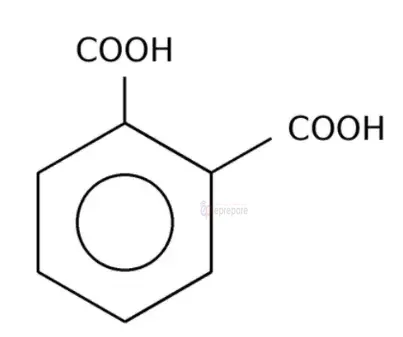
- A. Benzoic acid
- B. Malonic acid
- C. Phthalic acid
- D. Picric acid
Show answer and explanation
Answer: C. Phthalic acid
The compound contains two –COOH groups on adjacent carbons of a benzene ring.
Its systematic description is benzene-1,2-dicarboxylic acid.
This ortho dicarboxylic acid has the common name phthalic acid.
Phthalic acid is the correct option.
Q92. Acetic anhydride can be prepared when two molecules of carboxylic acids are dehydrated on heating strongly in the presence of:
Chemistry · Carboxylic acids
- A. V₂O₅
- B. P₂O₅
- C. H₂SO₄
- D. HgSO₄
Show answer and explanation
Answer: B. P₂O₅
An acid anhydride forms when water is removed from two carboxylic acid molecules.
Phosphorus pentoxide is a strong dehydrating agent.
It removes water from two molecules of acetic acid and allows the anhydride bond to form.
The required reagent is P₂O₅.
Q93. Carboxylic acid react with metals to form salt with the evolution of which gas?
Chemistry · Carboxylic acids
- A. CO₂
- B. CO
- C. H₂
- D. CH₄
Show answer and explanation
Answer: C. H₂
The hydrogen in a carboxyl group can be displaced by a reactive metal.
For sodium, the reaction is 2RCOOH + 2Na → 2RCOONa + H₂.
The salt formed is sodium carboxylate.
The gas evolved is hydrogen.
Q94. Which protein helps in muscles contractions and relaxation in our body?
Chemistry · Macromolecules
- A. Myosin
- B. Albumin
- C. Globulin
- D. Collagen
Show answer and explanation
Answer: A. Myosin
Myosin is a motor protein found in muscle fibres.
It binds to actin and uses ATP during cross-bridge cycling.
Repeated attachment and movement of myosin produce contraction.
ATP-dependent detachment also allows the muscle to relax.
Q95. Various polypeptide chains in haemoglobin remain intact due to:
Chemistry · Macromolecules
- A. Chemical bonds
- B. London dispersion forces
- C. Salt bridges
- D. Peptide bonds
Show answer and explanation
Answer: C. Salt bridges
Haemoglobin contains several polypeptide subunits.
Salt bridges between charged side chains help hold those subunits in their quaternary arrangement.
Peptide bonds hold amino acids within each individual chain.
Salt bridges are the interaction asked for between the chains.
Physics MCQs with answers and explanations (Q96 to Q135)
Q96. The vertical height and horizontal range of projectiles are equal at angle:
Physics · Force and motion
- A. 30°
- B. 45°
- C. 76°
- D. 90°
Show answer and explanation
Answer: C. 76°
For a projectile, maximum height is H = u²sin²θ/(2g).
Its horizontal range is R = u²sin2θ/g.
Equating H and R gives tanθ = 4.
The corresponding angle is approximately 76°.
Q97. Range of projectile is maximum at:
Physics · Force and motion
- A. 30°
- B. 45°
- C. 60°
- D. 90°
Show answer and explanation
Answer: B. 45°
Projectile range is R = u²sin2θ/g for a fixed launch speed.
The range is greatest when sin2θ reaches its maximum value of 1.
This happens at 2θ = 90°.
The required projection angle is therefore 45°.
Q98. A ball is thrown vertically upward, the ball descends towards earth after achieving a certain height because:
Physics · Force and motion
- A. Earth is exerting more gravitational force than ball
- B. The ball is exerting more gravitational force than earth
- C. The earth possesses more inertia
- D. The ball possesses more inertia
Show answer and explanation
Answer: C. The earth possesses more inertia
The ball and Earth exert equal gravitational forces on each other.
Earth has an enormously greater mass and therefore far greater inertia.
Its acceleration is negligible, while the ball accelerates downward.
The ball returns because Earth possesses much more inertia.
Q99. A bomb is exploded into two fragments A and B moving in opposite direction. They conserve:
Physics · Force and motion
- A. Kinetic Energy
- B. Potential Energy
- C. Momentum
- D. Both kinetic energy and potential energy
Show answer and explanation
Answer: C. Momentum
An explosion produces internal forces between the fragments.
If external impulse is negligible, those internal forces cannot change total momentum.
Stored energy may become kinetic energy, so kinetic energy need not remain constant.
The conserved quantity is momentum.
Q100. Work done is negative, when the angle between F and S is:
Physics · Work and energy
- A. 0°
- B. 60°
- C. 90°
- D. 180°
Show answer and explanation
Answer: D. 180°
Work done by a constant force is W = Fs cosθ.
Work becomes negative when the force has a component opposite the displacement.
At 180°, cosθ = −1 and the two directions are exactly opposite.
The angle producing negative work is 180°.
Q101. When the speed of a car is doubled, what will happen to its kinetic energy?
Physics · Work and energy
- A. Remains same
- B. Doubled
- C. Three times
- D. Four times
Show answer and explanation
Answer: D. Four times
Kinetic energy is K = ½mv².
The mass remains fixed while the speed changes from v to 2v.
Squaring the new speed gives (2v)² = 4v².
The kinetic energy becomes four times its original value.
Q102. The work efficiency of a dry cell battery is:
Physics · Work and energy
- A. 30%
- B. 40%
- C. 50%
- D. 90%
Show answer and explanation
Answer: D. 90%
Efficiency compares useful electrical energy with the chemical energy supplied by the cell.
Some energy is always lost inside a real battery.
The value used for the dry cell in this question is 90 percent.
The expected answer is therefore 90%.
Q103. With zero gravitational potential energy at infinity, when distance r from a massive body increases, the gravitational potential energy becomes:
Physics · Work and energy
- A. Less positive
- B. More negative
- C. Less negative
- D. More positive
Show answer and explanation
Answer: C. Less negative
Taking gravitational potential energy as zero at infinity gives U = −GMm/r.
Increasing r reduces the magnitude of the negative fraction.
The value moves upward toward zero.
Gravitational potential energy therefore becomes less negative.
Q104. How many Joules are there in 3KWh?
Physics · Work and energy
- A. 108MJ
- B. 10.8MJ
- C. 1.08MJ
- D. 0.108MJ
Show answer and explanation
Answer: B. 10.8MJ
One kilowatt-hour equals 1000 W multiplied by 3600 s.
This is 3.6 × 10⁶ J, or 3.6 MJ.
Three kilowatt-hours contain 3 × 3.6 MJ.
The energy is 10.8 MJ.
Q105. A car moving on a more steeply banked curves will require:
Physics · Rotational and circular motion
- A. Large speed and large radii
- B. Large speed and small radii
- C. Small speed and large radii
- D. Small speed and small radii
Show answer and explanation
Answer: B. Large speed and small radii
Ideal banking follows tanθ = v²/(rg).
A higher speed increases the value on the right and requires a steeper bank.
A smaller curve radius has the same effect.
Large speed with small radius gives the steepest requirement among the choices.
Q106. In a body angular acceleration is produced by:
Physics · Rotational and circular motion
- A. Net force
- B. Power
- C. Pressure
- D. Net torque
Show answer and explanation
Answer: D. Net torque
Angular acceleration requires a turning effect on the body.
That turning effect is torque.
The rotational equation τ_net = Iα links net torque directly with angular acceleration.
Net torque is the correct cause.
Q107. The analogue of force in circular / angular motion is:
Physics · Rotational and circular motion
- A. Momentum
- B. Torque
- C. Angular acceleration
- D. Angular velocity
Show answer and explanation
Answer: B. Torque
Force changes translational motion according to F = ma.
Torque changes rotational motion according to τ = Iα.
The two quantities play corresponding roles in linear and angular mechanics.
Torque is the rotational analogue of force.
Q108. 1° is equal to:
Physics · Rotational and circular motion
- A. π/90 radians
- B. π/180 radians
- C. π radians
- D. 2π radians
Show answer and explanation
Answer: B. π/180 radians
One complete revolution is 360°.
The same revolution measures 2π radians.
Dividing 2π by 360 gives the radian value of one degree.
Thus, 1° = π/180 radians.
Q109. In uniform circular motion, the angle between centripetal acceleration and linear velocity of a particle is:
Physics · Rotational and circular motion
- A. π/2
- B. π
- C. 2π
- D. Zero
Show answer and explanation
Answer: A. π/2
In uniform circular motion, velocity is tangent to the circular path.
Centripetal acceleration points along the radius toward the centre.
A tangent is perpendicular to the radius at the point of contact.
The angle between velocity and acceleration is π/2.
Q110. The distance between two consecutive nodes are:
Physics · Waves and simple harmonic motion
- A. λ
- B. λ/2
- C. 2λ
- D. λ/4
Show answer and explanation
Answer: B. λ/2
A stationary wave has alternating nodes and antinodes.
Two neighboring nodes are separated by half of a complete wavelength.
A node and its nearest antinode are only one-quarter wavelength apart.
The node-to-node distance is λ/2.
Q111. If a sound waves moves from air to water, there is NO change in:
Physics · Waves and simple harmonic motion
- A. Velocity
- B. Frequency
- C. Wavelength
- D. Temperature
Show answer and explanation
Answer: B. Frequency
The source fixes the frequency of a wave.
When the wave enters water, its speed changes because the medium changes.
Its wavelength adjusts through v = fλ, but the source frequency stays the same.
Frequency is the quantity that does not change.
Q112. The star moving closer to earth will experience:
Physics · Waves and simple harmonic motion
- A. Blue shift
- B. Red shift
- C. Orange shift
- D. Yellow shift
Show answer and explanation
Answer: A. Blue shift
Light from an approaching star is compressed to shorter observed wavelengths.
Shorter wavelength corresponds to higher frequency.
This Doppler change shifts spectral lines toward the blue end of the spectrum.
The approaching star shows a blue shift.
Q113. If the amplitude of a wave is doubled, its intensity is:
Physics · Waves and simple harmonic motion
- A. Doubled
- B. Halved
- C. Quadrupled
- D. One quarter
Show answer and explanation
Answer: C. Quadrupled
For a wave in the same medium, intensity is proportional to amplitude squared.
Doubling amplitude changes A² into (2A)².
The new value is 4A².
The intensity therefore becomes four times greater.
Q114. Which of the following is an example of first law of thermodynamics?
Physics · Thermodynamics
- A. Thunderstorm
- B. Metabolism
- C. Rusting
- D. Earthquake
Show answer and explanation
Answer: B. Metabolism
The first law of thermodynamics expresses conservation of energy.
Metabolism converts chemical energy from food into work, stored energy and heat.
The total energy is redistributed rather than created or destroyed.
Metabolism is the matching example.
Q115. Thermos flask tea as a system is shaken vigorously then there will be:
Physics · Thermodynamics
- A. Increase in temperature only
- B. Increase in kinetic energy only
- C. Increase in temperature & kinetic energy
- D. No change in temperature & kinetic energy
Show answer and explanation
Answer: C. Increase in temperature & kinetic energy
Shaking the flask means mechanical work is done on the tea.
A thermos limits heat exchange with the surroundings.
The work is dissipated into internal energy, increasing molecular motion.
Both temperature and average kinetic energy rise.
Q116. Difference between molar specific heat at constant pressure and molar specific heat at constant volume is equal to:
Physics · Thermodynamics
- A. Boltzmann constant
- B. Universal gas constant
- C. Plank's constant
- D. Rydberg constant
Show answer and explanation
Answer: B. Universal gas constant
For an ideal gas, Cp includes the energy needed for expansion work.
Cv does not include that work because volume remains fixed.
The difference between the two molar heat capacities is R.
R is the universal gas constant.
Q117. Coulomb's law of electrostatics is valid for:
Physics · Electrostatics
- A. Point charges
- B. Stationary charges
- C. Stationary & point charges
- D. Accelerated point charges
Show answer and explanation
Answer: C. Stationary & point charges
Coulomb's law treats charges as stationary point sources.
Under these conditions, force depends on charge values and inverse square distance.
Extended or accelerating charge distributions require broader electromagnetic treatment.
Stationary point charges satisfy the stated law directly.
Q118. If the positive charge is placed in a uniform electric field, the charge will move in the:
Physics · Electrostatics
- A. Opposite direction of electric field
- B. Direction of electric field
- C. Perpendicular to the direction of electric field
- D. Remains at rest
Show answer and explanation
Answer: B. Direction of electric field
Electric field direction is defined as the force direction on a positive test charge.
For a positive charge, F = qE points along the field.
The resulting acceleration and initial motion follow that direction.
The charge moves in the direction of the electric field.
Q119. For each element, value of half-life is:
Physics · Nuclear physics
- A. Variable
- B. Constant
- C. Decrease
- D. Increase
Show answer and explanation
Answer: B. Constant
Half-life is a characteristic property of a particular radionuclide.
It does not depend on the initial amount of the sample.
Removing material changes the activity but not the decay probability of each nucleus.
The half-life remains constant for that radionuclide.
Q120. The unit of RC is:
Physics · Electrostatics
- A. Ohm
- B. Farad
- C. Second
- D. Ohm/Farad
Show answer and explanation
Answer: C. Second
Resistance is measured in ohms and capacitance in farads.
The product RC has units ΩF.
Using the electrical unit definitions, ΩF reduces to seconds.
RC is therefore a time quantity.
Q121. The fractional change in resistance per kelvin is known as the temperature coefficient of:
Physics · Current electricity
- A. Conductance
- B. Resistance
- C. Inductance
- D. Conductivity
Show answer and explanation
Answer: B. Resistance
The temperature coefficient describes fractional change per kelvin.
Here, the quantity changing with temperature is electrical resistance.
It is written as the change in resistance divided by the original resistance and temperature change.
The name required is temperature coefficient of resistance.
Q122. Which of the following is an example of Ohmic in nature?
Physics · Current electricity
- A. Thermistor
- B. Filament lamp
- C. Semiconductor
- D. Conductor
Show answer and explanation
Answer: D. Conductor
An ohmic device obeys V = IR at a constant temperature.
Its resistance remains approximately constant as current changes.
A metallic conductor shows this behavior, unlike a thermistor or filament lamp.
Conductor is the ohmic example.
Q123. The material whose resistance decreases with increase in temperature have:
Physics · Current electricity
- A. Positive temperature coefficient
- B. Negative temperature coefficient
- C. Thermal coefficient
- D. Coefficient of friction
Show answer and explanation
Answer: B. Negative temperature coefficient
A positive temperature rise is accompanied by a fall in resistance.
The ratio of resistance change to temperature change is therefore negative.
Materials showing this behavior are often described as NTC materials.
They have a negative temperature coefficient.
Q124. The number of field lines passing through unit area is called:
Physics · Electromagnetism
- A. Magnetic field
- B. Magnetic flux
- C. Magnetic flux density
- D. Magnetization
Show answer and explanation
Answer: C. Magnetic flux density
Magnetic flux measures the total magnetic field passing through a surface.
Flux divided by perpendicular area gives magnetic flux density.
This quantity is represented by B and measured in tesla.
Field lines per unit area describe magnetic flux density.
Q125. The magnetic force of a charged particle moving in a uniform magnetic fields depends on:
Physics · Electromagnetism
- A. Velocity, area & magnetic field
- B. Charge, current & velocity
- C. Magnetic field, voltage & charge
- D. Velocity, magnetic field & charge
Show answer and explanation
Answer: D. Velocity, magnetic field & charge
The force on a moving charge is F = qvB sinθ.
Its magnitude depends on the charge q and speed v.
It also depends on magnetic-field strength B and the angle between v and B.
Velocity, magnetic field and charge form the matching set.
Q126. The magnetic force acting on a charged particle is maximum when the angle between v and B is:
Physics · Electromagnetism
- A. 0°
- B. 45°
- C. 90°
- D. 180°
Show answer and explanation
Answer: C. 90°
Magnetic force contains the angular factor sinθ.
The greatest possible value of sinθ is 1.
This occurs when the velocity is perpendicular to the field.
The force is maximum at 90°.
Q127. Generator effect is practical application of:
Physics · Electromagnetic induction
- A. Static e.m.f.
- B. Dynamic e.m.f.
- C. Mutual induction
- D. Back emf
Show answer and explanation
Answer: B. Dynamic e.m.f.
A generator creates emf by moving a conductor through a magnetic field.
The conductor cuts magnetic flux and charges experience magnetic force.
This motion-generated voltage is called dynamic emf.
Generator action is an application of dynamic emf.
Q128. If number of turns of coil becomes double, the induced emf will be:
Physics · Electromagnetic induction
- A. Double
- B. Reduced to half
- C. Remain same
- D. Quadruple
Show answer and explanation
Answer: A. Double
Faraday's law gives induced emf as ε = N|ΔΦ|/Δt.
If flux change and time remain fixed, emf is directly proportional to the number of turns.
Changing N to 2N therefore changes ε to 2ε.
The induced emf doubles.
Q129. Electromagnetic sensor in seismograph converts ground movement into:
Physics · Electromagnetic induction
- A. Magnetic signals
- B. Electric signals
- C. Audio signals
- D. Vibratory signals
Show answer and explanation
Answer: B. Electric signals
A seismograph first detects mechanical movement of the ground.
Its electromagnetic sensor responds to that motion.
The sensor produces a voltage or current that can be recorded electronically.
Ground movement is converted into an electrical signal.
Q130. A full wave bridge rectifier consists of:
Physics · Electronics
- A. No diode
- B. Four diodes
- C. Two diodes
- D. One diode
Show answer and explanation
Answer: B. Four diodes
A bridge rectifier contains four diodes.
One pair conducts during the positive half-cycle.
The other pair conducts during the negative half-cycle while keeping load current in the same direction.
Four diodes are required for the bridge arrangement.
Q131. An electrical component used to convert AC into DC is:
Physics · Electronics
- A. Transistor
- B. Capacitor
- C. Diode
- D. Resistor
Show answer and explanation
Answer: C. Diode
A diode conducts readily in one direction and blocks current in the other.
This one-way behavior is called rectification.
Rectification changes an alternating input into a pulsating direct output.
The component used for this purpose is a diode.
Q132. A photon has:
Physics · Dawn of modern physics
- A. Zero mass, Zero momentum
- B. Finite mass, finite momentum
- C. Zero mass, finite momentum
- D. Finite mass, zero momentum
Show answer and explanation
Answer: C. Zero mass, finite momentum
A photon has no rest mass.
It nevertheless carries energy E = hf.
Its momentum is p = h/λ, which is not zero.
A photon therefore has zero rest mass and finite momentum.
Q133. Devices such as photocells and solar cells are applications of:
Physics · Dawn of modern physics
- A. Photo electric effect
- B. Compton's effect
- C. Pair production
- D. Interference of light
Show answer and explanation
Answer: A. Photo electric effect
Photocells respond when light releases electrons from a material.
Solar cells also convert photon energy into electrical energy by exciting charge carriers.
Both devices rely on the interaction of photons with electrons.
The relevant principle is the photoelectric effect.
Q134. Which of the following particle has smaller De Broglie wave length?
Physics · Dawn of modern physics
- A. Gamma particle
- B. Beta particle
- C. Proton
- D. Alpha particle
Show answer and explanation
Answer: D. Alpha particle
The question does not state the condition required for a strict wavelength comparison.
Under the usual equal-speed assumption, de Broglie wavelength is λ = h/(mv).
Greater particle mass then gives a shorter wavelength.
The alpha particle is used as the conditional answer because it is the heaviest listed material particle.
Q135. In the spectrum of hydrogen atom which of the following series has smallest wavelength?
Physics · Atomic spectra
- A. Paschen series
- B. Balmer series
- C. Lyman series
- D. Brackett series
Show answer and explanation
Answer: C. Lyman series
Hydrogen spectral series differ according to their final energy level.
Lyman transitions end at n = 1 and have the largest energy gaps.
Larger photon energy means higher frequency and shorter wavelength.
The Lyman series has the smallest wavelengths.
English MCQs with answers and explanations (Q136 to Q150)
Q136. The antonym for the word clarity is:
English · Formal and lexical aspects of language
- A. Upright
- B. Understanding
- C. Vagueness
- D. Clear
Show answer and explanation
Answer: C. Vagueness
Clarity means that an idea is easy to understand.
Vagueness describes language that is uncertain or unclear.
The two words express opposite meanings.
Vagueness is the antonym of clarity.
Q137. Yasir Ameen could not pay the rent; accordingly, he was (evicted). Meaning of the bracketed word is:
English · Formal and lexical aspects of language
- A. Expelled from the house
- B. Investigated
- C. Threatened
- D. Rewarded
Show answer and explanation
Answer: A. Expelled from the house
A tenant who is evicted is legally or forcibly removed from a property.
The word does not mean investigated, threatened or rewarded.
Yasir could not pay the rent, so removal from the house fits the context.
Evicted here means expelled from the house.
Q138. Fill in the blank with the correct verb. The baby ______ all morning.
English · Formal and lexical aspects of language
- A. Is crying
- B. Has been crying
- C. Cry
- D. Have been crying
Show answer and explanation
Answer: B. Has been crying
The phrase all morning describes an activity continuing over a period up to the present.
Present perfect continuous is used for this kind of unfinished action.
Its structure is has or have been followed by the –ing form.
With the singular subject baby, the correct form is has been crying.
Q139. By 2040, robots ______ many of the jobs that people do today.
English · Formal and lexical aspects of language
- A. Will be taking over
- B. Will take over
- C. Will have taken over
- D. Has taken over
Show answer and explanation
Answer: C. Will have taken over
The phrase by 2040 sets a future completion point.
The job takeover will be complete before or at that future time.
Future perfect uses will have followed by the past participle.
Will have taken over is the required form.
Q140. "Each time one of us touches the soil, we feel a sense of personal renewal". The type of sentence is
English · Formal and lexical aspects of language
- A. Compound
- B. Complex
- C. Compound Complex
- D. Simple
Show answer and explanation
Answer: B. Complex
Each time one of us touches the soil is a dependent time clause.
We feel a sense of personal renewal is the independent main clause.
One dependent clause joined to one independent clause forms a complex sentence.
The sentence is complex.
Q141. Identify the correctly punctuated sentence.
English · Formal and lexical aspects of language
- A. Milton the great English Poet, was blind
- B. Milton, the great English poet, was blind
- C. Milton the great English poet was, blind
- D. Milton the great, English poet was blind
Show answer and explanation
Answer: B. Milton, the great English poet, was blind
The words the great English poet rename Milton and add nonessential information.
This kind of phrase is a nonrestrictive appositive.
A comma is placed before and after such an appositive.
Milton, the great English poet, was blind is correctly punctuated.
Q142. Identify the correct sentence.
English · Writing skills
- A. A Sindhi woman is going through a bazaar with bear feet
- B. A Sindhi women are going through a bazaar with bare feet
- C. A Sindhi woman is going through a bazaar with bare feet
- D. A Sindhi woman is going through a bazaar with bare foot
Show answer and explanation
Answer: C. A Sindhi woman is going through a bazaar with bare feet
A woman is singular, so it must be followed by is going.
Bare means uncovered and is the correct adjective for feet.
Women would require a plural verb, while bear has a different meaning.
A Sindhi woman is going through a bazaar with bare feet is correct.
Q143. Complete the sentence using correct preposition. The public are cautioned ______ pickpockets.
English · Formal and lexical aspects of language
- A. Against
- B. Of
- C. For
- D. With
Show answer and explanation
Answer: A. Against
Caution follows the fixed expression cautioned against.
Against introduces the danger or person about whom the warning is given.
The remaining prepositions do not form the standard expression in this sentence.
The public are cautioned against pickpockets.
Q144. Select the correct pair. Lack of sleep can ______ your health and have a bad ______ on your grades.
English · Formal and lexical aspects of language
- A. Affect / affect
- B. Effect / effect
- C. Effect / affect
- D. Affect / effect
Show answer and explanation
Answer: D. Affect / effect
Affect is normally a verb meaning to influence.
Effect is normally a noun meaning a result or consequence.
Lack of sleep can affect health and produce a bad effect on grades.
The correct pair is affect and effect.
Q145. Select the correct sentence in style.
English · Writing skills
- A. Having finished his exercise, the books were put away.
- B. Having finishing his exercise, the books were put away
- C. Having finishing his exercise, he put his books away
- D. Having finished his exercise, he put away his books.
Show answer and explanation
Answer: D. Having finished his exercise, he put away his books.
Having finished his exercise must describe the person who performed that action.
Placing the books immediately after the phrase creates a dangling modifier.
The subject he correctly identifies the person who finished the exercise.
Having finished his exercise, he put away his books is the well-formed sentence.
Q146. Select the statement that best describes the given sentence. "He is anything but a liar."
English · Reading and thinking skills
- A. He is a liar.
- B. He is certainly not a liar.
- C. He is not a good character and liar as well
- D. He is a good character but a liar to some extent
Show answer and explanation
Answer: B. He is certainly not a liar.
Anything but is an idiom that strongly rejects the description that follows.
Calling someone anything but a liar means the speaker does not consider him a liar.
It does not suggest partial dishonesty or poor character.
The sentence means that he is certainly not a liar.
Q147. Select the best option to describe the given sentence. "Unless you apologise I shall punish you."
English · Reading and thinking skills
- A. Without apology, you will be forgiven.
- B. With apology, you will be punished.
- C. There is no need of apology.
- D. Without apology you will be punished.
Show answer and explanation
Answer: D. Without apology you will be punished.
Unless introduces a negative condition and means if not.
The sentence can be rewritten as: If you do not apologise, I shall punish you.
Punishment depends on the absence of an apology.
Without an apology, the person will be punished.
Q148. "From the attitude it is clear that he wants to pay off his old scores." The sentence means that he wants to:
English · Reading and thinking skills
- A. Improve his marks
- B. Pay off his debt
- C. Help needy people
- D. Have his revenge
Show answer and explanation
Answer: D. Have his revenge
To pay off or settle old scores is an idiom.
It refers to taking revenge for an earlier wrong or disagreement.
The phrase is unrelated to examination marks or an ordinary financial debt.
He wants to have his revenge.
Q149. A person needs to reflect (profoundly) on his/her life. The bracketed word means:
English · Formal and lexical aspects of language
- A. Deeply
- B. Superficially
- C. Shallow
- D. Mirroring
Show answer and explanation
Answer: A. Deeply
Profoundly describes something done with great depth or seriousness.
Reflecting profoundly means thinking carefully about one's life.
Superficially and shallow express the opposite idea.
The bracketed word means deeply.
Q150. Due to his non-serious attitude, Ali took the advice with a pinch of salt. It means:
English · Reading and thinking skills
- A. Took it seriously
- B. Did not take it seriously.
- C. Accept it candidly.
- D. Implemented it happily.
Show answer and explanation
Answer: B. Did not take it seriously.
Taking advice with a pinch of salt means receiving it with doubt or reservation.
The listener does not accept the advice completely at face value.
It is different from following the advice happily or treating it as unquestionably correct.
Ali did not take the advice seriously.
Frequently asked questions
Is this the official NUMS 2026 answer key?
No. These answers were worked out and checked by ePrepare's teachers, with an explanation for each. If you think an answer is wrong, read its explanation or message us on WhatsApp.
When was the NUMS 2026 test held?
On Sunday, 13 September 2026, at 15 centres in Pakistan and one in Saudi Arabia. About 43,000 candidates appeared.
How many MCQs were in NUMS 2026?
Paper I had 150 subject MCQs (Biology 55, Chemistry 40, Physics 40, English 15) and Paper II was a 50-MCQ psychological test.
Is the psychological test included here?
No. Paper II has no right or wrong answers to learn, so this page covers Paper I only.
Can I attempt the NUMS 2026 paper online?
Yes. Our free online test has all 150 MCQs with a timer and every explanation.
What are the NUMS passing marks?
55% for MBBS and 50% for BDS, with at least 60% in HSSC.
Keep practising
Try the KMU MDCAT 2026 paper with answer key, or plan your preparation with the MDCAT preparation guide. Every past paper is in the ePrepare app; register to practise them all.
Sources: NUMS MDCAT table of specifications (pattern); NUMS announcements as reported by Quetta Voice (22 September 2026) for the test date, centres and candidates. Answers, explanations and chapter tagging are ePrepare's.