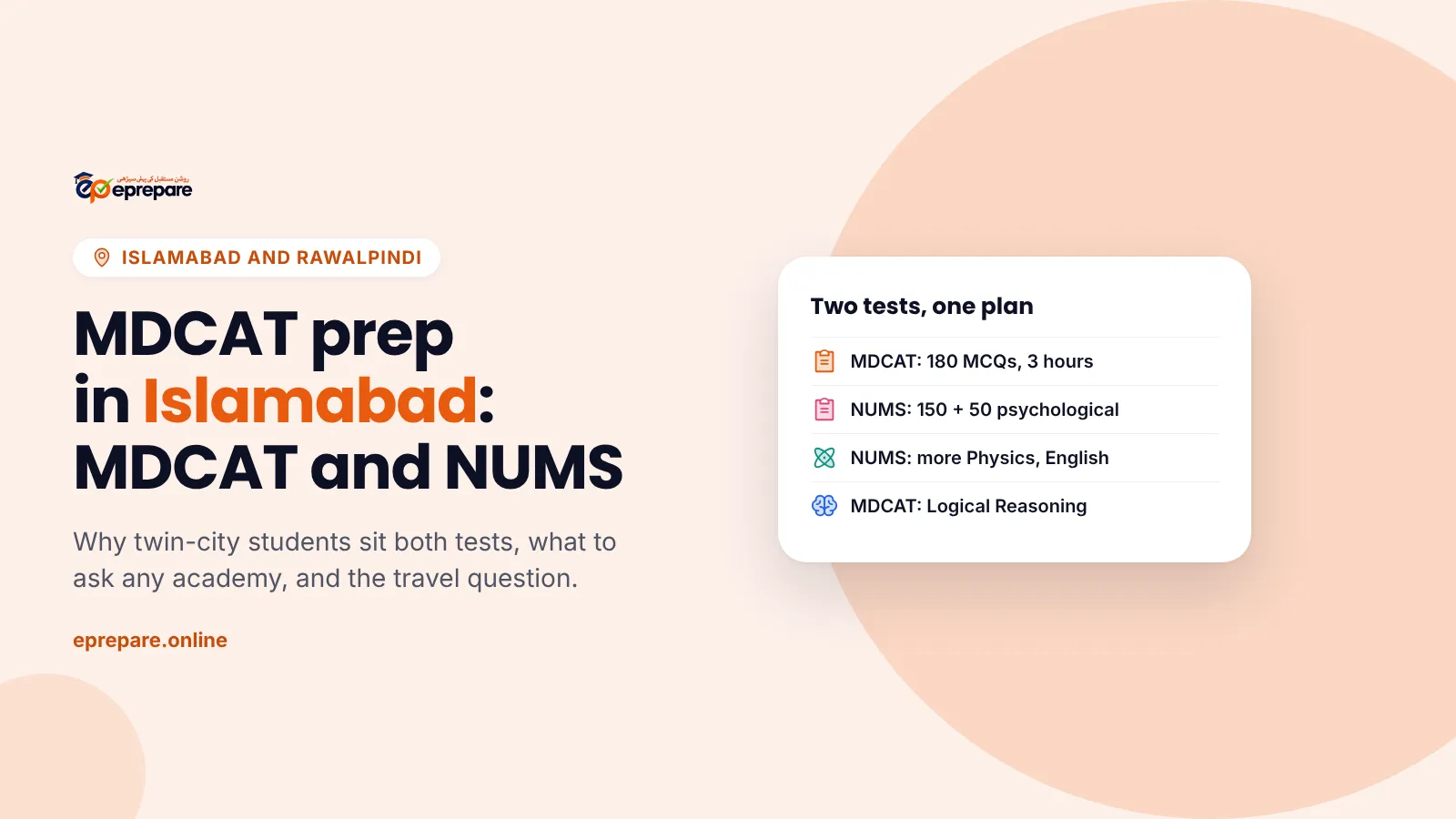
Every MDCAT topper started in the same place: a syllabus that looked too big, a calendar that felt too short, and no clear idea what to do on Monday morning. The difference is that they turned the syllabus into a plan and followed it. This guide gives you that plan, whether you have a full year, six months, ninety days or only one month left.
It is built on the official paper pattern in PM&DC's uniform MDCAT curriculum and on how thousands of ePrepare students prepare every year. You will find a plan for each timeline, daily timetables for school-going and full-time students, how to split your hours by subject, how to use past papers and mock tests, and how to prepare for NUMS at the same time.
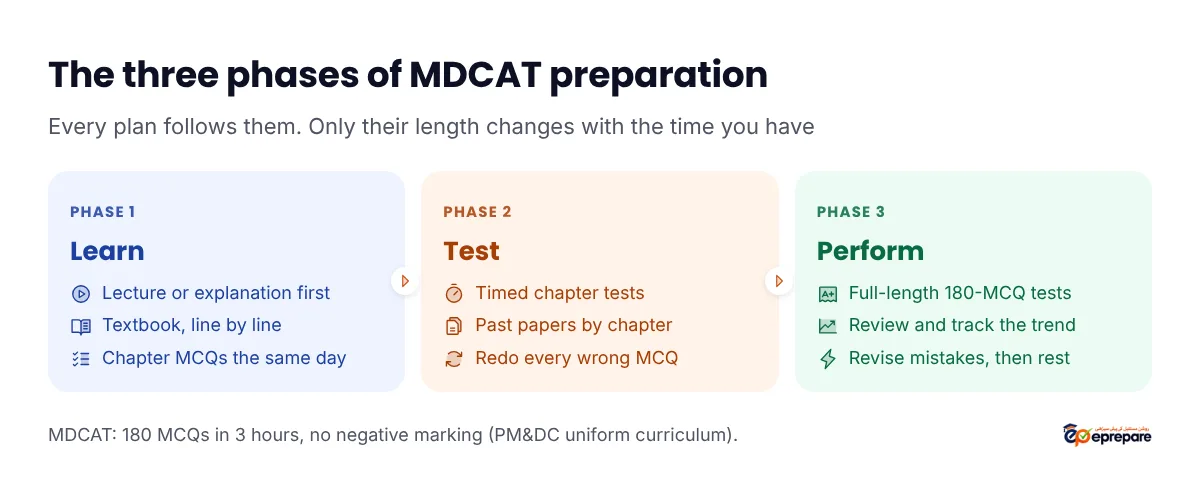
The short answer: MDCAT is 180 MCQs in 3 hours: Biology 81, Chemistry 45, Physics 36, English 9 and Logical Reasoning 9, with no negative marking. It is half your aggregate. Prepare in three phases: learn every chapter with its MCQs, test yourself by chapter and with past papers, then sit full-length mock tests and fix every mistake. Give Biology the most time, practise daily, and never leave a chapter untested.
First, know exactly what you are preparing for
A plan only works if it matches the paper. PM&DC's curriculum sets the structure every province follows:
| What | The rule |
|---|---|
| Questions and time | 180 MCQs in 3 hours, paper-based |
| Biology | 81 MCQs (45%) |
| Chemistry | 45 MCQs (25%) |
| Physics | 36 MCQs (20%) |
| English and Logical Reasoning | 9 MCQs each (5% each) |
| Negative marking | No negative marking |
| Pass marks | 55% for MBBS, 50% for BDS |
| Weight in your aggregate | 50% (FSc 40%, Matric 10%) |
Three things follow from this table. Biology alone is almost half the paper. Every mark counts, because a wrong answer costs nothing more than a blank. And since MDCAT is half your aggregate, it is the one result you can still change a lot. See every unit and topic on our MDCAT syllabus page, where you can also download the syllabus as a PDF.
Step 1: Set a target score, not a vague goal
"Get into a good college" is not a plan. "Score 165 out of 180" is. Your target depends on your Matric and FSc marks and the colleges you want.
- Enter your marks in the aggregate calculator and use "What MDCAT score do I need?" to find the score for the aggregate you want.
- Check last year's closing aggregates. For Khyber Pakhtunkhwa, see KMU closing merit and the college predictor.
- Write your target where you will see it every day, and convert it into a weekly test score to beat.
A target tells you how hard to push and when you are on track. It also stops panic: if your weekly tests are near your target, you are fine.
Step 2: Choose the plan for the time you have
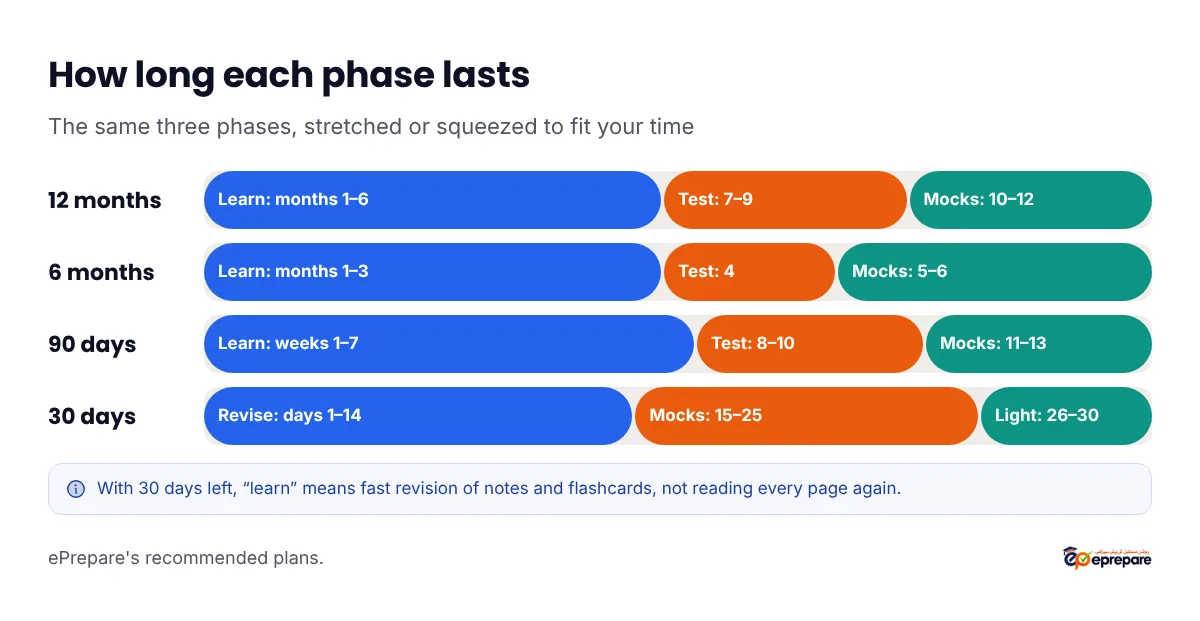
The three phases are the same for everyone. What changes is how long each one lasts. Find your row and follow that plan.
The 12-month plan (start in first year or early second year)
You have time to learn everything properly and still revise twice. Use it, but do not let it make you slow.
| Months | Focus | Weekly target |
|---|---|---|
| 1 to 6 | Learn each chapter alongside FSc: lecture, textbook, chapter MCQs | 3 to 4 chapters across subjects, one chapter test each |
| 7 to 9 | Finish any remaining chapters; start past papers chapter by chapter | 2 chapter tests and 1 mixed past-paper set |
| 10 to 11 | First full revision; weekly full-length tests | 1 full-length test and its review |
| 12 | Mocks and revision of mistakes only | 2 to 3 full-length tests |
The 6-month plan (the most common)
| Months | Focus | Weekly target |
|---|---|---|
| 1 to 3 | Cover the whole syllabus once, every chapter with its MCQs | 5 to 6 chapters, a test after each |
| 4 | Past papers by chapter; fix weak chapters | 3 chapter tests and 2 past-paper sets |
| 5 | Second revision and weekly full-length tests | 1 to 2 full-length tests |
| 6 | Mocks, mistakes and short revision | 2 to 3 full-length tests |
The 90-day plan
Three months is enough for a strong score if you study every day and never skip testing.
| Weeks | Focus | Daily target |
|---|---|---|
| 1 to 7 | One pass of the syllabus, Biology first, with chapter MCQs | 1 to 2 chapters and 50 to 80 MCQs |
| 8 to 10 | Past papers by chapter and revision of weak chapters | 100 MCQs, all reviewed |
| 11 to 13 | Full-length tests twice a week, revision in between | One test or one revision block a day |
The 30-day plan
With a month left, do not try to learn every page again. Revise what is most tested and practise hard.
| Days | Focus | Daily target |
|---|---|---|
| 1 to 14 | Fast revision of every chapter from notes and flashcards, then MCQs | 3 to 4 chapters and 150 MCQs |
| 15 to 25 | Full-length test every other day; revise mistakes on the days between | 1 test, or 150 MCQs from weak chapters |
| 26 to 30 | Light revision, saved MCQs and rest | Mistakes list and flashcards only |
Repeating MDCAT? Do not restart from zero. Find where your marks went first, then follow the plan for the time you have. Our repeaters guide shows how.
Step 3: Build a daily timetable you can keep
A timetable that looks perfect but breaks on day three is worse than a simple one you follow every day. Pick the one that matches your life.
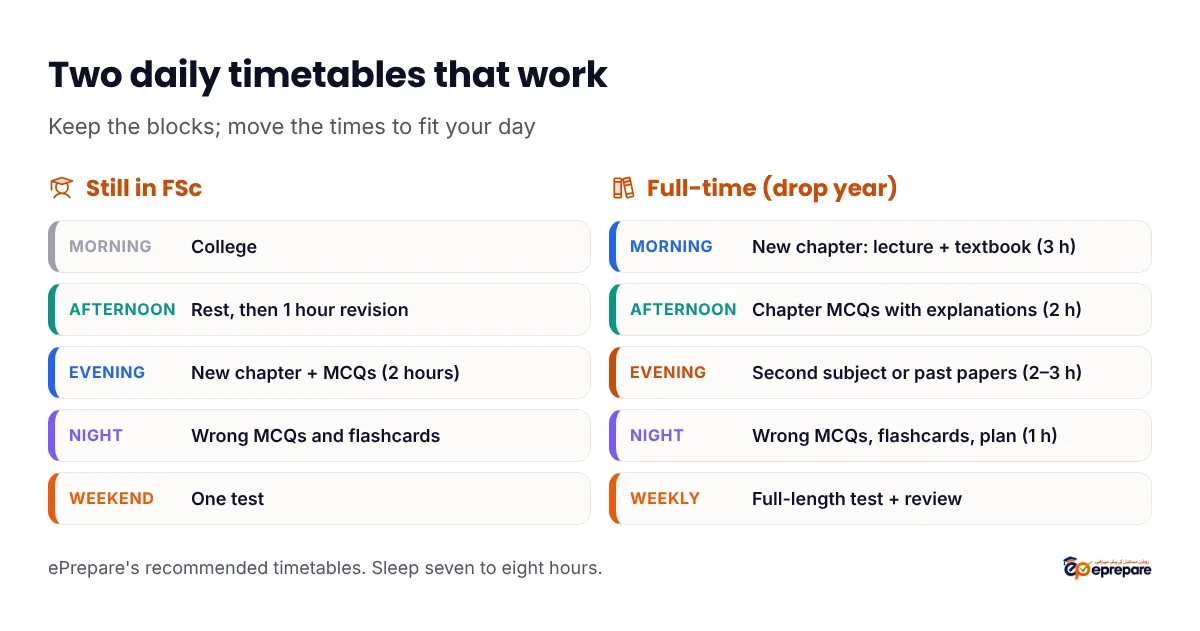
| Block | Student still in FSc | Full-time (drop year) |
|---|---|---|
| Morning | College | New chapter: lecture and textbook (3 hours) |
| Afternoon | Rest and meal, then 1 hour of revision | Chapter MCQs with explanations (2 hours) |
| Evening | New chapter and its MCQs (2 hours) | Second subject: chapter or past papers (2 to 3 hours) |
| Night | Wrong MCQs and flashcards (30 to 45 minutes) | Wrong MCQs, flashcards, plan tomorrow (1 hour) |
| Weekly | One test on the weekend | One full-length test and its review |
Sleep seven to eight hours. Memory is built while you sleep, and tired students make careless mistakes in easy MCQs.
Step 4: Split your hours by what the paper rewards
Give each subject time in proportion to its MCQs, then adjust for your weak areas.
| Subject | MCQs | Suggested share of study time |
|---|---|---|
| Biology | 81 | About 40 to 45% |
| Chemistry | 45 | About 25% |
| Physics | 36 | About 20 to 25% |
| English and Logical Reasoning | 18 | About 10%, in short daily sets |
- Biology: read textbook lines carefully; many questions come from them. Practise Biology MCQs.
- Chemistry: split it into physical, inorganic and organic, and learn reactions as reagent, condition and product. Practise Chemistry MCQs.
- Physics: keep a formula sheet per unit and practise numericals by hand, since calculators are not allowed. Practise Physics MCQs.
- English: learn the grammar rules in the curriculum and confusing word pairs. Practise English MCQs.
- Logical Reasoning: learn one method per question type. Practise reasoning MCQs.
Within each subject some chapters carry more MCQs than others. Our chapter-wise weightage guide shows where they usually come from, but finish every chapter: every unit can appear.
Step 5: Learn each chapter in five moves
- Understand: watch the lecture or read a clear explanation first.
- Read the textbook: go line by line, because MDCAT tests textbook facts and diagrams.
- Practise: attempt the chapter's MCQs the same day and read every explanation, including for the ones you got right.
- Test: take a timed chapter test within a few days.
- Fix: move every wrong MCQ to a revision list and redo it a week later.
The fifth move is where most marks are won. A mistake you fix once rarely comes back. A mistake you ignore usually costs you again on exam day.
Step 6: Use past papers the right way
Past papers show you how the curriculum turns into MCQs. Use them in stages: chapter by chapter while you learn, timed by chapter once you know the content, mixed across subjects to practise switching, and finally as full papers. Try real KMU MDCAT past-paper MCQs free, and read our past papers guide for the full method.
Step 7: Take mock tests, and review them properly
A full-length test teaches you pace, stamina and where your marks leak. It only helps if you review it.
- Sit it like the real exam: 180 MCQs, 3 hours, one sitting, no phone.
- Review the same day or the next: every wrong MCQ, every guess, and every MCQ that took too long.
- Track your score trend across weeks, not one paper. A single bad test is information, not a verdict.
How many to take and how to analyse them is covered in our guide to mock tests and FLPs.
Preparing for NUMS and MDCAT together
Many students sit both. The subjects are the same, but the papers are not.
| What | PM&DC MDCAT | NUMS MDCAT |
|---|---|---|
| Subject MCQs | 180 in 3 hours | 150 in 2 hours 45 minutes |
| Biology / Chemistry / Physics | 81 / 45 / 36 | 55 / 40 / 40 |
| English | 9 | 15 |
| Logical Reasoning | 9 | Not tested |
| Extra paper | No extra paper | 50-MCQ psychological test |
If you are sitting NUMS too, give Physics and English a little more time than MDCAT alone needs, and practise NUMS papers in its own timing. Try free NUMS past-paper MCQs.
Mistakes that cost students the most marks
- Reading without testing. You do not know a chapter until you have done its MCQs.
- Collecting too many books. Your textbooks, one good MCQ bank and past papers are enough.
- Skipping "small" subjects. English and Logical Reasoning are 18 marks, and they are quick to learn.
- Ignoring wrong MCQs. The same traps come back. Keep a revision list.
- Starting mocks too late. Pace and stamina need practice too.
- Studying beyond the syllabus. Check the syllabus before spending time on a topic.
How ePrepare helps you follow this plan
Everything in this guide is built into the ePrepare app, so you spend your time studying instead of organising:
- A study plan that schedules your chapters up to exam day.
- Lectures, notes and Bookline MCQs for every chapter, plus past papers from every province.
- Explanations in English and Urdu, and a hint before you answer.
- Your wrong MCQs saved for revision automatically.
- The Quiz Builder and the FLP series for full-length tests.
Compare what each package includes on the packages page, or register to start today.
Frequently asked questions
How many months do I need to prepare for MDCAT?
Six months is enough for most students to cover the syllabus, test themselves and sit mocks. With a strong FSc base, three months of daily, focused work can also produce a high score. Starting earlier mostly gives you more time to revise.
How many hours a day should I study for MDCAT?
Full-time students usually manage 7 to 9 focused hours. Students still in FSc can do well with 3 to 4 hours on weekdays and more at weekends. Consistency matters more than one long day.
Can I pass MDCAT in one month?
If you already know your FSc well, one month of hard revision and daily MCQs can get you past the pass marks and much higher. Follow the 30-day plan above and focus on practice, not re-reading.
Do I need to join an academy for MDCAT?
No. What you need is a plan, the right material, regular tests and help when you are stuck. Many students prepare online from home. Our guide on online vs academy preparation helps you choose.
When should I start solving past papers?
From the first chapter. Attempt each chapter's past-paper MCQs as soon as you finish the chapter, and move to full papers in the last phase.
Is there negative marking in MDCAT?
No. PM&DC's MDCAT has no negative marking, so attempt every MCQ.
Are calculators allowed in MDCAT?
No. Practise Physics and Chemistry numericals by hand and simplify before you multiply.
Which subject should I start with?
Start with Biology because it carries 81 MCQs, but study two subjects in parallel so you do not forget the other one.
Start your plan today
Pick your timeline, copy its table into your notebook, and do the first day's work today. Small, steady days add up to a big score.
Sources: paper pattern, pass marks and no negative marking from PM&DC's uniform MDCAT curriculum; NUMS pattern from NUMS's table of specifications; aggregate weighting from the admission documents of KMU, UHS and NUMS. Study plans and time shares are ePrepare's recommendations.