


The KMU MDCAT 2026 paper was held on Sunday, 20 September 2026, across Khyber Pakhtunkhwa. This page has the complete paper: every one of the 180 MCQs from Code A with its options, the official KMU answer key for all four codes (A, B, C and D), a full explanation for every answer, and a chapter-by-chapter analysis of what KMU tested.
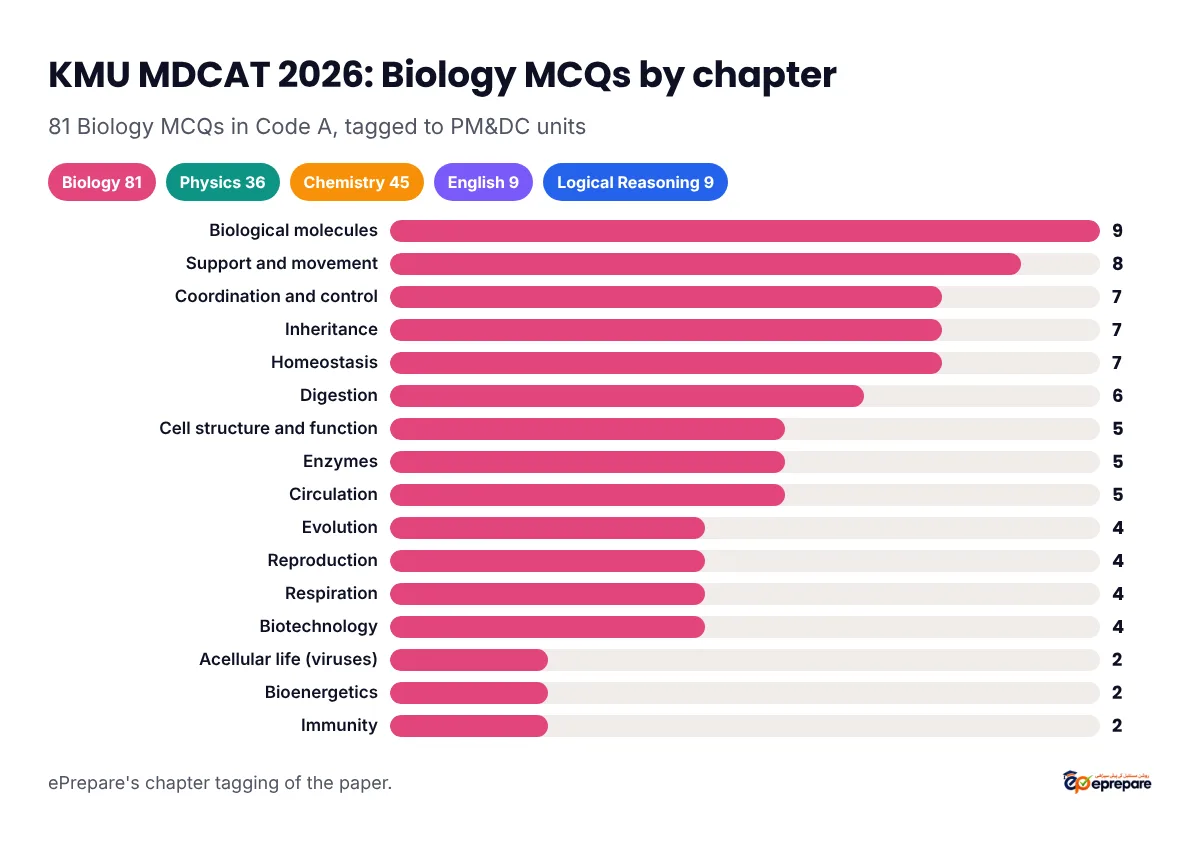
The short answer: KMU MDCAT 2026 had 180 MCQs in 3 hours with no negative marking: Biology 81, Physics 36, Chemistry 45, English 9 and Logical Reasoning 9. KMU released the official key for Codes A, B, C and D after the test, and in Code A, question 11 accepts both A and D. In KMU's result, reported on 25 September, 37,747 candidates appeared and the overall success ratio was 66%. Want to test yourself first? Attempt the full paper online with a 3-hour timer and instant marking.
KMU MDCAT 2026 at a glance
| What | Details |
|---|---|
| Test date | Sunday, 20 September 2026 (moved from 16 August) |
| Conducted by | Khyber Medical University (KMU), Peshawar |
| Questions and time | 180 MCQs in 3 hours, paper-based |
| Paper codes | A, B, C and D (same questions, different order) |
| Subjects (Code A order) | Biology Q1–81, Physics Q82–117, Chemistry Q118–162, English Q163–171, Logical Reasoning Q172–180 |
| Negative marking | No negative marking |
| Candidates | 38,845 registered, 37,747 appeared |
| Result | Reported on 25 September; 66% overall success ratio; top score 180/180 |
To pass, you needed 55% (99 out of 180) for MBBS or 50% (90 out of 180) for BDS. A pass makes you eligible to apply; your college depends on your aggregate. Work yours out with the KMU aggregate calculator.
Official KMU MDCAT 2026 answer key (Codes A, B, C and D)
Find the code printed on your question paper and read down that column. This is KMU's official key exactly as published. Where KMU accepts two options, both are shown (for example "A / D").
| Q | Code A | Code B | Code C | Code D |
|---|---|---|---|---|
| 1 | C | A / D | D | B |
| 2 | C | D | C | C |
| 3 | C | B | C | B |
| 4 | C | C | A | A |
| 5 | B | B | B | D |
| 6 | D | D | C | A |
| 7 | B | B | A | A |
| 8 | C | B | A | B |
| 9 | B | C | A | C |
| 10 | D | B | A | D |
| 11 | A / D | D | B | C |
| 12 | D | C | C | B |
| 13 | B | C | B | D |
| 14 | C | A | A | D |
| 15 | B | B | D | B |
| 16 | D | C | A | D |
| 17 | B | A | A | B |
| 18 | B | A | B | D |
| 19 | C | A | C | B |
| 20 | B | A | D | A |
| 21 | D | B | C | C |
| 22 | C | C | B | D |
| 23 | C | B | D | B |
| 24 | A | A | D | C |
| 25 | B | D | B | C |
| 26 | C | A | D | B |
| 27 | A | A | B | D |
| 28 | A | B | D | B |
| 29 | A | C | B | B |
| 30 | A | D | A | D |
| Q | Code A | Code B | Code C | Code D |
|---|---|---|---|---|
| 31 | B | C | C | C |
| 32 | C | B | D | C |
| 33 | B | D | B | A |
| 34 | A | D | C | C |
| 35 | D | B | C | B |
| 36 | A | D | B | A |
| 37 | A | B | D | C |
| 38 | B | D | B | A |
| 39 | C | B | B | B |
| 40 | D | A | D | C |
| 41 | C | C | C | B |
| 42 | B | D | C | B |
| 43 | D | B | A | C |
| 44 | D | C | C | C |
| 45 | B | C | B | C |
| 46 | D | B | A | D |
| 47 | B | D | C | A |
| 48 | D | B | A | B |
| 49 | B | B | B | C |
| 50 | A | D | C | B |
| 51 | C | C | B | C |
| 52 | D | C | B | C |
| 53 | B | A | C | C |
| 54 | C | C | C | C |
| 55 | C | B | C | C |
| 56 | B | A | D | B |
| 57 | D | C | A | D |
| 58 | B | A | B | B |
| 59 | B | B | C | C |
| 60 | D | C | B | B |
| Q | Code A | Code B | Code C | Code D |
|---|---|---|---|---|
| 61 | C | B | C | D |
| 62 | C | B | C | A / D |
| 63 | A | C | C | D |
| 64 | C | C | C | B |
| 65 | B | C | C | C |
| 66 | A | D | B | B |
| 67 | C | A | D | D |
| 68 | A | B | B | B |
| 69 | B | C | C | B |
| 70 | C | B | B | C |
| 71 | B | C | D | B |
| 72 | B | C | A / D | D |
| 73 | C | C | D | C |
| 74 | C | C | B | C |
| 75 | C | C | C | A |
| 76 | D | B | B | B |
| 77 | A | D | D | C |
| 78 | B | B | B | A |
| 79 | C | C | B | A |
| 80 | B | B | C | A |
| 81 | C | D | B | A |
| 82 | C | B | B | A |
| 83 | C | B | B | A |
| 84 | C | C | A | C |
| 85 | B | B | C | B |
| 86 | B | C | B | A |
| 87 | A | A | C | A |
| 88 | A | C | A | C |
| 89 | C | A | C | B |
| 90 | B | B | A | A |
| Q | Code A | Code B | Code C | Code D |
|---|---|---|---|---|
| 91 | B | B | A | C |
| 92 | C | A | C | A |
| 93 | B | C | B | A |
| 94 | C | B | A | C |
| 95 | A | C | A | C |
| 96 | C | A | C | C |
| 97 | A | C | B | B |
| 98 | B | A | A | B |
| 99 | B | A | C | A |
| 100 | A | C | A | A |
| 101 | C | B | A | C |
| 102 | B | A | C | B |
| 103 | C | A | C | B |
| 104 | A | C | C | C |
| 105 | C | B | B | B |
| 106 | A | A | B | C |
| 107 | A | C | A | A |
| 108 | C | A | A | C |
| 109 | B | A | C | A |
| 110 | A | C | B | B |
| 111 | A | C | B | B |
| 112 | C | C | C | A |
| 113 | B | B | B | C |
| 114 | A | B | C | B |
| 115 | C | A | A | C |
| 116 | A | A | C | A |
| 117 | A | C | A | C |
| 118 | D | C | C | A |
| 119 | B | A | A | C |
| 120 | C | A | B | A |
| Q | Code A | Code B | Code C | Code D |
|---|---|---|---|---|
| 121 | A | C | C | A |
| 122 | C | B | B | D |
| 123 | B | C | C | A |
| 124 | C | B | D | A |
| 125 | B | A | C | C |
| 126 | B | B | A | C |
| 127 | C | B | B | B |
| 128 | C | C | A | A |
| 129 | A | A | C | D |
| 130 | A | B | A | C |
| 131 | C | C | A | B |
| 132 | B | B | D | A |
| 133 | C | C | A | D |
| 134 | B | D | A | B |
| 135 | A | C | C | C |
| 136 | B | A | C | A |
| 137 | B | B | B | C |
| 138 | C | A | A | B |
| 139 | A | C | D | C |
| 140 | B | A | C | B |
| 141 | C | A | B | B |
| 142 | B | D | A | C |
| 143 | C | A | D | C |
| 144 | D | A | B | A |
| 145 | C | C | C | A |
| 146 | A | C | A | C |
| 147 | B | B | C | B |
| 148 | A | A | B | C |
| 149 | C | D | C | B |
| 150 | A | C | B | A |
| Q | Code A | Code B | Code C | Code D |
|---|---|---|---|---|
| 151 | A | B | B | B |
| 152 | D | A | C | B |
| 153 | A | D | C | C |
| 154 | A | B | A | A |
| 155 | C | C | A | B |
| 156 | C | A | C | C |
| 157 | B | C | B | B |
| 158 | A | B | C | C |
| 159 | D | C | B | D |
| 160 | C | B | A | C |
| 161 | B | B | B | A |
| 162 | A | C | B | B |
| 163 | D | B | C | A |
| 164 | C | C | C | C |
| 165 | B | C | A | C |
| 166 | C | C | C | D |
| 167 | C | A | C | C |
| 168 | C | C | D | B |
| 169 | A | C | C | C |
| 170 | C | D | B | C |
| 171 | C | C | C | C |
| 172 | D | A | C | B |
| 173 | D | B | C | A |
| 174 | A | C | B | A |
| 175 | B | C | A | D |
| 176 | C | B | A | D |
| 177 | C | A | D | A |
| 178 | B | A | D | B |
| 179 | A | D | A | C |
| 180 | A | D | B | C |
Which chapters KMU tested
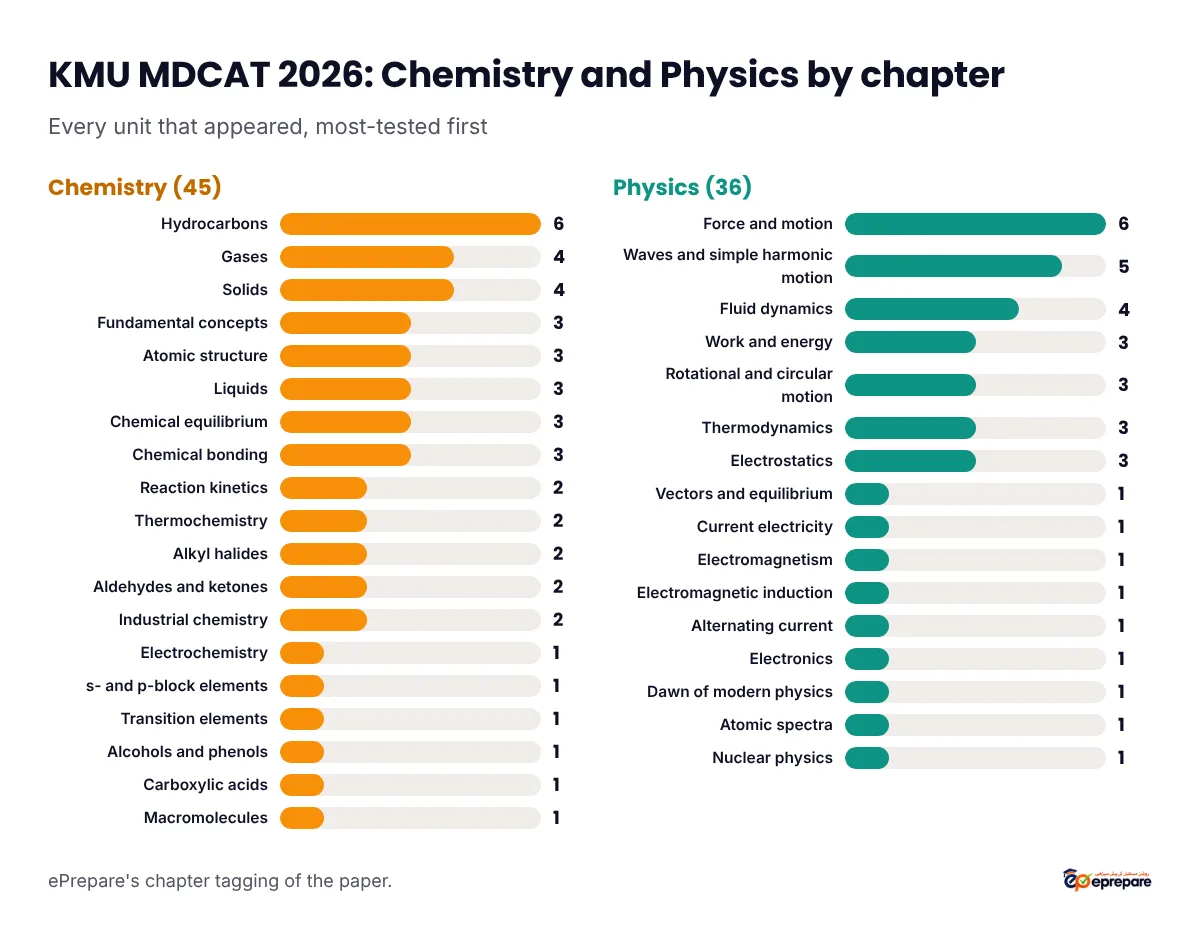
We tagged every Code A question to its PM&DC unit. In Biology, the biggest chapters were Biological molecules (9), Support and movement (8), Coordination and control (7), Inheritance (7). In Chemistry, Hydrocarbons (6), Gases (4), Solids (4); in Physics, Force and motion (6), Waves and simple harmonic motion (5), Fluid dynamics (4). The paper covered 16 of 16 Biology units, 19 of 20 Chemistry units and 16 of 16 Physics units: almost the whole syllabus, which is the clearest reason never to skip a chapter.
Biology: 81 MCQs
| Chapter | MCQs | Share of Biology |
|---|---|---|
| Biological molecules | 9 | 11% |
| Support and movement | 8 | 10% |
| Coordination and control | 7 | 9% |
| Inheritance | 7 | 9% |
| Homeostasis | 7 | 9% |
| Digestion | 6 | 7% |
| Cell structure and function | 5 | 6% |
| Enzymes | 5 | 6% |
| Circulation | 5 | 6% |
| Evolution | 4 | 5% |
| Reproduction | 4 | 5% |
| Respiration | 4 | 5% |
| Biotechnology | 4 | 5% |
| Acellular life (viruses) | 2 | 2% |
| Bioenergetics | 2 | 2% |
| Immunity | 2 | 2% |
Chemistry: 45 MCQs
| Chapter | MCQs | Share of Chemistry |
|---|---|---|
| Hydrocarbons | 6 | 13% |
| Gases | 4 | 9% |
| Solids | 4 | 9% |
| Fundamental concepts | 3 | 7% |
| Atomic structure | 3 | 7% |
| Liquids | 3 | 7% |
| Chemical equilibrium | 3 | 7% |
| Chemical bonding | 3 | 7% |
| Reaction kinetics | 2 | 4% |
| Thermochemistry | 2 | 4% |
| Alkyl halides | 2 | 4% |
| Aldehydes and ketones | 2 | 4% |
| Industrial chemistry | 2 | 4% |
| Electrochemistry | 1 | 2% |
| s- and p-block elements | 1 | 2% |
| Transition elements | 1 | 2% |
| Alcohols and phenols | 1 | 2% |
| Carboxylic acids | 1 | 2% |
| Macromolecules | 1 | 2% |
Physics: 36 MCQs
| Chapter | MCQs | Share of Physics |
|---|---|---|
| Force and motion | 6 | 17% |
| Waves and simple harmonic motion | 5 | 14% |
| Fluid dynamics | 4 | 11% |
| Work and energy | 3 | 8% |
| Rotational and circular motion | 3 | 8% |
| Thermodynamics | 3 | 8% |
| Electrostatics | 3 | 8% |
| Vectors and equilibrium | 1 | 3% |
| Current electricity | 1 | 3% |
| Electromagnetism | 1 | 3% |
| Electromagnetic induction | 1 | 3% |
| Alternating current | 1 | 3% |
| Electronics | 1 | 3% |
| Dawn of modern physics | 1 | 3% |
| Atomic spectra | 1 | 3% |
| Nuclear physics | 1 | 3% |
English: 9 MCQs
| Chapter | MCQs | Share of English |
|---|---|---|
| Formal and lexical aspects of language | 5 | 56% |
| Reading and thinking skills | 3 | 33% |
| Writing skills | 1 | 11% |
Logical Reasoning: 9 MCQs
| Chapter | MCQs | Share of Logical Reasoning |
|---|---|---|
| Logical problems | 3 | 33% |
| Logical deductions | 2 | 22% |
| Course of action | 2 | 22% |
| Letter and symbol series | 1 | 11% |
| Critical thinking | 1 | 11% |
How to use this paper
- Attempt it first, then check. Sit the paper in 3 hours on our free online test before reading the answers below.
- Read every explanation, including the ones you got right; half the value is knowing why the other options are wrong.
- Fix chapters, not questions. If you miss two Inheritance MCQs, revise the whole unit and practise more Biology MCQs.
- Practise more KMU papers on KMU MDCAT past papers.
Biology MCQs with answers and explanations (Q1 to Q81)
Q1. Which of the following is correctly matched with its morphological type?
Biology · Acellular life (viruses)
- A. Tobacco mosaic virus — Polyhedral virus
- B. Poliovirus — Rod shaped virus
- C. Bacteriophage — Tadpole virus
- D. Tobacco mosaic virus — Spherical virus
Show answer and explanation
Answer: C. Bacteriophage — Tadpole virus
A bacteriophage has an icosahedral head and tail, giving the familiar tadpole appearance. Poliovirus is roughly spherical or polyhedral, while tobacco mosaic virus is rod shaped.
The shape pairing in option C is therefore the one that fits.
Q2. A patient diagnosed with AIDS has an increased susceptibility to infections due to:
Biology · Acellular life (viruses)
- A. Destruction of red blood cells
- B. Excess production of antibodies
- C. Weakening of the immune system
- D. Overproduction of digestive enzymes
Show answer and explanation
Answer: C. Weakening of the immune system
HIV damages immune function, particularly by depleting CD4 helper T cells. The body then becomes less able to coordinate a protective response to microbes.
Increased susceptibility follows from this weakened defence. Destruction of red cells or excess digestive enzymes does not explain the defining immune defect.
Q3. Which of the following is converted into a two-carbon molecule with the release of carbon dioxide?
Biology · Bioenergetics
- A. Acetyl-CoA
- B. Lactate
- C. Pyruvate
- D. Glycerol
Show answer and explanation
Answer: C. Pyruvate
In the link reaction, three carbon pyruvate loses one carbon as carbon dioxide. The remaining two carbon acetyl group attaches to coenzyme A.
Acetyl CoA is the product of this conversion, so it is not the starting molecule requested in the question.
Q4. Metabolism of an 18-carbon fatty acid results in ____ number of Acetyl-CoA?
Biology · Bioenergetics
- A. 3
- B. 6
- C. 9
- D. 18
Show answer and explanation
Answer: C. 9
Beta oxidation removes two carbon units from an even chain fatty acid, and each unit enters acetyl CoA. Divide the 18 carbons into groups of two.
The number of acetyl CoA molecules is nine. Do not confuse this with the eight beta oxidation cycles needed to cut the chain into nine units.
Working
18 ÷ 2 = 9 acetyl CoA
beta oxidation cycles = 9 − 1 = 8
Q5. Which of the following are classified as organic molecules in humans?
Biology · Biological molecules
- A. Water, mineral, oxygen, carbon dioxide
- B. Carbohydrates, proteins, lipids, nucleic acids
- C. Vitamins, minerals, water, oxygen
- D. Glucose, sodium chloride, water, calcium
Show answer and explanation
Answer: B. Carbohydrates, proteins, lipids, nucleic acids
These four groups are major carbon based biological molecules. Their structures and functions make them organic components of living cells.
The competing lists include water, mineral ions, oxygen, or carbon dioxide, which cannot all be classified as organic biomolecules.
Q6. The structural similarity between DNA and RNA nucleotides is due to the presence of:
Biology · Biological molecules
- A. Thymine
- B. Ribose
- C. Deoxyribose
- D. Phosphoric acid
Show answer and explanation
Answer: D. Phosphoric acid
A nucleotide contains a phosphate group, sugar, and nitrogenous base. Both DNA and RNA nucleotides have phosphate in their backbone.
Their sugars differ, and thymine is characteristic of DNA rather than RNA. Thus phosphoric acid is their shared component among the options.
Q7. Which property of water is primarily helpful in providing a cooling effect to plants and animals?
Biology · Biological molecules
- A. Heat capacity
- B. Heat of vaporization
- C. Solvent properties
- D. Force of cohesion
Show answer and explanation
Answer: B. Heat of vaporization
When sweat or water on a leaf evaporates, it needs energy to change into vapour. That energy is drawn as heat from the body or leaf surface.
A high heat of vaporization therefore gives evaporative cooling. Heat capacity helps resist temperature changes but is not the main mechanism asked here.
Q8. The reduction of water content in protoplasm to about 10% results in:
Biology · Biological molecules
- A. Increased metabolic activity
- B. Faster cell division
- C. Loss of survival of protoplasm
- D. Increased protein synthesis
Show answer and explanation
Answer: C. Loss of survival of protoplasm
Water provides the medium for biochemical reactions and supports the structure of protoplasm. Severe dehydration makes normal cellular activity impossible.
At about ten percent water content, the expected result in this question is loss of protoplasm survival, rather than faster growth or more protein synthesis.
Q9. Maltose is classified as:
Biology · Biological molecules
- A. Monosaccharide
- B. Disaccharide
- C. Trisaccharide
- D. Polysaccharide
Show answer and explanation
Answer: B. Disaccharide
Maltose consists of two glucose units joined by a glycosidic bond. A sugar made from two monosaccharide units is a disaccharide.
It is therefore neither a single sugar unit nor a long polysaccharide chain.
Q10. Haemoglobin is an example of which level of protein structure?
Biology · Biological molecules
- A. Primary
- B. Secondary
- C. Tertiary
- D. Quaternary
Show answer and explanation
Answer: D. Quaternary
Functional haemoglobin consists of four polypeptide subunits associated in one protein complex. The arrangement of multiple chains defines quaternary structure.
A single subunit can also have its own tertiary folding, but the complete haemoglobin molecule is the intended example of quaternary structure.
Q11. In cell, glycoproteins are found in the:
Biology · Biological molecules
- A. Mitochondria
- B. DNA
- C. RNA
- D. Plasma membrane
Show answer and explanation
Answer: A. Mitochondria / D. Plasma membrane
KMU's official Code A key accepts both A and D.
Plasma membrane glycoproteins are well established and project carbohydrate groups toward the extracellular surface.
The mitochondrial option needs careful wording, because glycosylation of mitochondrial proteins is more specialised than the standard textbook plasma membrane example. Both answers are accepted, exactly as KMU published them.
Q12. A DNA molecule has a length of 340 nm. How many base pairs does it contain?
Biology · Biological molecules
- A. 100
- B. 340
- C. 500
- D. 1000
Show answer and explanation
Answer: D. 1000
Adjacent base pairs in ordinary B form DNA are separated by approximately 0.34 nm along the helical axis. Divide the length by this rise per pair.
The result is 1000 base pairs. A base pair contains two nucleotides, so base pairs and individual nucleotides must not be confused.
Working
Number of base pairs = 340 nm ÷ 0.34 nm per pair
= 1000 base pairs
Q13. Fatty acids and glycerol are related to ____, whereas ____ are related to protein.
Biology · Biological molecules
- A. Nucleic acids; amino acids
- B. Lipids; amino acids
- C. Polymers; polypeptides
- D. Amino acids; polypeptides
Show answer and explanation
Answer: B. Lipids; amino acids
Fatty acids and glycerol are the familiar building components of many lipids. Proteins, in turn, are polymers of amino acids.
The two blanks ask for the product class first and the protein building blocks second, which gives lipids followed by amino acids.
Q14. A student observes a discoid organelle with a double membrane, stroma and thylakoids in a plant cell. Which organelle is this?
Biology · Cell structure and function
- A. Golgi apparatus
- B. Endoplasmic reticulum
- C. Chloroplast
- D. Mitochondria
Show answer and explanation
Answer: C. Chloroplast
The stroma is the fluid interior of a chloroplast, and thylakoids form its internal membrane system. Their stacked regions are associated with light reactions.
A mitochondrion also has two membranes, but it contains cristae rather than thylakoids, so the internal details identify the chloroplast.
Q15. Which of the following is a common feature of prokaryotic and eukaryotic cells?
Biology · Cell structure and function
- A. Mitochondria
- B. Ribosomes
- C. Endoplasmic reticulum
- D. Golgi complex
Show answer and explanation
Answer: B. Ribosomes
Both cell types synthesize proteins, so both contain ribosomes. The ribosomes differ in size and composition but share the same basic role.
Mitochondria, endoplasmic reticulum, and Golgi apparatus are membrane bound structures absent from typical prokaryotes.
Q16. Which one of the following is a self-replicating organelle?
Biology · Cell structure and function
- A. Golgi apparatus
- B. Lysosome
- C. Peroxisome
- D. Mitochondria
Show answer and explanation
Answer: D. Mitochondria
Mitochondria carry their own DNA and divide from pre existing mitochondria. This gives them a degree of replication within the cell.
The Golgi apparatus and lysosomes do not have the same independent genetic machinery; mitochondria are the intended choice.
Q17. If a cell's smooth endoplasmic reticulum is destroyed, which processes will be most affected?
Biology · Cell structure and function
- A. Protein synthesis and protein folding
- B. Lipid synthesis and detoxification
- C. ATP production and aerobic respiration
- D. DNA replication and cell division
Show answer and explanation
Answer: B. Lipid synthesis and detoxification
Smooth ER is a major site for lipid synthesis and enzymatic detoxification. Removing it directly interferes with both processes.
Protein synthesis on bound ribosomes belongs mainly to rough ER, while aerobic ATP generation belongs mainly to mitochondria.
Q18. The centromere is important because it:
Biology · Cell structure and function
- A. Synthesizes proteins
- B. Holds identical chromatids together
- C. Replicates DNA
- D. Produces ATP
Show answer and explanation
Answer: B. Holds identical chromatids together
After DNA replication, the two sister chromatids remain joined at the centromeric region until separation. This region also supports kinetochore assembly for spindle attachment.
It is a chromosome structure rather than an ATP producing or protein synthesizing organelle.
Q19. Which of the following correctly describes the action of the sodium-potassium pump in a resting neuron?
Biology · Coordination and control
- A. Two Na⁺ ions are pumped in and three K⁺ ions are pumped out
- B. Three Na⁺ ions are pumped in and two K⁺ ions are pumped out
- C. Three Na⁺ ions are pumped out and two K⁺ ions are pumped in
- D. Equal numbers of Na⁺ and K⁺ ions are exchanged
Show answer and explanation
Answer: C. Three Na⁺ ions are pumped out and two K⁺ ions are pumped in
For each ATP used, the pump sends three sodium ions out of the neuron and brings two potassium ions in. Both movements run against the respective concentration gradients.
This helps maintain the ion gradients required for resting potential and later nerve impulses; reversing the directions is a common trap.
Q20. Which of the following structures can be found in a typical neuron?
Biology · Coordination and control
- A. Dendrites, cell body, cilia
- B. Dendrites, cell body, axon
- C. Dendrites, cell body, ganglion
- D. Cauda equina, cell body, myelin sheath
Show answer and explanation
Answer: B. Dendrites, cell body, axon
Dendrites mainly receive signals, the cell body integrates them, and the axon carries output away. Together they describe a typical neuron's main structural plan.
A ganglion is a collection of neuronal cell bodies, not one part of a single neuron; cilia and cauda equina do not complete this standard list.
Q21. The reversal of polarity across two sides of the membrane from −70 mV to 50 mV is called:
Biology · Coordination and control
- A. Polarization
- B. Hyperpolarization
- C. Repolarization
- D. Depolarization
Show answer and explanation
Answer: D. Depolarization
A resting membrane near −70 mV becomes less negative as sodium enters. Movement toward a positive value is the depolarizing phase of the action potential.
Repolarization is the later return toward the resting negative value, so it does not name the change described in the stem.
Q22. A student quickly pulls his hand away from a hot iron after accidentally touching it. This response is best classified as:
Biology · Coordination and control
- A. Conditioned reflex
- B. Cranial reflex
- C. Spinal reflex
- D. Voluntary action
Show answer and explanation
Answer: C. Spinal reflex
The rapid withdrawal is coordinated through a spinal reflex arc before conscious processing becomes the main response. This short path protects tissue from further heat damage.
It is involuntary and immediate, rather than a learned conditioned response or a deliberate voluntary movement.
Q23. A patient suffers a brain injury following a head trauma. During recovery, the patient experiences disturbed sleep patterns and is unable to dream normally. Which part of the brain is most likely affected?
Biology · Coordination and control
- A. Cerebellum
- B. Medulla oblongata
- C. Pons
- D. Thalamus
Show answer and explanation
Answer: C. Pons
The pons participates in sleep regulation and REM sleep circuitry, so injury there can disturb sleep patterns and dreaming. It also forms part of the brainstem.
The cerebellum chiefly coordinates movement, while the medulla handles vital autonomic functions; the pons best matches this symptom pair.
Q24. Damage to the area containing dopamine-releasing neurons would most likely affect the:
Biology · Coordination and control
- A. Midbrain
- B. Cerebellum
- C. Pons
- D. Medulla
Show answer and explanation
Answer: A. Midbrain
Dopamine producing neuronal groups such as the substantia nigra and ventral tegmental area are in the midbrain. Injury there can therefore affect dopamine related motor and reward pathways.
The other listed regions have different primary functions and do not locate these classic midbrain dopamine populations.
Q25. The amygdala is a part of the:
Biology · Coordination and control
- A. Cerebellum
- B. Limbic system
- C. Reticular formation
- D. Medulla oblongata
Show answer and explanation
Answer: B. Limbic system
The amygdala is a limbic structure involved in emotional processing, including fear related responses. It communicates with other brain areas during emotional learning.
It is not a component of the medulla, cerebellum, or reticular formation listed as alternatives.
Q26. Which characteristic distinguishes enzymes during a chemical reaction?
Biology · Enzymes
- A. They change the final product
- B. They slow down metabolic steps
- C. They remain chemically unchanged
- D. They become part of reaction product
Show answer and explanation
Answer: C. They remain chemically unchanged
An enzyme binds reactants and lowers the activation energy, then releases products and can be used again. It is not permanently incorporated into those products.
The reaction becomes faster, while the enzyme's overall chemical identity remains unchanged after one catalytic cycle.
Q27. According to the lock and key hypothesis, the active site in enzyme action is regarded as a ____ structure.
Biology · Enzymes
- A. Rigid
- B. Flexible
- C. Dynamic
- D. Elastic
Show answer and explanation
Answer: A. Rigid
The classical lock and key model imagines a pre shaped active site complementary to its substrate. In this simplified model, the site is regarded as rigid.
A flexible changing shape is instead emphasised by the induced fit model. The question specifically names lock and key.
Q28. Enzyme pepsin shows maximum activity at pH:
Biology · Enzymes
- A. 1.5–1.6
- B. 4.5–4.7
- C. 7.8–8.7
- D. 8.7–9.1
Show answer and explanation
Answer: A. 1.5–1.6
Pepsin functions in the acidic environment of the stomach. Its activity is greatest at a very low pH, approximately within the first option's range.
Near neutral or alkaline pH, the active site's charge and shape no longer support the same activity.
Q29. pH affects the activity of an enzyme by causing the:
Biology · Enzymes
- A. Ionization of an active site
- B. Increase in the activation energy
- C. Removal of prosthetic group from enzyme
- D. Decreasing the temperature of reaction mixture
Show answer and explanation
Answer: A. Ionization of an active site
Changing pH changes the protonation and charge of amino acid groups at the active site. That can disrupt substrate binding or the catalytic step.
pH is not itself a temperature decrease and does not necessarily remove a prosthetic group; the direct mechanism here is altered ionization.
Q30. Which molecule has a similar structure to the normal substrate?
Biology · Enzymes
- A. Competitive inhibitor
- B. Non-competitive inhibitor
- C. Heavy metal ion
- D. Cyanide
Show answer and explanation
Answer: A. Competitive inhibitor
A competitive inhibitor resembles the substrate closely enough to bind at the same active site. Substrate and inhibitor compete for access.
A noncompetitive inhibitor acts through a different site or mechanism, so resemblance to the normal substrate identifies the competitive type.
Q31. Human beings are involved in an intense struggle for existence because resources such as food, water and space:
Biology · Evolution
- A. Double every year
- B. Cannot increase at the same rate
- C. Increase at the same rate
- D. Remain constant
Show answer and explanation
Answer: B. Cannot increase at the same rate
Population can rise more rapidly than food, water, and space. When resources are limited, individuals compete and not every organism survives or reproduces.
The idea does not require resources to stay exactly constant; it requires their increase to lag behind demand.
Q32. Lamarck explained the long neck of giraffe on the basis of:
Biology · Evolution
- A. Mutation
- B. Natural selection
- C. Inheritance of acquired characteristics
- D. Genetic drift
Show answer and explanation
Answer: C. Inheritance of acquired characteristics
Lamarck proposed that repeated use could lengthen a structure and that the acquired change could pass to offspring. The long giraffe neck was a classic example of his proposed mechanism.
This is a historical explanation, not the accepted modern genetic account of evolution by natural selection.
Q33. A population of rabbits shows variation in fur colour. During snowy winters, white rabbits are less visible to predators and survive in greater numbers than brown rabbits. According to Darwin, this is an example of:
Biology · Evolution
- A. Overproduction
- B. Natural selection
- C. Artificial selection
- D. Genetic drift
Show answer and explanation
Answer: B. Natural selection
Fur colours vary, and white rabbits are harder for predators to see against snow. They survive and reproduce more often under those conditions.
Because the environment changes survival by an inherited trait, the example illustrates natural selection rather than deliberate artificial breeding.
Q34. According to Lamarck, what would be expected if an organism loses or modifies a body part during its lifetime?
Biology · Evolution
- A. It is passed to offspring
- B. It has no effect on offspring
- C. It causes genetic mutation
- D. It occurs through natural selection
Show answer and explanation
Answer: A. It is passed to offspring
Lamarck's theory held that traits acquired through use or disuse during life could be inherited by offspring. Thus a change to a body part would be expected to pass on in that theory.
Modern genetics generally does not support inheritance of an ordinary acquired bodily modification; the question asks specifically what Lamarck proposed.
Q35. Post ovulation, the ruptured follicle is transformed into a glandular structure called:
Biology · Reproduction
- A. Cervix
- B. Fimbriae
- C. Endometrium
- D. Corpus luteum
Show answer and explanation
Answer: D. Corpus luteum
Following ovulation, the remaining follicular tissue reorganizes into the corpus luteum. It secretes progesterone and helps support the endometrium.
The cervix and fimbriae are separate structures, while the endometrium is the uterine lining.
Q36. Both vas deferens of a male are surgically cut (vasectomy done). Which process remains unaffected after the procedure?
Biology · Reproduction
- A. Testosterone secretion
- B. Sperm transport
- C. Ejaculation of sperms
- D. Fertilization ability
Show answer and explanation
Answer: A. Testosterone secretion
Vasectomy cuts the vas deferens, blocking sperm from entering the ejaculate. The testes remain in place and their hormone producing cells continue to secrete testosterone.
The procedure interferes with sperm transport and fertilization, but it does not directly shut down endocrine function.
Q37. A woman has irregular menstruation due to failure of proliferative endometrial thickening. Which hormone is deficient in her body?
Biology · Reproduction
- A. Estrogen
- B. Oxytocin
- C. Luteinizing hormone
- D. Follicle-stimulating hormone
Show answer and explanation
Answer: A. Estrogen
Estrogen from developing ovarian follicles drives proliferation and thickening of the uterine lining before ovulation. Deficiency can therefore impair this phase.
Progesterone is more important for the later secretory phase; oxytocin does not cause the proliferative thickening described here.
Q38. A patient having a painless, non-itching ulcerated sore with hard edges on genitals is most likely suffering from:
Biology · Reproduction
- A. Gonorrhea
- B. Syphilis
- C. Genital herpes
- D. AIDS
Show answer and explanation
Answer: B. Syphilis
A primary syphilitic chancre classically presents as a painless ulcer with a firm edge. The symptoms in the stem point to that pattern.
Genital herpes more commonly produces painful grouped vesicles or ulcers, so it is a poorer match.
Q39. The ribs not attached to the sternum are called:
Biology · Support and movement
- A. True ribs
- B. False ribs
- C. Floating ribs
- D. Vertebro-sternal ribs
Show answer and explanation
Answer: C. Floating ribs
Floating ribs, usually pairs 11 and 12, have no anterior attachment to the sternum. That makes option C a literal match to the question.
A note on the wording: false ribs include the floating ribs and other ribs that lack a direct sternal attachment. If “not attached” means no attachment at all, floating ribs are intended; if it means no direct attachment, option B could also be argued. KMU's official key is C.
Q40. A tissue is found to have cells embedded in a firm matrix, lacks blood vessels and receives nutrients by diffusion. It also resists compression forces in joints. This tissue is most likely:
Biology · Support and movement
- A. Compact bone
- B. Spongy bone
- C. Adipose
- D. Cartilage
Show answer and explanation
Answer: D. Cartilage
Cartilage cells lie in a firm extracellular matrix, and cartilage has no blood vessels of its own. Nutrients reach the cells by diffusion.
That matrix resists compression at joints. Bone is vascular, and adipose tissue does not have this cartilage like supporting matrix.
Q41. A tissue sample shows striated, multinucleated cells and has voluntary control. Which fundamental role is most associated with this tissue?
Biology · Support and movement
- A. Pumping blood
- B. Movement of internal organs
- C. Maintenance of posture and locomotion
- D. Production of digestive enzymes
Show answer and explanation
Answer: C. Maintenance of posture and locomotion
Striated multinucleated fibres under voluntary control identify skeletal muscle. Skeletal muscles move bones and help maintain posture.
Heart pumping belongs to cardiac muscle, whereas movement of internal organs belongs mainly to smooth muscle.
Q42. The T-tubule and the terminal portion of the adjacent sarcoplasmic reticulum collectively form:
Biology · Support and movement
- A. Sarcomere
- B. Triad
- C. Sarcoplasm
- D. Sarcolemma
Show answer and explanation
Answer: B. Triad
A skeletal muscle triad consists of one transverse T tubule between two terminal cisternae of the sarcoplasmic reticulum. It couples the electrical signal to calcium release.
The sarcomere is a contractile unit, while sarcoplasm and sarcolemma name cytoplasm and membrane, respectively.
Q43. During skeletal muscle contraction, the A-band of fibre:
Biology · Support and movement
- A. Shortens
- B. Elongates
- C. Disappears
- D. Remains constant
Show answer and explanation
Answer: D. Remains constant
The A band corresponds to the length of thick myosin filaments. Sliding filament contraction changes the degree of overlap without shortening the thick filaments.
The I band and H zone can shrink, but the A band's length remains essentially constant.
Q44. The joint formed between adjacent vertebrae allows slight movement and has no synovial cavity. It is classified as:
Biology · Support and movement
- A. Synovial joint
- B. Fibrous joint
- C. Hinge joint
- D. Cartilaginous joint
Show answer and explanation
Answer: D. Cartilaginous joint
Intervertebral discs join vertebral bodies with fibrocartilage, allowing limited movement and absorbing compression. There is no synovial cavity between these vertebral bodies.
The stem describes this cartilaginous joint, rather than a freely movable synovial joint; it also differs from a fibrous suture.
Q45. A cricketer rotates his shoulder joint to throw the ball in any direction. What type of joint is this?
Biology · Support and movement
- A. Pivot joint
- B. Ball and socket joint
- C. Hinge joint
- D. Condyloid joint
Show answer and explanation
Answer: B. Ball and socket joint
The rounded humeral head fits into the shoulder socket. This arrangement permits movement around several axes, including rotation.
A hinge chiefly bends in one plane, whereas a pivot rotates around one axis; the shoulder is ball and socket.
Q46. In arthritis, friction and inflammation of joints primarily affects which body function?
Biology · Support and movement
- A. Exchange of gases
- B. Production of RBCs
- C. Deposition of calcium in bones
- D. Smooth movement of joints
Show answer and explanation
Answer: D. Smooth movement of joints
Inflammation and damage at a joint increase pain and friction, restricting how smoothly its surfaces move. That explains the main functional effect of arthritis.
Gas exchange and red blood cell production occur in different body systems.
Q47. If green is a dominant and yellow is a recessive trait, then what percentage of the F₂ generation will be homozygous recessive?
Biology · Inheritance
- A. 0%
- B. 25%
- C. 50%
- D. 75%
Show answer and explanation
Answer: B. 25%
For a single gene cross between heterozygous F1 parents, the genotypes appear in a 1:2:1 ratio. One of four offspring genotypes is homozygous recessive.
The dominant and recessive phenotypes follow 3:1, but the question asks specifically for the homozygous recessive genotype.
Working
Gg × Gg → GG, Gg, Gg, gg
gg = 1 ÷ 4 = 25%
Q48. In a monohybrid cross of round (RR) and wrinkled seeded (rr) pea plants, all F₁ offspring are round seeded (Rr). If an F₁ plant is crossed with a homozygous recessive (rr) plant, what will be the phenotypic ratio of round to wrinkled offspring?
Biology · Inheritance
- A. 1:3
- B. 1:4
- C. 0:4
- D. 1:1
Show answer and explanation
Answer: D. 1:1
Crossing Rr with rr produces Rr and rr offspring in equal proportions. Rr is round and rr is wrinkled.
Therefore the phenotypic ratio of round to wrinkled is 1:1; the 3:1 ratio applies to Rr × Rr instead.
Working
Rr × rr → Rr, rr
round : wrinkled = 1 : 1
Q49. Which condition results in a 1:1:1:1 phenotypic ratio in the offspring of a dihybrid test cross?
Biology · Inheritance
- A. Complete linkage
- B. No linkage
- C. Sex linkage
- D. Mutation
Show answer and explanation
Answer: B. No linkage
An unlinked dihybrid makes four types of gametes in equal frequencies. A test cross with a double recessive partner reveals those gametes as four equal phenotype classes.
Complete linkage would favour parental combinations and disrupt the equal 1:1:1:1 result.
Q50. An X-linked recessive allele inherited from a carrier mother (father is unaffected) is most likely to be expressed in which child?
Biology · Inheritance
- A. Son
- B. Daughter
- C. Both equally
- D. None of them
Show answer and explanation
Answer: A. Son
A son receives his only X chromosome from his mother and a Y from his father. If that X bears the recessive allele, there is no second normal X to mask it.
A daughter of a carrier mother and unaffected father usually has a normal paternal X, so she is less likely to express this recessive trait.
Q51. Which of the following is a disorder caused by a recessive X-linked trait?
Biology · Inheritance
- A. Vitamin D resistant rickets
- B. Anemia
- C. Colour blindness
- D. Cystic fibrosis
Show answer and explanation
Answer: C. Colour blindness
Common red green colour blindness is a classic X linked recessive trait. Its frequency is higher in males because males have only one X chromosome.
Vitamin D resistant rickets is usually taught as X linked dominant, while cystic fibrosis is autosomal recessive.
Q52. Identify the X-linked dominant disorder from the following:
Biology · Inheritance
- A. Haemophilia
- B. Colour blindness
- C. Baldness
- D. Hypophosphatemic rickets
Show answer and explanation
Answer: D. Hypophosphatemic rickets
X linked hypophosphatemic rickets can be expressed when one affected X chromosome is present. That inheritance pattern is dominant.
Haemophilia and common red green colour blindness are recessive X linked examples, helping separate the options.
Q53. The genetic basis of haemophilia is:
Biology · Inheritance
- A. A dominant allele on chromosome 21
- B. A recessive allele on the X chromosome
- C. A recessive allele on the Y chromosome
- D. A mitochondrial mutation
Show answer and explanation
Answer: B. A recessive allele on the X chromosome
The common inherited haemophilias A and B arise from mutations in clotting factor genes on the X chromosome. The recessive inheritance pattern explains why males are more often affected.
It is not a Y linked or mitochondrial disorder and does not depend on a dominant chromosome 21 allele.
Q54. The fluid present in the pericardial cavity functions to:
Biology · Circulation
- A. Nourish the heart muscles
- B. Prevent blood clotting
- C. Reduce friction during heart movement
- D. Generate electrical impulse
Show answer and explanation
Answer: C. Reduce friction during heart movement
A thin film of fluid separates the layers of the serous pericardium. As the heart beats, this lubrication reduces rubbing between the moving surfaces.
The fluid does not generate the electrical impulse or supply the heart muscle's main nutrients.
Q55. The phase of the cardiac cycle during which blood is pumped to lungs and the entire body is called:
Biology · Circulation
- A. Atrial systole
- B. Atrial diastole
- C. Ventricular systole
- D. Ventricular diastole
Show answer and explanation
Answer: C. Ventricular systole
During ventricular systole, the right ventricle ejects blood toward the lungs and the left ventricle ejects it into the aorta. Both outflows occur as the ventricles contract.
Atrial systole mainly completes ventricular filling; ventricular diastole is the relaxation and filling phase.
Q56. Hepatic portal subsystem carries nutrients from the small intestine to the:
Biology · Circulation
- A. Vena cava
- B. Liver
- C. Pancreas
- D. Kidney
Show answer and explanation
Answer: B. Liver
The hepatic portal vein carries nutrient rich blood from the gut to the liver first. The liver can process, store, or regulate absorbed materials before they enter general circulation.
The vena cava receives blood later; it is not the first organ reached by this portal route.
Q57. Why are arteries thicker than veins?
Biology · Circulation
- A. To store more blood
- B. To prevent backflow
- C. To increase diffusion rate
- D. To withstand high pressure
Show answer and explanation
Answer: D. To withstand high pressure
Blood leaves the heart under relatively high pressure, so arteries need a thick muscular and elastic wall. That wall helps them tolerate and smooth pressure changes.
Veins operate at lower pressure and rely more on valves to limit backflow.
Q58. Lymph is most closely related to:
Biology · Circulation
- A. Blood plasma
- B. Interstitial fluid
- C. Sweat
- D. Saliva
Show answer and explanation
Answer: B. Interstitial fluid
Fluid that leaves capillaries enters tissue spaces as interstitial fluid. Once collected into lymphatic vessels, it is called lymph.
It ultimately originates from plasma, but its immediate precursor and closest counterpart is interstitial fluid.
Q59. B-lymphocytes produce a small, soluble and specific protein called:
Biology · Immunity
- A. Antigen
- B. Antibody
- C. Prostaglandin
- D. Perforin
Show answer and explanation
Answer: B. Antibody
Activated B cells can become plasma cells that release antigen specific antibodies. These soluble proteins bind particular targets in an adaptive immune response.
An antigen is the target that stimulates immunity; perforin is associated mainly with cytotoxic immune cells.
Q60. A vaccine containing weakened microbes is administered to a person. Which aspect of adaptive immunity provides long-lasting protection against future infections?
Biology · Immunity
- A. Inflammatory response
- B. Rise in body temperature
- C. Engulfment by phagocytes
- D. Formation of memory cells
Show answer and explanation
Answer: D. Formation of memory cells
Vaccination exposes the adaptive immune system to antigen without the full risk of the natural infection. Memory B and T cells then persist and respond more rapidly on later exposure.
Fever, inflammation, and phagocytosis are useful immediate defences but do not themselves explain the long lasting adaptive memory.
Q61. Which has no cartilage in its structure?
Biology · Respiration
- A. Larynx
- B. Trachea
- C. Bronchioles
- D. Bronchi
Show answer and explanation
Answer: C. Bronchioles
Trachea and bronchi have cartilage supporting their walls, while smaller bronchioles lack cartilage. Bronchiolar calibre is controlled largely by smooth muscle.
The larynx also contains cartilage, so bronchioles are the structure that meets the “no cartilage” condition.
Q62. The mucus and cilia of the nasal cavity work together to:
Biology · Respiration
- A. Increase the rate of diffusion of oxygen
- B. Produce mucus for vocal cord lubrication
- C. Filter air and prevent the entry of microorganisms
- D. Exchange oxygen and carbon dioxide with blood
Show answer and explanation
Answer: C. Filter air and prevent the entry of microorganisms
Mucus traps inhaled particles and microbes. Cilia move the trapped material toward the throat so it can be cleared.
Gas exchange happens mainly across alveoli, not in the nasal cavity; the nasal structures chiefly condition and clean inspired air.
Q63. During gaseous exchange in the human body, the maximum percentage of CO₂ is transported from body tissues to lungs as:
Biology · Respiration
- A. Bicarbonate ion
- B. Carbaminohemoglobin
- C. Dissolved CO₂ in plasma
- D. Gaseous form as bubbles
Show answer and explanation
Answer: A. Bicarbonate ion
Most carbon dioxide entering red cells is converted to carbonic acid and then bicarbonate. Bicarbonate moves in the blood and carries the largest share toward the lungs.
Smaller portions travel dissolved in plasma or attached to haemoglobin as carbamino compounds.
Q64. Smoking causes alveolar destruction in:
Biology · Respiration
- A. Pneumonia
- B. Chronic bronchitis
- C. Emphysema
- D. Asthma
Show answer and explanation
Answer: C. Emphysema
Emphysema involves destruction of alveolar walls and loss of elastic recoil. This reduces the effective surface area available for gas exchange.
Chronic bronchitis mainly involves inflamed, mucus producing airways; the alveolar destruction in the question identifies emphysema.
Q65. Which of the following is not a function of liver?
Biology · Digestion
- A. Detoxification
- B. Insulin synthesis
- C. Producing bile
- D. Storage of vitamin A
Show answer and explanation
Answer: B. Insulin synthesis
The liver detoxifies many substances, makes bile, and stores vitamin A. Insulin, however, is synthesized and secreted by pancreatic beta cells.
Thus the pancreas rather than the liver is responsible for the activity in option B.
Q66. Find the correct sequence of phases in the swallowing mechanism. 1. Pharyngeal 2. Oral 3. Esophageal
Biology · Digestion
- A. 2–1–3
- B. 1–2–3
- C. 2–3–1
- D. 3–1–2
Show answer and explanation
Answer: A. 2–1–3
A swallow begins with the oral phase, continues through the pharyngeal phase, and then passes through the esophagus. Map those names to the numbers in the question.
Oral is 2, pharyngeal is 1, and esophageal is 3; therefore the official answer is the sequence 2–1–3.
Working
Oral (2) → pharyngeal (1) → esophageal (3)
Q67. The release of bicarbonate-rich fluid from the pancreas is stimulated by the action of:
Biology · Digestion
- A. Pepsin
- B. Gastrin
- C. Secretin
- D. Trypsin
Show answer and explanation
Answer: C. Secretin
Acidic chyme entering the duodenum stimulates secretin release. Secretin promotes bicarbonate rich pancreatic secretion that neutralizes the acid.
Gastrin mainly stimulates gastric activity, while pepsin and trypsin are enzymes rather than the hormone sought here.
Q68. Which structures in the intestinal villus are directly involved in nutrient absorption?
Biology · Digestion
- A. Blood capillaries and lacteals
- B. Arteries and goblet cells
- C. Circular and longitudinal muscles
- D. Crypts of Lieberkühn and microvilli
Show answer and explanation
Answer: A. Blood capillaries and lacteals
Blood capillaries receive many absorbed sugars and amino acids. A central lacteal transports much of the absorbed lipid in lymph.
Both structures are within the villus and directly carry nutrients away, unlike muscle layers or mucus producing cells.
Q69. The primary function of peristalsis in the large intestine is to:
Biology · Digestion
- A. Digest carbohydrates
- B. Move undigested food toward the rectum
- C. Absorb fats
- D. Secrete digestive enzymes
Show answer and explanation
Answer: B. Move undigested food toward the rectum
Rhythmic contractions push residual intestinal contents along the colon toward the rectum. Water absorption occurs during this transit.
The large intestine is not primarily responsible for carbohydrate digestion or for secreting major digestive enzymes.
Q70. A patient experiences chronic gastric discomfort and endoscopy confirms gastric ulcers. Which finding best explains the underlying cause?
Biology · Digestion
- A. Deficiency of pepsinogen secretion
- B. Excess absorption of hydrochloric acid
- C. Spread of Helicobacter pylori into stomach wall
- D. Lack of intrinsic factor and vitamin B₁₂
Show answer and explanation
Answer: C. Spread of Helicobacter pylori into stomach wall
Helicobacter pylori can colonize the gastric mucosa, disrupt its protective barrier, and promote ulcer formation. That fits chronic discomfort with an endoscopically confirmed ulcer.
The other choices do not give the common direct explanation for gastric mucosal injury asked for here.
Q71. Which region of the kidney contains glomeruli and Bowman's capsules?
Biology · Homeostasis
- A. Renal medulla
- B. Renal cortex
- C. Renal pelvis
- D. Hilum
Show answer and explanation
Answer: B. Renal cortex
Renal corpuscles contain a glomerulus within Bowman's capsule. They are located in the outer renal cortex.
The medulla contains structures such as loops of Henle and collecting ducts, but not the renal corpuscles requested.
Q72. If glucose appears in urine of a patient, it indicates failure of which process?
Biology · Homeostasis
- A. Pressure filtration
- B. Selective reabsorption
- C. Tubular secretion
- D. Osmoregulation
Show answer and explanation
Answer: B. Selective reabsorption
Glucose is filtered at the renal corpuscle and normally reclaimed in the proximal tubule. Finding it in urine can mean reabsorption capacity has been exceeded or the process is impaired.
Thus selective reabsorption is the relevant process among the options; filtration itself is what brings glucose into the filtrate.
Q73. Which part of the nephron is impermeable to water?
Biology · Homeostasis
- A. Glomerulus
- B. Descending limb
- C. Ascending limb
- D. Proximal tubule
Show answer and explanation
Answer: C. Ascending limb
The ascending limb of the loop of Henle transports salts but is effectively impermeable to water. This separation helps establish the medullary osmotic gradient.
The descending limb is water permeable, which is why exchanging the two limbs gives the wrong answer.
Q74. When water intake is high:
Biology · Homeostasis
- A. ADH secretion increases, producing concentrated urine
- B. Aldosterone secretion increases, producing concentrated urine
- C. ADH release is inhibited, resulting in a large volume of dilute urine
- D. Ultrafiltration stops until water balance is restored
Show answer and explanation
Answer: C. ADH release is inhibited, resulting in a large volume of dilute urine
When the body has ample water, ADH release falls. The collecting ducts then reabsorb less water and a larger volume of dilute urine is excreted.
The response prevents excessive water retention; ultrafiltration does not simply stop.
Q75. Peritubular capillaries are formed from:
Biology · Homeostasis
- A. Glomerulus
- B. Afferent arteriole
- C. Efferent arteriole
- D. Interlobular artery
Show answer and explanation
Answer: C. Efferent arteriole
Blood leaves each glomerulus through an efferent arteriole. That vessel branches into peritubular capillaries, and in some nephrons the vasa recta.
The afferent arteriole carries blood into the glomerulus, so it is upstream of this second capillary network.
Q76. Dialysis or kidney transplantation is usually required when kidney function falls below ____ of normal.
Biology · Homeostasis
- A. 70%
- B. 50%
- C. 25%
- D. 10%
Show answer and explanation
Answer: D. 10%
The item asks about the level of remaining function at which dialysis or transplantation is usually needed. The official option is below ten percent of normal function.
Clinical decisions also depend on symptoms and laboratory findings, but among the stated thresholds ten percent represents very advanced failure.
Q77. Which nitrogenous waste is the main excretory product in humans and has relatively low toxicity compared to ammonia?
Biology · Homeostasis
- A. Urea
- B. Uric acid
- C. Creatinine
- D. Ammonia
Show answer and explanation
Answer: A. Urea
Humans convert much of the highly toxic ammonia produced during amino acid metabolism into urea in the liver. The kidneys then excrete urea.
Uric acid and creatinine are also excreted, but urea is the main nitrogenous product intended by this comparison.
Q78. DNA probes enable faster identification of disease-causing bacteria than conventional methods because of advances in:
Biology · Biotechnology
- A. Non-biological methods
- B. Biotechnology
- C. Antibiotics
- D. Surgery
Show answer and explanation
Answer: B. Biotechnology
A DNA probe can recognize a complementary sequence from a microorganism. This molecular identification is a biotechnology method and can be faster than conventional culture.
Antibiotics treat infections and surgery is a procedure; neither names the technology behind the probe.
Q79. The most common vector used to deliver a therapeutic gene into target cells is:
Biology · Biotechnology
- A. Plasmid
- B. Liposome
- C. Genetically altered virus
- D. Restriction enzyme
Show answer and explanation
Answer: C. Genetically altered virus
Engineered viruses can enter target cells and deliver a therapeutic gene. Their natural cell entry machinery makes them useful vectors once modified for safety.
Plasmids can also be vectors in some settings, but the question asks for the most common choice among its listed alternatives.
Q80. Monoclonal antibodies are:
Biology · Biotechnology
- A. A mixture of different antibodies
- B. A group of identical antibodies produced by identical immune cells
- C. Antibodies produced only by T-lymphocytes
- D. Radioactively labelled antibodies
Show answer and explanation
Answer: B. A group of identical antibodies produced by identical immune cells
A single B cell lineage produces antibodies with the same binding specificity. A monoclonal preparation therefore contains essentially identical antibodies derived from one clone.
A mixed antibody population is polyclonal; radioactive labelling is a possible later modification, not the definition.
Q81. Which of the following correctly matches the biotechnology product with its application?
Biology · Biotechnology
- A. Biochips: Supply biologically fixed nitrogen to crops
- B. Mycorrhiza: Deliver drugs to target cells using nanoparticles
- C. Nanoparticles: Efficient drug delivery at target cells and diagnosis of disease
- D. Biofertilizers: Detect bioterrorism agents using miniaturized laboratories
Show answer and explanation
Answer: C. Nanoparticles: Efficient drug delivery at target cells and diagnosis of disease
Nanoparticles can be designed to carry medicines to target tissues and support diagnostic imaging or detection. This matches the application in option C.
Biochips are analytical platforms, while mycorrhizae are plant fungus associations; the other pairings assign them unrelated functions.
Physics MCQs with answers and explanations (Q82 to Q117)
Q82. When two vectors A and B are added, which statement is correct?
Physics · Vectors and equilibrium
- A. A + B and B + A have different magnitudes but the same direction
- B. The resultant depends on which vector is drawn first
- C. A + B = B + A, so changing the order does not change the resultant
- D. The commutative law applies only when the vectors are perpendicular
Show answer and explanation
Answer: C. A + B = B + A, so changing the order does not change the resultant
Vector addition is commutative: reversing the order of two vectors leaves both the magnitude and direction of their resultant unchanged. A head to tail diagram reaches the same endpoint.
The law applies to vectors at any angle; perpendicular vectors are not a special requirement.
Q83. The direction of linear momentum is the same as the direction of:
Physics · Force and motion
- A. Force
- B. Acceleration
- C. Velocity
- D. Displacement
Show answer and explanation
Answer: C. Velocity
Linear momentum is the product of a positive scalar mass and the velocity vector. Multiplying by mass changes the vector's size but not its direction.
Force and acceleration can point elsewhere, particularly while an object is slowing or turning.
Working
p⃗ = m v⃗
for m > 0, p⃗ points along v⃗
Q84. Which situation represents uniform acceleration?
Physics · Force and motion
- A. Velocity changes by unequal amounts during equal time intervals
- B. Acceleration changes continuously with time
- C. Velocity changes by equal amount in equal intervals of time
- D. Velocity remains constant throughout the motion
Show answer and explanation
Answer: C. Velocity changes by equal amount in equal intervals of time
Acceleration measures how rapidly velocity changes. If equal time intervals always produce equal changes in velocity, acceleration stays constant.
Constant velocity would instead mean zero acceleration, a special case; option C directly states the defining test for uniform acceleration.
Working
a⃗ = Δv⃗ ÷ Δt
Q85. A particle moves from 40 m at 10 s to 20 m at 15 s. Its average velocity is:
Physics · Force and motion
- A. 4 m/s
- B. −4 m/s
- C. 0.04 m/s
- D. −0.04 m/s
Show answer and explanation
Answer: B. −4 m/s
Use signed displacement rather than total distance. The particle's position decreases by 20 m over a five second interval.
The negative sign shows motion toward decreasing position; dropping it would turn average velocity into a positive speed.
Working
Δx = 20 − 40 = −20 m
Δt = 15 − 10 = 5 s
v̄ = Δx ÷ Δt = −4 m/s
Q86. A 4 kg block and an 8 kg block are pushed with the same force on a frictionless surface. Which statement is correct?
Physics · Force and motion
- A. Both blocks have the same acceleration
- B. The 4 kg block has double the acceleration of the 8 kg block
- C. The 8 kg block has double the acceleration of the 4 kg block
- D. Both blocks move with the same velocity
Show answer and explanation
Answer: B. The 4 kg block has double the acceleration of the 8 kg block
For equal applied force on a frictionless surface, acceleration is inversely proportional to mass. Halving the mass doubles the acceleration.
The 4 kg block therefore has twice the acceleration of the 8 kg block; equal force does not imply equal acceleration.
Working
a₄ = F ÷ 4
a₈ = F ÷ 8
a₄ ÷ a₈ = 2
Q87. The maximum height reached by a projectile is directly proportional to:
Physics · Force and motion
- A. sin²θ
- B. cos²θ
- C. cosθ
- D. sinθ
Show answer and explanation
Answer: A. sin²θ
Only the initial vertical component, u sin θ, determines how high an ideal projectile rises. The height depends on the square of that vertical component.
With launch speed and g fixed, maximum height is directly proportional to sin² θ, not to sin θ alone.
Working
H = (u sin θ)² ÷ (2g)
therefore H ∝ sin² θ
Q88. In an isolated system, total energy and momentum is ____ in all situations.
Physics · Force and motion
- A. Conserved
- B. Lost
- C. Doubled
- D. Halved
Show answer and explanation
Answer: A. Conserved
An isolated system exchanges no net energy or momentum with its surroundings. Its total energy can change form internally while its total momentum remains fixed.
Individual objects may gain or lose energy or momentum, but the totals for the complete isolated system are conserved.
Q89. A person pushes against a stationary wall with a constant force for 2 minutes. The work done on the wall is:
Physics · Work and energy
- A. Positive
- B. Negative
- C. Zero
- D. Equal to the applied force
Show answer and explanation
Answer: C. Zero
Mechanical work on an object requires displacement of that object along the force. The wall does not move during the push.
The person can still expend biological energy, but the mechanical work done on the stationary wall is zero.
Working
W = F s cos θ
s = 0
W = 0 J
Q90. A motor performs 2400 J of work in 2 minutes. The power generated is:
Physics · Work and energy
- A. 10 W
- B. 20 W
- C. 1200 W
- D. 4800 W
Show answer and explanation
Answer: B. 20 W
Power is work divided by elapsed time. Convert two minutes to 120 seconds before dividing.
Using two as though it were seconds would give the misleading 1200 W option.
Working
t = 2 × 60 = 120 s
P = W ÷ t = 2400 ÷ 120 = 20 W
Q91. The equation P.E. = mgh is not applicable when:
Physics · Work and energy
- A. The body's height is much less than Earth's radius
- B. The body's height is much greater than Earth's radius
- C. The mass is zero
- D. Gravity is constant
Show answer and explanation
Answer: B. The body's height is much greater than Earth's radius
The expression mgh treats gravitational field strength g as approximately constant over the height change. This approximation works near Earth's surface.
At heights comparable with or greater than Earth's radius, g changes substantially with distance, so mgh is no longer the appropriate general expression.
Q92. If the string breaks while a ball is moving in a circle, the ball will:
Physics · Rotational and circular motion
- A. Continue moving in a circle
- B. Stop immediately
- C. Move in a straight line tangent to the circle
- D. Fall directly towards the centre
Show answer and explanation
Answer: C. Move in a straight line tangent to the circle
The string supplies centripetal force while intact. At the instant it breaks, the ball retains its instantaneous velocity, which points tangent to the circle.
After release, other forces such as gravity can bend its later path; the initial motion is along the tangent.
Q93. One radian is the angle subtended at the centre by an arc whose length is equal to the ____ of the circle.
Physics · Rotational and circular motion
- A. Diameter
- B. Radius
- C. Circumference
- D. Chord
Show answer and explanation
Answer: B. Radius
Angle in radians equals arc length divided by circle radius. A one radian angle therefore cuts off an arc whose length matches the radius.
Diameter and circumference are different lengths, so they do not define a one radian central angle.
Working
θ = s ÷ r
if s = r, θ = 1 rad
Q94. The SI unit of angular displacement is:
Physics · Rotational and circular motion
- A. Degree
- B. Revolution
- C. Radian
- D. Rad/s
Show answer and explanation
Answer: C. Radian
Angular displacement measures a change in angle. The named SI unit for plane angle is the radian.
Degrees and revolutions are other angle measures, whereas rad/s is an angular speed unit.
Q95. A raindrop falls through the air and eventually reaches terminal velocity. At this instant, the net force acting on the raindrop is:
Physics · Fluid dynamics
- A. Zero
- B. Greater than its weight
- C. Equal to the air resistance
- D. Equal to the weight
Show answer and explanation
Answer: A. Zero
At terminal velocity, upward drag balances downward weight. With equal opposing forces the raindrop no longer accelerates.
The raindrop is still moving, but constant velocity requires zero net force rather than zero individual forces.
Working
F_net = mg − F_drag = 0
Q96. As the skydiver slows down after opening the parachute and approaches terminal velocity 2, the air resistance is:
Physics · Fluid dynamics
- A. Zero
- B. Increased
- C. Reduced
- D. Not changed
Show answer and explanation
Answer: C. Reduced
Just after a parachute opens, a large upward drag slows the skydiver. As downward speed falls, the drag also falls until it balances weight at the new terminal speed.
The question asks what happens during the slowing phase: resistance reduces from its immediate post opening value. At the new terminal velocity it is steady and equals weight.
Q97. A hosepipe ejects water with a velocity of 2 m/s from an opening of 0.05 m². To double the velocity, the cross-sectional area should be:
Physics · Fluid dynamics
- A. 0.025 m²
- B. 0.0125 m²
- C. 0.05 m²
- D. 0.10 m²
Show answer and explanation
Answer: A. 0.025 m²
For approximately incompressible steady flow, the product of area and speed stays constant. Doubling speed requires half the original cross sectional area.
Half of 0.05 m² is 0.025 m², the value in option A.
Working
A₁v₁ = A₂v₂
A₂ = 0.05 × 2 ÷ 4 = 0.025 m²
Q98. If the radius of an artery is reduced due to arteriosclerosis, the heart must increase blood pressure to:
Physics · Fluid dynamics
- A. Increase the blood flow rate
- B. Maintain the same blood flow rate
- C. Reduce the blood flow rate
- D. Increase the radius of the artery
Show answer and explanation
Answer: B. Maintain the same blood flow rate
A narrower vessel resists blood flow more strongly. To sustain a given flow rate, the heart must provide a greater pressure difference.
The higher pressure compensates for the extra resistance; it does not itself widen the artery.
Working
Q = ΔP ÷ R
if R increases and Q is maintained, ΔP must increase
Q99. In a progressive wave, a wave crest moves a distance of ____ during one complete period (T).
Physics · Waves and simple harmonic motion
- A. Half a wavelength
- B. One wavelength
- C. Two wavelengths
- D. Multiple wavelengths
Show answer and explanation
Answer: B. One wavelength
A travelling wave advances one wavelength in the time taken for one complete oscillation. This is the defining relation among speed, wavelength, and period.
Half a wavelength corresponds to half a period at the same wave speed.
Working
v = λ ÷ T
distance in T = vT = λ
Q100. In transverse waves, the particles of the medium vibrate ____ to the direction of wave propagation, whereas in longitudinal waves they vibrate ____.
Physics · Waves and simple harmonic motion
- A. Perpendicular; parallel
- B. Parallel; perpendicular
- C. Parallel; parallel
- D. Perpendicular; perpendicular
Show answer and explanation
Answer: A. Perpendicular; parallel
In a transverse wave, medium particles oscillate perpendicular to the propagation direction. In a longitudinal wave, their motion is parallel to propagation.
Think of a vibrating string for transverse motion and compressions in air for longitudinal motion.
Q101. A wave travels through a string with a frequency of 25 Hz and a wavelength of 1.6 m. How far does the wave travel in 8 seconds?
Physics · Waves and simple harmonic motion
- A. 160 m
- B. 240 m
- C. 320 m
- D. 400 m
Show answer and explanation
Answer: C. 320 m
The wave speed is frequency times wavelength. Multiply that speed by eight seconds to obtain the distance the disturbance travels.
It is easy to stop after calculating speed; the question asks for distance over a specified duration.
Working
v = fλ = 25 × 1.6 = 40 m/s
d = vt = 40 × 8 = 320 m
Q102. The increase in speed of sound in gas for each 1°C rise in temperature is:
Physics · Waves and simple harmonic motion
- A. 0.2 m/s
- B. 0.6 m/s
- C. 1.2 m/s
- D. 2.0 m/s
Show answer and explanation
Answer: B. 0.6 m/s
Near ordinary temperatures in air, sound speed increases by approximately 0.6 m/s for each 1 °C rise. This is a standard near room temperature approximation.
The relationship is approximate because the exact speed depends on gas composition and absolute temperature.
Q103. According to Laplace, sound waves travel through air so rapidly that:
Physics · Waves and simple harmonic motion
- A. Heat is completely lost to the surroundings
- B. Heat is completely gained from the surroundings
- C. No heat is exchanged with the surroundings
- D. Heat is exchanged slowly with the surroundings
Show answer and explanation
Answer: C. No heat is exchanged with the surroundings
Compressions and rarefactions during a sound wave occur quickly. Laplace treated these changes as approximately adiabatic.
An adiabatic process exchanges negligible heat with its surroundings, unlike the slower isothermal assumption.
Q104. A gas absorbs 1.5 × 10³ J of heat and performs 5.0 × 10² J of work. Its change in internal energy (ΔU) is:
Physics · Thermodynamics
- A. 1.0 × 10³ J
- B. −1.0 × 10³ J
- C. 2.0 × 10³ J
- D. −2.0 × 10³ J
Show answer and explanation
Answer: A. 1.0 × 10³ J
Use the first law with work done by the gas taken as positive: change in internal energy equals heat received minus work performed. The gas receives 1500 J and performs 500 J of work.
Subtracting gives a positive 1000 J increase; adding heat and work would use the wrong sign convention.
Working
Q = 1.5 × 10³ J
W = 5.0 × 10² J
ΔU = Q − W = 1.0 × 10³ J
Q105. One mole of an ideal gas is heated through 20 K at constant pressure, where R = 8.315 J mol⁻¹ K⁻¹. If Cᵥ = 21 J mol⁻¹ K⁻¹, the heat supplied is:
Physics · Thermodynamics
- A. 166 J
- B. 420 J
- C. 586 J
- D. 752 J
Show answer and explanation
Answer: C. 586 J
The supplied constant volume molar heat capacity is 21 J mol⁻¹ K⁻¹. Add the gas constant to obtain the constant pressure molar heat capacity, then multiply by one mole and 20 K.
The result rounds to 586 J, matching option C; using C_V directly would give 420 J.
Working
C_P = C_V + R = 21 + 8.315 = 29.315 J mol⁻¹ K⁻¹
Q = nC_PΔT = 1 × 29.315 × 20 = 586.3 J
Q106. In an adiabatic process, if a gas is allowed to expand suddenly, its temperature will:
Physics · Thermodynamics
- A. Decrease
- B. Increase
- C. Remain constant
- D. Become absolute zero
Show answer and explanation
Answer: A. Decrease
A rapidly expanding gas can do work with little time to receive heat from its surroundings. Its internal energy then falls.
For an ideal gas, internal energy is linked to temperature, so the temperature decreases.
Q107. According to Coulomb's law, if the distance between two point charges is doubled while their magnitudes remain unchanged, the electrostatic force between them becomes:
Physics · Electrostatics
- A. One-fourth of its original value
- B. One-half of its original value
- C. Twice its original value
- D. Four times its original value
Show answer and explanation
Answer: A. One-fourth of its original value
Coulomb's law gives an inverse square dependence on the distance between point charges. Replacing r with 2r multiplies the denominator by four.
Charge magnitudes are unchanged, so the force becomes one quarter of its starting value.
Working
F ∝ 1 ÷ r²
F_new ÷ F_old = r² ÷ (2r)² = 1 ÷ 4
Q108. A 12 V battery transfers 5000 C of charge through a circuit. The energy delivered is:
Physics · Electrostatics
- A. 4.17 × 10² J
- B. 4.17 × 10³ J
- C. 6.0 × 10⁴ J
- D. 6.0 × 10⁵ J
Show answer and explanation
Answer: C. 6.0 × 10⁴ J
Voltage is energy transferred per unit charge. Multiply the battery potential difference by the total charge.
The result is 6.0 × 10⁴ J, the value shown in option C.
Working
E = VQ = 12 × 5000 = 60000 J = 6.0 × 10⁴ J
Q109. An infinite plane sheet has a surface charge density σ = 8.85 × 10⁻⁶ C m⁻². The electric field on either side of the sheet is:
Physics · Electrostatics
- A. 0.25 × 10⁶ N C⁻¹
- B. 0.5 × 10⁶ N C⁻¹
- C. 1 × 10⁶ N C⁻¹
- D. 2 × 10⁶ N C⁻¹
Show answer and explanation
Answer: B. 0.5 × 10⁶ N C⁻¹
For one isolated infinite plane sheet, the electric field on either side has magnitude surface charge density divided by twice the vacuum permittivity. The field is equal in magnitude on the two sides.
Using σ/ε₀ would give 10⁶ N C⁻¹ and miss the factor of two for a single sheet.
Working
E = σ ÷ (2ε₀)
= (8.85 × 10⁻⁶) ÷ (2 × 8.85 × 10⁻¹²)
= 0.5 × 10⁶ N C⁻¹
Q110. Steady current in a metallic conductor is due to the ____ under an electric field.
Physics · Current electricity
- A. Directed flow of free electrons
- B. Random electron motion
- C. Positive ion movement
- D. Continuously changing electron flow
Show answer and explanation
Answer: A. Directed flow of free electrons
Conduction electrons already move randomly because of thermal motion. An applied electric field adds a small net drift, creating steady current.
Random motion alone averages to zero current; the directed component is the key distinction.
Q111. Which expression correctly represents the SI unit of magnetic flux density?
Physics · Electromagnetism
- A. N A⁻¹ m⁻¹
- B. N A⁻¹ m
- C. N C⁻¹
- D. Wb m²
Show answer and explanation
Answer: A. N A⁻¹ m⁻¹
A current carrying wire of length L feels magnetic force F = BIL when it is perpendicular to the field. Rearranging gives B in newtons per ampere metre.
This is equivalent to the tesla and to Wb m⁻²; the option's inverse powers of ampere and metre matter.
Working
B = F ÷ (IL)
[B] = N A⁻¹ m⁻¹
Q112. If the number of turns of a coil is doubled while the rate of change of magnetic flux remains constant, the induced e.m.f. will be:
Physics · Electromagnetic induction
- A. Halved
- B. Unchanged
- C. Doubled
- D. One-fourth
Show answer and explanation
Answer: C. Doubled
Faraday's law makes induced emf proportional to the number of turns times the rate of change of magnetic flux through each turn. The stated flux change rate stays fixed.
Doubling the turns therefore doubles the magnitude of the induced emf; its sign depends on the direction convention.
Working
Magnitude of ε = N × magnitude of ΔΦ/Δt
2N gives 2 × magnitude of ε
Q113. In an alternating current wave, the phase of the maximum positive value is:
Physics · Alternating current
- A. 0°
- B. 90°
- C. 180°
- D. 270°
Show answer and explanation
Answer: B. 90°
A sinusoidal AC quantity written as I = I₀ sin θ reaches its maximum positive value when sin θ equals one. That occurs at 90 degrees in the first cycle.
At 0 and 180 degrees the sine is zero, and at 270 degrees it is maximally negative.
Working
sin 90° = 1
I = +I₀
Q114. When a diode is reverse biased, it:
Physics · Electronics
- A. Almost stops the current
- B. Reduces the resistance of the junction
- C. Allows current to pass
- D. Increases the current
Show answer and explanation
Answer: A. Almost stops the current
Reverse bias increases the depletion region's barrier to majority carriers. An ordinary diode therefore passes only a very small reverse leakage current before breakdown.
It does not become a better conductor in the reverse direction; “almost stops” accounts for the small leakage.
Q115. According to Planck's theory, an atom in one quantum state:
Physics · Dawn of modern physics
- A. Emits energy continuously
- B. Absorbs energy continuously
- C. Neither emits nor absorbs energy
- D. Emits one photon every second
Show answer and explanation
Answer: C. Neither emits nor absorbs energy
A stationary quantum state has a definite allowed energy. An atom remaining in that same state does not continuously radiate energy.
Emission or absorption accompanies a transition between different energy levels, with photon energy equal to their difference.
Q116. Which type of spectrum consists of bright lines of various frequencies?
Physics · Atomic spectra
- A. Line emission
- B. Line absorption
- C. Continuous
- D. Band
Show answer and explanation
Answer: A. Line emission
Excited atoms can emit photons with particular energies as electrons transition to lower levels. Those discrete energies appear as bright lines at specific frequencies.
A line absorption spectrum instead has dark lines against a continuous background.
Q117. The half-life of a radioactive element is:
Physics · Nuclear physics
- A. Constant
- B. Variable
- C. Dependent on the quantity
- D. Dependent on temperature and pressure
Show answer and explanation
Answer: A. Constant
For a given radioactive isotope under ordinary conditions, each nucleus has a fixed probability of decay per unit time. The half life consequently stays constant as the sample shrinks.
The activity falls with time, but the time required for the remaining nuclei to halve does not depend on the initial quantity.
Chemistry MCQs with answers and explanations (Q118 to Q162)
Q118. What is the mass of 1 mole of calcium carbonate (CaCO₃)? (Molar mass of calcium: 40 g/mol, carbon: 12 g/mol, oxygen: 16 g/mol)
Chemistry · Fundamental concepts
- A. 25 g
- B. 50 g
- C. 75 g
- D. 100 g
Show answer and explanation
Answer: D. 100 g
Add the molar masses of one calcium atom, one carbon atom, and three oxygen atoms in CaCO₃. One mole has a mass numerically equal to this formula mass in grams.
The sum is 100 g per mole, so a one mole sample has mass 100 g.
Working
M(CaCO₃) = 40 + 12 + 3(16) = 100 g mol⁻¹
mass of 1 mol = 100 g
Q119. A limiting reagent:
Chemistry · Fundamental concepts
- A. Is present in maximum amount
- B. Produces minimum number of moles of product
- C. Produces maximum number of moles of product
- D. Does not affect the amount of product
Show answer and explanation
Answer: B. Produces minimum number of moles of product
The limiting reagent runs out first in the reaction according to the balanced mole ratio. It sets the maximum product that can actually be formed.
Compare the product amounts predicted from each reactant: the smaller prediction identifies the limiting reagent.
Q120. Which of the following is a correct statement about yield?
Chemistry · Fundamental concepts
- A. Theoretical yield is the amount of product actually produced experimentally during a chemical reaction
- B. The percent yield of a reaction tells us the total mass of reactants used
- C. Chemists use percentage yield to express the efficiency of a chemical reaction
- D. Actual yield is the amount of product calculated from a balanced equation
Show answer and explanation
Answer: C. Chemists use percentage yield to express the efficiency of a chemical reaction
Percentage yield compares what a reaction actually produced with its theoretical maximum. Chemists use it to express the efficiency of obtaining a product.
Actual yield comes from experiment; theoretical yield comes from the balanced equation. Reversing these definitions makes the other statements wrong.
Working
Percent yield = (actual yield ÷ theoretical yield) × 100%
Q121. The shape of an orbital depends on the ____ quantum number.
Chemistry · Atomic structure
- A. Azimuthal
- B. Magnetic
- C. Principal
- D. Spin
Show answer and explanation
Answer: A. Azimuthal
The azimuthal or angular momentum quantum number l distinguishes s, p, d, and f orbital shapes. For example, s orbitals are spherical and p orbitals have two lobes.
The principal number chiefly describes shell and energy, while the magnetic number describes orientation.
Q122. According to Pauli's exclusion principle, no two electrons in an atom can have the same set of ____ quantum numbers.
Chemistry · Atomic structure
- A. Two
- B. Three
- C. Four
- D. Five
Show answer and explanation
Answer: C. Four
No two electrons in one atom can have an identical set of all four quantum numbers. Even two electrons in the same orbital must have opposite spin quantum numbers.
The full set is n, l, m_l, and m_s; matching only some of them is allowed.
Working
(n, l, m_l, m_s): all four cannot match for two electrons
Q123. What is the electronic configuration of calcium?
Chemistry · Atomic structure
- A. [Ar] 4s¹
- B. [Ar] 4s²
- C. [Ne] 3s²
- D. [He] 2s²
Show answer and explanation
Answer: B. [Ar] 4s²
Calcium has 20 electrons. Argon accounts for 18, leaving two electrons to occupy the 4s orbital.
The correct shorthand therefore has the argon core followed by 4s², as in option B.
Q124. The average kinetic energy of gas molecules is directly proportional to ____ of the gas.
Chemistry · Gases
- A. Density
- B. Pressure
- C. Absolute temperature
- D. Volume
Show answer and explanation
Answer: C. Absolute temperature
For an ideal gas, mean translational kinetic energy depends only on temperature measured in kelvins. It rises when absolute temperature rises.
Pressure and volume may change along with temperature, but they are not the direct proportional variable in this relation.
Working
Mean E_k = (3/2) k_B T
Q125. If the pressure of a gas is doubled at constant temperature, its volume will:
Chemistry · Gases
- A. Double
- B. Halve
- C. Remain unchanged
- D. Triple
Show answer and explanation
Answer: B. Halve
Boyle's law gives an inverse relationship between pressure and volume when temperature and amount of gas stay fixed. Doubling pressure requires half the original volume.
A direct doubling of volume would contradict the constant product P V.
Working
P₁V₁ = P₂V₂
if P₂ = 2P₁, V₂ = V₁ ÷ 2
Q126. If the absolute temperature of a gas doubles at constant pressure, its volume will:
Chemistry · Gases
- A. Remain unchanged
- B. Double
- C. Halve
- D. Triple
Show answer and explanation
Answer: B. Double
Charles's law states that volume is proportional to kelvin temperature at constant pressure and gas amount. A factor of two in absolute temperature gives a factor of two in volume.
The word “absolute” matters: doubling a Celsius reading is not generally the same operation.
Working
V₁/T₁ = V₂/T₂
T₂ = 2T₁ → V₂ = 2V₁
Q127. Absolute zero is equal to ____ °C.
Chemistry · Gases
- A. −100
- B. −173
- C. −273
- D. −373
Show answer and explanation
Answer: C. −273
Zero kelvin is the lower limit of thermodynamic temperature. Converting kelvins to Celsius subtracts 273.15.
Rounded to the options supplied, absolute zero is −273 °C.
Working
t(°C) = T(K) − 273.15
at T = 0 K, t ≈ −273 °C
Q128. The kinetic energy of liquid molecules is ____ compared to that of solids.
Chemistry · Liquids
- A. Constant
- B. Equal
- C. Greater
- D. Lower
Show answer and explanation
Answer: C. Greater
In the usual introductory comparison at comparable conditions, liquid particles have more freedom of motion and greater average kinetic energy than particles in the solid state. This is the intended ordering.
Strictly, at the same absolute temperature, mean translational kinetic energy cannot be inferred from phase alone, and the question does not specify the temperature. KMU's official key is C.
Q129. At the boiling point, added heat is used to break ____ forces.
Chemistry · Liquids
- A. Intermolecular
- B. Ionic
- C. Magnetic
- D. Nuclear
Show answer and explanation
Answer: A. Intermolecular
While a substance boils at constant pressure, added energy separates molecules into the vapour phase rather than increasing their average kinetic energy. The temperature stays approximately constant.
The heat overcomes intermolecular attractions; it does not break the covalent bonds inside individual molecules.
Q130. Hydrogen bonding occurs between hydrogen and a highly ____ atom.
Chemistry · Liquids
- A. Electronegative
- B. Electropositive
- C. Nonpolar
- D. Radioactive
Show answer and explanation
Answer: A. Electronegative
A hydrogen bonded to nitrogen, oxygen, or fluorine can interact strongly with a lone pair on another electronegative atom. High electronegativity produces the strong bond polarity required.
Electropositive or nonpolar atoms do not provide the same typical hydrogen bond attraction.
Q131. In a sodium chloride lattice, each ion is surrounded by ions of ____ charge.
Chemistry · Solids
- A. Equal
- B. Negative
- C. Opposite
- D. Positive
Show answer and explanation
Answer: C. Opposite
The NaCl lattice alternates positive sodium and negative chloride ions. Electrostatic attraction between unlike charges stabilizes the ordered crystal.
A given ion is nearest to ions of opposite charge, rather than to a shell of identical charges.
Q132. Ionic solids conduct electricity in ____ state.
Chemistry · Solids
- A. Frozen
- B. Molten
- C. Solid
- D. Vapour
Show answer and explanation
Answer: B. Molten
In the solid lattice, ions are held in fixed positions and cannot carry charge through the bulk. Melting frees the ions to move.
The mobile ions make molten ionic substances conduct electricity; an aqueous solution would also conduct but is not an option.
Q133. A unit cell of crystal lattice is characterized by ____ parameters.
Chemistry · Solids
- A. 4
- B. 5
- C. 6
- D. 7
Show answer and explanation
Answer: C. 6
A unit cell is specified by three edge lengths and three angles between the edges. These six values describe its geometry.
Its symmetry may make some values equal, but the standard complete parameter list still contains six.
Working
a, b, c and α, β, γ = six parameters
Q134. When gaseous ions of opposite charge combine to form an ionic crystal, lattice energy is ____.
Chemistry · Solids
- A. Absorbed
- B. Released
- C. Stored
- D. Vaporized
Show answer and explanation
Answer: B. Released
Bringing oppositely charged gaseous ions together lowers electrostatic potential energy as a crystal forms. Energy is released to the surroundings.
The reverse process, pulling an ionic crystal completely apart into gaseous ions, requires energy input. Always check which direction the question states.
Q135. An increase in temperature shifts the equilibrium in favor of the ____ reaction.
Chemistry · Chemical equilibrium
- A. Endothermic
- B. Exothermic
- C. Irreversible
- D. Static
Show answer and explanation
Answer: A. Endothermic
Increasing temperature adds heat to an equilibrium system. The equilibrium shifts toward the direction that absorbs this added heat.
That direction is endothermic; the exact chemical products cannot be named without the reaction equation.
Q136. Addition of sodium acetate to aqueous solution of acetic acid suppresses its:
Chemistry · Chemical equilibrium
- A. Condensation
- B. Ionization
- C. Evaporation
- D. Reduction
Show answer and explanation
Answer: B. Ionization
Sodium acetate supplies acetate ions, already produced when acetic acid dissociates. Adding this common ion shifts the acid equilibrium toward undissociated acetic acid.
This is the common ion effect, so the fraction of acetic acid ionizing decreases.
Working
CH₃COOH ⇌ H⁺ + CH₃COO⁻
added CH₃COO⁻ shifts left
Q137. The Haber process is exothermic; therefore, decreasing the temperature favors:
Chemistry · Chemical equilibrium
- A. Decomposition of ammonia
- B. Formation of ammonia
- C. Formation of nitrogen gas
- D. No change in equilibrium
Show answer and explanation
Answer: B. Formation of ammonia
The forward synthesis of ammonia releases heat. Lowering temperature favours the heat producing, exothermic direction at equilibrium.
This concerns equilibrium yield; a lower temperature can also make the reaction slower, which is why real industry chooses a compromise.
Q138. Activation energy is the minimum energy to:
Chemistry · Reaction kinetics
- A. Increase the reaction yield
- B. Break all chemical bonds in the reactants
- C. Initiate a chemical reaction
- D. Separate a mixture
Show answer and explanation
Answer: C. Initiate a chemical reaction
Reacting particles must reach a transition state before products can form. Activation energy is the minimum energy barrier for this reaction route.
It does not necessarily mean enough energy to break every bond in every reactant molecule or to increase the final yield.
Q139. A reaction with a lower activation energy proceeds at a ____ rate.
Chemistry · Reaction kinetics
- A. Faster
- B. Later
- C. Slower
- D. Unchanged
Show answer and explanation
Answer: A. Faster
A smaller activation energy barrier lets a larger fraction of collisions succeed at the same temperature. The reaction proceeds more rapidly.
Catalysts exploit this by giving an alternate route with lower activation energy without changing the overall equilibrium position.
Q140. When heat is absorbed by the system from the surroundings, the sign of heat (q) is:
Chemistry · Thermochemistry
- A. Negative
- B. Positive
- C. Variable
- D. Zero
Show answer and explanation
Answer: B. Positive
Under the usual chemistry sign convention, heat entering the system is q > 0. Heat leaving it is q < 0.
The statement says heat is absorbed from the surroundings, so q is positive regardless of whether work also occurs.
Working
q_system > 0 for heat absorbed
Q141. According to Hess's law, the overall enthalpy change depends only on the:
Chemistry · Thermochemistry
- A. Activation energy
- B. Reaction pathway
- C. Initial and final states
- D. Reaction mechanism
Show answer and explanation
Answer: C. Initial and final states
Enthalpy is a state function: its overall change depends on the start and end states. A reaction may be divided into different intermediate steps without changing the sum.
That is why enthalpy changes for steps can be added to find an otherwise difficult overall reaction enthalpy.
Q142. Which change in oxidation number represents reduction?
Chemistry · Electrochemistry
- A. +1 → +3
- B. +2 → 0
- C. 0 → +2
- D. −1 → +1
Show answer and explanation
Answer: B. +2 → 0
Reduction is a decrease in oxidation number, corresponding to gain of electrons in a simple ion. Moving from +2 to 0 is a two unit decrease.
The other listed transitions increase oxidation number and therefore describe oxidation.
Working
+2 → 0: gain of 2 e⁻
oxidation number falls by 2
Q143. According to VSEPR theory, what determines the shape of a molecule?
Chemistry · Chemical bonding
- A. Electron charge
- B. Electron mass
- C. Electron pairs
- D. Electron volume
Show answer and explanation
Answer: C. Electron pairs
Valence shell electron pairs repel each other and arrange as far apart as practicable around the central atom. Bonding and lone pairs together influence shape.
Electron mass or volume is not the organizing rule of VSEPR; the geometry arises from electron pair repulsions.
Q144. In the excited state, carbon has ____ half-filled orbitals.
Chemistry · Chemical bonding
- A. 1
- B. 2
- C. 3
- D. 4
Show answer and explanation
Answer: D. 4
Promoting one carbon 2s electron to an empty 2p orbital gives four singly occupied valence orbitals. This simple excited state account explains carbon's four bonding possibilities.
One 2s and three 2p orbitals then each hold a single electron.
Working
Ground valence: 2s² 2p²
excited valence: 2s¹ 2p³
singly occupied orbitals = 4
Q145. The dipole moment is used to estimate the ____ character of a bond.
Chemistry · Chemical bonding
- A. Acidic
- B. Basic
- C. Ionic
- D. Organic
Show answer and explanation
Answer: C. Ionic
A bond dipole arises from unequal sharing of electrons. Comparing the measured dipole with the ideal fully separated charge estimate can indicate the bond's percentage ionic character.
It does not by itself measure whether a bond is acidic, basic, or organic.
Q146. Which Group IV-A tetrachloride does not react with water at room temperature?
Chemistry · s- and p-block elements
- A. CCl₄
- B. GeCl₄
- C. PbCl₄
- D. SiCl₄
Show answer and explanation
Answer: A. CCl₄
Carbon tetrachloride does not hydrolyze readily at room temperature. Carbon lacks suitable low lying vacant orbitals for the usual hydrolysis route available to heavier group 14 tetrachlorides.
Silicon tetrachloride, for example, reacts readily with water, which helps identify CCl₄ among the choices.
Q147. Copper shows an exceptional electronic configuration because it has a more stable ____ subshell.
Chemistry · Transition elements
- A. Half-filled
- B. Filled
- C. Paired
- D. Vacant
Show answer and explanation
Answer: B. Filled
Copper adopts [Ar] 3d¹⁰ 4s¹ rather than the simple predicted [Ar] 3d⁹ 4s². The completely filled 3d subshell is relatively stable.
The relevant word is “filled,” not merely “half filled,” which is associated with other common configuration exceptions.
Working
Cu: [Ar] 3d¹⁰ 4s¹
Q148. When chlorine is present in excess during chlorination of methane, the major product is:
Chemistry · Hydrocarbons
- A. Carbon tetrachloride
- B. Chloroform
- C. Methyl chloride
- D. Methylene chloride
Show answer and explanation
Answer: A. Carbon tetrachloride
Radical substitution can replace each of methane's four hydrogen atoms step by step. With excess chlorine, substitution proceeds toward the fully chlorinated product.
The limiting or shorter exposure conditions would favour mixtures containing chloromethane, dichloromethane, and chloroform.
Working
CH₄ → CH₃Cl → CH₂Cl₂ → CHCl₃ → CCl₄
Q149. Which carbon chain is selected first when assigning the IUPAC name of an alkene?
Chemistry · Hydrocarbons
- A. Cyclic carbon chain
- B. Most highly branched carbon chain
- C. Longest with maximum number of double bonds
- D. Longest with maximum number of triple bonds
Show answer and explanation
Answer: C. Longest with maximum number of double bonds
The selected parent must contain the multiple bond and, when applicable, the maximum possible number of double bonds. Length is then considered within the relevant selection rules.
A highly branched chain or a chain chosen for triple bonds alone would miss the alkene features being named.
Q150. Which method prepares an alkene by removing water from an alcohol?
Chemistry · Hydrocarbons
- A. Dehydration
- B. Dehydrohalogenation
- C. Halogenation
- D. Hydrogenation
Show answer and explanation
Answer: A. Dehydration
Removing H and OH from neighbouring positions of an alcohol eliminates a molecule of water and forms a carbon carbon double bond. This process is dehydration.
Dehydrohalogenation instead removes a hydrogen halide from a haloalkane, so the starting material distinguishes the methods.
Q151. Which statement best describes the structure of benzene? It is a:
Chemistry · Hydrocarbons
- A. Planar molecule with six sp²-hybridized carbon atoms
- B. Tetrahedral molecule with six sp³-hybridized carbon atoms
- C. Linear molecule with sp-hybridized carbon atoms
- D. Non-planar molecule with alternating single and double bonds
Show answer and explanation
Answer: A. Planar molecule with six sp²-hybridized carbon atoms
Each carbon in benzene is sp² hybridized, leaving a p orbital for the delocalized π system. The six carbons form a planar ring.
The printed alternative mentioning a nonplanar ring is wrong even though it includes alternating bonds; planarity is essential to the intended description.
Q152. Compared with alkenes, benzene undergoes ____ reaction to retain its aromatic character.
Chemistry · Hydrocarbons
- A. Addition
- B. Elimination
- C. Polymerization
- D. Substitution
Show answer and explanation
Answer: D. Substitution
Addition across benzene's ring would disrupt its aromatic π system. Substitution replaces a ring hydrogen while allowing aromaticity to be restored.
This is why electrophilic substitution, rather than the ordinary alkene addition pattern, is typical of benzene.
Q153. Hydration of ethyne in the presence of H₂SO₄ and HgSO₄ (100°C) ultimately gives:
Chemistry · Hydrocarbons
- A. Acetaldehyde
- B. Acetic acid
- C. Ethanol
- D. Ethene
Show answer and explanation
Answer: A. Acetaldehyde
Catalysed hydration of ethyne first gives the enol vinyl alcohol. That unstable enol tautomerizes to the more stable carbonyl compound acetaldehyde.
The question asks for the ultimate product, so stopping at the initial enol would miss the rearrangement.
Working
HC≡CH + H₂O → CH₂=CHOH → CH₃CHO
Q154. According to IUPAC, when two different halogens are present in a haloalkane at the same position, which rule decides which substituent is written first?
Chemistry · Alkyl halides
- A. Alphabetical order
- B. Branching
- C. Chain length
- D. Molecular mass
Show answer and explanation
Answer: A. Alphabetical order
Different substituent names are listed alphabetically when constructing an IUPAC name, once the parent and locants have been chosen. For example, bromo precedes chloro.
Their atomic masses or the amount of branching do not decide the order in the final name.
Q155. Which alkyl halide has the highest carbon–halogen bond energy?
Chemistry · Alkyl halides
- A. C–Br
- B. C–Cl
- C. C–F
- D. C–I
Show answer and explanation
Answer: C. C–F
Fluorine is small, so the carbon fluorine bond is short and strong. Among the listed carbon halogen single bonds, it has the greatest bond dissociation energy.
Carbon iodine is the longest and generally weakest of the listed series; do not equate a heavy halogen with a stronger bond.
Q156. An alcohol that produces cloudiness immediately with Lucas reagent is:
Chemistry · Alcohols and phenols
- A. Primary
- B. Secondary
- C. Tertiary
- D. Trihydric
Show answer and explanation
Answer: C. Tertiary
Lucas reagent replaces the OH group with chloride, producing an insoluble alkyl chloride and visible cloudiness. Tertiary alcohols react rapidly because a relatively stable tertiary carbocation can form.
Secondary alcohols react more slowly, while primary alcohols generally do not cloud immediately at room temperature.
Q157. Reduction of an ester with lithium aluminium hydride mainly produces:
Chemistry · Carboxylic acids
- A. Alkene
- B. Alcohol
- C. Aldehyde
- D. Ketone
Show answer and explanation
Answer: B. Alcohol
Lithium aluminium hydride is a strong reducing agent that converts an ester to alcohol products. The acyl portion becomes a primary alcohol, and the alkoxy portion is released as an alcohol after workup.
Stopping at an aldehyde would require different conditions or a milder reagent; the strong reduction continues.
Working
RCOOR′ → RCH₂OH + R′OH after workup
Q158. Which carbonyl compound is generally more reactive toward nucleophilic addition?
Chemistry · Aldehydes and ketones
- A. Aldehyde
- B. Alcohol
- C. Ether
- D. Ketone
Show answer and explanation
Answer: A. Aldehyde
An aldehyde carbonyl carbon is generally less sterically hindered than a ketone carbonyl carbon. It also receives less electron donation from alkyl groups.
These effects make nucleophilic attack easier on a typical aldehyde than on a comparable ketone.
Q159. Which reagent distinguishes aldehydes from ketones by producing a silver mirror?
Chemistry · Aldehydes and ketones
- A. Benedict's
- B. Clemmensen
- C. Fehling's
- D. Tollens'
Show answer and explanation
Answer: D. Tollens'
Tollens reagent contains a silver complex that aldehydes can reduce to metallic silver. The deposited silver produces the characteristic mirror.
Ketones generally do not give the same test. Fehling reagent gives a different coloured precipitate rather than a silver mirror.
Q160. Which of the following protein–prosthetic group combinations is correctly matched?
Chemistry · Macromolecules
- A. Chromoproteins — Carbohydrates
- B. Glycoproteins — Lipids
- C. Lipoproteins — Lipids
- D. Nucleoproteins — Carbohydrates
Show answer and explanation
Answer: C. Lipoproteins — Lipids
Lipoproteins contain a protein component associated with lipids, so that pairing fits. Glycoproteins instead have carbohydrate groups attached.
Chromoproteins contain coloured groups, and nucleoproteins contain nucleic acids, ruling out the other printed combinations.
Q161. A manufacturer needs an adhesive that solidifies on cooling and is widely used in bookbinding and packaging. Which type of adhesive is most suitable?
Chemistry · Industrial chemistry
- A. Contact
- B. Hot-melt
- C. Pressure-sensitive
- D. Solvent-based
Show answer and explanation
Answer: B. Hot-melt
Hot melt adhesive is applied while heated and fluid. It solidifies as it cools, bonding surfaces in packaging and bookbinding.
A pressure sensitive adhesive stays tacky under pressure, so the setting mechanism in the stem identifies hot melt.
Q162. Which polymer is produced through condensation polymerization?
Chemistry · Industrial chemistry
- A. Nylon-6,6
- B. Polyethene
- C. Polyvinyl chloride
- D. Polystyrene
Show answer and explanation
Answer: A. Nylon-6,6
Nylon 6,6 forms from a diamine and a dicarboxylic acid, creating amide links while eliminating small molecules. That is condensation polymerization.
Polyethene, PVC, and polystyrene are commonly formed by addition polymerization of alkene monomers.
English MCQs with answers and explanations (Q163 to Q171)
Q163. I like cake, however my friend likes chocolate. The transitional device is used for:
English · Reading and thinking skills
- A. Exception
- B. Sequence
- C. Addition
- D. Contrast
Show answer and explanation
Answer: D. Contrast
“I like cake” and “my friend likes chocolate” present different preferences. The transition “however” signals that the second clause contrasts with the first.
It does not add a matching example, give a sequence, or state a special exception to a rule.
Q164. Electric cars are becoming increasingly popular due to concerns about air pollution and fossil fuels. They produce zero emissions and are powered by rechargeable batteries. According to the passage, why are electric cars becoming popular?
English · Reading and thinking skills
- A. They are faster than other cars
- B. They are cheaper to manufacture
- C. They reduce air pollution
- D. They use petrol efficiently
Show answer and explanation
Answer: C. They reduce air pollution
The passage connects their popularity with pollution concerns and says electric cars produce no emissions during operation. The matching answer is reduced air pollution.
The passage does not claim that they are faster or cheaper to manufacture, and it says they use rechargeable batteries rather than petrol.
Q165. Which of the following sentences uses the gerund as a subject?
English · Formal and lexical aspects of language
- A. I love singing in the shower
- B. Singing is my favorite hobby
- C. She is singing a beautiful song
- D. The singing bird is a nightingale
Show answer and explanation
Answer: B. Singing is my favorite hobby
“Singing” is an -ing form used as a noun and occupies the subject position before “is.” That makes the second sentence the requested example.
In “I love singing,” it is an object; “is singing” is part of a verb phrase, and “singing bird” is descriptive.
Q166. My cat is hiding ____ the bed. Use the correct preposition.
English · Formal and lexical aspects of language
- A. From
- B. Inside
- C. Under
- D. To
Show answer and explanation
Answer: C. Under
“Under the bed” expresses a position lower than and covered by the bed. It fits the ordinary spatial meaning of the sentence.
“Inside” would require enclosure, while “to” and “from” express different relationships.
Q167. Turn left ____ the traffic signal and the cafe will be on your right.
English · Formal and lexical aspects of language
- A. Into
- B. On
- C. At
- D. Between
Show answer and explanation
Answer: C. At
“Turn left at the traffic signal” treats the signal as the point where the turn happens. The sentence uses a location marker, so “at” is idiomatic.
“Into” suggests entering something, and “between” needs two reference points.
Q168. Which one of the following options contains the appropriate use of tense?
English · Formal and lexical aspects of language
- A. The light went out while I am reading
- B. The light has gone out while I was reading
- C. The light went out while I was reading
- D. The light goes out while I am reading
Show answer and explanation
Answer: C. The light went out while I was reading
The ongoing background action takes past continuous “was reading.” The shorter event that interrupts it takes simple past “went out.”
The other options mix present and past time in ways that do not fit the intended narrative.
Working
Ongoing: I was reading
interrupting event: the light went out
Q169. Which one of the following sentences employs correct subject–verb agreement?
English · Writing skills
- A. The number of students in Class 9 is twenty
- B. The number of students in Class 9 are twenty
- C. The numbers of students in Class is twenty
- D. The numbers of student in Class 9 are twenty
Show answer and explanation
Answer: A. The number of students in Class 9 is twenty
The head of the subject is singular “number” in the phrase “the number of students.” The verb therefore takes singular “is.”
“Students” is plural but belongs to the modifying phrase; it does not control the agreement here.
Q170. My parents do not allow me to stay out ____.
English · Formal and lexical aspects of language
- A. Latter
- B. Lately
- C. Late
- D. Later
Show answer and explanation
Answer: C. Late
“Stay out late” means remain away until a late hour. “Late” works directly as the adverb modifying the action in this expression.
“Lately” means recently, while “later” compares a time with an earlier one.
Q171. Which of the following is the false cause-and-effect claim?
English · Reading and thinking skills
- A. Smoking causes lung cancer
- B. Rain causes wet roads
- C. Wearing red clothes causes intelligence
- D. Exercise improves health
Show answer and explanation
Answer: C. Wearing red clothes causes intelligence
Clothing colour has no credible causal connection to intelligence. The assertion confuses an arbitrary feature with a cause.
The other examples describe familiar plausible effects, such as rain wetting roads and exercise improving health.
Logical Reasoning MCQs with answers and explanations (Q172 to Q180)
Q172. In how many different ways can four persons be seated on four chairs for a photograph?
Logical Reasoning · Logical problems
- A. 8
- B. 12
- C. 16
- D. 24
Show answer and explanation
Answer: D. 24
There are four choices for the first chair, three for the second, two for the third, and one for the last. Multiply the choices because chair positions are distinct.
This is the permutation of four people in four seats, not a selection of an unordered group.
Working
4 × 3 × 2 × 1 = 4! = 24
Q173. What is the missing term of the sequence? 1, 3, 6, 10, 15, 21, 28, ____
Logical Reasoning · Letter and symbol series
- A. 30
- B. 32
- C. 34
- D. 36
Show answer and explanation
Answer: D. 36
The successive differences are 2, 3, 4, 5, 6, and 7. The next increase is therefore eight.
Adding eight to 28 gives 36, which is the listed option D.
Working
Differences: +2, +3, +4, +5, +6, +7, +8
28 + 8 = 36
Q174. Meetings are at 9 am, 11 am and 2 pm. Finance meets before HR. IT meets last. HR does not meet at 9 am. Which team meets at 11 am?
Logical Reasoning · Logical problems
- A. HR
- B. IT
- C. Finance
- D. Cannot be determined
Show answer and explanation
Answer: A. HR
IT meets last, so it takes 2 pm. Finance must meet before HR, while HR cannot take the 9 am slot.
The only consistent arrangement is Finance at 9 am and HR at 11 am.
Working
9 am Finance
11 am HR
2 pm IT
Q175. Aimen is Amna's daughter and Salman is Amna's father. Sarah is Salman's daughter. What is Aimen to Salman?
Logical Reasoning · Logical deductions
- A. Grandmother
- B. Granddaughter
- C. Daughter
- D. Mother
Show answer and explanation
Answer: B. Granddaughter
Salman is Amna's father, and Amna is Aimen's mother. Following those two parent child links places Salman one generation above Amna and two above Aimen.
From Salman's viewpoint, Aimen is his granddaughter; Sarah's relation is extra information and does not change the answer.
Working
Salman → Amna → Aimen
Q176. A hospital performs 25 surgeries daily for 6 days a week. How many surgeries are performed weekly?
Logical Reasoning · Logical problems
- A. 120
- B. 145
- C. 150
- D. 175
Show answer and explanation
Answer: C. 150
The hospital performs the same count on each of six days in the week. Multiply the daily count by the number of working days.
The result is 150 surgeries, matching option C rather than a seven day total.
Working
25 surgeries/day × 6 days = 150 surgeries
Q177. You park your car in a no-parking zone and are approached by a traffic police officer. What is the most appropriate response?
Logical Reasoning · Course of action
- A. Argue with the officer to resolve the issue
- B. Leave immediately without permission
- C. Cooperate with the officer and comply with traffic regulations
- D. Try to run away from the location
Show answer and explanation
Answer: C. Cooperate with the officer and comply with traffic regulations
Parking in the prohibited area has already occurred, so the appropriate response is to cooperate with the officer and follow traffic rules. That addresses the situation responsibly.
Arguing, fleeing, or leaving without permission avoids the officer's instructions instead of resolving the violation.
Q178. Why is it important to monitor the implementation of a decision?
Logical Reasoning · Course of action
- A. To hinder progress
- B. To improve and adapt
- C. To assign blame for mistakes
- D. To shut down feedback
Show answer and explanation
Answer: B. To improve and adapt
Monitoring reveals whether a decision is producing its intended result. Feedback allows adjustments when circumstances or evidence change.
The purpose is to improve the action, not to obstruct progress, silence feedback, or assign blame automatically.
Q179. Human rights protection leads to economic growth. Pakistan improved its labour laws to protect workers' rights, but economic growth is still low. The argument concludes that human rights protection does not support economic growth. What is its weakness?
Logical Reasoning · Critical thinking
- A. Human rights are only one of many factors influencing economic growth
- B. Labour laws alone guarantee economic growth
- C. Economic growth depends only on labour rights
- D. Human rights have no impact on national development
Show answer and explanation
Answer: A. Human rights are only one of many factors influencing economic growth
The argument observes improved labour rights but low growth and assumes rights therefore have no helpful effect. Economic growth depends on many other conditions as well.
One factor can support growth without being sufficient to guarantee it, so the observed outcome does not disprove the claimed contribution.
Q180. In a shop having three fruits, oranges are cheaper than grapefruit and pricier than grapes. Then:
Logical Reasoning · Logical deductions
- A. Grapefruit is more expensive than grapes
- B. Grapes are more expensive than grapefruit
- C. Oranges are cheaper than grapes
- D. Grapefruit and grapes cost the same
Show answer and explanation
Answer: A. Grapefruit is more expensive than grapes
Oranges are cheaper than grapefruit, and oranges are more expensive than grapes. Put those two comparisons in one order.
Grapefruit is at the top and grapes at the bottom; therefore grapefruit costs more than grapes.
Working
Grapefruit > oranges > grapes
Frequently asked questions
Is this the official KMU MDCAT 2026 answer key?
Yes. The key tables reproduce KMU's official answer key for Codes A, B, C and D, released after the test on 20 September 2026. Every Code A answer in the question-by-question section matches it.
Which code are these questions from?
Code A. All four codes had the same questions in a different order, so use the key column for your own code to check your score.
Why does question 11 have two answers?
KMU's official key accepts both A (mitochondria) and D (plasma membrane) for Code A question 11, so either answer earns the mark.
When was the KMU MDCAT 2026 result announced?
KMU's result was reported on 25 September 2026. Of 37,747 candidates who appeared, 66% passed, and the top score was 180 out of 180.
Can I attempt the KMU MDCAT 2026 paper online?
Yes. Our free MDCAT online test has the full paper with a 3-hour timer, instant marking and every explanation.
What score did I need to pass?
55% (99 out of 180) for MBBS and 50% (90 out of 180) for BDS.
Keep practising
Try the NUMS 2026 paper with answer key, practise subject-wise MCQs, or plan your next steps with the MDCAT preparation guide. Every past paper is in the ePrepare app; register to practise them all with explanations in English and Urdu.
Sources: KMU's official MDCAT 2026 answer key (Codes A–D), as published by KMU; KMU's result announcement as reported by Daily Times (25 September 2026); paper pattern from PM&DC's uniform MDCAT curriculum. Explanations and chapter tagging are ePrepare's.