

Two questions arrive together every year, usually from students who have just got their FSc Part 1 result or are waiting for Part 2: "How many FSc marks do I need for MBBS?" and "Does my Matric even matter?" The honest answer has two layers. There is a minimum to apply, which is low, and there is the mark you need to actually win a seat, which is much higher and depends on your MDCAT.
This guide gives you both, out of 1100 and out of 1200, with a table of the MDCAT score you need at each FSc percentage for recent closing merit figures.
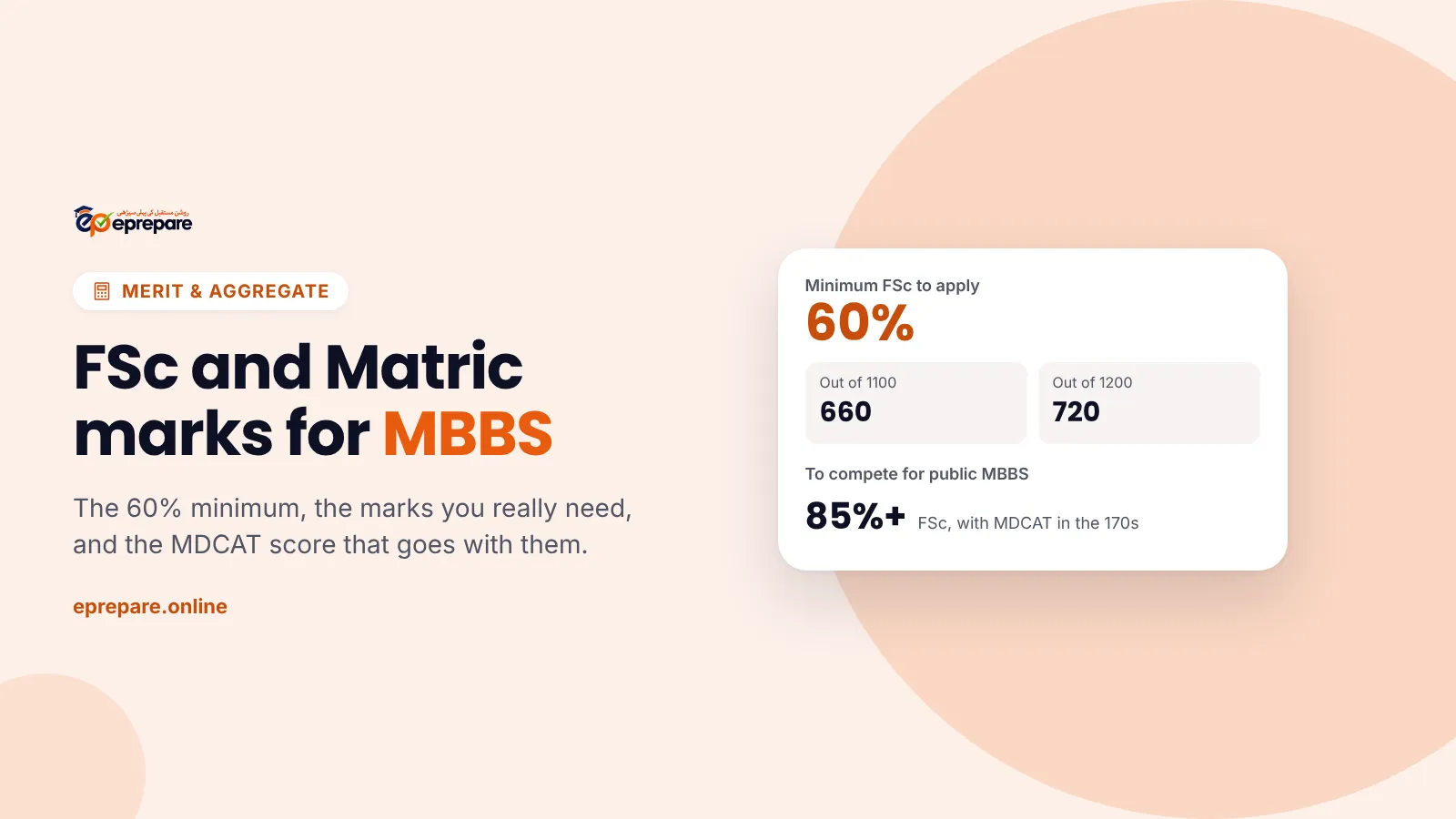
The short answer: to apply for MBBS or BDS anywhere in Pakistan you need at least 60% in FSc (pre-medical or an equivalent): 660 out of 1100 or 720 out of 1200. There is no separate Matric minimum. To compete for a public open-merit MBBS seat at recent closing levels, you realistically need about 85% or more in FSc (935/1100 or 1,020/1200) together with an MDCAT score in the 170s. With 95% in Matric and 90% in FSc, ePrepare's 2026-27 estimate for KPK's last public MBBS college (93.94) needs 175 out of 180. Matric counts for 10% of your aggregate, so it matters, but less than FSc.
The minimum FSc marks to apply for MBBS
PM&DC (the Pakistan Medical and Dental Council) sets the national floor. Its 2026 admission regulations, notified on 12 October 2026, say a student must have "obtained a Higher Secondary School Certificate qualification ("HSSC") or an equivalent 12th grade qualification recognized in Pakistan and having obtained a minimum of sixty percent (60%) marks therein, or a higher percentage as may be notified by the Pakistan Medical and Dental Council". You must also have passed biology and chemistry, with either physics or mathematics.
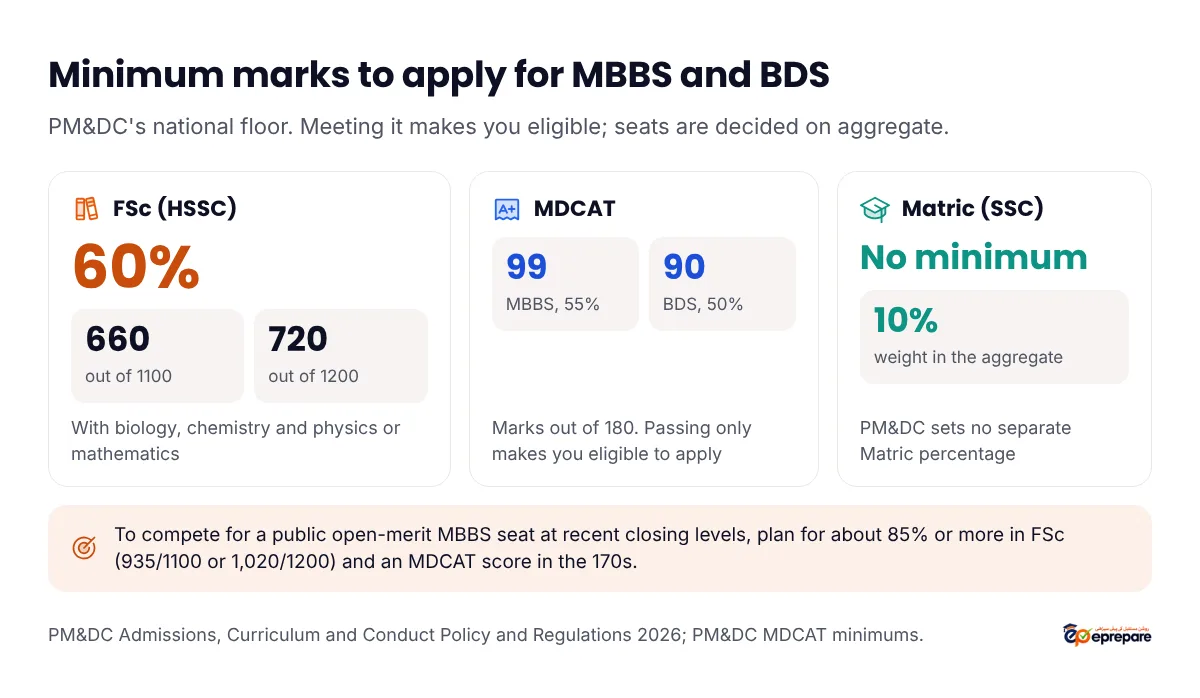
| Requirement | Percentage | Out of 1100 | Out of 1200 |
|---|---|---|---|
| FSc (HSSC pre-medical or equivalent) | At least 60% | 660 | 720 |
| Matric (SSC) | No separate minimum | Counts 10% in the aggregate | Counts 10% in the aggregate |
On top of this you need an MDCAT pass: at least 55% for MBBS (99 out of 180) and 50% for BDS (90 out of 180). Our guide to MDCAT passing marks explains those minimums in detail.
Does the minimum differ by province?
The admitting universities follow PM&DC's floor, and PM&DC can raise it by notification. Here is what the documents we checked say:
- KPK (KMU): KMU's public-sector policy accepts candidates with "≥60% marks in HSSC/equivalent", and its private-sector notice also asks for 60% in FSc.
- Punjab (UHS), Sindh and Islamabad (SZABMU): 60% in FSc.
- Balochistan: the 2025-26 prospectus and admission notice asked for 65%, although PM&DC had set the national minimum at 60% in a notification of 31 October 2025, and the prospectus says PM&DC decisions will be followed. Check the current prospectus before you apply.
One more rule catches students out: the result you upload is the one that counts. KMU and UHS do not accept a revised or improved result declared after the closing date for that session. If you plan to improve your marks, read our guide to KMU rules for improvers and repeaters.
What FSc marks you actually need to get a seat
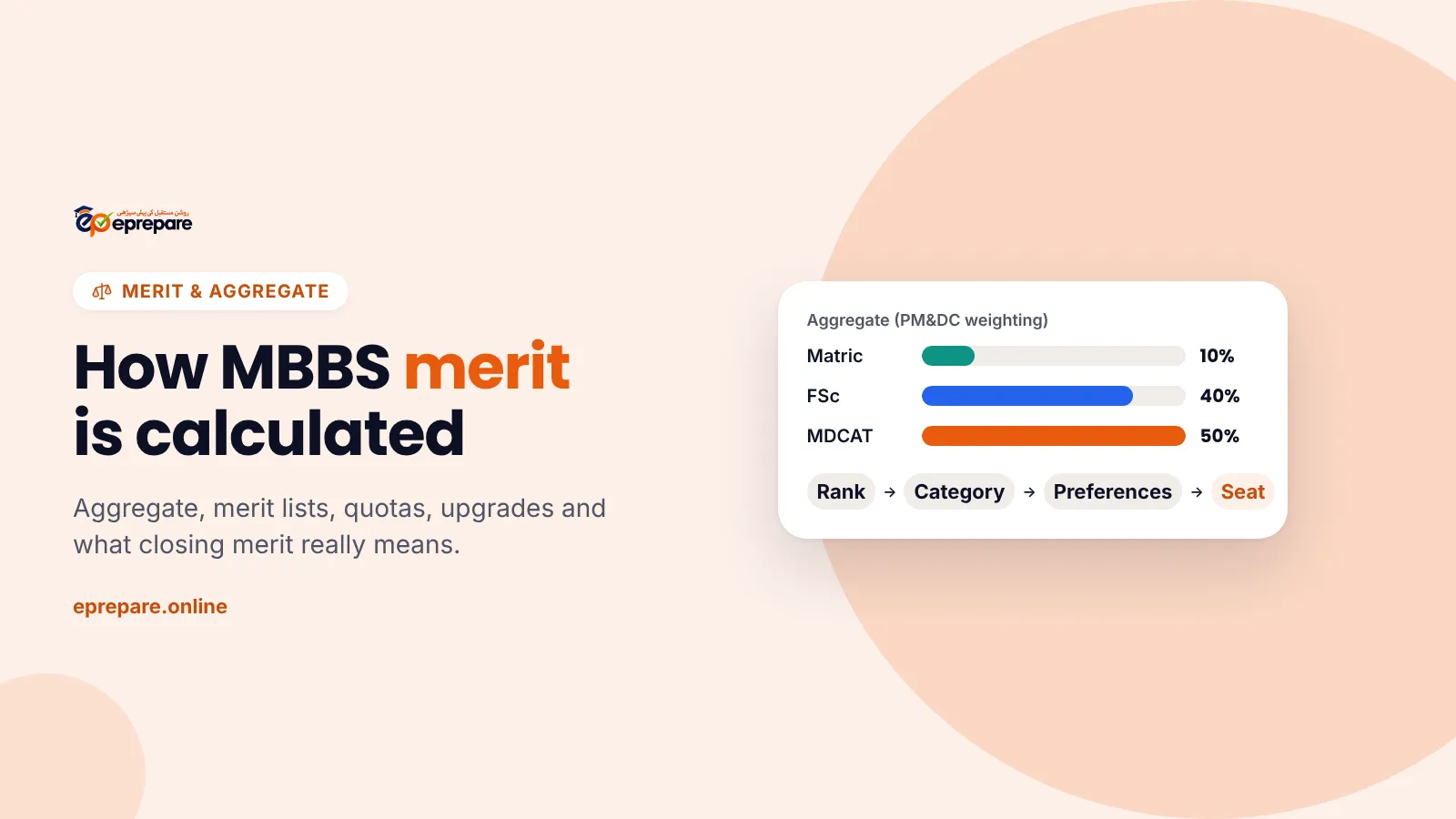
Admission is decided on aggregate, not on FSc alone. Every admitting university uses PM&DC's weighting:
Aggregate = (Matric marks ÷ Matric total) × 10 + (FSc marks ÷ FSc total) × 40 + (MDCAT marks ÷ 180) × 50
Once your Matric and FSc are fixed, the formula tells you the MDCAT score you need for any target aggregate. The table below does that for four recent figures from our data, assuming 95% in Matric:
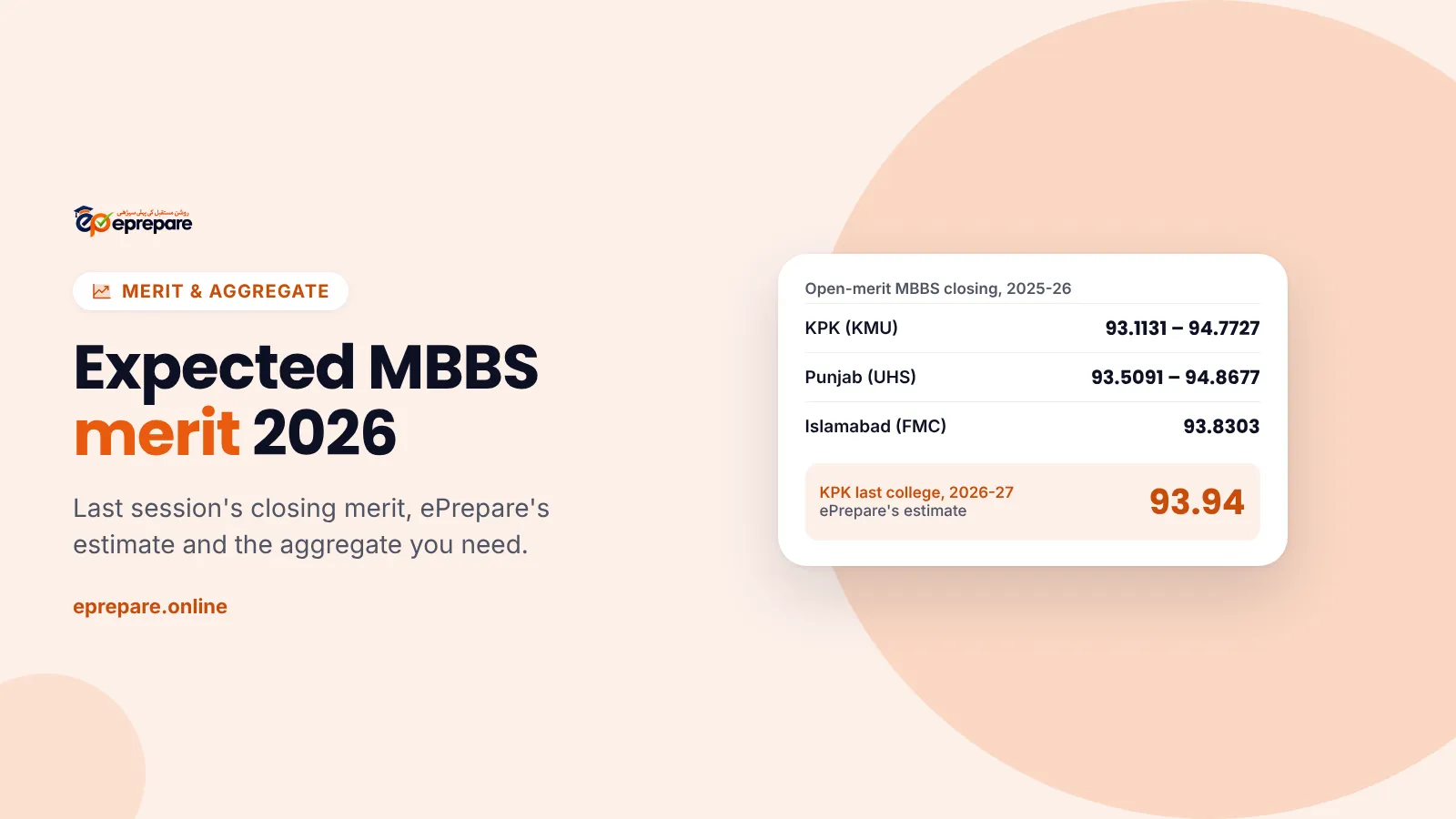
- 93.94: ePrepare's estimate for KPK's last public MBBS college (KIMS, Kohat) in 2026-27. It is an estimate, not a KMU figure.
- 93.5091: the lowest open-merit closing at a Punjab public medical college (Narowal) in UHS's final list for 2025-26.
- 93.1131: the lowest open-merit closing at a KPK public medical college (KIMS, Kohat) in KMU's final round for 2025-26.
- 92.6061: the lowest self-finance MBBS closing in KPK's public colleges (Gomal Medical College), 2025-26.
| FSc % (out of 1100 / 1200) | 93.94 (KPK estimate) | 93.5091 (Punjab) | 93.1131 (KPK) | 92.6061 (KPK self-finance) |
|---|---|---|---|---|
| 95% (1,045 / 1,140) | 168 | 166 | 165 | 163 |
| 93% (1,023 / 1,116) | 171 | 169 | 168 | 166 |
| 92% (1,012 / 1,104) | 172 | 170 | 169 | 167 |
| 90% (990 / 1,080) | 175 | 173 | 172 | 170 |
| 88% (968 / 1,056) | 178 | 176 | 175 | 173 |
| 85% (935 / 1,020) | Out of reach | Out of reach | 179 | 177 |
| 80% (880 / 960) | Out of reach | Out of reach | Out of reach | Out of reach |
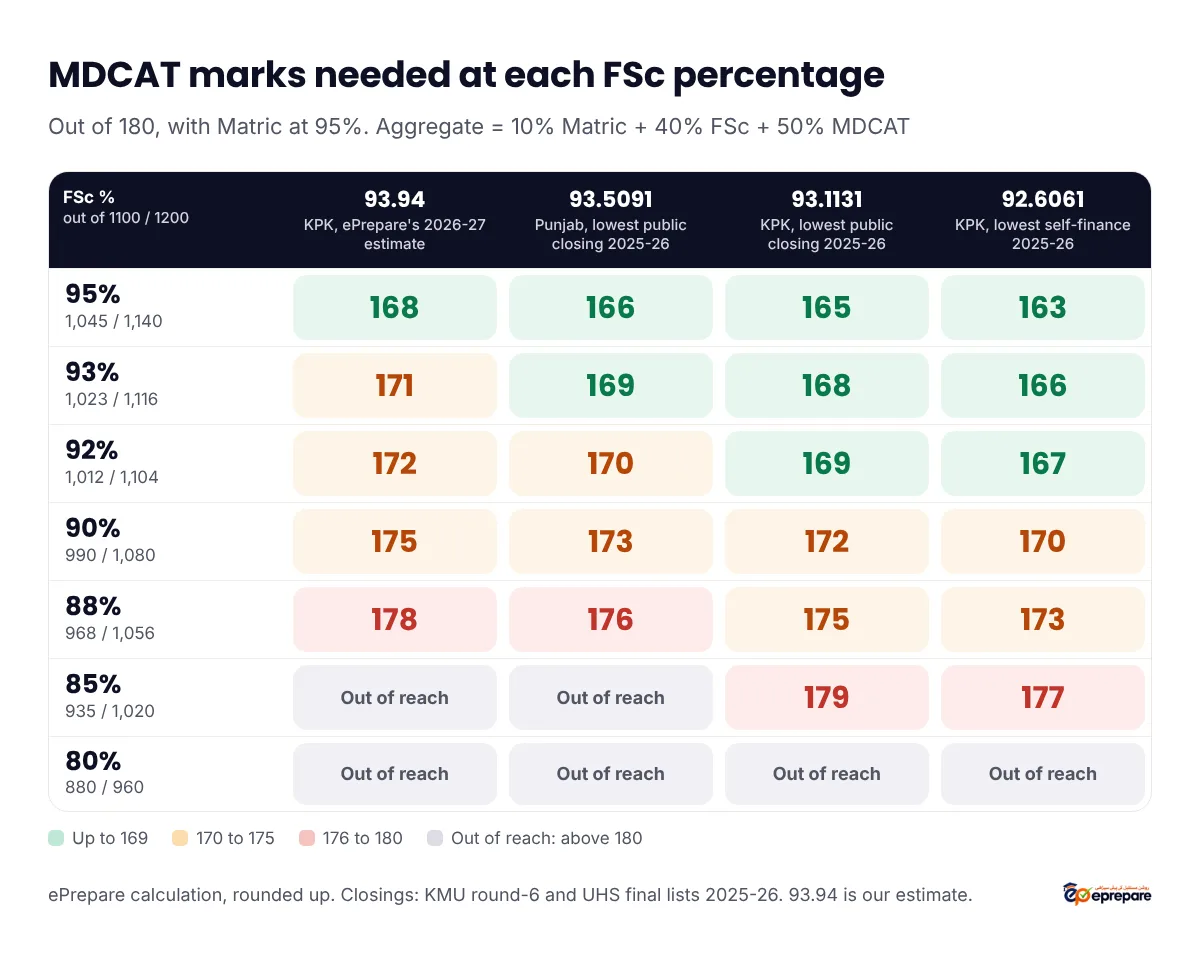
How we worked it out: MDCAT needed = (target − 0.1 × Matric % − 0.4 × FSc %) ÷ 50 × 180, rounded up. For example, at FSc 90% and target 93.94: 93.9414 − 9.5 − 36 = 48.4414, and 48.4414 ÷ 50 × 180 = 174.39, so you need 175.
Three things stand out:
- The real floor is about 84 to 86% in FSc, not 60%. With 95% in Matric, a perfect 180 reaches 93.1131 only if your FSc is at least 84.03%, and 93.94 only from 86.10%. With 90% in Matric, those floors rise to 85.28% and 87.35%.
- Each 1% of FSc is worth about 1.4 MDCAT marks. Going from 90% to 93% in FSc saves you 4 MDCAT marks for the same target.
- At the top, the margins are tiny. Even with 95% in both Matric and FSc, the three open-merit figures need 165 to 168 marks, which means no more than 12 to 15 mistakes in the whole paper.
Put your own marks into the aggregate calculator to see the exact score you need for any college. It has a version for each admitting university.
Lists that close lower
Not every list closes in the 93s. In Balochistan, the last provincial-merit MBBS seat at Bolan Medical College on the first list of 2025-26 went at 89.4646, and district seats closed lower still. With 90% in Matric, matching 89.4646 needs about 175 in the MDCAT at 80% FSc, 168 at 85% FSc and 163 at 88% FSc; at 75% FSc it is out of reach. Seat categories and districts change the picture a great deal, so compare yourself with the list you will actually be on. Our guide to how MBBS merit is calculated explains how those lists work.
Does Matric matter for MBBS?
Yes. Matric is 10% of your aggregate in every province, and NUMS counts it too. It matters less than FSc (40%) or the MDCAT (50%), but at the top of a merit list, small differences decide seats.
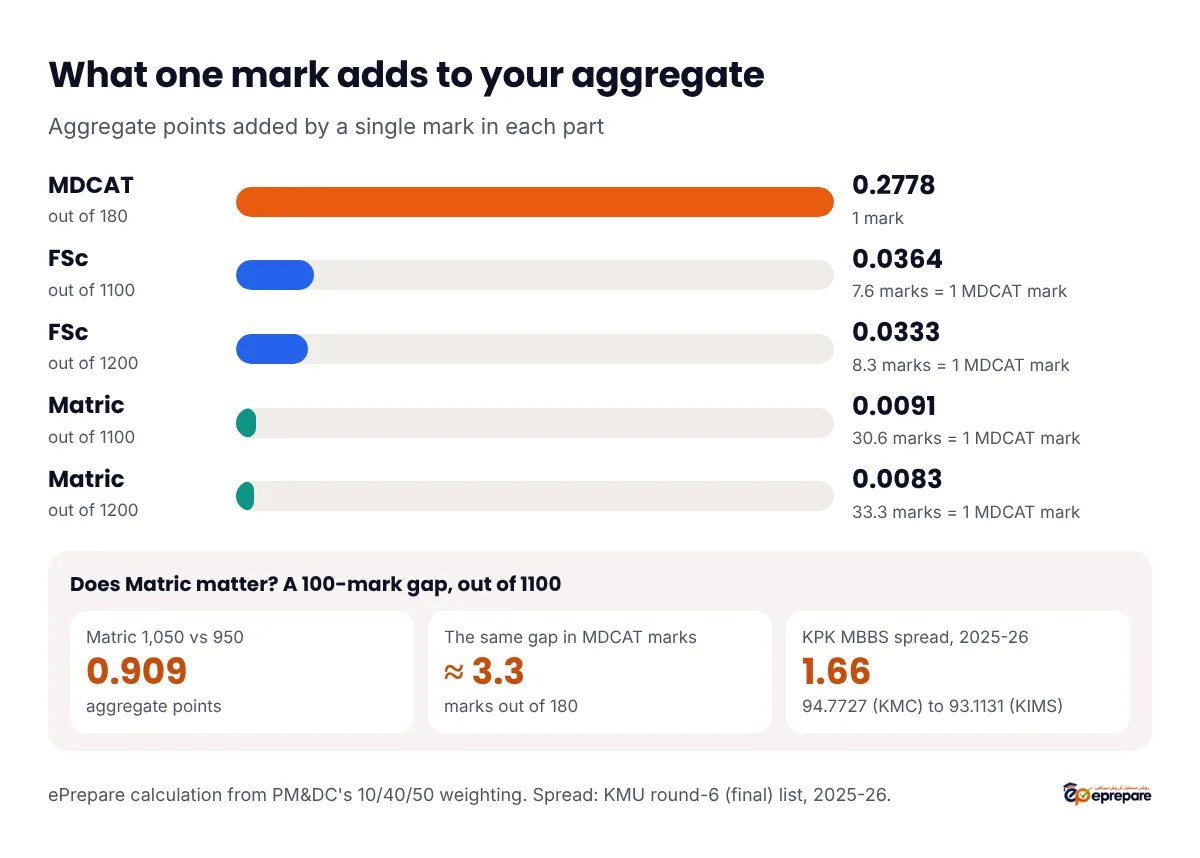
Here is what each part is worth, mark for mark:
| One mark in | Adds to your aggregate | Equal to this many MDCAT marks |
|---|---|---|
| MDCAT (out of 180) | 0.2778 | 1 |
| FSc (out of 1100) | 0.0364 | about 1/7.6 |
| FSc (out of 1200) | 0.0333 | 1/8.3 |
| Matric (out of 1100) | 0.0091 | about 1/30.6 |
| Matric (out of 1200) | 0.0083 | 1/33.3 |
Take two students with the same FSc and MDCAT marks, one with 1,050 in Matric and one with 950, both out of 1100. The 100-mark gap is worth 0.909 aggregate, about 3.3 MDCAT marks. In KPK's 2025-26 final round, the open-merit MBBS closings from Khyber Medical College (94.7727) down to KIMS, Kohat (93.1131) were only 1.66 points apart, so a gap of 0.909 can easily mean a different college.
In the target table above, if your Matric is 90% instead of 95%, add about 2 marks to each MDCAT figure: 5% of Matric is 0.5 aggregate, or 1.8 MDCAT marks. At FSc 90% and target 93.94, the MDCAT needed is 173 with 100% in Matric, 175 with 95%, 177 with 90%, 178 with 85% and 180 with 80%.
Matric is already done for most students reading this. If your Matric is weaker than you would like, there is nothing to fix there. What you can still move is the MDCAT: every extra mark adds 0.278 to your aggregate, three times what 30 Matric marks would.
FSc Part 1 marks and MBBS
Your Part 1 marks are part of your final HSSC result, and that final result is what universities check for the 60% rule and use in the aggregate. So Part 1 does count, through your overall FSc percentage.
Use Part 1 as a planning tool:
- Work out your Part 1 percentage from the marks and the total printed on your Part 1 result card.
- Set your overall FSc target from the table above, for example 90% or more.
- Work out what Part 2 needs. If your board gives Part 1 and Part 2 the same total, your final percentage is the average of the two. So 86% in Part 1 needs 94% in Part 2 to finish at 90% overall.
- Plan the MDCAT around your expected FSc. If your FSc is likely to land around 88%, your target for 93.94 is 178 with 95% in Matric; at 92% it is 172.
Because the MDCAT syllabus is built on the FSc textbooks, the work you put into Part 2 counts twice: it lifts your FSc percentage and prepares you for the test. Our MDCAT syllabus guide shows how the chapters line up.
How much percentage is required in FSc for MBBS? A summary
| Your FSc | What it means for public MBBS (with 95% Matric) |
|---|---|
| Below 60% (below 660/1100 or 720/1200) | Not eligible to apply |
| 60% to about 84% | Eligible, but recent public open-merit closings in KPK and Punjab are out of reach even with 180 |
| About 85% to 89% | In range only with a near-perfect MDCAT (about 173 to 180) |
| 90% to 92% | Competitive with about 167 to 175 |
| 93% and above | Competitive with about 163 to 171 |
These bands come from the target table above and from last session's closing merit, which tends to rise. Lower-closing lists such as Balochistan's district seats, reserved quotas and BDS give students with lower board marks more room, so check every category you qualify for. The full college-wise figures are on our KMU closing merit and UHS closing merit pages.
Frequently asked questions
How many marks are required in FSc out of 1200 for MBBS?
At least 720 out of 1200 (60%) to apply. To compete for a public open-merit MBBS seat at recent closing levels, plan for about 1,020 (85%) as a bare minimum and 1,080 (90%) or more to give yourself room, together with an MDCAT score in the 170s.
How many marks are required in FSc out of 1100 for MBBS?
At least 660 out of 1100 (60%) to apply. For a realistic chance at a public open-merit seat, aim for about 935 (85%) as a floor and 990 (90%) or more, with a strong MDCAT. With 95% in Matric and 990/1100 in FSc, ePrepare's 2026-27 estimate for KPK's last public college needs 175 out of 180.
Do Matric marks matter in MDCAT admission?
Yes. Matric counts for 10% of your aggregate everywhere, including NUMS. A 100-mark difference in Matric out of 1100 is worth 0.909 aggregate, about 3.3 MDCAT marks, which can change your college.
How many marks are required in Matric for MBBS?
PM&DC sets no separate minimum percentage for Matric. It only counts through its 10% share of the aggregate, so higher Matric marks help, but low Matric marks do not stop you from applying.
Do FSc Part 1 marks count for MBBS?
They count as part of your final HSSC result, which is what universities use for eligibility and merit. Use your Part 1 percentage to work out what you need in Part 2 to reach your overall target.
How much percentage is required in FSc for MBBS?
60% is the legal minimum under PM&DC's regulations (Balochistan's 2025-26 notice asked for 65%). For a public open-merit MBBS seat at recent closing levels, you realistically need about 85% or more in FSc together with a near-perfect MDCAT.
Can I get MBBS with 80% in FSc?
Not on public open merit in KPK or Punjab at recent levels: with 80% in FSc and 95% in Matric, even 180 out of 180 gives 91.5, below every 2025-26 public open-merit closing in both provinces. Lists that close lower are where an 80% FSc can still compete: some district and quota seats, and private colleges. At NUMS's private affiliated colleges, for example, the sixth lists of 2025-26 ended between 83.8453 and 86.5380.
Your board marks set the starting line; the MDCAT decides how far you go from it. If you are preparing now, ePrepare's question bank and full-length papers show you each week how close your score is to the number in the table above for your own FSc. Create your free ePrepare account and start practising.
Sources: Pakistan Medical and Dental Council, PM&DC (Admissions, Curriculum and Conduct) Policy and Regulations 2026, notified 12 October 2026 (60% HSSC minimum, required subjects, 10/40/50 weighting); MDCAT minimums as reported by The Nation, 24 October 2026; KMU admission policy for public sector colleges and KMU private-sector admission notice; UHS prospectus; Balochistan admission prospectus (Bolan Medical College); closing merit from KMU's round-6 list and UHS's thirteenth and final selection list for 2025-26, as shown on our KMU and UHS closing merit pages. The 2026-27 figure of 93.94 is ePrepare's estimate, not KMU data. Always check your admitting university's latest notice.