

"Sir, my aggregate is 93.2. Is that merit?" We hear some version of this question every admission season, and it shows how easily three different numbers get mixed up: your aggregate, your rank on a merit list, and a college's closing merit. MBBS admission in Pakistan runs on all three, plus your seat category and the order in which you list colleges.
This guide explains how MBBS merit is calculated, from the formula to the final list, using the rules of PM&DC (the Pakistan Medical and Dental Council) and the admitting universities: KMU in Khyber Pakhtunkhwa (KP), UHS in Punjab, the Sindh universities, Balochistan's Selection Committee, SZABMU in Islamabad and NUMS. It ends with what closing merit means and a province-by-province summary.
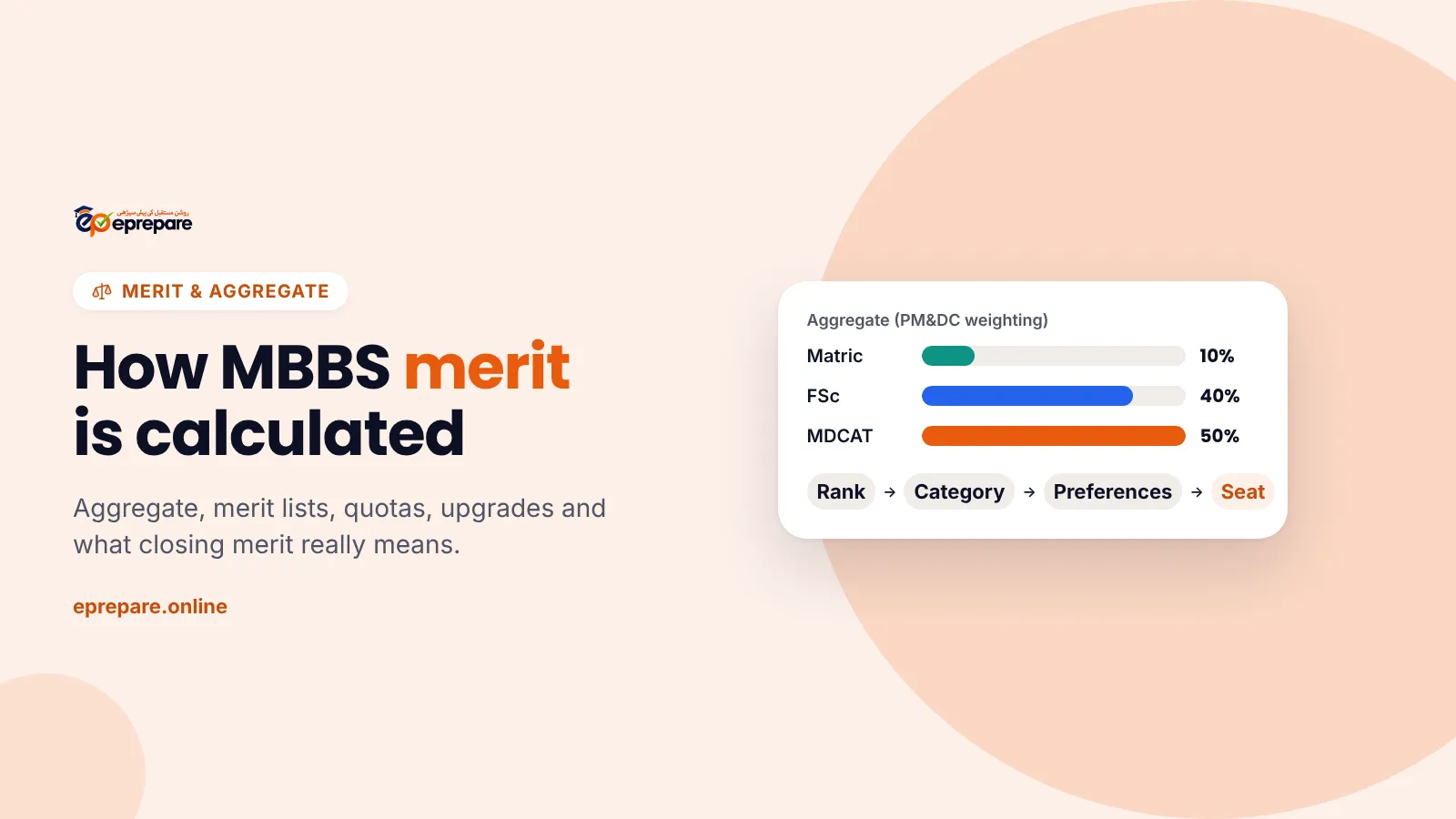
The short answer: your merit is your aggregate: 10% of your Matric percentage + 40% of your FSc percentage + 50% of your MDCAT percentage. The university ranks every applicant by aggregate in a separate merit list for each seat category. Then, starting from the top, it gives each student the highest college on their own preference list that still has a seat (merit-cum-choice). This happens over at least three merit lists, with upgrades in between. Closing merit is the aggregate of the last student admitted to a college in a category once the lists end. It is a result, not a cut-off fixed in advance.
Merit, aggregate, rank and closing merit: four different things
Before the steps, here are the words you will see in every notice and merit list:
| Term | What it means | Who decides it |
|---|---|---|
| Aggregate | Your single score out of 100 from Matric, FSc and MDCAT | Your marks and the formula |
| Rank (merit number) | Your position on a merit list, highest aggregate first | You and everyone else in the same list |
| Seat category | The pool you compete in: open merit, a quota, a district, self-finance | The admission policy and your eligibility |
| Closing merit | The aggregate of the last student admitted to a college in a category | Known only after the lists end |
Your aggregate is fixed once your results are out. Your rank and the closing merit depend on how many seats there are and how everyone else scored. That is why the same aggregate can win a seat one year and miss it the next.
Step 1: how your aggregate is calculated
PM&DC's admission regulations set one weighting for public and private colleges across Pakistan, and every admitting university uses it:
Aggregate = (Matric marks ÷ Matric total) × 10 + (FSc marks ÷ FSc total) × 40 + (MDCAT marks ÷ 180) × 50
Use the totals printed on your own result cards (1,100 or 1,200 for most boards). NUMS announces its test result as a percentage, so for NUMS the test part is simply half of that percentage.
A worked example
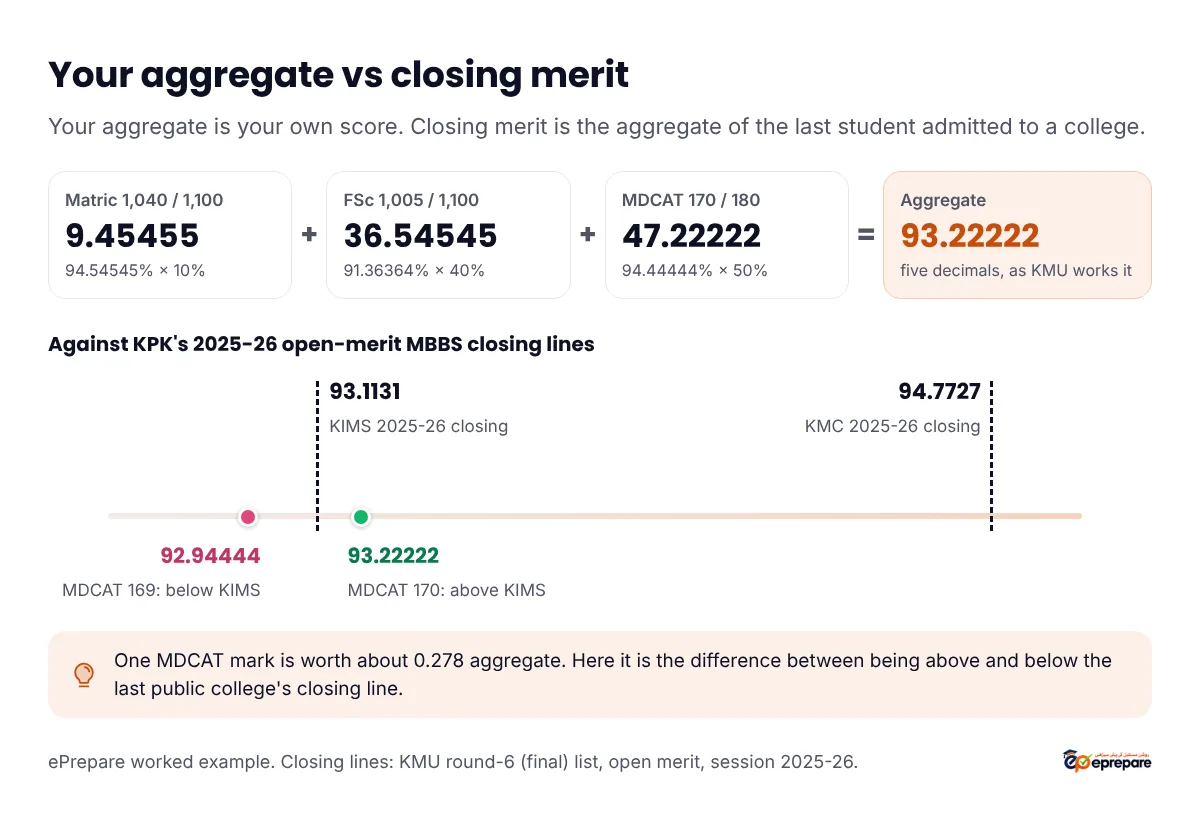
Take a student with Matric 1,040 out of 1,100, FSc 1,005 out of 1,100 and MDCAT 170 out of 180:
- Matric: 1,040 ÷ 1,100 = 94.54545%, and 10% of that is 9.45455.
- FSc: 1,005 ÷ 1,100 = 91.36364%, and 40% of that is 36.54545.
- MDCAT: 170 ÷ 180 = 94.44444%, and 50% of that is 47.22222.
- Aggregate = 9.45455 + 36.54545 + 47.22222 = 93.22222.
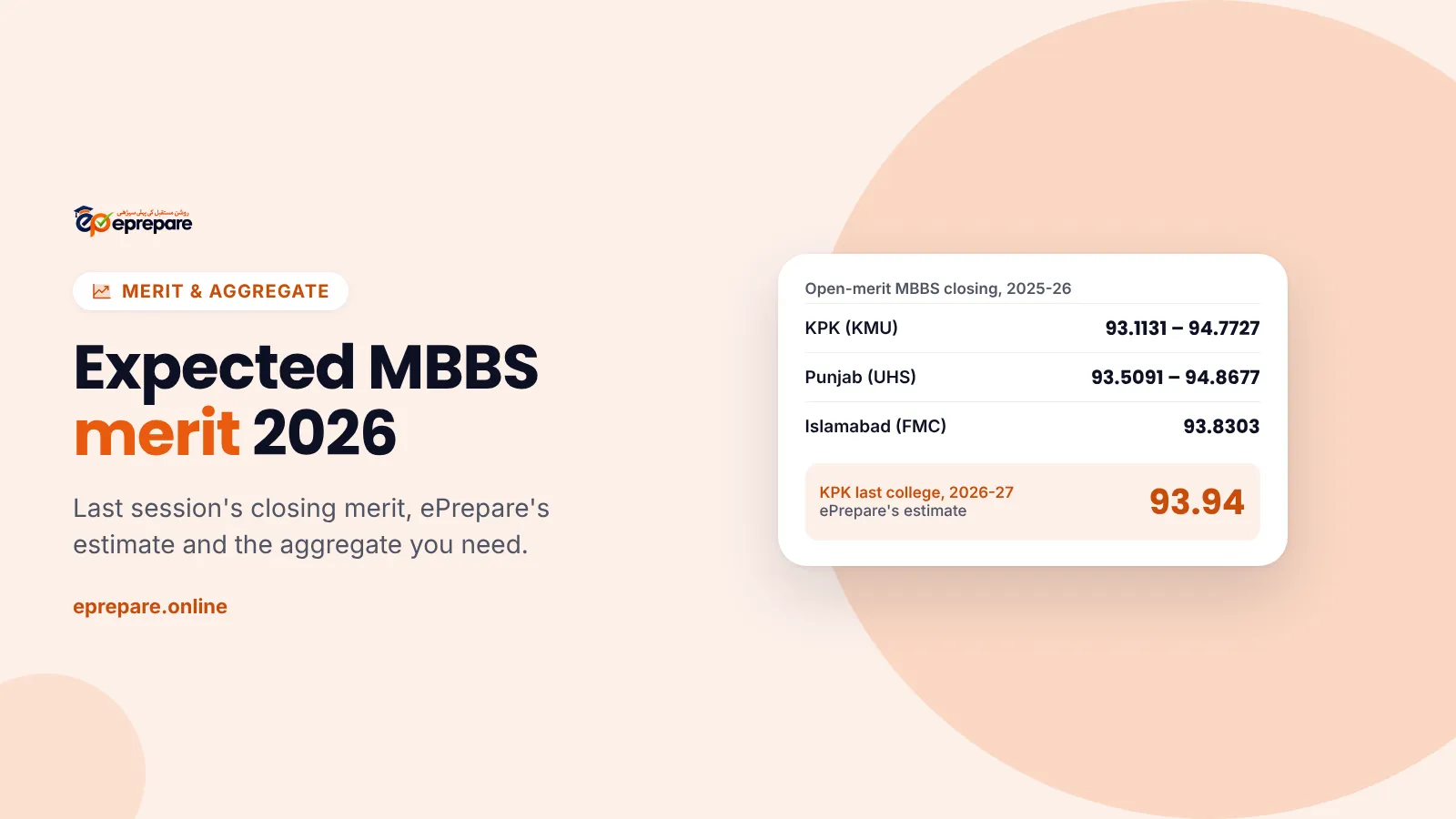
In KPK last session, that aggregate was above the 2025-26 open-merit closing at KMU Institute of Medical Sciences (KIMS), Kohat (93.1131) and below Khyber Medical College (94.7727). With one MDCAT mark less, 169, the aggregate drops to 92.94444, and it falls below the KIMS line. Each MDCAT mark is worth about 0.278 aggregate, so a single MCQ can move you across a closing line.
Universities differ in how many decimals they keep: KMU, Sindh and SZABMU work to five, UHS, Balochistan's lists and NUMS to four. You can check yours in the aggregate calculator, which has a version for each university. For the formula in more depth, see our MDCAT aggregate formula guide.
Who is eligible to be ranked
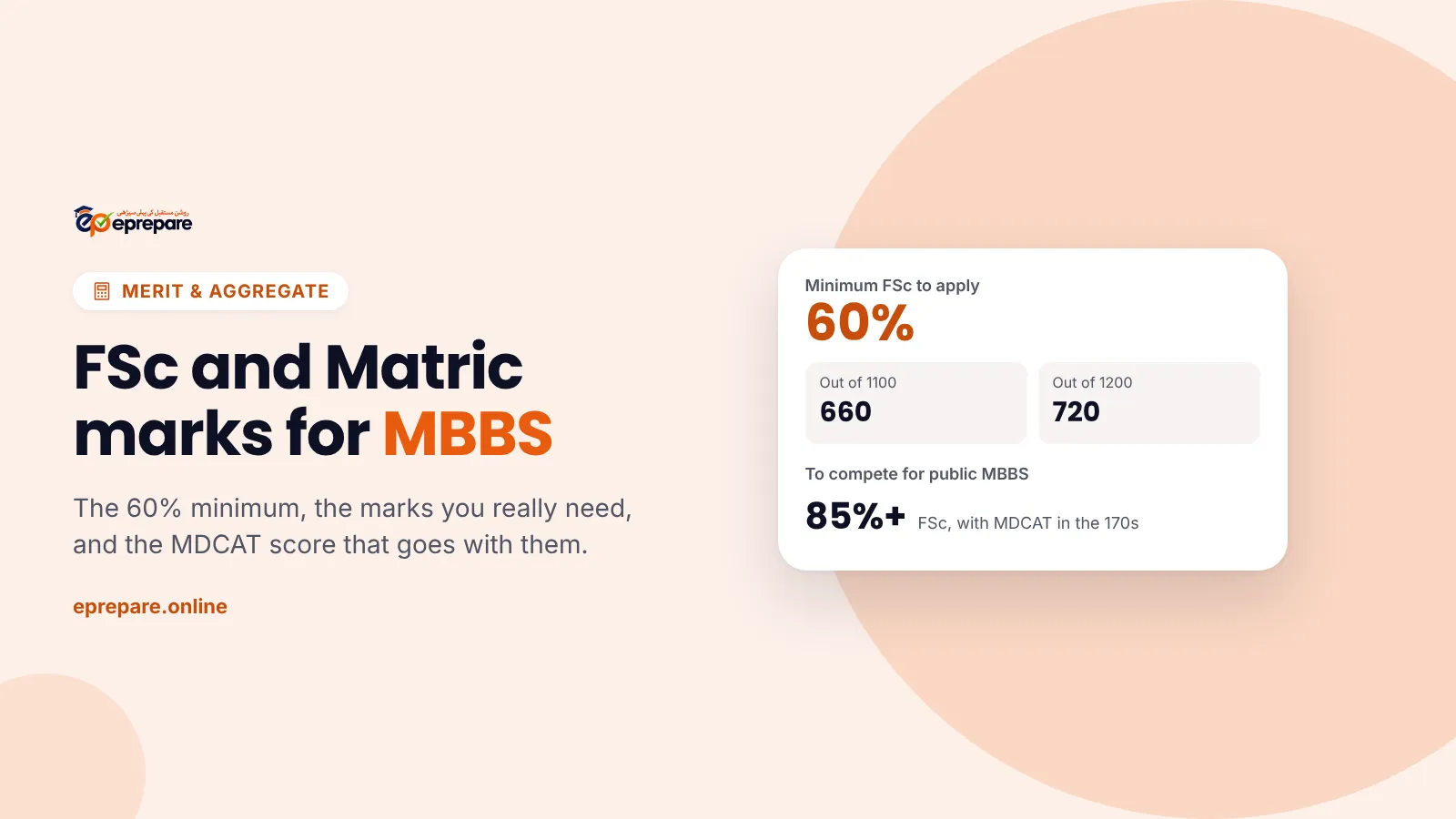
You enter a merit list only if you meet the minimums: at least 60% in FSc (HSSC pre-medical or an equivalent) under PM&DC's regulations, and an MDCAT pass of 55% for MBBS (99 out of 180) or 50% for BDS (90 out of 180). Passing makes you eligible; it does not get you a seat. Our guide to MDCAT passing marks explains the gap.
Step 2: the merit list and your rank
After applications close, the admitting university sorts every eligible applicant by aggregate, highest first. Your place on that list is your rank or merit number. Before seats are given out, most universities show a provisional list so that students can report mistakes:
- KMU displays a merit list for each category. You can object in writing to the Chairman of the KMU Admission Committee, and the final merit list is displayed two days before the placement interviews.
- UHS first shows a provisional order of merit of the top 6,000 applicants, and you have 48 hours to email a complaint about any error.
Check your marks, category and date of birth the day the list appears. Your date of birth matters because in most provinces it decides ties, as the tie-break section below shows.
Step 3: quotas and seat categories
There is no single national list. Each university keeps separate lists for each seat category, and you compete only with the students in the same list. KMU's policy puts it this way: "Selection under each category of seats shall be done on the basis of inter se merit amongst the eligible applicants."
Categories change from province to province:
- KPK (KMU): open merit, general self-finance, Merged Districts, backward areas, special ability, minorities, overseas Pakistanis and more. You must apply in each category to be considered in it.
- Punjab (UHS): open merit for Punjab domicile, plus reserved seats such as under-developed districts, disability, Cholistan, overseas Pakistanis and seats for other provinces and regions.
- Sindh: seats are shared out by district, and "a candidate from one district shall not compete with a candidate of other districts."
- Balochistan: provincial, divisional and district seats, filled in a fixed order.
- Islamabad (SZABMU): every Pakistani competes on open merit and is also considered on their own domicile quota.
Because each list has its own seats and its own applicants, each one closes at a different aggregate. At Federal Medical College, Islamabad, last session's lowest open-merit offer was 93.8303, while the Islamabad (ICT) quota went down to 92.4051. If you qualify for more than one category, our guide to which KMU seat category to choose explains how to weigh them.
Step 4: preferences and merit-cum-choice
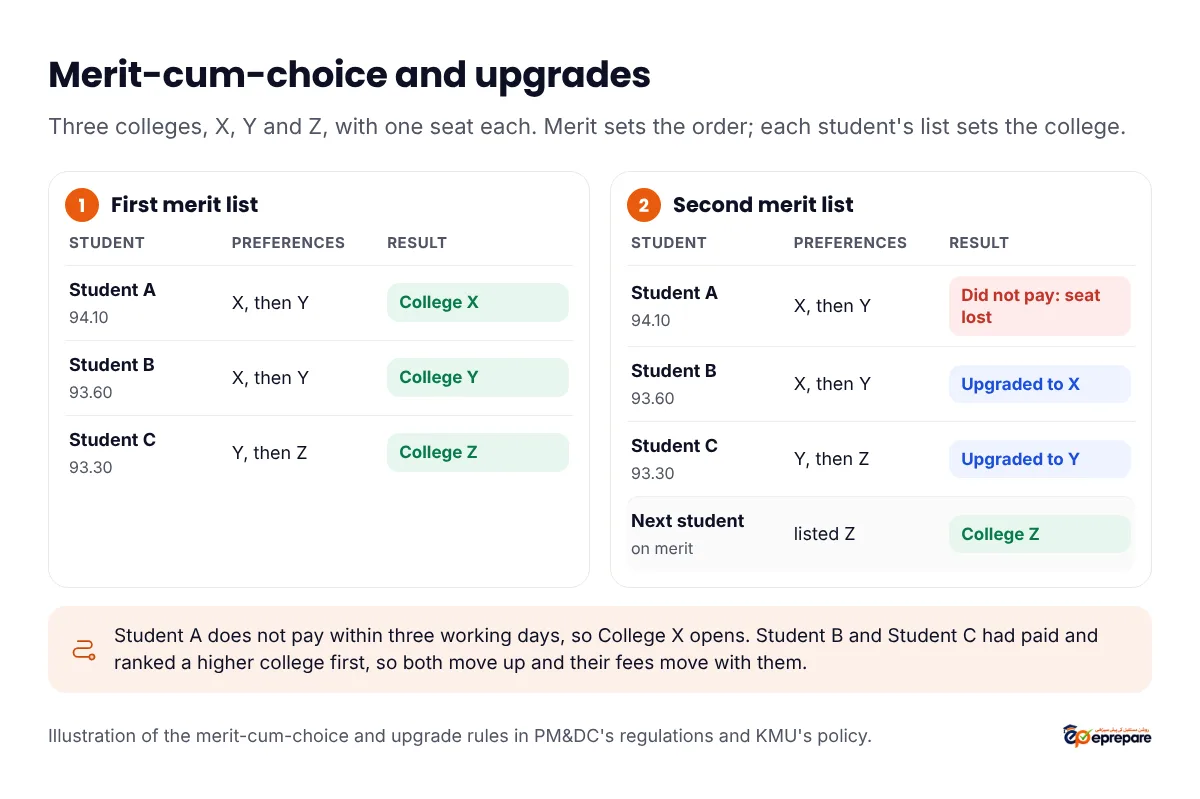
Once the list is final, seats are given out on merit-cum-choice. Merit decides the order in which students are placed; your own preference list decides which college you get. The university starts with rank 1, gives that student their first choice, moves to rank 2, gives them the highest college on their list that still has a seat, and so on down the list.
Two rules follow from this, and both cost students seats every year:
- You are never offered a college you did not list. KMU's policy says: "If a college is not mentioned in his/her preferences, admission shall not be offered in that particular college." UHS asks public-sector applicants to list every college in order.
- Your order is the order you will be placed in. Put the college you want most first, even if last year's closing looks out of reach. A higher first choice never pushes you out of a lower one.
Step 5: merit lists, rounds and upgrades
Seats are not settled in one go. PM&DC's 2026 admission regulations say public-sector admissions "shall be completed by displaying at least three consecutive merit lists" by the admitting university. Here is how the rounds work:
- First list. Each student near the top is offered the highest college on their list that their merit reaches.
- Pay in three working days. Under PM&DC's regulations, a candidate who does not deposit the fee within three working days of the list loses any right to the seat that year.
- Second and third lists. Seats left by students who did not pay go to the students next in merit.
- Upgrades. If a seat opens in a college you ranked higher, you can be moved up. PM&DC's regulations say the fee you paid "shall be transferred to new institution without any deduction."
- Vacant seats at the end. In KPK, a reserved seat still empty at the end becomes an open-merit seat (foreign self-finance seats become general self-finance seats).
The details differ by university. UHS makes upgradation compulsory in public colleges: if a college you ranked higher opens, you move. KMU does not let you go back to a college you refused. In practice there are often many more than three lists. Last session, KMU ran six rounds and every seat on its round-6 list was filled by 25 February 2026, UHS issued thirteen selection lists, and SZABMU issued 34 MBBS lists for Federal Medical College between 8 December 2025 and 27 March 2026. For KPK's rules in full, read how KMU merit lists, upgrades and the waiting list work.
Pay first, then wait for the upgrade. Paying for the seat you are offered keeps you in the running for every college above it, and the fee moves with you. Refusing a seat to wait for a better one is a gamble: in KPK, a college you refused is never offered to you again.
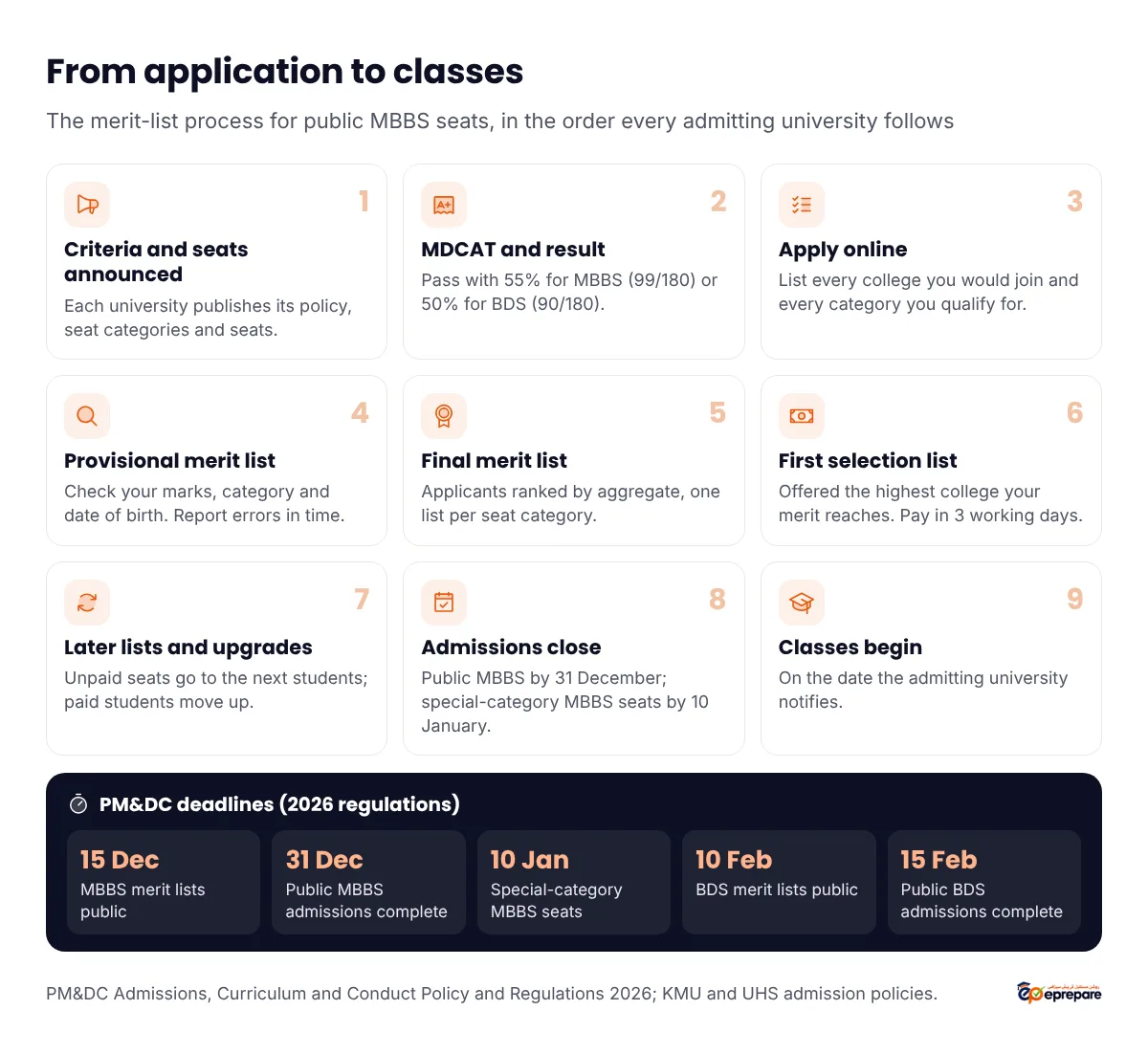
The merit-list process from application to classes
Dates change every year and each university announces its own schedule, but PM&DC's 2026 regulations fix the outer deadlines for public colleges. Merit lists must be made public by 15 December, and admissions to public medical colleges completed by 31 December. Special-category MBBS seats (those not on open merit) must be filled by 10 January. For dental colleges, merit lists are due by 10 February, admissions close by 15 February and special-category seats by 28 February.
Lists can run later than these dates in practice. Last session SZABMU's lists ran until 27 March 2026, and in Balochistan, Bolan Medical College published its first list on 24 March, a second on 30 April and a third on 15 June 2026. Keep checking every list until your university announces that admissions are closed. For KPK's step-by-step dates, see the KMU admission schedule.
What does closing merit mean?
Closing merit is the aggregate of the last student who was admitted to a particular college, in a particular seat category, when the merit lists ended. Anyone in that list with a higher aggregate who had placed that college high enough could have had the seat.
Four points students often miss:
- It is not set in advance. No university announces "the merit will be 93" before admissions. Closing merit is simply where the queue stopped once the seats ran out.
- It belongs to one college and one category. In KPK's 2025-26 final round, open-merit MBBS closed at 94.7727 at Khyber Medical College and 93.1131 at KIMS, Kohat, while general self-finance at Gomal Medical College closed at 92.6061.
- It moves during the rounds. As students take upgrades or miss the fee deadline, lower ranks are reached, so the closing usually falls from the first list to the last. That is why Balochistan's first-list figures carry a warning that the final closing on some seats may be lower.
- Different snapshots give slightly different numbers. Our yearly KMU series puts the last open-merit MBBS seat of 2025 at 93.107, while KMU's round-6 list shows 93.1131 at KIMS. A seat can change hands after a list is published. The difference is a few hundredths of a point.
Closing merit vs your aggregate
Your aggregate is your own score. Closing merit is last year's line for a college. Comparing the two tells you roughly where you stand, but last year's line is not this year's: KMU's last open-merit MBBS seat rose from 86.73 in 2020 to 93.107 in 2025, and it fell in only one of those years. Being a little above last year's closing is a good sign, not a guarantee. Our article on KMU closing merit trends shows how far it has moved each year.
How ties are broken at each university
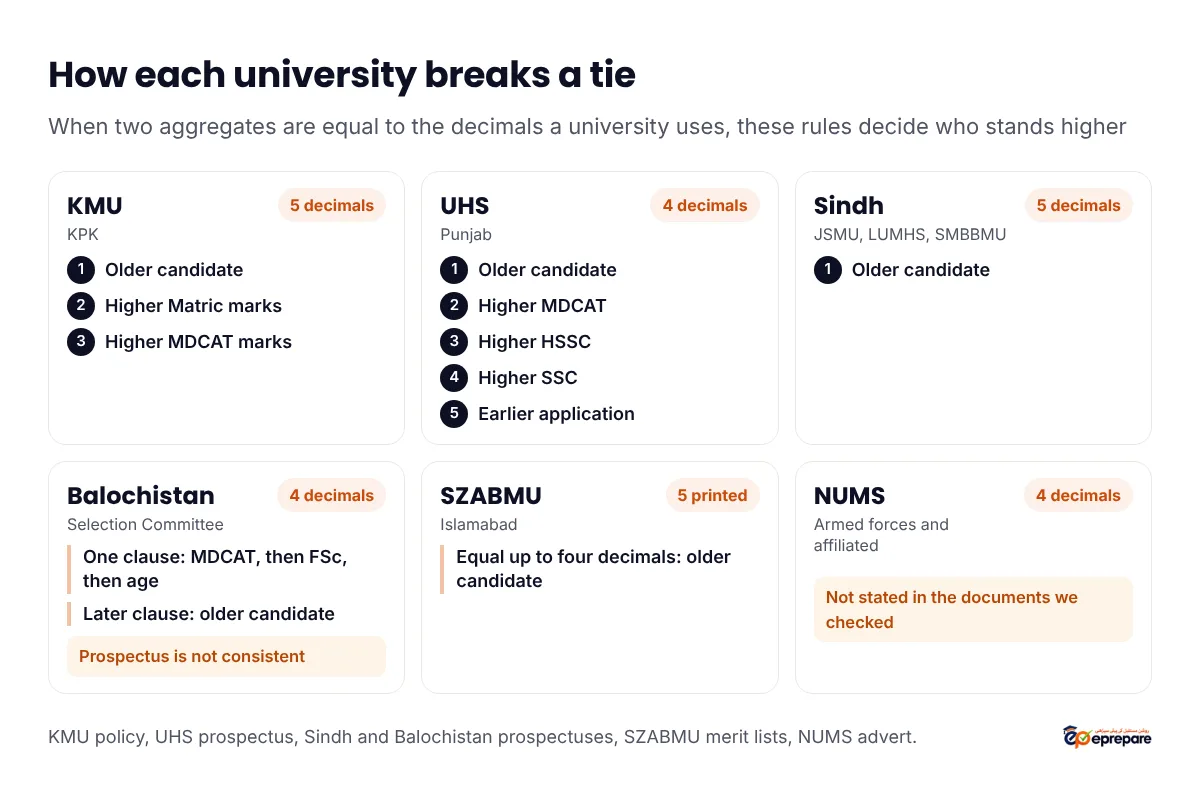
With thousands of students packed into a few aggregate points, ties do happen. This is how each admitting university breaks them, from its own policy or prospectus:
| University | Decimals | If aggregates are equal |
|---|---|---|
| KMU (KPK) | 5 | The older candidate, then higher Matric marks, then higher MDCAT marks |
| UHS (Punjab) | 4 | The older candidate, then higher MDCAT, then higher HSSC, then higher SSC marks, then the earlier online application |
| Sindh (JSMU, LUMHS, SMBBMU) | 5 | The older candidate |
| Balochistan (Selection Committee) | 4 | The prospectus is not consistent: one clause puts higher MDCAT first, then FSc, then age; a later clause says the older candidate |
| SZABMU (Islamabad) | 5 printed | Equal up to four decimals: the older candidate |
| NUMS | 4 | Not stated in the documents we checked; see NUMS's admission advert |
Closing merit province by province (2025-26)
Each university publishes its results differently, so the figures below are not all the same kind of number. Compare yourself only with the list you will actually be on.
| Province (admitting body) | Open-merit MBBS, 2025-26 | Full figures |
|---|---|---|
| KPK (KMU) | 94.7727 (KMC) down to 93.1131 (KIMS), final round | KMU closing merit |
| Punjab (UHS) | 94.8677 (KEMC) down to 93.5091 (Narowal), final list | UHS closing merit |
| Sindh, Karachi Division (DUHS) | No college-wise closing published; merit no. 1,000 was 82.19% | MDCAT closing merit |
| Balochistan (Bolan Medical College) | Provincial merit 89.4646 on the first list; district seats lower | Balochistan admission guide |
| Islamabad (SZABMU) | Federal Medical College open merit: lowest offer 93.8303 | Islamabad admission guide |
| NUMS colleges | No official college-wise closing list for NUMS's own colleges that we could check | NUMS colleges guide |
Sindh's figure is not a closing merit: DUHS called merit numbers 1 to 1,000 for its final MBBS seat allocation, and a student near number 1,000 got a seat only if one was still open when their turn came. Balochistan's figures come from BMC's first list, before later lists filled vacancies.
How to work out where you stand
- Calculate your aggregate to the decimals your university uses, in the aggregate calculator.
- Find the lists you will be on: open merit, plus every quota, district or self-finance category you qualify for.
- Compare with last year's closing for each college in each of those lists, and allow for a rise. If you are applying in KPK, the college predictor does this college by college.
- List every college you would join, in your true order of preference, and apply for BDS as well if you would accept it.
- Keep the fee ready before the first list, and check every list until admissions close.
Frequently asked questions
How do I calculate my merit for MBBS?
Your merit is your aggregate. Take 10% of your Matric percentage, 40% of your FSc percentage and 50% of your MDCAT percentage, and add them. For example, Matric 1,040/1,100, FSc 1,005/1,100 and MDCAT 170/180 give 9.45455 + 36.54545 + 47.22222 = 93.22222.
How is MDCAT merit calculated?
The MDCAT counts for 50% of your aggregate. Your score out of 180 is turned into a percentage and halved, so 170/180 adds 47.22222 to your aggregate. Every MDCAT mark is worth about 0.278 aggregate points. NUMS gives its result as a percentage, and half of that percentage counts.
What does closing merit mean?
It is the aggregate of the last student admitted to a college in a particular seat category after the final merit list. It is worked out from the lists after admissions end, not announced beforehand, and it is different for every college and category.
Is closing merit the same as aggregate?
No. Your aggregate is your own score. Closing merit is the aggregate of the last student who got a seat in a college. If your aggregate is above a college's closing merit and you listed that college, you would have been offered a seat there in that year.
Why is the first merit list higher than the final closing merit?
Because seats keep opening. Students who do not pay the fee lose their seats, and students who are upgraded leave a seat behind, so later lists reach lower ranks. The closing merit usually falls a little from the first list to the last.
What happens if two students have the same aggregate?
Most universities place the older candidate higher. KMU then looks at Matric marks and then MDCAT marks; UHS looks at MDCAT, then HSSC, then SSC marks, then who applied first. Balochistan's prospectus has two different tie rules, so check the current one.
Is MBBS merit calculated the same way in every province?
The formula is the same everywhere: 10% Matric, 40% FSc and 50% MDCAT, under PM&DC's regulations. What differs is the number of decimals, the tie-break, the seat categories and how seats are shared out, such as districts in Sindh and Balochistan.
Can I get admission below last year's closing merit?
It is possible if fewer strong students apply or seats are added, and closing merit did fall once in KPK, in 2021. But KMU's open-merit closing rose in every other year from 2020 to 2025, so plan to be above last year's figure, not below it.
Every step of this process starts from one number you can still change: your MDCAT score. If you are preparing for the next MDCAT, ePrepare's full-length papers and question bank show you every week how close your score is to the aggregate you need. Create your free ePrepare account and start practising today.
Sources: Pakistan Medical and Dental Council, PM&DC (Admissions, Curriculum and Conduct) Policy and Regulations 2026, notified 12 October 2026 (eligibility, 10/40/50 weighting, merit-list deadlines, three merit lists, fee and upgrade rules); PM&DC's MDCAT minimums as reported by The Nation, 24 October 2026; KMU admission policy for public sector colleges (inter se merit, preferences, tie-break, five decimals); UHS prospectus, public sector (four decimals, tie-break) and the UHS thirteenth and final selection list, 2025-26; Sindh admission prospectus (JSMU) and the DUHS merit lists and notices; Balochistan admission prospectus (Bolan Medical College); SZABMU merit lists, 2025-26; KMU round-6 closing aggregates, 2025-26, on our KMU closing merit page. Rules and dates change every session; always check your admitting university's latest notice.