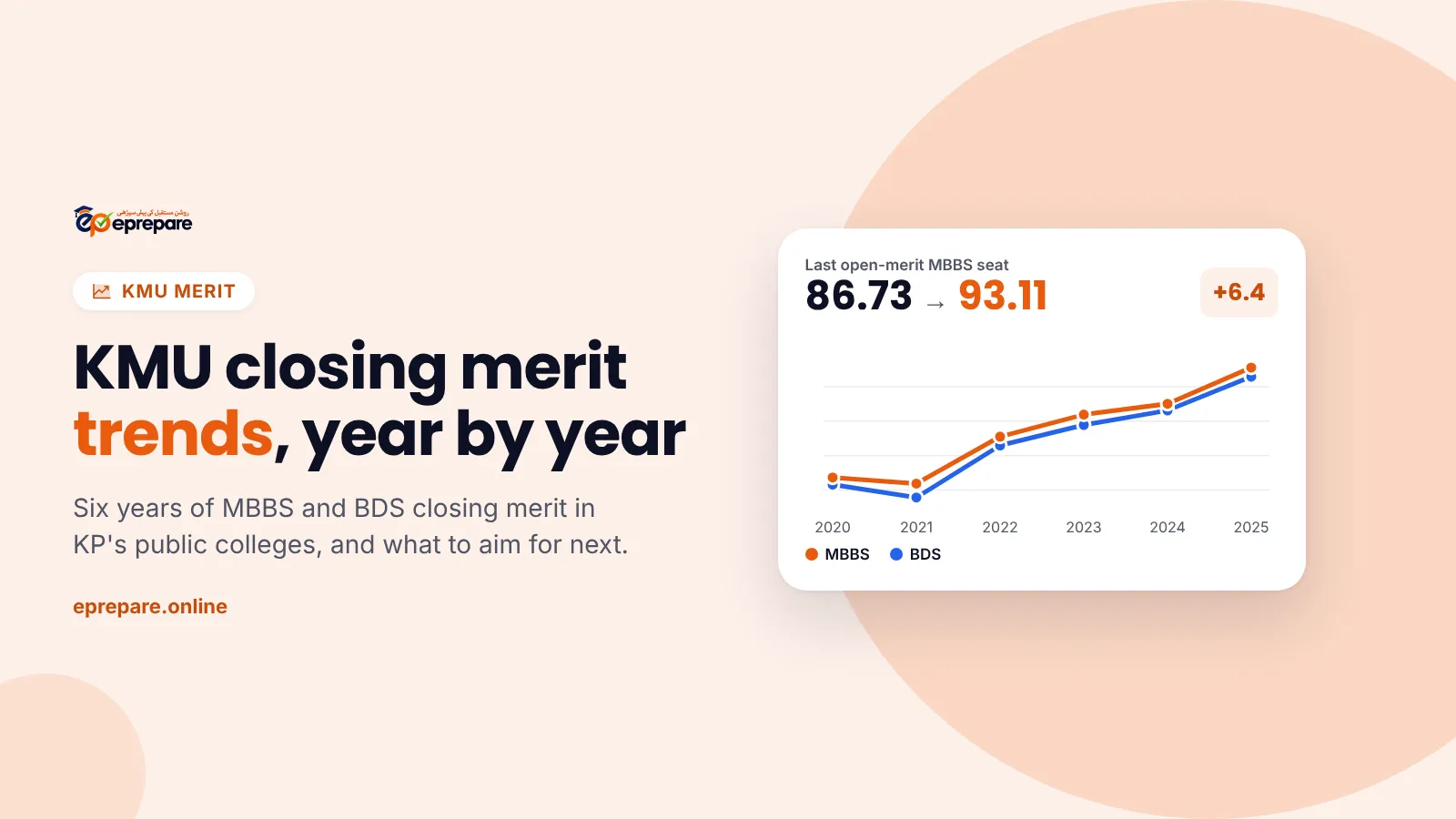
"What aggregate do I need for MBBS in KPK?" Students ask us this every week, and the honest answer keeps changing, because KMU's closing merit has moved almost every year. So we went back six years. Our team compiled the last open-merit seat from KMU's merit lists for every year from 2020 to 2025, for both MBBS and BDS, and lined them up.
KMU is Khyber Medical University, which runs admission to the public medical and dental colleges of Khyber Pakhtunkhwa (KP, also called KPK). This page shows how far its closing merit has risen, the one year it fell, what might be driving it, and the MDCAT score you need for each target at the Matric and FSc marks most students have.
The short answer: the last open-merit MBBS seat in KP's public colleges closed at 86.73 in 2020 and 93.107 in 2025, a rise of 6.38 aggregate points. BDS rose almost exactly as much, from 86.32 to 92.578. The only fall was in 2021. The biggest jumps were 2022 (+2.72 MBBS) and 2025 (+2.10). For 2026-27 our team's early estimate puts the last public MBBS college at about 93.94. With 95% in Matric and 93% in FSc, that needs about 171 out of 180 in the MDCAT.
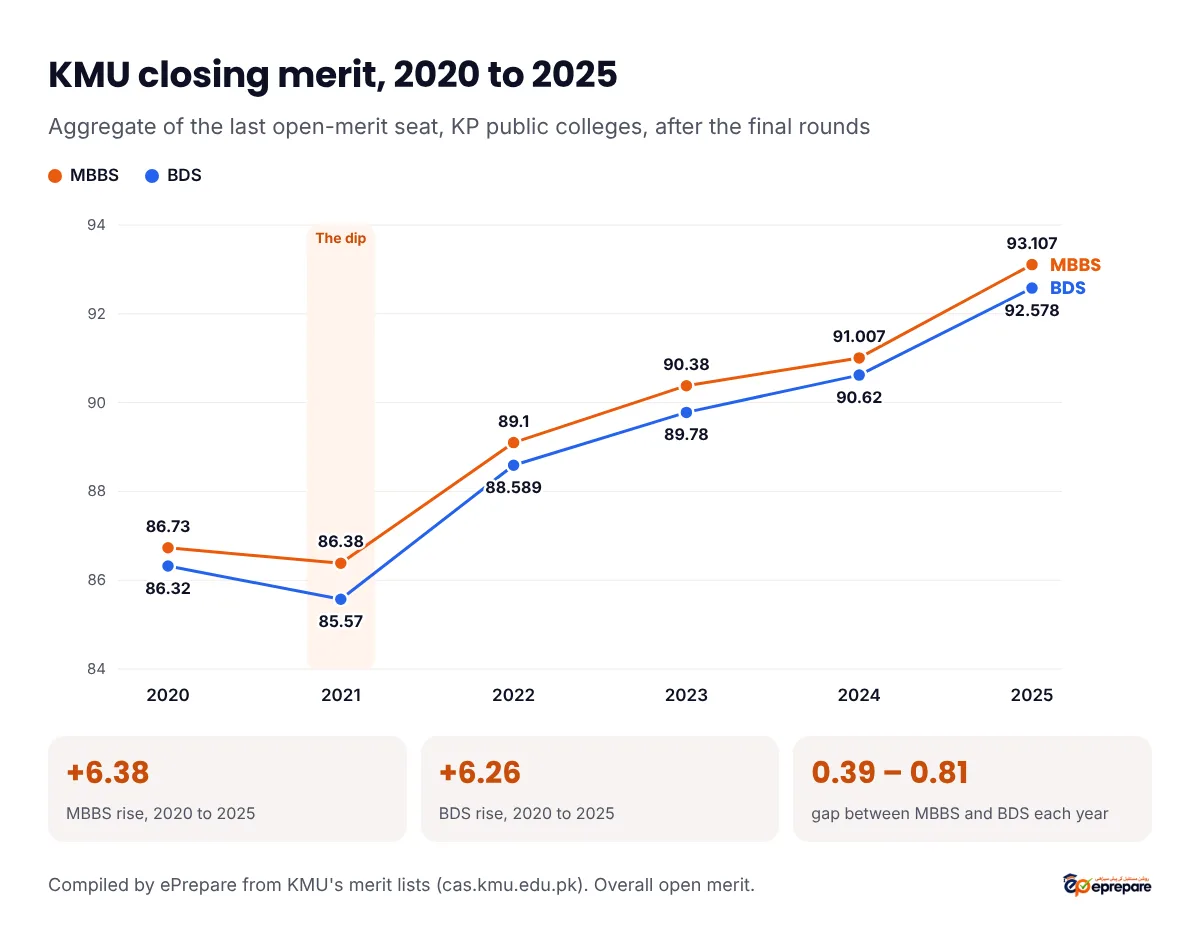
KMU closing merit, year by year
These figures are the overall closing open merit: the aggregate of the last student admitted on an open-merit seat in KP's public colleges, after the final rounds, as compiled by our team from KMU's merit lists. The rank is that student's merit number on KMU's list.
| Year | MBBS closing (rank) | BDS closing (rank) | MBBS change |
|---|---|---|---|
| 2025 | 93.107 (1,025) | 92.578 (1,402) | +2.10 |
| 2024 | 91.007 (1,054) | 90.62 (1,370) | +0.63 |
| 2023 | 90.38 (954) | 89.78 (1,350) | +1.28 |
| 2022 | 89.1 (970) | 88.589 (1,387) | +2.72 |
| 2021 | 86.38 (922) | 85.57 (above 1,450) | -0.35 |
| 2020 | 86.73 (978) | 86.32 (1,325) | First year in our data |
Read it like this: in 2025, if your aggregate was 93.107 or higher, an open-merit MBBS seat in some public college was yours. Below that, you were looking at self-finance, BDS or another route. For a single college, use the college-wise figures further down and on our KMU closing merit page.
How much merit moved each year
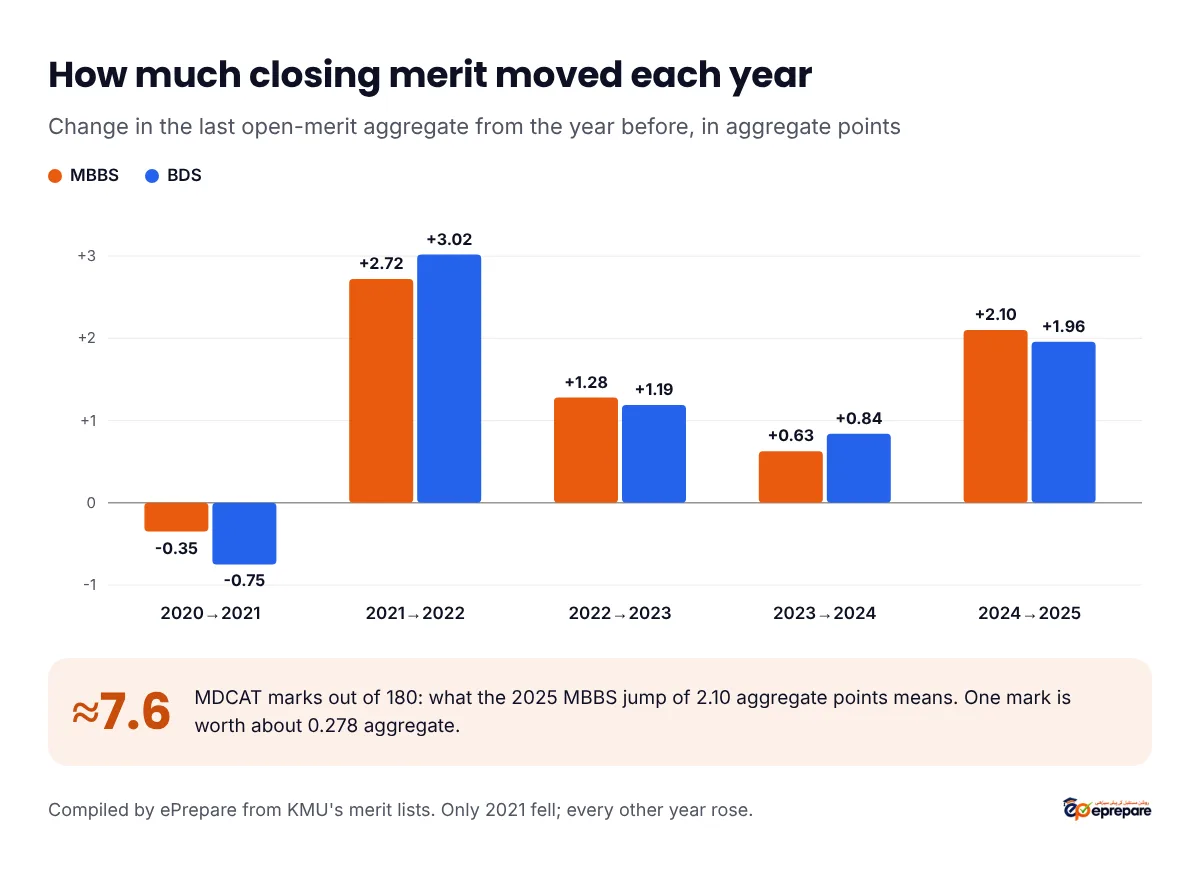
Some plain numbers from the table:
- Total rise, 2020 to 2025: MBBS +6.38, BDS +6.26.
- Average rise per year since the 2021 low: about 1.7 points for both MBBS and BDS.
- Smallest rise: 2024, when MBBS went up only 0.63 and BDS 0.84.
- Largest rise: 2022, +2.72 for MBBS and +3.02 for BDS.
To feel what this means in the exam hall: one MDCAT mark out of 180 is worth about 0.278 aggregate. The 2.10-point MBBS jump in 2025 is about 7.6 MDCAT marks. A student with exactly the same Matric and FSc as the last admitted student of 2024 needed roughly 8 more correct MCQs in 2025 to get the same result. The whole six-year rise of 6.38 points is about 23 MDCAT marks.
The 2021 dip
2021 is the only year both lines went down: MBBS by 0.35 and BDS by 0.75. KMU did not publish a reason, and we will not invent one. The usual factors that can pull closing merit down in a year are a harder paper (lower MDCAT scores across the board), more seats, or fewer strong applicants. Any of these could have played a part. What matters for you is the next point: 2021 was followed by the largest rise in our data, so one soft year is no reason to expect the next one to be easy.
Why does KMU merit keep rising?
No official source explains the rise year by year, so treat what follows as possibilities, not proven causes. Here is what the data and official notices can and cannot tell us.
1. The whole field is scoring higher
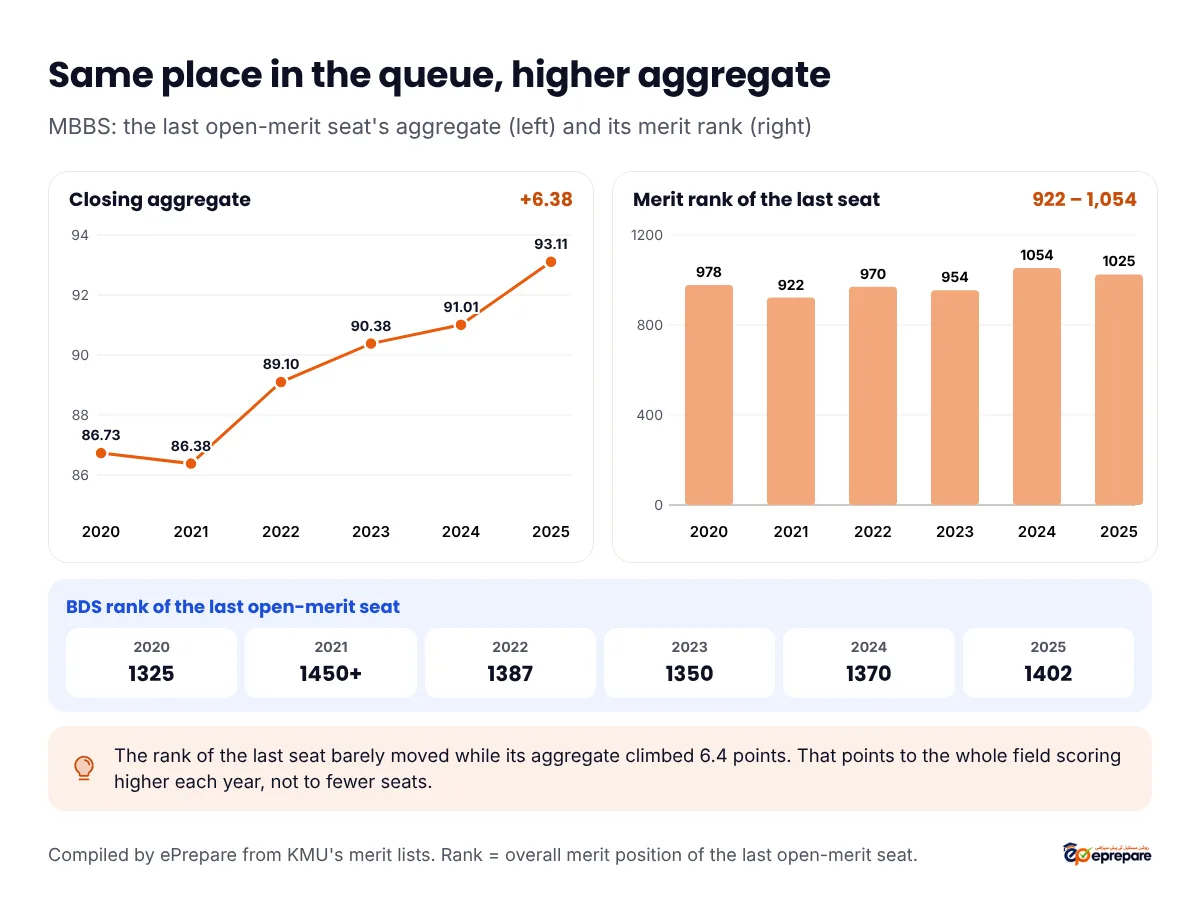
This is the clearest signal in the data. The rank of the last open-merit MBBS seat stayed between 922 and 1,054 in all six years. In plain words, KMU filled its open-merit MBBS seats at roughly the same place in the merit list every year. Yet the aggregate at that place rose by 6.4 points. If the number of seats being filled had shrunk sharply, the rank would have dropped. It did not. So the most likely reading is that the students around that position were simply scoring higher each year.
2. More students are sitting the MDCAT
PM&DC (the Pakistan Medical and Dental Council) said in July 2024 that almost 180,534 students appeared in the MDCAT the year before and that about 200,000 were expected in 2024. More candidates usually means more high scorers chasing the same seats. We do not have official KP-only applicant numbers for each year, so we cannot measure this effect exactly.
3. The paper itself changed
PM&DC's 2023 MDCAT curriculum set 200 MCQs in 3.5 hours, with 20% easy, 60% moderate and 20% hard questions, and PM&DC said the 2024 syllabus would stay the same as 2023. For 2025, PM&DC moved to 180 MCQs in 3 hours, with 15% easy, 70% moderate and 15% difficult. Fewer hard questions can push top scores up. It is possible this helped the 2025 jump, but nobody has shown it officially. We could not confirm the paper size before 2023 on pmdc.pk, so we do not compare raw MDCAT marks across years. Aggregates are percentages, so the aggregate trend itself is fair to compare.
4. Seats
Adding seats normally lowers closing merit, and removing seats raises it. In 2025-26, KMU's round-6 list shows 832 open-merit MBBS seats across the ten public medical colleges, yet the last open seat sat at rank 1,025. The gap is likely students above that rank who took a different seat, a different category, or a college outside KMU. Our 2026-27 estimate also shows the seats effect: the last college is estimated at 93.94, or about 93.74 if 150 more seats are added.
MBBS vs BDS: how far apart?
BDS always closes a little below MBBS, because the strongest students take MBBS first. The gap between the last open MBBS seat and the last open BDS seat was 0.41 (2020), 0.81 (2021), 0.51 (2022), 0.60 (2023), 0.39 (2024) and 0.53 (2025). That is only about 1.4 to 2.9 MDCAT marks. BDS is not a "low-merit" option in KP. If you are within 2 or 3 marks of MBBS, apply for BDS as well. Our KMU BDS admission guide covers the dental colleges and how to apply.
College-wise closing merit 2025-26
The yearly figures above are for the last open-merit seat overall. The college-wise picture comes from KMU's round-6 (final) list for session 2025-26. By 25 February 2026, every seat on it had been filled.
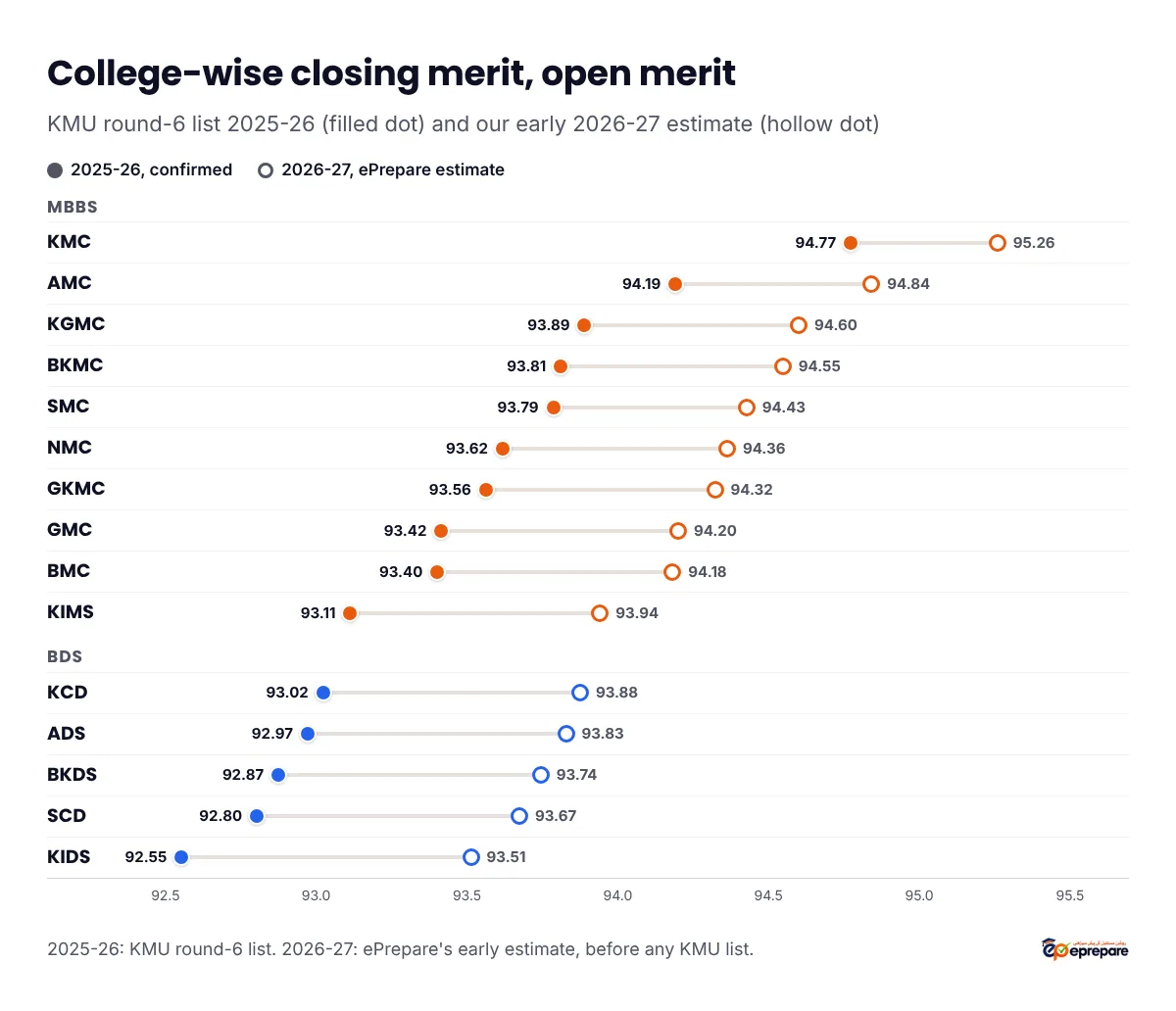
| College (open merit) | 2025-26 closing | Open seats | 2026-27 estimate |
|---|---|---|---|
| Khyber Medical College (KMC), Peshawar | 94.7727 | 181 | 95.26 |
| Ayub Medical College (AMC), Abbottabad | 94.1909 | 142 | 94.84 |
| Khyber Girls Medical College (KGMC), Peshawar | 93.8899 | 89 | 94.60 |
| Bacha Khan Medical College (BKMC), Mardan | 93.8111 | 60 | 94.55 |
| Saidu Medical College (SMC), Swat | 93.7859 | 57 | 94.43 |
| Nowshera Medical College (NMC) | 93.6182 | 73 | 94.36 |
| Gajju Khan Medical College (GKMC), Swabi | 93.5626 | 30 | 94.32 |
| Gomal Medical College (GMC), D.I. Khan | 93.4152 | 57 | 94.20 |
| Bannu Medical College (BMC) | 93.4020 | 50 | 94.18 |
| KMU Institute of Medical Sciences (KIMS), Kohat | 93.1131 | 93 | 93.94 |
| Khyber College of Dentistry (KCD), Peshawar | 93.0232 | 66 | 93.88 |
| Ayub Dental Section (ADS), Abbottabad | 92.9717 | 21 | 93.83 |
| Bacha Khan Dental Section (BKDS), Mardan | 92.8748 | 28 | 93.74 |
| Saidu College of Dentistry (SCD), Swat | 92.8030 | 39 | 93.67 |
| KMU Institute of Dental Sciences (KIDS), Kohat | 92.5535 | 41 | 93.51 |
Why 93.107 and 93.1131 are not the same number
You may notice that the lowest college-wise MBBS closing in 2025-26 is 93.1131 at KIMS, while the overall 2025 figure in our yearly table is 93.107. They come from different snapshots. The overall figure is the last open-merit seat after the final rounds, as compiled by our team. The college-wise table comes from KMU's round-6 list. A small difference like this can appear when a seat changes hands after that list. The same thing happens in BDS: KIDS closed at 92.5535 on the round-6 list, against 92.578 in the overall figure. The gap is a few hundredths of a point, well under one MDCAT mark, and it does not change any conclusion on this page.
Self-finance seats close lower. In the same round-6 list, the lowest general self-finance closing was 92.6061 for MBBS (Gomal) and 92.3919 for BDS (KIDS). Our guide on self-finance vs open merit explains the fee difference before you tick that box.
What aggregate should you target for 2026-27?
Our team's early 2026-27 estimates, made before any KMU merit list, put the last public MBBS college (KIMS) at about 93.94, or about 93.74 if 150 more seats are added. They put KMC at about 95.26 and the last dental college at about 93.51. These are estimates, not KMU figures. The real closing will depend on seats, applicants and how hard the 2026 MDCAT was.
For context, the estimate for the last college is 0.83 above the 2025-26 round-6 figure. That is a smaller rise than 2022 or 2025, and about half the average yearly rise since 2021 (about 1.7), so treat it as a floor rather than a ceiling. Here is how we would plan:
- Any public MBBS seat: treat 94 or more as your working target, with 94.5 or more if you want a margin for a strong year.
- The top colleges (KMC, AMC, KGMC): plan for 95 or more.
- Public BDS: about 93.5 on the estimate.
- Always list self-finance and BDS as well if you are near the line. KMU gives seats on merit-cum-choice, and upgrades happen in later lists. Our merit list and upgrade guide explains how.
Check your own position against every college with the college predictor.
MDCAT marks needed for each target
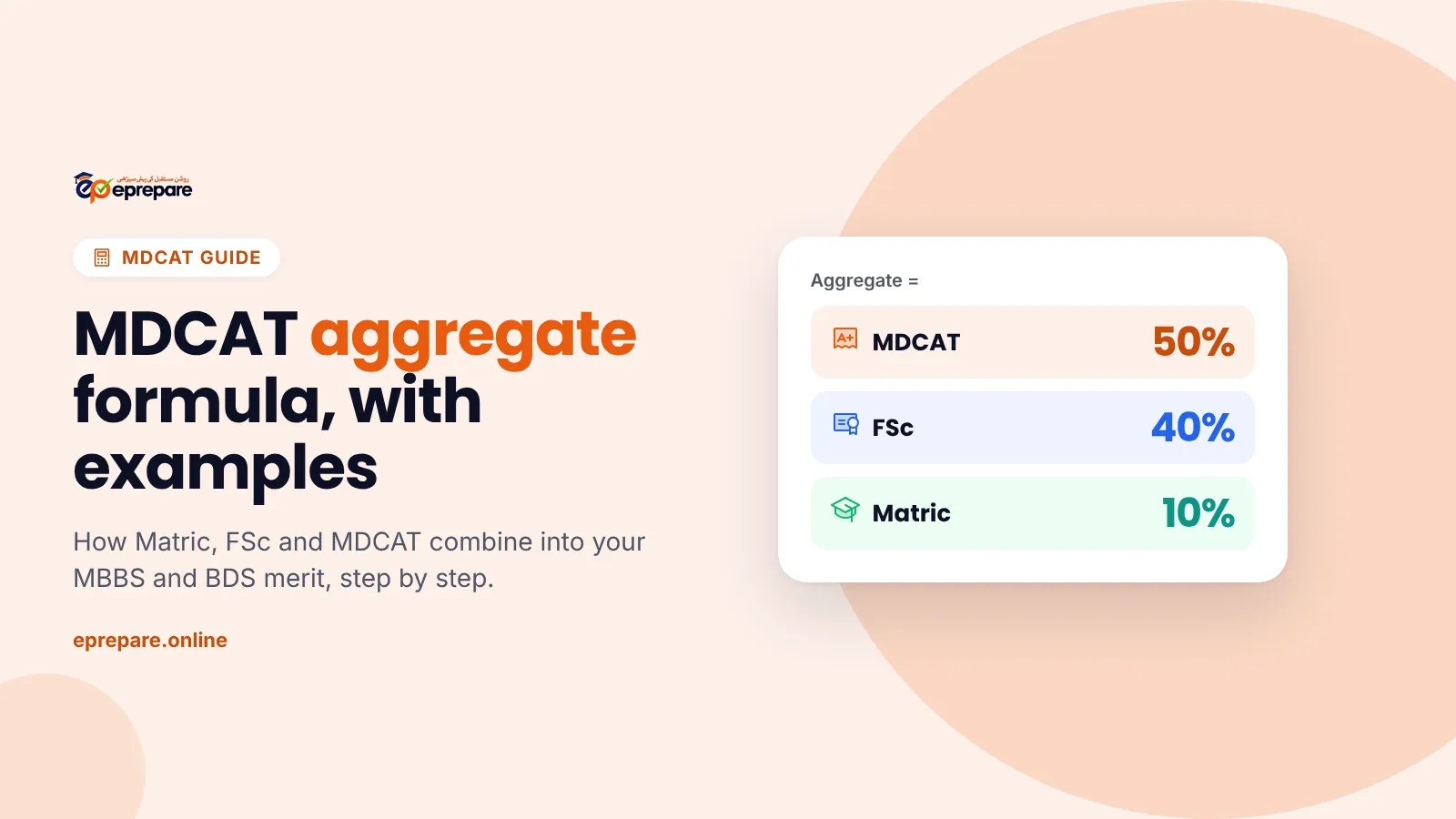
KMU's aggregate is 10% Matric + 40% FSc + 50% MDCAT, with MDCAT out of 180. Once your board marks are fixed, the formula tells you the MDCAT score you need. We worked it out for four common profiles, rounded up to whole marks:
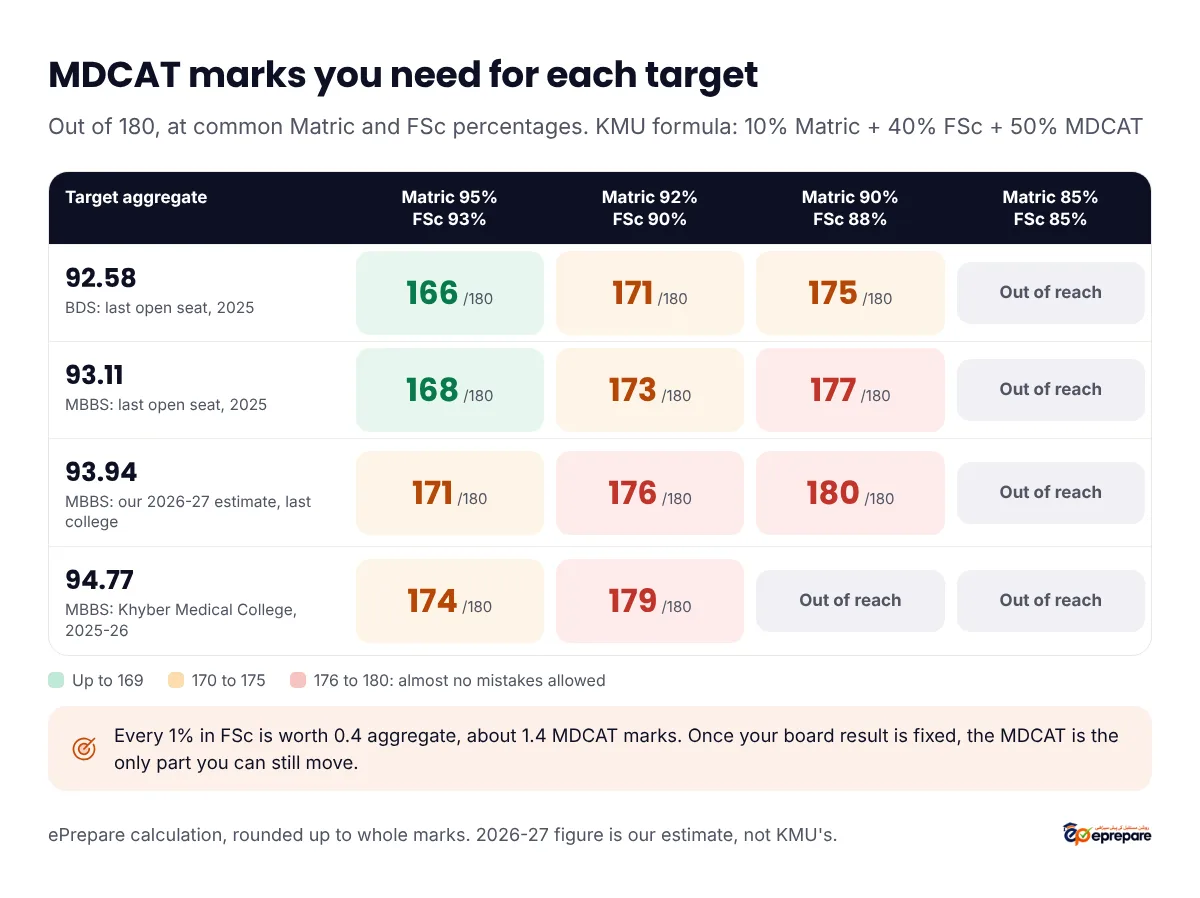
| Target aggregate | Matric 95%, FSc 93% | Matric 92%, FSc 90% | Matric 90%, FSc 88% | Matric 85%, FSc 85% |
|---|---|---|---|---|
| 92.58 (BDS, last open seat 2025) | 166 | 171 | 175 | Out of reach |
| 93.11 (MBBS, last open seat 2025) | 168 | 173 | 177 | Out of reach |
| 93.94 (MBBS, our 2026-27 estimate) | 171 | 176 | 180 | Out of reach |
| 94.77 (KMC, 2025-26) | 174 | 179 | Out of reach | Out of reach |
How we calculated it: MDCAT needed = (target − 0.1 × Matric % − 0.4 × FSc %) ÷ 50 × 180. For example, at Matric 95% and FSc 93%: 93.94 − 9.5 − 37.2 = 47.24, and 47.24 ÷ 50 × 180 = 170.1, so you need 171. "Out of reach" means the answer is above 180, so even a perfect MDCAT would not be enough.
Three lessons from this table:
- Board marks set your ceiling. At 85% in both Matric and FSc, no MDCAT score reaches public MBBS merit at recent levels. Every 1% in FSc is worth 0.4 aggregate, about 1.4 MDCAT marks.
- Every mark counts at the top. For a student with 95% in Matric and 93% in FSc, every target in the table sits between 166 and 174 marks.
- Accuracy beats speed. A score of 171 to 176 means you can afford only 4 to 9 mistakes in the whole paper.
Try your own numbers in the KMU merit calculator or the aggregate calculator. The full formula with worked examples is in the MDCAT aggregate formula.
A note on comparing old years
Aggregates are percentages, so 90.38 in 2023 and 93.107 in 2025 sit on the same scale. Raw MDCAT marks do not. PM&DC's 2023 curriculum set 200 MCQs, and its 2025 paper had 180. If an older senior tells you "I got in with 175", ask which year: 175 out of 200 and 175 out of 180 are very different scores. Our MDCAT paper pattern page has the current subject split.
Frequently asked questions
What was the KMU closing merit for MBBS in 2025?
The last open-merit MBBS seat in KP's public colleges closed at 93.107 (rank 1,025), as compiled by our team from KMU's merit lists. By college, on KMU's 2025-26 round-6 list, closings ran from 94.7727 at KMC down to 93.1131 at KIMS, Kohat.
What was the KMU closing merit for BDS in 2025?
92.578 for the last open-merit BDS seat (rank 1,402). On the round-6 list, KCD closed at 93.0232 and KIDS, Kohat at 92.5535.
Has KMU merit ever gone down?
Yes, once in our six years of data: in 2021, MBBS fell from 86.73 to 86.38 and BDS from 86.32 to 85.57. Every other year it rose.
How much will KMU merit increase in 2026?
Nobody knows until KMU's lists are out. Our early estimate puts the last public MBBS college at about 93.94 and KMC at about 95.26 for 2026-27. Since 2021, closing merit has risen about 1.7 points a year on average.
What aggregate is safe for MBBS in KPK?
For 2026-27 we suggest planning for 94 or more for any public MBBS seat, and 95 or more for KMC, AMC or KGMC. Being above last year's closing is not a guarantee, because merit rose in four of the last five years.
How many MDCAT marks do I need for MBBS in KPK?
It depends on your Matric and FSc. With 95% in Matric and 93% in FSc, you need about 168 out of 180 to match the 2025 closing and 171 for our 2026-27 estimate. With 90% and 88%, you need 177 and 180.
Why is BDS merit so close to MBBS merit?
Because many strong students apply for both. The gap between the last MBBS and last BDS open seat has been only 0.39 to 0.81 aggregate, about 1.4 to 2.9 MDCAT marks.
Why did KMU merit jump so much in 2025?
KMU has not given a reason. Possible factors include more candidates, higher scores across the board, and PM&DC's 2025 paper change to 180 MCQs with fewer hard questions (15% instead of 20%). None of these is officially confirmed as the cause.
The trend is clear: each year, the same seat needs a few more correct MCQs. The students who make it are the ones who have already practised full papers under exam conditions. Start with our FLP series of full-length papers and the KMU MDCAT past papers, and register on ePrepare to track your score against these targets every week.
Sources: yearly overall closing open merit (2020 to 2025) compiled by the ePrepare team from Khyber Medical University's merit lists for public sector colleges (cas.kmu.edu.pk). College-wise 2025-26 closings and open seats: KMU's round-6 (final) merit list, session 2025-26, as shown on our KMU closing merit page. 2026-27 figures are ePrepare's early estimates, not KMU data. MDCAT pattern and candidate numbers: Pakistan Medical and Dental Council, MDCAT Curriculum 2023, press release of 19 July 2024 and press release on the MDCAT 2025 syllabus. Merit changes every year; always check KMU's latest lists.