Every year, many students in Khyber Pakhtunkhwa decide on BDS only after the MBBS merit lists are out, and by then they have already made the biggest mistake: they never applied for dental at all. KMU treats medical and dental admissions as two separate programmes, with their own application, their own merit lists and their own deadlines.
This guide covers everything about BDS admission in KP's public dental colleges, using KMU's latest admission policy for public sector colleges, published on the KMU admission portal. It explains how many seats each dental college has and in which categories, who is eligible, how merit works, what BDS costs, the deadlines, and what happens after you join.
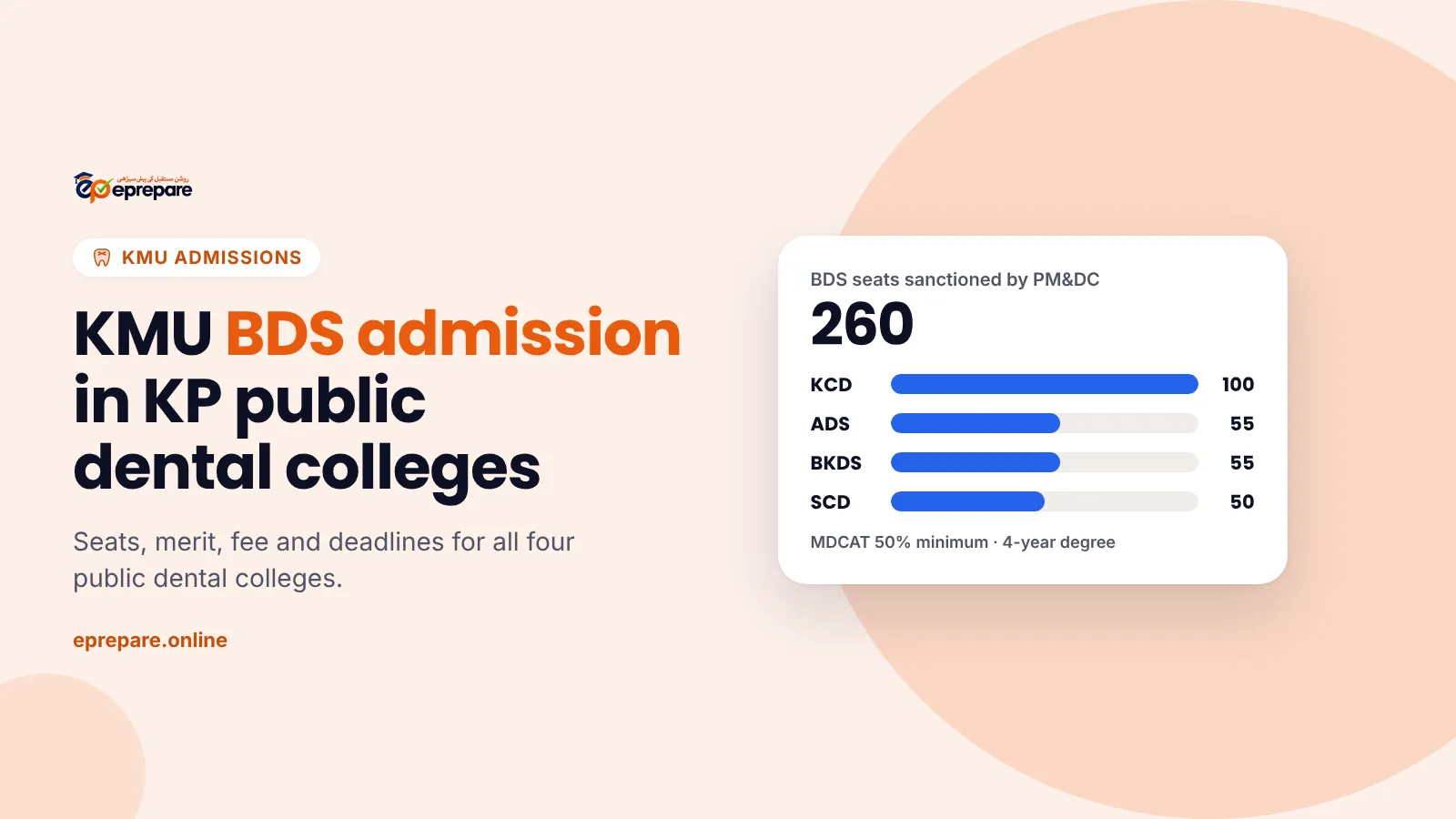
The short answer: KMU admits BDS students to four public dental colleges with 260 sanctioned seats: Khyber College of Dentistry, Peshawar (100), Ayub Dental Section, Abbottabad (55), Bacha Khan Dental Section, Mardan (55) and Saidu College of Dentistry, Swat (50). 154 are open merit. You need at least 60% in HSSC and 50% in the MDCAT (90 out of 180), and you must apply for the dental programme separately. Open merit BDS admissions close before 15 February and special categories by 28 February. Open merit BDS costs about Rs 3.6 lakh to Rs 4.4 lakh for all four years; self-finance costs Rs 35.12 lakh.
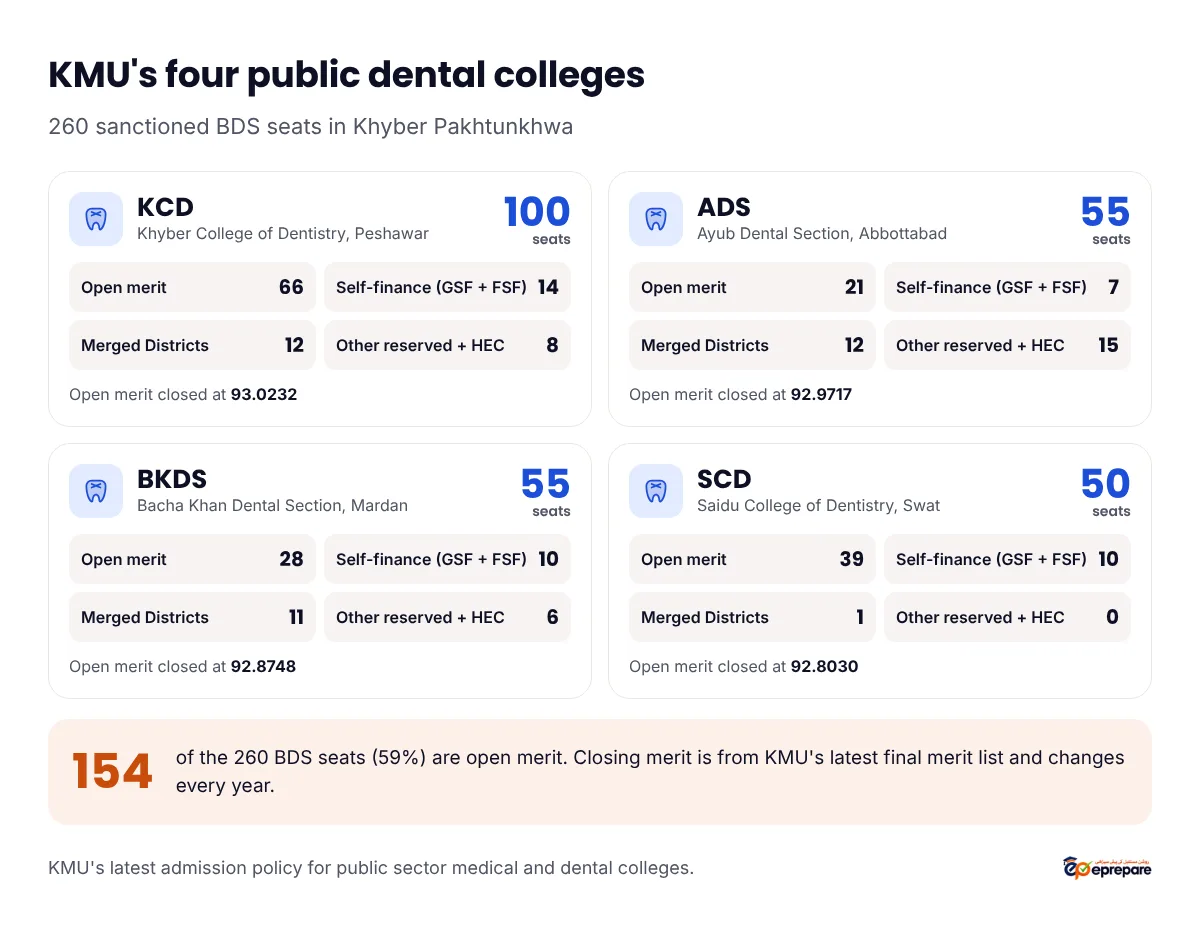
KMU's four public dental colleges
| College | City | Sanctioned seats | Open merit |
|---|---|---|---|
| Khyber College of Dentistry (KCD) | Peshawar | 100 | 66 |
| Ayub Dental Section (ADS) | Abbottabad | 55 | 21 |
| Bacha Khan Dental Section (BKDS) | Mardan | 55 | 28 |
| Saidu College of Dentistry (SCD) | Swat | 50 | 39 |
| All four | 4 cities | 260 | 154 |
BDS is a four-year degree in all four colleges. On top of the 260 sanctioned seats, the policy adds 13 over-and-above seats in dentistry: 12 additional foreign seats and 1 under the Pakistan Technical Assistance Program (PTAP) at KCD. To see how the dental colleges compare with the medical colleges, read our KMU college-wise seats guide.
Seats in each dental college, category by category
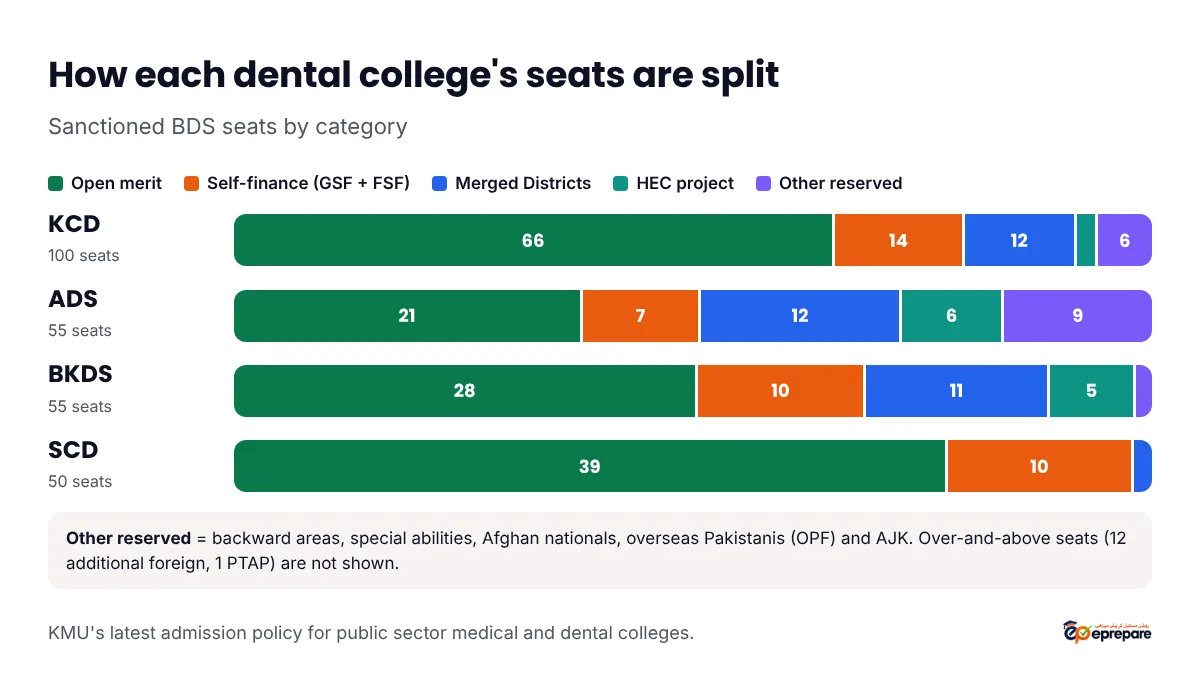
Each category has its own merit list, so it helps to know exactly where the seats are. This table comes straight from the policy's seat distribution:
| Seat category | KCD | ADS | BKDS | SCD |
|---|---|---|---|---|
| Open merit | 66 | 21 | 28 | 39 |
| General self-finance (GSF) | 10 | 4 | 7 | 7 |
| GSF reserved for minorities | 1 | 0 | 1 | 0 |
| Foreign self-finance (FSF) | 3 | 3 | 2 | 3 |
| Special abilities (disabled) | 1 | 1 | 0 | 0 |
| Backward areas | 3 | 4 | 0 | 0 |
| Merged Districts | 12 | 12 | 11 | 1 |
| Afghan nationals | 1 | 1 | 0 | 0 |
| Azad Jammu & Kashmir | 0 | 1 | 0 | 0 |
| Overseas Pakistanis (OPF) | 1 | 2 | 1 | 0 |
| MDs/Balochistan project (HEC) | 2 | 6 | 5 | 0 |
| Sanctioned seats | 100 | 55 | 55 | 50 |
| Additional foreign seats (over and above) | 4 | 3 | 3 | 2 |
| Pakistan Technical Assistance Program (PTAP) (over and above) | 1 | 0 | 0 | 0 |
| Grand total | 105 | 58 | 58 | 52 |
Saidu College of Dentistry has the highest open merit share of all KMU's public colleges (39 of 50 seats, 78%), while Ayub Dental Section has the most reserved seats of the four (only 21 of 55 are open merit). The three general self-finance seats reserved for minorities include two in dentistry, at KCD and BKDS.
Merged Districts BDS seats
Students with a Merged Districts domicile have 36 BDS seats in KP's dental colleges, split by district, and 7 more in other provinces: 4 at Nishtar Institute of Dentistry, Multan (Orakzai 1, Kurram 1, Ex-FRs 2), 2 at the Dental Section of Punjab Medical College, Faisalabad (North Waziristan 1, Mohmand 1) and 1 at Liaquat University of Medical & Health Sciences, Jamshoro (Ex-FRs 1).
| College | MDs seats | By district |
|---|---|---|
| KCD | 12 | Bajaur 2, S. Waziristan 2, N. Waziristan 2, Khyber 1, Orakzai 1, Mohmand 1, Kurram 2, Ex-FRs 1 |
| ADS | 12 | Bajaur 2, S. Waziristan 2, N. Waziristan 2, Khyber 2, Orakzai 1, Mohmand 1, Kurram 1, Ex-FRs 1 |
| BKDS | 11 | Bajaur 1, S. Waziristan 1, N. Waziristan 1, Khyber 2, Orakzai 2, Mohmand 2, Kurram 1, Ex-FRs 1 |
| SCD | 1 | S. Waziristan 1 |
The rules, including the 90% / 10% inside-candidate split and the Home & Tribal Affairs step, are in our Merged Districts seats guide.
Backward area and other reserved BDS seats
| College | Backward area seats | For which areas |
|---|---|---|
| KCD | 3 | Chitral 1, Gadoon & Amazai 1, Shangla 1 |
| ADS | 4 | Kohistan 1, Chitral 1, Tor Ghar 1, Tank 1 |
- Special abilities: 2 seats, one each at KCD and ADS. See KMU special ability seats.
- Afghan nationals: 2 seats, at KCD and ADS. See KMU Afghan national seats.
- Overseas Pakistanis (OPF): 4 seats: KCD 1, ADS 2, BKDS 1. See KMU OPF seats.
- Azad Jammu & Kashmir: 1 seat at ADS, for AJK candidates nominated through Muzaffarabad.
- MDs/Balochistan project (HEC): 13 seats: KCD 2, ADS 6, BKDS 5. You apply to HEC, not KMU.
Backward area BDS candidates sign the same five-year service bond as MBBS candidates; read the KP backward area seats guide before you accept.
Who is eligible for BDS?
The basic eligibility is the same as for MBBS, except for the MDCAT minimum. The policy says a candidate must have:
"Obtained a Higher Secondary School Certificate qualification (HSSC) or an equivalent 12th grade qualification recognized in Pakistan and obtained a minimum of sixty percent (60%) marks therein, or a higher percentage as may be notified by the Medical and Dental Council"
- HSSC: at least 60%, with biology, chemistry and either physics or mathematics.
- MDCAT: "at least 55% for admission into MBBS and 50% for admission into BDS". On the current 180-mark paper, that is 90 marks for BDS (and 99 for MBBS).
- Domicile: for open merit, you and your father must hold a KP domicile (your mother's, with your father's death certificate, if he has died). Other categories have their own rules.
- Foreign qualifications such as O and A levels need an IBCC equivalence certificate before the closing date. See our O and A level guide.
- No age limit: "There is no lower or upper age limit for admission in public sector Medical/Dental colleges of Khyber Pakhtunkhwa."
The full list, including the rule for students who passed HSSC in 2021, is in our KMU eligibility criteria guide.
Apply for BDS separately, even if MBBS is your first choice
This is the rule that costs the most dental seats. The policy says:
"Admissions to medical and dental programs shall be conducted separately and each student shall be required to apply separately to a medical or dental program. A student having not applied to a given program shall not be entitled to admission to such program."
So if there is any chance you would accept BDS, apply for both MBBS and BDS when KMU opens admissions. List every dental college you would join in your preferences, because "if a college is not mentioned in his/her preferences, admission shall not be offered in that particular college." Applying for BDS does not reduce your MBBS chances; it simply keeps the door open.
How BDS merit works
BDS merit uses the same aggregate as MBBS: 10% Matric + 40% FSc + 50% MDCAT, calculated to five decimal places, with the older candidate placed higher in a tie. Here is a worked example with MDCAT out of 180:
- Matric 1,050 out of 1,100 = 95.45455% × 0.10 = 9.54545
- FSc 1,030 out of 1,100 = 93.63636% × 0.40 = 37.45455
- MDCAT 165 out of 180 = 91.66667% × 0.50 = 45.83333
- Aggregate = 92.83333
Against KMU's latest final merit list, that aggregate would have been just above Saidu College of Dentistry's open merit closing (92.8030), but below KCD (93.0232). Every MDCAT mark is worth about 0.28 aggregate, so just one more mark (166 instead of 165, for 93.11111) would have cleared KCD's closing. Work out your own figure with the aggregate calculator.
BDS closing merit
| College | Open merit closing | Self-finance closing | Gap |
|---|---|---|---|
| KCD, Peshawar | 93.0232 | 92.5788 | 0.44 |
| ADS, Abbottabad | 92.9717 | 92.5697 | 0.40 |
| BKDS, Mardan | 92.8748 | 92.4859 | 0.39 |
| SCD, Swat | 92.8030 | 92.4859 | 0.32 |
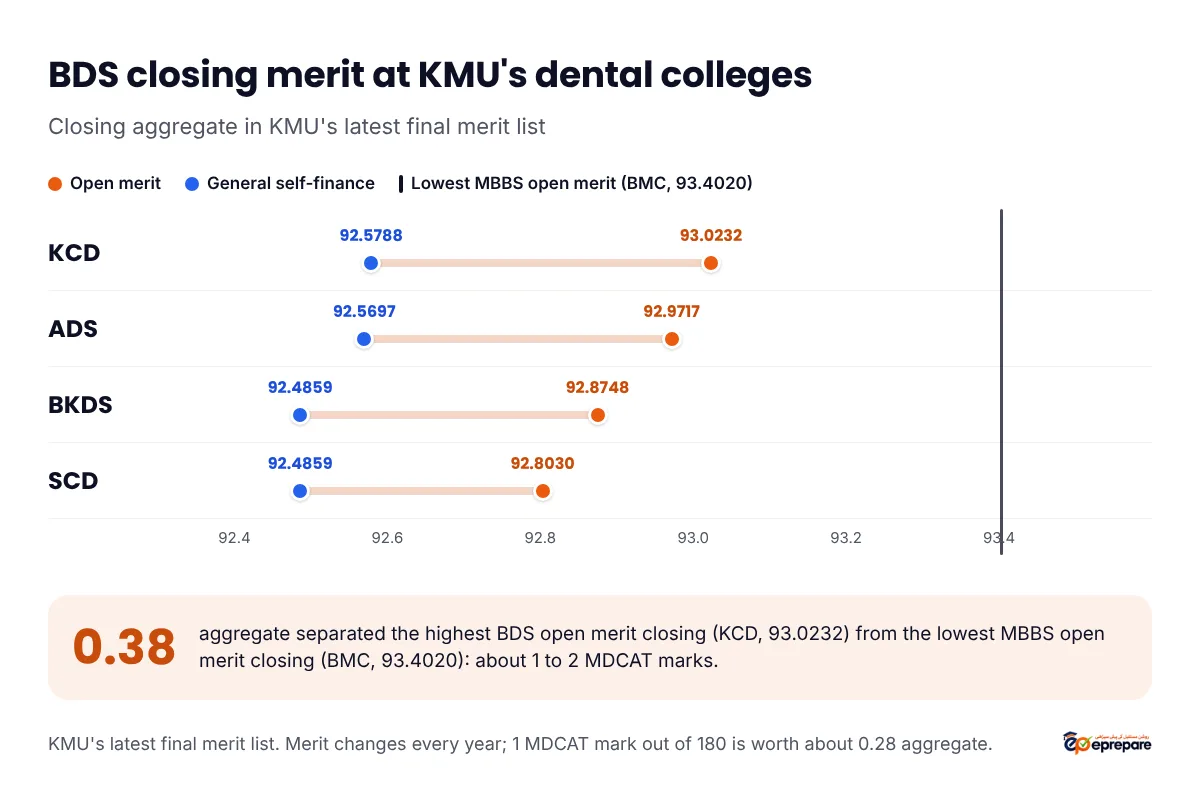
Two things stand out. First, BDS is competitive: in KMU's latest final merit list, the highest BDS open merit closing (KCD, 93.0232) was only 0.38 aggregate below the lowest MBBS open merit closing (Bannu Medical College, 93.4020), roughly one or two MDCAT marks. Second, the self-finance gap is small in dentistry: 0.32 to 0.44 aggregate, or one to two MDCAT marks. Merit changes every year; see the KMU closing merit page and try the college predictor.
BDS fee at KMU's public dental colleges
Open merit BDS (Rs per year)
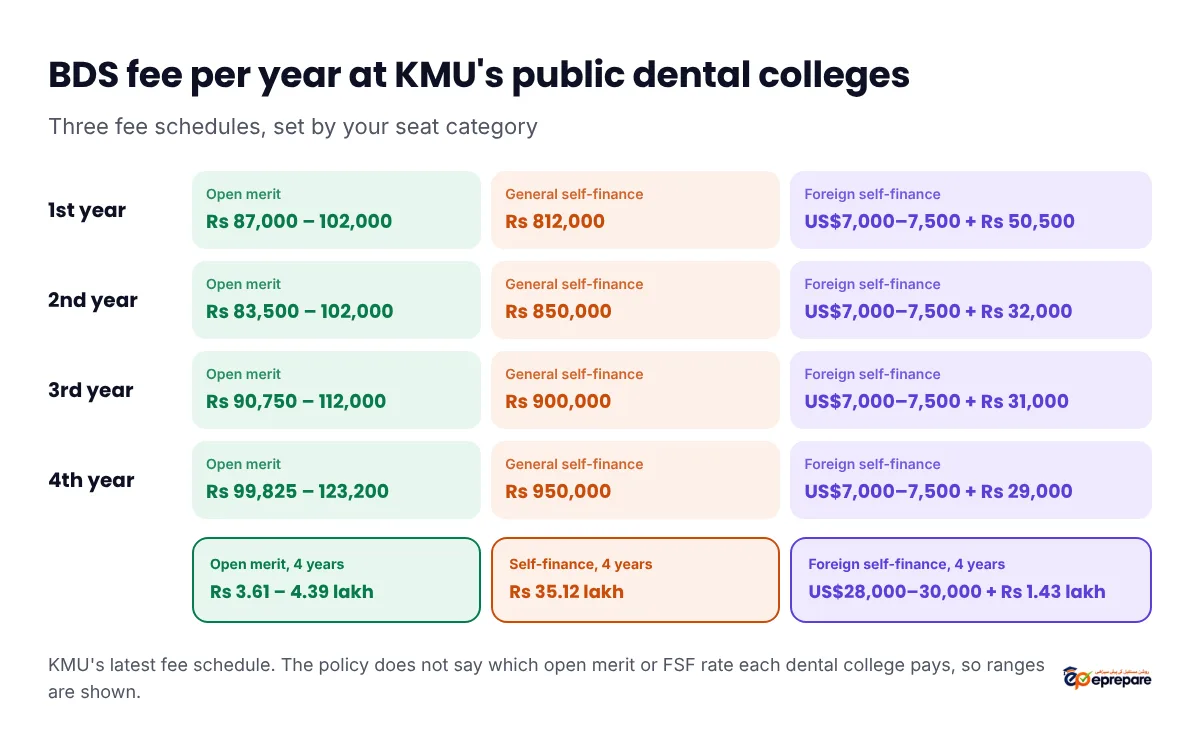
The open merit fee table covers "MBBS/BDS" and has two rates: a higher one for Khyber Medical College, Khyber Girls Medical College and Ayub Medical College, and a lower one for "all other medical colleges". The policy does not say which rate each dental college pays, so we show both.
| Year | Lower rate | Higher rate |
|---|---|---|
| 1st year | 87,000 | 102,000 |
| 2nd year | 83,500 | 102,000 |
| 3rd year | 90,750 | 112,000 |
| 4th year | 99,825 | 123,200 |
| Total, 4 years | 361,075 | 439,200 |
The same open merit fee applies to most reserved seats, including Merged Districts, backward area, special ability, AJK, OPF and Afghan national seats.
Self-finance BDS (Rs per year)
| Year | Tuition | Total fee |
|---|---|---|
| 1st year | 762,000 | 812,000 |
| 2nd year | 817,000 | 850,000 |
| 3rd year | 867,000 | 900,000 |
| 4th year | 917,000 | 950,000 |
| Total, 4 years | 3,363,000 | 3,512,000 |
Unlike MBBS, self-finance BDS has one rate for every public dental college.
Foreign self-finance BDS
| Year | Tuition | Rupee charges |
|---|---|---|
| 1st year | US$7,000 to 7,500 | Rs 50,500 |
| 2nd year | US$7,000 to 7,500 | Rs 32,000 |
| 3rd year | US$7,000 to 7,500 | Rs 31,000 |
| 4th year | US$7,000 to 7,500 | Rs 29,000 |
The FSF fee is paid in foreign exchange for the whole degree; see the KMU foreign self-finance guide. Every fee table, including MBBS, is in our KMU fee structure guide. Hostel, books, instruments and dental materials are extra; BDS students usually buy their own instruments.
BDS deadlines and the admission timeline
Dental admissions run on a later clock than MBBS. The policy fixes these dates every year:
"admissions of Public Sector Dental Colleges shall be completed before 15th February, of each year … Admissions to all special category seats in public dental colleges not being on open merit shall be completed by 28th February of each year."
| Step | When |
|---|---|
| Criteria and seat categories announced | By 1 August |
| Online application at cas.kmu.edu.pk | Dates in KMU's advertisement after the MDCAT result |
| Merit lists, placement interviews and upgrades | At least three merit lists; fee within three working days of the offer letter |
| Open merit BDS admissions complete | Before 15 February |
| Special category BDS admissions complete | By 28 February |
| Final list of admitted students made public | By 28 February |
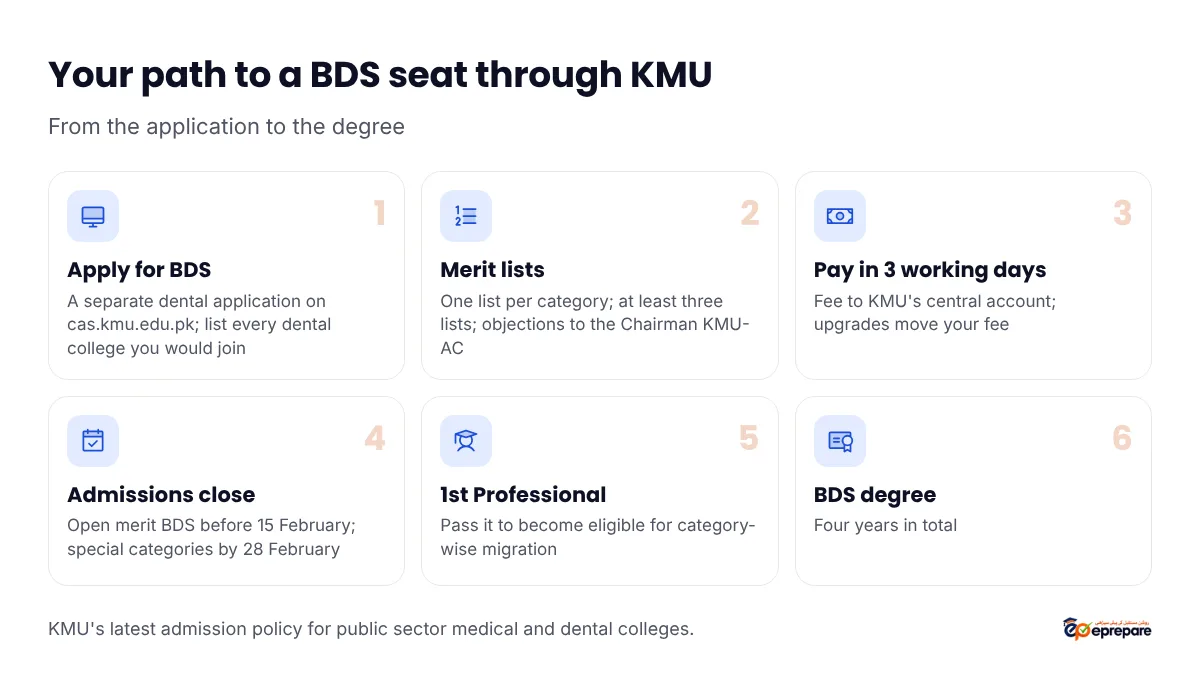
Our KMU admission schedule shows the whole cycle, and our guide to KMU merit lists and upgrades explains the fee deadline and upgrades in detail. Have your documents ready before you apply; our KMU documents checklist lists them.
After you join: migration and the rules that apply
- Migration: BDS students can migrate to another dental college "after passing … 1st Professional in BDS", into a vacant seat of the same category. Colleges report vacant seats "in … 2nd, 3rd and Final Professional BDS class". Fees are Rs 50,000 within KP for public colleges. See the KMU migration policy.
- Attendance: a first-year student absent for four continuous weeks from the start of the session without a valid reason is struck off the roll.
- Provisional admission: documents can be checked at any stage, and a false document means cancellation and blacklisting. Read our guide to KMU rules after admission.
Should you take BDS?
BDS is a full professional degree in its own right, not a consolation prize, and the merit figures show how many strong students choose it. If you are deciding between a lower MBBS college and a BDS seat, think about the career you want, the length of the degree (four years against five), and the cost. Whatever you decide, apply for both programmes, so the choice stays yours when the lists come out.
Frequently asked questions
How many BDS seats are there in KP public dental colleges?
260 sanctioned seats in four colleges: KCD Peshawar 100, ADS Abbottabad 55, BKDS Mardan 55 and SCD Swat 50. Another 13 seats are added over and above (12 additional foreign and 1 PTAP).
What MDCAT score do I need for BDS at KMU?
The minimum to be eligible is 50%, which is 90 out of 180. To actually get an open merit seat you need a much higher aggregate: in KMU's latest final merit list, open merit BDS closed between 92.8030 (SCD) and 93.0232 (KCD).
Do I need a separate application for BDS?
Yes. KMU's policy says medical and dental admissions are conducted separately, and a student who has not applied to a programme is not entitled to admission to it.
What is the last date for BDS admission at KMU?
Open merit admissions to public dental colleges must be completed before 15 February, and special category seats by 28 February. KMU announces the exact application dates in its advertisement.
How much is the BDS fee in KP public dental colleges?
Open merit BDS costs Rs 87,000 to Rs 102,000 in the first year and Rs 3.61 lakh to Rs 4.39 lakh over four years. Self-finance BDS costs Rs 812,000 in the first year and Rs 35.12 lakh in total.
Which is the best public dental college in KP?
The policy doesn't rank colleges, but merit does show demand: KCD Peshawar had the highest open merit closing in KMU's latest final merit list (93.0232), followed by ADS (92.9717), BKDS (92.8748) and SCD (92.8030).
Can I move from BDS to MBBS later?
Not through migration. KMU's migration policy only covers moving to another college within your seat category, after the 1st Professional in BDS; it has no route from BDS to MBBS. To study MBBS you would have to apply again through the admission process.
Are there BDS seats for Merged Districts students?
Yes: 36 in KP's dental colleges (KCD 12, ADS 12, BKDS 11, SCD 1) and 7 in Punjab and Sindh dental colleges.
The gap between a BDS seat and an MBBS seat is often just a couple of MDCAT marks, and so is the gap between two dental colleges. If you are preparing for the MDCAT, start with ePrepare for KPK textbook MCQs, full-length tests and a predicted score.
Sources: Khyber Medical University, latest Admission Policy for Public Sector Medical and Dental Colleges of Khyber Pakhtunkhwa (college-wise seat distribution, Merged Districts seats in KP and other provinces, eligibility, admission procedure, migration policy and annual fee schedule), and KMU's latest final merit list (closing merit). The worked example and totals are our own calculations. Always check the current policy and notices on cas.kmu.edu.pk.