Applying for medicine and dentistry through Shaheed Zulfiqar Ali Bhutto Medical University (SZABMU) starts with three separate questions: Am I eligible, which seat categories can I compete for, and are my documents complete? Meeting the minimum marks requirement answers only the first question. Selection still depends on your aggregate, the relevant seat category and the admission process.
SZABMU’s MBBS and BDS admission pages list different MDCAT minimums, a shared aggregate formula and detailed quota evidence. This guide brings those rules together, reproduces every seat allocation in those two pages, and explains the practical differences before you apply.
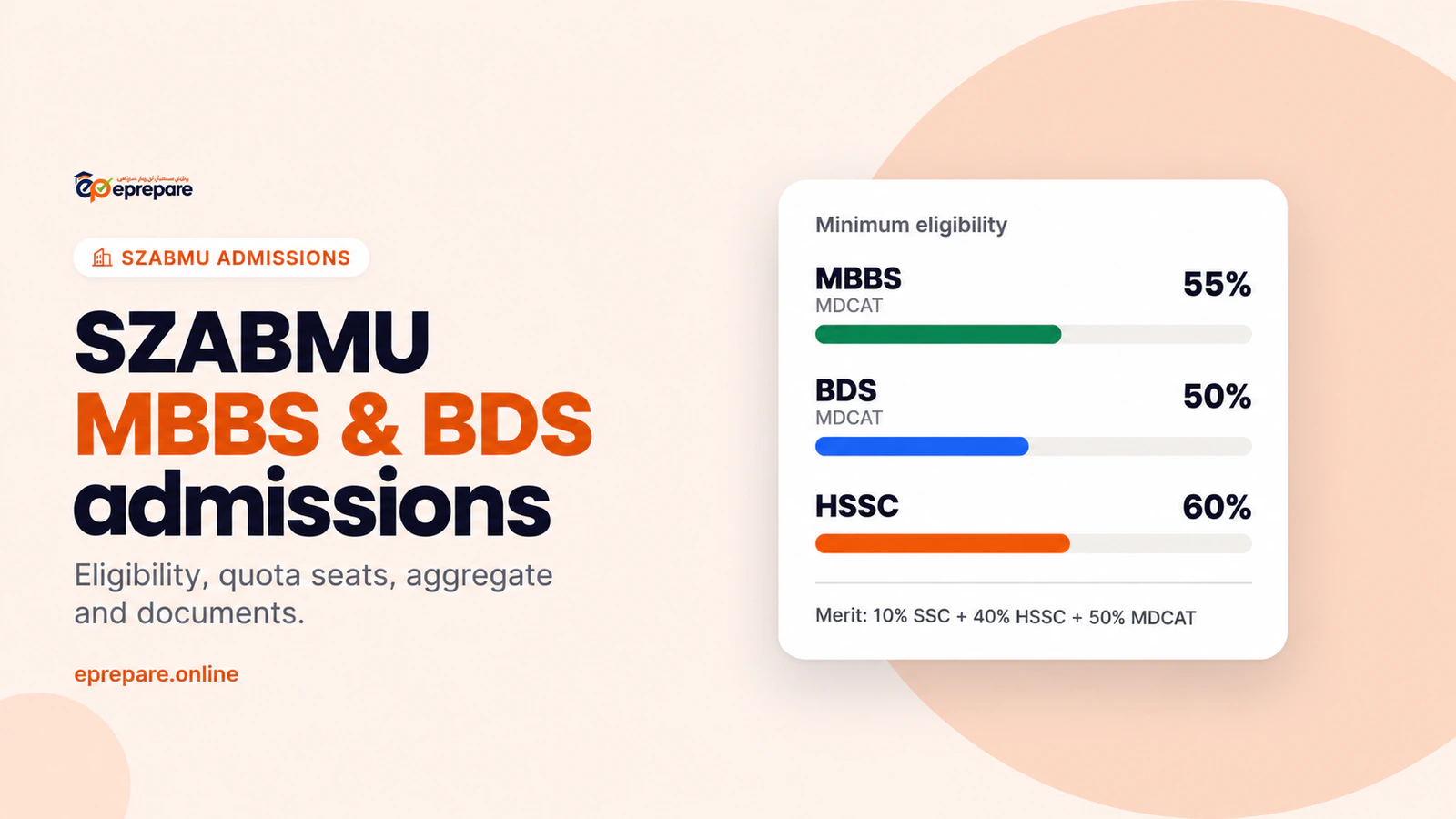
The short answer: the admission-page text referring to MDCAT 2026 requires 55% MDCAT for MBBS, 50% for BDS and at least 60% HSSC or equivalent for both, subject to any higher minimum notified by PM&DC. Merit is 10% SSC + 40% HSSC + 50% MDCAT. The listed allocations are 100 MBBS seats at Federal Medical College, Islamabad, 100 MBBS seats at SKZMDC, Lahore and 50 seats in the separate SZABMU BDS allocation. Programme-specific paid processing-fee challans and the right quota evidence matter.
Source scope: this guide follows the two SZABMU admission-page versions referring to MDCAT 2026 and citing the 2025 admissions regulations. These pages alone do not establish whether applications are currently open. Check the current admission notice for dates, fee amounts, accepted test years and any revised rules.
SZABMU MBBS and BDS admissions at a glance
The MBBS page names two colleges. The separate BDS page provides its own 50-seat table. Keep these allocations separate: a college’s total intake is not the number of open-merit seats available to every applicant.
| Allocation | Programme | Total listed seats | Open merit within that total |
|---|---|---|---|
| Federal Medical College (FMC), Islamabad | MBBS | 100 | 6 |
| Shaikh Khalifa Bin Zayed Al-Nahyan Medical & Dental College (SKZMDC), Lahore | MBBS | 100 | 6 |
| SZABMU’s separate BDS allocation | BDS | 50 | 3 |
There are 250 seats across these three listed allocations: 200 MBBS and 50 BDS. This is a sum of the tables in this guide, not a claim about every college affiliated with SZABMU. For context on Federal Medical College and the School of Dentistry in Islamabad, read our Islamabad federal medical colleges guide.
Eligibility: what is different for MBBS and BDS?
The main difference is the MDCAT pass threshold. HSSC eligibility, the required subjects and the aggregate weighting are shared.
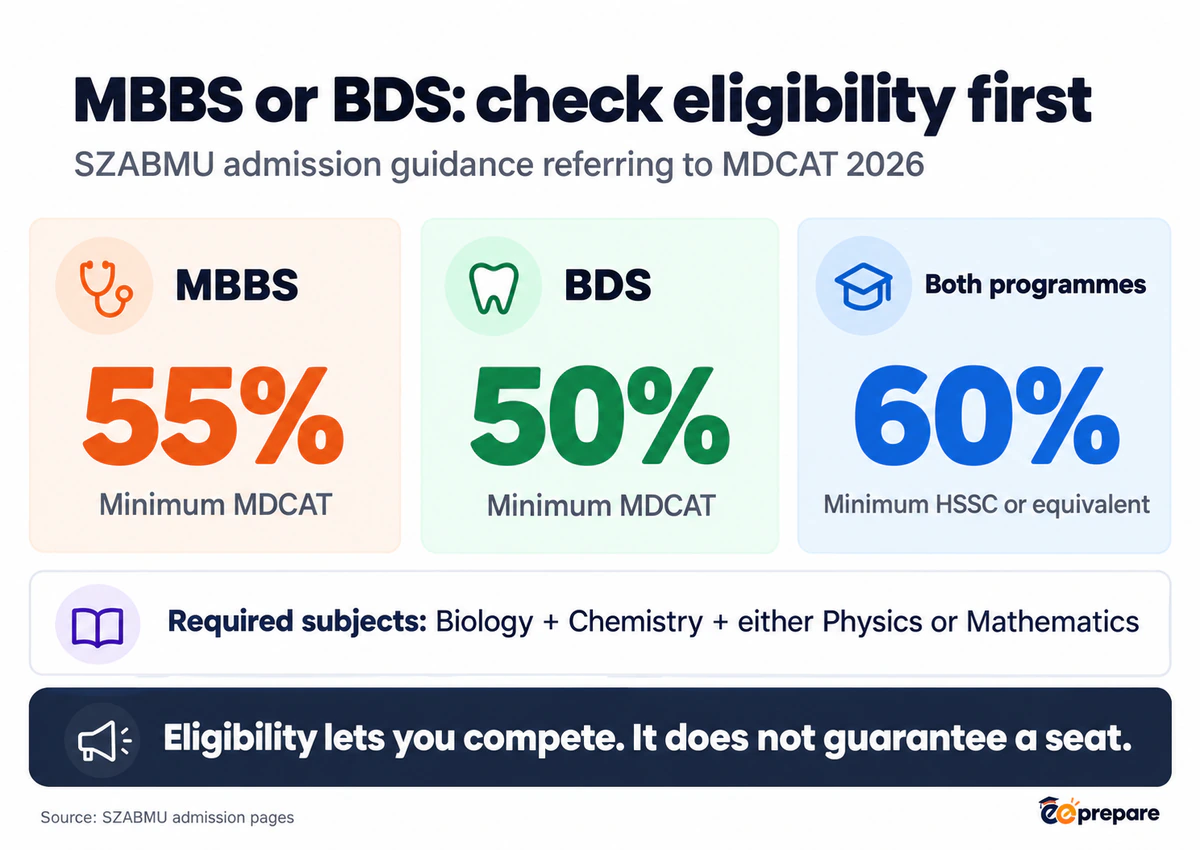
| Requirement | MBBS | BDS |
|---|---|---|
| MDCAT | At least 55% | At least 50% |
| HSSC or equivalent | At least 60%, or a higher minimum notified by PM&DC | At least 60%, or a higher minimum notified by PM&DC |
| Qualification level | A recognised HSSC or equivalent 12th-grade qualification | A recognised HSSC or equivalent 12th-grade qualification |
| Mandatory subjects | Biology and chemistry, plus either physics or mathematics | Biology and chemistry, plus either physics or mathematics |
| MDCAT year mentioned in these page versions | 2026 | 2026 |
Do not confuse the MDCAT minimum with the aggregate. A 55% MDCAT result is the listed MBBS eligibility threshold; it is not a 55% admission aggregate and does not promise a seat. Likewise, the lower BDS threshold does not tell you what the BDS closing merit will be.
If your result is from another year, check the current notice’s accepted-test-year rule before paying. The two page versions used here do not establish which earlier results are accepted. For the wider distinction between the tests, see PM&DC MDCAT versus NUMS MDCAT.
O Levels, A Levels and other foreign qualifications
The document instructions call for IBCC equivalence for O-Level/10th-grade and A-Level/12th-grade qualifications, as applicable. Applicants with foreign qualifications must also upload their original results showing the subjects studied. An equivalence certificate and an original result serve different purposes; prepare both where the instructions require them.
Use the marks and total on the relevant recognised result or equivalence certificate when calculating your percentage. Do not compare raw marks from different grading systems.
How the SZABMU aggregate is calculated
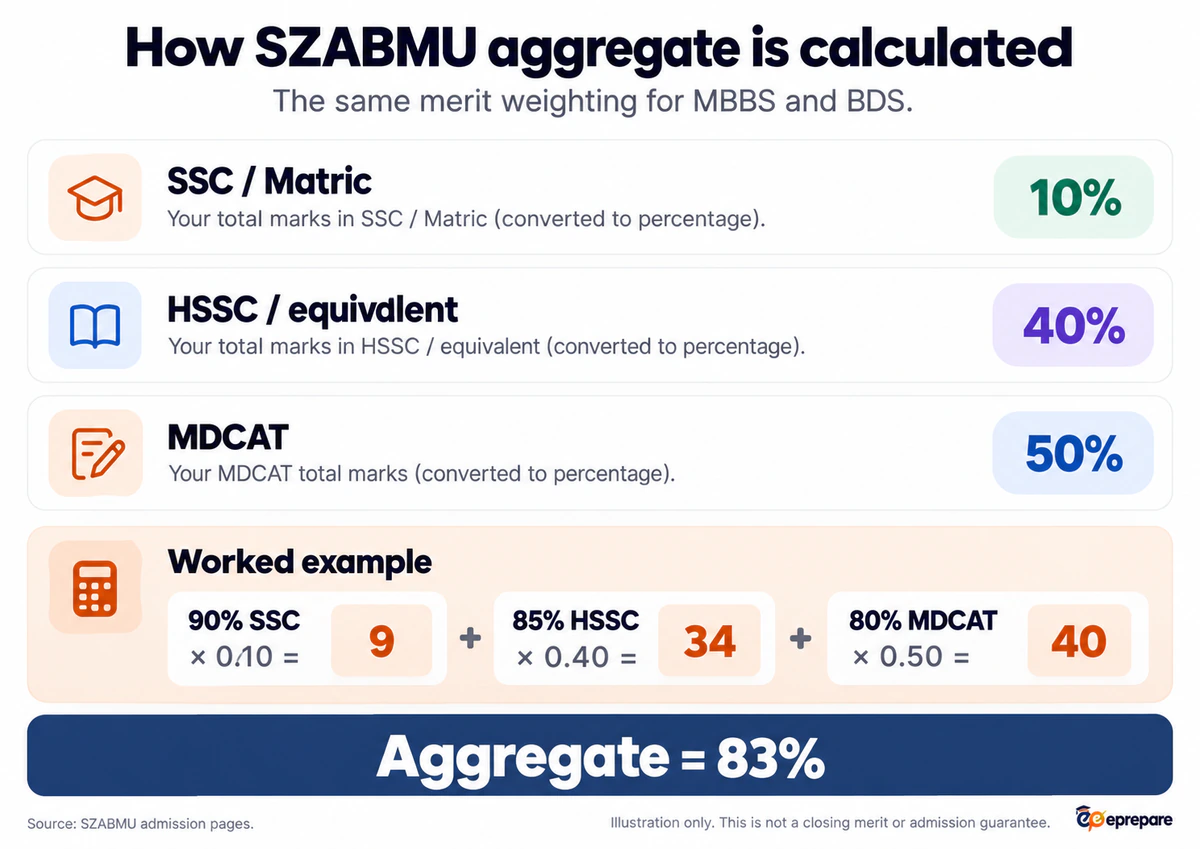
Both pages give the same weighting:
Aggregate = (SSC percentage × 0.10) + (HSSC percentage × 0.40) + (MDCAT percentage × 0.50).
| Result | Weight | Calculation |
|---|---|---|
| SSC / Matric / equivalent | 10% | SSC percentage × 0.10 |
| HSSC / FSc / equivalent | 40% | HSSC percentage × 0.40 |
| MDCAT | 50% | MDCAT percentage × 0.50 |
First convert marks to a percentage: marks obtained ÷ total marks × 100. Then apply the weight. For example, 990 out of 1,100 is 90%; its SSC contribution is 9 aggregate points, not 90.
Worked example: an 83% aggregate
Consider an applicant with 90% SSC, 85% HSSC and 80% MDCAT. These are illustrative results, not actual closing-merit figures.
| Result | Applicant’s percentage | Weighted contribution |
|---|---|---|
| SSC | 90% | 90 × 0.10 = 9 |
| HSSC | 85% | 85 × 0.40 = 34 |
| MDCAT | 80% | 80 × 0.50 = 40 |
| Total aggregate | — | 9 + 34 + 40 = 83% |
Because MDCAT carries half the weighting, a one-percentage-point increase in MDCAT adds 0.5 aggregate points. The same increase in HSSC adds 0.4, and in SSC adds 0.1. Use our Islamabad merit calculator to check the arithmetic against your own results, then compare only with the correct programme and quota.
Open merit, domicile and reserved quotas: who can compete?
The pages state that all Pakistani citizens, including applicants from AJK and Gilgit-Baltistan, can compete for open-merit seats. Applicants are also considered under their respective domicile quotas. Open merit and domicile consideration can therefore apply to the same person; they are not interchangeable labels.
A domicile certificate is only part of the evidence. Applicants applying on domicile must also provide proof of residence, property, education or other tangible evidence of a connection to the region. Upload evidence that supports your actual circumstances.
| Category | Evidence to prepare | Important distinction |
|---|---|---|
| Domicile-based seats | Applicant’s domicile certificate and supporting evidence of residence, property, education or stay | The source asks for supporting evidence in addition to domicile. |
| Federal Government Employee (FGE) | Parent’s employment certificate from the relevant federal government institution or department | Use SZABMU’s prescribed specimen; do not assume any employment letter is sufficient. |
| Disability quota | Certificate from a federal or provincial government disability board describing the disability, plus relevant documents for SZABMU’s Medical Examination Board | A certificate from an individual public or private medical practitioner is not accepted for this purpose. |
| Ex-FATA | Domicile verification from the relevant Deputy Commissioner or Assistant Commissioner | Use the specimen provided by SZABMU. The seat tables retain the label “FATA”. |
| Foreign quota, where offered | Applicable nationality or residence proof, original academic results and IBCC equivalence; the upload checklist also asks for residence and study evidence | Document possession alone does not establish eligibility for a particular foreign seat. |
Federal Medical College, Islamabad: all 100 MBBS seats
SZABMU’s revised FMC allocation lists 6 open-merit seats and 94 seats across the other listed categories. Punjab has 29 and Islamabad Capital Territory has 25. These are separate pools, not 100 places in one national open-merit list.
| Seat category | Seats |
|---|---|
| Open Merit | 6 |
| Islamabad Capital Territory | 25 |
| Punjab | 29 |
| Sindh (R) | 7 |
| Sindh (U) | 5 |
| Khyber Pakhtunkhwa | 7 |
| Balochistan | 4 |
| Gilgit Baltistan | 2 |
| FATA | 2 |
| Azad Jammu and Kashmir | 2 |
| Federal Government Employee | 9 |
| Disabled quota | 2 |
| Total | 100 |
SKZMDC Lahore: all 100 MBBS seats
The Lahore college’s MBBS allocation is also 100, but its distribution is different. It lists 16 ICT seats, 4 Sindh Urban seats and a separate 10-seat foreign category. Do not copy FMC’s quota numbers onto a Lahore application.
| Seat category | Seats |
|---|---|
| Open Merit | 6 |
| ICT | 16 |
| Punjab | 29 |
| Sindh (R) | 7 |
| Sindh (U) | 4 |
| Khyber Pakhtunkhwa | 7 |
| Balochistan | 4 |
| Gilgit Baltistan | 2 |
| FATA | 2 |
| Azad Jammu and Kashmir | 2 |
| Federal Government Employee | 9 |
| Foreign Seats | 10 |
| Disabled quota | 2 |
| Total | 100 |
The ten foreign seats are already included in this 100-seat total. They are not ten additional places above the published intake.
SZABMU BDS: all 50 listed seats
The separate BDS table lists 3 open-merit seats, with 14 each for ICT and Punjab. Its total is 50, not the 100 shown for either MBBS allocation.
| Seat category | Seats |
|---|---|
| Open Merit | 3 |
| Islamabad Capital Territory | 14 |
| Punjab | 14 |
| Sindh (R) | 3 |
| Sindh (U) | 2 |
| Khyber Pakhtunkhwa | 3 |
| Balochistan | 2 |
| Gilgit Baltistan | 1 |
| FATA | 1 |
| Azad Jammu and Kashmir | 1 |
| Federal Government Employee | 5 |
| Disabled quota | 1 |
| Total | 50 |
The BDS table has no separate foreign-seat row. Although the document checklist includes generic foreign-quota instructions, that wording does not establish an additional BDS foreign allocation. Confirm the programme and category in the current official notice before applying on that basis.
Documents required for MBBS and BDS
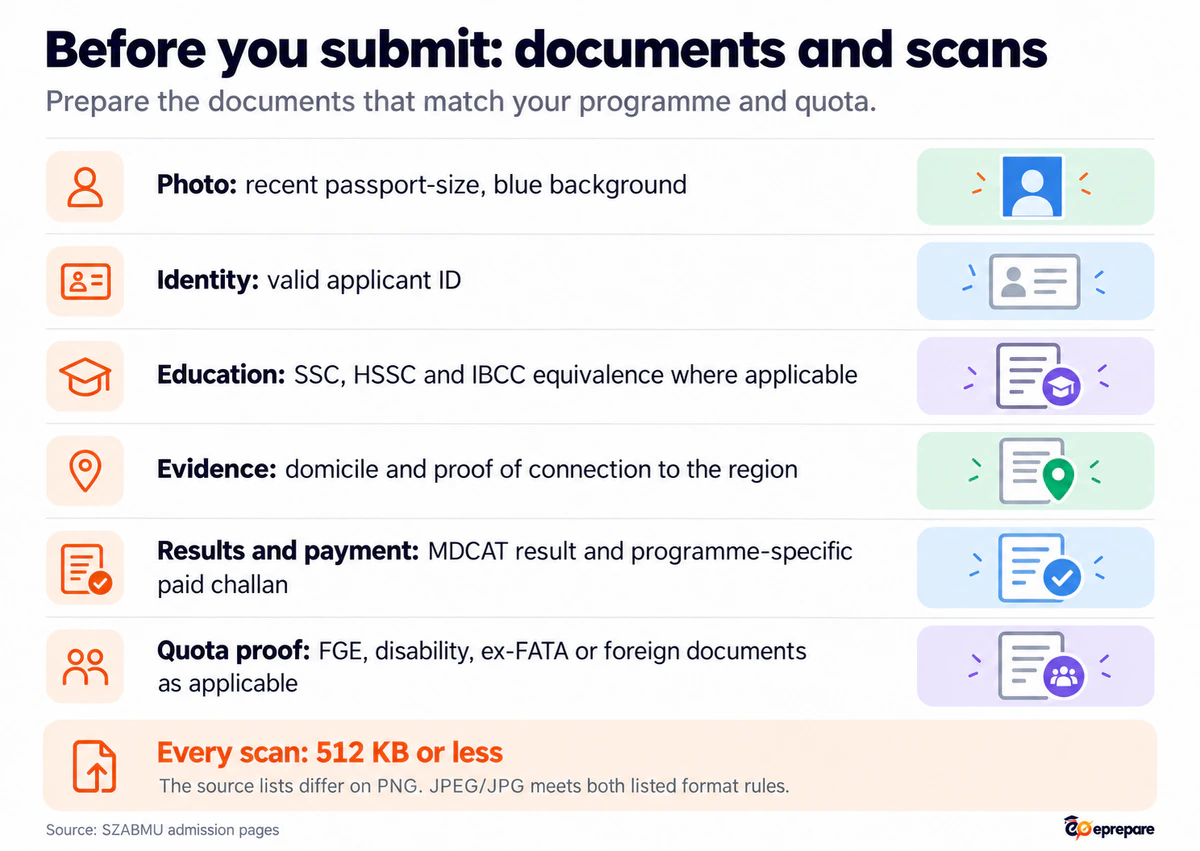
Make a document folder before beginning the application. Include the common documents first, then the evidence required for the quota or qualification you are using.
| Document | What the source specifies |
|---|---|
| Photograph | Recent passport-size colour photograph with a blue background. |
| Applicant identification | Valid CNIC, NICOP or passport in the main checklist; the detailed scan checklist also mentions CRC. Match the current portal’s accepted identification field. |
| SSC / Matric evidence | Relevant certificate or transcript; IBCC equivalence for O-Level/10th-grade qualifications where applicable. |
| HSSC / FSc evidence | Relevant certificate and transcript as requested by the upload fields; IBCC equivalence for A-Level/12th-grade qualifications where applicable. |
| Foreign-system original results | Original results showing the subjects studied, in addition to required equivalence documents. |
| Domicile | Applicant’s domicile certificate. |
| Regional connection | Evidence of residence, property, education or other tangible evidence of stay in the domicile region. |
| MDCAT result | PM&DC MDCAT result certificate. |
| Paid processing-fee challan | Scanned paid challan, separate for MBBS and BDS. |
| Quota-specific evidence | FGE, government-board disability, ex-FATA verification or foreign-category documents, as applicable. |
Additional documents for foreign-quota applicants
The pages describe foreign nationality or an overseas Pakistani permanently resident abroad and list documents such as a valid Iqama, residence permit, permanent-resident card, Green Card, Maple Card or foreign passport, as applicable. They also refer to HSSC/equivalent qualifications and IBCC equivalence, including study completed inside or outside Pakistan.
The detailed upload instructions additionally ask foreign applicants for original results showing subjects, proof of residence and proof of study from the last institution, such as a school-leaving certificate. Prepare the documents relevant to your case, but confirm eligibility against the actual foreign-seat category being offered. A residence document by itself is not a guarantee of admission or of eligibility for every overseas category.
Scan format and file size: the 512 KB rule
Both page versions contain two format instructions: one says JPEG/JPG only; another permits JPEG, JPG or PNG. Both give the same size limit: no more than 512 KB per document.
A practical way to meet both listed instructions: prepare a clear JPEG/JPG scan at 512 KB or less. If you want to use PNG, check that the relevant live upload field accepts it. The current portal’s validation and official instructions govern the submission.
- Scan the original document clearly, with its edges and required information visible.
- Check names, dates, marks, signatures and stamps after reducing file size.
- Convert the file properly; simply renaming a PDF to “.jpg” does not turn it into a valid image.
- Upload the correct document into the correct field, and review the displayed file before submitting.
SZABMU states that applicants are responsible for correct uploads and that incorrect documents can lead to rejection without notice. A readable file in the wrong field is still a problem.
How to prepare your SZABMU application
- Start with the current official notice. Go through SZABMU’s official website to the admission notice and application link for your intended session. Check which programmes and categories are open.
- Confirm eligibility for each programme. Check HSSC marks, subjects, MDCAT percentage and the test years accepted by that notice.
- Calculate your aggregate. Use percentages and the 10/40/50 formula; compare MBBS and BDS separately.
- Choose only categories you can document. Prepare domicile evidence and the prescribed certificates for FGE, disability or ex-FATA categories where relevant.
- Check payment instructions before paying. The pages require separate paid processing-fee challans for MBBS and BDS. Use the current notice to confirm the amount and payment method.
- Prepare and inspect your scans. Meet the 512 KB limit and confirm the accepted format in each field.
- Review the complete application. Check programme choices, category, identity details, marks, payment and uploaded evidence before final submission.
- Retain your records. Keep the submitted application acknowledgement and payment evidence, then follow official notices for the next steps.
The preparation sequence above is a practical checklist, not a claim about the current portal’s exact screen order or whether submitted applications can be edited.
Admission dates, fees and closing merit: what still needs checking?
The eligibility and seat-allocation pages are useful, but they do not answer every time-sensitive question. Check the current official notice and the correct programme’s merit lists for the following:
| Question | What to verify |
|---|---|
| Are applications open, and what is the last date? | The current session’s opening and closing dates, including any extension. |
| How much is the application fee? | Current programme-specific processing-fee amounts and payment instructions. |
| What are the tuition and other college charges? | The relevant college’s current fee schedule; an application challan is not the annual tuition. |
| Which older MDCAT results are accepted? | The current notice’s accepted test years and any related conditions. |
| What is the closing merit? | The correct session, college, programme and seat category; minimum eligibility is not closing merit. |
| Does a revised rule replace the page wording? | Any newer official notice or applicable PM&DC regulation. |
For wider context, our Islamabad federal admissions guide discusses the Islamabad colleges. Check the dates and source session on any historical merit figure before using it to judge your own chances.
Common application mistakes to avoid
- Treating a minimum as a selection score: passing MDCAT establishes eligibility, not a reserved place.
- Using one seat table for both programmes: the BDS allocation is 50, with its own distribution.
- Confusing the two MBBS allocations: FMC has 25 ICT seats; SKZMDC has 16. Their Sindh Urban and foreign rows also differ.
- Claiming a quota without the prescribed evidence: domicile, FGE, disability and ex-FATA requirements are specific.
- Assuming a regular doctor’s certificate satisfies the disability quota: the source requires the relevant government disability board.
- Reusing one challan for two programmes: the instructions specify separate MBBS and BDS paid processing-fee challans.
- Assuming the website year proves applications are open: check the actual admission notice and deadline.
Frequently asked questions
What MDCAT percentage is required for SZABMU MBBS and BDS?
The admission-page versions referring to MDCAT 2026 state at least 55% for MBBS and 50% for BDS. Check the current admission notice for any revised requirements and accepted test years.
What HSSC marks and subjects do I need?
The pages state at least 60% HSSC or equivalent, or a higher minimum notified by PM&DC. They require biology and chemistry, plus either physics or mathematics in the recognised HSSC/equivalent qualification.
Can students from outside Islamabad apply?
Yes. The pages state that Pakistani citizens, including AJK and Gilgit-Baltistan applicants, can compete for open merit and are also considered under their respective domicile quotas. The seat tables include several provincial and regional categories.
Are all 100 FMC MBBS seats open merit?
No. The listed FMC total is 100, but only six are in the open-merit row. The remaining 94 are distributed among the other listed categories.
Is the aggregate formula the same for MBBS and BDS?
Yes. Both pages give 10% SSC, 40% HSSC and 50% MDCAT. The minimum MDCAT percentages and seat distributions differ.
Do MBBS and BDS require separate paid challans?
Yes. Both document checklists explicitly state separate application processing paid-fee challans for MBBS and BDS. They do not give the amounts; check the current payment instructions.
Can I upload PNG documents?
The source contains both a JPEG/JPG-only instruction and another allowing JPEG/JPG/PNG. JPEG/JPG is common to both. Keep each document at 512 KB or less and check whether the relevant live field accepts PNG.
Does the ten-seat foreign quota also apply to BDS?
The ten-seat foreign row appears in the SKZMDC Lahore MBBS allocation. The 50-seat BDS table has no separate foreign row. Do not transfer a quota between programmes without an official allocation.
Which disability certificate does SZABMU require?
A certificate from a federal or provincial government disability board describing the disability, with relevant documents for SZABMU’s Medical Examination Board. The page says a certificate issued by an individual public or private medical practitioner is not accepted for this purpose.
What are the last date and closing merit?
The two admission-page versions used here do not establish a current deadline or closing merit. Check SZABMU’s current admission notice and the relevant college, programme, session and quota merit lists.
Before you apply
Check eligibility first, calculate your aggregate, identify the seat categories you can support with documents, and verify the latest notice before paying. For MDCAT preparation, use our MDCAT syllabus guide to plan coverage and the Islamabad merit calculator to check your weighted score. For the application itself, follow SZABMU’s official instructions.
Sources and scope
- SZABMU: MBBS admission guidance — supplied page version; eligibility, aggregate formula, documents and revised FMC/SKZMDC allocations.
- SZABMU: BDS admission guidance — supplied page version; BDS eligibility, documents and 50-seat allocation.
- PM&DC admissions regulations 2025 — the regulation linked by those pages; this guide does not claim it is the latest applicable version.
- SZABMU official website — check the current admission notice, application link, revised rules and programme-specific updates before submission.
The numerical allocations above reproduce the supplied page versions and each table adds up to its stated total. The example aggregate and the 250-seat combined total are calculations by ePrepare, not additional university allocations. This is an independent explanatory guide, not an official admission notice or a promise of admission.