

Every year KMU admits students to Khyber Pakhtunkhwa’s public medical and dental colleges in several rounds, and many students join one college while hoping to reach a better one. Two words get mixed up at this stage: shifting and migration. They are completely different processes, with different timing and different rules. Mixing them up leads to bad decisions, such as refusing a seat or trying to swap seats with a friend. This guide explains both, from KMU’s admission policy for public sector medical and dental colleges.
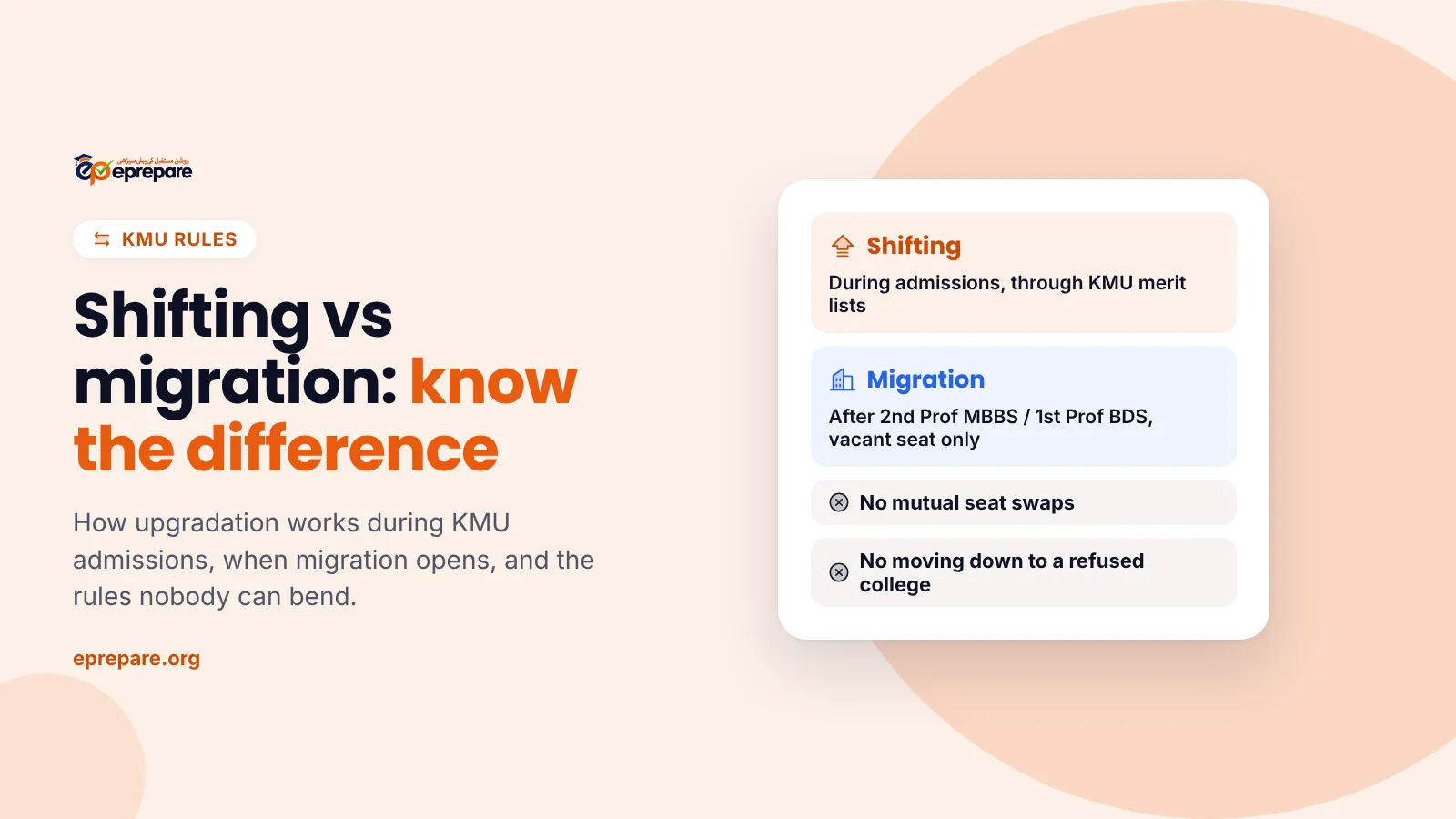
The short answer: Shifting (upgradation) happens during admissions, through KMU’s later merit lists: if a seat opens in a college you ranked higher and your merit reaches it, you move up. Migration happens years later, only after passing the 2nd Professional MBBS (or 1st Professional BDS), and only into a vacant seat in the same category. Neither allows mutual exchange of seats, and you cannot shift down to a college you already refused.
Source: Khyber Medical University (KMU) Admission Policy for public sector medical and dental colleges of Khyber Pakhtunkhwa, the policy KMU links for current admissions. Dates for each merit list are announced by KMU; check its notices for the current round.
Shifting vs migration at a glance
| Shifting (upgradation) | Migration | |
|---|---|---|
| When | During the admission rounds of first year | Only after passing 2nd Professional MBBS or 1st Professional BDS |
| How | Automatically through KMU’s next merit list, on merit and choice | Application with KMU’s proforma to the Chairman KMU Admission Committee |
| Needs a vacant seat | Yes, in a college you ranked higher | Yes, in the same class, college strength and seat category |
| Decided by | Your aggregate and order of choice | Merit among applicants on your last examination result |
| Mutual swap | Not possible | Not allowed |
| Moving down | Not allowed to a college you already refused | Only where a vacant seat exists |
| Fee | Fee already paid is transferred to the new college without deduction | Rs 50,000 migration fee within KP public colleges (other fees for other cases) |
What is shifting (upgradation)?
KMU completes admissions to public sector colleges by displaying at least three consecutive merit lists. When a selected student does not deposit the fee in time, or a seat falls vacant for any other reason, that seat is filled in the next list. KMU’s policy says vacant seats are filled on a merit-cum-choice basis through upgradation of admitted students and by candidates from the waiting list.
In practice, “shifting” means this: you have joined a college, a seat opens in a college you placed higher in your choices, and your aggregate is high enough for it. KMU moves you up in the next list. The fee you deposited in your previous college is transferred to the new college without any deduction.
Rule 1: no mutual shifting
Seats are allotted only by KMU, on merit and choice. There is no provision for two students to exchange seats between themselves, even if both agree. Any “deal” to swap seats has no standing under the policy.
Rule 2: no shifting down to a college you refused
The policy says down-gradation to an institute that was already refused is not allowed, and candidates on the waiting list are not offered admission in an institution they already refused. If you chose a higher college, you cannot later ask to move to a lower one through the shifting process.
Rule 3: keep attending classes while shifting runs
Later merit lists can come after classes have started, so shifting runs alongside teaching. Keep attending your current college until you are actually moved. The policy is strict about absence: a first-year student who is continuously absent for four weeks from the start of the session without a valid reason is struck off the roll. If your merit reaches a college you prefer, go through the shifting process; it is part of the normal admission rounds.
Rule 4: the fee deadline still applies
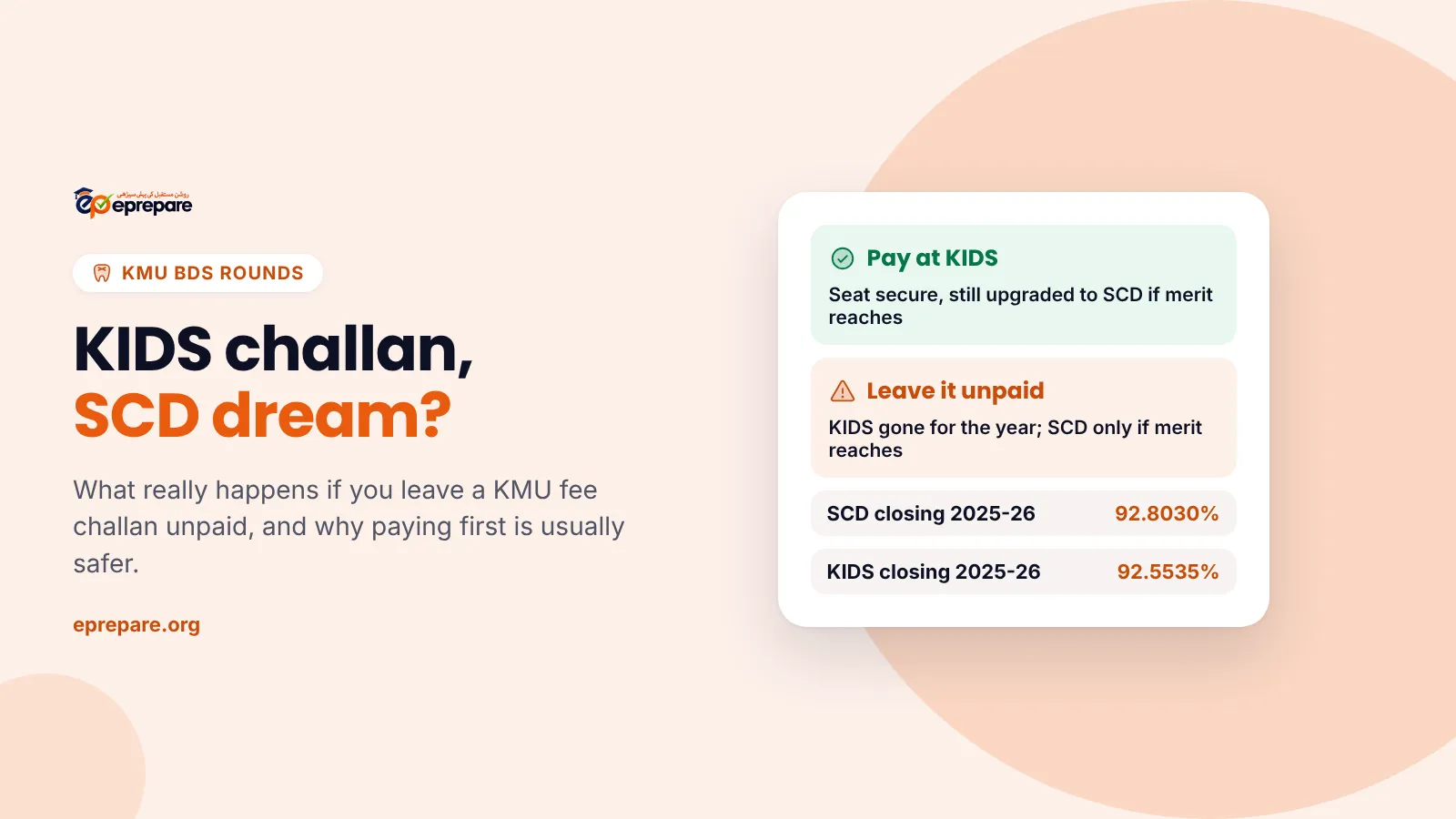
A candidate who does not deposit the admission fee within three working days of the admission offer letter loses that admission. Do not skip the fee at your current college in the hope of shifting later; keep your seat secure first.
What is migration?
Migration is a transfer from one medical or dental college to another after the first years of study. KMU’s migration policy for MBBS and BDS students of Khyber Pakhtunkhwa sets these rules:
- Timing: migration is allowed only after passing the 2nd Professional MBBS or the 1st Professional BDS examination. Colleges report vacancies in the 3rd, 4th and final year of MBBS and the 2nd, 3rd and final year of BDS.
- Vacant seat only: a seat must be vacant in the corresponding class, in the college’s total approved strength and in your seat category.
- Same category: migration is category-wise. A student admitted on open merit can migrate only to a vacant open merit seat, and the same applies to self-finance and reserved seats.
- Merit decides: among applicants for a seat, migration goes by merit on the last examination result.
- No mutual migration and no migration from a private college to a public college.
- Process: fill KMU’s proforma and submit it with your application and processing fee to the Chairman of the KMU Admission Committee, which recommends migration to the Provincial Admission Committee. No other forum entertains such requests.
- Fee: Rs 50,000 for migration between public sector colleges within Khyber Pakhtunkhwa and Rs 100,000 for students coming from other provinces (higher amounts apply to private colleges).
- Across provinces: a student migrating to or from another province needs NOCs from both the college and the university; the Registrar KMU issues the NOC for students leaving KP colleges.
For the full rules, read our detailed KMU migration policy guide.
Which one applies to you?
- You are in first year and KMU’s merit lists are still coming: that is shifting. Keep your fee paid, keep attending, and check every list. See our guide to KMU merit lists, upgrades and the waiting list.
- Admissions are closed and you want a different college: you will have to wait for migration after the 2nd Professional MBBS (1st Professional BDS), and even then only if a seat in your category is vacant.
- Someone offers to swap seats with you: neither process allows it. Ignore such offers.
Frequently asked questions
What is the difference between shifting and migration in KMU?
Shifting is upgradation during the first-year admission rounds through KMU’s merit lists, based on merit and your order of choice. Migration is a transfer to another college after passing the 2nd Professional MBBS or 1st Professional BDS, only into a vacant seat in the same category.
Is mutual shifting or seat exchange allowed?
No. KMU allots seats only on merit and choice, and its migration policy states that mutual migration is not allowed.
Can I shift from a higher college to a lower college?
No. KMU’s policy does not allow down-gradation to an institute you already refused.
Should I attend classes while waiting for shifting?
Yes. Shifting can run after classes begin, and four weeks of continuous absence from the start of the session without a valid reason gets a first-year student struck off the roll.
What happens to my fee if I am shifted to another college?
The fee you deposited at your previous college is transferred to the new college without any deduction.
When can I apply for migration?
Only after passing the 2nd Professional MBBS or the 1st Professional BDS examination, and only when a seat in your category is vacant in the college you want.
How much is the KMU migration fee?
Rs 50,000 for migration between public sector colleges within Khyber Pakhtunkhwa and Rs 100,000 for students migrating from other provinces, deposited in KMU’s account. Private colleges have higher fees.
Can I migrate from a private college to a public college?
No. KMU’s migration policy does not allow migration from a private sector college to a public sector college.
Sources
- KMU Admission Policy, public sector medical and dental colleges of Khyber Pakhtunkhwa: merit lists, upgradation, fee deadline, attendance and the migration policy.
- KMU Centralized Admission System: merit lists and current notices.
Read next: documents to carry when joining a KMU college, KMU rules after admission and the KMU closing merit for every college.
This is an independent guide by ePrepare, not an official KMU notice. Always follow KMU’s notices for the dates and instructions of each merit list.