"What is your aggregate?" is one of the first questions every admission form asks, and it confuses a lot of students. Many think it is just another word for percentage. It is not. A percentage describes one exam. An aggregate combines several results into one number, usually with a different weight for each.
This guide explains what an aggregate is, how it differs from a percentage, and how to calculate it from your Matric and FSc marks for any admission, whether your marks are out of 1100 or 1200.
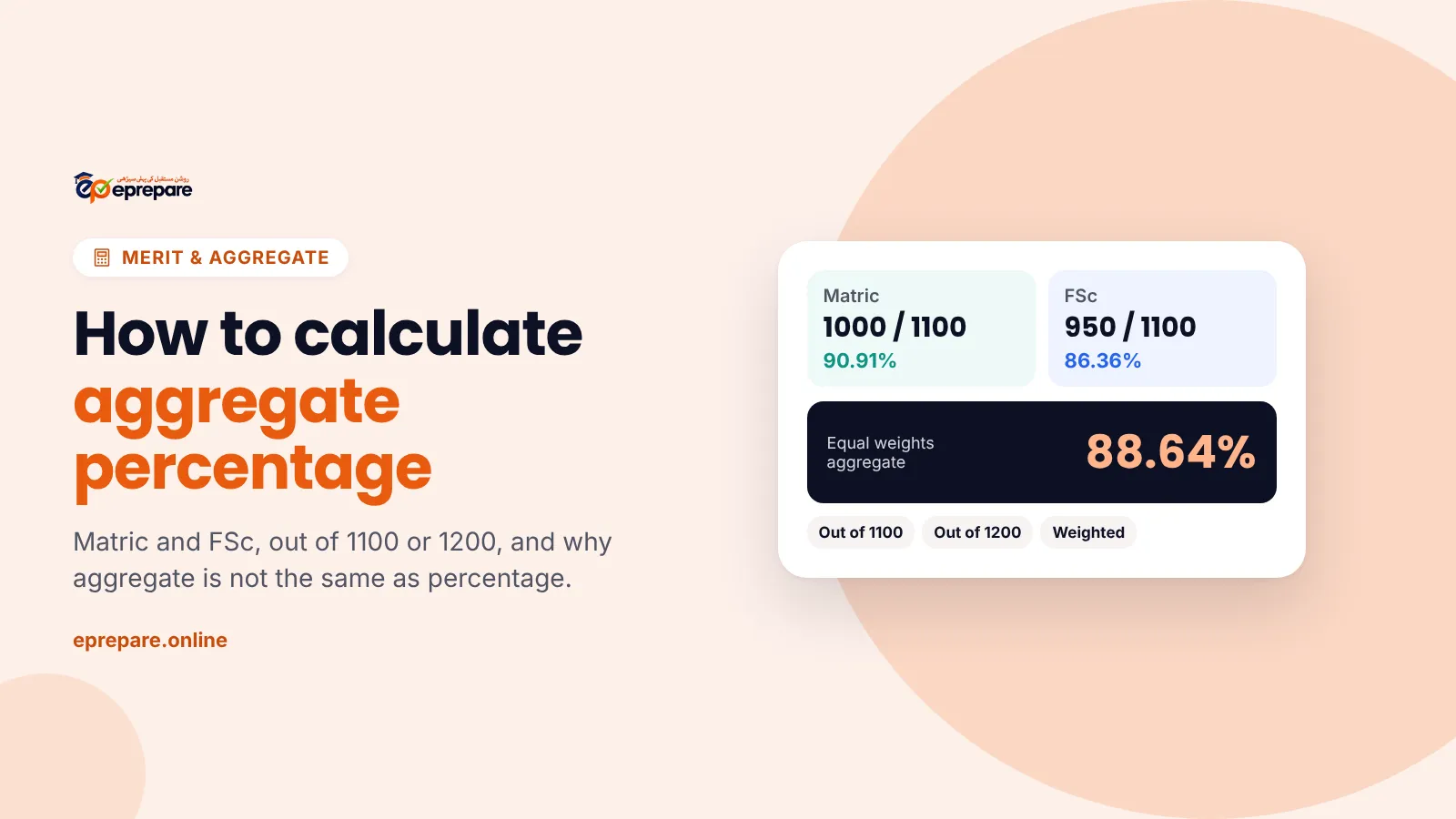
The short answer: Percentage = marks ÷ total × 100, for one exam. Aggregate = each result's percentage × its weight, added together. For example, Matric 1000/1100 is 90.91% and FSc 950/1100 is 86.36%. With equal weight on both, the aggregate is 88.64%. With the weights an admission notice sets, it can be quite different, so always use the weights in the notice.
What is an aggregate?
An aggregate is a single score that an institution builds from several of your results so it can rank every applicant on one list. Each result is first turned into a percentage of its own total, then multiplied by the weight the institution has chosen, and the parts are added. Because the weights add up to 100%, the aggregate is itself a percentage.
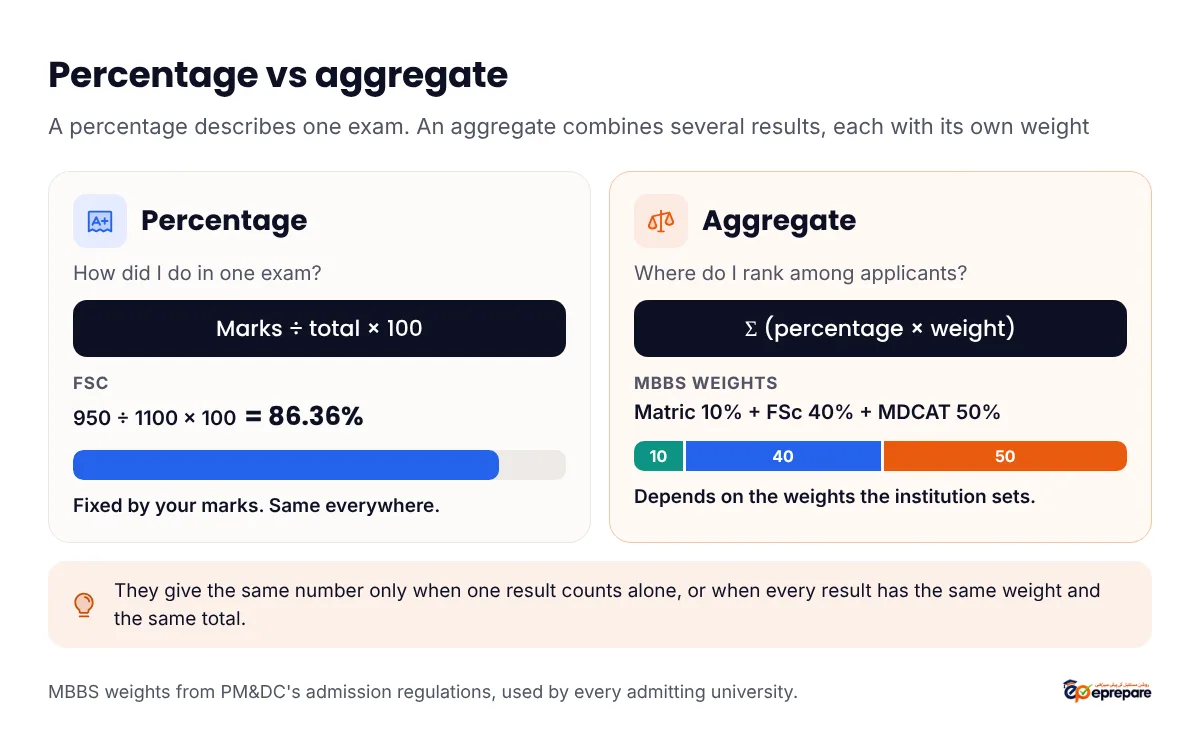
The weights are the institution's choice and are printed in its admission notice or prospectus. For MBBS and BDS, for example, every admitting university in Pakistan uses Matric 10%, FSc 40% and the MDCAT 50%. Other programmes use their own weights, and some include an entry test or interview.
Aggregate vs percentage: are they the same?
No. They answer different questions:
| Percentage | Aggregate | |
|---|---|---|
| Describes | One exam | Several results combined |
| Formula | Marks ÷ total × 100 | Sum of (percentage × weight) |
| Who decides it | Fixed by your marks | Depends on the weights the institution sets |
| Example | FSc 950/1100 = 86.36% | MBBS: 10% Matric + 40% FSc + 50% MDCAT |
They come out the same only in special cases: when one result counts alone, or when every result has the same weight and the same total.
How to calculate your Matric or FSc percentage
Start here, because every aggregate is built from percentages:
Percentage = marks obtained ÷ total marks × 100
- Matric 1000 out of 1100: 1000 ÷ 1100 × 100 = 90.91%
- FSc 950 out of 1100: 950 ÷ 1100 × 100 = 86.36%
- Matric 1100 out of 1200: 1100 ÷ 1200 × 100 = 91.67%
Keep two or more decimals while you work. Admission lists are often ranked to four or five decimals, and rounding early can change your position.
How to calculate aggregate for any admission
The method is the same for every admission. Only the weights change.
- Find the weights in the admission notice or prospectus, for example "Matric 10%, FSc 40%, test 50%". Check that they add up to 100.
- Turn each result into a percentage of its own total.
- Multiply each percentage by its weight written as a decimal (10% = 0.10, 40% = 0.40).
- Add the parts. The total is your aggregate percentage.
Aggregate % = (Matric % × Matric weight) + (FSc % × FSc weight) + (test % × test weight, if there is a test)
If the notice asks only for "percentage of total marks" without weights, add your marks and add the totals, then divide: (Matric marks + FSc marks) ÷ (Matric total + FSc total) × 100. When in doubt, follow the wording of the notice exactly.
Three ways to combine the same marks
Here is why the method matters. Sara has Matric 1100/1200 (91.67%) and FSc 950/1100 (86.36%). The three common ways of combining them give three different answers:
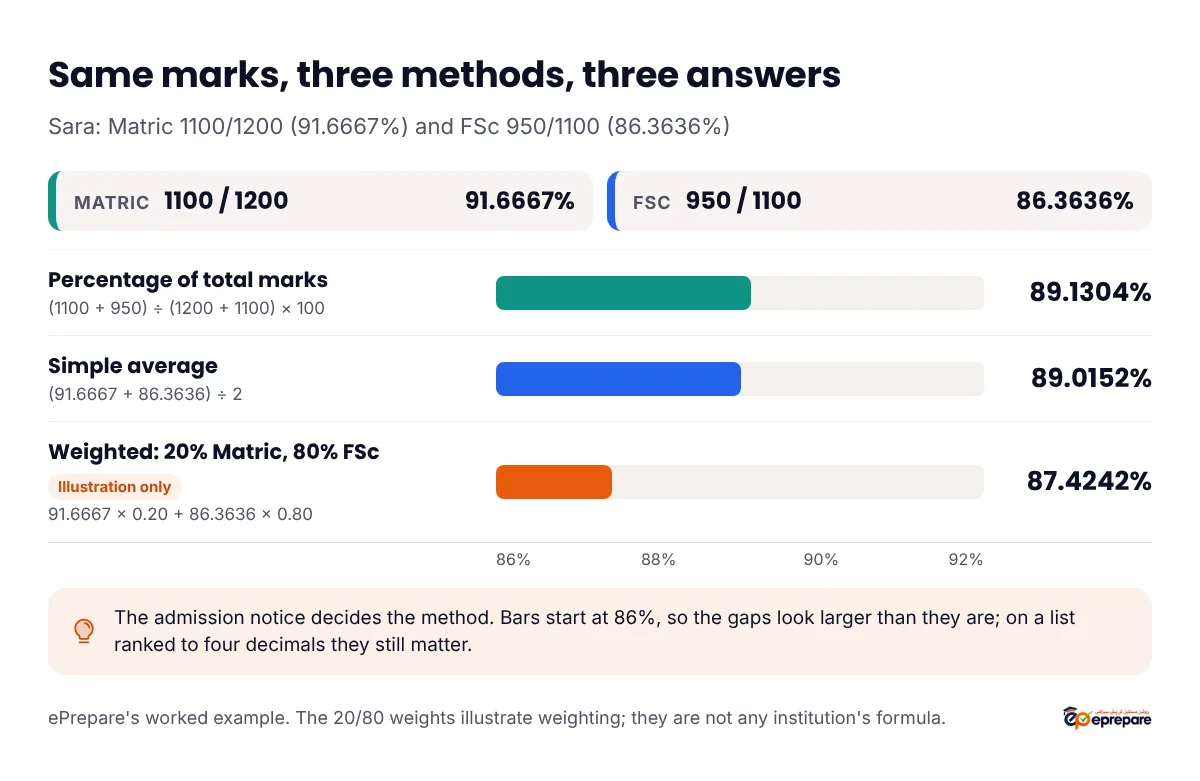
| Method | Working | Result |
|---|---|---|
| Percentage of total marks | (1100 + 950) ÷ (1200 + 1100) × 100 | 89.1304% |
| Simple average (equal weights) | (91.6667 + 86.3636) ÷ 2 | 89.0152% |
| Weighted, 20% Matric and 80% FSc (illustration only) | 91.6667 × 0.20 + 86.3636 × 0.80 | 87.4242% |
The 20/80 weights in the last row are only an illustration of how weighting works, not any institution's formula. Because FSc carries more weight there, Sara's weaker FSc pulls her aggregate down. That is the main thing weights do: they decide which of your results matters most.
Watch out: the first two methods agree only when both totals are the same. With one result out of 1200 and the other out of 1100, adding marks quietly gives the 1200 exam more weight.
Marks out of 1100 and 1200
Pakistani boards have used both totals for Matric and FSc, depending on the board, the year and the scheme of studies. You do not need to know why yours is one or the other. You only need to use the total printed on your own result card.
The same marks mean a different percentage on each total. 1000 marks is 90.91% out of 1100 but only 83.33% out of 1200. So never compare raw marks between two students with different totals: compare percentages.
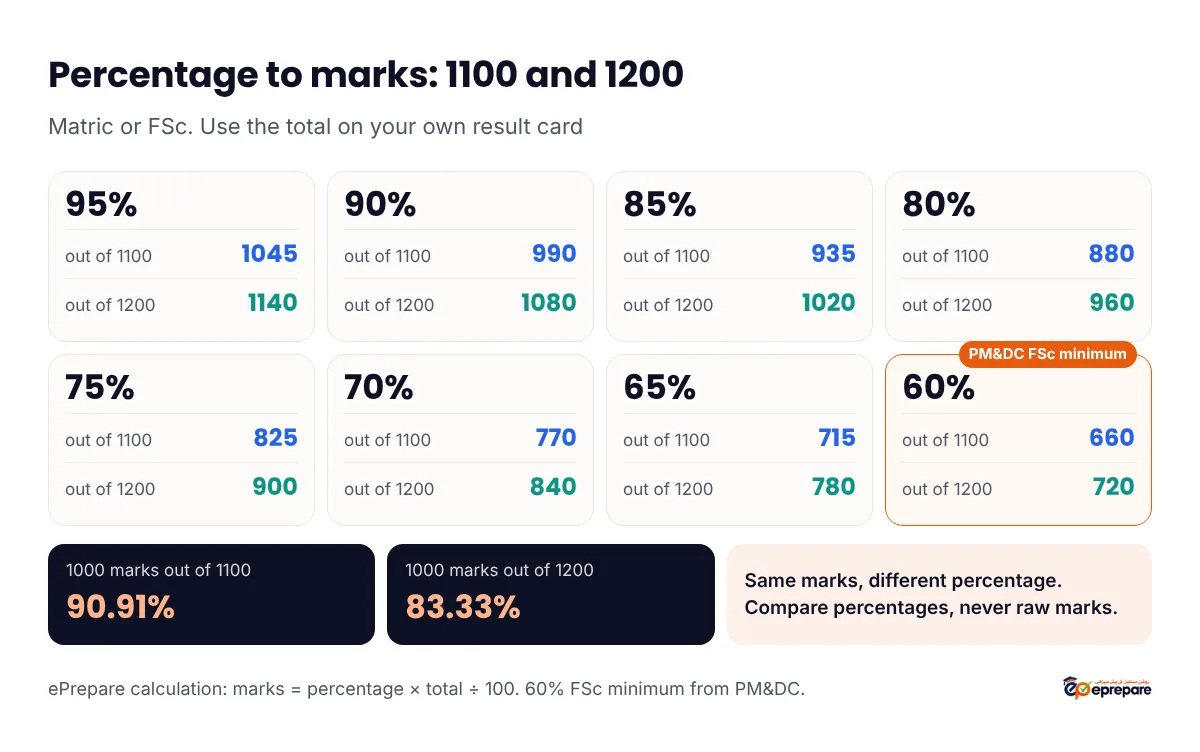
Conversion table: percentage to marks
| Percentage | Marks out of 1100 | Marks out of 1200 |
|---|---|---|
| 95% | 1045 | 1140 |
| 90% | 990 | 1080 |
| 85% | 935 | 1020 |
| 80% | 880 | 960 |
| 75% | 825 | 900 |
| 70% | 770 | 840 |
| 65% | 715 | 780 |
| 60% | 660 | 720 |
| 50% | 550 | 600 |
Conversion table: marks to percentage
| Marks | Out of 1100 | Out of 1200 |
|---|---|---|
| 1050 | 95.45% | 87.50% |
| 1000 | 90.91% | 83.33% |
| 950 | 86.36% | 79.17% |
| 900 | 81.82% | 75.00% |
| 850 | 77.27% | 70.83% |
| 800 | 72.73% | 66.67% |
| 750 | 68.18% | 62.50% |
| 700 | 63.64% | 58.33% |
To convert marks from one total to the other, keep the percentage the same: marks out of 1200 = marks out of 1100 ÷ 1100 × 1200. So 1000 out of 1100 is the same percentage as about 1090.9 out of 1200. This is only for comparing; on any form, enter your real marks and the real total.
Worked examples
Example 1: both results out of 1100
Ali has Matric 1000/1100 and FSc 950/1100.
- Matric: 1000 ÷ 1100 × 100 = 90.9091%
- FSc: 950 ÷ 1100 × 100 = 86.3636%
- Percentage of total marks: 1950 ÷ 2200 × 100 = 88.6364%, which here equals the simple average, because both totals are 1100.
Example 2: different totals
Sara has Matric 1100/1200 and FSc 950/1100. As the table above shows, the percentage of total marks is 89.1304%, while the simple average is 89.0152%. The gap is small here, but on a merit list ranked to four decimals it is a big difference. Use whichever method the notice specifies.
Example 3: with an entry test (MBBS)
Sara also scores 160/180 in the MDCAT. For MBBS, every admitting university uses Matric 10%, FSc 40% and MDCAT 50%. A quick way is to divide each result by its total and multiply by its weight as a whole number:
- Matric: 1100 ÷ 1200 × 10 = 9.166667
- FSc: 950 ÷ 1100 × 40 = 34.545455
- MDCAT: 160 ÷ 180 × 50 = 44.444444
- Aggregate = 88.156566, rounded to five decimals = 88.15657%
Notice that her aggregate is lower than her Matric percentage. Her strongest result, Matric, only carries 10%.
For MBBS specifically
For medical and dental admissions you do not need to guess the weights. KMU, UHS, the Sindh universities, Balochistan, SZABMU and NUMS all use 10% Matric, 40% FSc and 50% for the entry test. What differs is the test (NUMS gives a percentage result), the decimals and the tie-break rules.
Our complete guide, how to calculate MDCAT aggregate for every university, works through an example for each one and shows how to work backwards to the MDCAT score you need. To skip the arithmetic, put your marks into the free aggregate calculator.
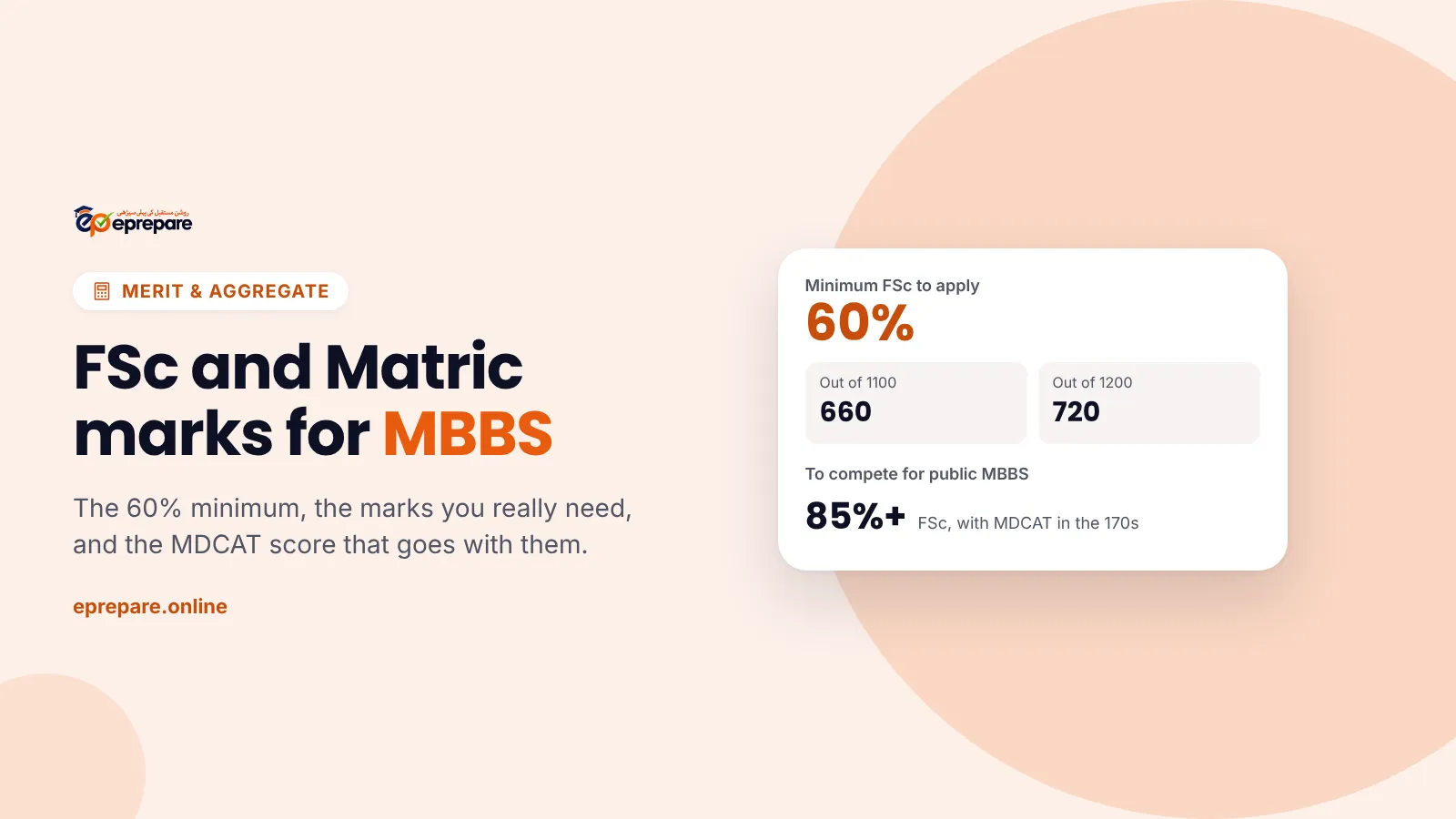
One more MBBS number worth knowing: PM&DC requires at least 60% in FSc (HSSC pre-medical or equivalent) to apply, which is 660 out of 1100 or 720 out of 1200. Some admitting universities have asked for more, so check the current prospectus.
Entry tests and other admissions
Engineering, university and other entry tests each set their own weights for Matric, FSc and the test. Our guide to entry test aggregate formulas for ETEA, NUST and HEC covers the formulas we could confirm from official sources. For anything else, read the weights in that institution's own admission notice and apply the four steps above.
If you studied O and A levels, use the marks and totals on your IBCC equivalence certificates, not your grades. Our guide to IBCC equivalence explains how it works for medical admissions.
Frequently asked questions
What is aggregate?
An aggregate is one score built from several results, such as Matric, FSc and an entry test. Each result becomes a percentage, is multiplied by the weight the institution sets, and the parts are added.
Is aggregate and percentage the same?
No. A percentage describes one exam (marks ÷ total × 100). An aggregate combines several percentages with weights. They match only when one result counts alone, or when all results have equal weights and equal totals.
How do I calculate the aggregate of Matric and FSc?
Turn each into a percentage, multiply by the weights in the admission notice and add. If the notice gives no weights and asks for the percentage of total marks, divide the sum of your marks by the sum of the totals: Matric 1000/1100 and FSc 950/1100 give 1950 ÷ 2200 × 100 = 88.64%.
How do I find my aggregate percentage from marks?
Use marks ÷ total × 100 for each result first, then apply the weights. For MBBS: 10% of your Matric percentage + 40% of your FSc percentage + 50% of your MDCAT percentage.
Is Matric out of 1100 or 1200?
Boards have used both. Use the total printed on your own result card, because the same marks give a different percentage on each total.
What is 60% of 1100 and of 1200?
660 out of 1100 and 720 out of 1200. That is PM&DC's minimum FSc percentage to apply for MBBS or BDS.
How do I calculate aggregate for MBBS?
Matric 10%, FSc 40% and MDCAT 50%, as every admitting university in Pakistan uses. Our MDCAT aggregate guide has a worked example for each university.
Know your number, then improve it
Once your Matric and FSc results are out, the only part of an MBBS aggregate you can still change is the MDCAT, and it carries half the weight. If you are preparing, ePrepare's question bank and full-length papers show your predicted score as you go. Create your free ePrepare account and see how far your marks can take you.
Sources: MBBS and BDS weighting and minimums from KMU's admission policy, UHS prospectus, NUMS admissions advert and PM&DC's clarification on FSc and MDCAT minimums. Percentages and conversions are ePrepare's own calculations.