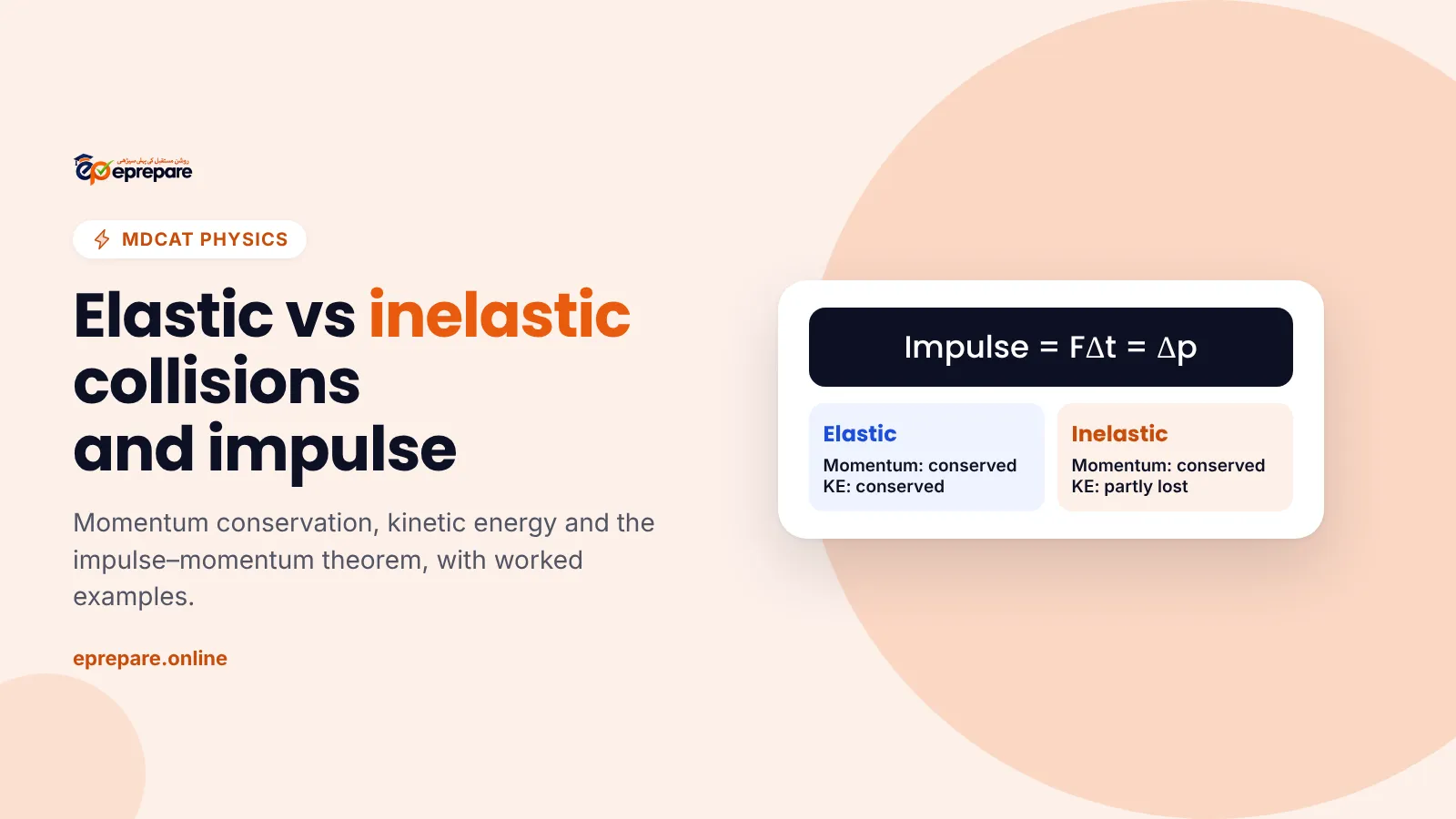
The short answer: The impulse–momentum theorem says impulse equals change in momentum: FΔt = mv − mu. In an elastic collision both momentum and kinetic energy are conserved. In an inelastic collision momentum is conserved but some kinetic energy turns into heat, sound or deformation; if the bodies stick together, it is perfectly inelastic.
Collisions are a favourite MDCAT topic because one short question can test three ideas at once: momentum, kinetic energy and Newton's laws. This guide explains momentum and impulse, proves the impulse–momentum theorem in two lines, compares elastic and inelastic collisions side by side, and gives you the shortcuts that turn elastic-collision numericals into ten-second answers. Worked examples, five practice MCQs and answers to the questions students search come at the end.
All of this sits in the Force and motion unit of PM&DC's MDCAT curriculum, which asks you to describe Newton's second law "as rate of change of momentum", to solve elastic and inelastic collisions in one dimension using conservation of momentum, and to identify that in a perfectly elastic collision "the relative speed of approach is equal to the relative speed of separation".
Momentum: the quantity that is conserved
The linear momentum of a body is its mass times its velocity:
Momentum: p = mv. It is a vector in the direction of the velocity, measured in kg m/s.
Newton's second law is really a statement about momentum: the net force on a body equals its rate of change of momentum, F = Δp ÷ Δt. When the mass stays constant this becomes the familiar F = ma.
The law of conservation of linear momentum
If no net external force acts on a system, the total momentum of the system stays constant. In a collision between two bodies:
m₁u₁ + m₂u₂ = m₁v₁ + m₂v₂
where u is the velocity before the collision and v the velocity after. The reason is Newton's third law. During the collision the two bodies push on each other with equal and opposite forces for exactly the same time, so they receive equal and opposite impulses. Whatever momentum one body gains, the other loses, and the total does not change. This holds for every collision, elastic or inelastic, and for explosions too.
What is impulse? The impulse–momentum theorem
Impulse is the product of a force and the time for which it acts: impulse = FΔt. It is a vector, in the direction of the force, and its SI unit is the newton second (N s), which is the same as kg m/s.
The impulse–momentum theorem states that the impulse on a body equals its change in momentum. It follows straight from Newton's second law:
- F = ma = m(v − u) ÷ Δt
- Multiply both sides by Δt: FΔt = mv − mu = Δp
When the force changes during the impact, as it always does in a real collision, F is the average force, and the impulse equals the area under the force–time graph.
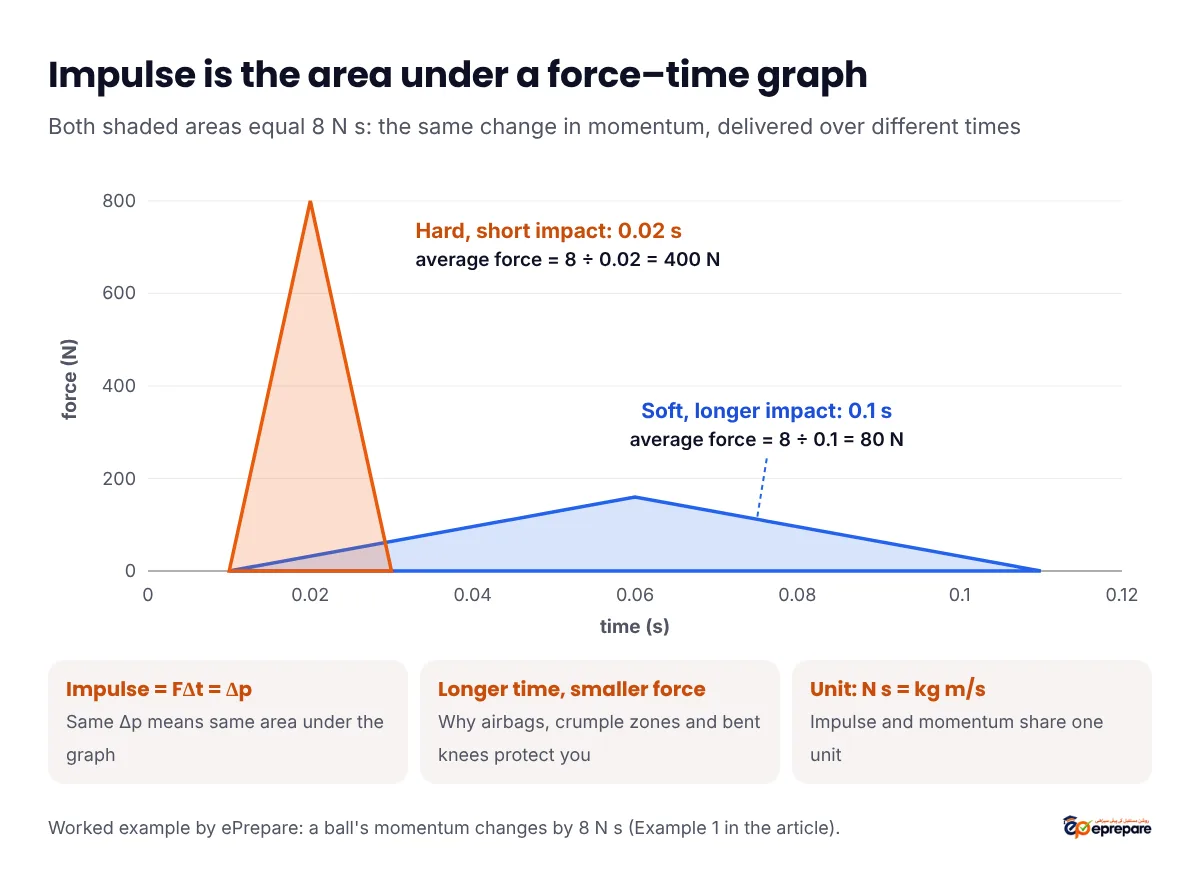
This is why so much safety design is about stretching out the time of impact. For a fixed change in momentum, a longer time means a smaller force:
- Airbags and crumple zones in cars lengthen the time a passenger takes to stop.
- You bend your knees when you land from a jump.
- A fielder pulls the hands back while catching a fast cricket ball.
- Packing foam protects fragile goods when a parcel is dropped.
The opposite also works: a batter's "follow-through" keeps the bat in contact with the ball for longer, giving a bigger impulse and so a bigger change in the ball's momentum.
Elastic vs inelastic collisions: the difference
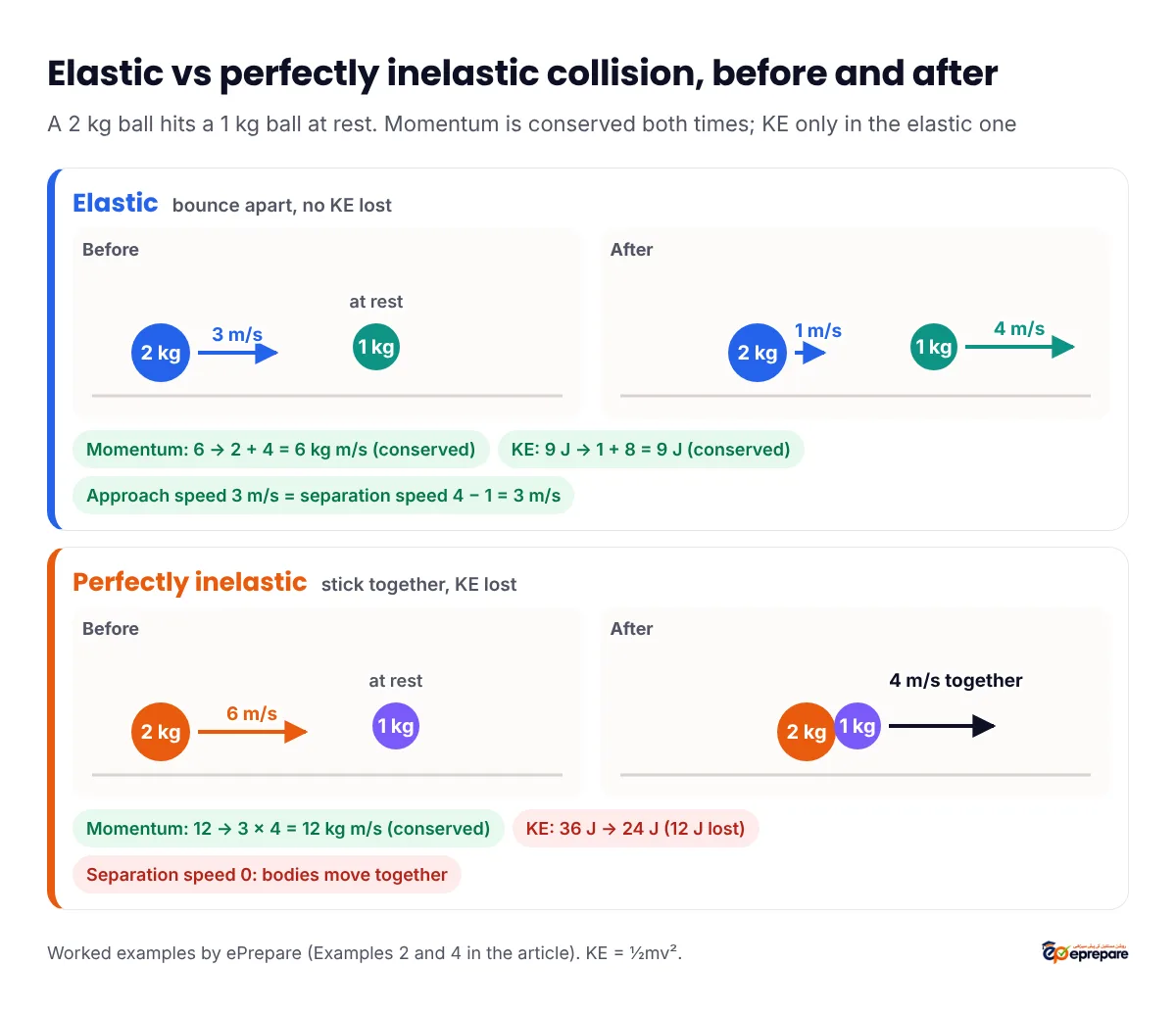
An elastic collision is one in which the total kinetic energy of the bodies is the same after the collision as before. An inelastic collision is one in which some kinetic energy is converted into other forms, such as heat, sound or permanent deformation. A perfectly inelastic collision is the extreme case: the bodies stick together and move off as one, and the loss of kinetic energy is the largest possible.
| Feature | Elastic | Inelastic | Perfectly inelastic |
|---|---|---|---|
| Momentum | Conserved | Conserved | Conserved |
| Kinetic energy | Conserved | Partly lost | Maximum loss |
| Total energy | Conserved | Conserved (KE becomes heat, sound, deformation) | Conserved |
| After the collision | Bodies separate | Bodies separate | Bodies stick together |
| Relative speed | Separation speed = approach speed | Separation speed < approach speed | Separation speed = 0 |
| Examples | Collisions between gas molecules; very nearly, steel balls | A ball bouncing lower each time, most real collisions | A bullet lodging in a block, clay hitting a wall |
Two things never change: momentum is conserved in every collision, and total energy is conserved in every collision. The only question is whether the kinetic energy survives. Collisions between everyday objects are always at least slightly inelastic, because some energy is always lost as sound and heat.
Perfectly elastic collisions in one dimension
For a perfectly elastic head-on collision, two equations hold at once: conservation of momentum and conservation of kinetic energy. Combining them gives a much simpler rule, which the curriculum names directly:
u₁ − u₂ = v₂ − v₁ (relative speed of approach = relative speed of separation)
When the second body (m₂) starts at rest, solving gives the velocities after the collision:
- v₁ = [(m₁ − m₂) ÷ (m₁ + m₂)] u₁
- v₂ = [2m₁ ÷ (m₁ + m₂)] u₁
Three special cases come up again and again in MCQs:
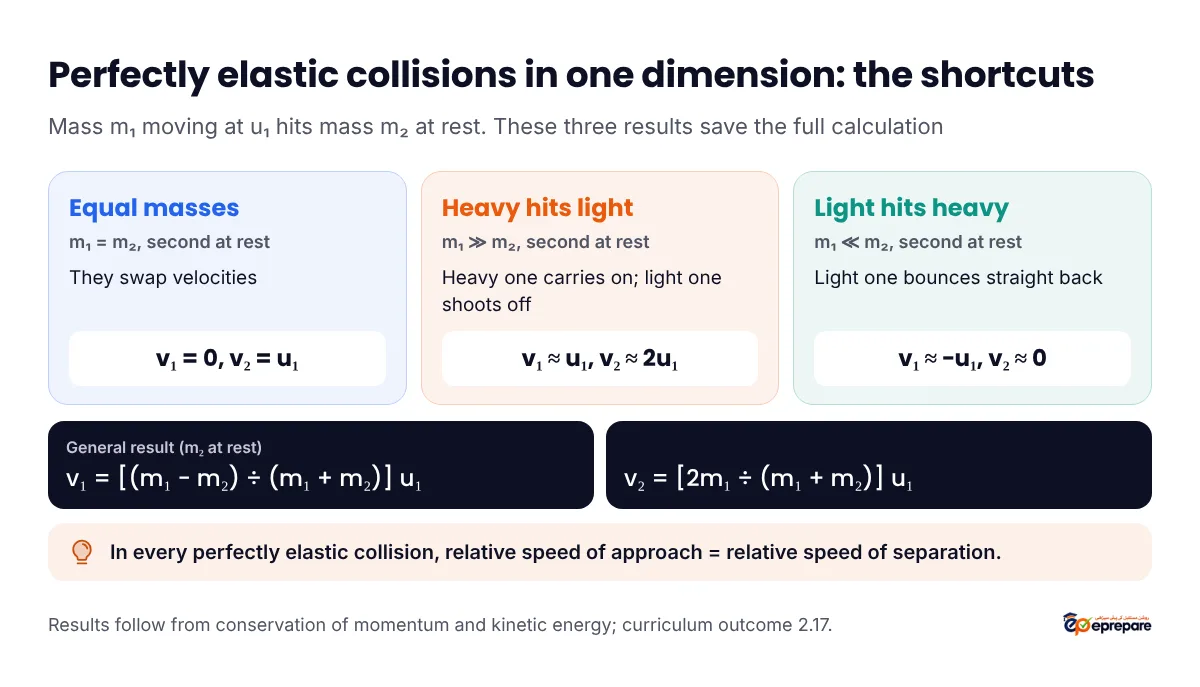
- Equal masses: the bodies exchange velocities. The moving ball stops dead and the other moves off with its speed.
- Heavy body hits a light one at rest: the heavy body carries on almost unaffected, and the light one moves off at nearly twice the heavy body's speed.
- Light body hits a heavy one at rest: the light body bounces back with almost the same speed, and the heavy one hardly moves (a ball bouncing off a wall).
Worked examples
Example 1: impulse and average force
A 0.16 kg ball moving at 30 m/s is hit straight back at 20 m/s. The bat is in contact with the ball for 0.02 s. Find the impulse and the average force.
- Take the ball's original direction as positive: u = +30 m/s, v = −20 m/s.
- Impulse = Δp = m(v − u) = 0.16 × (−20 − 30) = −8 N s, so its magnitude is 8 N s, directed back towards the bowler.
- Average force = impulse ÷ time = 8 ÷ 0.02 = 400 N.
Had the same change in momentum taken 0.1 s, the average force would have been only 8 ÷ 0.1 = 80 N.
Example 2: a perfectly inelastic collision
A 2 kg trolley moving at 6 m/s hits a 1 kg trolley at rest, and they stick together. Find their common velocity and the kinetic energy lost.
- Momentum before = 2 × 6 + 1 × 0 = 12 kg m/s.
- Momentum after = (2 + 1) × v, so v = 12 ÷ 3 = 4 m/s.
- KE before = ½ × 2 × 6² = 36 J. KE after = ½ × 3 × 4² = 24 J.
- KE lost = 36 − 24 = 12 J, one third of the original, turned mostly into heat and sound.
Example 3: an elastic collision between equal masses
A 0.5 kg ball moving at 4 m/s makes a head-on elastic collision with an identical ball at rest. Find the velocities afterwards.
- Equal masses in an elastic collision exchange velocities: the first ball stops and the second moves off at 4 m/s.
- Check: momentum 0.5 × 4 = 2 kg m/s before and after; KE ½ × 0.5 × 4² = 4 J before and after.
Example 4: an elastic collision between unequal masses
A 2 kg ball moving at 3 m/s collides elastically and head-on with a 1 kg ball at rest. Find both velocities afterwards.
- v₁ = [(2 − 1) ÷ (2 + 1)] × 3 = 1 m/s (still forwards).
- v₂ = [2 × 2 ÷ (2 + 1)] × 3 = 4 m/s.
- Check momentum: 2 × 3 = 6 before; 2 × 1 + 1 × 4 = 6 after.
- Check KE: ½ × 2 × 3² = 9 J before; ½ × 2 × 1² + ½ × 1 × 4² = 1 + 8 = 9 J after.
- Check the relative speeds: approach 3 m/s; separation 4 − 1 = 3 m/s.
Example 5: recoil, an "explosion" in reverse
A 4 kg gun fires a 0.02 kg bullet at 400 m/s. Find the recoil velocity of the gun.
- Total momentum before firing is zero, so it is zero afterwards: 0.02 × 400 + 4 × v = 0.
- v = −8 ÷ 4 = −2 m/s: the gun moves back at 2 m/s, opposite to the bullet.
MDCAT shortcuts and common traps. Momentum is conserved in every collision; only elastic collisions conserve kinetic energy. Total energy is always conserved, so "energy is lost in an inelastic collision" means kinetic energy. Velocity is a vector: a ball that rebounds at the same speed has Δp = 2mv, not zero. Equal masses in an elastic collision swap velocities. In a perfectly inelastic collision with the second body at rest, the fraction of KE lost is m₂ ÷ (m₁ + m₂). Impulse in N s equals momentum in kg m/s, and a longer impact time means a smaller force.
Practice MCQs: collisions and impulse
Try each one before opening the answer. For more, practise the Force and motion chapter in our MDCAT Physics MCQs.
Question 1
In a perfectly elastic collision, which of the following is conserved?
- Momentum only
- Kinetic energy only
- Both momentum and kinetic energy
- Neither momentum nor kinetic energy
Show answer
Answer: C. Momentum is conserved in every collision, and the defining feature of an elastic collision is that kinetic energy is conserved too.
Question 2
A 0.2 kg ball hits a wall at 10 m/s and rebounds along the same line at 10 m/s. What is the magnitude of its change in momentum?
- 0 kg m/s
- 2 kg m/s
- 4 kg m/s
- 20 kg m/s
Show answer
Answer: C. Δp = m(v − u) = 0.2 × (−10 − 10) = −4 kg m/s, so the magnitude is 4 kg m/s. Option A is the classic trap: the speed is unchanged, but the velocity reverses, so the momentum changes by 2mv.
Question 3
A 3 kg body moving at 4 m/s collides with a 1 kg body at rest, and they stick together. What is their common velocity?
- 1 m/s
- 3 m/s
- 4 m/s
- 12 m/s
Show answer
Answer: B. Momentum before = 3 × 4 = 12 kg m/s. After, the combined 4 kg mass has the same momentum: v = 12 ÷ 4 = 3 m/s.
Question 4
A fielder pulls the hands backwards while catching a fast ball. This is done to:
- Reduce the change in momentum of the ball
- Increase the time of impact and so reduce the force
- Increase the impulse on the hands
- Reduce the mass of the ball
Show answer
Answer: B. The ball must be brought to rest either way, so the change in momentum (and the impulse) is fixed. Since FΔt = Δp, increasing Δt reduces the average force on the hands.
Question 5
A ball moving with speed u collides head-on and elastically with an identical ball at rest. After the collision:
- Both balls move with speed u/2
- The first ball stops and the second moves with speed u
- Both balls stop
- The first ball rebounds with speed u
Show answer
Answer: B. Equal masses in an elastic collision exchange velocities. Option A conserves momentum but not kinetic energy (half the KE would be lost), so it cannot be elastic.
Frequently asked questions
What is the impulse–momentum theorem?
It states that the impulse on a body equals its change in momentum: FΔt = mv − mu. It comes directly from Newton's second law and explains why a longer impact time means a smaller force for the same change in momentum.
What is impulse in physics?
Impulse is the product of a force and the time it acts for, FΔt. It equals the change in momentum it produces, it is the area under a force–time graph, and its SI unit is the newton second (N s), equal to kg m/s.
Is impulse a vector or a scalar?
Impulse is a vector. It points in the direction of the force, which is also the direction of the change in momentum.
What is an elastic collision?
A collision in which the total kinetic energy of the bodies is the same before and after. Momentum is also conserved, and the bodies separate with the same relative speed at which they approached. Collisions between gas molecules are treated as elastic.
What is an inelastic collision?
A collision in which momentum is conserved but some kinetic energy is converted into heat, sound or deformation, so the total kinetic energy afterwards is less. If the bodies stick together, the collision is perfectly inelastic.
What is the difference between elastic and inelastic collision?
Kinetic energy. Both conserve momentum and total energy, but only an elastic collision conserves kinetic energy. In an inelastic collision some kinetic energy is lost to other forms, and the bodies separate more slowly than they approached, or not at all.
Is momentum conserved in an inelastic collision?
Yes. Momentum is conserved in every collision where no external force acts, because the two bodies exert equal and opposite forces on each other for the same time. Only kinetic energy is not conserved.
What is the law of conservation of linear momentum?
The total linear momentum of an isolated system, one with no net external force, remains constant. For two colliding bodies, m₁u₁ + m₂u₂ = m₁v₁ + m₂v₂.
Keep practising collisions
Collision numericals reward a fixed routine: choose a positive direction, write momentum before and after, and check kinetic energy only when the question asks whether the collision is elastic. See how this fits with projectile motion and the rest of the unit in our MDCAT Physics high-yield chapters guide and the full MDCAT syllabus. Then register on ePrepare to practise timed Physics MCQs with worked explanations.