

Equilibrium and thermochemistry share one habit that MDCAT loves to test: a single formula or rule that you apply in ten seconds if you understand it, and get wrong if you only memorised it. This guide covers Kc and Kp, the reaction quotient Q, Le Chatelier's principle and Hess's law, with worked numbers for each, a comparison table, traps and five practice MCQs.
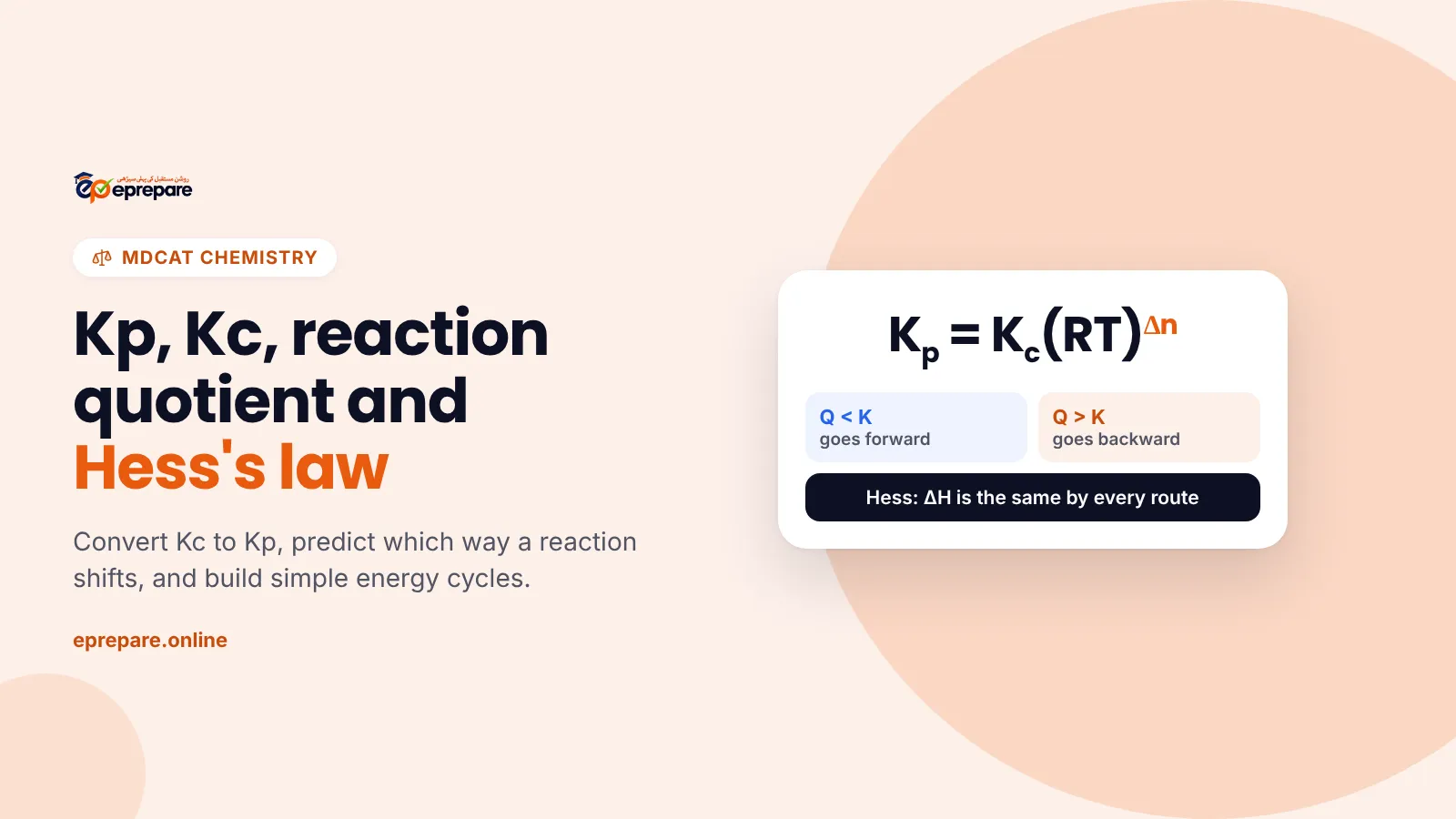
The short answer: Kc is the equilibrium constant written with concentrations; Kp is the same constant written with partial pressures of gases. They are linked by Kp = Kc(RT)Δn. The reaction quotient Q uses the same expression with the concentrations you have right now: if Q < K the reaction moves forward, if Q > K it moves backward. Hess's law says the total enthalpy change is the same whatever route the reaction takes.
What is Kc in equilibrium?
At equilibrium, the forward and reverse reactions run at the same rate, so the concentrations stop changing. For a general reaction
aA + bB ⇌ cC + dD
the law of mass action gives the equilibrium constant in terms of molar concentrations (mol dm⁻³):
Kc = [C]c[D]d ÷ ([A]a[B]b)
Products go on top and reactants underneath, each raised to the power of its coefficient in the balanced equation. Pure solids and pure liquids are left out because their concentrations do not change.
Worked example: calculating Kc
For H₂(g) + I₂(g) ⇌ 2HI(g), suppose an equilibrium mixture contains [H₂] = 0.10, [I₂] = 0.10 and [HI] = 0.70 mol dm⁻³ (practice values).
- Write the expression: Kc = [HI]² ÷ ([H₂][I₂])
- Substitute: Kc = (0.70)² ÷ (0.10 × 0.10) = 0.49 ÷ 0.010
- Answer: Kc = 49, with no units, because the concentration units cancel (two on top, two below).
Units of Kc are not always cancelled. For N₂ + 3H₂ ⇌ 2NH₃, Kc = [NH₃]² ÷ ([N₂][H₂]³), so its units are (mol dm⁻³)²⁻⁴ = dm⁶ mol⁻².
What is Kp in chemistry?
Kp is the equilibrium constant for a gaseous reaction written with partial pressures instead of concentrations. The partial pressure of a gas is the pressure it would exert if it filled the container alone (by Dalton's law, partial pressure = mole fraction × total pressure).
Kp = (pC)c(pD)d ÷ ((pA)a(pB)b)
Worked example: for N₂O₄(g) ⇌ 2NO₂(g), an equilibrium mixture has p(NO₂) = 0.40 atm and p(N₂O₄) = 0.80 atm (practice values). Kp = (0.40)² ÷ 0.80 = 0.16 ÷ 0.80 = 0.20 atm.
The relation between Kp and Kc
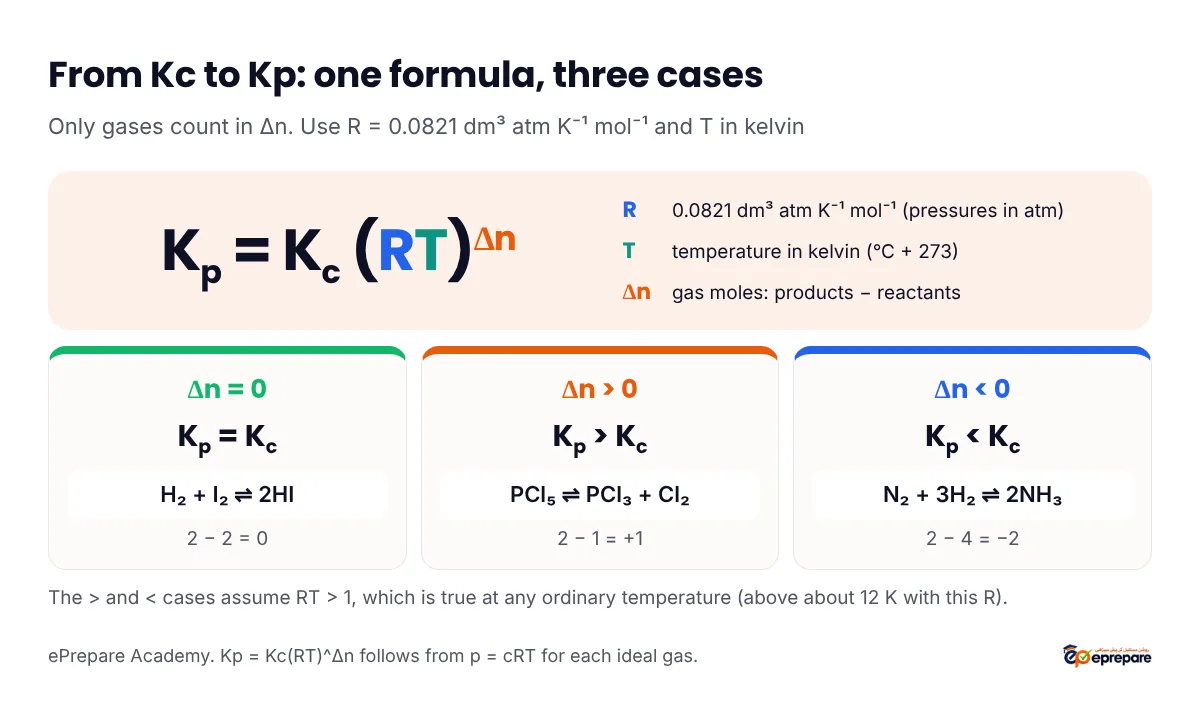
For an ideal gas, pV = nRT, so p = (n/V)RT = cRT. Put p = cRT for every gas into the Kp expression and the RT factors collect into one term:
Kp = Kc(RT)Δn, where Δn = (moles of gaseous products) − (moles of gaseous reactants), R = 0.0821 dm³ atm K⁻¹ mol⁻¹ (with pressures in atm) and T is in kelvin.
| Reaction | Δn (gas) | Relation |
|---|---|---|
| H₂ + I₂ ⇌ 2HI | 2 − 2 = 0 | Kp = Kc |
| N₂ + O₂ ⇌ 2NO | 2 − 2 = 0 | Kp = Kc |
| PCl₅ ⇌ PCl₃ + Cl₂ | 2 − 1 = +1 | Kp = Kc(RT) |
| N₂O₄ ⇌ 2NO₂ | 2 − 1 = +1 | Kp = Kc(RT) |
| 2SO₂ + O₂ ⇌ 2SO₃ | 2 − 3 = −1 | Kp = Kc(RT)⁻¹ |
| N₂ + 3H₂ ⇌ 2NH₃ | 2 − 4 = −2 | Kp = Kc(RT)⁻² |
"Kc = Kp when Δn equals what?" (answer: zero) was a question in the NUMS 2026 paper, so learn the Δn = 0 cases by heart.
Worked examples: converting Kc to Kp
Example 1 (Δn = +1). For PCl₅(g) ⇌ PCl₃(g) + Cl₂(g), Kc = 0.040 mol dm⁻³ at 500 K (practice value). Find Kp.
- Δn = 2 − 1 = +1
- RT = 0.0821 × 500 = 41.05
- Kp = 0.040 × (41.05)¹ = 1.64 atm
Example 2 (Δn = −2). For N₂(g) + 3H₂(g) ⇌ 2NH₃(g), Kc = 0.50 dm⁶ mol⁻² at 500 K (practice value). Find Kp.
- Δn = 2 − 4 = −2
- (RT)⁻² = 1 ÷ (41.05)² = 1 ÷ 1685
- Kp = 0.50 ÷ 1685 = 2.97 × 10⁻⁴ atm⁻²
Example 3 (going backwards). Using Kp = 0.20 atm for N₂O₄ ⇌ 2NO₂ at 298 K: Kc = Kp ÷ (RT)¹ = 0.20 ÷ (0.0821 × 298) = 0.20 ÷ 24.47 = 8.2 × 10⁻³ mol dm⁻³.
How to find the reaction quotient (Q)
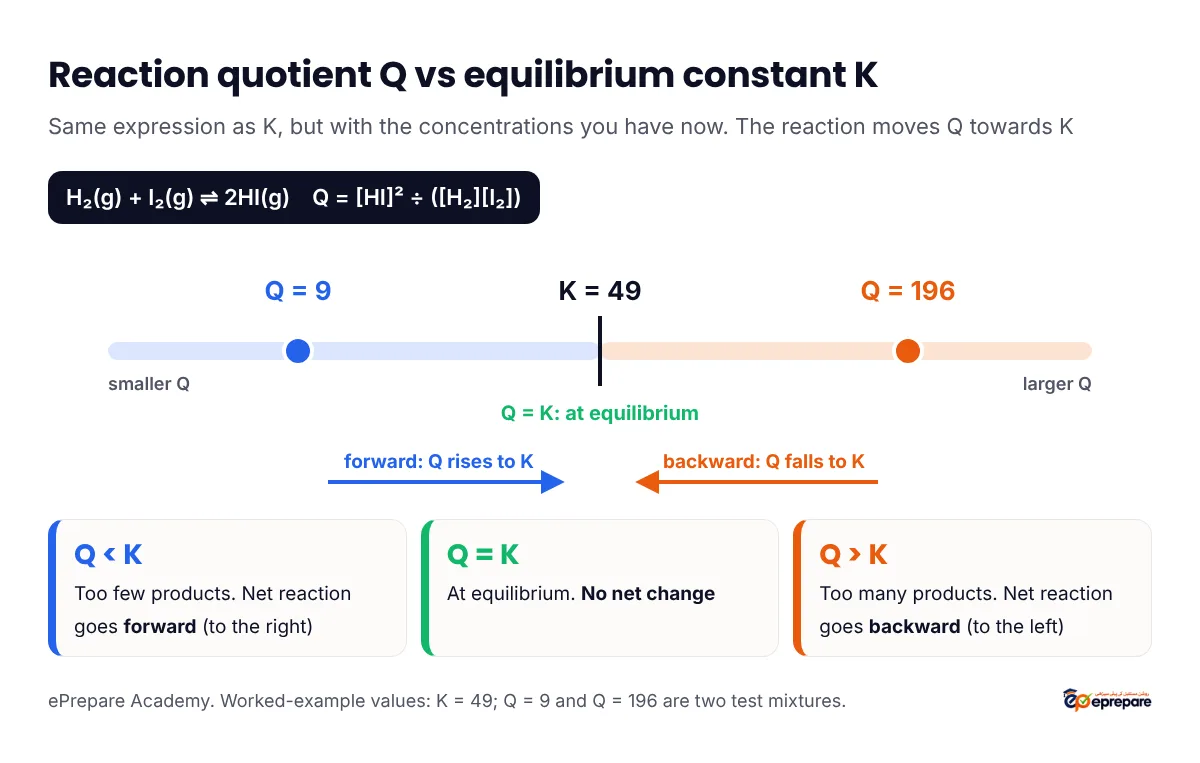
The reaction quotient Q has exactly the same expression as K, but you substitute the concentrations (or partial pressures) present at any moment, not only at equilibrium. Comparing Q with K tells you which way the reaction will go.
- Write the K expression from the balanced equation.
- Substitute the concentrations you are given right now. The result is Q.
- Compare Q with K.
| Comparison | What it means | Net direction |
|---|---|---|
| Q < K | Too few products for equilibrium | Forward (to the right), more products form |
| Q = K | The mixture is at equilibrium | No net change |
| Q > K | Too many products for equilibrium | Backward (to the left), more reactants form |
Worked example: which way will it shift?
Take H₂ + I₂ ⇌ 2HI with Kc = 49 (from the example above).
- Mixture A: [H₂] = 0.20, [I₂] = 0.20, [HI] = 0.60 mol dm⁻³. Q = (0.60)² ÷ (0.20 × 0.20) = 0.36 ÷ 0.040 = 9. Q < K, so the reaction goes forward and more HI forms.
- Mixture B: [H₂] = 0.10, [I₂] = 0.10, [HI] = 1.40 mol dm⁻³. Q = 1.96 ÷ 0.010 = 196. Q > K, so the reaction goes backward and some HI splits into H₂ and I₂.
- Mixture C: [H₂] = 0.10, [I₂] = 0.10, [HI] = 0.70 mol dm⁻³. Q = 49 = K, so the mixture is already at equilibrium.
Kc vs Kp vs Q at a glance
| Feature | Kc | Kp | Q |
|---|---|---|---|
| Uses | Molar concentrations | Partial pressures | Concentrations or pressures at any moment |
| Applies to | Solutions and gases | Gases only | Any mixture, at equilibrium or not |
| Value changes with | Temperature only | Temperature only | Every change in the mixture |
| Tells you | The extent of reaction at equilibrium | The same, for gases | Which way the reaction will move |
Le Chatelier's principle in brief
Le Chatelier's principle: if a system at equilibrium is disturbed by a change in concentration, pressure or temperature, the equilibrium shifts in the direction that opposes the change. Q explains why: adding a reactant lowers Q below K, so the reaction moves forward until Q equals K again.
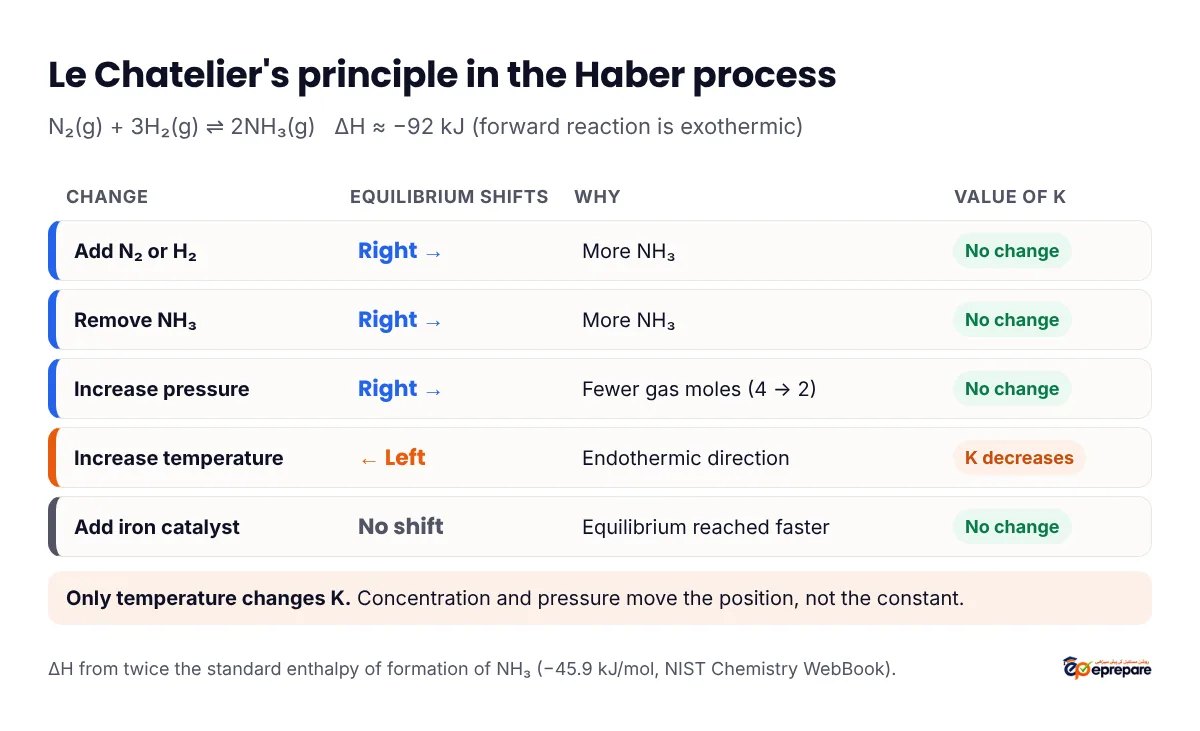
- Concentration: add a reactant or remove a product and the equilibrium shifts right. K does not change.
- Pressure: increasing pressure shifts the equilibrium to the side with fewer gas molecules. In the Haber process, 4 moles of gas become 2, so high pressure favours ammonia. If Δn = 0 (H₂ + I₂ ⇌ 2HI), pressure has no effect.
- Temperature: heating favours the endothermic direction. The forward Haber reaction is exothermic (ΔH ≈ −92 kJ, twice the enthalpy of formation of NH₃), so raising the temperature shifts it left and lowers K.
- Catalyst: it speeds up the forward and reverse reactions equally. Equilibrium is reached sooner, but neither its position nor K changes.
What is Hess's law?
Hess's law: the total enthalpy change of a reaction is the same whether it happens in one step or in several steps, as long as the starting and final states are the same. This works because enthalpy is a state function: it depends only on where you start and where you finish, not on the path.
Hess's law lets you find enthalpy changes that are hard or impossible to measure directly by adding up steps you can measure. Around any complete cycle, the enthalpy changes add up to zero (ΔHcycle = 0). Both MDCAT papers in 2026 had a Hess's law question: NUMS asked for ΔHcycle = 0, and KMU asked what the overall enthalpy change depends on (the initial and final states). See the KMU MDCAT paper with answer key for that one.
Worked cycle: the enthalpy of formation of CO
You cannot measure ΔH for C(s) + ½O₂(g) → CO(g) directly, because burning carbon in limited oxygen always produces some CO₂ as well. But you can measure two other reactions:
- C(s) + O₂(g) → CO₂(g) ΔH = −393.5 kJ mol⁻¹
- CO(g) + ½O₂(g) → CO₂(g) ΔH₂ = −283.0 kJ mol⁻¹
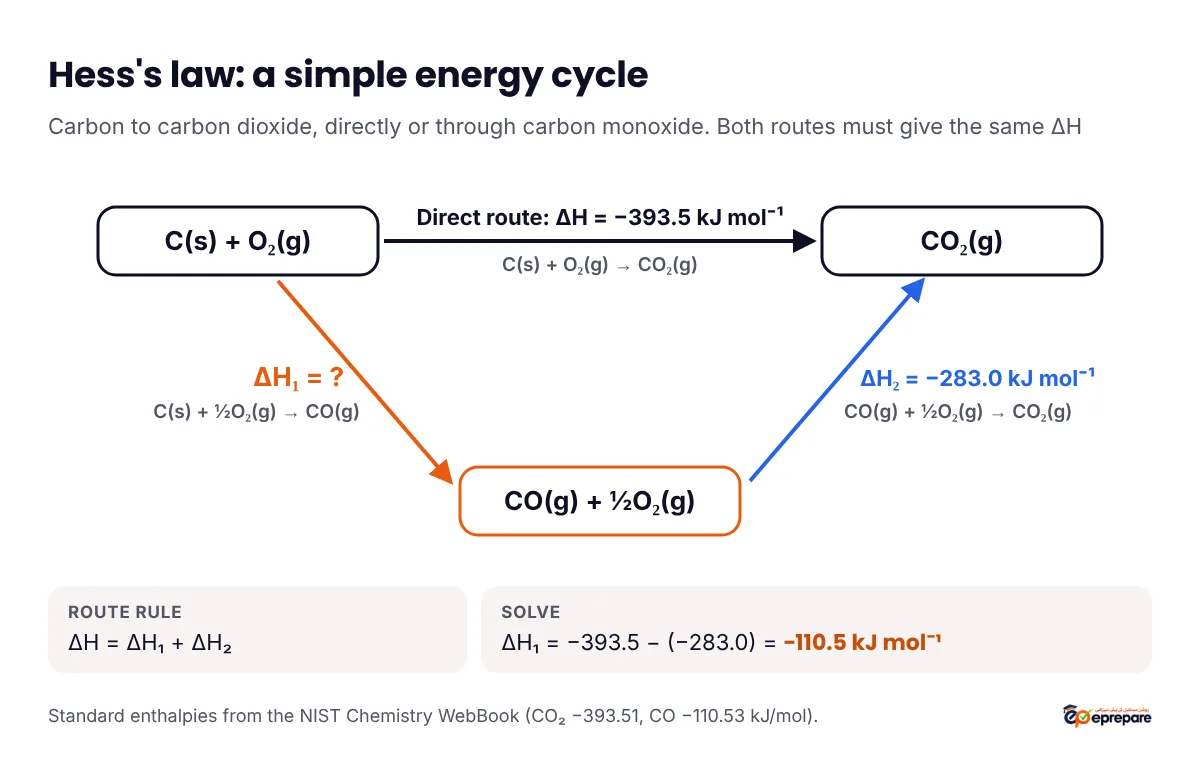
- Both routes start at C + O₂ and end at CO₂, so ΔH = ΔH₁ + ΔH₂.
- Rearrange: ΔH₁ = ΔH − ΔH₂.
- Substitute: ΔH₁ = −393.5 − (−283.0) = −110.5 kJ mol⁻¹.
This matches the measured standard enthalpy of formation of carbon monoxide.
Worked example: Hess's law by adding equations
Find the enthalpy of formation of methane, C(s) + 2H₂(g) → CH₄(g), from three enthalpies of combustion:
- C(s) + O₂(g) → CO₂(g) ΔH = −393.51 kJ mol⁻¹
- H₂(g) + ½O₂(g) → H₂O(l) ΔH = −285.83 kJ mol⁻¹
- CH₄(g) + 2O₂(g) → CO₂(g) + 2H₂O(l) ΔH = −890.35 kJ mol⁻¹
We need C and H₂ on the left and CH₄ on the right. So keep equation 1, double equation 2 and reverse equation 3 (reversing flips the sign of ΔH):
ΔHf(CH₄) = (−393.51) + 2(−285.83) − (−890.35) = −393.51 − 571.66 + 890.35 = −74.82 kJ mol⁻¹
The CO₂, H₂O and O₂ cancel, leaving exactly the target equation. The two rules to remember: reverse an equation, change the sign of ΔH; multiply an equation, multiply its ΔH by the same number.
MDCAT shortcuts and common traps: (1) Count only gases in Δn; ignore solids and liquids. (2) Δn = 0 means Kp = Kc and pressure has no effect on the equilibrium. (3) Use R = 0.0821 (not 8.314) with atm and mol dm⁻³, and convert °C to kelvin. (4) Q < K goes forward, Q > K goes backward. A quick memory hook: the reaction always moves to make Q equal K. (5) Only temperature changes K; a catalyst changes neither K nor the position. (6) Reversing a reaction inverts K (K becomes 1/K) and flips the sign of ΔH. Doubling the coefficients squares K but only doubles ΔH.
Practice MCQs: Kp, Kc, Q and Hess's law
Question 1
For which reaction is Kp equal to Kc?
- N₂(g) + 3H₂(g) ⇌ 2NH₃(g)
- PCl₅(g) ⇌ PCl₃(g) + Cl₂(g)
- H₂(g) + I₂(g) ⇌ 2HI(g)
- 2SO₂(g) + O₂(g) ⇌ 2SO₃(g)
Show answer
Answer: C. Kp = Kc when Δn = 0. For H₂ + I₂ ⇌ 2HI there are 2 moles of gas on each side, so Δn = 0 and (RT)⁰ = 1. The other reactions have Δn = −2, +1 and −1.
Question 2
For N₂O₄(g) ⇌ 2NO₂(g), the correct relation is:
- Kp = Kc(RT)⁻¹
- Kp = Kc
- Kp = Kc(RT)
- Kp = Kc(RT)²
Show answer
Answer: C. Δn = 2 − 1 = +1, so Kp = Kc(RT)¹. Option D would need Δn = 2. A common slip is to use the total moles (3) or the product moles (2) instead of the difference.
Question 3
For 2SO₂(g) + O₂(g) ⇌ 2SO₃(g), Kc = 100 at a certain temperature. A mixture at that temperature has Q = 250. What happens?
- The mixture is at equilibrium
- Net reaction goes forward, forming more SO₃
- Net reaction goes backward, forming more SO₂ and O₂
- Kc rises to 250
Show answer
Answer: C. Q > K means there is more product than equilibrium allows, so the reverse reaction runs until Q falls to 100. Kc itself changes only with temperature, so option D is wrong.
Question 4
For A → B, ΔH = −50 kJ. For B → C, ΔH = +20 kJ. What is ΔH for C → A?
- −30 kJ
- +30 kJ
- −70 kJ
- +70 kJ
Show answer
Answer: B. By Hess's law, A → C = −50 + 20 = −30 kJ. C → A is the reverse, so its sign flips to +30 kJ. Check with the cycle: −50 + 20 + 30 = 0, as Hess's law requires.
Question 5
For N₂(g) + 3H₂(g) ⇌ 2NH₃(g), ΔH ≈ −92 kJ. Which change alters the value of Kc?
- Adding more nitrogen
- Increasing the pressure
- Adding an iron catalyst
- Raising the temperature
Show answer
Answer: D. Kc depends only on temperature. Because the forward reaction is exothermic, raising the temperature favours the reverse reaction and Kc decreases. Adding nitrogen and increasing pressure shift the position of equilibrium but leave Kc unchanged; a catalyst changes neither.
For more practice, try past-paper equilibrium and thermochemistry questions with full working on our free MDCAT Chemistry MCQs page. To see how much these units count, read MDCAT Chemistry: high-yield chapters, and check the exact learning outcomes (chemical equilibrium and Le Chatelier in unit 6, Hess's law in unit 8) on the MDCAT syllabus page.
Frequently asked questions
What is Kp in chemistry?
Kp is the equilibrium constant for a reaction involving gases, written in terms of partial pressures instead of concentrations. For N₂O₄ ⇌ 2NO₂, Kp = (pNO₂)² ÷ pN₂O₄. Like Kc, it changes only with temperature.
What is the relation between Kp and Kc?
Kp = Kc(RT)Δn, where Δn is the number of moles of gaseous products minus moles of gaseous reactants, R = 0.0821 dm³ atm K⁻¹ mol⁻¹ and T is in kelvin. If Δn = 0, Kp = Kc. If Δn is positive, Kp is larger than Kc; if negative, Kp is smaller.
What is Kc in equilibrium?
Kc is the equilibrium constant expressed with molar concentrations: the product of the product concentrations divided by the product of the reactant concentrations, each raised to the power of its coefficient. A large Kc means the equilibrium mixture is mostly products; a small Kc means mostly reactants.
How do you find the reaction quotient?
Write the same expression you would use for K, then substitute the concentrations (or partial pressures) present at that moment. For H₂ + I₂ ⇌ 2HI with [H₂] = [I₂] = 0.20 and [HI] = 0.60 mol dm⁻³, Q = 0.36 ÷ 0.040 = 9. Then compare Q with K to predict the direction.
What is the relationship between Q and Kc at equilibrium?
At equilibrium Q = Kc. If Q is smaller than Kc the reaction moves forward; if Q is larger it moves backward, until Q becomes equal to Kc.
What is Le Chatelier's principle?
If a system at equilibrium is disturbed by a change in concentration, pressure or temperature, the equilibrium shifts to oppose that change. A catalyst does not shift the equilibrium; it only helps the system reach it faster.
What is Hess's law?
Hess's law states that the total enthalpy change for a reaction is the same whether it takes place in one step or several, provided the initial and final states are the same. It follows from enthalpy being a state function, and it lets you calculate enthalpy changes that cannot be measured directly, such as the formation of CO from carbon.
Equilibrium and thermochemistry numericals become quick marks once you have worked enough of them that the steps feel automatic. Register on ePrepare to practise them in timed sets with every calculation explained, and track your progress unit by unit.
Sources: PM&DC Uniform Curriculum MDCAT (Chemistry units 6 and 8); standard enthalpies of formation and combustion from the NIST Chemistry WebBook: CO₂, CO, H₂O, CH₄ and NH₃; past-paper questions from the KMU and NUMS 2026 papers as published on ePrepare. Kc, Kp and Q values in the worked examples are practice values.