Alkyl halides are one of the shortest units in FSc organic chemistry, but they carry ideas that keep coming back: nucleophiles and electrophiles, SN1 and SN2, carbocations and elimination. Once these click, alcohols, aldehydes and even benzene reactions become easier to follow. This guide answers the questions students search most, then gives you worked examples, a comparison table, traps to avoid and five practice MCQs.
The short answer: an alkyl halide (haloalkane) is an alkane with one hydrogen replaced by a halogen, R–X. Its carbon is slightly positive, so nucleophiles attack it. SN2 replaces X in one step with inversion and suits primary halides. SN1 goes in two steps through a carbocation and suits tertiary halides.
What is an alkyl halide?
An alkyl halide is a compound in which a halogen atom (F, Cl, Br or I) is bonded to an sp³ carbon of an alkyl group. Its general formula is CₙH₂ₙ₊₁X, often written simply as R–X. Bromoethane, CH₃CH₂Br, is the example you will see most often in MCQs.
The C–X bond is polar because the halogen is more electronegative than carbon. Carbon carries a partial positive charge (δ+) and the halogen a partial negative charge (δ−). That δ+ carbon is the reason alkyl halides react: electron-rich species are drawn to it, and the halogen leaves as a halide ion, X⁻.
Primary, secondary and tertiary alkyl halides
Classify an alkyl halide by looking at the carbon that holds the halogen and counting how many other carbons are bonded to it.
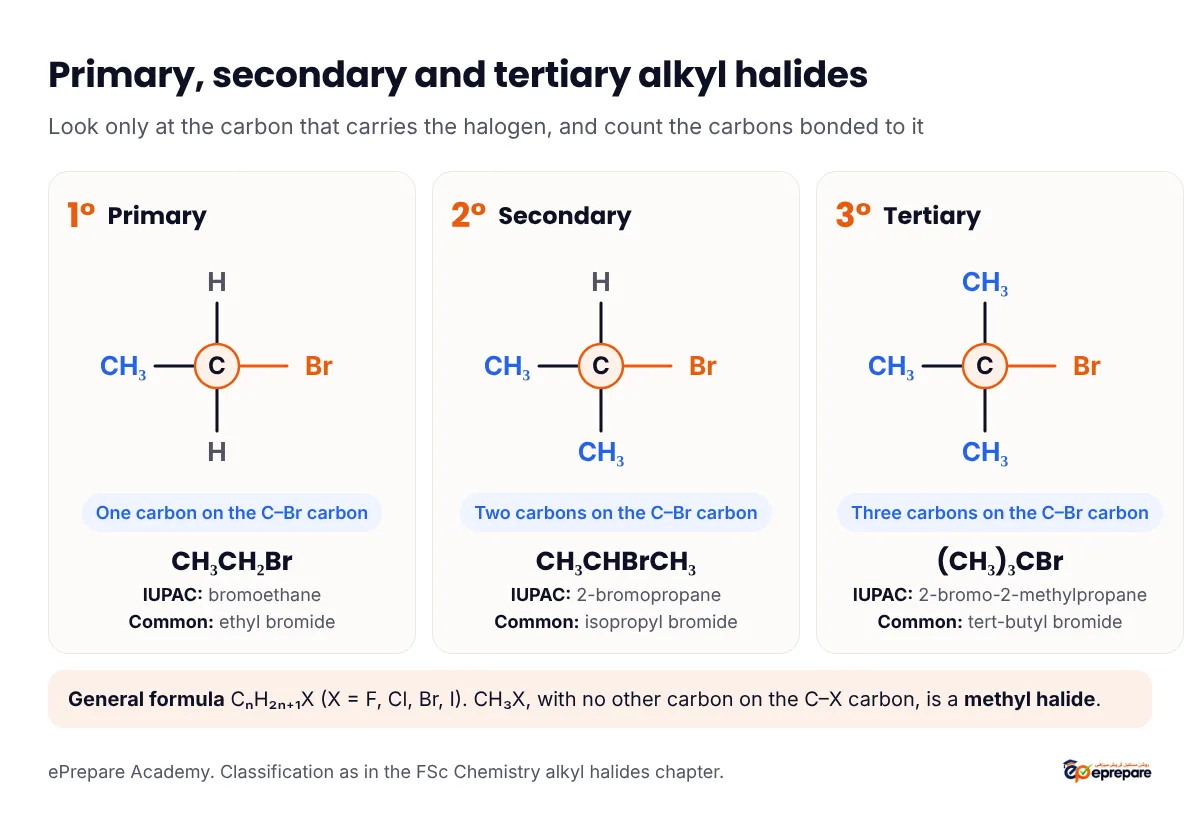
| Type | Carbons on the C–X carbon | Example (IUPAC name) | Common name |
|---|---|---|---|
| Methyl | 0 | CH₃Br (bromomethane) | Methyl bromide |
| Primary (1°) | 1 | CH₃CH₂Br (bromoethane) | Ethyl bromide |
| Secondary (2°) | 2 | CH₃CHBrCH₃ (2-bromopropane) | Isopropyl bromide |
| Tertiary (3°) | 3 | (CH₃)₃CBr (2-bromo-2-methylpropane) | tert-Butyl bromide |
Naming alkyl halides (IUPAC)
- Find the longest carbon chain that contains the carbon bonded to the halogen. This gives the parent alkane.
- Number the chain so that the substituents get the lowest numbers.
- Name the halogen as a prefix: fluoro, chloro, bromo, iodo.
- If there are different substituents, list them in alphabetical order. Bromo comes before chloro, and chloro before methyl.
Worked example: CH₃–CHCl–CH(CH₃)–CH₃. The longest chain has four carbons (butane). Numbering from the left puts Cl on C2 and the methyl group on C3. The name is 2-chloro-3-methylbutane. Numbering from the right would give 3-chloro-2-methylbutane, which has the same set of locants {2, 3}, so the tie goes to the substituent named first in alphabetical order: chloro gets the lower number.
Structural isomers of alkyl halides
Structural isomers have the same molecular formula but different structural formulas. C₃H₇Br has two: 1-bromopropane (a primary halide) and 2-bromopropane (a secondary halide). They differ only in where the bromine sits, so they are position isomers. C₄H₉Br has four, including tert-butyl bromide. Isomer counting questions are common, so practise drawing each chain and moving the halogen along it.
What is a nucleophile and an electrophile?
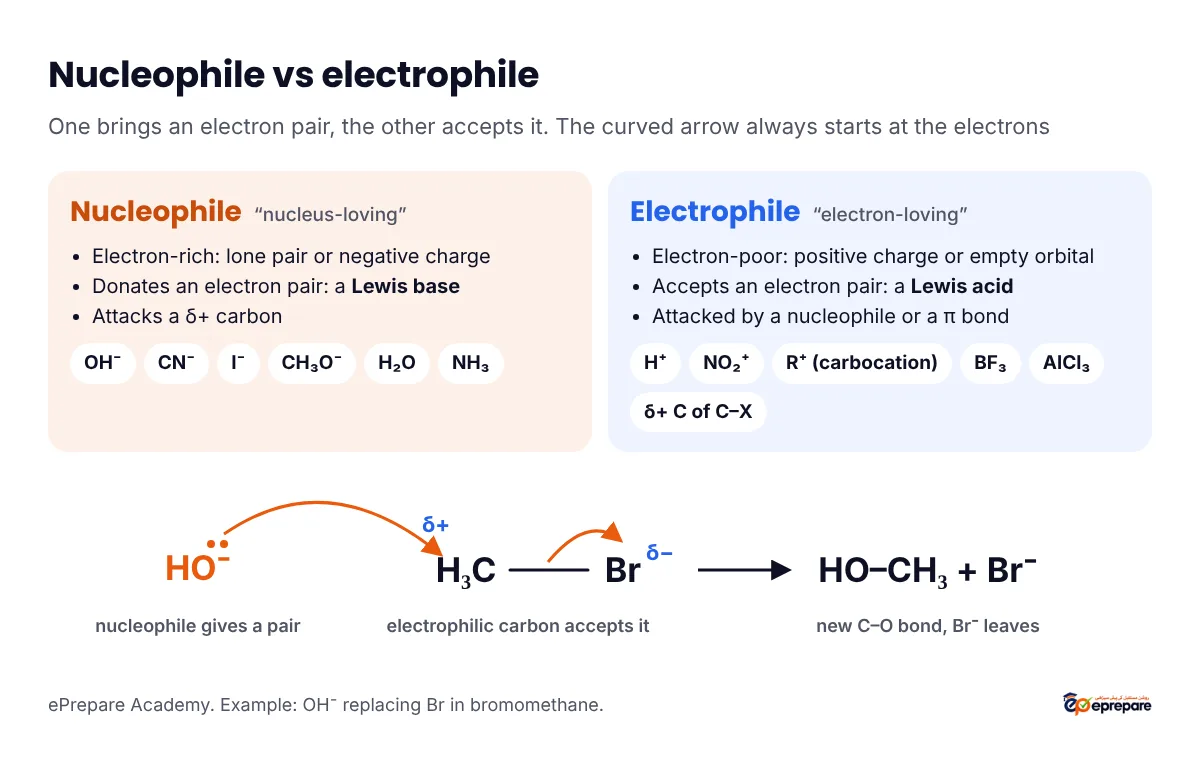
Almost every organic mechanism is one electron-rich species meeting one electron-poor species.
- A nucleophile ("nucleus-loving") is electron-rich. It has a lone pair or a negative charge and donates an electron pair to form a new bond. Every nucleophile is a Lewis base. Examples: OH⁻, CN⁻, I⁻, CH₃O⁻ (alkoxide), H₂O, NH₃.
- An electrophile ("electron-loving") is electron-poor. It has a positive charge or an empty orbital and accepts an electron pair. Every electrophile is a Lewis acid. Examples: H⁺, NO₂⁺ (the nitronium ion in nitration of benzene), carbocations (R⁺), BF₃, AlCl₃ and the δ+ carbon of a C–X bond.
| Feature | Nucleophile | Electrophile |
|---|---|---|
| Electron density | Rich (lone pair or negative charge) | Poor (positive charge or empty orbital) |
| Electron pair | Donates it | Accepts it |
| Lewis theory | Lewis base | Lewis acid |
| Attacks | A δ+ carbon (alkyl halides, C=O) | A π bond (alkenes, benzene) or a lone pair |
| Typical reactions | Nucleophilic substitution, nucleophilic addition | Electrophilic addition, electrophilic substitution |
Is water a nucleophile or an electrophile?
Water is a nucleophile. Its oxygen has two lone pairs it can donate. It is a weak nucleophile because it is neutral, which is why water alone works best with tertiary halides by the SN1 route, where the nucleophile does not need to be strong. The same goes for oxygen in alcohols: an oxygen with lone pairs acts as a nucleophile. Negatively charged OH⁻ is a much stronger nucleophile than neutral H₂O.
What are SN1 and SN2 reactions?
In a nucleophilic substitution reaction, a nucleophile replaces the halogen of an alkyl halide. The halogen leaves as a halide ion, so it is called the leaving group. In general:
Nu⁻ + R–X → R–Nu + X⁻ For example, OH⁻ + CH₃CH₂Br → CH₃CH₂OH + Br⁻ (aqueous KOH turns an alkyl halide into an alcohol).
The name tells you the mechanism: S for substitution, N for nucleophilic, and the number for the molecularity of the slowest step. SN2 means two species take part in the slow step; SN1 means only one does.
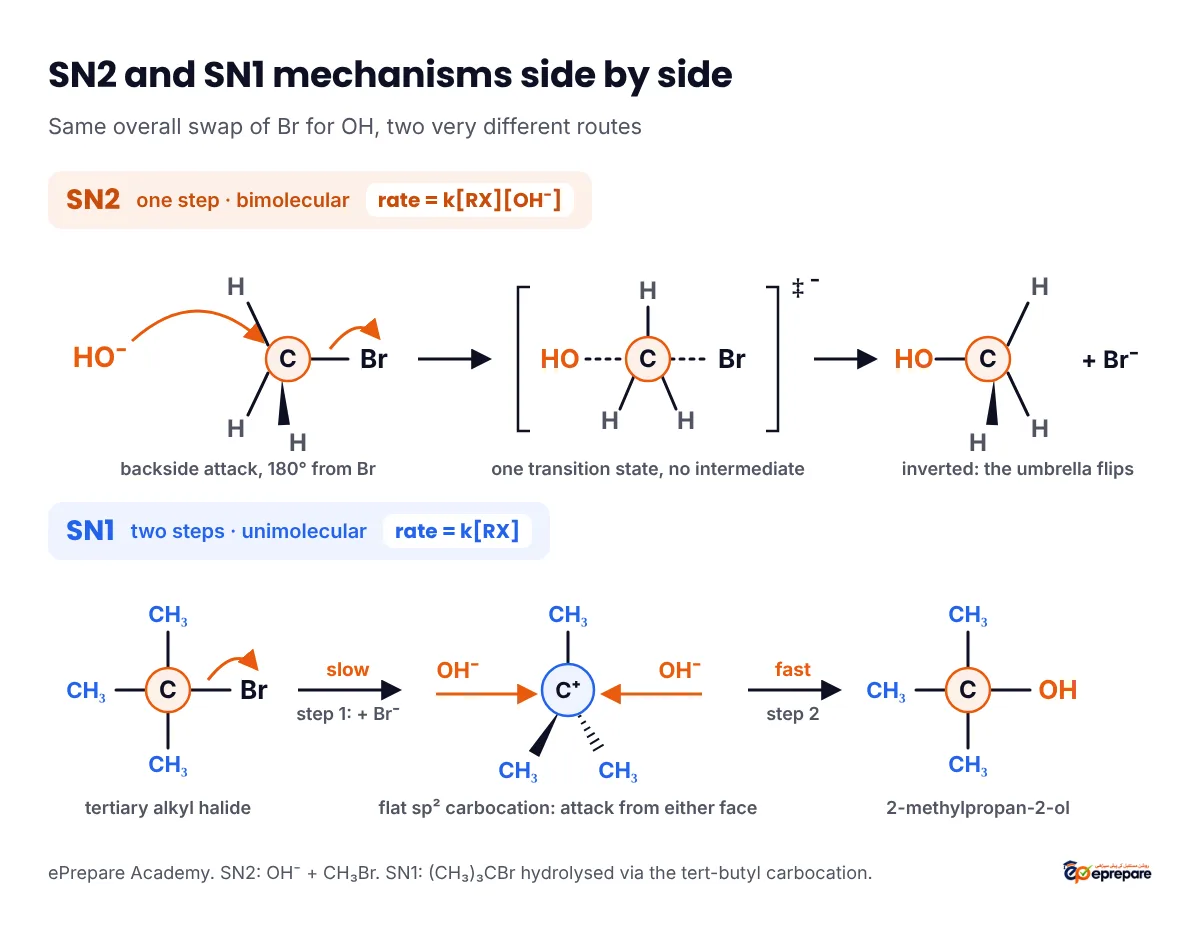
The SN2 mechanism: one step
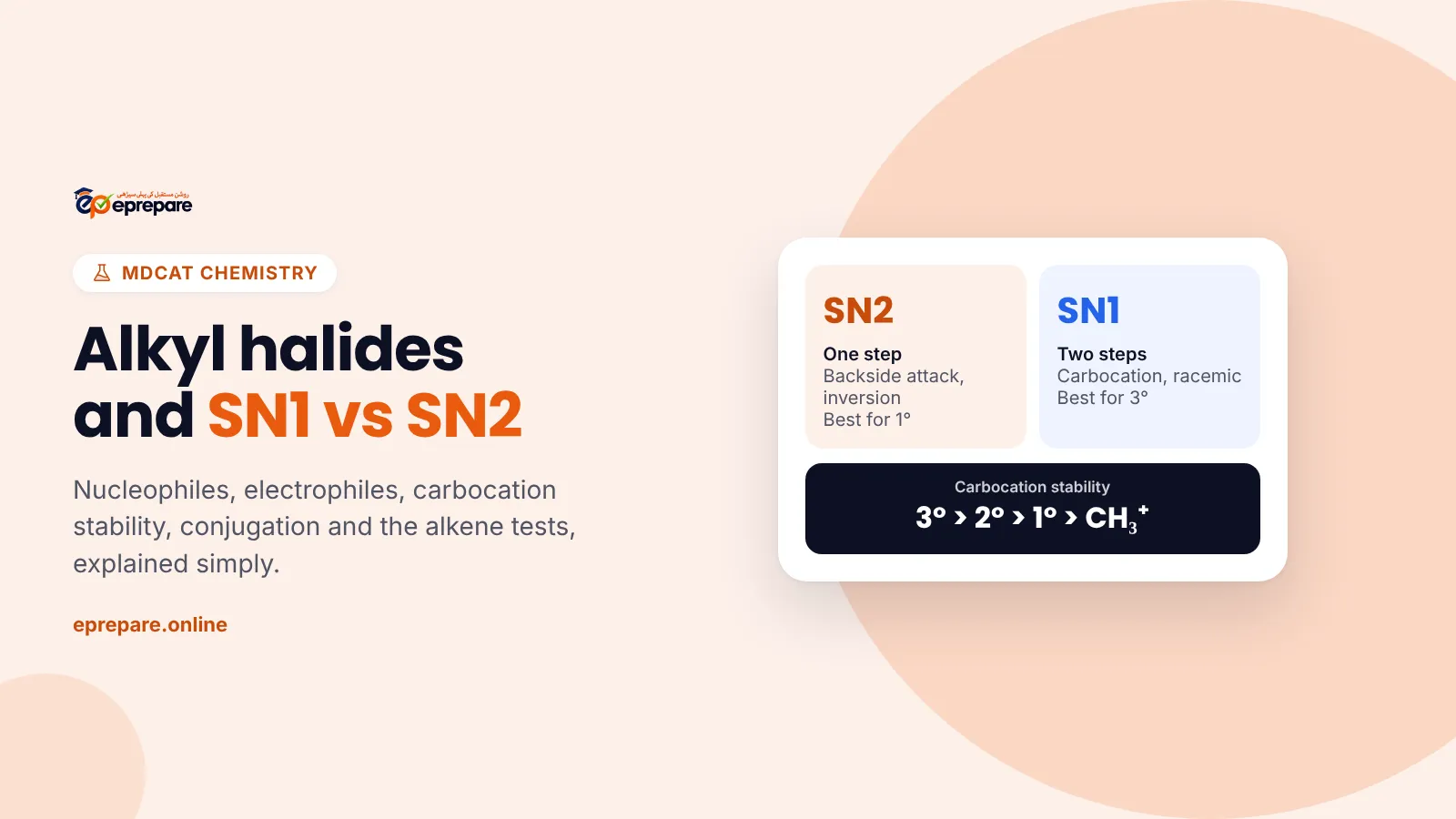
The nucleophile attacks the carbon from the side directly opposite the halogen (backside attack, at 180°) at the same moment as the C–X bond breaks. For an instant the carbon is partly bonded to both: this is the transition state, with five groups around carbon. It is not an intermediate and cannot be isolated. As the halide leaves, the other three groups flip over like an umbrella in the wind. This is inversion of configuration.
Because the alkyl halide and the nucleophile are both in the single slow step, rate = k[RX][Nu⁻]. The reaction is second order.
The SN1 mechanism: two steps
- Slow step (rate-determining): the C–X bond breaks on its own, giving a carbocation and X⁻.
- Fast step: the nucleophile attacks the carbocation.
The carbocation is sp² hybridised and flat, so the nucleophile can attack from either face. If the carbon was chiral, the product is a roughly equal mixture of both forms, a racemic mixture. Only the alkyl halide is in the slow step, so rate = k[RX]. The reaction is first order and the concentration of the nucleophile does not change the rate.
SN1 vs SN2: comparison table
| Feature | SN1 | SN2 |
|---|---|---|
| Full name | Substitution nucleophilic unimolecular | Substitution nucleophilic bimolecular |
| Steps | Two | One (concerted) |
| Intermediate | Carbocation | None, only a transition state |
| Rate law | Rate = k[RX] | Rate = k[RX][Nu⁻] |
| Order | First order | Second order |
| Best substrate | 3° > 2° (1° and methyl hardly react this way) | Methyl > 1° > 2° (3° hardly reacts this way) |
| Nucleophile | Weak is enough (H₂O, ROH) | Strong needed (OH⁻, CN⁻, RO⁻) |
| Stereochemistry | Racemic mixture (attack from both faces) | Inversion of configuration |
| Energy profile | Two humps with a dip for the carbocation | One hump |
Why does the substrate matter so much? In SN2 the nucleophile has to reach the back of the carbon. Three bulky methyl groups on a tertiary carbon block that path (steric hindrance). In SN1 nothing has to squeeze in. The speed depends on how easily the carbocation forms, and tertiary carbocations are the most stable.
Which halogen leaves fastest?
The weaker the C–X bond, the easier it breaks. Bond strength falls from C–F to C–I, so the reactivity order is R–I > R–Br > R–Cl > R–F. This exact order appeared as an MCQ in the NUMS 2026 paper, and the KMU 2026 paper asked which C–X bond has the highest bond energy (C–F). Both are explained in our KMU MDCAT paper with answer key.
Carbocation stability order
A carbocation is an ion with a positively charged carbon that has only three bonds and an empty p orbital. The stability order is:
3° > 2° > 1° > methyl (CH₃⁺). Each alkyl group pushes electron density towards the positive carbon (the +I, electron-donating inductive effect). This spreads the positive charge, and the more alkyl groups there are, the more stable the ion.
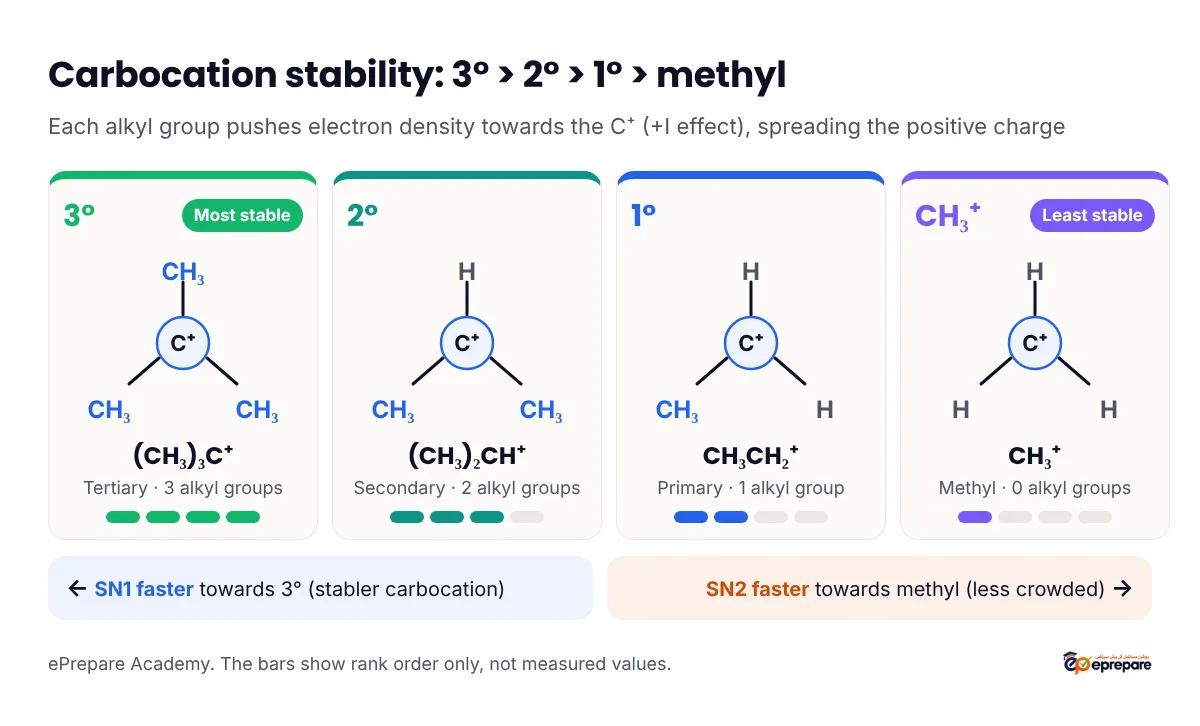
How to determine carbocation stability in an MCQ: find the positive carbon and count the carbons bonded to it. More carbons means more stable. Then check for a double bond or a benzene ring next door: an allylic or benzylic carbocation is extra stable because the positive charge is spread by conjugation.
Elimination: substitution's rival
A nucleophile is also a base. Instead of attacking carbon, it can remove a hydrogen from the carbon next to the C–X carbon (the β-hydrogen). The halogen leaves at the same time and a C=C double bond forms. This is elimination, also called dehydrohalogenation:
CH₃CH₂Br + KOH (alcoholic) → CH₂=CH₂ + KBr + H₂O
- E2: one step, rate = k[RX][base], favoured by a strong base.
- E1: two steps through a carbocation, rate = k[RX], favoured by tertiary halides. It competes with SN1.
The condition decides the product, and this is a favourite MCQ: aqueous KOH gives substitution (an alcohol); alcoholic KOH gives elimination (an alkene). Heat also pushes the reaction towards elimination.
What is conjugation in organic chemistry?
Conjugation is the overlap of p orbitals across three or more neighbouring atoms. It usually comes from alternating single and double bonds. The π electrons are no longer locked between two carbons. They are delocalised over the whole system, which lowers the energy and makes the molecule more stable.
- Conjugated: buta-1,3-diene, CH₂=CH–CH=CH₂. The double bonds are separated by one single bond.
- Not conjugated (isolated): penta-1,4-diene, CH₂=CH–CH₂–CH=CH₂. The sp³ CH₂ group in the middle has no p orbital, so it breaks the overlap.
- Benzene is the classic case: six p orbitals in a ring, with the π electrons spread evenly. This is its resonance stabilisation, and it is why benzene prefers substitution to addition.
Long conjugated chains also absorb visible light, which is why carrots and tomatoes are coloured.
Do not mix this up with Biology. The PM&DC Biology curriculum lists "conjugated molecules (glycolipids, glycoproteins)". There, conjugated means two different kinds of molecule joined together, such as a carbohydrate attached to a lipid or a protein. It is the same word with a different meaning.
What is hydrogenation?
Hydrogenation is the addition of hydrogen (H₂) across a C=C or C≡C bond in the presence of a metal catalyst. It turns an alkene or alkyne into an alkane:
CH₂=CH₂ + H₂ → CH₃–CH₃ (catalyst: finely divided nickel at about 250–300 °C, or platinum or palladium at room temperature). An alkyne adds two molecules of H₂: HC≡CH + 2H₂ → CH₃–CH₃.
Industry uses the same reaction to turn liquid vegetable oils, which are unsaturated, into solid vegetable ghee and margarine.
The heat of hydrogenation is the enthalpy change when one mole of an unsaturated compound is hydrogenated. It is always exothermic: for ethene it is about −136 kJ/mol. A more stable alkene releases less heat. That is how chemists measured the extra stability of conjugated dienes and benzene: benzene releases far less heat than three separate C=C bonds would, and the difference is its resonance energy.
How to test for alkenes
Alkenes are unsaturated, so reagents can add across the double bond. Both standard tests use a coloured reagent that loses its colour when it adds.
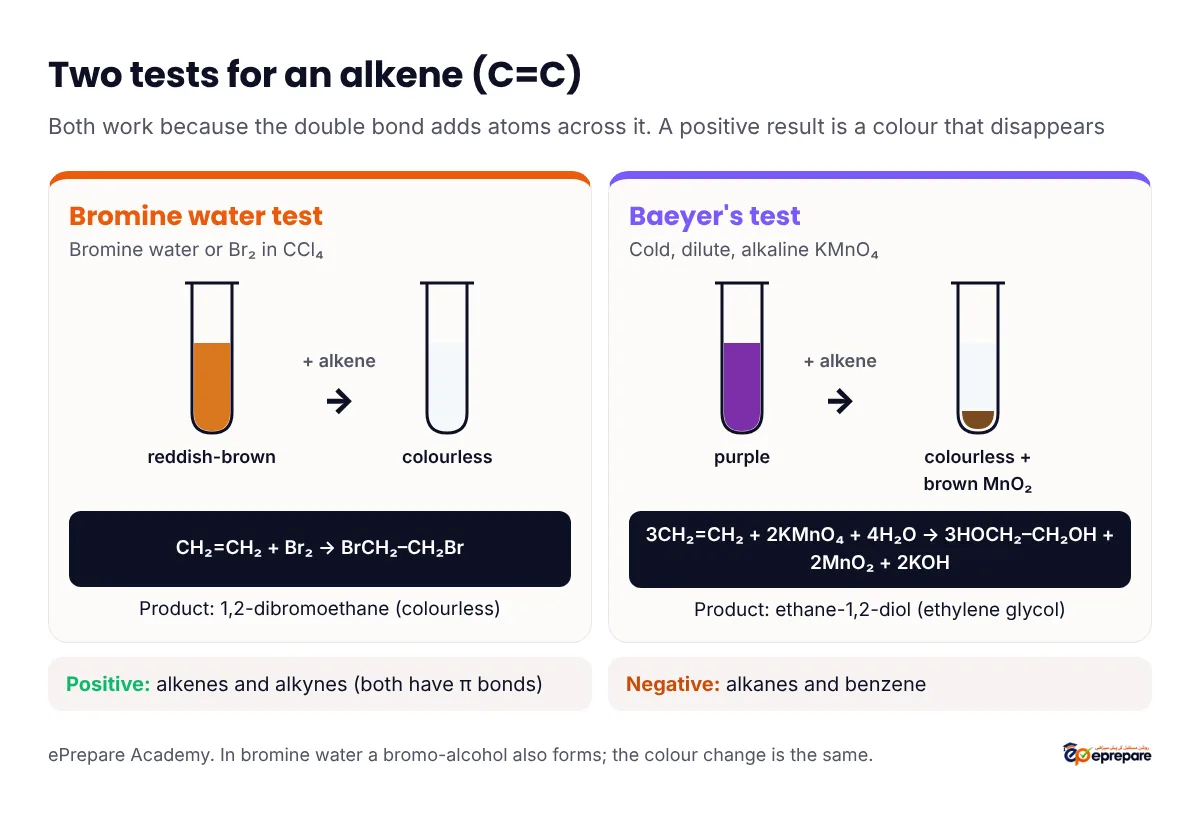
- Bromine water test: shake the compound with bromine water (or bromine dissolved in CCl₄). An alkene turns the reddish-brown colour colourless at room temperature, without sunlight. With bromine in CCl₄ the product is 1,2-dibromoethane: CH₂=CH₂ + Br₂ → BrCH₂–CH₂Br. With bromine water, a bromo-alcohol forms as well, but the colour change is the same.
- Baeyer's test: add cold, dilute, alkaline KMnO₄ (Baeyer's reagent). The purple colour disappears and a brown precipitate of MnO₂ forms. The alkene becomes a diol: 3CH₂=CH₂ + 2KMnO₄ + 4H₂O → 3HOCH₂–CH₂OH + 2MnO₂ + 2KOH. The product is ethane-1,2-diol (ethylene glycol).
Alkanes give neither result: they have no π bond, and they react with bromine only slowly by substitution in sunlight. Alkynes give both tests, so a positive test shows a C=C or a C≡C. Benzene does not decolourise either reagent under these conditions, despite its double bonds.
While you are here: the general formula of alkanes is CₙH₂ₙ₊₂, of alkenes CₙH₂ₙ and of alkynes CₙH₂ₙ₋₂.
MDCAT shortcuts and common traps: (1) Tertiary means SN1, primary means SN2, and secondary can go either way. (2) Inversion means SN2; racemic mixture means SN1. (3) Aqueous KOH gives an alcohol and alcoholic KOH gives an alkene. (4) C–F is the most polar C–X bond but the least reactive, because bond strength decides reactivity: R–I > R–Br > R–Cl > R–F. (5) BF₃ and AlCl₃ have no charge but are electrophiles, because they have empty orbitals. (6) Alkynes also pass the bromine water and Baeyer's tests, so a positive result does not prove an alkene.
Practice MCQs: alkyl halides and SN1/SN2
Question 1
Which alkyl halide reacts fastest by the SN1 mechanism?
- CH₃Br
- CH₃CH₂Br
- (CH₃)₂CHBr
- (CH₃)₃CBr
Show answer
Answer: D. SN1 goes through a carbocation, so the halide that forms the most stable carbocation reacts fastest. (CH₃)₃CBr gives a tertiary carbocation, stabilised by three electron-donating methyl groups. CH₃Br would give the least stable carbocation, the methyl cation.
Question 2
An optically active alkyl halide reacts with OH⁻ by the SN2 mechanism. The product is:
- Formed with retention of configuration
- Formed with inversion of configuration
- A racemic mixture
- Not formed, because SN2 needs a carbocation
Show answer
Answer: B. In SN2 the nucleophile attacks from the side opposite the leaving group in a single step, so the other three groups flip over. A racemic mixture is the mark of SN1, where a flat carbocation is attacked from both faces. SN2 has no carbocation.
Question 3
Which of these is NOT a nucleophile?
- NH₃
- H₂O
- CN⁻
- BF₃
Show answer
Answer: D. Boron in BF₃ has only six electrons in its valence shell and an empty orbital, so it accepts an electron pair: it is an electrophile (a Lewis acid). NH₃ and H₂O have lone pairs and CN⁻ is negatively charged, so all three donate electron pairs.
Question 4
Bromoethane is heated with alcoholic KOH. The main organic product is:
- Ethanol
- Ethene
- Ethane
- Diethyl ether
Show answer
Answer: B. In alcoholic KOH the hydroxide acts as a base and removes a β-hydrogen, so HBr is eliminated and ethene forms: CH₃CH₂Br + KOH → CH₂=CH₂ + KBr + H₂O. Aqueous KOH would give ethanol by substitution.
Question 5
Which compound contains conjugated double bonds?
- CH₂=CH–CH₂–CH=CH₂
- CH₂=CH–CH=CH₂
- CH₃–CH=CH–CH₃
- CH₂=C=CH₂
Show answer
Answer: B. In buta-1,3-diene the two C=C bonds are separated by exactly one single bond, so p orbitals overlap across all four carbons. In option A the sp³ CH₂ group isolates the double bonds. Option C has only one double bond. In option D (allene) the two double bonds share one carbon and their π bonds sit at right angles, so they do not overlap.
Want more? Our free MDCAT Chemistry MCQs page has past-paper questions from every unit, with explanations. To see where alkyl halides fit among the 45 Chemistry questions, read MDCAT Chemistry: high-yield chapters. The official learning outcomes (IUPAC naming, structure and reactivity of RX, and the mechanisms of substitution and elimination) are listed on our MDCAT syllabus page.
Frequently asked questions
What is an alkyl halide?
An alkyl halide (haloalkane) is an alkane in which one hydrogen has been replaced by a halogen atom. Its general formula is CₙH₂ₙ₊₁X, or R–X. Examples are CH₃Cl (chloromethane) and CH₃CH₂Br (bromoethane). Alkyl halides are classified as primary, secondary or tertiary by the number of carbons bonded to the carbon that carries the halogen.
What is the difference between SN1 and SN2 reactions?
SN1 happens in two steps through a carbocation intermediate. Its rate depends only on the alkyl halide (rate = k[RX]), it is fastest for tertiary halides and it gives a racemic mixture. SN2 happens in one step with backside attack. Its rate depends on both the alkyl halide and the nucleophile (rate = k[RX][Nu⁻]), it is fastest for methyl and primary halides and it gives inversion of configuration.
What is an electrophile and a nucleophile?
A nucleophile is an electron-rich species (with a lone pair or negative charge) that donates an electron pair to form a bond, such as OH⁻, CN⁻, H₂O or NH₃. An electrophile is an electron-poor species (with a positive charge or an empty orbital) that accepts an electron pair, such as H⁺, NO₂⁺, a carbocation or BF₃. Nucleophiles are Lewis bases and electrophiles are Lewis acids.
Is water a nucleophile?
Yes. The oxygen in water has two lone pairs, so water can donate an electron pair. It is a weak nucleophile because it has no charge, so it reacts best with tertiary alkyl halides by the SN1 mechanism.
Is SN2 exothermic or endothermic?
Neither label fits every SN2 reaction, because ΔH depends on which bond forms and which bond breaks. In the usual textbook examples, such as OH⁻ replacing Br⁻, a weaker C–Br bond is replaced by a stronger C–O bond, so the reaction is exothermic. Every SN2 reaction shares the same energy profile shape: a single hump (one transition state) and no intermediate.
How do you determine carbocation stability?
Count the alkyl groups attached to the positive carbon. The order is tertiary > secondary > primary > methyl, because alkyl groups donate electron density (the +I effect) and spread the positive charge. Carbocations next to a double bond or a benzene ring are further stabilised by conjugation.
What is conjugation in organic chemistry?
Conjugation is the overlap of p orbitals across three or more neighbouring atoms, usually alternating single and double bonds, as in buta-1,3-diene or benzene. The π electrons are delocalised over the whole system, which makes the molecule more stable.
How do you test for alkenes?
Use bromine water or Baeyer's reagent. An alkene turns reddish-brown bromine water colourless. It also turns cold, dilute, alkaline KMnO₄ from purple to colourless, with a brown precipitate of MnO₂. Alkanes give neither result. Alkynes give both, so the tests show unsaturation rather than proving a C=C bond.
Organic chemistry becomes manageable once each mechanism is a picture in your head rather than a line to memorise. Register on ePrepare to practise alkyl halide and hydrocarbon MCQs with full explanations, and let Wrong MCQs bring back every question you miss until the mechanism sticks.
Sources: PM&DC Uniform Curriculum MDCAT (Chemistry unit 15, Alkyl halides; unit 14, Hydrocarbons; Biology unit 3); heat of hydrogenation of ethene from the NIST Chemistry WebBook; past-paper questions from the KMU and NUMS 2026 papers as published on ePrepare.