The Krebs cycle is where most of the energy in your food is released. Students usually remember the name, then lose marks on the details: where exactly it happens, what comes out of each turn, and whether the final ATP count is 36 or 38. This guide answers each of those questions directly, then walks through the steps with a cycle diagram, the ATP count, the traps examiners like and five practice MCQs.
The short answer: the Krebs cycle takes place in the matrix of the mitochondria. In bacteria, which have no mitochondria, it happens in the cytoplasm. Each turn breaks down one acetyl-CoA and gives 3 NADH, 1 FADH₂, 1 ATP (via GTP) and 2 CO₂. One glucose turns the cycle twice.
What is the Krebs cycle?
The Krebs cycle is the second main stage of aerobic respiration. In a ring of reactions it oxidises the 2-carbon acetyl group of acetyl-CoA to carbon dioxide. Most of the energy released is captured in the reduced coenzymes NADH and FADH₂, which then power the electron transport chain. It has three names, and MCQs use all of them:
- Krebs cycle, after the biochemist Hans Krebs.
- Citric acid cycle, because the first compound formed is citric acid (citrate).
- Tricarboxylic acid (TCA) cycle, because citrate has three carboxyl groups.
It is called a cycle because the 4-carbon compound it starts with, oxaloacetate, is made again at the end, ready to accept the next acetyl group.
Where does the Krebs cycle occur in the cell?
In eukaryotic cells (plants, animals, fungi and protists), the Krebs cycle happens in the mitochondrial matrix, the fluid that fills the space inside the inner mitochondrial membrane. The enzymes of the cycle are in the matrix, and so is the acetyl-CoA it uses, because the link reaction also takes place there. (One enzyme, succinate dehydrogenase, sits in the inner membrane, but the cycle as a whole is described as taking place in the matrix.)
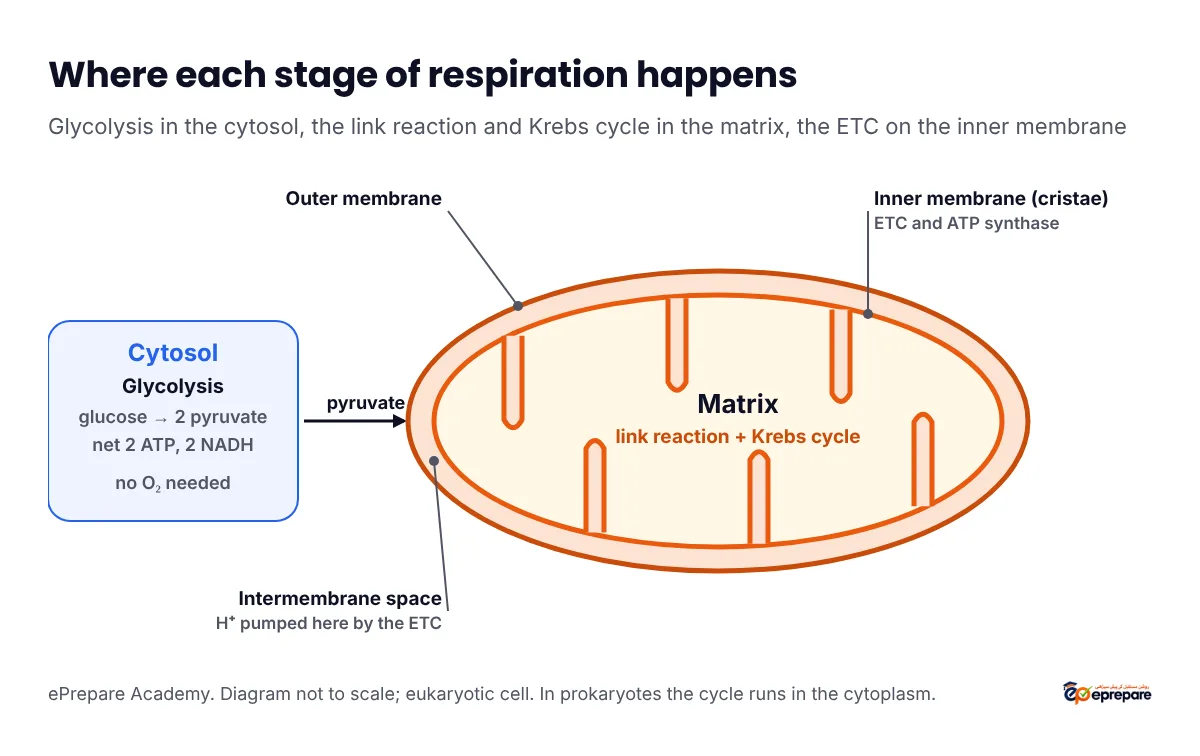
Prokaryotes such as bacteria have no mitochondria, so their Krebs cycle runs in the cytoplasm, and their electron transport chain sits in the cell membrane.
The four stages of aerobic respiration and where they happen
| Stage | Site (eukaryotes) | Products per glucose | Needs O₂? |
|---|---|---|---|
| Glycolysis | Cytosol | 2 pyruvate, net 2 ATP, 2 NADH | No |
| Link reaction | Mitochondrial matrix | 2 acetyl-CoA, 2 NADH, 2 CO₂ | Indirectly |
| Krebs cycle | Mitochondrial matrix | 6 NADH, 2 FADH₂, 2 ATP, 4 CO₂ | Indirectly |
| Electron transport chain | Inner mitochondrial membrane (cristae) | Most of the ATP, and water | Yes, O₂ is the final electron acceptor |
"Indirectly" means the Krebs cycle does not use oxygen itself, but it stops without it. Oxygen keeps the electron transport chain running, and the chain turns NADH and FADH₂ back into NAD⁺ and FAD, which the cycle needs to keep going.
The link reaction: from pyruvate to acetyl-CoA
Pyruvate (3C) from glycolysis does not enter the Krebs cycle directly. It is moved into the mitochondrion, where it loses one carbon as CO₂, gives hydrogen to NAD (forming NADH) and joins coenzyme A to form acetyl-CoA (2C). Because one glucose gives two pyruvate, the link reaction happens twice per glucose: 2 acetyl-CoA, 2 NADH and 2 CO₂.
The steps of the Krebs cycle
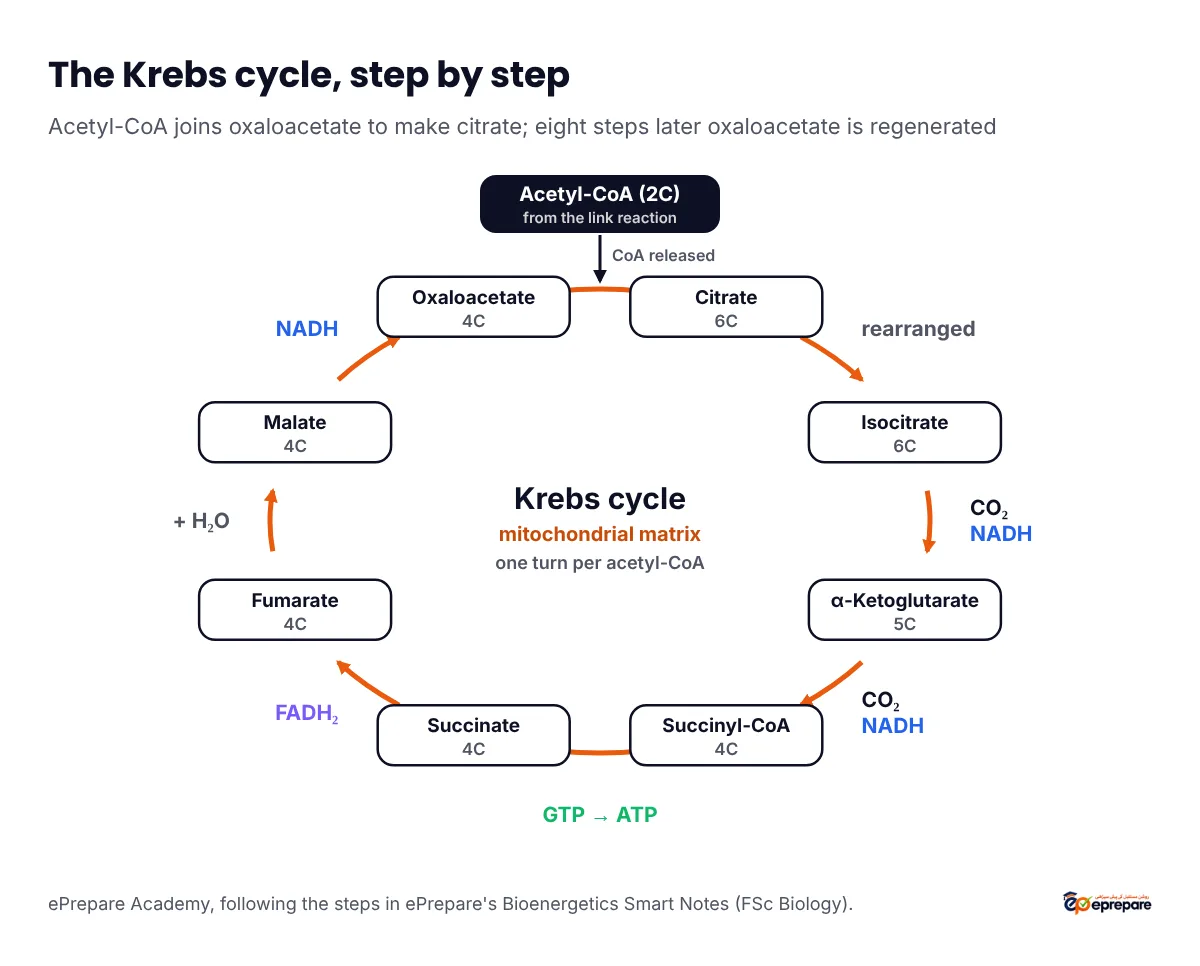
- Citrate formation: acetyl-CoA (2C) combines with oxaloacetate (4C) to form citrate (6C). Coenzyme A is released, ready to carry another acetyl group.
- Citrate → isocitrate: a rearrangement that prepares the molecule for oxidation.
- Isocitrate → α-ketoglutarate (5C): the first CO₂ is released and NAD⁺ is reduced to NADH.
- α-Ketoglutarate → succinyl-CoA (4C): the second CO₂ is released and another NADH forms.
- Succinyl-CoA → succinate (4C): energy released here makes GTP, which gives ATP. This is substrate-level phosphorylation: ATP made directly, without the electron transport chain.
- Succinate → fumarate (4C): FAD is reduced to FADH₂.
- Fumarate → malate (4C): water is added.
- Malate → oxaloacetate (4C): the third NADH forms, and oxaloacetate is ready to start the next turn.
A memory hook for the order: "Can I Keep Some Sweets For My Own?": citrate, isocitrate, α-ketoglutarate, succinyl-CoA, succinate, fumarate, malate, oxaloacetate.
What the Krebs cycle produces
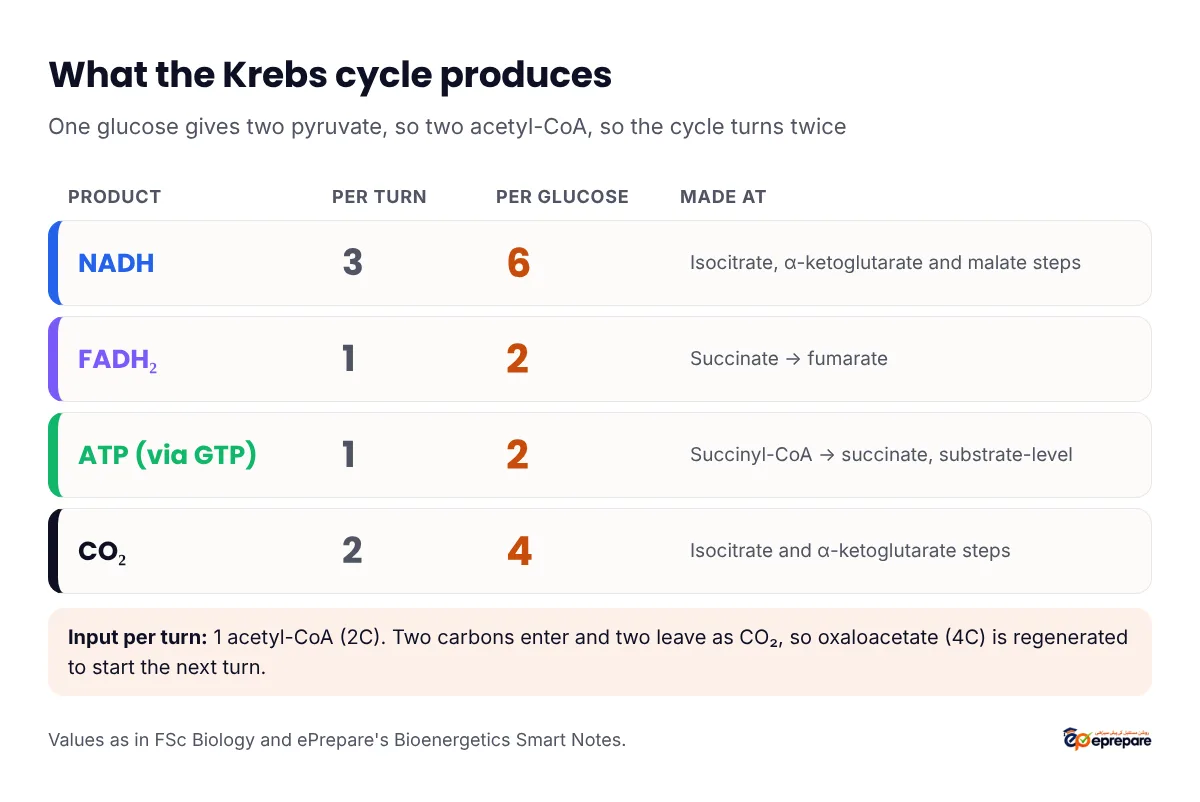
| Product | Per turn (1 acetyl-CoA) | Per glucose (2 turns) |
|---|---|---|
| NADH | 3 | 6 |
| FADH₂ | 1 | 2 |
| ATP (via GTP) | 1 | 2 |
| CO₂ | 2 | 4 |
The NUMS 2026 paper asked for exactly this: the net product of the Krebs cycle was 4CO₂, 2ATP, 6NADH and 2FADH₂, the per-glucose set (see the NUMS paper with answer key). Read the question carefully. "Per turn" and "per glucose" give different answers, and both appear among the options.
How much ATP does the Krebs cycle produce?
There are two correct answers, depending on what the question counts:
- ATP made directly by the cycle: 1 per turn, so 2 per glucose, by substrate-level phosphorylation.
- ATP that the cycle's products lead to: using the textbook values of 3 ATP per NADH and 2 per FADH₂, one turn gives 1 + (3 × 3) + (1 × 2) = 12 ATP, and one glucose gives 2 + 18 + 4 = 24 ATP.
If an MCQ says "directly" or "by substrate-level phosphorylation", the answer is 2 per glucose.
Total ATP from one glucose: 36 or 38?
FSc Biology counts the ATP from complete aerobic respiration of one glucose like this:
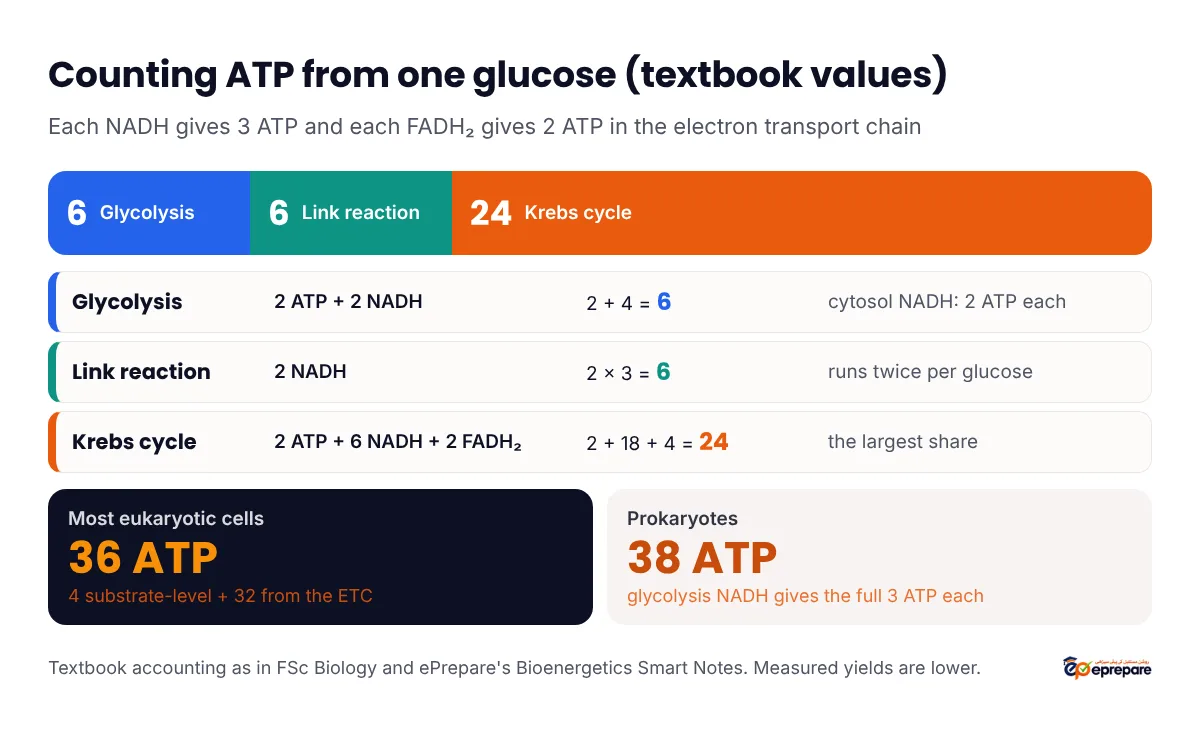
| Stage | Direct ATP | NADH and FADH₂ | ATP (eukaryote) |
|---|---|---|---|
| Glycolysis | 2 (net) | 2 NADH → 4 ATP | 6 |
| Link reaction | 0 | 2 NADH → 6 ATP | 6 |
| Krebs cycle | 2 | 6 NADH → 18 ATP; 2 FADH₂ → 4 ATP | 24 |
| Total | 4 | 32 | 36 |
Why 36 in eukaryotes and 38 in prokaryotes? The two NADH from glycolysis are made in the cytosol, and the mitochondrial membrane does not let NADH through. Only their electrons are passed inside, where they are picked up by FAD. So each gives 2 ATP instead of 3: 4 ATP instead of 6. That makes 36 in most eukaryotic cells, including most human cells. Prokaryotes have no mitochondrial membrane to cross, so the full 6 ATP count and the total is 38. Some textbooks simply quote 38 as the maximum for aerobic respiration, without separating the two cases.
Which number should you use? FSc Biology, and ePrepare's Bioenergetics Smart Notes that follow it, use 36 ATP for most eukaryotic (human) cells and 38 for prokaryotes. If an MCQ offers both, look for the word eukaryote, prokaryote or human cell. Measured values are lower than either figure: modern biochemistry puts the real yield at about 30 ATP per glucose, because the cell does not convert NADH and FADH₂ into ATP at the full textbook rate. For the exam, stick with your textbook's numbers.
How fats and proteins join the Krebs cycle
PM&DC's Bioenergetics outcome asks you to outline the respiration of proteins and fats and compare it with glucose. The Krebs cycle is the link: it is the common final pathway for all three foods.
- Fats are split into glycerol and fatty acids. Glycerol enters glycolysis (as glyceraldehyde 3-phosphate, G3P). Fatty acids are broken into many 2-carbon units that enter the Krebs cycle as acetyl-CoA, which is why fats release so much energy per gram.
- Proteins are broken into amino acids. Each amino acid first loses its amino group (deamination); the nitrogen leaves the body as urea. The remaining carbon skeleton enters respiration as pyruvate, as acetyl-CoA, or directly as a Krebs cycle intermediate.
- Carbohydrates enter as glucose through glycolysis and the link reaction.
This "metabolic pool" idea, with different foods entering the same pathway at different points, is the key comparison the outcome is looking for.
MDCAT shortcuts and common traps: (1) Matrix, not cristae: the cycle runs in the matrix, while the ETC is on the inner membrane (cristae). (2) Per turn gives 3 NADH, 1 FADH₂, 1 ATP and 2 CO₂; per glucose, double everything. (3) The first product is citrate (6C), so it is called the citric acid cycle. (4) FADH₂ comes only from succinate → fumarate, and the ATP (via GTP) only from succinyl-CoA → succinate. (5) The Krebs cycle does not use O₂ directly, but it stops without O₂. (6) In textbook values, 36 ATP is for eukaryotes and 38 for prokaryotes. (7) Glycolysis is the only stage outside the mitochondria.
Practice MCQs: the Krebs cycle
Question 1
In a human liver cell, the Krebs cycle takes place in the:
- Cytosol
- Outer mitochondrial membrane
- Inner mitochondrial membrane (cristae)
- Mitochondrial matrix
Show answer
Answer: D. The enzymes of the Krebs cycle are in the mitochondrial matrix, where acetyl-CoA is also made by the link reaction. The cristae carry the electron transport chain and ATP synthase, and the cytosol is the site of glycolysis.
Question 2
The first compound formed in the Krebs cycle, when acetyl-CoA combines with oxaloacetate, is:
- Isocitrate (6C)
- Citrate (6C)
- α-Ketoglutarate (5C)
- Malate (4C)
Show answer
Answer: B. Acetyl-CoA (2C) and oxaloacetate (4C) combine to form citrate (6C), and coenzyme A is released. This is why the Krebs cycle is also called the citric acid cycle.
Question 3
The complete oxidation of the acetyl-CoA from one glucose molecule in the Krebs cycle produces:
- 2 CO₂, 3 NADH, 1 FADH₂, 1 ATP
- 4 CO₂, 6 NADH, 2 FADH₂, 2 ATP
- 6 CO₂, 10 NADH, 2 FADH₂, 4 ATP
- 4 CO₂, 2 NADH, 6 FADH₂, 2 ATP
Show answer
Answer: B. One glucose gives two acetyl-CoA, so the cycle turns twice. One turn gives 2 CO₂, 3 NADH, 1 FADH₂ and 1 ATP, so two turns give 4 CO₂, 6 NADH, 2 FADH₂ and 2 ATP. Option A is a single turn. Option C wrongly adds in glycolysis and the link reaction.
Question 4
Which step of the Krebs cycle reduces FAD to FADH₂?
- Isocitrate → α-ketoglutarate
- Succinyl-CoA → succinate
- Succinate → fumarate
- Malate → oxaloacetate
Show answer
Answer: C. FADH₂ forms only when succinate is oxidised to fumarate. Isocitrate → α-ketoglutarate and malate → oxaloacetate produce NADH, and succinyl-CoA → succinate produces ATP (via GTP) by substrate-level phosphorylation.
Question 5
Using the textbook values (3 ATP per NADH, 2 per FADH₂), how many ATP does complete aerobic respiration of one glucose give in most human cells?
- 2
- 24
- 36
- 38
Show answer
Answer: C. 4 ATP come from substrate-level phosphorylation and 32 from the electron transport chain. The two cytosolic NADH from glycolysis give only 2 ATP each in eukaryotes, because their electrons enter the mitochondrion through FAD. 38 is the prokaryote figure, 24 is the Krebs cycle's share and 2 is glycolysis's net direct gain.
For more practice, our free MDCAT Biology MCQs page has past-paper questions with explanations, unit by unit. To plan your Biology revision, see MDCAT Biology: high-yield chapters. On syllabus coverage: PM&DC's Bioenergetics unit has one outcome (respiration of proteins and fats compared with glucose), while the NUMS syllabus lists the respiration pathways themselves. See our MDCAT syllabus page and the PM&DC vs NUMS syllabus comparison.
Frequently asked questions
Where does the Krebs cycle occur?
In eukaryotic cells the Krebs cycle occurs in the matrix of the mitochondria. In prokaryotes such as bacteria, which have no mitochondria, it occurs in the cytoplasm.
Where in the cell does the Krebs cycle occur compared with glycolysis and the electron transport chain?
Glycolysis happens in the cytosol. The link reaction and the Krebs cycle happen in the mitochondrial matrix. The electron transport chain and ATP synthase are on the inner mitochondrial membrane, which is folded into cristae.
How much ATP does the Krebs cycle produce?
Directly, 1 ATP per turn (via GTP), which is 2 ATP per glucose. If you also count the ATP made later from its NADH and FADH₂ using textbook values, one turn leads to 12 ATP and one glucose to 24 ATP.
How many NADH and FADH₂ does the Krebs cycle produce?
Each turn produces 3 NADH and 1 FADH₂, so one glucose (two turns) produces 6 NADH and 2 FADH₂. It also releases 2 CO₂ per turn, or 4 per glucose.
Does the Krebs cycle need oxygen?
Not directly: no step of the cycle uses oxygen. But it runs only in aerobic conditions, because the electron transport chain, which needs oxygen as its final electron acceptor, regenerates the NAD⁺ and FAD that the cycle uses up.
Is the total ATP from glucose 36 or 38?
Both appear in textbooks. In FSc Biology's accounting, most eukaryotic cells make 36 ATP per glucose, because the two NADH from glycolysis give only 2 ATP each after their electrons are passed into the mitochondrion. Prokaryotes make 38. Measured yields are lower, about 30, but MDCAT questions follow the textbook values.
Why is the Krebs cycle called the citric acid cycle?
Because the first compound formed, when acetyl-CoA joins oxaloacetate, is citric acid (citrate). Citrate has three carboxyl groups, which is also why the cycle is called the tricarboxylic acid (TCA) cycle.
Bioenergetics is a short unit, so it is a good one to get completely right. Register on ePrepare to revise it with our Bioenergetics Smart Notes, which you can highlight and annotate, then test yourself with Biology MCQs that explain every answer.
Sources: PM&DC Uniform Curriculum MDCAT (Biology unit 2, Bioenergetics); the steps, per-turn yields and the 36 ATP budget follow FSc Biology as summarised in ePrepare's Bioenergetics Smart Notes; the modern estimate of about 30 ATP per glucose (29.85 in one detailed calculation) is from BioNumbers, Harvard Medical School (entry 101778); the past-paper question is from the NUMS 2026 paper as published on ePrepare.