Four short topics from FSc Chemistry come up in MDCAT again and again: molecular shapes from VSEPR, electronic configuration by the Aufbau principle, the difference between ionization energy and electron affinity, and finding oxidation numbers. Each is quick to learn and easy to confuse under time pressure. This page gives you a direct answer to each, then tables, diagrams, worked examples, the traps examiners use and five practice MCQs.
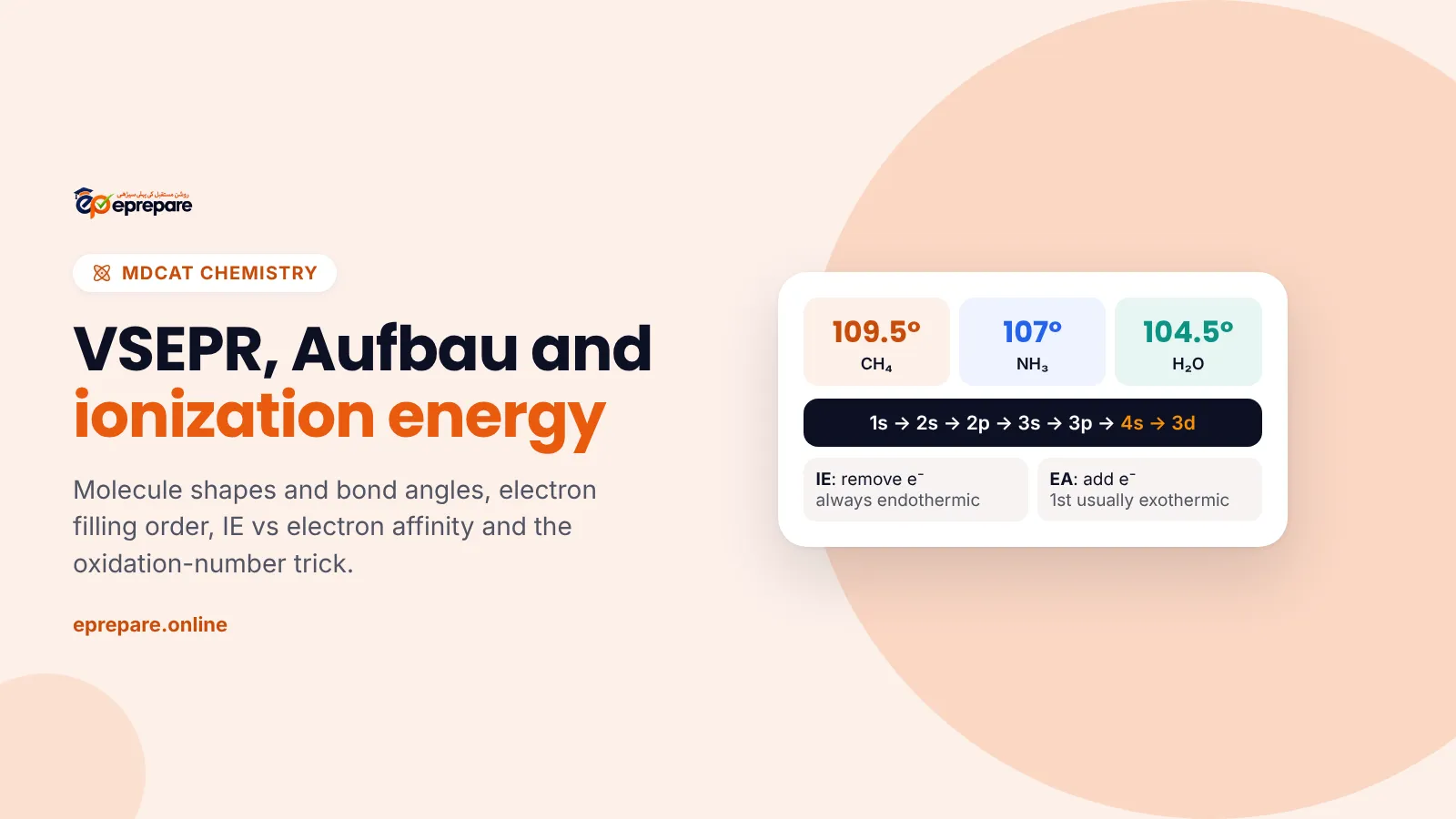
The short answer: VSEPR theory says electron pairs around a central atom repel each other and spread as far apart as possible, and lone pairs repel more than bond pairs. The Aufbau principle says electrons fill orbitals from the lowest energy upwards (1s, 2s, 2p, 3s, 3p, 4s, 3d…). Ionization energy is the energy needed to remove an electron from a gaseous atom and is always endothermic. Electron affinity is the energy change when a gaseous atom gains an electron, and the first one is usually exothermic.
What is VSEPR theory?
VSEPR stands for Valence Shell Electron Pair Repulsion. It predicts the shape of a molecule from the number of electron pairs around its central atom. The key ideas:
- Electron pairs in the valence shell of the central atom (bond pairs and lone pairs) repel one another.
- They arrange themselves as far apart as possible to keep repulsion lowest.
- Lone pairs take up more space than bond pairs, so the repulsion order is lone pair–lone pair > lone pair–bond pair > bond pair–bond pair.
- A double or triple bond counts as one region, like a single bond.
- The shape is named from the positions of the atoms only, not the lone pairs.
The KMU 2026 paper asked exactly this: according to VSEPR theory, what decides the shape of a molecule? The answer is electron pairs (see our KMU MDCAT paper with answer key).
VSEPR shapes and bond angles table
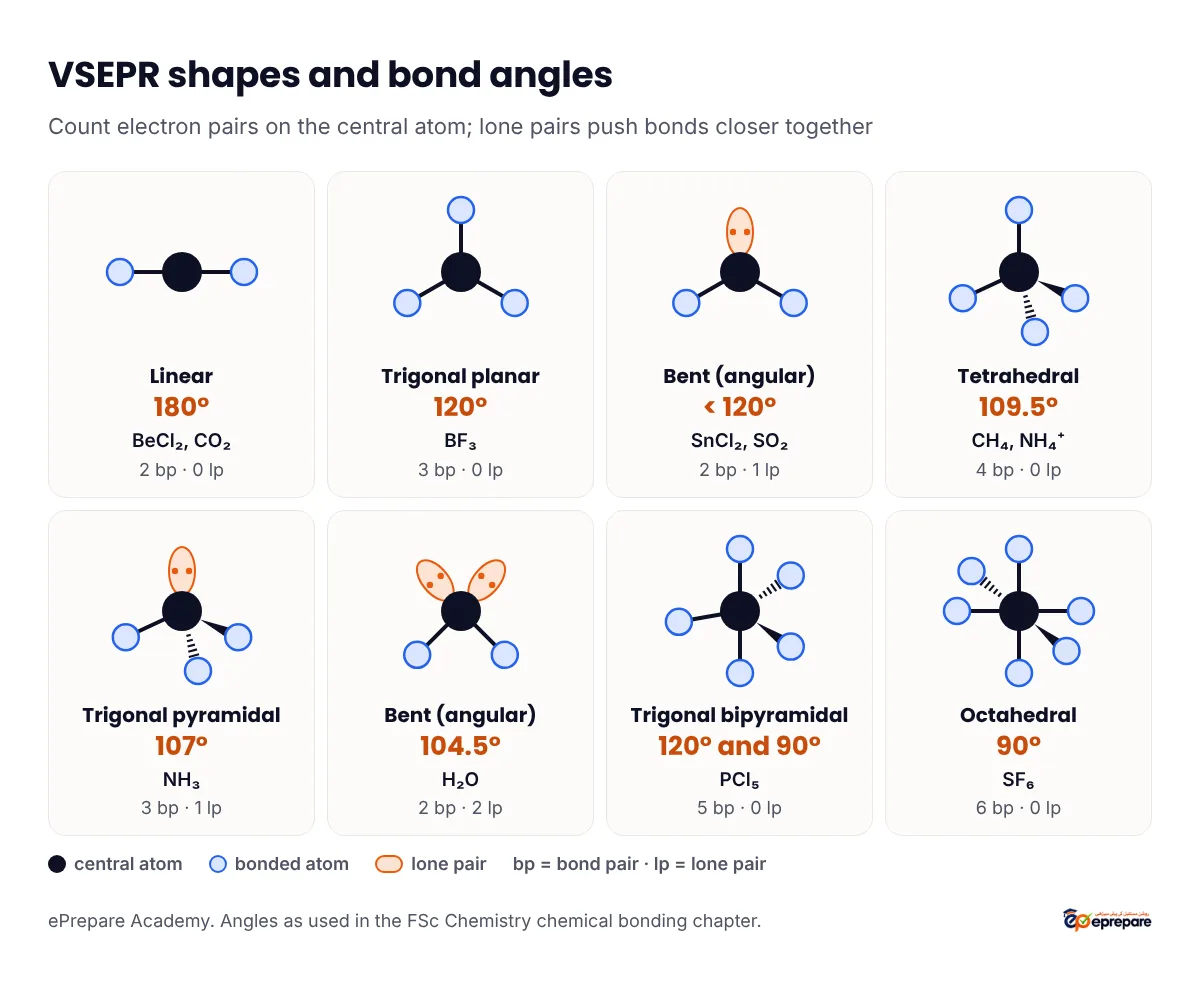
| Electron pairs (bond + lone) | Shape | Bond angle | Example | Hybridisation |
|---|---|---|---|---|
| 2 (2 + 0) | Linear | 180° | BeCl₂, CO₂ | sp |
| 3 (3 + 0) | Trigonal planar | 120° | BF₃ | sp² |
| 3 (2 + 1) | Bent (angular) | Less than 120° | SnCl₂, SO₂ | sp² |
| 4 (4 + 0) | Tetrahedral | 109.5° | CH₄, NH₄⁺ | sp³ |
| 4 (3 + 1) | Trigonal pyramidal | 107° | NH₃ | sp³ |
| 4 (2 + 2) | Bent (angular) | 104.5° | H₂O | sp³ |
| 5 (5 + 0) | Trigonal bipyramidal | 120° and 90° | PCl₅ | sp³d |
| 6 (6 + 0) | Octahedral | 90° | SF₆ | sp³d² |
How to work out a shape in four steps
- Take the number of valence electrons on the central atom.
- Add one for each surrounding atom that forms a single bond, such as H or a halogen. Add nothing for oxygen or sulphur. Add one for each negative charge and subtract one for each positive charge.
- Divide by 2 to get the number of electron pairs.
- Bond pairs = number of surrounding atoms. Lone pairs = electron pairs − bond pairs. Read the shape from the table.
- NH₃: 5 + 3 = 8, giving 4 pairs. With 3 bond pairs and 1 lone pair, NH₃ is trigonal pyramidal, 107°.
- H₂O: 6 + 2 = 8, giving 4 pairs. With 2 bond pairs and 2 lone pairs, H₂O is bent, 104.5°.
- NH₄⁺: 5 + 4 − 1 = 8, giving 4 pairs. With 4 bond pairs and no lone pair, NH₄⁺ is tetrahedral, 109.5°.
- SO₂: 6 + 0 = 6, giving 3 pairs. With 2 bond pairs and 1 lone pair, SO₂ is bent, below 120°.
- CO₂: 4 + 0 = 4, giving 2 regions, so CO₂ is linear, 180°.
How to remember VSEPR: learn the five parent shapes for 2, 3, 4, 5 and 6 pairs (linear, trigonal planar, tetrahedral, trigonal bipyramidal, octahedral). In the tetrahedral family, each lone pair takes about 2.5° off the angle: 109.5° (CH₄), then 107° (NH₃), then 104.5° (H₂O).
What is the Aufbau principle?
The Aufbau principle (from the German for "building up") says that electrons occupy orbitals in order of increasing energy: the lowest-energy orbital available is filled first. The order is decided by the (n + l) rule. The subshell with the lower value of n + l fills first. If two subshells have the same n + l, the one with the lower n fills first.
- 4s: n + l = 4 + 0 = 4. 3d: n + l = 3 + 2 = 5. So 4s fills before 3d.
- 3d and 4p both have n + l = 5, so 3d (lower n) comes first.
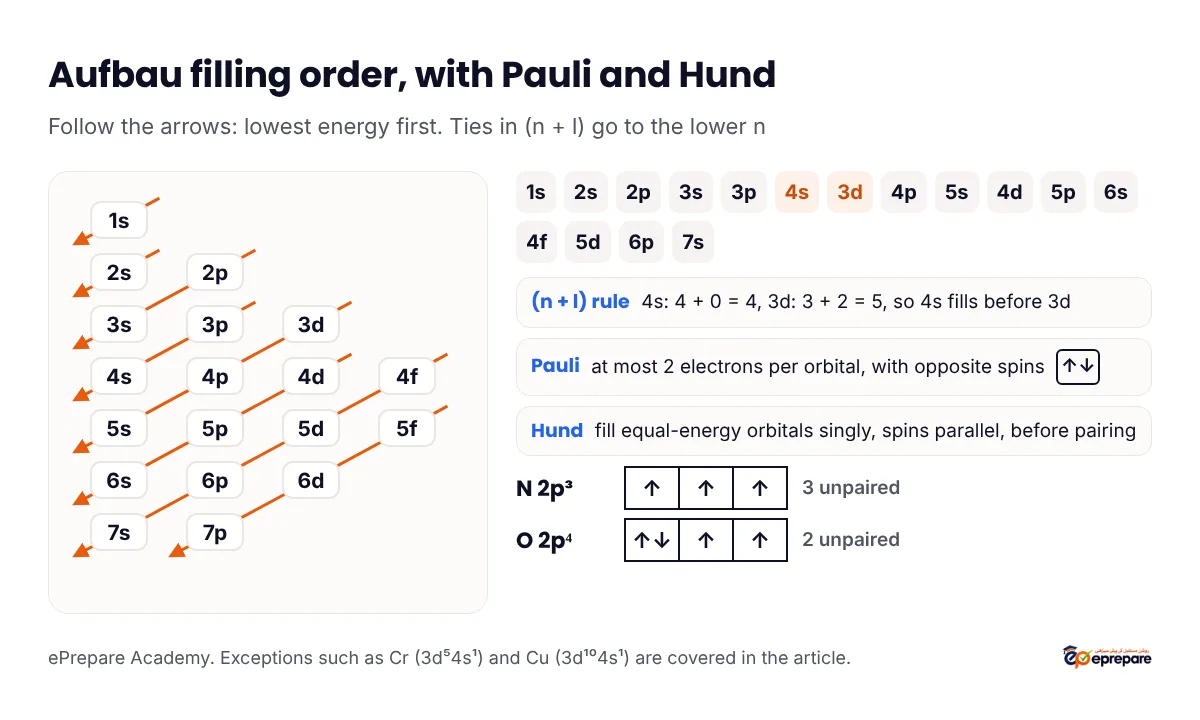
Filling order: 1s → 2s → 2p → 3s → 3p → 4s → 3d → 4p → 5s → 4d → 5p → 6s → 4f → 5d → 6p → 7s. Capacities: s holds 2, p holds 6, d holds 10 and f holds 14 electrons.
Pauli exclusion principle and Hund's rule
- Pauli exclusion principle: an orbital holds at most two electrons, and they must have opposite spins. Put another way, no two electrons in an atom can have the same set of four quantum numbers.
- Hund's rule: when orbitals of equal energy are available (the three p orbitals or the five d orbitals), electrons occupy them singly with parallel spins before any pairing begins. Nitrogen's 2p³ therefore has three unpaired electrons, and oxygen's 2p⁴ has one pair and two unpaired.
Worked electronic configurations
| Element | Configuration | Note |
|---|---|---|
| Na (11) | 1s² 2s² 2p⁶ 3s¹ | One valence electron |
| P (15) | 1s² 2s² 2p⁶ 3s² 3p³ | Three unpaired 3p electrons (Hund) |
| Fe (26) | [Ar] 3d⁶ 4s² | 4s filled before 3d |
| Cr (24) | [Ar] 3d⁵ 4s¹ | Exception: half-filled 3d is extra stable |
| Cu (29) | [Ar] 3d¹⁰ 4s¹ | Exception: completely filled 3d is extra stable |
| Fe³⁺ | [Ar] 3d⁵ | Ions lose 4s electrons before 3d |
Ionization energy vs electron affinity
Ionization energy (IE) is the minimum energy needed to remove the most loosely held electron from an isolated gaseous atom in its ground state. For sodium:
Na(g) → Na⁺(g) + e⁻ ΔH = +496 kJ mol⁻¹
Electron affinity (EA) is the energy change when an electron is added to an isolated gaseous atom to form a negative ion. For chlorine:
Cl(g) + e⁻ → Cl⁻(g) ΔH ≈ −349 kJ mol⁻¹
| Feature | Ionization energy | Electron affinity | Electronegativity |
|---|---|---|---|
| What happens | An electron is removed from a gaseous atom | An electron is added to a gaseous atom | A bonded atom pulls the shared pair towards itself |
| Ion formed | Positive ion | Negative ion | No ion (a property in a bond) |
| Energy sign | Always positive (endothermic) | First EA usually negative (exothermic); second EA always positive | No units (Pauling scale) |
| Highest value | Helium (among all elements) | Chlorine | Fluorine |
| Across a period | Increases (with dips at B and O) | Generally more negative | Increases |
| Down a group | Decreases | Generally less negative (except F < Cl) | Decreases |
Periodic trend for ionization energy
Across a period, the nuclear charge increases while electrons go into the same shell, so atoms get smaller and hold their electrons more tightly. Ionization energy therefore increases across a period. Down a group, the outer electron is in a shell further from the nucleus and is shielded by more inner shells, so ionization energy decreases down a group. That is why the NUMS 2026 paper's answer for decreasing ionization energy was F > Cl > Br (see the NUMS paper with answer key).
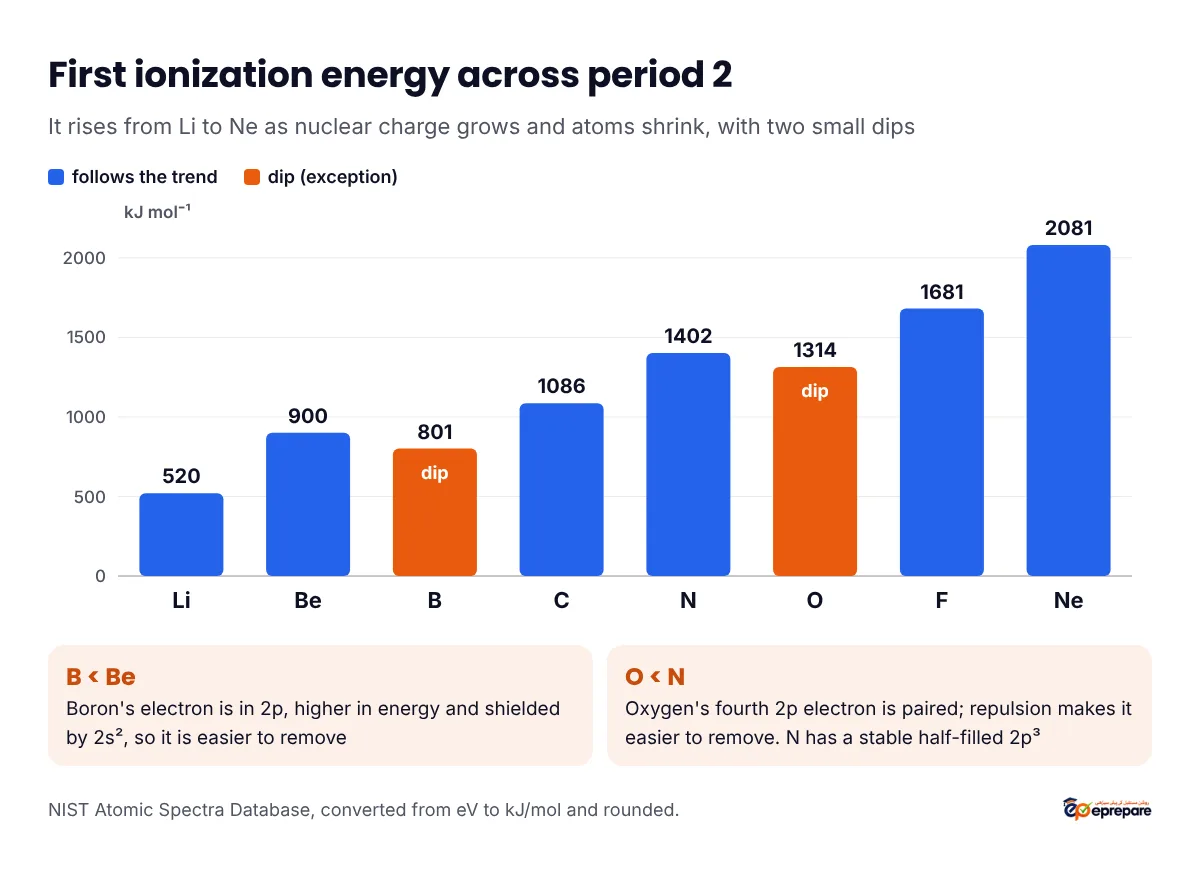
The two dips are favourite MCQs:
- Be (900) > B (801): boron's outer electron is in a 2p orbital, which is higher in energy and partly shielded by the 2s² pair, so it is easier to remove.
- N (1402) > O (1314): nitrogen has a stable half-filled 2p³. Oxygen's fourth 2p electron shares an orbital with another electron, and their repulsion makes it easier to remove.
The same pattern repeats in period 3: Mg (738) > Al (578), and P (1012) > S (1000). Successive ionization energies always increase (second IE > first IE), because each electron is removed from an increasingly positive ion.
Periodic trend for electron affinity
Electron affinity generally becomes more negative across a period (smaller atoms with higher nuclear charge attract an extra electron more strongly) and less negative down a group (larger atoms attract it less). The big exception: chlorine (about −349 kJ mol⁻¹) has a more negative electron affinity than fluorine (about −328 kJ mol⁻¹). Fluorine's 2p subshell is so small and crowded that the incoming electron is repelled by the electrons already there. So the relationship between electron affinity and atomic radius is "smaller atom, more negative EA", with fluorine as the exception.
Noble gases and the Group 2 elements beryllium and magnesium have filled subshells, so an extra electron must go into a new, higher subshell: their electron affinities are close to zero or positive. Nitrogen's half-filled 2p³ also gives it an unusually low electron affinity.
Is ionization endothermic or exothermic?
Ionization is always endothermic: energy must be supplied to pull an electron away from the attraction of the nucleus. Electron affinity is different: the first electron affinity of most elements is exothermic, because the nucleus attracts the incoming electron and energy is released. The second electron affinity (for example O⁻ + e⁻ → O²⁻) is always endothermic, because the electron has to be forced onto an ion that is already negative.
How to find oxidation number: the trick
An oxidation number is the charge an atom would have if all its bonds were ionic. The fast method: fix every atom whose value you know, call the unknown atom x, and make the total equal the overall charge.
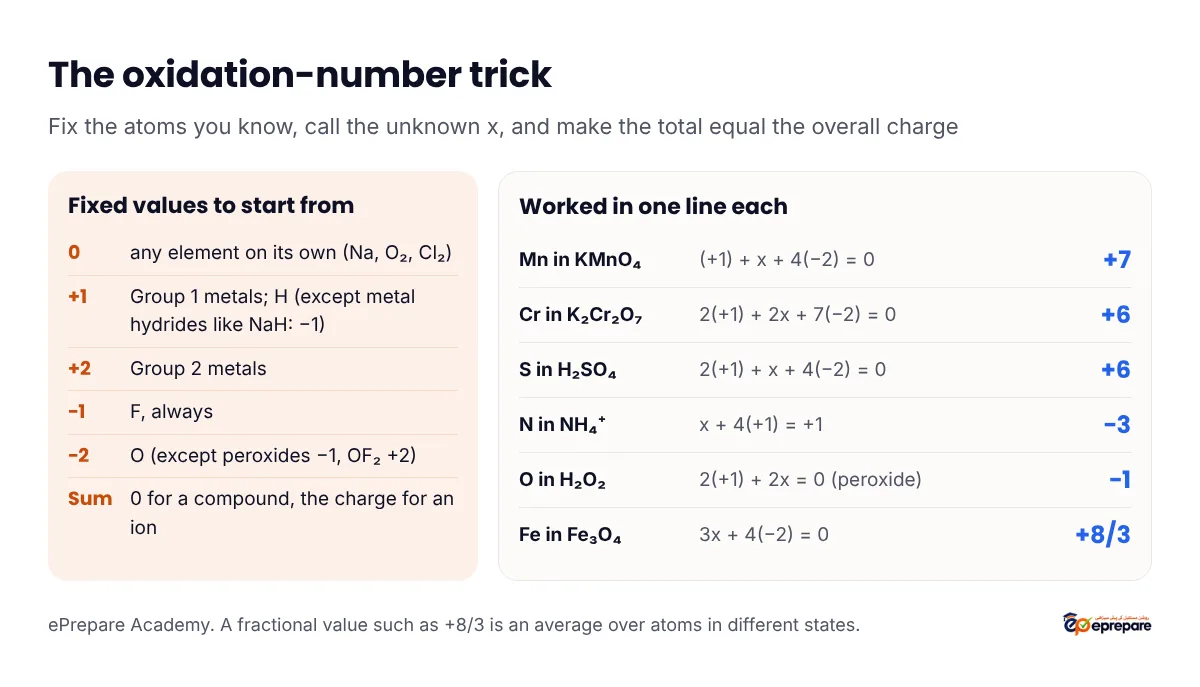
- Free elements are 0 (Na, O₂, Cl₂, S₈).
- The sum is 0 for a neutral compound and equals the charge for an ion.
- Group 1 metals are +1 and Group 2 metals are +2 in their compounds.
- Fluorine is always −1.
- Hydrogen is +1, except in metal hydrides such as NaH, where it is −1.
- Oxygen is −2, except in peroxides such as H₂O₂ and Na₂O₂ (−1), superoxides such as KO₂ (−½) and OF₂ (+2).
Worked: Mn in KMnO₄: (+1) + x + 4(−2) = 0, so x = +7. This exact question appeared in the NUMS 2026 paper. Cr in Cr₂O₇²⁻: 2x + 7(−2) = −2, so x = +6. Fe in Fe₃O₄: 3x = +8, so x = +8/3, an average, because the compound contains both Fe²⁺ and Fe³⁺. A fraction is a correct MCQ answer when atoms of the same element are in different states.
In redox reactions, an increase in oxidation number is oxidation and a decrease is reduction. The KMU 2026 paper tested this with +2 → 0 as the reduction.
MDCAT shortcuts and common traps: (1) Shape names ignore lone pairs: NH₃ has four electron pairs but is pyramidal, not tetrahedral. (2) Each lone pair in the tetrahedral family takes off about 2.5°: 109.5° → 107° → 104.5°. (3) 4s fills before 3d but empties first when ions form. (4) Cr and Cu are the two configuration exceptions to learn: 3d⁵4s¹ and 3d¹⁰4s¹. (5) The highest IE in period 2 order traps: N is above O, and Be is above B. (6) Cl, not F, has the most negative electron affinity, but F is the most electronegative. (7) Ionization is always endothermic. Only the first electron affinity is usually exothermic.
Practice MCQs: VSEPR, Aufbau, IE and EA
Question 1
The shape and bond angle of NH₃ are:
- Trigonal planar, 120°
- Tetrahedral, 109.5°
- Trigonal pyramidal, 107°
- Bent, 104.5°
Show answer
Answer: C. Nitrogen has four electron pairs: three bond pairs and one lone pair. The pairs point towards the corners of a tetrahedron, but the shape is named from the atoms only, so it is trigonal pyramidal. The lone pair pushes the bonds closer, from 109.5° to about 107°.
Question 2
The ground-state electronic configuration of chromium (Z = 24) is:
- [Ar] 3d⁴ 4s²
- [Ar] 3d⁵ 4s¹
- [Ar] 3d⁶
- [Ar] 4s² 4p⁴
Show answer
Answer: B. The Aufbau order would predict 3d⁴4s², but one 4s electron moves into 3d to give a half-filled 3d⁵, which is extra stable. Copper is the other common exception: [Ar] 3d¹⁰ 4s¹.
Question 3
Which element has the highest first ionization energy?
- Boron
- Carbon
- Nitrogen
- Oxygen
Show answer
Answer: C. Ionization energy generally rises across period 2, but oxygen (1314 kJ mol⁻¹) is below nitrogen (1402 kJ mol⁻¹). Nitrogen's half-filled 2p³ is stable, while oxygen's paired 2p electron is easier to remove because of electron–electron repulsion.
Question 4
Which element has the most negative (most exothermic) electron affinity?
- Fluorine
- Chlorine
- Oxygen
- Neon
Show answer
Answer: B. Chlorine releases about 349 kJ mol⁻¹ on gaining an electron, more than fluorine (about 328 kJ mol⁻¹). Fluorine's small, crowded 2p subshell repels the incoming electron. Neon has a full shell, so its electron affinity is not exothermic.
Question 5
The oxidation number of sulphur in sodium thiosulphate, Na₂S₂O₃, is:
- +2
- +4
- +6
- −2
Show answer
Answer: A. 2(+1) + 2x + 3(−2) = 0, so 2x = +4 and x = +2. This is the average over the two sulphur atoms, which is what the method gives and what MCQs expect.
Practise more of these on our free MDCAT Chemistry MCQs page, which includes real past-paper questions with explanations. For where atomic structure, bonding and periodic trends sit among the Chemistry units, see MDCAT Chemistry: high-yield chapters. The official learning outcomes for each (units 2, 9, 10 and 11) are on the MDCAT syllabus page.
Frequently asked questions
What is VSEPR theory?
VSEPR (Valence Shell Electron Pair Repulsion) theory predicts molecular shapes. Electron pairs around the central atom repel each other and arrange themselves as far apart as possible, with lone pairs repelling more strongly than bond pairs. Two pairs give a linear shape (180°), three trigonal planar (120°), four tetrahedral (109.5°), five trigonal bipyramidal and six octahedral.
How can I remember VSEPR shapes?
Learn the five parent shapes for 2 to 6 electron pairs, then remember that lone pairs are not counted in the name and each one squeezes the angle. In the tetrahedral family the angle drops by about 2.5° per lone pair: CH₄ 109.5°, NH₃ 107°, H₂O 104.5°.
What is the Aufbau principle?
The Aufbau principle states that electrons fill orbitals in order of increasing energy, lowest first. The order follows the (n + l) rule: 1s, 2s, 2p, 3s, 3p, 4s, 3d, 4p, 5s and so on. Chromium and copper are the common exceptions.
What is Hund's rule?
Hund's rule says that electrons enter orbitals of equal energy singly, with parallel spins, before they pair up. For example, nitrogen's three 2p electrons occupy all three 2p orbitals singly.
What is the difference between ionization energy and electron affinity?
Ionization energy is the energy needed to remove an electron from a gaseous atom, forming a positive ion; it is always endothermic. Electron affinity is the energy change when a gaseous atom gains an electron, forming a negative ion; the first electron affinity is usually exothermic. Electronegativity is different again: it describes how strongly an atom in a bond attracts the shared electron pair.
Is electron affinity endothermic or exothermic?
The first electron affinity of most elements is exothermic, because energy is released as the nucleus attracts the added electron. The second electron affinity is always endothermic, because the electron is being added to a negative ion that repels it. Ionization energy is always endothermic.
What are the periodic trends for ionization energy and electron affinity?
Ionization energy increases across a period and decreases down a group, with small dips at Group 13 (B, Al) and Group 16 (O, S). Electron affinity generally becomes more negative across a period and less negative down a group, except that chlorine's is more negative than fluorine's.
What is the trick to find oxidation numbers?
Fix the oxidation numbers you know (Group 1 is +1, Group 2 is +2, F is −1, H is usually +1, O is usually −2), call the unknown atom x, and set the total equal to the overall charge: zero for a compound, or the ion's charge. For KMnO₄: 1 + x − 8 = 0, so Mn = +7.
These are the kind of topics where a few minutes of daily practice turns into sure marks on exam day. Register on ePrepare to drill bonding, atomic structure and periodic-trend MCQs with explanations, and let Wrong MCQs bring back each one you miss until it sticks.
Sources: PM&DC Uniform Curriculum MDCAT (Chemistry units 2, 9, 10 and 11); first ionization energies from the NIST Atomic Spectra Database (converted from eV at 96.485 kJ mol⁻¹ per eV and rounded); electron affinities of chlorine and fluorine from the NIST Chemistry WebBook; past-paper questions from the KMU and NUMS 2026 papers as published on ePrepare.