You can know the answer to every MCQ and still lose marks on MDCAT day, because the paper is marked from your answer sheet, not from your question booklet. A faint bubble, a tick instead of a fill, two marks in one row, or one skipped row that shifts every answer after it: these are mistakes of the pen, not of knowledge. This guide shows you what a correctly filled OMR (optical mark recognition) sheet looks like, which marks go wrong, how to plan your time so bubbling never becomes a last-minute rush, and gives you a practice grid to print.
The short answer: Fill exactly one bubble per question, completely and darkly, with the pen your admit card and answer sheet tell you to use. Write and bubble your roll number and any paper code carefully before you start, check that question numbers match every 10 questions, and keep the sheet clean and unfolded. MDCAT has no negative marking, so never leave a row blank. Above all, follow the instructions printed on your own admit card and OMR sheet, because your conducting university sets them.
First rule: your own sheet's instructions come first
MDCAT is set by PM&DC but conducted by different universities in different regions. In 2026 they were:
- UHS Lahore for Punjab
- Sukkur IBA University for Sindh
- KMU Peshawar for Khyber Pakhtunkhwa
- BUMHS Quetta for Balochistan
- SZABMU Islamabad for Islamabad, AJK, Gilgit-Baltistan and Riyadh
Each conducting university prints its own answer sheet and its own instructions: the layout, the fields, the kind of pen, and what to do if you make a mistake. The rules in this guide are general ones that apply to almost every OMR sheet. Where your admit card or sheet says something different, do what your sheet says. Read those instructions at home when the admit card arrives, and again in the hall before the paper starts. NUMS runs its own separate test for Armed Forces colleges, with its own instructions.
Why bubbles must be filled properly
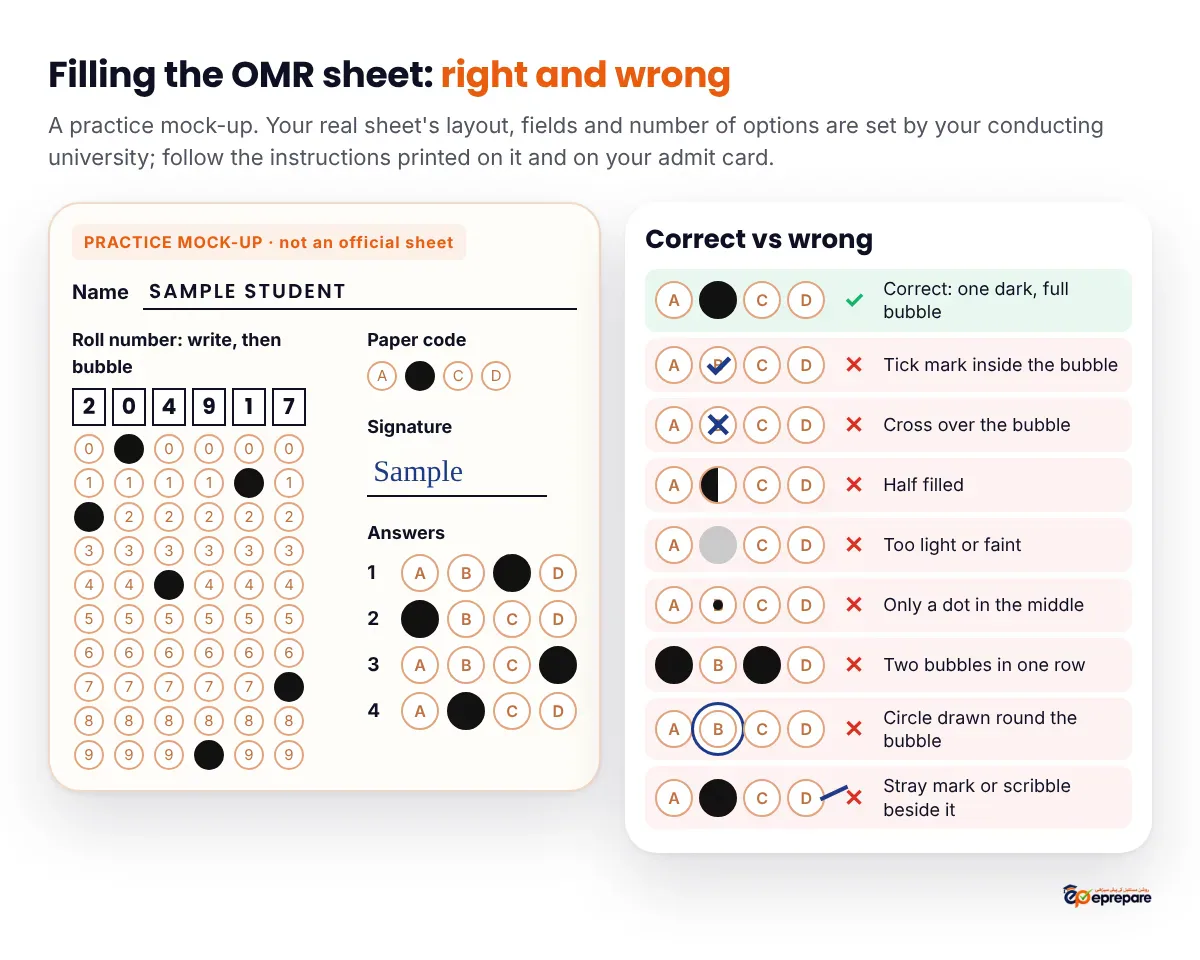
An OMR sheet is read by a scanner that looks for dark marks in fixed positions. It does not read handwriting and it cannot guess what you meant. A full, dark bubble is read as your answer. A tick, a light shade or a dot may be read as nothing. A second mark in the same row may be read as two answers, and a stray scribble near a bubble may be read as a mark. That is why the "boring" rules matter.
Before the paper starts: fill the fields carefully
Most sheets have a few fields to fill before the answers: usually your name, roll number and signature, and sometimes a paper code, version or booklet number. Do these slowly. A wrong roll number can be far more serious than one wrong answer.
- Copy the roll number from your admit card, not from memory.
- Write the digits in the boxes at the top of each column, if your sheet has them.
- Bubble the matching digit in each column. In the mock-up, roll number 204917 has 2 bubbled in the first column, 0 in the second, 4 in the third, and so on.
- Check the written digits against the bubbles, column by column, then against your admit card once more.
- Fill any paper code or version exactly as printed on your question booklet, if your sheet asks for it.
- Sign only where the sheet asks, and nowhere else on the sheet.
The bubble rules (general and widely applicable)
| Do | Do not |
|---|---|
| Fill the bubble completely, edge to edge, and darkly | Tick, cross, dot, half-fill or lightly shade it |
| Mark one bubble per question | Mark two bubbles in one row |
| Use the pen your admit card and sheet instruct (commonly a blue or black ballpoint) | Assume a pencil, gel pen or marker is allowed |
| Keep the sheet flat, clean and dry | Fold, staple, crumple or wet it, or rest a sweaty hand on it |
| Do rough work on the question booklet or where you are told to | Write, doodle or calculate anywhere on the answer sheet |
| Decide on your answer before you bubble it | Use correction fluid or try to erase ink, unless your instructions allow a way to correct |
| Check question numbers every 10 questions | Leave the alignment check until the end |
Remember this: with a ballpoint, a bubble usually cannot be undone cleanly. Decide first, then fill. If you do make a mistake, raise your hand and follow the invigilator's and the sheet's instructions; do not scratch at the bubble.
The alignment trap: one skipped row shifts everything
This is the costliest OMR mistake. You skip question 23 to come back later, but you mark question 24's answer in row 23. Now every answer after it is in the wrong row, and a whole block of correct answers can be marked wrong.
How to prevent it:
- Say the number as you bubble. "Twenty-four, C." Look at the row number, not just the next empty row.
- Checkpoint every 10. At 10, 20, 30 and so on, make sure the question number in the booklet matches the row on the sheet. The practice grid below shades these rows.
- If you skip a question, skip its row too. Circle the question number in your booklet so you can find it quickly later.
- Before the end, scan for empty rows. Every row from 1 to the last question should have exactly one dark bubble.
Time strategy: when to bubble
MDCAT is 180 MCQs in 3 hours, so you have about one minute per question including bubbling. Filling 180 bubbles properly takes real time, so plan for it. There are three common approaches:
| Approach | How it works | Pros | Risks |
|---|---|---|---|
| Mark as you go | Solve a question, bubble it immediately | Nothing is left to transfer at the end; safest if time runs out | Switching between booklet and sheet on every question; easy to drift out of alignment if you skip |
| Transfer in blocks | Solve one page or section (about 10–20 questions), then bubble that block | Fewer switches; a natural alignment checkpoint after each block | Only if your instructions allow marking answers on the booklet; the last block must not be left too late |
| Transfer all at the end | Solve the whole paper, then bubble everything | Fewest switches | Very risky: if time runs short, many rows stay empty, and rushed bubbles are messy |
For most students, marking as you go or transferring in small blocks is the sensible choice. Never leave all 180 answers for the last part of the paper.
A sample time plan for 180 minutes
| Section | MCQs | Time budget |
|---|---|---|
| Biology | 81 | 70 min |
| Chemistry | 45 | 45 min |
| Physics | 36 | 40 min |
| English | 9 | 7 min |
| Logical Reasoning | 9 | 10 min |
| Final check: empty rows, double marks, roll number | — | 8 min |
| Total | 180 | 180 min |
Adjust it to your strengths and to the order of sections in your paper, and practise it in full-length papers. For more on pacing, read MDCAT time management.
No negative marking: never leave a bubble empty
MDCAT has no negative marking, so a wrong answer costs nothing more than a blank one, while a guess might be right. If you are unsure, eliminate the options you know are wrong and bubble the best of the rest. In the final minutes, make sure no row is empty. More on this in MDCAT negative marking explained.
Practise bubbling before exam day
Bubbling feels trivial until you do it 180 times under a clock. Practise it at least a few times before MDCAT so the extra time and the alignment checks become automatic. Print the grid below and bubble every answer on it when you solve a past paper or a printed set of questions.
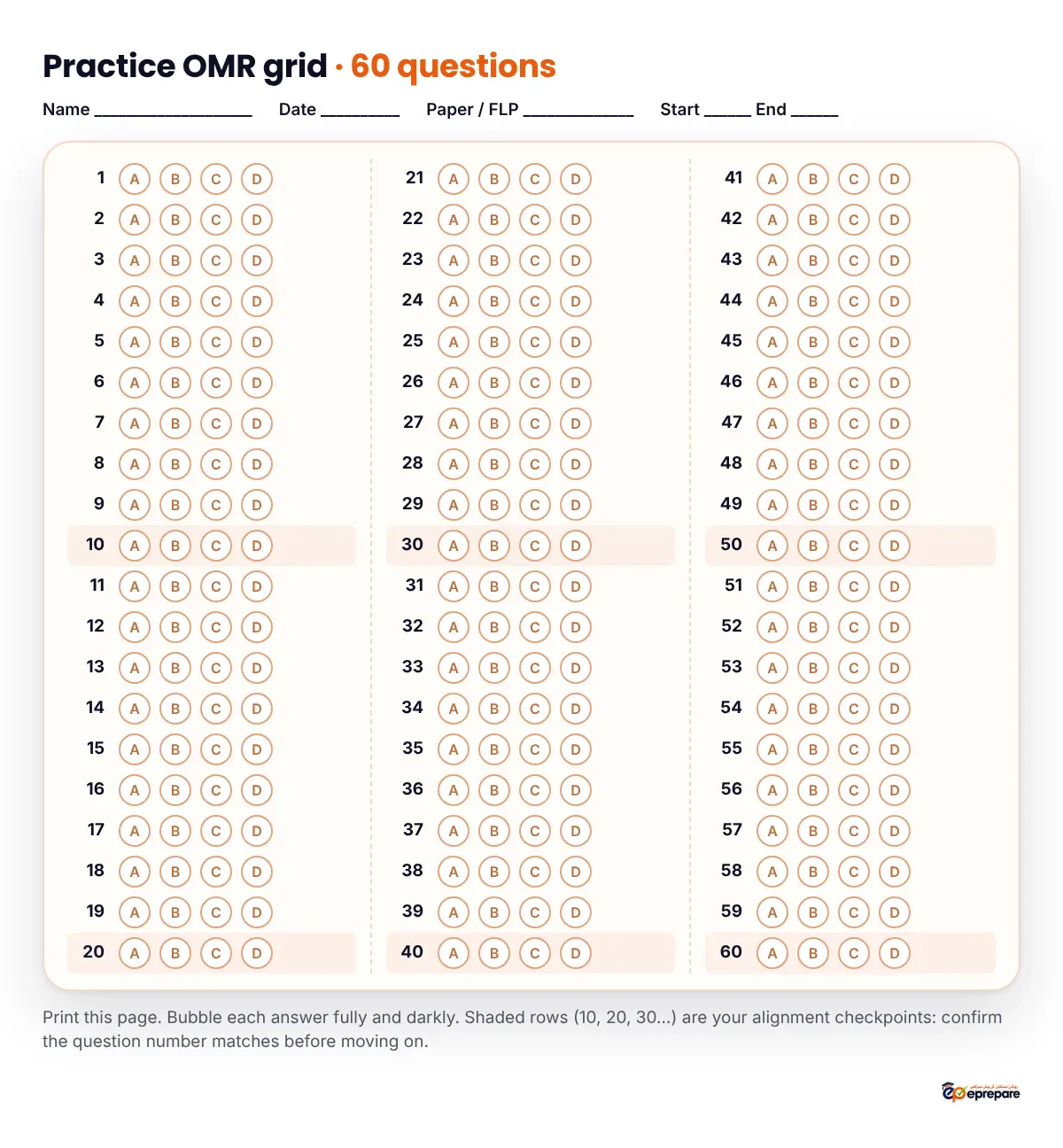
A good routine:
- Use three printed grids for one full paper (60 + 60 + 60 rows).
- Time yourself for the full three hours, bubbling included.
- Check the alignment at every shaded row.
- At the end, note how many minutes the bubbling took and whether any row was shifted, double-marked or empty.
Build stamina with full-length papers
The other half of OMR success is having enough time left to bubble calmly, which comes from practising the whole 3-hour paper. ePrepare's FLP series gives you full-length papers of 180 MCQs in 180 minutes, two papers for each syllabus stage, with your result, rank and a leaderboard after you submit.
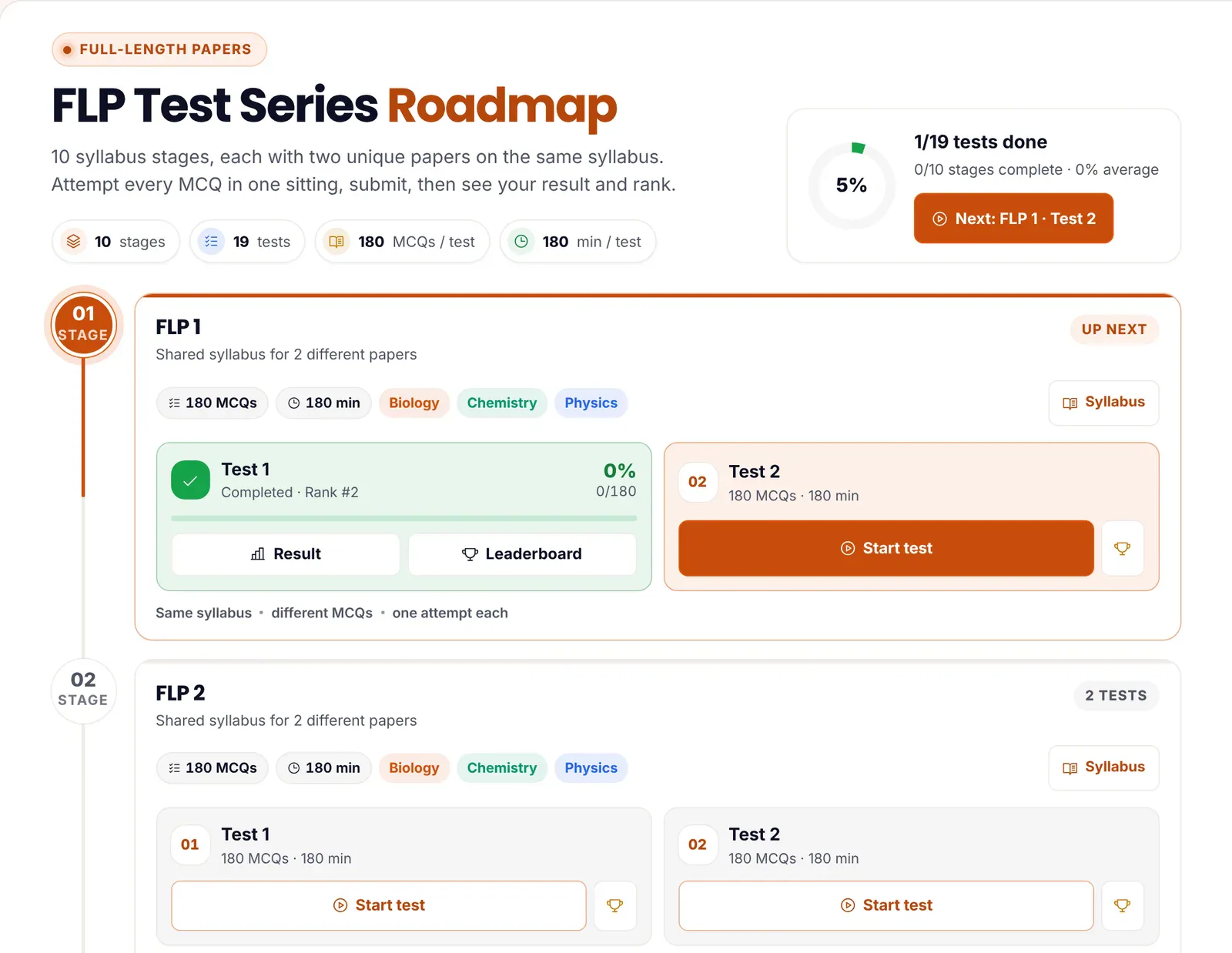
For one or two of these papers, keep a printed practice grid beside you and also bubble each answer on it as you go. You will feel exactly how much time bubbling adds. Read more in ePrepare's FLP series explained and how to use MDCAT mock tests. The FLP series is part of the Advance package; see packages or the FLP series page.
Exam-day OMR checklist
- Read the instructions on your admit card the day it arrives, and note the pen it asks for.
- Carry more than one pen of the kind your instructions specify.
- Bring the documents your admit card lists.
- In the hall, read the instructions printed on the OMR sheet before writing anything.
- Copy your roll number from the admit card; write it, bubble it, check it.
- Fill any paper code or version exactly as printed on your booklet.
- Bubble one dark, full circle per question; check alignment every 10.
- Leave about 8 minutes at the end: no empty rows, no double marks, roll number correct.
- Hand in the sheet flat and unfolded, as the invigilator instructs.
Common OMR mistakes and their fixes
| Mistake | Prevention |
|---|---|
| Answers shifted by one row | Say the number as you bubble; checkpoint every 10 questions |
| Faint or half-filled bubbles | Fill edge to edge with steady pressure; practise on the grid |
| Two bubbles in one row | Decide before you bubble; never "mark both and decide later" |
| Running out of time to transfer | Mark as you go or in small blocks; follow a time plan |
| Empty rows at the end | No negative marking: guess smartly and fill every row |
| Wrong roll number | Copy from the admit card; check written digits against bubbles |
| Wrong pen | Use only what your admit card and sheet specify |
| Folded or damaged sheet | Keep it flat; rough work goes on the booklet |
آسان الفاظ میں: OMR sheet ایک machine پڑھتی ہے، اس لیے ہر سوال کا صرف ایک bubble مکمل اور گہرا بھریں۔ Tick، cross، ہلکا یا آدھا bubble غلط پڑھا جا سکتا ہے۔ Roll number admit card سے دیکھ کر لکھیں اور ہر column میں صحیح digit بھریں۔ ہر 10 سوال کے بعد check کریں کہ سوال نمبر اور row ایک ہی ہیں۔ MDCAT میں negative marking نہیں، اس لیے کوئی row خالی نہ چھوڑیں۔ اور سب سے اہم بات: اپنے admit card اور sheet پر لکھی ہدایات پر عمل کریں، کیونکہ ہر conducting university اپنی ہدایات خود دیتی ہے۔
Frequently asked questions
Which pen should I use for the MDCAT OMR sheet?
Use exactly what your admit card and the answer sheet instruct. Blue or black ballpoint is common for OMR sheets, but each conducting university sets its own rule, so do not assume a pencil or gel pen is allowed.
What happens if I fill two bubbles for one question?
On most OMR sheets, a row with two marks is not counted as a correct answer. Decide before you bubble, and if you make a mistake, follow the instructions on your sheet and ask the invigilator rather than scratching at the bubble.
Can I change an answer on the OMR sheet?
With a ballpoint, a filled bubble usually cannot be erased cleanly, and correction fluid is often not allowed. Check your sheet's instructions for whether and how corrections are possible, and avoid the problem by deciding first.
Should I leave a question blank in MDCAT if I am not sure?
No. MDCAT has no negative marking, so a blank row can only score zero. Eliminate the options you know are wrong and bubble your best choice.
Should I fill the OMR sheet at the end or as I go?
Mark as you go, or transfer in small blocks of one page or section if your instructions allow marking the booklet. Leaving all 180 answers to the end risks running out of time and shifting rows.
How can I practise filling an OMR sheet at home?
Print the practice grid on this page, three copies for a full paper, and bubble every answer while you solve a timed past paper. Combine it with full-length papers to build the stamina to finish with time to spare.