

When a son or daughter decides to prepare for MDCAT, the whole house prepares with them. Dinner times move, the television gets quieter, and parents start hearing words like "aggregate", "FLP" and "merit list" every day. Most parents we speak to at ePrepare want to help but are not sure how. Push too little and you worry they will drift. Push too much and you watch them burn out.
This guide is for you, the parent. It covers what your child is actually up against, how to support them at home without adding pressure, the signs of burnout, the dates and deadlines you should track yourself, what MDCAT and a medical degree can cost, how to judge progress, how to choose a preparation option and which documents to arrange early. The admission details use Khyber Pakhtunkhwa (KP) as the example, because that is where most of our students are, but the advice on supporting your child works in every province.
The short answer: give your child a calm routine, protected sleep, regular meals and clear phone rules, and keep comparisons with other children out of the house. Check progress once a week by looking at the trend in test scores, not one paper. Track the dates yourself: MDCAT registration on the Pakistan Medical and Dental Council (PM&DC) portal (22 June to 8 July in 2026), test day, the admission advertisement, merit lists and the fee, which KMU wants within three working days of an offer letter. Arrange documents such as your child's and the father's domicile and CNIC or B-Form months early, because certificates issued after the closing date do not count. And if you see signs of burnout, slow down and talk to a doctor or counsellor.
What your child is preparing for
The Medical and Dental College Admission Test (MDCAT) is conducted under PM&DC's rules and is required for admission to public and private MBBS and BDS seats in Pakistan. It is 180 multiple-choice questions in 3 hours: 81 Biology, 45 Chemistry, 36 Physics, 9 English and 9 Logical Reasoning, with no negative marking.
- It is half of the merit. For public MBBS and BDS seats, merit (the "aggregate") is 10% Matric, 40% FSc and 50% MDCAT. One MDCAT mark out of 180 is worth about 0.28 aggregate, so a few MCQs can move a student past hundreds of others. Try your child's numbers in the aggregate calculator, and see how it works in our aggregate formula guide.
- Passing is not the same as getting a seat. The minimum is 55% for MBBS and 50% for BDS, but in recent years the last open merit MBBS seats in KP's public colleges have closed at around 93% aggregate. With good board marks that means roughly 166 to 171 out of 180 in MDCAT. See the KMU closing merit page and our passing marks guide.
- Each province admits through its own university. In KP that is Khyber Medical University (KMU). Elsewhere it is the University of Health Sciences (UHS) in Punjab, Dow University of Health Sciences (DUHS) and Jinnah Sindh Medical University (JSMU) in Sindh, and Bolan University of Medical and Health Sciences (BUMHS) in Balochistan. The army medical colleges admit through the National University of Medical Sciences (NUMS). Our guides for Punjab, Sindh, Balochistan, Islamabad and NUMS cover the details.
In other words, your child is not just studying for a pass. They are competing for a small number of seats, usually over many months. That is why steady support at home matters so much.
How to support your child at home
A routine the whole house respects
Students who do well are rarely the ones who study 14 hours one day and nothing the next. They are the ones who follow a plan every day. You can help by making the day predictable:
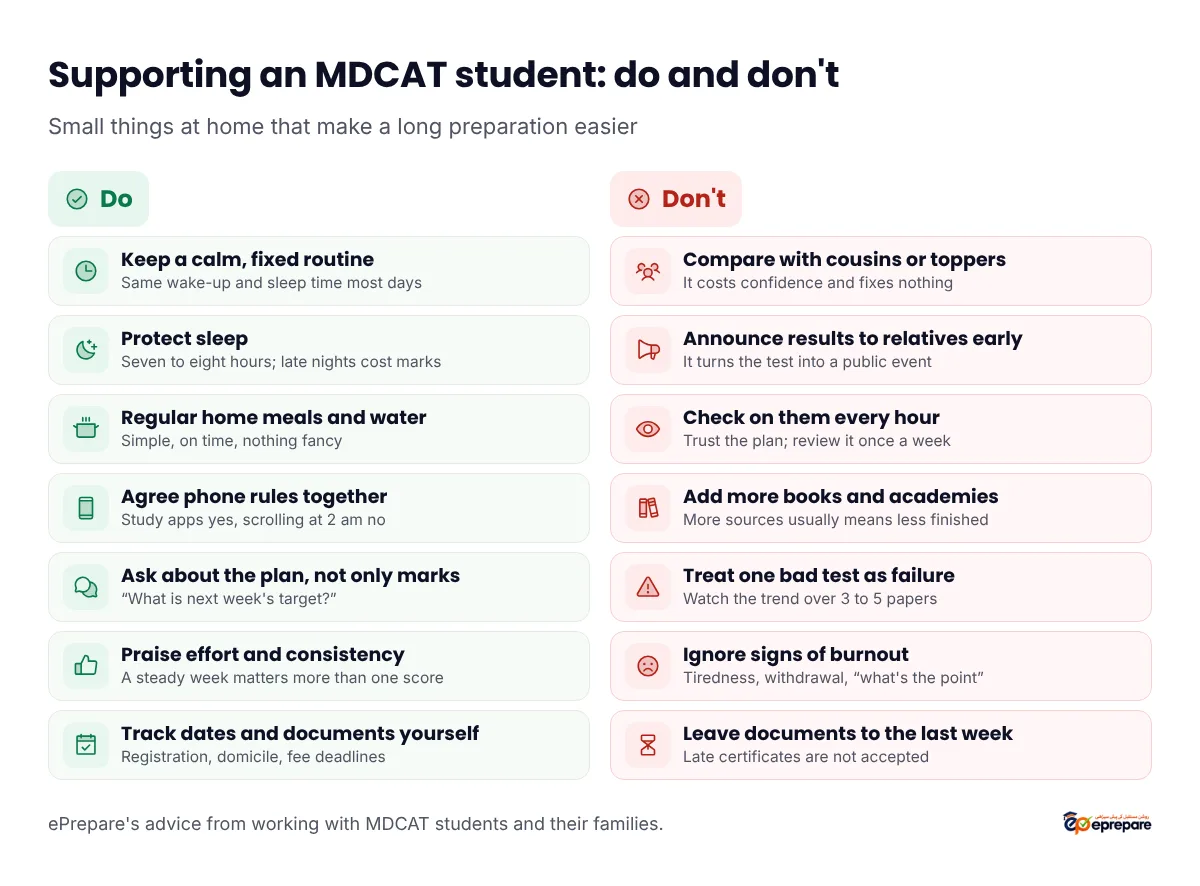
- A fixed time to wake up and a fixed time to sleep, on most days.
- Quiet study hours that the family knows about, with visitors and errands kept outside them where possible.
- One lighter half-day each week. Rest is part of the plan, not a reward.
- A say for your child in family events. Some weddings and gatherings are worth attending; a week of them in the final month usually is not.
Sleep and food: keep it simple
We are teachers, not doctors, so we will stick to the basics we see work. Our preparation guide recommends seven to eight hours of sleep, because tired students make careless mistakes on easy MCQs. Late-night study that steals sleep usually costs more than it gains. For food, regular home meals at normal times and water at the desk are enough; there is no special "exam diet" you need to buy. Tea is fine, but not as a replacement for sleep. If your child has a health problem, or you are worried about their eating or weight, please see a doctor.
The phone: a study tool and a trap
Many students now study on their phones. ePrepare itself is an app, with lectures, MCQs and tests on the phone. So taking the phone away completely is not the answer. Agree a few rules together instead, and keep them for yourself too:
- Notifications off during study blocks; social media apps used only at set times.
- The phone charges outside the bedroom at night.
- Result posts, rumours and "leaked paper" groups muted. They cost time and confidence.
- If your child says they are studying on the phone, ask to see what they finished, kindly, at the weekly check-in, rather than checking over their shoulder.
Pressure: what helps and what hurts
Almost every MDCAT student already feels pressure. Your job is to lower it, not add to it.
- Do not compare. "Your cousin got 170" never raised anyone's score. Compare your child only with their own last month.
- Keep the test private. Telling relatives which college your child "will get" turns a test into a public event. Let your child decide what to share.
- Talk about the plan, not just marks. "What is the target for next week?" is a better question than "How much did you get?"
- Praise effort and consistency. A steady week deserves notice even when a test goes badly.
- Do not keep mentioning money. Your child knows what the preparation costs. Reminders add guilt, not marks.
Recognising burnout, and when to get help
Long preparation can wear a young person down. These are signs to take seriously, especially when several appear together or last more than a couple of weeks:
- Tiredness that does not improve with rest, or sleeping much more or much less than usual.
- Avoiding study or tests altogether, or test scores falling for several weeks in a row.
- Withdrawing from family and friends, irritability or frequent crying.
- Saying things like "what's the point" or "I can't do this anymore".
- Frequent headaches, stomach trouble or changes in appetite.
If you see these, slow down. Sit with your child without the study plan in the room. Allow real rest for a few days. Ask what feels heaviest. Above all, talk to a doctor or a counsellor; your family doctor is a good first step. The Higher Education Commission (HEC) lists a toll-free National Youth Helpline, 0800-69457, launched in 2022 under the Prime Minister's Youth Programme as a pilot for psychosocial support and counselling. We could not confirm that it is still running, so if it does not connect, go to a doctor. If your child ever talks about harming themselves, do not wait: stay with them and take them to the nearest hospital the same day.
The admission calendar parents should track
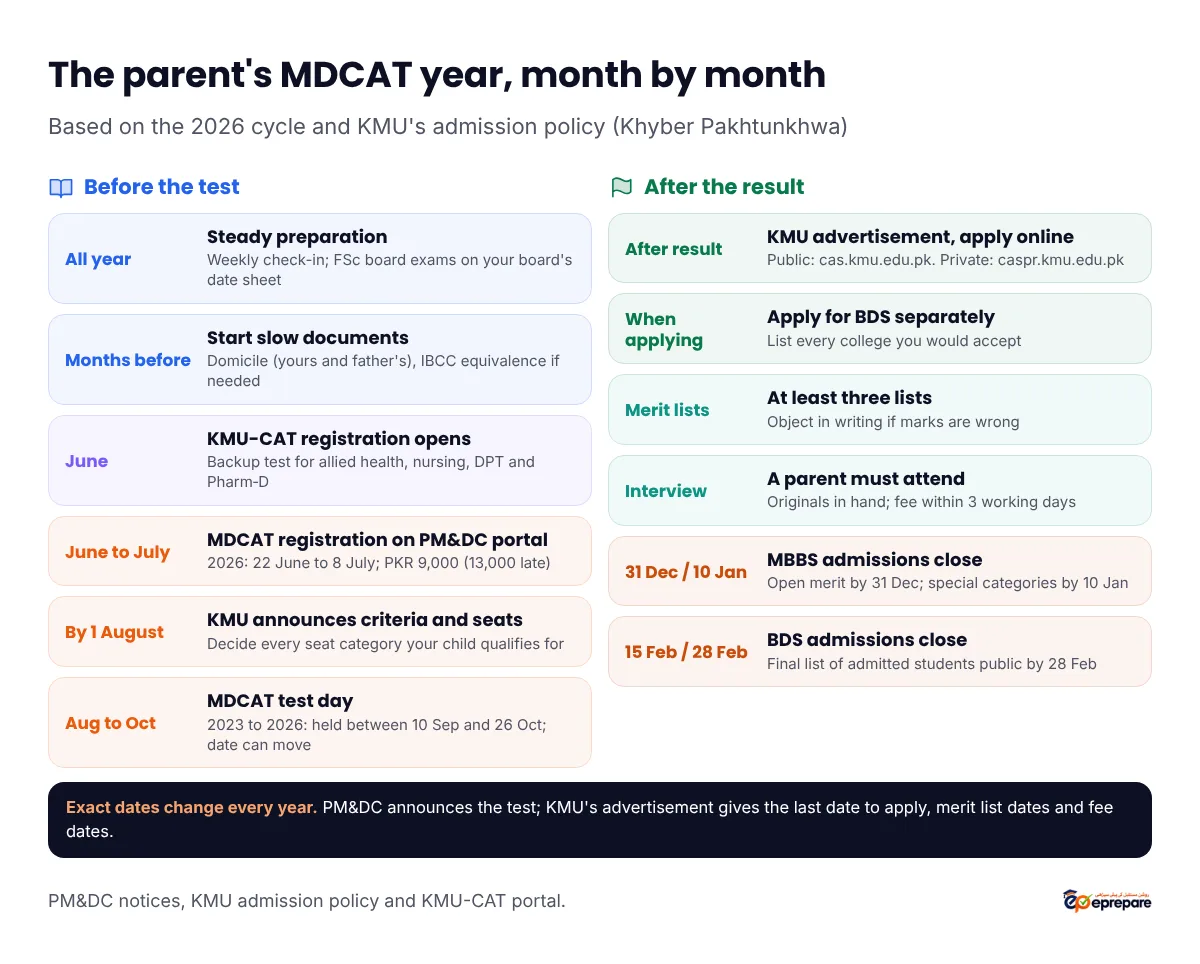
Students are busy studying. Many deadlines are missed not because of low marks but because nobody at home was watching the dates. This is the order of events in a typical year, based on the 2026 cycle and KMU's admission policy:
| When | What happens | What parents do |
|---|---|---|
| Months before | Preparation; board exams | Apply for slow documents: domicile (child's and father's), IBCC equivalence for O and A levels |
| June to July | MDCAT registration on PM&DC's portal (2026: 22 June to 8 July, late fee to 13 July) | Register in the first week, pay the fee, keep the receipt and login details |
| By 1 August | KMU announces merit criteria and seat categories | Check every category your child qualifies for |
| Test day | MDCAT; from 2023 to 2026 it was held between 10 September and 26 October | Plan travel, visit the centre the day before, check the admit card |
| After the result | KMU advertises admissions; online application at cas.kmu.edu.pk (public) and caspr.kmu.edu.pk (private) | Apply before the last date, for every category and for BDS too if acceptable |
| Merit lists | At least three merit lists and placement interviews | Go with your child: a parent or legal guardian must attend. Have the fee ready |
| Offer letter | Fee due within three working days | Deposit on time, or the admission is cancelled |
| 31 Dec to 28 Feb | MBBS open merit closes by 31 December, special categories by 10 January; BDS open merit before 15 February, special categories by 28 February | Keep watching later lists for upgrades |
The MDCAT date often moves: in 2026 it was first set for 16 August and held on 20 September. Follow PM&DC's notices on pmdc.pk and our MDCAT date and registration guide. For every admission step, read the KMU admission schedule and how merit lists, upgrades and the waiting list work. If your child would also consider allied health degrees, the KMU Centralized Admission Test (KMU-CAT) opens registration in June on cat.kmu.edu.pk, before the MDCAT result.
What MDCAT and a medical degree can cost
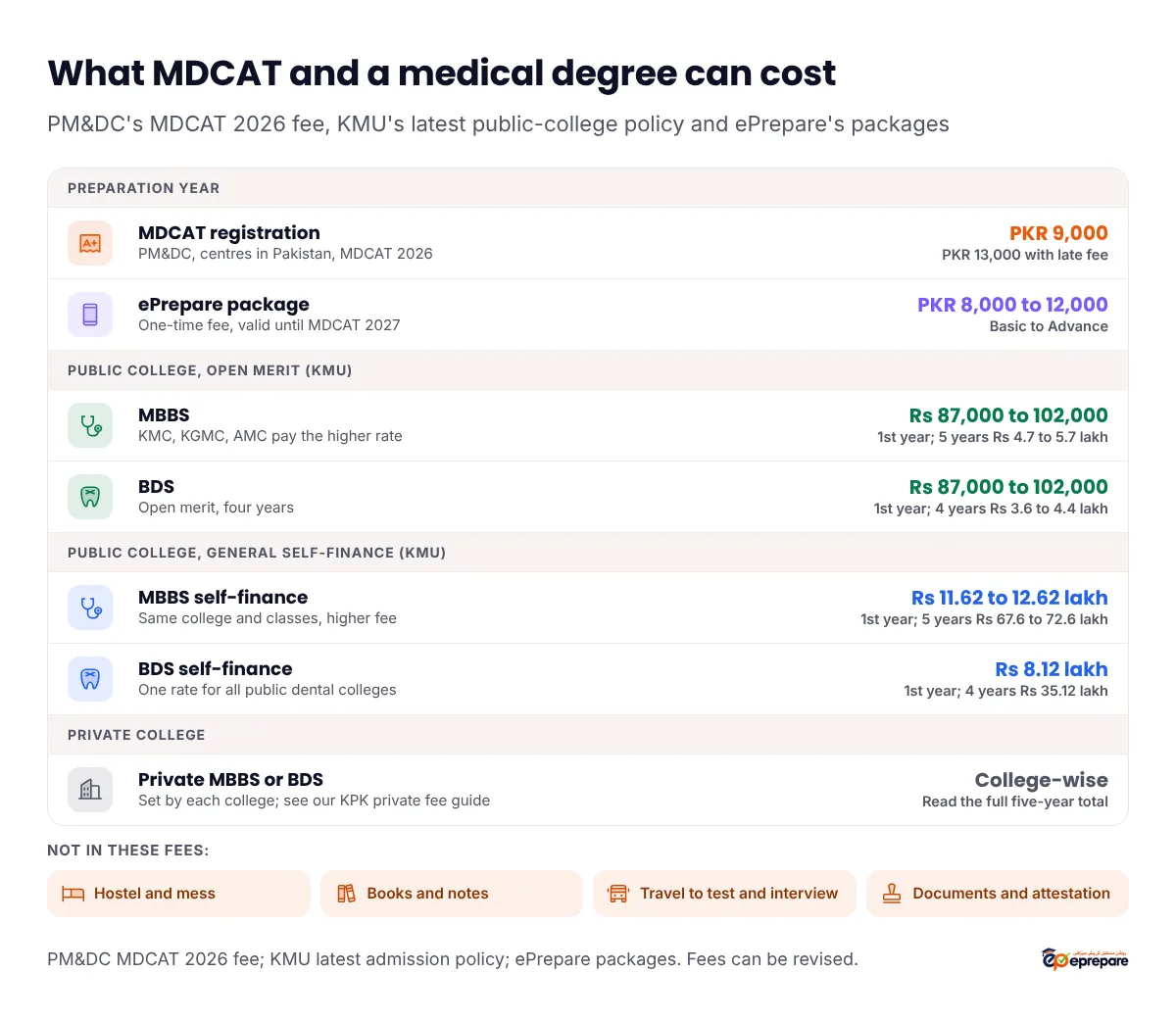
It is better to sit down with these numbers now than in the week of the offer letter.
| Item | Amount | Notes |
|---|---|---|
| MDCAT registration (2026) | PKR 9,000; PKR 13,000 with late fee | Centres in Pakistan; non-refundable. Check PM&DC's notice each year |
| Open merit MBBS, KMU public college | Rs 87,000 to 102,000 in year 1; Rs 4.7 to 5.7 lakh over 5 years | Higher rate at KMC, KGMC and AMC |
| Open merit BDS, KMU public college | Rs 3.6 to 4.4 lakh over 4 years | Most reserved seats pay the same fee as open merit |
| Self-finance MBBS, same public colleges | Rs 11.62 to 12.62 lakh in year 1; Rs 67.6 to 72.6 lakh over 5 years | Same classes, hostel and house job as open merit |
| Self-finance BDS | Rs 8.12 lakh in year 1; Rs 35.12 lakh over 4 years | One rate for every public dental college |
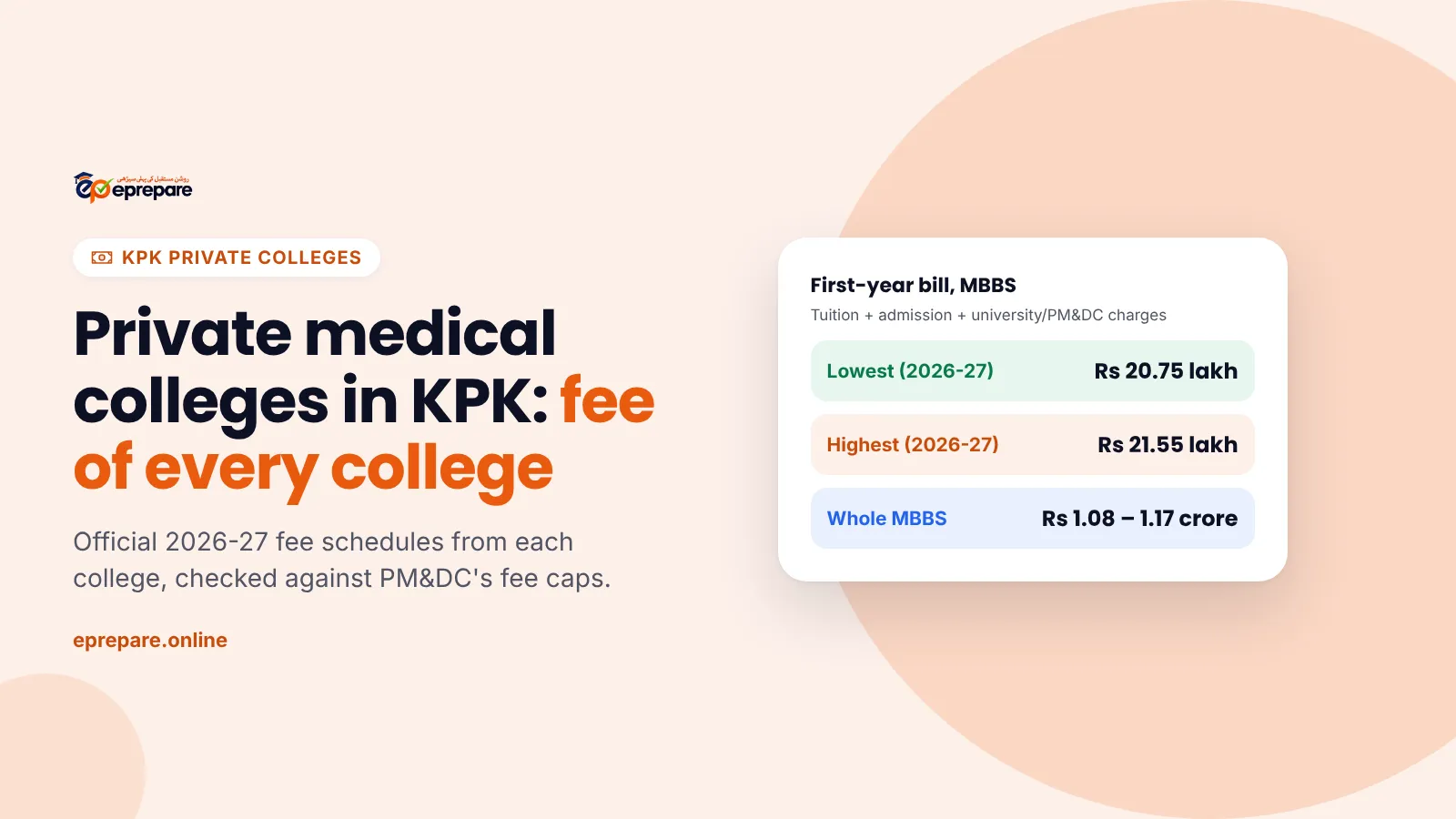
| Private MBBS or BDS | Set by each college | See our KPK private college fee guide |
Three things to know. First, KMU's policy says a "revised fees structure will be applicable to all the candidates from time to time", so plan for fees to rise. Second, the fee must be deposited within three working days of the offer, so keep the first year's amount ready before interviews begin. Third, KMU's admission fee is forfeited and not refunded in several situations, including if a student leaves. The full tables are in our KMU fee structure guide, our comparison of self-finance and open merit and our guide to private medical college fees in KPK. Hostel, mess, books, BDS instruments and travel are extra.
How to judge progress without hovering
You do not need to understand organic chemistry to know whether preparation is on track. Look at these four things, once a week:
- Is the plan being followed? Chapters finished against the plan. A good plan covers the whole syllabus well before the test, with time left for revision.
- Are practice scores going up? Look at chapter test accuracy over several weeks, not one day.
- What do full-length mock tests say? A full-length paper (FLP) is 180 MCQs in 3 hours, like the real test. Watch the average of the last three to five papers. One bad paper means little; three falling in a row means something needs to change. Our guide to mock tests and FLPs explains how many to take and how to review them.
- How far is the target? Agree a target score with your child from the aggregate calculator and last year's closing merit. ePrepare's predicted score shows the gap and which topics to fix next.
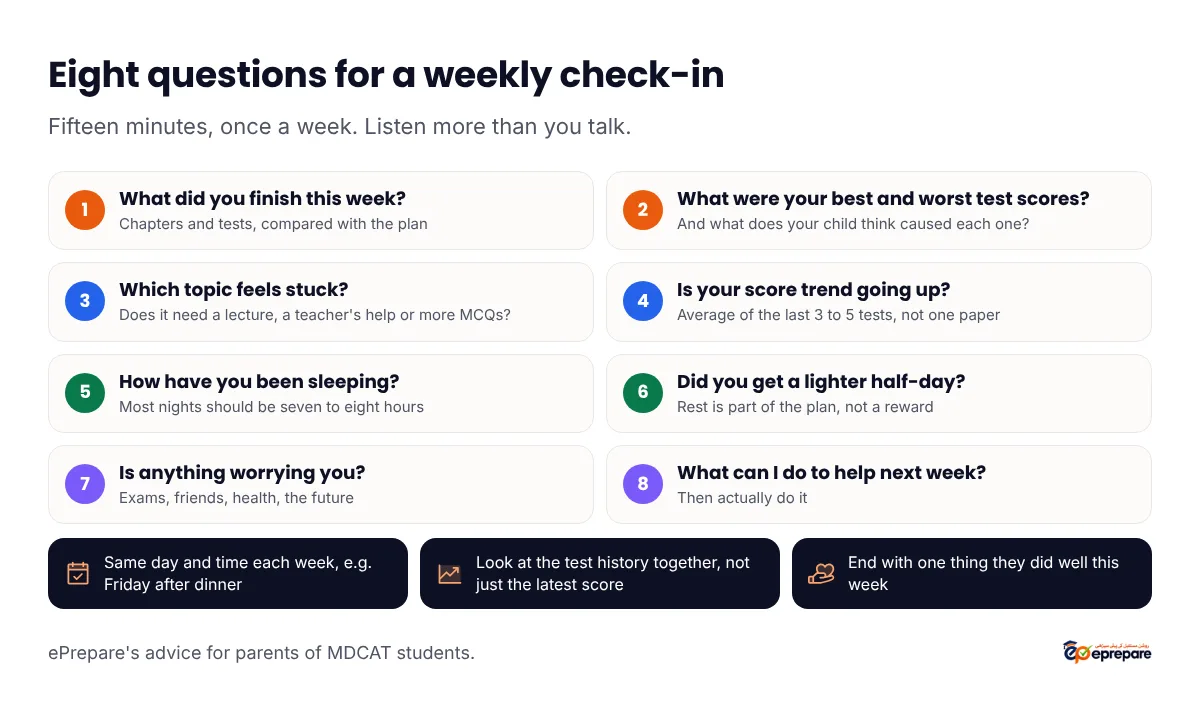
Keep the check-in short and kind. If scores are flat for several weeks, the answer is usually not "study more hours" but "study differently": more testing, more review of mistakes, help with a stuck topic. If you are unsure, ask your child's teacher or mentor to look at the test history with you.
How to choose a preparation option
Whatever you choose, check that it gives your child these things:
- Teaching and MCQs that follow the PM&DC syllabus and your province's textbooks.
- Regular chapter tests with explanations, so mistakes are understood, not just marked.
- Full-length papers in the real pattern, with a way to review them.
- A study plan that reaches the end of the syllabus before the test.
- Someone to ask when a doubt blocks a chapter.
- Progress you can see, such as test history and scores over time.
- A clear fee and refund policy, read before you pay.
ePrepare offers four one-time packages for MDCAT 2027, valid until the test: Basic (PKR 8,000), Plus (PKR 9,000), Pro (PKR 10,000) and Advance (PKR 12,000). Every package has the full MCQ toolkit, notes, study plan, predicted score and mentors. They differ in lectures (from Plus), the Quiz Builder (from Pro) and the full-length paper series with rank and percentile (Advance). Compare them on the packages page or read which package is right for your child. Fees are non-refundable, so ask the team on WhatsApp at 0341 4874938 before you pay. If you are deciding between studying at home and joining a physical academy, our guide to online vs academy preparation sets out the trade-offs.
Documents parents must arrange
This is the part where parents matter most, because many of these papers need a parent's own documents, signature or visit to an office. KMU's policy is strict: "Any certificate issued after the closing date for admission, shall not be considered for the purpose of calculation of merit", and documents uploaded on the portal "cannot be changed and shall be considered as final."
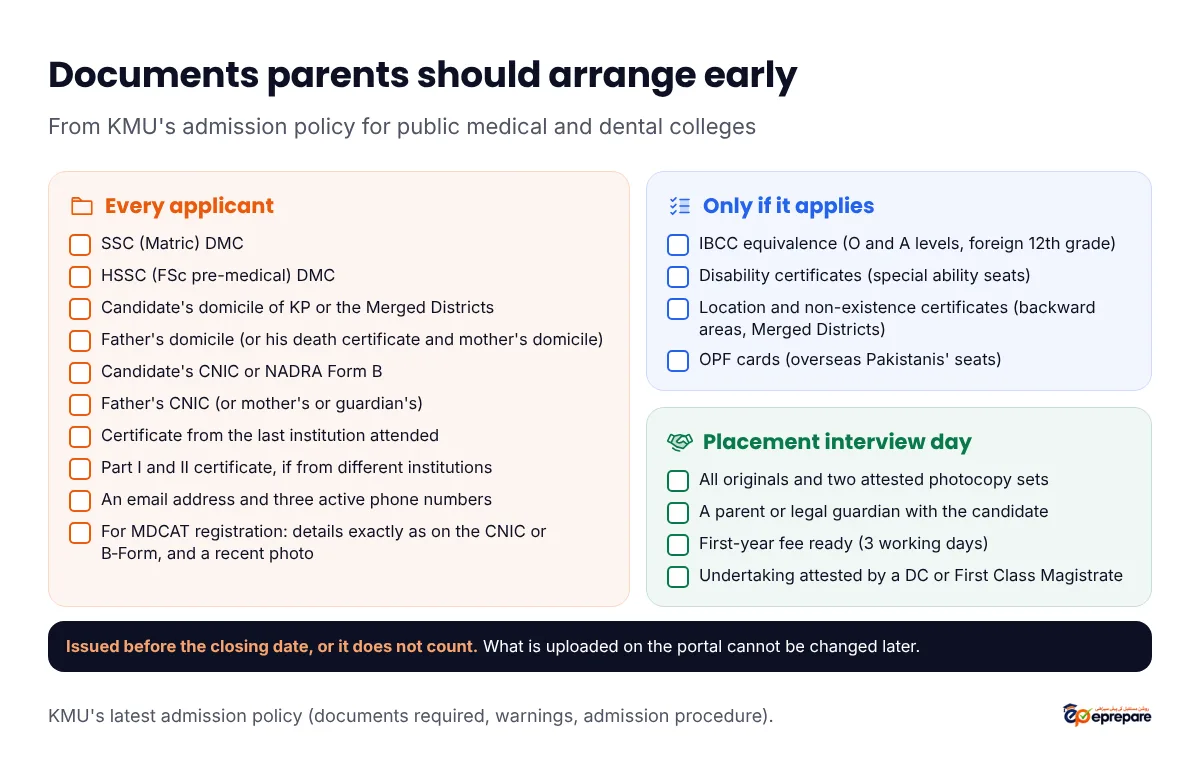
- Domicile, yours too. For KP's provincial seats, the policy checks the father's domicile as well as the candidate's. If the father has passed away, his death certificate and the mother's domicile are accepted. Apply weeks before KMU's advertisement.
- CNIC or B-Form. The candidate's CNIC or NADRA Form B and the father's CNIC (or the mother's or guardian's). Names and dates must match the school certificates exactly; the same details go into the MDCAT registration form.
- Marks certificates. Matric and FSc detailed marks certificates (DMCs). O and A level students need an IBCC equivalence certificate before the closing date; see our O and A level guide.
- Phone numbers that work. The policy asks for at least three active numbers, including a landline and a mobile. KMU uses them during merit lists, so give numbers someone will actually answer.
- The interview and undertaking. "The parent(s) or legal guardians must accompany all the candidates at the time of placement interview." The father or guardian also signs an undertaking at the college, accepting liability of Rs 1,00,000 per year of study if it is breached, attested by a Deputy Commissioner or First Class Magistrate. Book that attestation in advance.
The complete list, including special category papers, is in our KMU admission documents checklist.
If the result is not what you hoped
Your child will know the result before anyone says a word. What they need from you then is calm, time and help thinking through the options: later merit lists, BDS, self-finance seats, a repeat year, or another health degree such as Pharm-D, physical therapy or nursing. "We are proud of the work you did. Let's look at the options together" is the most useful sentence you can say. Our guide to what to do if not selected in MDCAT walks through every option with the official rules, and our repeaters guide helps if your child decides to try again.
Frequently asked questions
How can parents help with MDCAT preparation?
Keep a calm daily routine, protect seven to eight hours of sleep, agree phone rules together, avoid comparisons, check progress once a week by looking at the test score trend, and take charge of dates, fees and documents so your child can focus on studying.
How many hours a day should my child study for MDCAT?
Our preparation guide suggests 7 to 9 focused hours for full-time students and 3 to 4 hours on weekdays for students still in FSc, with more at weekends. Consistency matters more than one long day.
When is MDCAT registration and how much is the fee?
PM&DC announces it each year. For MDCAT 2026, registration ran from 22 June to 8 July, with a late fee until 13 July. The fee for centres in Pakistan was PKR 9,000, or PKR 13,000 with the late fee.
Do parents need to go to the KMU placement interview?
Yes. KMU's policy says "The parent(s) or legal guardians must accompany all the candidates at the time of placement interview." Bring the originals and keep the first-year fee ready.
How much does MBBS cost in a government college in KP?
Under KMU's latest policy, open merit MBBS costs Rs 87,000 to Rs 102,000 in the first year and about Rs 4.7 lakh to Rs 5.7 lakh for five years. Self-finance MBBS in the same colleges costs Rs 11.62 lakh to Rs 12.62 lakh in the first year.
How do I know if my child's MDCAT preparation is on track?
Look at the average of the last three to five full-length mock tests against the target score, and check that the study plan will finish the syllabus with time left for revision. A single bad test means little; several falling scores in a row mean the approach needs to change.
What are the signs of exam burnout in a student?
Ongoing tiredness, big changes in sleep or appetite, avoiding study, withdrawing from family, irritability or crying, and saying things like "what's the point". If you notice these, reduce pressure, allow rest and talk to a doctor or counsellor.
Which documents should parents prepare for MBBS admission?
Matric and FSc DMCs, the candidate's and father's domicile, the candidate's CNIC or B-Form, the father's CNIC, a certificate from the last institution, and any category certificates. Everything must be issued before the closing date. Our KMU documents checklist has the full list.
You are part of the team
Your child does the studying, but a calm home, a watched calendar and a file of ready documents are a real part of the result. If you would like to see how ePrepare's study plan, tests and full-length papers can support your child, compare the options on our packages page or register here.
Sources: PM&DC notices on MDCAT 2026 registration, fee and dates, and PM&DC's uniform MDCAT curriculum (paper pattern), on pmdc.pk; Khyber Medical University's latest admission policy for public sector medical and dental colleges (merit formula, pass marks, schedule, deadlines, fees, documents, undertaking and placement interviews) on cas.kmu.edu.pk, and KMU's latest final merit list; KMU-CAT portal (cat.kmu.edu.pk); Higher Education Commission, National Youth Helpline announcement and Prime Minister's Youth Programme contact page on hec.gov.pk. Package prices are ePrepare's own. Dates and fees change every session; always check the latest official notice.