
If you live in Punjab and want a government MBBS or BDS seat, one university decides where you go: the University of Health Sciences (UHS), Lahore. The Punjab government names UHS the "Admitting University" every year, and UHS then runs one central admission for all the public medical and dental colleges in the province, and a separate one for the private colleges.
For session 2026-27 the rules come from two official documents: the admission policy notified by Punjab's Specialized Healthcare and Medical Education (SHC&ME) Department on 14 October 2026, and the UHS prospectus for public sector colleges that follows it. We read both from start to finish. This guide puts every rule a student needs in one place: who is eligible, how merit is worked out, the quota and reserved seats with their official numbers, the fee, the dates and how to apply.
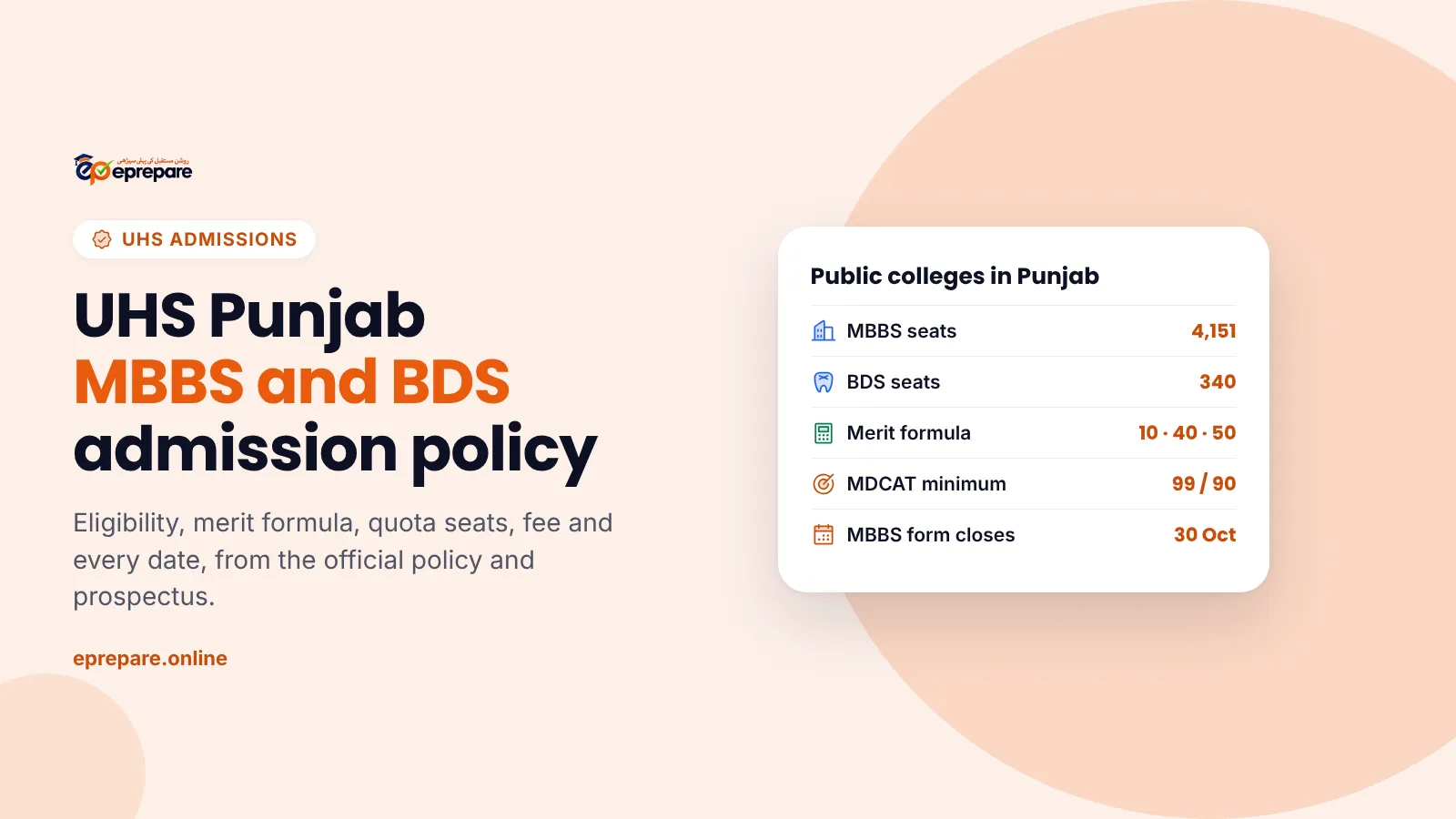
The short answer: to apply for MBBS or BDS in Punjab's public colleges you need at least 60% in FSc pre-medical (or an IBCC equivalent), an MDCAT pass of 55% for MBBS (99/180) or 50% for BDS (90/180) from 2026, 2025 or 2024, and a Punjab domicile for open merit. UHS ranks everyone by 10% Matric + 40% FSc + 50% MDCAT, rounded to four decimals, with no Hafiz-e-Quran marks. There are 4,151 MBBS and 340 BDS seats in 19 medical and 5 dental colleges this session. The MBBS form on publicmbbs.uhs.edu.pk closes on 30 October 2026 at 5 pm. Last year the lowest open-merit MBBS seat closed at 93.5091%.
Who runs MBBS and BDS admission in Punjab?
The first line of Punjab's admission policy says it plainly: UHS, Lahore, as the Admitting University, "shall conduct Central admissions to MBBS/ BDS courses of public and private sector Medical and Dental Institutions/ Colleges in Punjab for the Session 2026- 2027." UHS also conducted the MDCAT in Punjab for this session.
That means two separate UHS admissions, each with its own portal, dates and rules:
- Public sector colleges (government colleges such as KEMC, AIMC, Nishtar and RMC): apply on publicmbbs.uhs.edu.pk for MBBS and publicbds.uhs.edu.pk for BDS.
- Private sector colleges: apply on privatembbs.uhs.edu.pk and privatebds.uhs.edu.pk.
Medical and dental are also separate. If you want both MBBS and BDS, you must fill both forms. A student who has not applied for a programme cannot be admitted to it.
Eligibility for MBBS and BDS in Punjab
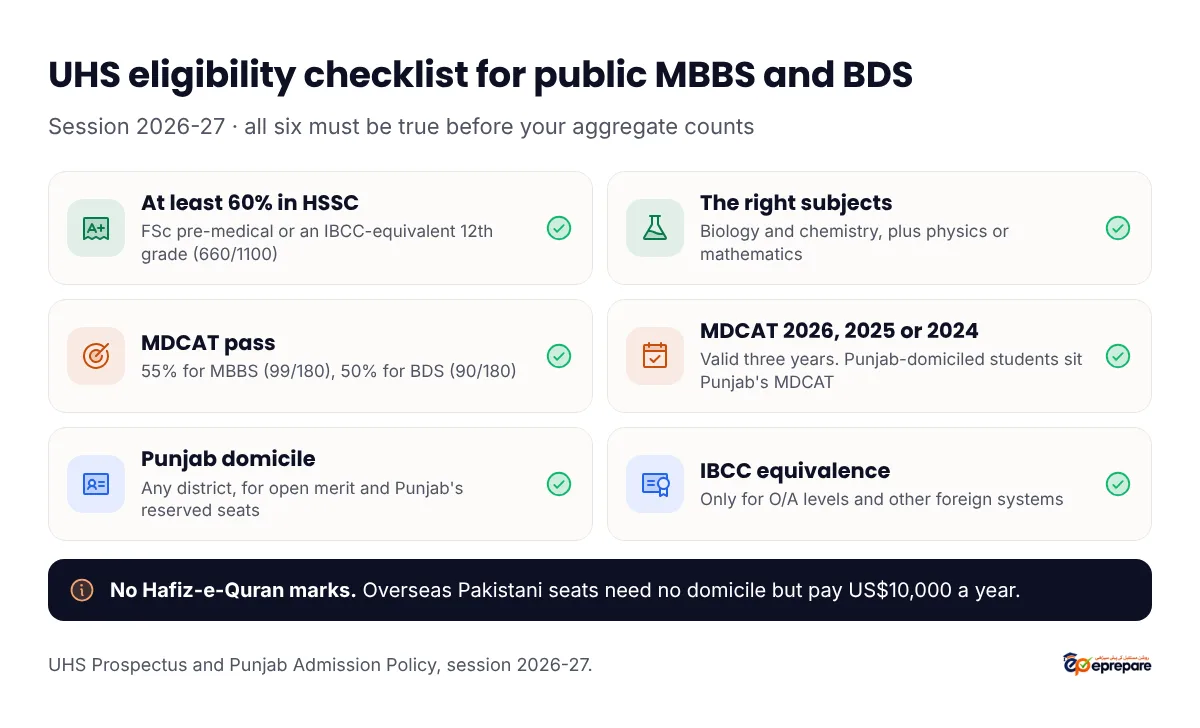
1. FSc (HSSC) with at least 60%
You need at least 60% in HSSC pre-medical, or an equivalent 12-year qualification. On a 1,100-mark result that is 660; on a 1,200-mark result it is 720. Your HSSC must include biology and chemistry, plus physics or mathematics. A student without biology or chemistry is not eligible, whatever the marks.
2. MDCAT: 55% for MBBS, 50% for BDS
The policy sets the MDCAT pass mark at 55% for MBBS and 50% for BDS, valid for "three years from the date of conduct of MDCAT". On the current 180-MCQ paper that is 99 marks for MBBS and 90 for BDS. UHS accepts MDCAT 2026, 2025 or 2024 for this session. Our guide to MDCAT passing marks explains what passing does and does not mean.
One line in the policy matters for Punjab students in particular: "Candidates having domicile of Punjab shall appear in the MDCAT of Punjab." If you hold a Punjab domicile, plan to take Punjab's MDCAT.
3. Domicile
A domicile of any district of Punjab is mandatory for open merit, the under-developed district seats, the disability seats, the Cholistan seat and the reciprocal seats for Punjab students in other provinces. The UDD and Cholistan seats need the domicile of that specific district, and the tribal-area seats in D.G. Khan and Rajanpur need "Tribal Area" written on the domicile. Overseas Pakistanis applying on their own quota do not need a domicile.
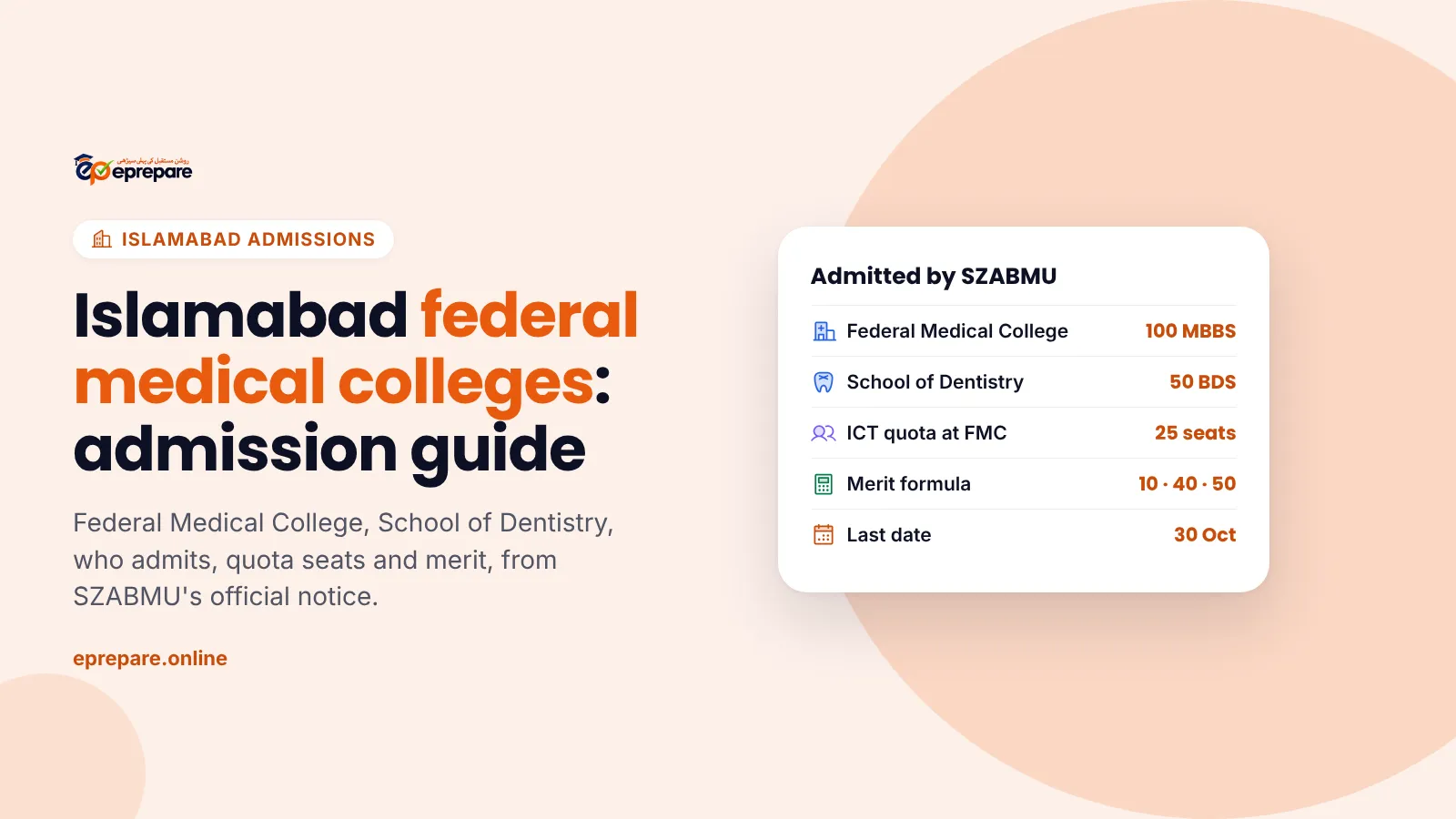
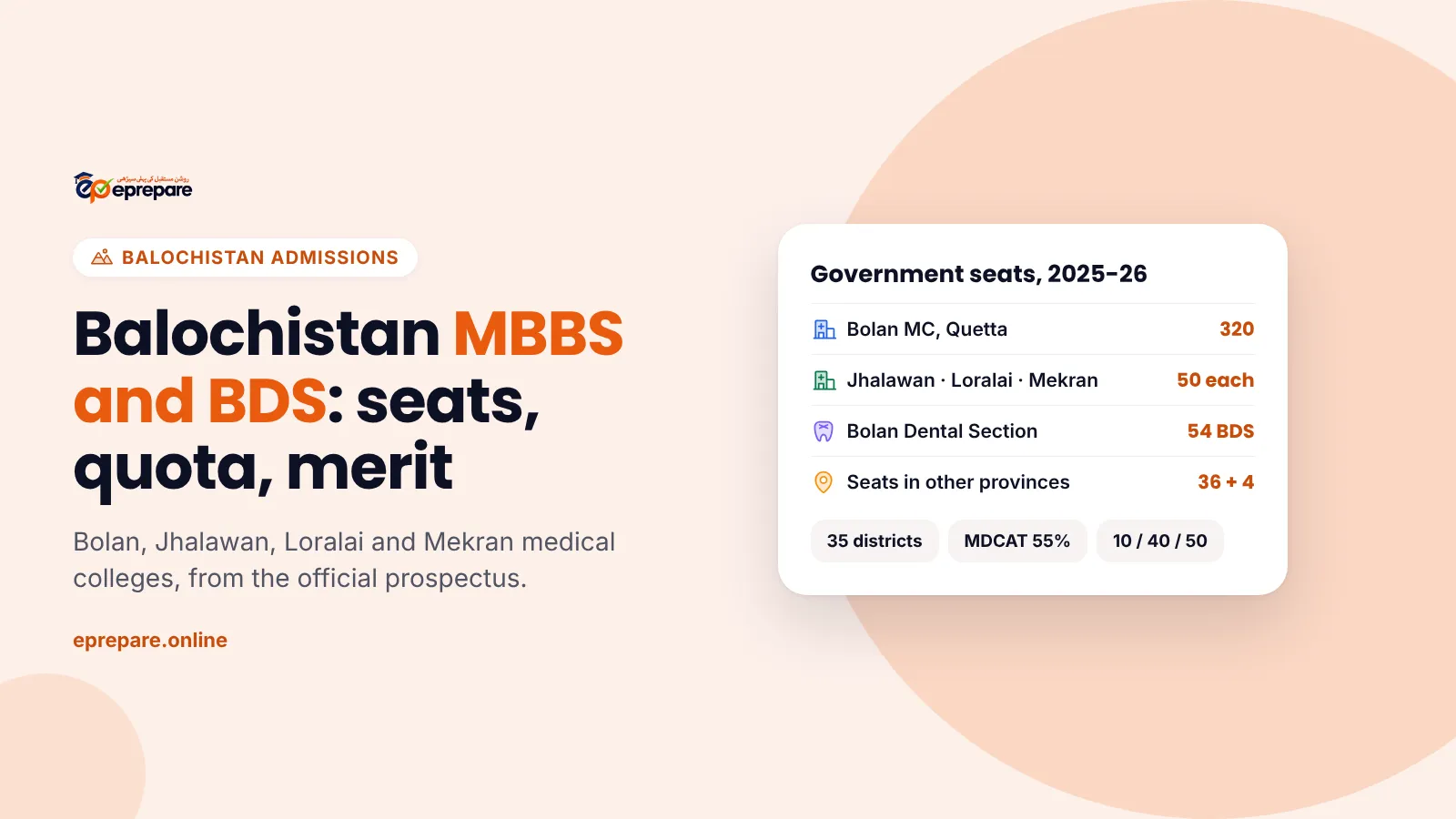
Students from Islamabad, AJ&K, Gilgit-Baltistan, Balochistan and ex-FATA cannot compete on open merit in Punjab's public colleges, but they have their own quota seats in the same colleges, filled through a separate UHS portal. Our guide to UHS quota seats for other provinces covers them in full.
4. O levels, A levels and foreign qualifications
Students with A levels, IB, American or Canadian 12th grade or any other foreign system must upload an IBCC equivalence certificate or provisional equivalence letter for both their 10th and 12th grade. The 60% minimum applies "after equivalence", so use the marks printed on your IBCC certificate. Sort this out with the Inter Boards Coordination Commission (IBCC) early, because the certificate or letter has to be uploaded with your application.
5. Age
The UHS prospectus prints no age limit. Age only matters in a tie, where the older candidate is placed higher.
The UHS merit formula, rounding and tie-break
Punjab's policy and the UHS prospectus both set the same weighting: Matric (SSC) 10%, FSc (HSSC) 40% and MDCAT 50%. Each part is first turned into a percentage of its own total, then multiplied by its weight, and the three are added. The prospectus says the "final calculation in percentage will be rounded up to four decimal points".
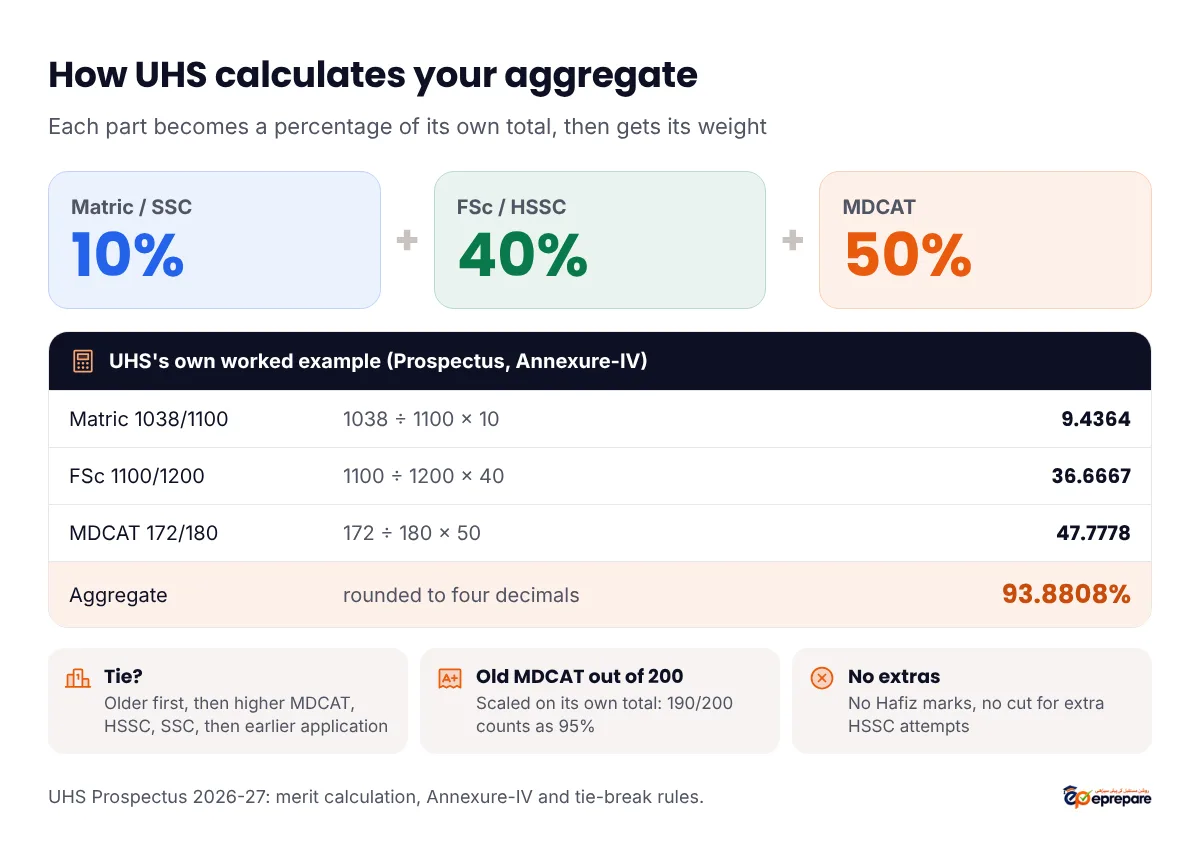
The worked example above is the one printed in the prospectus (Annexure-IV), shown here as points out of 100. The prospectus also gives a second example with an MDCAT 2024 score of 190 out of 200, which shows that an older MDCAT is scaled on its own total of 200. So 190/200 counts as 95%, the same as 171/180.
Two more rules from the prospectus:
- Ties: if two candidates have exactly the same aggregate, the older one goes first. If they are still level, UHS looks at higher MDCAT marks, then higher HSSC marks, then higher SSC marks, and finally whoever submitted the online application first.
- Extra HSSC attempts: "No marks will be deducted for extra attempts availed in HSSC/equivalent examination". But a revised or improved result declared after the closing date is not accepted for the current session.
Work out your own figure with the UHS merit calculator, which uses this exact formula. The full method with more examples is in the MDCAT aggregate formula.
Is there a Hafiz-e-Quran rule in Punjab?
Yes, and the answer is no extra marks. Paragraph 5 of the policy says: "The marks for Hifz-e-Quran shall not be granted for admission to Medical and Dental Colleges in the light of PM&DC Medical and Dental Undergraduate Education (Admissions, Curriculum and Conduct) Policy and Regulations 2025 and the decision of six membered Bench vide Order dated 04.04.2023 in Suo-Moto case." PM&DC is the Pakistan Medical and Dental Council.
Public medical and dental colleges in Punjab, with seats
These are the seats printed in UHS's prospectus for session 2026-27. "Open merit" is the share every Punjab-domiciled student competes for; the rest of each college's total is reserved seats, explained in the next section.
| College | City | Total MBBS | Open merit |
|---|---|---|---|
| King Edward Medical College | Lahore | 350 | 338 |
| Allama Iqbal Medical College | Lahore | 325 | 314 |
| Nishtar Medical College | Multan | 350 | 318 |
| Fatima Jinnah Medical College (women only) | Lahore | 300 | 284 |
| Services Institute of Medical Sciences | Lahore | 270 | 261 |
| Punjab Medical College | Faisalabad | 350 | 320 |
| Rawalpindi Medical College | Rawalpindi | 350 | 325 |
| Quaid-e-Azam Medical College | Bahawalpur | 350 | 322 |
| Sheikh Zayed Medical College | Rahim Yar Khan | 210 | 180 |
| Sargodha Medical College | Sargodha | 145 | 120 |
| Nawaz Sharif Medical College | Gujrat | 61 | 49 |
| Sahiwal Medical College | Sahiwal | 170 | 141 |
| Gujranwala Medical College | Gujranwala | 170 | 141 |
| D.G. Khan Medical College | Dera Ghazi Khan | 150 | 115 |
| Khawaja Muhammad Safdar Medical College | Sialkot | 140 | 115 |
| Ameer-ud-Din Medical College | Lahore | 160 | 154 |
| Narowal Medical College | Narowal | 100 | 99 |
| Maryam Nawaz Sharif Medical College* | Mianwali | 100 | 100 |
| Medical College, University of Rasul* | Mandi Bahauddin | 100 | 100 |
| Total, 19 medical colleges | Punjab | 4,151 | 3,796 |
The five dental colleges have 340 BDS seats: de'Montmorency College of Dentistry, Lahore (110), Nishtar Institute of Dentistry, Multan (65), Dental Institute, Punjab Medical College, Faisalabad (65), Fatima Jinnah Institute of Dental Sciences, Lahore (50*) and Quaid-e-Azam Medical & Dental College, Bahawalpur (50*). BDS open merit is 285 seats.
* Subject to approval by PM&DC. The two official documents differ slightly here: the government policy's seat annex lists 18 medical colleges with 4,051 MBBS seats, while the UHS prospectus and advertisement add the Mandi Bahauddin college, giving 4,151.
Fatima Jinnah Medical College admits women only, so the portal does not show it to male applicants. Every other college is co-educational.
Quota and reserved seats in Punjab's public colleges
Reserved seats sit inside each college's total. Some are for Punjab-domiciled students in special situations; others are for students of other provinces and regions, who apply on a separate UHS portal. This is the official count for 2026-27:
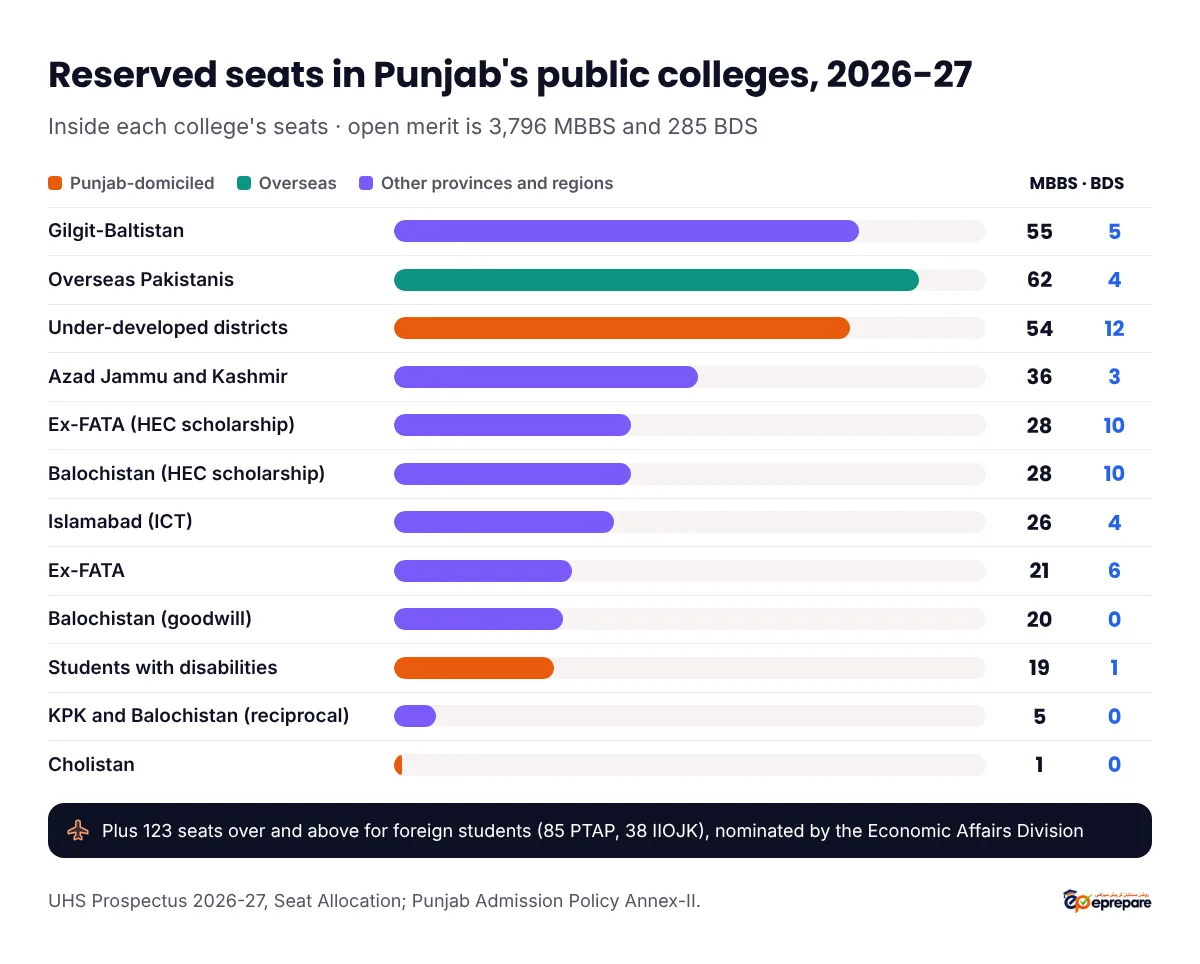
| Seat category | MBBS | BDS | Who can apply |
|---|---|---|---|
| Students with disabilities | 19 | 1 | Punjab domicile, cleared by a UHS medical board |
| Under-developed districts (UDD) | 54 | 12 | Domicile and class 1 to 12 schooling in one of 7 districts |
| Cholistan | 1 | 0 | Cholistani by birth, HSSC from Bahawalnagar, Bahawalpur or Rahim Yar Khan |
| Overseas Pakistanis | 62 | 4 | Pakistanis living abroad with a Green Card, Iqama or similar |
| Other provinces and regions | 214 | 38 | ICT, AJ&K, GB, Balochistan and ex-FATA domiciles |
| Reciprocal, KPK and Balochistan | 5 | 0 | Nominated by KMU or BUMHS, not direct |
| Foreign students (over and above) | 110 | 13 | PTAP and IIOJK nominees of the Economic Affairs Division |
Students with disabilities (19 MBBS, 1 BDS)
You must meet the normal eligibility and hold a Punjab domicile, upload a disability certificate from the National Council for Rehabilitation of Disabled Persons or a Social Welfare Department, and appear before a UHS medical board (3 to 5 November 2026 for MBBS). The policy defines the disability as "substantial" and "permanent", where substantial "means neither minor nor very severe". The board's decision is final.
Under-developed districts (54 MBBS, 12 BDS)
These seats are for seven districts: D.G. Khan (10 MBBS, 2 BDS), Rajanpur (9, 2), Muzaffargarh/Kot Addu (8, 1), Bhakkar (8, 2), Layyah (8, 2), Lodhran (7, 2) and Mianwali (4, 1). Some D.G. Khan and Rajanpur seats are for their tribal areas. You need the district's domicile and must have studied from class one to twelve in that district, proved by an Education Verification Certificate signed by every school and college you attended and countersigned by the Deputy Commissioner. After admission you sign a Rs 500,000 surety bond to serve in your district for at least five years.
You can apply on open merit and UDD together. If both would give you a seat, UHS gives you whichever college is higher on your own preference list.
Cholistan (1 MBBS seat)
One MBBS seat at Sheikh Zayed Medical College, Rahim Yar Khan, for a student who is Cholistani by birth, lives in Cholistan (certified by the Cholistan Development Authority) and passed HSSC from Bahawalnagar, Bahawalpur or Rahim Yar Khan.
Overseas Pakistanis (62 MBBS, 4 BDS)
For Pakistani citizens permanently living abroad with a Green Card, Maple Card, Pakistan Origin Card or a long-term permit such as an Iqama. They can submit MDCAT, or SAT-II (550 in each science) or MCAT/UCAT with 50%. If selected on these seats they pay US$10,000 a year for the whole programme. An overseas Pakistani who wins an open merit seat pays the normal fee. Any vacant overseas seat goes to open merit.
Seats for other provinces and regions (214 MBBS, 38 BDS)
Islamabad 26 and 4, AJ&K 36 and 3, Gilgit-Baltistan 55 and 5, Balochistan goodwill 20 MBBS, ex-FATA 21 and 6, plus 28 MBBS and 10 BDS each for the Balochistan and ex-FATA HEC scholarship seats. UHS advertises these separately; details are in our UHS quota seats guide.
Reciprocal seats
Two different things share this name. Punjab students get 14 MBBS seats in other regions: Bolan Medical College, Quetta (4), Khyber Medical College, Peshawar (1), and 3 each at Mohtarma Benazir Bhutto Shaheed Medical College, Mirpur, AJK Medical College, Muzaffarabad and Poonch Medical College, Rawalakot. You tick this category on the same UHS form, and it is filled on merit like open merit. In return, KPK and Balochistan students get 5 MBBS seats in Punjab, but only through nomination by KMU or BUMHS, never by applying to UHS directly.
Foreign students and minorities
123 seats over and above the totals (85 under the Pakistan Technical Assistance Programme, PTAP, and 38 for students of Indian Illegally Occupied Jammu and Kashmir, IIOJK) are filled only through the Economic Affairs Division. The 2026-27 policy and prospectus contain no separate quota for religious minorities in Punjab's public colleges.
Public vs private: two UHS admissions
UHS runs the private sector admission too, but the rules are different in a few important ways:
| Point | Public colleges | Private colleges |
|---|---|---|
| Colleges | 19 medical, 5 dental | 34 medical, 18 dental in UHS's advert |
| Domicile | Punjab for open merit | Any district of Pakistan |
| College preferences | You must list every college | No limit; at least one |
| MBBS application dates | 16 to 30 October 2026 | 23 October to 6 November 2026 |
| To hold a seat | Pay the college fee in 3 working days | Deposit Rs 600,000 with UHS in 3 working days |
| Overseas seats | 62 MBBS, 4 BDS at US$10,000 a year | Up to 15% of each college's seats |
The merit formula and the minimum marks are the same in both. In private colleges, students can choose at joining whether to keep their seat or stay in line for upgradation; in public colleges upgradation is compulsory. The private sector policy annex lists 4,400 MBBS seats in 33 colleges and 1,100 BDS seats; UHS's advert adds a 34th college admitted under a court order. Check each private college's fee on its own website before you list it.
Fee in Punjab's public medical and dental colleges
The policy fixes tuition at Rs 50,000 a year for public sector MBBS and BDS, except overseas and foreign seats. The prospectus gives the full schedule for session 2026-27:
| Year | MBBS (Rs) | BDS (Rs) |
|---|---|---|
| First year (incl. Rs 200 admission fee) | 53,030 | 53,050 |
| Second year | 50,630 | 50,650 |
| Third year | 50,830 | 50,650 |
| Fourth year | 50,630 | 50,650 (final year) |
| Fifth year | 50,730 | Not applicable |
Two more money points. At admission every student signs a Rs 3 million surety bond to serve the Punjab government for one year as a medical officer in primary healthcare after the house job, or pay Rs 3 million. And the head of each college can remit tuition for up to 10% of Punjab students on financial grounds. The application processing fee is a non-refundable Rs 2,000.
How to apply on the UHS portal, step by step
- Read the prospectus and policy on uhs.edu.pk.
- Open the right portal: publicmbbs.uhs.edu.pk or publicbds.uhs.edu.pk.
- Register with your name, email, CNIC/Passport/CRC number, mobile number and a password. More than one application, for example under a second email, leads to disqualification.
- Choose your seat category or categories (open merit, UDD, disability, Cholistan, reciprocal, overseas).
- Fill in personal details, then your SSC and HSSC marks, year and subjects, and your MDCAT score.
- Add every college in order of preference. For open merit you must select all medical colleges. If you change your category later, your preferences reset.
- Upload documents as JPG or PNG, each no larger than 500 KB, both sides of the CNIC as separate files.
- Accept the undertaking, generate the Rs 2,000 challan and pay at Bank of Punjab or National Bank through branch banking or the 1Bill Invoice option (never 1Bill top-up). Upload the paid challan.
- Download, check and submit. You can edit until the deadline, but after 30 October your preferences are locked for every list.
Documents checklist
- SSC and HSSC result cards, verified by your board (or IBCC equivalence for foreign systems)
- Punjab domicile certificate
- Your CNIC, B-Form/CRC, POC or passport, plus a parent's or guardian's CNIC (no expired documents)
- A colour photo on a white background, less than a month old
- Your signature in blue ink and left thumbprint on white paper
- UDD: Education Verification Certificate and school leaving certificates; Cholistan: CDA certificate; disability: disability certificate; overseas: Iqama, Green Card or residence permit
UHS admission schedule for 2026-27
The pattern is the same every year: the government notifies the policy, UHS advertises within days, the MBBS form stays open for about two weeks, merit lists follow in mid-November, and BDS runs about a month behind. Last session, applications opened on 7 November 2025; this session they opened three weeks earlier, on 16 October.
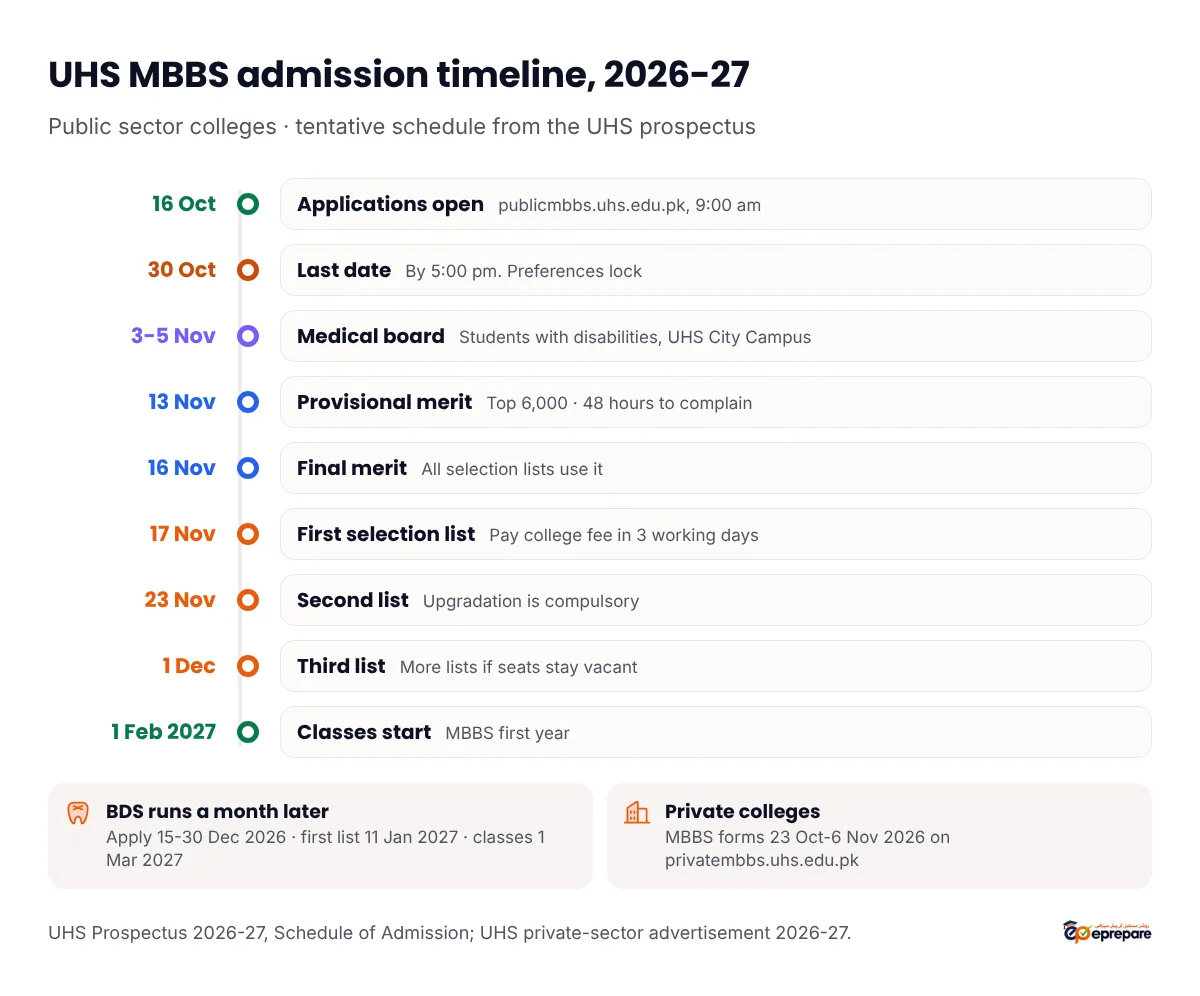
UHS calls this schedule tentative, and more than three lists may be issued if seats stay vacant. All lists are published only on uhs.edu.pk; UHS does not send letters.
After the merit list: joining and upgradation
- UHS first shows a provisional order of merit of the top 6,000 applicants. You have 48 hours to email a complaint about any error.
- In each selection list you are placed in the highest college on your list that your merit reaches.
- If selected, you have three working days to pay the college fee, report to the college in writing and upload the signed joining report. Miss any step and you lose the seat and all upgradation.
- Upgradation is compulsory in public colleges. If a seat opens in a college you ranked higher, you move. You cannot ask to stay.
- MBBS and BDS lists are separate. A student admitted to a dental college cannot be upgraded to a medical college, but can still get an MBBS seat later in the MBBS process if they applied for both programmes.
UHS closing merit last year (2025-26)
This is the aggregate of the last open-merit student admitted to each public medical college in UHS's thirteenth and final selection list for session 2025-26.
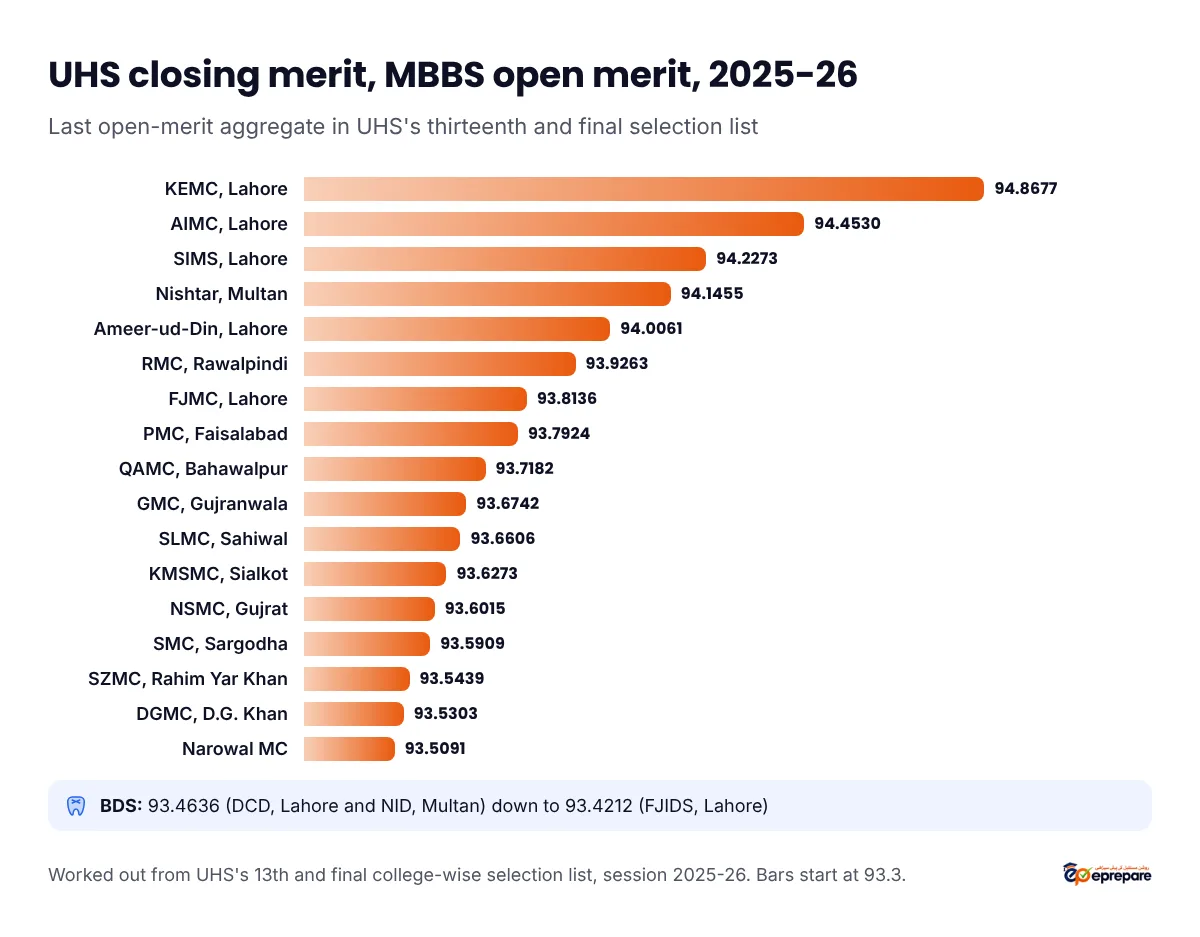
The whole range, top college to bottom, was only about 1.4 aggregate points. One MDCAT mark is worth about 0.28 aggregate, so a handful of MCQs decide which college you get. For a student with 1150/1200 in Matric and 1100/1200 in FSc, that meant about 171/180 for Narowal and 176/180 for KEMC.
Quota seats closed lower because they fill from separate lists: the lowest MBBS aggregates admitted were 93.5081 on reciprocal seats, 93.2293 on the Cholistan seat, 89.9414 on disability seats, 88.9424 on UDD seats and 67.5970 on overseas seats. See every college, the BDS figures and the MDCAT score each one needed on our UHS closing merit page, and check your own chances with the college predictor.
Frequently asked questions
What is the UHS merit formula for MBBS?
10% Matric, 40% FSc and 50% MDCAT. Each part is turned into a percentage of its own total, weighted and added, and UHS rounds the result to four decimal places. The UHS merit calculator does it for you.
What are the minimum MDCAT marks for MBBS in Punjab?
55% for MBBS (99 out of 180) and 50% for BDS (90 out of 180), plus at least 60% in FSc. Passing only makes you eligible; last year no open-merit public MBBS seat closed below 93.5% aggregate.
Does UHS give extra marks for Hafiz-e-Quran?
No. Punjab's 2026-27 policy says Hifz-e-Quran marks "shall not be granted", following PM&DC's regulations and a six-member bench's suo motu order of 4 April 2023.
Can a student with a KPK, Sindh or Islamabad domicile get admission in Punjab's government medical colleges?
Not on open merit, which needs a Punjab domicile. Islamabad, AJ&K, GB, Balochistan and ex-FATA students have their own quota seats; KPK and Balochistan students also have 5 reciprocal seats by nomination. Private colleges in Punjab accept a domicile from any district of Pakistan.
What is the last date to apply for UHS MBBS admission?
For session 2026-27, 30 October 2026 by 5 pm for public colleges and 6 November 2026 for private colleges. BDS forms run from 15 to 30 December 2026 (public) and 18 December 2026 to 1 January 2027 (private).
How much is the fee in government medical colleges in Punjab?
Tuition is Rs 50,000 a year. With charges, first-year MBBS costs Rs 53,030 and later years about Rs 50,600 to Rs 50,800. Overseas quota students pay US$10,000 a year.
Can I use my MDCAT 2024 result for UHS admission?
Yes. UHS accepts MDCAT 2026, 2025 or 2024 with the pass percentage. A 2024 result out of 200 is scaled on its own total.
Can I change my college preferences after applying?
Only until the closing time on the last date. After that the number and order of your preferences are locked for every selection list, and a college you did not list cannot be given to you.
Every one of those 0.28-point MCQs is won months before the form opens. If you are preparing for next year's MDCAT, join ePrepare for lectures, chapter-wise MCQs, MDCAT past papers and weekly full-length papers, and track how close your predicted score is to your target college.
Sources: Government of the Punjab, Specialized Healthcare and Medical Education Department, Admission Policy for MBBS/BDS Session 2026-27 (Notification No. SO(ME-II)2-1/2026, 14 October 2026), published on uhs.edu.pk; UHS Prospectus, MBBS & BDS, Public Sector Medical and Dental Colleges in Punjab, Session 2026-27 (eligibility, seats, quotas, merit, schedule, fee); UHS advertisements for public and private sector MBBS and BDS admissions, session 2026-27; UHS public sector admission notice, session 2025-26 (last year's dates); closing merit worked out from UHS's thirteenth and final college-wise selection list, session 2025-26. Dates and seats can change by notification; always check uhs.edu.pk.