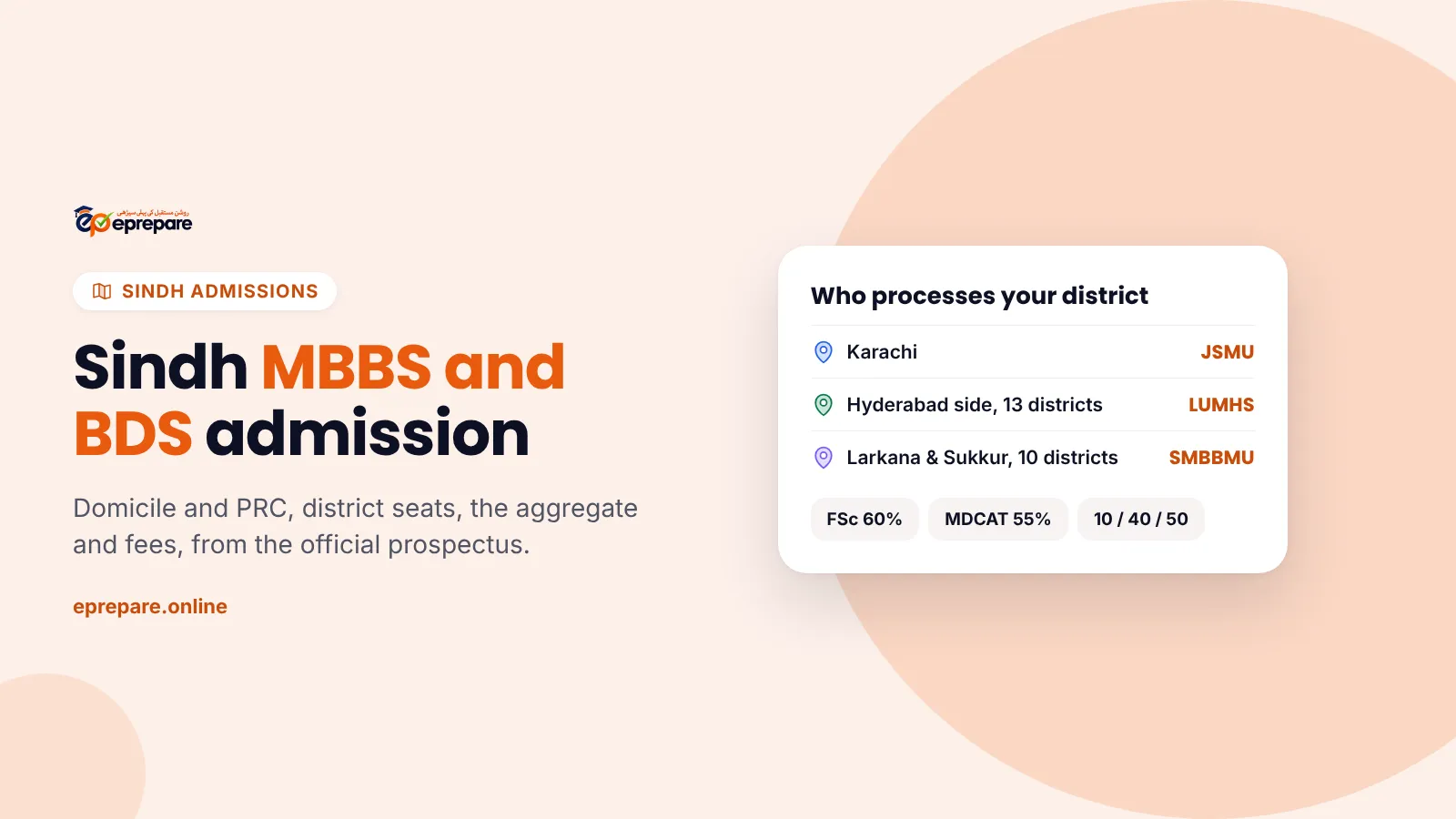
Admission to a government MBBS or BDS seat in Sindh does not work like KPK or Punjab. There is no single list for the whole province. Your seat depends on your district: you compete only with students who hold a Permanent Residence Certificate (PRC) and domicile of the same district, and three "processing universities" run the lists for different parts of Sindh.
We read the official joint prospectus for MBBS and BDS in Sindh's public sector medical and dental universities and colleges, published by the Health Department, Government of Sindh with the admitting universities, for session 2026-27, plus last session's prospectus, corrigendum, notices and merit lists. Everything below comes from those documents. Where they disagree with each other, we say so.
The short answer: to apply you need a PRC and domicile of a Sindh district (and your father's, or your mother's if your father has died or your parents are divorced, from Sindh), at least 60% in FSc or an IBCC equivalent, and an MDCAT pass of 55% for MBBS or 50% for BDS (99 or 90 out of 180) in the MDCAT conducted by IBA Sukkur in 2024, 2025 or 2026. Merit is 10% Matric + 40% FSc + 50% MDCAT. You apply online on the site of the university that covers your district (JSMU for Karachi, LUMHS for the Hyderabad side, SMBBMU for the Larkana and Sukkur side), then hand in the printed form at a Leopards Courier centre with a Rs 3,500 fee. For session 2026-27 forms opened on 12 October 2026 and the advertised last date was 26 October 2026.
Who admits to which college in Sindh
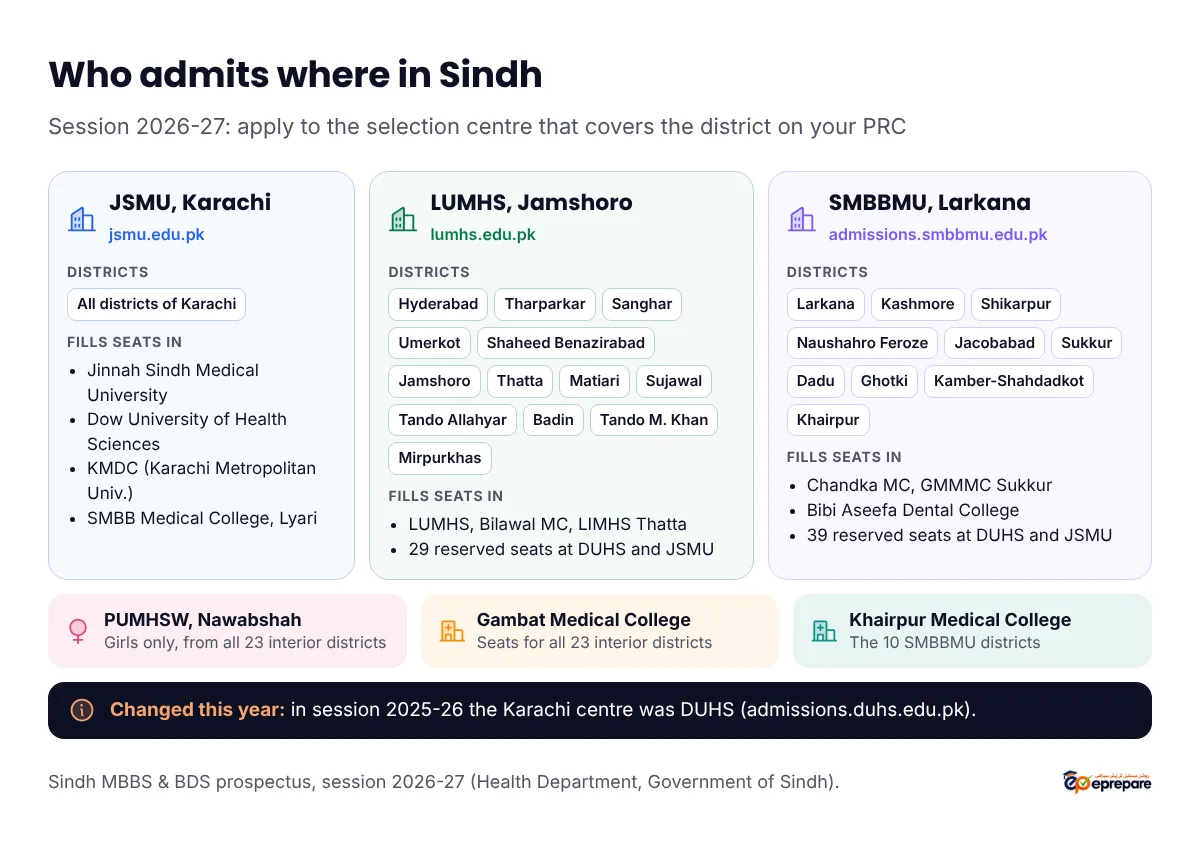
Sindh's prospectus names nine public universities and colleges for MBBS and BDS, and three "processing universities" that take the applications. For session 2026-27 the Karachi selection centre moved to Jinnah Sindh Medical University (JSMU). Last session (2025-26) it was Dow University of Health Sciences (DUHS) on admissions.duhs.edu.pk. So do not go by last year's habit: check which site your notice names.
| Selection centre | Districts it covers | Colleges it fills |
|---|---|---|
| JSMU, Karachi (jsmu.edu.pk) | All districts of Karachi | JSMU, DUHS, KMDC (Karachi Metropolitan University) and SMBBMC Lyari |
| LUMHS, Jamshoro (lumhs.edu.pk) | 13 districts from Hyderabad to Tharparkar | LUMHS and its colleges, plus reserved seats in Karachi |
| SMBBMU, Larkana (admissions.smbbmu.edu.pk) | 10 districts from Larkana to Ghotki | Chandka (Larkana), GMMMC (Sukkur), Bibi Aseefa Dental College, plus reserved seats in Karachi |
Two colleges take students from more than one region. Peoples University of Medical and Health Sciences for Women (PUMHSW) in Shaheed Benazirabad (Nawabshah) admits only girls, from all 23 districts outside Karachi. Gambat Medical College also has seats for all 23 interior districts. Khairpur Medical College takes the 10 districts of the SMBBMU side.
The district rule, in the prospectus's own words
"Competition in each district shall take place among candidates of that district (same district). Thus, a candidate from one district shall not compete with a candidate of other districts."
That one sentence explains most of Sindh's merit. A student from Tharparkar competes for Tharparkar's seats, not Karachi's. Seats are then given "merit-cum-choice": students are called in merit order and pick from the seats still open for their district and category.
Seats in every public college
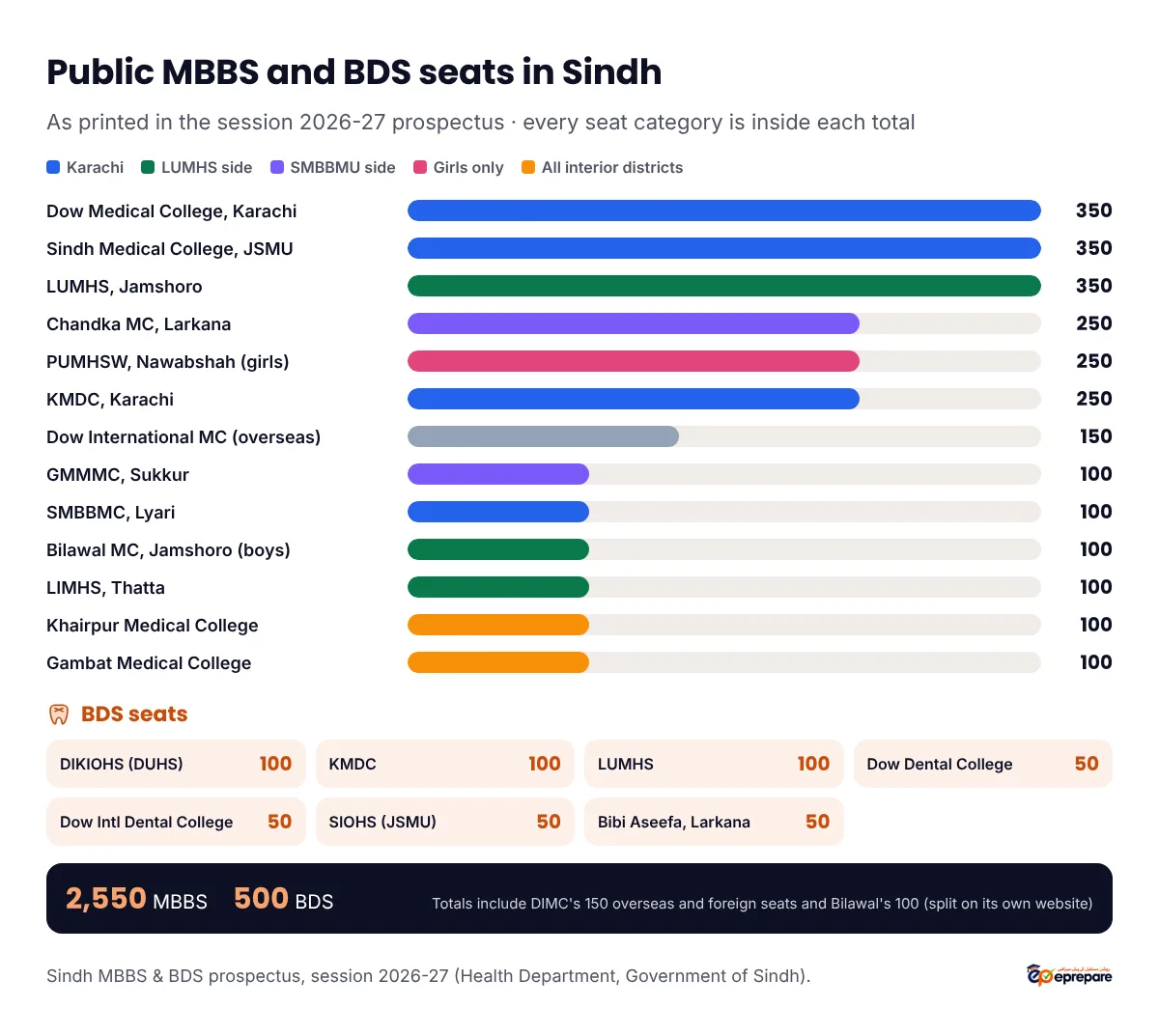
These are the seats printed in the session 2026-27 prospectus. Every seat category is inside each college's total.
| College | University | MBBS | BDS |
|---|---|---|---|
| Dow Medical College, Karachi | DUHS | 350 | 0 |
| Dow International Medical College, Karachi | DUHS | 150 (overseas and foreign) | 0 |
| Dr. Ishrat-ul-Ebad Khan Institute of Oral Health Sciences | DUHS | 0 | 100 |
| Dow Dental College and Dow International Dental College | DUHS | 0 | 50 + 50 |
| Sindh Medical College and SIOHS, Karachi | JSMU | 350 | 50 |
| Karachi Medical and Dental College (KMDC) | Karachi Metropolitan University | 250 | 100 |
| SMBB Medical College, Lyari | Affiliated with DUHS | 100 | 0 |
| LUMHS and Institute of Dentistry, Jamshoro | LUMHS | 350 | 100 |
| Bilawal Medical College for Boys, Jamshoro | LUMHS | 100 | 0 |
| Liaquat Institute of Medical and Health Sciences, Thatta | LUMHS | 100 | 0 |
| PUMHSW, Nawabshah (girls only) | PUMHSW | 250 | 0 |
| Chandka Medical College and Bibi Aseefa Dental College, Larkana | SMBBMU | 250 | 50 |
| Ghulam Muhammad Mahar Medical College, Sukkur | SMBBMU | 100 | 0 |
| Khairpur Medical College, Khairpur Mirs | Public college | 100 | 0 |
| Gambat Medical College, Gambat | PAQSJIMS Gambat | 100 | 0 |
Added up, that is 2,550 MBBS and 500 BDS seats, but read the totals with care. They include Dow International Medical College's 150 seats, which are for overseas Pakistanis and foreign nationals, and self-finance and nominated seats inside every college. Bilawal Medical College's split is not in the prospectus; it says to check the college's own website.
How a 350-seat college splits its seats
Dow Medical College and Sindh Medical College show how many seats in a "350" college are really open to a normal Karachi applicant:
| Category | Dow Medical College | Sindh Medical College |
|---|---|---|
| Open merit, Karachi domicile | 237 | 232 |
| Reserved for interior Sindh (merit-cum-choice) | 22 | 46 |
| Self-finance (UEDP local) | 43 | 34 |
| Children of overseas Pakistanis | 10 | 18 |
| Foreign nationals (HEC and PTAP nominees) | 32 | 18 |
| Balochistan, AJK and Gilgit-Baltistan | 5 | 1 |
| Disabled candidate | 1 | 1 |
| Total | 350 | 350 |
PTAP is the Pakistan Technical Assistance Programme; its nominees come through the Ministry of Economic Affairs. UEDP (University Education Development Programme) is the self-finance scheme; LUMHS and PUMHSW call it UDP, Gambat IEAP and Khairpur CEAP. Self-finance candidates are ranked on the same merit, and a UEDP applicant is considered for an open merit seat first if one falls vacant.
One small inconsistency: JSMU's page splits its 46 interior seats as Hyderabad Board 10, Larkana 14, Mirpurkhas 8 and Sukkur 14, while LUMHS's page sends 8 Hyderabad, 5 Mirpurkhas and 5 Shaheed Benazirabad candidates to JSMU. The total of 46 is the same; ask JSMU if you are counting on one of these seats.
District seats outside Karachi
LUMHS's 294 district merit seats are split across its 13 districts, from Hyderabad (41) and Sanghar (37) down to Tando Muhammad Khan (12). Chandka's 183 are split across 7 districts (Dadu 32, Naushahro Feroze 31, Larkana 30 and so on) and GMMMC's 93 across Sukkur, Ghotki and Khairpur (43). PUMHSW's 183 girls' seats run from Shaheed Benazirabad (21) to Sujawal, Jacobabad, Kashmore and Sukkur (5 each). Gambat's 82 general seats give each district between 1 and 6.
SMBB Medical College Lyari is different again. Its 100 seats are split by Karachi town: Lyari 15, Bin Qasim 10, Kemari 10, Gadap 10, the rest of Karachi 20, 10 self-finance seats, and 5 seats each for the Hyderabad, Mirpurkhas, Shaheed Benazirabad, Sukkur and Larkana divisions. Only students who apply for SMBBMC are considered for it, and the 25 division seats have their own online form on JSMU's site.
Domicile and PRC rules
This is where most Sindh applications fail. The prospectus asks for two documents, the Permanent Residence Certificate on Form "C" and the domicile certificate, for you and for your father.
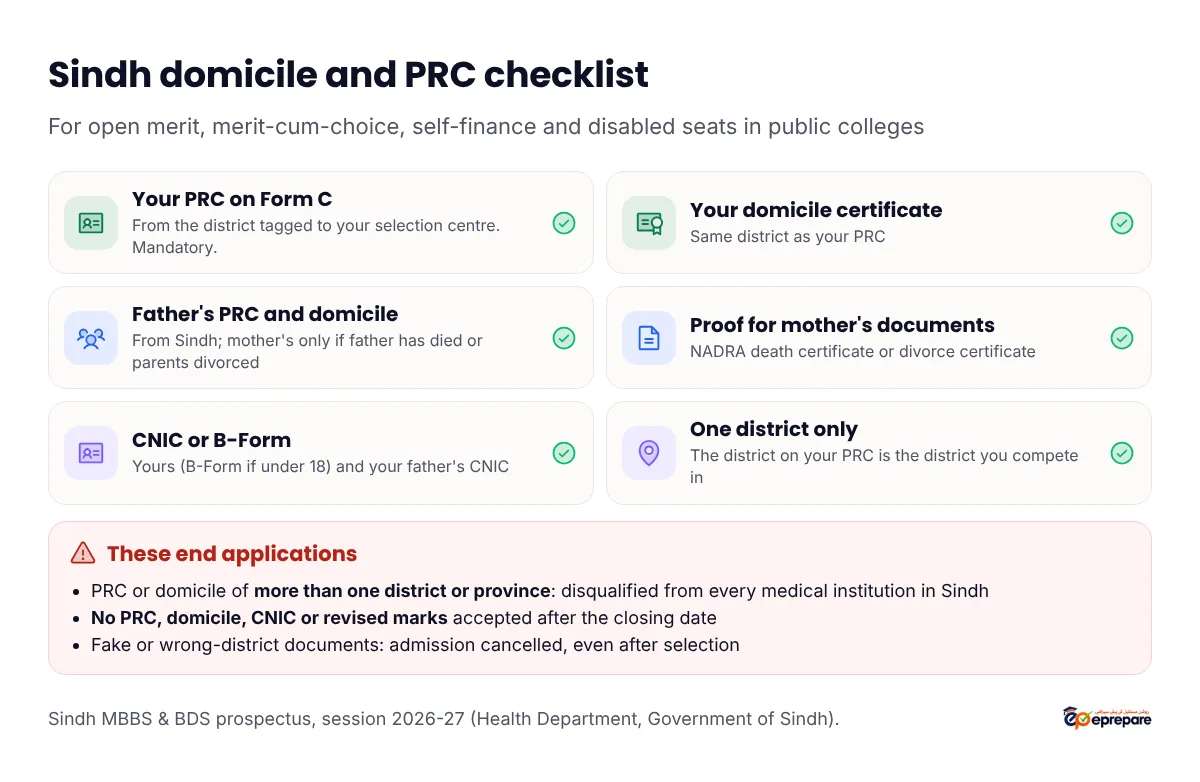
- Your PRC and domicile must be from your "tagged" district, the one your selection centre covers. The district on your PRC is the district you compete in.
- Your father must also hold a Sindh PRC. Your mother's is accepted only if your father has died or your parents are divorced, with the death certificate from NADRA or the divorce certificate.
- Only one district. "Any candidate found having PRC/Domicile of more than one district/province in Pakistan shall be disqualified for admission in any medical institution of Sindh."
- No late documents. No marks certificate, revised marks certificate, PRC, domicile or CNIC is entertained after the closing date.
- Admission is provisional until your documents are verified, and SMBBMC Lyari checks each PRC and domicile with the issuing office before it confirms a seat.
The prospectus contradicts itself on double domicile. The document checklist says one district only, but the admission committee section of the 2026-27 prospectus says a candidate with a domicile "of more than two districts" is not eligible. Play safe: hold one PRC and one domicile, from one district.
KMDC has an extra Karachi rule
Karachi Medical and Dental College asks that you passed both Matric and Intermediate (or O and A levels) from a Karachi board or centre, with your domicile, PRC and CNIC issued in Karachi. There is an exception for children of government employees posted outside Karachi, with a deputation letter.
Eligibility and MDCAT minimums
| Requirement | What the 2026-27 prospectus says |
|---|---|
| FSc (HSSC) pre-medical | At least 60% (660/1100), or 60% unadjusted in an IBCC-recognised equivalent. Grace marks not counted. |
| Subjects | Biology and chemistry, plus physics or mathematics |
| MDCAT for MBBS | At least 55% (99 out of 180) |
| MDCAT for BDS | At least 50% (90 out of 180) |
| Which MDCAT | 2026, 2025 or 2024, conducted by IBA Sukkur |
| Residence | PRC of your tagged district, and a Sindh PRC for your father or mother |
Last session showed why you should read every corrigendum. The 2025-26 advertisement asked for 65% in FSc. A corrigendum issued by SMBBMU then cut it to 60%, citing a Pakistan Medical and Dental Council (PM&DC) notification of 31 October 2025, accepted MDCAT 2024 (retake) results, and extended the last date from 17 to 19 November 2025. For more on the national pass marks, read MDCAT passing marks.
O and A level students need IBCC equivalence (from the Inter Board Committee of Chairmen) for both levels. Overseas and foreign-quota candidates have their own section in the prospectus: for example, they may use SAT-II (550 in each subject) or a foreign MCAT or UCAT with at least 50% instead of MDCAT. Read that section closely, because the colleges word the overseas rules differently.
The aggregate formula in Sindh
Sindh uses the same national weighting as KPK and Punjab, and the prospectus prints its own worked example.
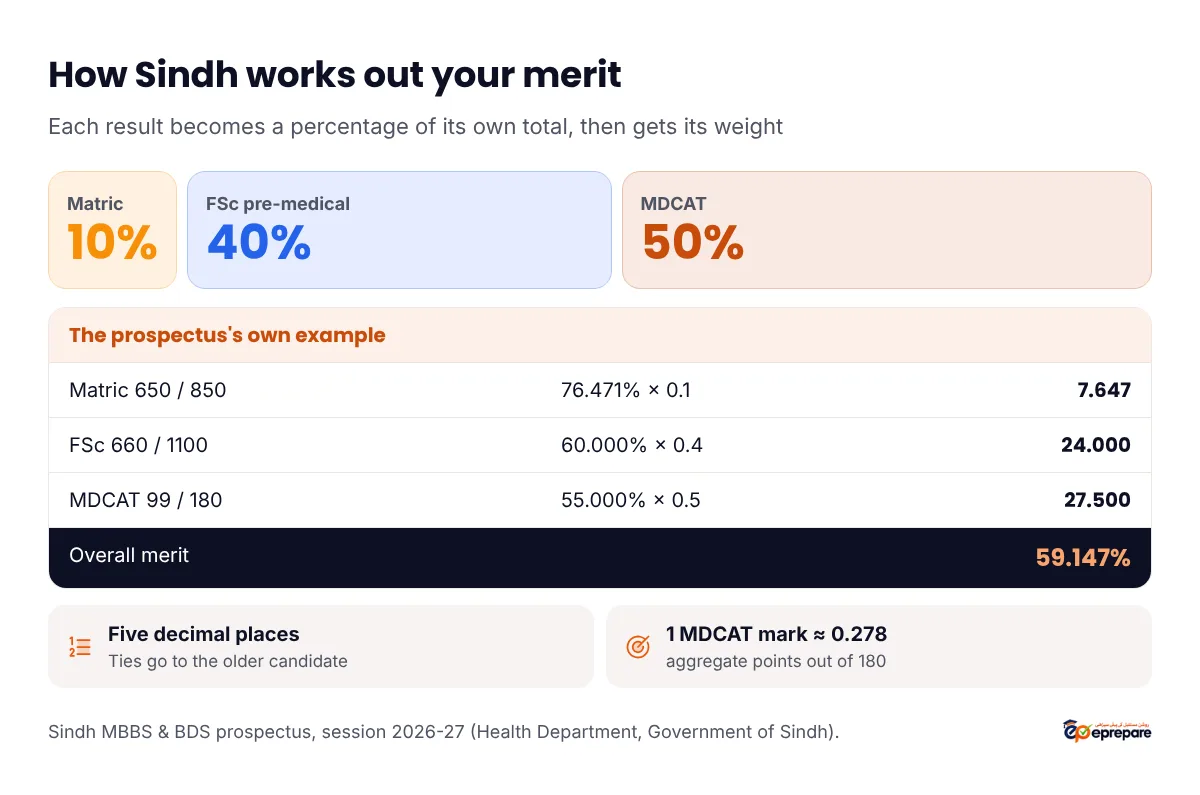
- Matric percentage × 0.10
- FSc percentage × 0.40
- MDCAT percentage × 0.50
"All calculation in percentages will be rounded up to five decimal points. In case final merit of more than one candidate is equal up to five decimals, the candidate older in age shall stand higher in merit." Each MDCAT mark out of 180 is worth about 0.278 aggregate, so one more correct MCQ can move you past dozens of students in a crowded district. Work out yours with the Sindh merit calculator, and see the full method in the MDCAT aggregate formula.
How to apply, step by step
- Find your selection centre from your PRC district: JSMU (Karachi), LUMHS (13 districts) or SMBBMU (10 districts).
- Fill the online form on that university's website. MBBS and BDS need separate forms. JSMU's instructions stress the MDCAT details and your list of college preferences, so fill them carefully.
- Print the form and attach two sets of documents, each attested by a government officer of grade 17 or above.
- Write your name, father's name, district of domicile and programme clearly on the file or envelope.
- Submit at a designated Leopards Courier centre (only). Leopards charges Rs 3,500 per programme, courier included, and gives you the receipt.
- Check the provisional merit list and object within the window if your marks or data are wrong.
- Go to seat allocation when your merit number is called, with all original documents and one parent or guardian.
- Pay the fee and hand in documents within 3 working days of the final selection list, or the seat goes to the next student.
The extra forms come separately. JSMU's site carries a form for the 15 untagged BDS seats at SIOHS for students outside Karachi (13 open merit, 2 self-finance) and for SMBBMC Lyari's 25 division seats. Self-finance seats are advertised by each university after the merit lists.
Documents to keep ready
- MDCAT admit card and result card (IBA Sukkur)
- Matric certificate and marks sheet; FSc certificate and marks sheet (or IBCC equivalence with transcript)
- Your PRC (Form C) and domicile; your father's PRC and domicile
- Your CNIC or B-Form and your father's CNIC
- Father's death certificate from NADRA, or divorce certificate, if you are using your mother's documents
- Disability certificate from Sindh's Social Welfare Department or the Civil Services Hospital, if applying on the disabled seat
- Three passport-size photographs with your name on the back
- Proof of a parent working abroad, for overseas seats
After selection you also sign an affidavit on stamp paper that you will complete the course. If you leave early you pay the full fee of the course for your category. Your original Matric, FSc, PRC and domicile documents stay with the university until you finish, and a medical board checks every selected student (chest X-ray, blood and urine tests, hepatitis B vaccination, hepatitis and HIV screening).
The admission timeline
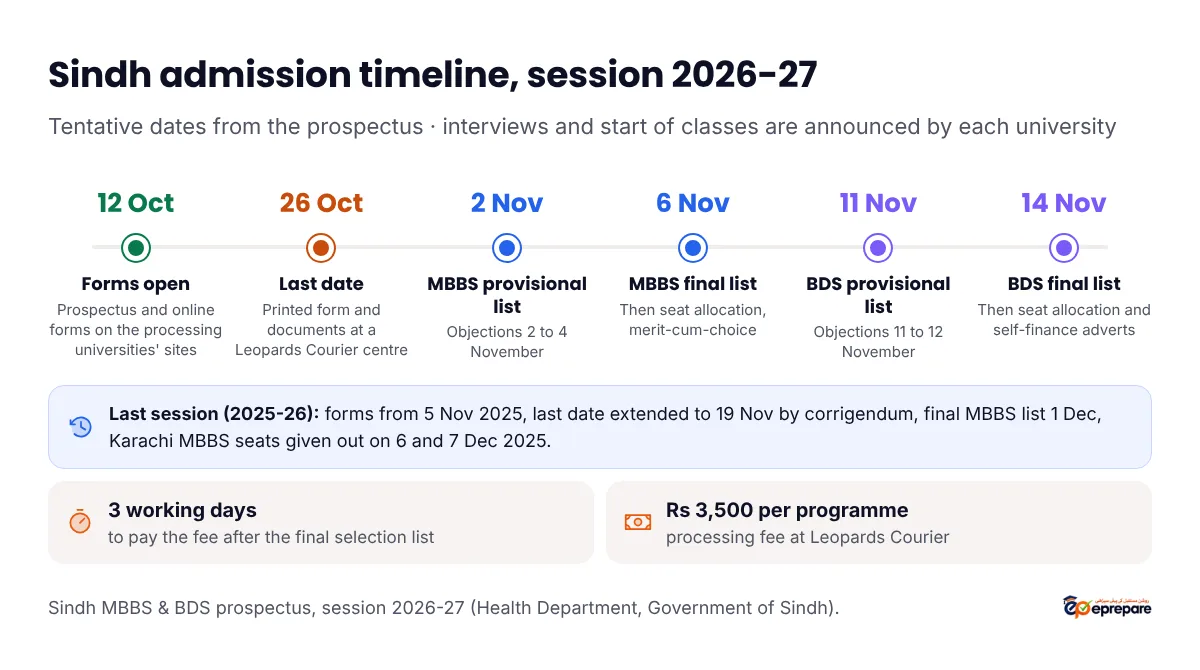
| Step | Session 2026-27 (tentative) |
|---|---|
| Prospectus and forms available | 12 October 2026 |
| Last date for MBBS and BDS forms | 26 October 2026 |
| Provisional MBBS merit list and objections | 2 November, objections 2 to 4 November 2026 |
| Final MBBS merit list | 6 November 2026 |
| Provisional BDS merit list and objections | 11 November, objections 11 to 12 November 2026 |
| Final BDS merit list | 14 November 2026 |
| Interviews, self-finance adverts, start of classes | Announced by each processing university |
Admissions in every category close by PM&DC's timelines, and a seat that falls vacant after that is not filled. You get 3 working days to respond to an offer.
Fees in public colleges
Open merit fees in Sindh are among the lowest in Pakistan. These are the tuition fees in the 2026-27 prospectus; each college adds one-time and yearly charges.
| College | Open merit tuition a year | Self-finance tuition a year |
|---|---|---|
| Dow Medical College | Rs 48,000 (first-year total Rs 124,500 without transport) | Rs 650,000 (first-year total Rs 774,045) |
| Sindh Medical College, JSMU | Rs 48,000 (first-year total Rs 103,500) | Rs 650,000 (first-year total Rs 731,815) |
| LUMHS, PUMHSW, Gambat, Khairpur | Rs 48,000 | Rs 650,000 |
| Chandka and GMMMC (SMBBMU) | Rs 58,080 | Rs 786,500 plus 3% sales tax |
| KMDC | Rs 117,600 | Rs 1,200,000 |
| BDS at DIKIOHS (DUHS) | Rs 200,000 | Rs 800,000 |
| BDS at SIOHS (JSMU) | Rs 175,000 | Rs 650,000 |
JSMU says its open merit tuition rises by 10% a year, and DUHS says its fees rise by 10% every year. One trap: Dow Dental College and Dow International Dental College fill their seats on merit, but the 2026-27 fee tables charge them at the self-finance rate (Rs 800,000 tuition a year). Sindh also adds 3% sales tax on fees above Rs 500,000 a year. Fees can be revised, so check your college's page in the prospectus.
Private medical colleges in Sindh
Private colleges have their own centralised admission, run for the Health Department by one university. For session 2025-26 that was SMBBMU Larkana, on admissions.smbbmu.edu.pk. (For 2023-24 it was DUHS.)
- Who can apply: candidates from all over Pakistan and abroad. No Sindh domicile is needed.
- Colleges: 13 private medical and 11 private dental colleges were listed, mostly in Karachi, plus Hyderabad, Mirpurkhas, Tando Muhammad Khan and Tando Adam.
- Eligibility: 60% in FSc or IBCC equivalent, MDCAT 2024 (retake) or 2025 with 55% for MBBS and 50% for BDS.
- Process: online form, printed copy and documents through Leopards Courier, Rs 4,000 per programme, and one order of preference for all private colleges, which "shall not be changed under any circumstances".
- Dates: 24 November to 10 December 2025, then a vacant-seats round with a last date of 15 April 2026.
For that vacant-seats round the notice cited a PM&DC notification of 8 April 2026 and lowered the MDCAT minimum to 52% for MBBS and 47% for BDS. That applied only to those remaining private seats. Private fees are set by each college, so check each college's own website.
Merit in Sindh: the official figures
Sindh's lists are prepared by district, so there is no single "Sindh closing merit". The clearest official figures we have are from DUHS's final merit lists for Karachi Division, session 2025-26, which covered the public colleges of DUHS, JSMU, KMDC and SMBBMC Lyari:
| Karachi Division, 2025-26 | MBBS | BDS |
|---|---|---|
| Students on the final merit list | 2,683 | 2,003 |
| Top aggregate | 96.289% | 92.164% |
| Called for final seat allocation | Merit no. 1 to 1,000 | Merit no. 1 to 1,000 |
| Aggregate at merit no. 1,000 | 82.19% | 78.532% |
Being called is not the same as getting a seat. Seats were given out in person on 6 and 7 December 2025 for MBBS and 21 December for BDS, and a student near merit number 1,000 got one only if a seat was still open when their turn came. On the first MBBS day DUHS called merit numbers 1 to 469; the aggregate at number 469 was 85.242%. DUHS did not publish which merit number took the last seat in each college. More figures, and how they compare with KPK and Punjab, are on our MDCAT closing merit page.
Frequently asked questions
Who conducts MBBS admission in Sindh?
The Health Department, Government of Sindh, through an admission committee of the public medical universities. For 2026-27, JSMU processes Karachi, LUMHS the Hyderabad-side districts and SMBBMU the Larkana and Sukkur side. In 2025-26 DUHS processed Karachi.
Is a Sindh domicile enough, or do I need a PRC too?
You need both: a PRC on Form C and a domicile of your tagged district, plus a Sindh PRC and domicile for your father, or your mother if your father has died or your parents are divorced.
What is the minimum FSc percentage for MBBS in Sindh?
60% (660 out of 1100), or 60% unadjusted in an IBCC equivalent. Grace marks are not counted.
Can I use my MDCAT from another province for Sindh?
The Sindh prospectus asks for the MDCAT conducted by IBA Sukkur in 2024, 2025 or 2026, and its document list asks for that admit card and result card. If you took MDCAT elsewhere, confirm with your processing university before you apply.
How is merit calculated for Sindh medical colleges?
10% Matric, 40% FSc and 50% MDCAT, worked to five decimal places. If two students tie, the older one is placed higher.
Do Karachi students compete with students from interior Sindh?
No. Each district competes only within itself. Interior Sindh has its own reserved seats in Karachi's colleges (22 at Dow Medical College, 46 at Sindh Medical College and 13 BDS seats at SIOHS), and Karachi has a few seats in LUMHS and PUMHSW.
What is the fee for MBBS in government colleges in Sindh?
Open merit tuition is Rs 48,000 a year at most colleges for 2026-27, Rs 58,080 at SMBBMU's colleges and Rs 117,600 at KMDC, plus other charges. Self-finance tuition is Rs 650,000 a year at most colleges.
Can girls apply to colleges other than PUMHSW?
Yes. PUMHSW in Nawabshah is the only girls-only college in the prospectus, and the prospectus says nobody is denied admission because of gender. Bilawal Medical College in Jamshoro is the one college marked for boys.
Make your district list work for you
Sindh's district quota means your real competition is a few hundred students from your own district, and every MDCAT mark moves you up that list. Use the Sindh merit calculator to set your target score, practise with MDCAT past papers and full-length papers, and if this year does not go to plan, read your real options if you are not selected. When you are ready, register on ePrepare and start.
Sources: Prospectus MBBS & BDS for Public Sector Medical Universities/Colleges of Sindh, session 2026-27, and its advertisement and admission instructions, published by Jinnah Sindh Medical University (jsmu.edu.pk) for the Health Department, Government of Sindh; the session 2025-26 prospectus, advertisement, document checklist and corrigendum (admissions.duhs.edu.pk and admissions.smbbmu.edu.pk); SMBBMU's notices for private sector MBBS and BDS admissions, session 2025-26; DUHS final merit lists of MBBS and BDS for Karachi Division and seat allocation notices, session 2025-26. Figures checked October 2026.